If someone has told you to replace your sewer line, you probably have more questions than answers. Is the entire pipe really bad? Could drain cleaning or a smaller repair solve the problem? How urgent is it? Do you need to dig up the yard? And how do you know whether the quote you received actually matches the work your home needs?
I’ll help you work through those questions in the right order. The most important thing to understand is that slow drains, recurring backups, roots, or an older sewer pipe do not automatically mean you need a full sewer line replacement. The right decision depends on what is actually happening inside the pipe, where the damage is located, and how much of the line is still serviceable.
When Should You Replace a Sewer Line?
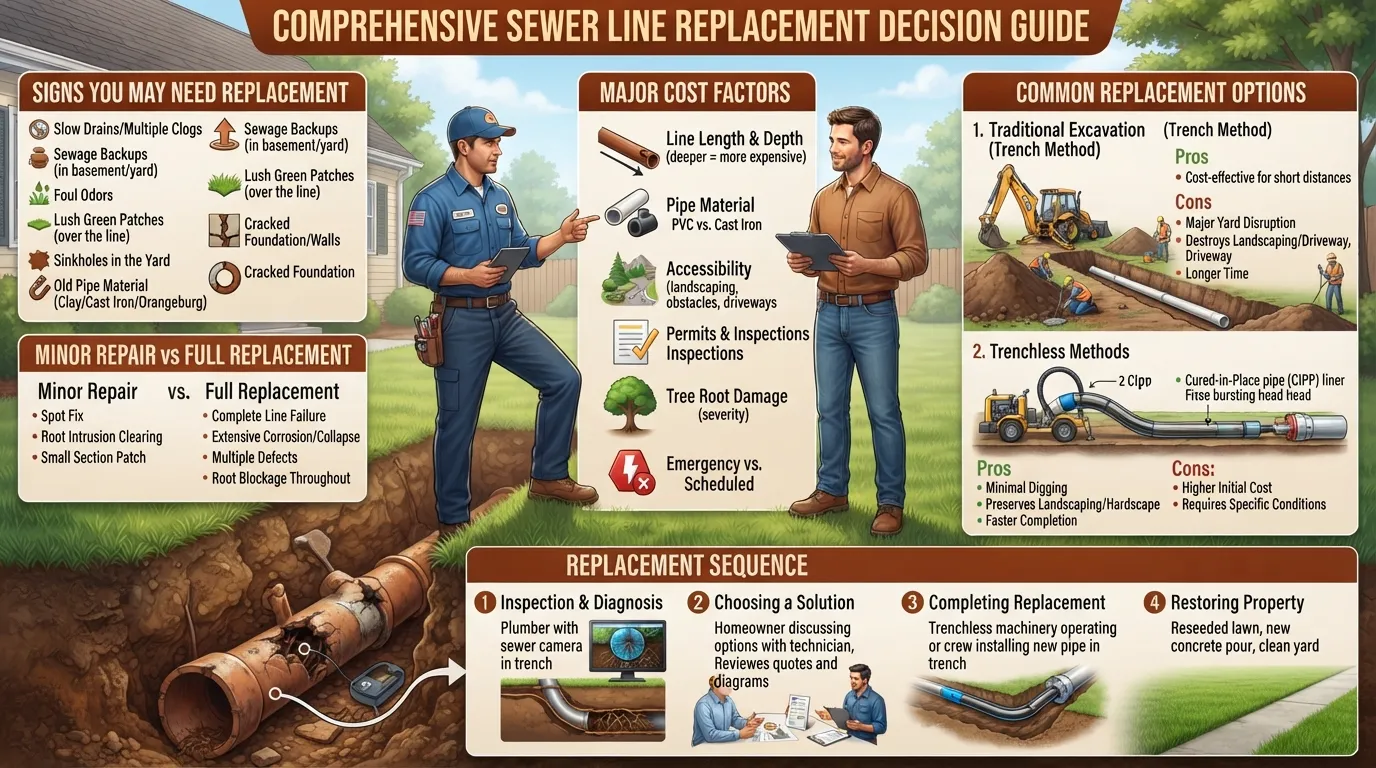
A sewer line is more likely to need replacement when a professional inspection finds significant structural failure, such as a collapsed section, extensive deterioration, multiple serious defects, major separation, or damage that cannot be corrected reliably with cleaning or a localized repair.
Before approving a full replacement, ask to see the camera findings, the exact location of the problem, the condition of the remaining pipe, and why cleaning, spot repair, lining, or another less invasive option would or would not work.
In this guide:
- How to tell if replacement is actually necessary
- How urgent your sewer problem may be
- What different camera findings can mean
- Cleaning vs. repair vs. replacement
- Traditional and trenchless options
- What actually affects sewer replacement cost
- Miami-Dade permits, responsibility, and local considerations
- Frequently asked questions
Do You Really Need to Replace Your Sewer Line?
Start with evidence, not symptoms alone.
A recurring backup tells you there is a problem, but it does not tell you whether that problem is grease, roots, scale, an isolated crack, a separated joint, a sagging section, or a pipe that has failed throughout much of its length. Those situations can lead to very different recommendations.
That is why a sewer camera inspection is so useful when replacement is being considered. A camera can help identify and locate obstructions and structural concerns without immediately excavating the entire line.
If a plumber recommends replacement, ask these questions before you make the decision:
- What exactly did the camera inspection show?
- Where is the defect located? Ask for a physical location, not just a vague statement that “the line is bad.”
- How long is the damaged section?
- What condition is the rest of the pipe in?
- Is the current problem an obstruction, structural damage, or both?
- Can a spot repair solve the defect?
- Is trenchless rehabilitation or replacement technically suitable?
- Why is full replacement better than the alternatives in this specific case?
A useful rule:
Do not make a five-figure plumbing decision from the age of a pipe or a symptom list alone. Make it from the condition, location, extent, and cause of the failure.
How Urgent Is Sewer Line Replacement?
One of the biggest questions homeowners have is not simply whether a sewer pipe is damaged, but how long they can safely wait. There is no universal timeline because urgency depends on the failure.
Act Promptly
- Sewage is backing up into the home.
- Wastewater appears to be leaking from the sewer line.
- The pipe has collapsed or flow is severely restricted.
- A major defect is preventing normal drainage.
- Wastewater is surfacing in the yard.
Schedule a Repair Decision Soon
- Backups repeatedly return after cleaning.
- A camera has shown cracks, separated joints, roots entering through defects, or deteriorated sections.
- Several parts of the line are damaged.
- You are repeatedly paying to treat the same underlying problem.
Inspect Before Assuming Replacement
- One drain is slow.
- You have had one isolated clog.
- Your sewer line is simply old.
- You have roots but do not yet know the condition of the pipe around them.
- You have symptoms but no camera evidence yet.
If sewage is entering living areas, minimize contact with contaminated water and arrange professional help rather than repeatedly running fixtures to “test” the drain.
Camera Finding to Correct Action: The Decision Most Guides Skip
This is where sewer replacement decisions become much clearer. Instead of asking, “Do I need a new sewer line?” ask, “What does the actual defect allow us to do?”
The important idea is simple: the best repair method should match the defect, not merely the symptom.
Drain Cleaning vs. Sewer Repair vs. Sewer Line Replacement
These three services solve different problems, but homeowners often hear the terms mixed together.
Drain or Sewer Cleaning
Cleaning removes material that is restricting flow. Depending on the obstruction and pipe condition, professional techniques may include mechanical drain cleaning or hydro jetting.
If inspection shows that your main problem is an obstruction rather than a structurally failed pipe, professional drain and sewer cleaning may be a logical step before you consider replacement.
But clearing the line does not repair a crack, separated joint, collapse, or other structural defect. That distinction matters when the same blockage keeps coming back.
Localized Sewer Repair
If damage is confined to one section and the rest of the pipe is in useful condition, you may be able to repair or replace only the problem area. The exact option depends on the pipe material, location, access, defect, local code requirements, and whether a trenchless repair is suitable.
Full Sewer Line Replacement
Replacing a longer section or the complete run can make more sense when deterioration is widespread, the pipe has multiple serious failures, sections are collapsing, or repeated localized work would leave you with an unreliable remaining line.
Don’t Pay for the Wrong Fix
A clog needs to be cleared. A failed pipe needs structural correction. If your quote jumps directly from “you have a backup” to “replace the whole sewer,” ask for the inspection evidence that connects those two conclusions.
Do You Have to Replace the Entire Sewer Line?
No. “Sewer line replacement” does not automatically mean every foot of pipe from the house to the street has to come out.
A plumber may recommend a spot replacement when one section has failed but the rest of the line remains serviceable. A complete replacement becomes more compelling when defects are widespread or the remaining pipe is in poor enough condition that repairing one section is unlikely to provide a dependable long-term solution.
Before approving a whole-line project, ask the contractor to identify:
- The beginning and end of the damaged area.
- The total length of line being replaced.
- The material and condition of the sections that will remain.
- Why partial replacement is or is not appropriate.
- Whether the new work will connect to older material and how that transition will be made.
Ways to Repair or Replace a Main Sewer Line
There is no single “best” sewer replacement method. The right choice depends on pipe condition, alignment, access, depth, surface conditions, code requirements, and what the inspection shows.
Traditional Excavation
A trench is opened so the damaged pipe can be physically accessed, removed or bypassed as required, and new piping installed.
May make sense when:
- The pipe has collapsed.
- Alignment or grade must be corrected.
- There are severe structural problems.
- The location is accessible for excavation.
Pipe Bursting
Pipe bursting is a trenchless replacement approach that breaks or displaces the existing pipe while pulling a new pipe along its path, usually through access points rather than an open trench along the entire run.
May be attractive when:
- A new pipe is needed.
- Surface disruption should be reduced.
- The existing route and site conditions are suitable.
CIPP / Pipe Lining
Cured-in-place pipe lining creates a new liner inside an existing pipe. It is more accurately considered pipe rehabilitation than conventional removal-and-replacement.
Important limitation:
The host pipe must be suitable for lining. Because the liner follows the existing path, it is not automatically a solution for every collapse, major deformation, or significant grade problem.
Which Method Is Cheapest?
The cheapest appropriate solution is the one that fixes the actual problem without paying for work you do not need or leaving a failure that forces you to pay again.
For example:
- If the pipe is structurally sound and simply blocked, cleaning can be far more logical than replacement.
- If one small section is damaged, a spot repair may cost less overall than replacing a long run.
- If excavation would destroy substantial concrete or landscaping, a suitable trenchless method may reduce restoration work.
- If the pipe has a major alignment problem or collapse, choosing a cheaper method that cannot correct the failure is not a savings.
Compare the total project cost, including access, excavation, restoration, permits, inspection, and what happens to the surfaces above the pipe—not just the advertised price per foot.
What Happens During a Sewer Line Replacement?
The exact sequence varies by property and method, but a professional project commonly moves through these decision points:
- Diagnose the failure. The line is evaluated to determine what is wrong and where.
- Locate the sewer route and defect. Knowing the path, depth, access points, and problem location helps define the work.
- Select the repair or replacement method. The contractor considers pipe condition, site conditions, code, access, and restoration.
- Address permits and utility requirements. Requirements vary by jurisdiction and project scope.
- Access or rehabilitate the pipe. This can involve excavation, access pits, slab access, lining, or another approved method.
- Install or complete the repair. Connections, alignment, drainage, and applicable inspection requirements must be addressed.
- Backfill and restore disturbed surfaces. Depending on the job, restoration can involve soil, lawn, concrete, driveway, patio, flooring, or other finishes.
A good estimate should make it clear which of those steps are included and which restoration items remain your responsibility.
How Much Does It Cost to Replace a Sewer Line?
There is no single price that accurately describes every sewer line replacement. A short, shallow, accessible repair is fundamentally different from a long line under a slab, driveway, landscaping, or other hardscape.
Instead of focusing only on an average, I recommend understanding the variables that create your quote.
What Changes the Price?
The amount of damaged line being repaired or replaced.
Deeper access can increase excavation complexity.
Open yard and under-slab locations are very different projects.
Spot repair, excavation, lining, and pipe bursting have different requirements.
Concrete, asphalt, landscaping, patios, flooring, and other finishes can materially affect the final cost.
Local requirements should be included when applicable.
What Should a Sewer Replacement Quote Include?
When comparing estimates, ask each contractor to define the same scope. Otherwise, a cheaper quote may simply exclude work that another contractor included.
- Camera inspection findings or diagnostic basis.
- Location of the defect.
- Approximate length of pipe being repaired or replaced.
- Depth and access assumptions.
- Proposed replacement or rehabilitation method.
- New pipe or liner specification where applicable.
- Excavation or access work.
- Permit and inspection responsibility.
- Backfill.
- Concrete, flooring, driveway, lawn, or landscape restoration.
- Debris removal.
- What is specifically excluded.
- Any written warranty that is actually offered for the project.
Before comparing two prices:
Make sure you are comparing the same footage, the same repair method, the same access assumptions, and the same restoration responsibilities.
What If the Sewer Line Is Under a Concrete Slab?
A sewer or main drain pipe beneath a slab creates a different access problem than a pipe running through an open yard.
The first step is to pinpoint the defect accurately. Depending on the condition and location of the pipe, possible strategies may include opening the slab at selected locations, replacing a section, rerouting where technically appropriate, or evaluating whether a trenchless rehabilitation method is suitable.
Do not assume that “under slab” automatically means the entire floor must be demolished. At the same time, do not assume that a no-dig technique can fix every under-slab defect. A collapsed pipe, significant loss of grade, or other structural condition may change what is technically possible.
Restoration also matters. Ask whether the plumbing quote includes only pipe work or also includes slab repair and finished flooring.
Sewer Line From the House to the Street: Who Is Responsible?
This is one of the most important questions to answer before excavation begins.
A homeowner may refer to the entire run as the “sewer line from the house to the street,” but responsibility can depend on the utility, jurisdiction, connection configuration, and exact location of the defect.
For Miami-Dade Water and Sewer Department customers, current county utility information states that the customer is responsible for installation and connection from the sewer main to the facilities within the customer’s property. Miami-Dade has also stated that repairs for clogs or backups within private-side wastewater lines are the homeowner’s responsibility.
But you should not guess where private responsibility ends. If a defect may be near a public connection, right-of-way, or sewer main, first determine the precise location and confirm responsibility with the applicable utility or municipality.
Replacing a Sewer Line in Miami-Dade: Permit and Local Considerations
If your property is in Miami-Dade, permit requirements should be part of the replacement plan—not an afterthought.
Miami-Dade County’s current plumbing permit guidance includes a specific process for sanitary line replacement. The county states that an applicant seeking a sanitary line replacement permit should use plumbing category 25, submit the required permit application and plumbing fee sheet, follow the county’s sanitary-line slab-cut repair detail, and provide a special inspector form for trench backfill and concrete-slab repair where applicable.
If the property falls under an incorporated municipality rather than the county’s direct permitting jurisdiction, confirm the applicable municipality’s process before work begins.
You can review the current requirements directly on the Miami-Dade County Plumbing Permits page.
Miami homeowners who want broader context on how fixtures, branch drains, the building drain, and the sewer lateral work together can also review our guide to how a home drainage system works.
Can a Homeowner Replace Their Own Sewer Line?
Technically, what an owner is allowed to do depends on the jurisdiction and permit structure. Practically, replacing a buried sanitary sewer line is very different from replacing a faucet or sink trap.
A sewer replacement can involve:
- Permit and inspection requirements.
- Locating buried utilities.
- Excavation hazards.
- Sewage exposure.
- Correct pipe sizing and approved materials.
- Proper grade and alignment.
- Connections to existing private or public infrastructure.
- Slab or trench restoration.
- Work near easements or rights-of-way.
Miami-Dade’s current utility information also says sewer connections covered by its rules are to be performed by a contractor with approved plans. Because the rules can depend on exactly what part of the system is being modified, verify the permit and utility requirements for your property before attempting any work.
Safety note:
Never begin excavation simply because you think you know where the sewer line runs. Buried utilities and site conditions must be properly addressed before digging.
Does Homeowners Insurance Cover Sewer Line Replacement?
Do not assume that it does.
Coverage depends on your individual policy, the cause of the loss, exclusions, endorsements, and whether you are asking about damage caused by sewage backup or the cost of repairing the pipe itself.
The Florida Department of Financial Services explains that some homeowners policies do not provide sewer-backup coverage and that water-backup coverage may be available through an endorsement. That still does not mean every damaged sewer pipe or replacement project will be covered.
Before approving major work when an insurance claim may be involved:
- Read the relevant water, sewer, service-line, and exclusion language in your policy.
- Ask your insurer or licensed insurance professional what coverage applies to the specific cause of your loss.
- Separate the question of damage to your home from the question of repairing the failed sewer pipe.
- Document the condition and damage before restoration work removes the evidence, when it is safe to do so.
How Long Does a Residential Sewer Line Last?
There is no responsible answer that says every sewer line should be replaced after a certain number of years.
Service life depends on:
- Pipe material.
- Installation quality.
- Joint condition.
- Soil movement.
- Corrosion and scale.
- Tree-root intrusion.
- Groundwater and site conditions.
- Traffic or structural loads above the line.
- Previous repairs.
An old pipe deserves closer attention, but age is a risk factor, not a diagnosis. If an older line is flowing correctly and a camera shows it remains structurally serviceable, its birthday alone is not a reason to excavate your property.
Likewise, a newer pipe can still fail because of installation problems, ground movement, damage, or other site-specific conditions.
How Often Do Sewer Lines Need to Be Replaced?
They should not be replaced on a routine calendar schedule. Replacement is a condition-based decision.
That means you replace or rehabilitate the line when inspection and performance show that structural problems justify it—not because a certain number of years has passed.
Sewer Line vs. Drain Line: What’s the Difference?
Homeowners often use “main drain pipe,” “main drain,” and “sewer line” interchangeably, but the location helps define what you are actually repairing.
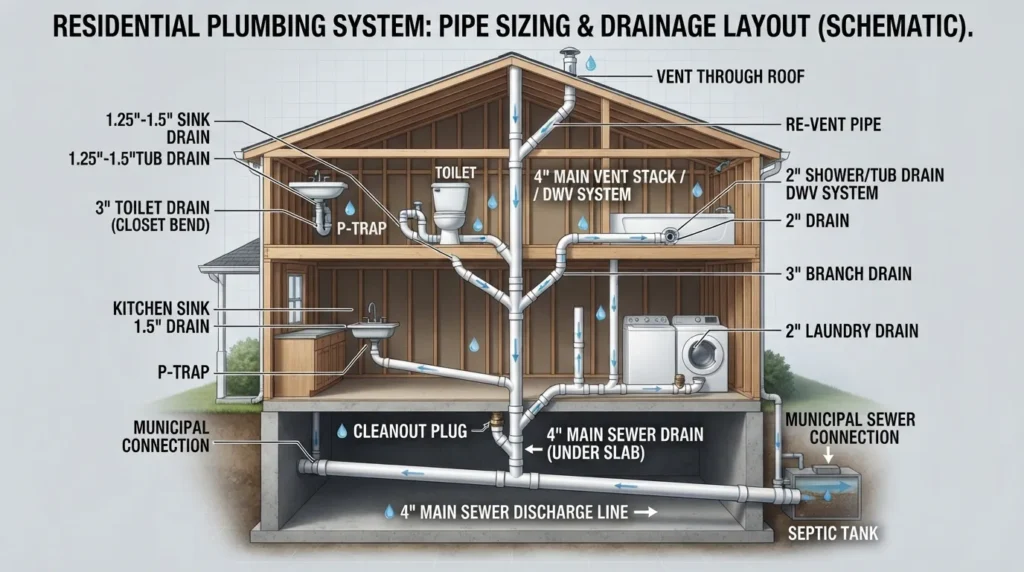
- Fixture and branch drains carry wastewater away from individual fixtures or groups of fixtures.
- The building drain collects wastewater from the building’s drainage system.
- The building sewer or sewer lateral carries wastewater toward the public sewer connection or another approved disposal system.
This distinction matters when someone says you need to “replace the main drain pipe in the house.” A damaged pipe beneath the building and a failed sewer lateral across the front yard may involve very different access, repair, permitting, and restoration requirements.
Four Signs Your Sewer Line May Be Broken or Seriously Damaged
These symptoms do not prove that replacement is necessary, but they justify investigating the main line:
- Several drains have problems at the same time. Multiple slow or backing-up fixtures can point to a shared downstream restriction.
- Sewer backups keep returning after the line is cleared. Recurring problems can indicate an underlying defect that cleaning alone does not correct.
- You see or smell wastewater outside. Persistent sewage odor, unexplained wet areas, or wastewater surfacing near the sewer route deserves prompt investigation.
- A camera inspection shows structural damage. Cracks, failed joints, corrosion, deformation, collapse, or other defects give you more useful evidence than symptoms alone.
What to Ask Before You Approve Sewer Line Replacement
This may be the most valuable checklist in the article. Take it with you when comparing recommendations.
- Can I see the complete sewer camera footage?
- What exactly is damaged?
- Where is the damaged section?
- How deep is it?
- How much of the pipe is structurally affected?
- What material is the existing pipe?
- What condition is the remaining line in?
- Could cleaning solve the current problem?
- Could a spot repair solve it?
- Could lining or pipe bursting work here?
- If not, why not?
- Does the pipe have a grade, belly, or alignment problem?
- How many feet are included in the estimate?
- Which surfaces need to be opened?
- Who handles permits and inspections?
- Who restores concrete, flooring, landscaping, or driveway surfaces?
- What is excluded from the quote?
- What happens if the actual conditions differ after the pipe is exposed?
A contractor should be able to explain the recommendation in a way you can understand. You should not need to approve a complete replacement simply because the diagnosis sounds technical.
Visual Guide: What Sewer Line Replacement Can Look Like
If you have never seen a residential sewer line replacement, this third-party video provides a useful visual overview of the general process and considerations. Actual methods, safety requirements, permits, materials, and site conditions can differ by property and jurisdiction.
Frequently Asked Questions About Replacing a Sewer Line
How do you know if a sewer line needs to be replaced?
The strongest evidence is a professional inspection showing structural damage that cannot be reliably solved with cleaning or a localized repair. Collapse, widespread deterioration, multiple significant defects, or severe structural problems make replacement more likely. Symptoms alone should not be the only basis for the decision.
What are four signs that your sewer line is broken?
Four warning signs are recurring main-line backups, several drains slowing or backing up together, sewage odors or wastewater surfacing outside, and structural damage visible during a camera inspection. These signs justify investigation but do not automatically mean the entire pipe must be replaced.
What’s the average cost of repairing a sewer line?
A single “average repair cost” can be misleading because sewer repair may mean clearing an obstruction, repairing one damaged section, lining an existing pipe, excavating under concrete, or replacing an entire lateral. The useful comparison is the cost for your exact footage, depth, method, access, permits, and restoration—not a national number that may describe a completely different project.
What is the cheapest way to replace a sewer line?
First determine whether replacement is necessary at all. If the pipe is serviceable and the problem is an obstruction, cleaning may be sufficient. If there is localized structural damage, compare spot repair with full replacement. For a failed longer section, compare excavation and suitable trenchless options based on total project and restoration costs. The cheapest method is not useful if it cannot correct the actual defect.
Can you repair a sewer line without digging?
Sometimes. CIPP lining and pipe bursting can reduce the amount of open trenching when the existing line and site are suitable. They are not universal solutions. Pipe condition, collapse, alignment, grade, access, material, connections, and local requirements can affect whether a trenchless method will work.
Can a homeowner replace their own sewer line?
Rules vary by jurisdiction, but this work can involve permits, inspections, buried utilities, excavation, sewage exposure, slope requirements, structural access, and utility connections. In Miami-Dade, sanitary line replacement has specific permit requirements, and applicable utility connection rules should be checked before work begins.
Do I need a permit to replace my sewer line in Miami-Dade?
Miami-Dade County currently provides a specific sanitary-line replacement plumbing permit process using category 25. The exact permitting authority can depend on whether your property is handled directly by the county or an incorporated municipality, so confirm the jurisdiction for your address before work begins.
Does homeowners insurance cover sewer lines?
It depends on the policy and cause of damage. Florida’s Department of Financial Services notes that some homeowners policies exclude sewer-backup damage and that water-backup coverage may be available by endorsement. Coverage for backup damage and coverage for repairing the failed pipe are separate questions, so review your own policy and speak with your insurer.
How many years does a sewer line last?
There is no single replacement age that applies to every sewer pipe. Material, soil, installation, joints, corrosion, roots, ground movement, and other site conditions all affect useful service life. Use age as a reason to inspect an older line—not as automatic proof that it needs replacement.
How often do residential sewer lines need to be replaced?
There is no routine replacement interval. A sewer line should be repaired, rehabilitated, or replaced based on its actual condition and performance.
What is the difference between a sewer line and a drain line?
Drain lines collect wastewater from fixtures and different parts of the building. The building sewer or sewer lateral carries the combined wastewater away toward the public sewer connection or another approved disposal system. The exact terminology can vary, so the location of the damaged pipe is more useful than the name a homeowner uses for it.
Diagnose First, Replace Second
If you remember one thing from this guide, make it this:
A sewer replacement recommendation should answer four questions clearly: What failed? Where did it fail? How much of the line failed? Why is the proposed solution better than the realistic alternatives?
That approach protects you from two expensive mistakes: repeatedly cleaning a pipe that is structurally failing, or replacing a sewer line when a less extensive solution could have solved the problem.
If you are dealing with recurring drain problems, a suspected main sewer issue, or a replacement recommendation in the Miami area, our local Miami plumbing team can help you determine the right next step based on the actual condition of your system.
Not Sure Whether You Need Cleaning, Repair, or Replacement?
Start with the problem—not the most expensive solution. A clear diagnosis can help you understand which option actually fits your sewer line.
Official Resources for Miami Homeowners
- Miami-Dade County Plumbing Permit Requirements — current county information for plumbing permits and sanitary line replacement.
- Miami-Dade Water & Sewer Utilities Information Request — information about sewer lateral locations, utility records, and connection responsibilities.
- Florida Department of Financial Services Homeowners Insurance Overview — official guidance for understanding policy coverage and sewer-backup considerations.