A sewer problem can put you in an uncomfortable position fast. You may have repeated backups, several slow drains, sewer odors, a wet area in the yard, or a plumber telling you the main line is damaged. Then comes the expensive question: Do you really need sewer replacement, or can the line be cleaned or repaired instead?
The answer should not come from symptoms alone. Before you agree to replace a residential sewer line, you need to know where the problem is, what caused it, how much of the pipe is affected, and what the inside of the line actually looks like.
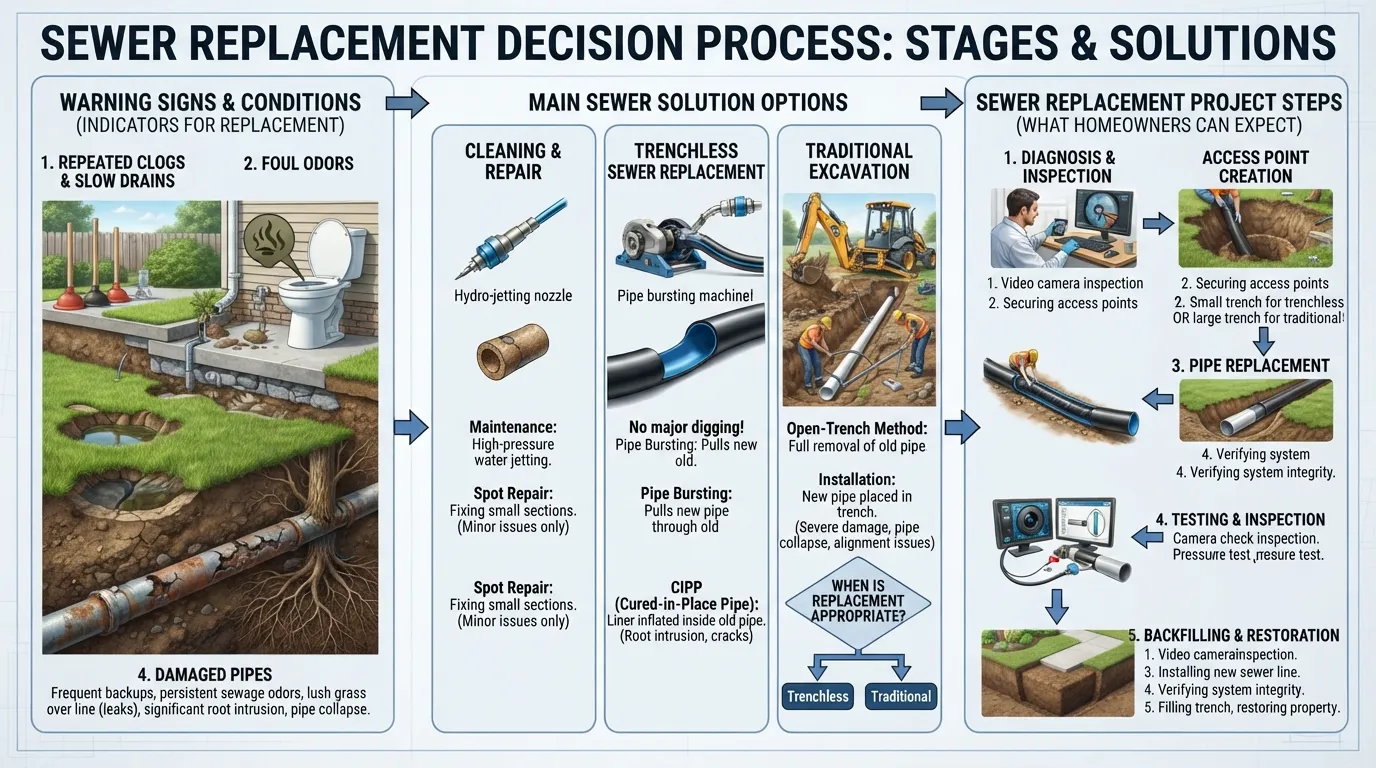
Sewer replacement is usually considered when the pipe has significant structural damage that cleaning or a smaller repair cannot reliably correct. Depending on the condition of the line, the right solution may instead be drain cleaning, a localized repair, pipe lining, pipe bursting, or traditional excavation. A sewer camera inspection and accurate line location are often key to making that decision.
What Is Sewer Replacement?
Sewer replacement means removing, bypassing, or rehabilitating a damaged section of the sewer line so wastewater can reliably travel from the house toward the sanitary sewer system.
Homeowners use several names for this pipe, including the main sewer line, building sewer, sewer lateral, main drain line, or house sewer. The exact terminology can vary, which is one reason sewer problems become confusing.
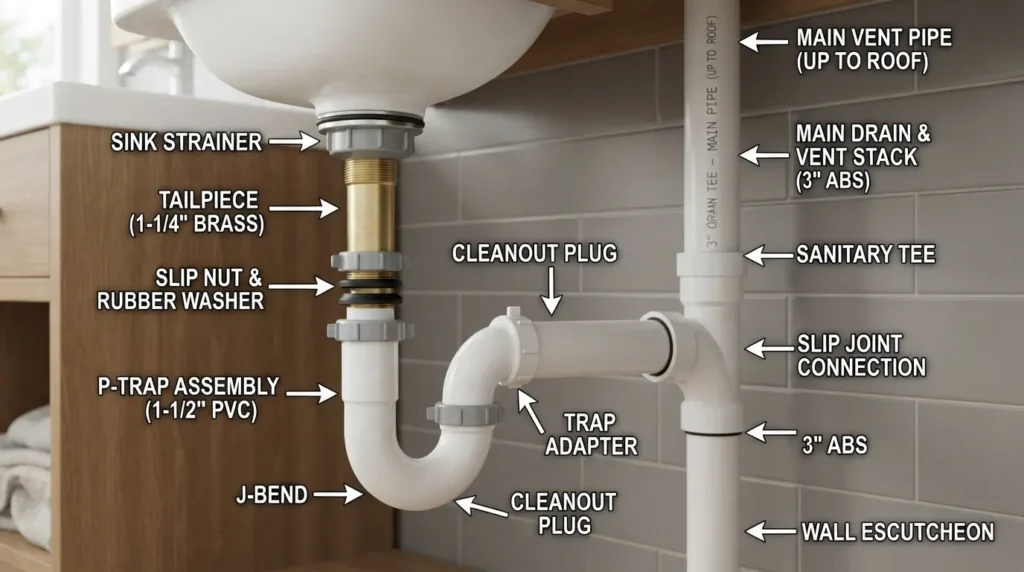
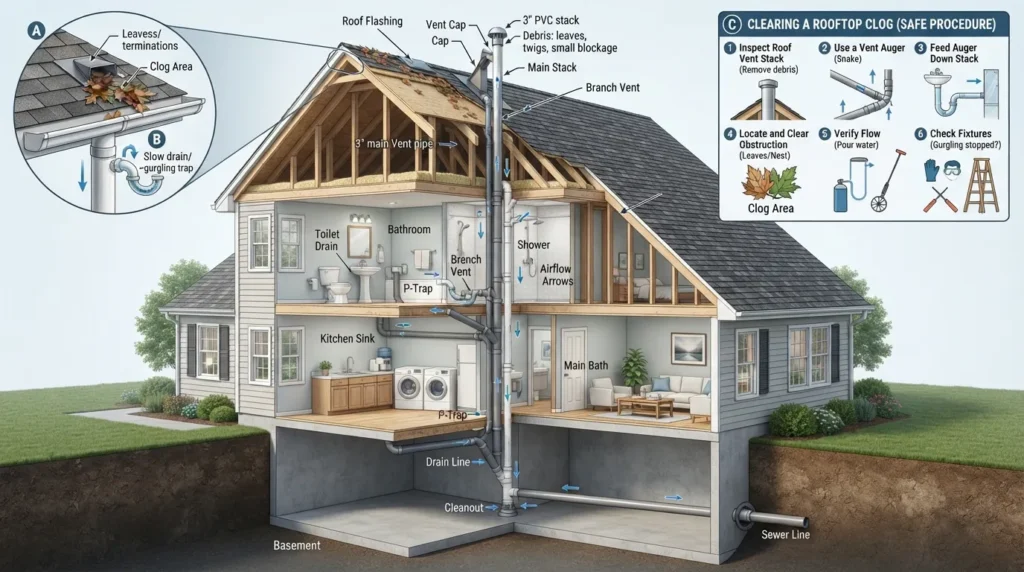
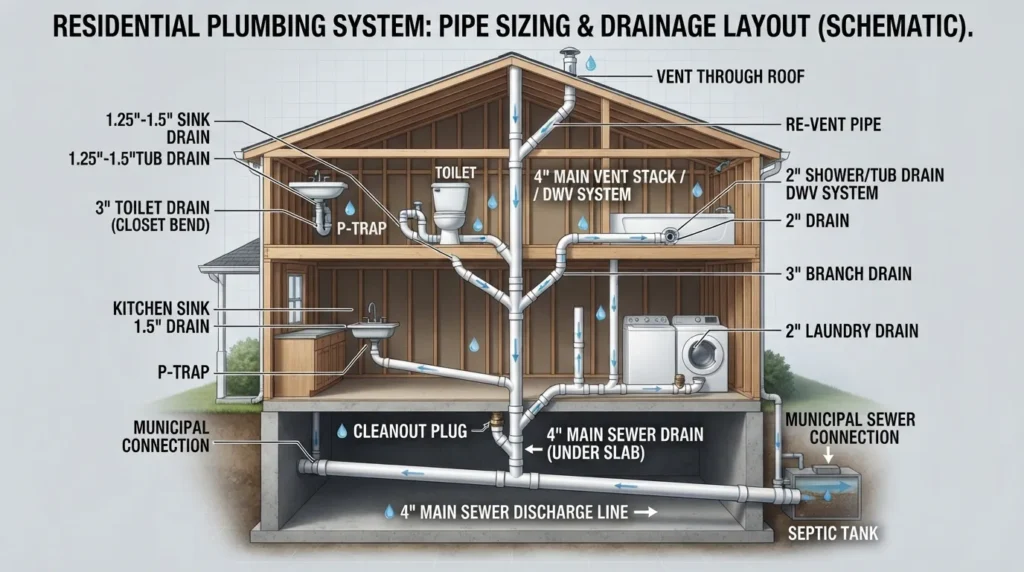
Your home’s sinks, showers, tubs, toilets, and appliances first drain through smaller pipes inside the building. Those lines eventually join larger drainage piping that carries wastewater out of the house and toward the sewer connection. If you want to understand that complete path first, see our guide to how a home drainage system works.
Do You Actually Need a New Sewer Line?
This is the most important question in the entire article.
A slow toilet, clogged sink, or even one sewer backup does not automatically mean the pipe needs replacement. Some sewer problems are caused by obstructions that can be cleared. Others involve a damaged joint or short section that may be repairable. Replacement becomes a more serious consideration when the problem is structural, widespread, recurring, or impossible to correct reliably with a less invasive method.
Signs that justify a closer sewer-line inspection
- Several fixtures are draining slowly at the same time.
- Wastewater repeatedly backs up through a toilet, shower, tub, or floor drain.
- You hear recurring gurgling from multiple plumbing fixtures.
- Sewer odors continue after obvious fixture-level causes have been ruled out.
- The same main-line blockage keeps returning after it has been cleared.
- You notice unexplained soft, wet, or unusually lush areas above the sewer route.
- A camera inspection has shown cracked, broken, offset, deteriorated, or collapsed piping.
- Roots are repeatedly entering through damaged joints or openings.
- Different sections of an aging line are failing rather than one isolated area.
Do not approve a full replacement based on symptoms alone
A responsible decision should identify the location, cause, extent, and physical condition of the problem. If replacement is recommended, ask what evidence shows that a smaller repair or cleaning would not provide a reliable solution.
The Sewer Replacement Decision: Cleaning vs. Repair vs. Replacement
Think of sewer work as a progression rather than one solution for every problem.
1. Drain Cleaning
Best suited to an obstruction or buildup when the pipe itself remains serviceable. Cleaning may remove grease, debris, some root intrusion, or other blockages, but it does not rebuild a broken pipe.
2. Localized Repair
May make sense when the damage is confined to a limited section and the surrounding sewer pipe is still in usable condition.
3. Trenchless Rehabilitation or Replacement
Methods such as pipe lining or pipe bursting may reduce the amount of open excavation when pipe condition, alignment, access, and project requirements make them appropriate.
4. Excavated Replacement
Traditional excavation provides direct access to remove and replace damaged piping and may be necessary when the line’s condition, grade, route, collapse, or surrounding conditions cannot be properly addressed another way.
If an inspection shows that your problem is primarily an obstruction rather than structural failure, professional drain cleaning in Miami may be a more appropriate starting point than replacing the sewer line.
What a Sewer Camera Inspection Should Tell You
A sewer camera is valuable because it lets the decision move beyond guesswork. But simply being told that a camera was used is not enough. You want to understand what the inspection found and how those findings support the proposed work.
Before agreeing to sewer replacement, ask these questions
- Where is the problem? Ask for the approximate location along the sewer route.
- How much pipe is affected? One damaged joint is different from deterioration throughout a long run.
- Is the line blocked, damaged, or both? An obstruction and a structural failure require different solutions.
- Can I see the camera footage? Ask the plumber to show you the relevant section rather than relying only on a verbal description.
- What type of damage is visible? Examples may include cracking, separation, root entry, corrosion, deformation, collapse, or a significant alignment problem.
- What condition is the remaining pipe in? That matters when deciding whether a spot repair makes financial and practical sense.
- Why isn’t cleaning enough? If the pipe itself is damaged, clearing an obstruction may restore flow without solving the structural problem.
- Why isn’t a localized repair appropriate? Ask what makes the damage too extensive or unsuitable for a smaller repair.
- Is trenchless work possible? If not, ask what condition or site constraint rules it out.
The evidence test
You should be able to connect the recommendation to an observable problem: “Here is the damaged section, here is why it is failing, and here is why this repair method is the appropriate response.” That is much more useful than simply being told that your sewer line is old.
Common Reasons Residential Sewer Lines Fail
Tree-root intrusion
Roots can enter through joints, cracks, or other openings and restrict wastewater flow. Removing roots may temporarily restore flow, but recurring intrusion can point to an underlying defect that also needs to be addressed.
Cracked or separated pipe
Pipe sections can crack or separate because of deterioration, soil movement, installation problems, physical loading, or other site conditions. The appropriate repair depends on how much pipe is affected and whether the surrounding line remains sound.
Corrosion and deterioration
Older metal piping can deteriorate internally and externally. A single weak area may be repairable, but widespread deterioration can make repeated spot repairs poor long-term value.
Collapsed or severely deformed pipe
Once a line loses the open pathway needed to carry wastewater, cleaning alone cannot restore the missing pipe structure. The condition also affects whether certain trenchless techniques are feasible.
A belly, sag, or grade problem
Gravity sewer piping depends on appropriate slope. If a section holds wastewater because its grade is wrong, simply clearing the line may not correct the underlying geometry. The contractor needs to determine what physical work is required to restore reliable drainage.
Aging or obsolete piping
Age is useful context, but age by itself is not a diagnosis. Two sewer lines made from the same material can be in very different condition because installation, environment, roots, loading, maintenance, and previous repairs all matter.
Traditional Sewer Replacement vs. Trenchless Options
Homeowners understandably want to know whether a sewer line can be replaced without digging up the entire yard. Sometimes it can. Sometimes excavation is the better or necessary option.
Traditional Excavation
- Provides direct access to the existing pipe.
- Allows damaged pipe to be physically removed and replaced.
- May be required to correct certain grade or alignment problems.
- Can involve significant yard, driveway, slab, sidewalk, or surface restoration depending on the route.
- Project scope is heavily affected by depth, access, utilities, and what sits above the line.
Trenchless Methods
- Can reduce continuous open-trench excavation.
- May help preserve landscaping and hardscape.
- Still requires suitable access and pipe/site conditions.
- May involve access pits rather than literally zero digging.
- Not every collapsed, badly aligned, or structurally unsuitable line is a candidate.
Pipe Lining vs. Pipe Bursting: They Are Not the Same Thing
Pipe lining or CIPP
Cured-in-place pipe lining creates a new liner inside an existing pipe. It can be useful in appropriate cracked, leaking, or deteriorated lines where the existing pathway can support the rehabilitation process.
It is not a universal answer. If a line has lost the geometry or open pathway needed for the liner, or if the underlying problem involves a condition lining cannot correct, another method may be needed.
Pipe bursting
Pipe bursting is a replacement technique in which equipment follows the route of the old pipe while pulling a new pipe into place. It can limit continuous trenching, although access points and suitable site conditions are still required.
Which trenchless method is better?
Neither method is automatically “better.” The correct choice depends on the existing pipe’s condition, diameter, alignment, access, damage pattern, connections, surrounding utilities, and what the replacement needs to accomplish.
A Practical Sewer-Line Decision Guide
The following framework is more useful than choosing a method based on advertising terms alone.
Mostly an obstruction
Start by determining whether professional cleaning can restore the line and whether the pipe has an underlying defect that caused the blockage.
One isolated damaged section
A spot repair or partial replacement may be worth evaluating if the rest of the line remains serviceable.
Cracks or leakage in a usable pathway
Ask whether lining is technically appropriate and what condition the host pipe must be in for the proposed system.
Severe structural failure
Partial or complete replacement becomes more likely when the pipe is extensively damaged, collapsed, badly displaced, or failing in multiple areas.
Grade or alignment problem
Ask whether the proposed method actually corrects the physical slope or alignment issue rather than simply treating the pipe’s interior.
Pipe under valuable surfaces
Compare the complete project cost and disruption of trenchless and excavated approaches, including restoration—not only the pipe-work price.
How Much Does Sewer Replacement Cost?
There is no honest one-price answer to sewer replacement because two homes can require completely different scopes of work.
National cost guides publish wide ranges, but they should be treated as planning references rather than a quote for your Miami property. A useful estimate should be tied to the actual line condition and proposed scope.
The major cost drivers are:
- Length of the repair or replacement: replacing one section is different from replacing the line from the house toward the main connection.
- Depth: deeper access generally changes excavation, safety, equipment, and labor requirements.
- Accessibility: an open yard is different from a line under a slab, driveway, patio, landscaping, sidewalk, or other obstruction.
- Type and extent of damage: a localized break, widespread deterioration, collapse, and grade problem do not require the same work.
- Method: spot repair, open-trench replacement, lining, and pipe bursting have different equipment and site requirements.
- Pipe material and specifications: the permitted replacement material and installation details affect the scope.
- Permits and inspections: required approvals can affect both scheduling and project cost.
- Surface restoration: concrete, landscaping, flooring, pavement, and other surfaces may need repair after access is created.
- Utility conflicts and site conditions: nearby utilities and difficult excavation conditions can change the project plan.
A better way to compare sewer quotes
Do not compare only the final dollar amount. Make sure each proposal is pricing the same scope.
- What exact section is being replaced?
- What method will be used?
- What material is specified?
- Are permits and inspections included?
- Is excavation included?
- What backfill and restoration are included?
- Who repairs concrete, landscaping, or other disturbed surfaces?
- What happens if additional damage is found?
What Happens During a Sewer Replacement?
Your exact project will depend on the method and property, but a professional sewer replacement generally follows a decision-and-installation sequence similar to this.
1. Diagnose the sewer problem
The first goal is to determine whether the issue is a blockage, damaged pipe, or another drainage problem. Camera inspection, cleaning when necessary for visibility, and line locating can help define the condition and route.
2. Define the repair scope
The contractor determines whether the project calls for cleaning, a spot repair, partial replacement, trenchless rehabilitation, trenchless replacement, or conventional excavation.
3. Confirm permits, access, and utilities
Required permits and inspections should be identified before work begins. Underground utilities also need to be considered before excavation.
4. Access the damaged line
Traditional work may require a trench. Trenchless projects may use smaller access points, depending on the method and site.
5. Repair or replace the pipe
The damaged portion is rehabilitated or replaced according to the approved scope. Sewer piping must maintain the required drainage path, connections, and installation conditions for wastewater to move properly.
6. Verify the completed work
Inspection, testing, or post-work camera verification may be used depending on the project and applicable requirements.
7. Backfill and restore the property
Excavated areas are closed and affected surfaces are restored according to the agreed scope. Confirm in advance who is responsible for landscaping, concrete, flooring, pavement, or other finish work.
How Long Does Sewer Replacement Take?
There is no reliable universal timeframe. A short, accessible residential repair is a very different project from a deep sewer line running beneath concrete, structures, landscaping, or congested utilities.
Your timeline can be affected by:
- the length of pipe being replaced;
- the depth of the sewer;
- how easily crews can reach the line;
- the replacement method;
- permit and inspection scheduling;
- underground utilities;
- surface removal and restoration;
- unexpected conditions found after access begins.
When requesting an estimate, ask for both the expected plumbing-work timeline and the expected restoration timeline. They may not be the same.
Who Is Responsible for the Sewer Line?
This question is more complicated than saying, “Everything in the yard belongs to the homeowner.” Responsibility can depend on the exact location of the defect, the type of connection, the local utility, easements, and jurisdictional rules.
Before paying for a major replacement, identify:
- where your private sewer or lateral runs;
- where it connects to the public system;
- the exact location of the failure;
- whether the affected section falls under the property owner’s responsibility;
- whether utility records match actual field conditions.
For properties served by Miami-Dade Water and Sewer, the County provides a process for requesting sewer-lateral location information and states that customers have responsibilities associated with the installation and connection from the sewer main to facilities within the property. Because records and actual field conditions can differ, the location should be confirmed for the individual property before major work is authorized.
Do You Need a Permit for Sewer Replacement in Miami-Dade?
Potentially, yes—and you should verify the exact requirements before work begins. Permit responsibility depends on the project scope and which authority has jurisdiction over the property.
Miami-Dade publishes plumbing-permit requirements specifically addressing sanitary-line replacement. Properties inside individual municipalities may also be subject to the applicable city’s permitting process rather than the same county workflow.
Before approving the project, ask:
- Which permitting authority has jurisdiction over this address?
- What plumbing or sanitary-line permit is required?
- Who is pulling the permit?
- Which inspections are required?
- Does the project affect concrete, slab areas, public right-of-way, or another regulated surface?
- Are permit and inspection costs included in the proposal?
Important: Do not rely on a generic online answer for the permit status of your specific property. Sewer work can cross different property and jurisdictional boundaries, so confirm the applicable requirements before digging or altering a sanitary line.
Can a Homeowner Replace a Sewer Line?
Legally permitted owner-builder work and a project being sensible as DIY are two different questions.
Miami-Dade has an owner-builder permitting process for qualifying property owners, including trade-permit pathways. That does not mean every homeowner should attempt a sewer replacement.
A residential sewer project can involve:
- excavation and trench-collapse hazards;
- underground gas, electrical, water, communication, and other utilities;
- exposure to wastewater and sewer gases;
- precise pipe routing and drainage grade;
- connections to an existing sanitary system;
- permits and inspections;
- concrete or slab repair;
- heavy equipment;
- property restoration.
If you are considering owner-builder work, first verify that you qualify, determine which permits and plans are required, and understand the legal responsibilities you take on. For most homeowners facing a main sewer line failure, professional diagnosis and installation are the safer and more practical route.
Will Homeowners Insurance Cover Sewer Line Replacement?
Sometimes, but not automatically.
Coverage depends on why the sewer line was damaged and what your individual policy covers. A sudden covered event can be treated differently from wear, age-related deterioration, maintenance problems, root intrusion, or other excluded causes.
Also separate these three questions:
- Is repair or replacement of the sewer line itself covered?
- Is damage inside the home from a sewage backup covered?
- Do you have a separate service-line or sewer-backup endorsement?
Before authorizing non-emergency work, document the condition, save inspection footage and photos, and ask your insurance carrier what documentation it needs. Your policy language and cause of loss control the answer—not a generic internet estimate.
How Often Should a Residential Sewer Line Be Replaced?
There is no fixed replacement schedule that applies to every house.
A sewer pipe should not be replaced merely because it reaches a certain birthday. Condition matters more than an arbitrary calendar.
Useful factors include:
- pipe material;
- current internal condition;
- installation quality;
- joint condition;
- soil and site conditions;
- tree-root exposure;
- drainage grade;
- history of recurring backups or repairs;
- physical damage or movement.
An older line that remains structurally functional may not need replacement, while a newer line with installation or physical-damage problems can fail much sooner.
What Pipe Materials Might You Find in a Residential Sewer System?
Depending on the home’s age and previous work, sewer and drainage piping may include materials such as PVC, cast iron, clay, concrete, ABS, Orangeburg, or other approved piping systems.
Do not choose replacement material based only on what sounds strongest. The correct material and installation must suit the project and applicable plumbing requirements. Existing pipe material is also useful diagnostically because different materials can develop different failure patterns.
What About a Sewer Line Under Concrete or a Slab?
A pipe beneath concrete changes the decision because access and restoration become major parts of the project.
Depending on the location and pipe condition, the contractor may evaluate:
- direct access through a controlled slab or concrete opening;
- access from another location;
- pipe lining where technically appropriate;
- pipe bursting where technically appropriate;
- rerouting, where allowed and practical;
- traditional excavation and replacement.
The right question is not simply, “Can this be done without breaking concrete?” It is:
“Which method will actually correct the pipe problem reliably, and what is the complete cost and disruption of that method after access and restoration are included?”
Miami Property Conditions That Can Change a Sewer Project
Even when two homes have the same type of pipe damage, their replacement projects can look different because the surrounding property is different.
For a Miami-area home, your plumber may need to evaluate factors such as:
- the sewer’s depth and route;
- ground conditions at the property;
- groundwater encountered during excavation;
- nearby underground utilities;
- slab, driveway, walkway, patio, or other concrete above the pipe;
- tree roots and mature landscaping;
- limited equipment access;
- the connection point to the sanitary sewer;
- local permit and inspection requirements.
These are reasons an accurate sewer replacement plan should be property-specific rather than copied from a national cost calculator.
Before You Sign a Sewer Replacement Proposal, Check These 12 Things
- You have a clear diagnosis, not just a symptom.
- You know the location of the damaged section.
- You know how much of the pipe is affected.
- You have seen or been offered the relevant camera findings.
- You understand why cleaning is not enough.
- You understand why a spot repair is or is not suitable.
- Trenchless options have been evaluated where appropriate.
- You know what part of the property will be disturbed.
- You know who is responsible for permits and inspections.
- You know what restoration is included.
- You know how unexpected conditions or scope changes will be handled.
- The proposal describes the work clearly enough for you to compare it with another quote.
When a Second Opinion Makes Sense
Replacing the sewer line from the house toward the main can be a major project. Getting another professional opinion can be reasonable when:
- you are being told to replace the entire line without seeing inspection evidence;
- the explanation of the failure is vague;
- one company recommends cleaning while another recommends complete replacement;
- you are not told why a smaller repair is unsuitable;
- the quote does not explain excavation or restoration;
- the contractor cannot explain why the proposed method fits the observed pipe condition.
A second opinion is not about automatically choosing the lowest price. It is about confirming that you are paying for the right scope of work.
What Should You Do If Sewage Is Backing Up Right Now?
If wastewater is actively backing up into the home, treat it as an urgent plumbing problem rather than trying to diagnose the entire sewer system yourself.
- Stop using water-producing fixtures where possible so you do not add more wastewater to the drainage system.
- Keep people and pets away from contaminated wastewater.
- Do not repeatedly flush toilets to “test” whether the blockage has cleared.
- Arrange professional assessment of the main drainage path.
Need Help Figuring Out Whether Your Sewer Needs Cleaning, Repair, or Replacement?
You should not have to approve a major sewer project without understanding what failed and why the proposed solution makes sense. If you are dealing with recurring backups, a suspected broken sewer line, or an inspection that shows damage, our Miami plumbing team can help you evaluate the problem and determine the appropriate next step.
Frequently Asked Questions About Sewer Replacement
If you remember one thing, make it this: a sewer replacement recommendation should be supported by the condition of the pipe, not just the inconvenience of the symptoms.
Start by identifying the problem and its location. Ask to understand the camera findings. Separate a clog from structural damage. Compare cleaning, localized repair, lining, pipe bursting, and excavation based on what each method can actually correct. Then account for permits, access, restoration, and the part of the sewer system you are responsible for.
That process gives you something much more useful than a generic answer to “How much is a sewer replacement?” It gives you a defensible way to decide whether replacement is necessary, what type of work fits the problem, and what you should expect before the first section of pipe is touched.