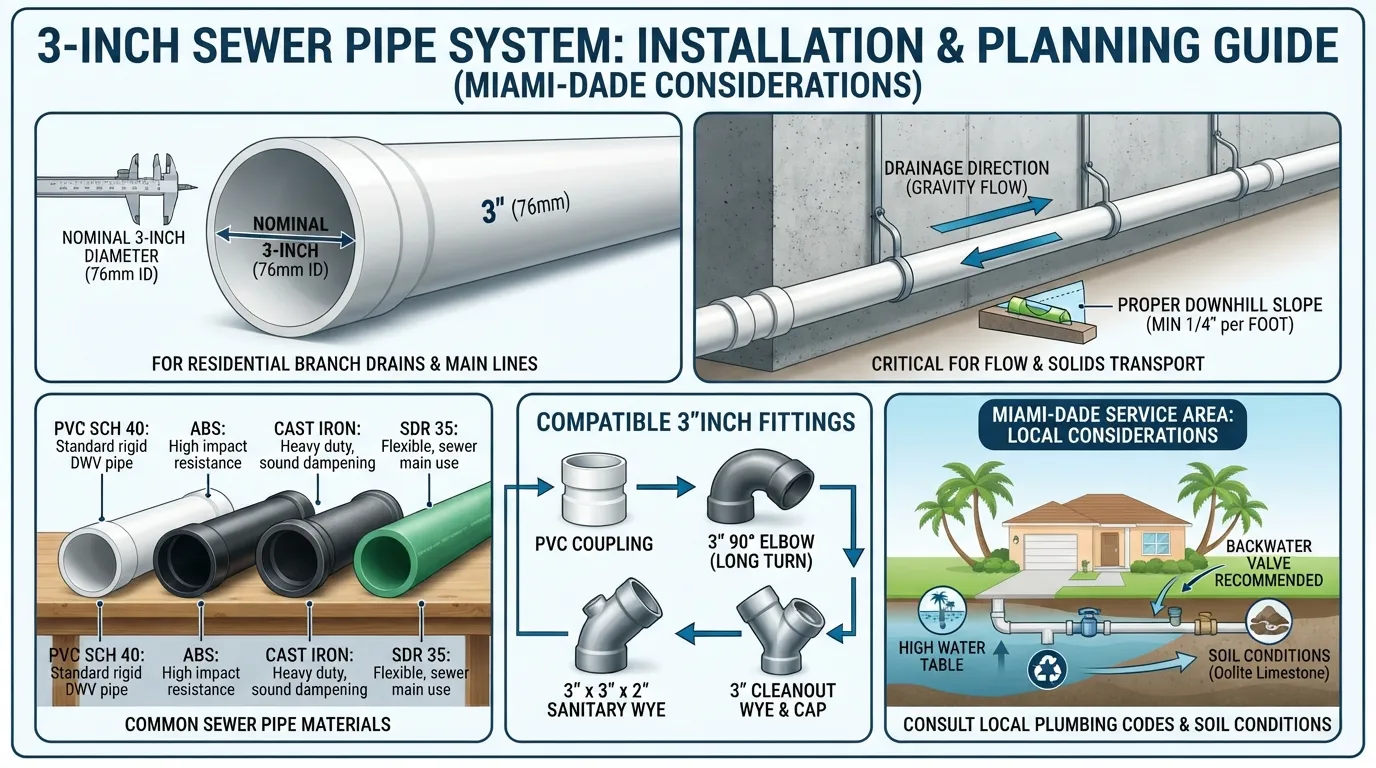
If you are searching for a 3 inch sewer pipe, the most important thing to know is that “3 inch” does not identify one universal pipe. Different 3-inch PVC pipes can have different outside diameters, wall constructions, ASTM standards, fittings, and approved applications.
If you ask me whether a 3-inch pipe can be used for a residential sewer line, the short answer is yes, in some systems—but pipe size alone is not enough to make that decision. You also need to check the drainage load, slope, pipe standard, fitting compatibility, installation conditions, and local plumbing requirements.
Quick Answer for Miami & Florida
Under the current 2023 Florida Building Code, Plumbing, horizontal drainage pipe from 3 to 6 inches must have a minimum uniform slope of 1/8 inch per foot. The same code states that a building drain serving a water closet cannot be smaller than 3 inches. However, an individual 3-inch system still has to be properly sized for its connected drainage fixture-unit load and built with materials approved for that application.
What Does “3 Inch Sewer Pipe” Actually Mean?
The term normally refers to the pipe’s nominal size. It does not automatically mean that the pipe measures exactly 3 inches across its outside surface.
This distinction matters because two products sold as 3-inch PVC pipe can be physically different.
3-Inch PVC D2729 Example
The JM Eagle 3-in. x 10-ft PVC D2729 sewer-and-drain pipe listed by Home Depot has a stated 3.25-inch outside diameter and 3.102-inch inside diameter. It is a non-pressure pipe marketed for gravity sewer and storm-drainage applications.
3-Inch Schedule 40 DWV Example
The Charlotte Pipe 3-in. Schedule 40 PVC DWV product listed by Home Depot has a stated 3.5-inch outside diameter and 3.026-inch inside diameter. It conforms to standards including ASTM D2665.
Practical takeaway: Do not buy a fitting simply because both products say “3 inch.” Check the actual pipe family, outside diameter, ASTM marking, connection type, and fitting compatibility first.
Is 3 Inch Pipe OK for a Sewer Line?
It can be. There is no useful one-size-fits-all answer such as “3 inch is always enough” or “every house needs 4 inch.” Sewer sizing depends on the amount of drainage the line must carry.
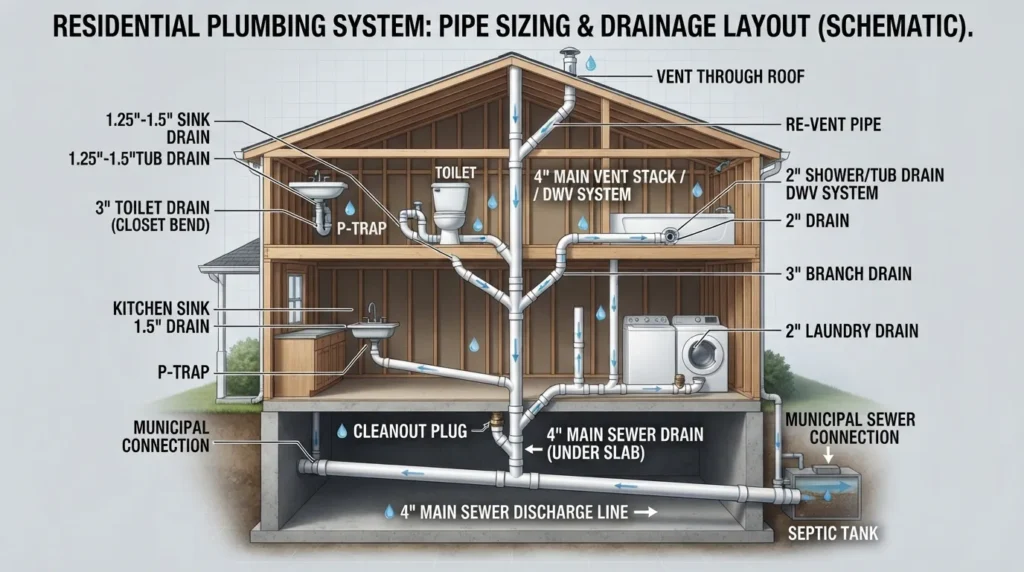
For building drains and building sewers, the Florida Plumbing Code uses drainage fixture units (DFUs) to determine permitted loads. For a 3-inch pipe, the current code table lists these maximum building-drain/building-sewer loads:
These numbers are fixture-unit capacities, not gallons-per-minute ratings. A plumber or system designer still has to total the connected fixtures and evaluate the actual layout.
The code also states that the minimum size of a building drain serving a water closet is 3 inches. That means a 3-inch line is not automatically too small simply because toilets connect to the drainage system.
3 Inch vs. 4 Inch Sewer Pipe
If you are choosing between 3-inch and 4-inch pipe, do not base the decision on the idea that “bigger is always better.” Use the required drainage capacity and the approved system design.
3-Inch Building Sewer
- Can be code-compliant within its permitted fixture-unit load.
- Minimum building-drain size where a water closet is served.
- Florida code capacity is 36 DFU at 1/8-inch-per-foot slope.
- Requires the correct approved pipe material and fittings.
4-Inch Building Sewer
- Provides substantially greater fixture-unit capacity.
- Florida code lists 180 DFU at 1/8-inch-per-foot slope.
- May be appropriate where the connected drainage load requires more capacity.
- Still must use compatible, approved materials and fittings.
For comparison, at a 1/8-inch-per-foot slope the Florida code table permits 36 DFU on a 3-inch building drain/sewer and 180 DFU on a 4-inch line. That is why sizing should be calculated rather than guessed.
How Much Fall Does a 3 Inch Sewer Pipe Need?
For Miami-Dade projects governed by the current Florida Plumbing Code, the minimum slope for horizontal drainage piping from 3 through 6 inches is 1/8 inch of fall per horizontal foot.
That equals:
- 1 inch of fall over 8 feet
- 1.25 inches of fall over 10 feet
- 2.5 inches of fall over 20 feet
- 5 inches of fall over 40 feet
The code requires a uniform alignment and uniform slope. The goal is not simply to make one end lower than the other; dips, humps, bellies, and poorly supported sections can interfere with reliable gravity drainage.
What About the Common 1/4-Inch-Per-Foot Rule?
A 1/4-inch-per-foot pitch may be used in appropriate designs, but it should not be presented as the universal minimum for every 3-inch drain in Florida. The current Florida code minimum for 3- through 6-inch horizontal drainage is 1/8 inch per foot. Always verify the code and design requirements that apply to your specific project.
What Happens If There Is Not Enough Slope?
When a gravity drain does not have adequate or consistent pitch, wastewater may move too slowly or collect in low areas. That can contribute to solids settling, recurring buildup, slow drainage, and blockages.
If an existing line repeatedly backs up, slope is only one possible cause. Grease, wipes, roots, damaged pipe, offsets, scale, or other obstructions may also be involved. In that situation, professional drain cleaning and blockage diagnosis can help identify what is actually restricting flow.
Can a Sewer Pipe Have Too Much Slope?
You may see online claims that anything steeper than a specific number automatically causes water to “outrun” solids. That is too simplistic.
The Florida code section for horizontal drainage establishes minimum slopes, and its building-drain capacity table even includes values at 1/2 inch per foot. Rather than relying on a universal internet “maximum,” the safer approach is to maintain a uniform, code-compliant slope and follow the approved design for the drainage system.
Not Every 3 Inch PVC Sewer and Drain Pipe Is the Same
This is one of the biggest points people miss when shopping for a 3 inch PVC drain or sewer pipe.
You may encounter several standards and pipe families, including:
ASTM D2729
Commonly seen on lightweight PVC sewer-and-drain products sold for non-pressure gravity drainage. The specific 3-inch JM Eagle D2729 retail listing reviewed for this guide has a 3.25-inch outside diameter.
ASTM D2949
A standard for PVC drain, waste, and vent pipe with a 3.25-inch outside diameter. The Florida Plumbing Code lists D2949 among approved PVC standards for several sanitary-drainage applications, including building sewer pipe.
ASTM D3034
A PVC sewer-pipe standard used for sewer-and-drain diameter systems. Florida’s building-sewer material table includes D3034 among its listed PVC standards.
Schedule 40 / ASTM D2665
Schedule 40 PVC DWV uses IPS dimensions. The reviewed Charlotte Pipe 3-inch Schedule 40 product has a 3.5-inch outside diameter and meets ASTM D2665 among other listed standards.
A Retail Label Saying “Sewer Pipe” Does Not Settle Code Approval
Important Florida Material Check
The current Florida Plumbing Code’s building-sewer table lists PVC standards such as ASTM D2665, F891, F1488, D3034, and D2949. ASTM D2729 is referenced elsewhere in the code for subsoil-drain applications, but it is not listed in the building-sewer material table. So a product being marketed by a retailer as “sewer and drain pipe” does not by itself prove that it is the correct material for a sanitary building sewer in your project.
This is why I would never choose a 3 sewer and drain pipe using only these three details:
- It is PVC.
- It says 3 inch.
- The store calls it sewer pipe.
Instead, check the printed ASTM standard on the pipe, the intended application, local requirements, actual diameter, fitting system, and installation instructions.
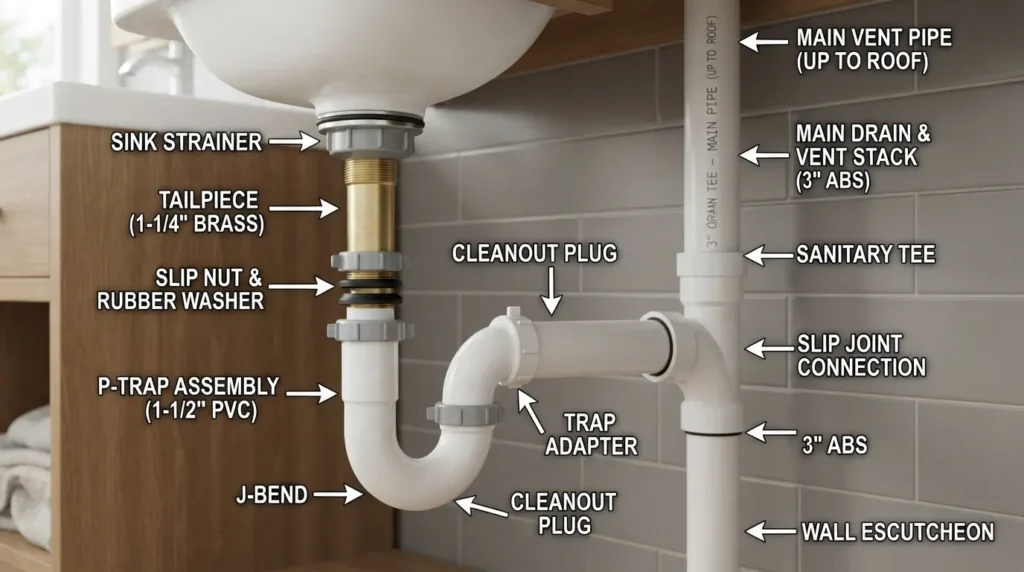
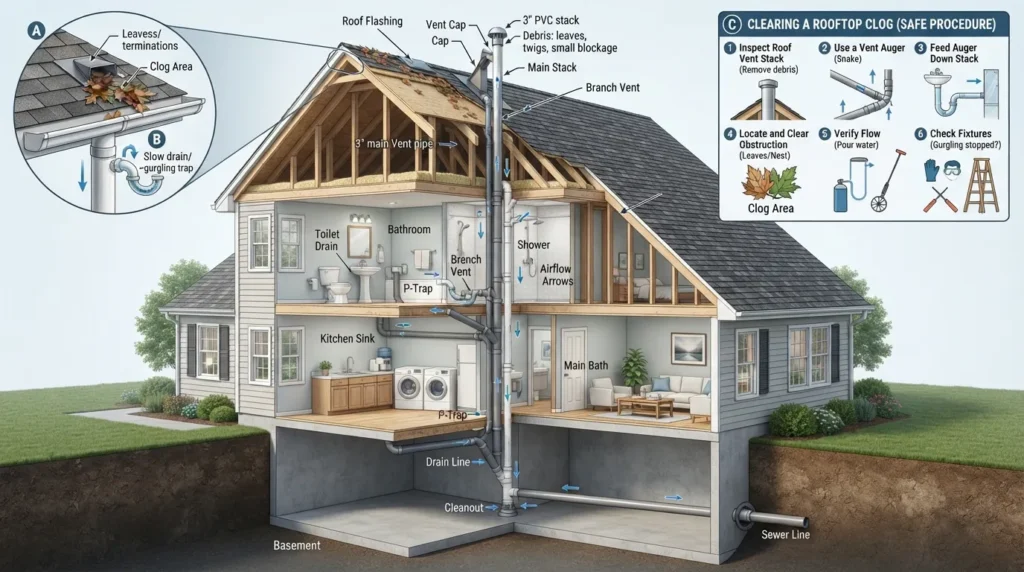
If you want to understand how the sewer line fits into the rest of the property’s plumbing, our guide to the home drainage system explains how fixtures, branch drains, stacks, building drains, sewer piping, vents, traps, and cleanouts work together.
3.25 Inch vs. 3.5 Inch Outside Diameter: Why the Difference Matters
This is one of the most useful checks you can make before buying pipe or fittings.
Based on the current retailer specifications reviewed:
- The JM Eagle 3-inch D2729 pipe lists a 3.25-inch OD.
- The Charlotte Pipe 3-inch Schedule 40 pipe lists a 3.5-inch OD.
Both are sold as “3 inch,” yet a quarter-inch difference in outside diameter is substantial when you are trying to connect fittings.
That is why the answer to “What is the outside diameter of a 3 inch sewer pipe?” should be:
It depends on the pipe standard.
Do not assume every nominal 3-inch PVC pipe has the same outside diameter. Identify the pipe type and standard before selecting fittings, couplings, adapters, or replacement sections.
What Fittings Are Used With a 3 Inch Sewer Pipe?
The exact fittings depend on the pipe system. A typical gravity drainage layout may involve components such as:
- Couplings
- Wyes
- Combination wye-and-bend fittings
- 45-degree bends
- Long-sweep bends
- Cleanout adapters and plugs
- Transition couplings where approved
Do not assume that a 3-inch Schedule 40 DWV fitting will fit a 3.25-inch-OD sewer-and-drain pipe. The fitting must be approved and dimensionally compatible with the pipe being installed.
The Florida Plumbing Code specifically requires pipe fittings to be approved for installation with the piping material used.
Can a Sewer Line Have a 45-Degree Angle?
Yes. A 45-degree change can be made using an approved drainage fitting appropriate for the direction of flow and pipe system.
There is an important cleanout detail in the current Florida code: when a horizontal drain, building drain, or building sewer changes horizontal direction by more than 45 degrees, a cleanout is required at that change of direction, subject to the code’s specific provisions.
That is another reason a sewer layout should be planned as a drainage system rather than assembled from whatever fittings happen to fit together.
Solid vs. Perforated 3 Inch Drain Pipe
A product search for 3 inch sewer and drain pipe may show both solid-wall and perforated products, but they solve different problems.
Solid Pipe
Solid pipe is designed to keep the conveyed water or waste inside the pipe as it moves toward a discharge or connection point. That is the form you would generally expect when the goal is to transport flow rather than collect groundwater along the pipe’s length.
Perforated Pipe
Perforated pipe allows water to enter or leave through openings in the pipe wall and is commonly associated with subsoil drainage, French drains, foundation drainage, and similar water-management applications.
Do not substitute one for the other: A pipe used to collect groundwater is performing a different job from a sealed sanitary sewer carrying wastewater.
10-Foot vs. 20-Foot 3 Inch Sewer Pipe
Search results commonly show both “3 inch sewer pipe 10 ft” and “3 inch sewer pipe 20 ft.” The correct choice is not just about length.
Longer pipe sections can reduce the number of joints needed across a long straight run, while shorter sections may be easier to transport and handle. More importantly, verify that the 10-foot or 20-foot product you are comparing is actually the same pipe standard, diameter system, wall type, and application.
A 20-foot product should not be treated as interchangeable with a 10-foot product just because both listings contain the words “3-inch PVC.”
How Much Does 3 Inch Sewer Pipe Cost?
There is no useful evergreen price for every 3-inch sewer pipe because the cost changes with:
- Pipe standard and wall construction
- Schedule or SDR/PS classification
- Solid vs. perforated construction
- 10-ft vs. 20-ft length
- Brand
- Local store inventory
- Delivery requirements
- Retailer and location
When comparing prices, compare like with like. A lower-priced lightweight D2729 product and a Schedule 40 DWV pipe are not simply two prices for the exact same pipe.
How I Would Choose the Right 3 Inch Pipe
- Identify the application. Sanitary building sewer, building drain, storm drainage, foundation drain, septic application, and other drainage uses are not automatically governed by the same material requirements.
- Read the pipe marking. Look for the ASTM standard, size, manufacturer, and other classification information printed on the pipe.
- Check the actual outside diameter. This determines what fitting system is compatible.
- Confirm sizing. For sanitary drainage, make sure the pipe’s permitted fixture-unit load is sufficient.
- Confirm slope. In the current Florida code, 3- through 6-inch horizontal drainage requires at least 1/8 inch per foot unless another applicable provision controls the installation.
- Match the fittings. Use approved drainage fittings made for that pipe material and diameter system.
- Verify local requirements before installation. Code rules, permits, site conditions, and connection requirements can vary by project.
Common Mistakes to Avoid
- Assuming all white 3-inch PVC pipe is interchangeable.
- Confusing nominal pipe size with actual outside diameter.
- Buying fittings before confirming the pipe standard.
- Using retail product naming as proof of code approval.
- Installing a drain without maintaining uniform slope.
- Ignoring fixture-unit sizing when choosing 3 inch vs. 4 inch.
- Using perforated drainage pipe where a sealed waste line is required.
- Making multiple direction changes without considering cleanout access.
- Replacing a clogged section without identifying why the line keeps blocking.
When a 3 Inch Sewer Line Needs Professional Attention
If you are simply comparing pipe specifications for a drainage project, careful product and code research may answer many of your questions. Existing sewer problems are different.
You should consider a professional evaluation when you are dealing with:
- Repeated sewer or drain backups
- Multiple slow fixtures at the same time
- Gurgling from toilets or drains
- Sewage odors
- Standing wastewater
- A suspected broken or offset underground line
- A line that has been cleared but quickly clogs again
- Uncertainty about an existing pipe’s material, diameter, or condition
For more information about plumbing and drainage help in the area, you can explore our Miami plumbing services and resources.
Not Sure What Is Blocking Your Drain or Sewer Line?
If you are dealing with recurring backups, slow drainage, or an existing line that needs attention, get help before guessing at pipe size or replacing parts unnecessarily.
Frequently Asked Questions About 3 Inch Sewer Pipe
Is 3 inch pipe OK for sewer lines?
Yes, a 3-inch building drain or sewer can be acceptable when its drainage load, slope, pipe material, fittings, and installation comply with applicable requirements. The Florida Plumbing Code states that a building drain serving a water closet must be at least 3 inches, but the connected fixture-unit load still has to remain within the pipe’s permitted capacity.
How much fall does a 3 inch sewer pipe need?
Under the current Florida Plumbing Code, horizontal drainage pipe from 3 through 6 inches requires a minimum slope of 1/8 inch per foot. Requirements in another jurisdiction can differ, so check the code that applies where the pipe is being installed.
What is the standard sewer pipe size?
There is no single standard size that is correct for every sewer line. Pipe diameter is selected according to system type, connected drainage load, slope, and local code. Three-inch and 4-inch piping may both appear in residential drainage systems, but they have very different capacities.
What is the outside diameter of a 3 inch sewer pipe?
It depends on the pipe system. The reviewed JM Eagle 3-inch D2729 product lists a 3.25-inch outside diameter, while the reviewed Charlotte 3-inch Schedule 40 PVC product lists a 3.5-inch outside diameter. Check the markings and specifications on your exact pipe rather than relying only on the nominal 3-inch label.
Can you have too much slope on a sewer pipe?
Do not rely on a universal internet maximum without checking the applicable design and code. Florida’s horizontal-drainage provision establishes minimum slopes, and its sizing table includes capacities at several slopes. The important requirement is a uniform, properly designed, code-compliant drainage run.
Can a sewer line have a 45 degree angle?
Yes, an approved drainage fitting can create a 45-degree change in direction. Under the current Florida Plumbing Code, a horizontal change of direction greater than 45 degrees can trigger a cleanout requirement, so the complete fitting layout matters.
What happens if there is not enough slope in a drain pipe?
Inadequate or uneven slope can allow wastewater to move slowly or collect in low sections of pipe. That can encourage solids to settle and contribute to recurring drainage problems and blockages.
Does Home Depot sell 3 inch PVC sewer pipe?
Yes. Home Depot currently lists products including a 3-inch x 10-ft JM Eagle PVC D2729 sewer-and-drain pipe and a separate 3-inch x 10-ft Charlotte Schedule 40 PVC DWV pipe. They have different specifications, so do not treat the two listings as interchangeable.
A 3 inch sewer pipe can be the correct choice, but “3 inch” is only the beginning of the specification.
Before buying or installing one, confirm:
- What the pipe will actually be used for
- The ASTM standard printed on it
- The true outside diameter
- Whether the fittings belong to the same pipe system
- The connected drainage fixture-unit load
- The required slope
- Whether the material is approved for the intended sanitary, storm, or subsoil-drain application
The biggest mistake is assuming that every product labeled 3 inch sewer and drain pipe is simply a different brand of the same thing. A 3.25-inch-OD lightweight drain product and a 3.5-inch-OD Schedule 40 DWV pipe can both carry a nominal 3-inch label while requiring different fittings and serving different approved applications.
If you remember one rule, make it this: choose the pipe by its application, standard, dimensions, and system requirements—not by the “3 inch” label alone.
Related Product & Code Resources
Use these references to compare exact product specifications and verify plumbing-code requirements. Retail availability, specifications, and pricing can change, so always check the current listing and the markings on the actual pipe.
- Home Depot – JM Eagle 3 in. x 10 ft. PVC D2729 Sewer and Drain Pipe
- Home Depot – Charlotte Pipe 3 in. Schedule 40 PVC DWV Pipe
- Lowe’s – 3 in. x 10 ft. PVC Sewer and Drain Pipe
- US Supply – 3 in. x 10 ft. PVC Sewer and Drain Pipe Reference
- Matt’s Building Materials – 3 in. Solid PVC Sewer and Drain Pipe
- Menards – 3 in. ASTM D2729 Solid PVC Sewer and Drain Pipe
- Ace Hardware – Drain Pipe Reference
- 2023 Florida Building Code, Plumbing – Chapter 7: Sanitary Drainage
- 2023 Florida Building Code, Plumbing – Chapter 11: Storm Drainage
- Miami-Dade Building Department – Florida Building Code Information
Code note: This guide references the 2023 Florida Building Code, Plumbing, Eighth Edition in effect for Miami-Dade at the time of publication. Plumbing codes and project requirements can change. Verify current local requirements before installation, replacement, or permitting work.