1 1/4 pipe fittings are fittings made for a nominal 1-1/4-inch pipe size. Common options include elbows, tees, couplings, unions, adapters, reducers, bushings, caps, and drain fittings. The right fitting depends on more than size: you also need to match the pipe material, application, connection type, and whether the system is designed for pressure or drainage.
If you are searching for 1 1/4 pipe fittings, you are probably trying to do one of two things: find the correct fitting for an existing pipe or understand which fitting you need before buying one. Either way, matching only the “1-1/4 inch” label is not enough.
In this guide, I’ll walk you through the common 1-1/4-inch fitting types, what they are used for, how nominal pipe size differs from actual dimensions, how to handle connections to 1-inch or 1-1/2-inch pipe, and what to check before you buy.
What Are 1 1/4 Pipe Fittings?
1 1/4 pipe fittings are plumbing components designed to connect, redirect, branch, reduce, terminate, or transition pipe in a nominal 1-1/4-inch size system.
The important word here is nominal. A nominal pipe size is a standardized size designation; it does not mean that every pipe or fitting will measure exactly 1.25 inches across. The actual inside and outside dimensions depend on the pipe or fitting type, material, wall thickness, and applicable standard.
Important: 1-1/4 inches does not tell you everything
Before buying a replacement fitting, check the nominal size, material, connection style, application, and product specifications. Two components can share a 1-1/4-inch nominal designation while still being unsuitable for the same job.
What Is a 1 1/4 Inch Pipe Used For?
A 1-1/4-inch pipe size can appear in different plumbing applications, including certain drain, waste, vent, and other plumbing systems. The exact use depends on the pipe material, product rating, local code requirements, and system design.
For example, 1-1/4-inch PVC DWV pipe and fittings are available for drainage applications, while 1-1/4-inch pressure fittings are also manufactured for applicable pressure-piping systems. These are not automatically interchangeable simply because they carry the same nominal size.
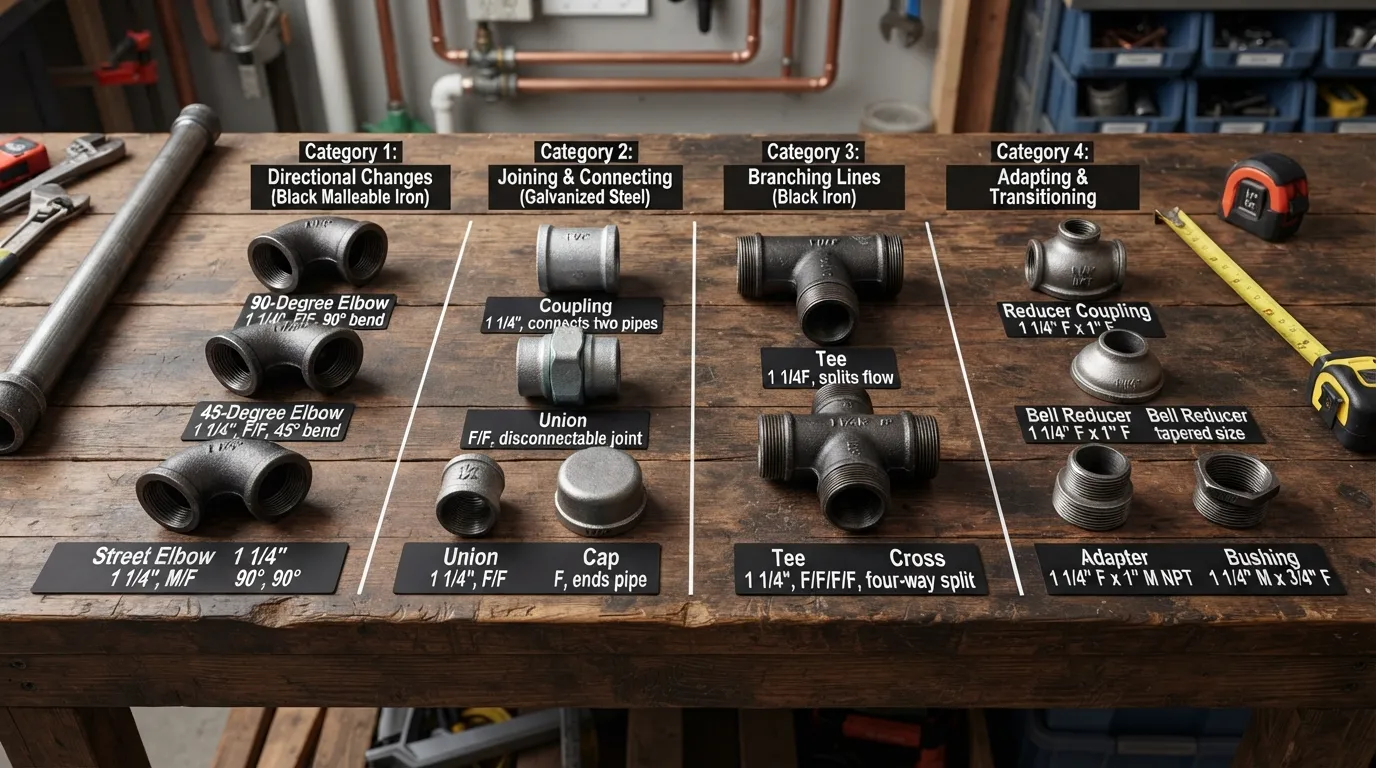
Types of 1 1/4 Pipe Fittings
The easiest way to choose a fitting is to start with the job you need it to perform.
How Do You Choose the Right 1 1/4 Fitting?
Instead of starting with the fitting name, start with the problem you are trying to solve.
- Identify the nominal pipe size. Confirm that the existing pipe or component is actually a 1-1/4-inch nominal size.
- Identify the material. Look for PVC, ABS, copper, brass, stainless steel, galvanized steel, or another material.
- Identify the application. Determine whether the connection is for drainage, waste and vent, potable water, another plumbing application, or a pressure system.
- Identify the connection method. Check whether the fitting uses threads, slip joints, compression, solvent welding, press connections, push-fit connections, or another system.
- Check the configuration. Decide whether you need an elbow, tee, coupling, adapter, reducer, union, cap, trap, or another fitting.
- Check compatibility. Match the fitting to the exact pipe and system rather than relying on the size label alone.
- Verify the manufacturer’s specifications. When the application is important or the connection is unusual, use the product documentation before purchasing.
The simple selection formula
Size → Material → Application → Connection → Fitting type → Compatibility
If all six match, you are much less likely to buy a fitting that looks right but does not belong in your system.
What Is the Actual Diameter of a 1 1/4 Inch Pipe?
A 1-1/4-inch pipe is identified by a nominal pipe size, not simply by measuring across the outside and expecting to see exactly 1.25 inches.
The actual inside diameter can change with wall thickness, while the outside diameter depends on the applicable pipe dimension standard. That is why you should not choose a fitting based only on a ruler measurement or assume that every 1-1/4-inch pipe has identical physical dimensions.
For example, schedule and product standards can affect wall thickness and therefore the internal opening. If you need an exact replacement, identify the pipe type and product standard and compare the manufacturer’s dimensions.
What Is the Size of a 1 1/4 Inch Drain Pipe?
A 1-1/4-inch drain pipe refers to a nominal drain size. It should be matched with fittings designed for the same drainage system and connection standard. Do not assume that a 1-1/4-inch pressure fitting and a 1-1/4-inch drain fitting are automatically interchangeable.
What Is a 1 1/4 Inch Waste Arm?
A 1-1/4-inch waste arm is a drain connection component used in applicable sink or fixture waste plumbing. It typically connects the fixture-side drain assembly toward the trap or drain piping.
When replacing one, match the nominal size, connection style, material, and fixture configuration. A waste arm is part of a drainage assembly, so it should not be treated like a generic pressure-water fitting simply because both products may use a 1-1/4-inch size designation.
1 1/4 PVC Pipe Fittings: What Should You Know?
PVC is commonly used for plumbing pipe and fittings, including DWV systems and certain pressure applications. However, PVC does not automatically mean that every fitting can be used everywhere.
A 1-1/4-inch PVC fitting should be selected according to the specific PVC system and application. Check whether the product is designed for pressure service or DWV service, what joining method it requires, and which pipe standard it is intended to match.
Can You Use 1 1/4 PVC Fittings for Drainage?
Yes, 1-1/4-inch PVC DWV pipe and fittings are manufactured for applicable drain, waste, and vent systems. The fitting still needs to be specifically rated and configured for the intended drainage application.
Do not mix up pressure and DWV fittings
DWV fittings are designed for drainage, waste, and vent applications, while pressure-rated fittings are designed for systems that operate under pressure. A matching nominal size alone does not make two fittings interchangeable.
1 1/4 PVC vs. ABS: Are They the Same?
PVC and ABS are both used in plumbing systems, including applicable DWV installations, but they are different materials and should be matched to the joining method and system requirements.
If you are replacing an existing fitting, first identify whether the pipe is PVC, ABS, or another material. Then choose a fitting and transition method specifically designed for that combination. Do not assume that two plastic components can be joined simply because their nominal sizes match.
Will 1 Inch PVC Fit Inside 1 1/4 PVC?
Do not assume that it will. Nominal pipe sizes are not the same thing as actual measured diameters, and simply inserting one pipe into another does not create a correct or code-compliant connection.
If you need to connect different nominal sizes, use a fitting specifically designed to make that transition, such as an appropriate reducer, reducing bushing, or adapter. The correct component depends on the pipe material, connection method, and application.
How Do You Connect 1 1/2 Inch Pipe to 1 1/4 Inch Pipe?
The usual approach is to use a properly sized reducer, reducing bushing, or adapter designed for the two pipe sizes and the specific connection system.
- Identify the material of both pipes.
- Confirm the nominal size of each pipe.
- Determine whether the system is pressure or DWV.
- Identify the connection type on both sides.
- Select a fitting rated for that exact combination.
- Follow the manufacturer’s installation requirements.
If the two pipes use different materials or connection systems, an ordinary coupling may not be the right solution. A purpose-made transition fitting may be required.
1 1/4 Inch Drain Pipe Fittings: Elbows, Tees, Traps and More
For drainage projects, you may encounter several 1-1/4-inch fittings that look similar but serve different purposes.
1 1/4 Drain Pipe 90-Degree Elbow
A 90-degree elbow changes the direction of the drain line by approximately 90 degrees. Choose the correct fitting configuration for the pipe and drainage system rather than selecting an elbow based only on the diameter label.
1 1/4 Drain Pipe 45-Degree Elbow
A 45-degree elbow provides a less abrupt directional change than a 90-degree elbow. It can be useful when the layout calls for a more gradual change in direction, subject to the system design and applicable plumbing requirements.
1 1/4 P-Trap
A P-trap is part of a fixture drainage assembly and is commonly associated with sinks and other fixtures. The correct trap size and configuration depend on the fixture, drain connection, and applicable plumbing requirements.
1 1/4 Pipe Fittings: What to Check Before Buying
Use this buying checklist
- Confirm the nominal pipe size.
- Identify the pipe and fitting material.
- Check whether the system is pressure or DWV.
- Confirm the connection type.
- Check male/female or hub/spigot configuration where applicable.
- Confirm whether you need a straight connection, elbow, tee, reducer, adapter, union, cap, or drain fitting.
- Check the product’s temperature, pressure, or application rating where applicable.
- Verify the manufacturer’s dimensions when physical fit is critical.
- Check local plumbing requirements for the installation.
Which 1 1/4 Fitting Do You Need?
Common Mistakes When Buying 1 1/4 Pipe Fittings
Choosing by size alone
The “1-1/4 inch” label is only the starting point. Material, connection type, application, and product standard matter too.
Confusing nominal size with actual diameter
A nominal size is a standardized designation. It should not be treated as a guaranteed measurement of the pipe’s inside or outside diameter.
Using a pressure fitting in a DWV application
Different fitting systems are designed for different applications. Always check the product’s intended use.
Forcing two different pipe sizes together
If you need to transition from 1 inch to 1-1/4 inch or from 1-1/2 inch to 1-1/4 inch, use an appropriate transition fitting instead of improvising the connection.
Ignoring the connection method
A threaded fitting, slip-joint fitting, solvent-weld fitting, compression fitting, press fitting, and push-fit fitting are not interchangeable just because they share a nominal size.
Frequently Asked Questions About 1 1/4 Pipe Fittings
What pipe size is 1 1/4?
1-1/4 inch is a nominal pipe size. The actual inside and outside dimensions depend on the pipe type, material, wall thickness, and applicable standard.
What is a 1-1/4-inch waste arm?
It is a drain connection component used in applicable fixture waste plumbing, often as part of a sink drain assembly. Match its size, material, connection style, and configuration to the existing system.
What is a 1 1/4 pipe used for?
It can be used in various plumbing applications, including applicable drain, waste, and vent systems and other systems designed for that nominal size. The exact use depends on the pipe product and system requirements.
What is the size of a 1-1/4-inch drain pipe?
It is identified by a nominal 1-1/4-inch drain size. The actual physical dimensions should be verified against the applicable pipe and fitting standard.
Do they make 1 1/4 PVC pipe?
Yes. 1-1/4-inch PVC pipe and fittings are available for applicable plumbing systems, including PVC DWV products. Always choose a product designed for your intended application.
What is a 1-1/4-inch drain pipe extension?
A drain extension is a component used to extend or modify an applicable fixture drain connection. The correct extension depends on the drain assembly, size, material, and connection configuration.
Will 1 inch PVC fit inside 1 1/4 PVC?
Do not assume it will. Nominal pipe sizes do not represent exact outside or inside diameters. Use a fitting specifically designed for the required size transition.
Does Home Depot carry 1 1/4 PVC pipe?
Large plumbing retailers such as Home Depot list 1-1/4-inch pipe and fitting products in their plumbing categories. Product availability varies by material, application, store, and location, so check the current product listing before buying.
What is the diameter of 1 1/4 PVC?
There is no single physical diameter that should be assumed from the nominal label alone. Check the specific PVC product’s dimensional specification for the actual outside and inside dimensions.
How do I connect 1 1/2 pipe to 1 1/4 pipe?
Use an appropriately sized reducer, reducing bushing, or adapter designed for the two pipe sizes and the specific material and connection system.
Final Takeaway: Choose by More Than the 1-1/4-Inch Label
The key point
Finding a 1-1/4-inch fitting is easy. Finding the right 1-1/4-inch fitting requires you to match the size, material, application, connection method, and compatibility.
If you are replacing an existing fitting, identify the pipe and fitting markings first and compare the manufacturer’s specifications before purchasing. If the connection involves an unusual transition, pressure system, concealed plumbing, or a code-sensitive installation, professional plumbing advice can help prevent a costly mistake.
For broader plumbing information and related services, you can explore our plumbing services. If your plumbing project also involves replacing a water heater, you can learn more about our water heater replacement service.
Need Help With a Plumbing Connection?
If you are unsure which fitting or plumbing solution is appropriate for your project, you can contact Miami Florida Plumbing for help.
Related Resources
If you are comparing 1-1/4-inch fittings before purchasing, these types of resources can help you review current product options and specifications:
- Home Depot 1-1/4-inch plumbing pipe fittings — useful for browsing current fitting categories and product options.
- McMaster-Carr 1-1/4-inch pipe fittings — useful for comparing different fitting configurations and connection types.
- Amazon 1-1/4-inch pipe fittings — useful for browsing currently listed products from different sellers.