A plumbing reducer is a fitting that connects pipes or fittings of different sizes. If you have a larger pipe that needs to transition to a smaller connection, the right reducer can make that change without forcing an incorrect fitting into the system.
The tricky part is choosing the correct one. Reducers come in different designs, materials, sizes, and connection types, and the best choice depends on what you are connecting and where the fitting will be used.
A plumbing reducer is used when you need to transition between two different pipe or fitting sizes. Common forms include reducer couplings, reducer bushings, concentric reducers, and eccentric reducers. To choose the right plumbing reducer, check the pipe sizes, materials, connection types, application, and whether the fitting is intended for a pressurized water system or a drain, waste, and vent (DWV) system.
In this guide, I’ll show you what a reducer does, how the main types differ, how reducer sizes are written, how material compatibility affects your choice, and what to check before buying or installing one.
What Is a Plumbing Reducer?
A plumbing reducer is a pipe fitting designed to connect two different nominal pipe sizes. Instead of trying to force a smaller pipe into a larger fitting or using an unsuitable connection, a reducer provides a purpose-built transition between the two sizes.
For example, a fitting described as a 1-inch × 1/2-inch reducer is intended to transition between those two nominal connection sizes, provided the connection style and application are compatible.
Reducers can be found in residential plumbing, drainage systems, commercial piping, and other fluid-handling applications. However, you should not assume that one reducer works for every plumbing application. The fitting must be appropriate for the pipe material, pressure, temperature, connection method, and intended use.
What Is the Purpose of a Plumbing Reducer?
The basic purpose of a reducer is simple: to create a controlled transition from one pipe size to another.
You might need one when a plumbing system changes from a larger branch or supply line to a smaller line, when an existing fitting has a different connection size, or when two compatible piping components have different nominal sizes.
Think of a reducer as a transition fitting
If one side of your connection is larger and the other side is smaller, the reducer provides the transition. The important question is not simply “What reducer looks right?” but “Which reducer matches both sides of this specific plumbing connection?”
What Are the Main Types of Plumbing Reducers?
The word reducer can describe several different fitting designs. Two reducers may both change pipe size but have completely different connection styles or geometry.
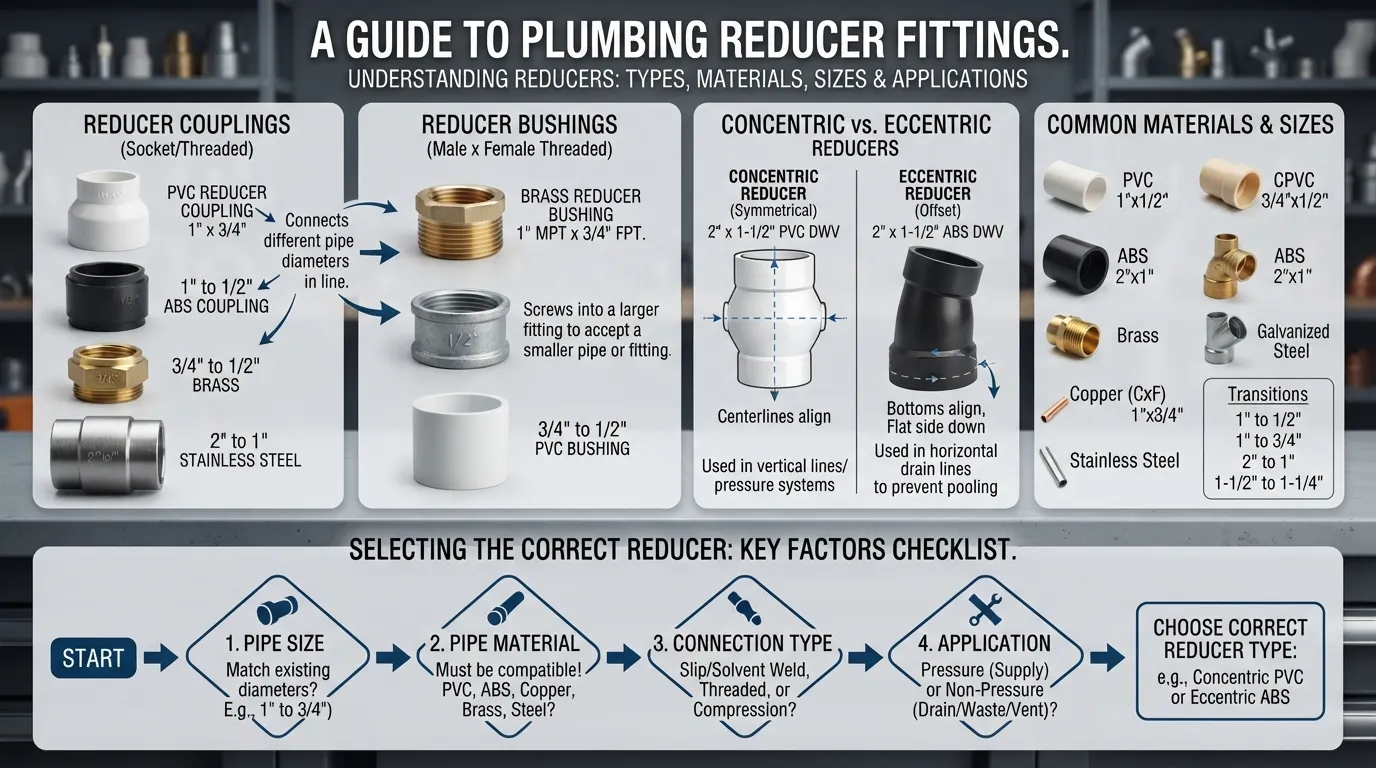
1. Reducer Coupling
A reducer coupling is generally used to join two different pipe sizes in a straight connection. It has different-size connection ends rather than two equal-size ends.
For example, a reducing coupling may connect a larger pipe to a smaller pipe when the fitting and pipe materials, connection method, and application are compatible.
2. Reducer Bushing
A reducer bushing is used to reduce the connection size of a larger fitting so that a smaller pipe or fitting can connect to it. The exact design depends on whether the bushing is threaded, socket-style, or another connection configuration.
A bushing should not automatically be treated as interchangeable with a reducer coupling. The fitting geometry and connection arrangement matter.
3. Concentric Reducer
A concentric reducer has its larger and smaller openings aligned around the same centerline. Its symmetrical shape creates a centered transition between the two sizes.
This configuration is commonly associated with applications where maintaining a centered transition is appropriate, including many vertical piping arrangements.
4. Eccentric Reducer
An eccentric reducer has offset centerlines, giving the fitting a flat side rather than a symmetrical cone around the centerline.
Eccentric reducers can be useful in appropriate horizontal piping arrangements where controlling how air or liquid collects within the piping is important. The correct orientation depends on the particular piping system and application, so an eccentric reducer should not be selected simply because the pipe runs horizontally.
Reducer types at a glance
Reducer vs. Coupling vs. Bushing vs. Adapter
These terms are easy to confuse because they are all pipe fittings, but they do not perform exactly the same job.
So if your only problem is that two compatible connections have different sizes, a reducer may be appropriate. If the connection types are different, you may need an adapter or a fitting designed specifically for that transition.
How Do Plumbing Reducer Sizes Work?
Reducer sizes are commonly expressed using two nominal pipe or fitting sizes, such as 1 inch × 1/2 inch or 2 inch × 1 inch.
The larger size is normally listed first and the smaller size second, although you should always confirm the manufacturer’s specification before purchasing.
Common Reducer Size Examples
- 1 inch × 1/2 inch: transitions between those nominal connection sizes.
- 1 inch × 3/4 inch: transitions from a 1-inch nominal size to a 3/4-inch nominal size.
- 2 inch × 1 inch: transitions from a 2-inch nominal size to a 1-inch nominal size.
- 3/4 inch × 1/2 inch: transitions between 3/4-inch and 1/2-inch nominal sizes.
Important sizing warning
A nominal pipe size is not necessarily the same as the pipe’s measured outside or inside diameter. Before ordering a reducer, identify the actual pipe standard and connection type rather than choosing a fitting based only on a ruler measurement.
What Materials Are Plumbing Reducers Made From?
The reducer material needs to be appropriate for the pipe material and the application. Common options include plastic and metal fittings, with the exact choice depending on the plumbing system.
PVC Reducers
PVC reducers are commonly used with compatible PVC piping in applications such as water piping or DWV systems, depending on the specific fitting’s rating and design.
ABS Reducers
ABS fittings are commonly associated with DWV applications. An ABS reducer should be selected according to the applicable pipe system and manufacturer’s specifications.
Brass and Copper Reducers
Brass and copper fittings are used in various plumbing supply and transition applications. Connection methods can include threaded, soldered, press, compression, or other designs depending on the specific fitting.
Stainless Steel Reducers
Stainless steel reducers are used in applications where their material properties and connection design are appropriate. They are more commonly encountered in specialized or commercial fluid-handling systems than in basic residential plumbing.
Flexible Reducer Couplings
Flexible rubber or elastomeric couplings with clamps can be used for certain transitions between compatible pipe sizes or materials. The coupling must be specifically rated for the intended application.
Can a Reducer Connect Different Pipe Materials?
Sometimes, but you should never assume that any reducer can connect any two materials.
For a transition such as PVC to metal, copper to another piping material, or cast iron to plastic, you need a fitting and connection method specifically intended for that combination. The correct solution may be a reducer, adapter, transition coupling, or another specialized fitting.
Before choosing the fitting, check:
- The material of both pipes.
- The nominal size of both connections.
- Whether each end is threaded, socket, compression, press, grooved, or another connection type.
- Whether the system carries potable water, drainage, waste, another fluid, or a specialized service.
- The pressure and temperature requirements.
- The fitting manufacturer’s approved applications and ratings.
Water Supply vs. DWV: Why the Application Matters
One of the easiest mistakes is treating all plumbing reducers as interchangeable. A fitting designed for a drain, waste, and vent system should not automatically be used on a pressurized water line.
For a pressurized water system, the fitting needs to be suitable for the system’s pressure, temperature, pipe material, and connection method. DWV fittings have different design requirements because they are intended for drainage and venting rather than the same type of continuous water pressure.
Before you buy a reducer
- Identify the pipe material.
- Identify both nominal sizes.
- Identify the connection type at each end.
- Determine whether the application is water supply, DWV, or another service.
- Confirm the fitting is rated and approved for that application.
How Do You Choose the Right Plumbing Reducer?
If you’re standing in front of a wall of plumbing reducer fittings, don’t choose one just because the two openings appear to match your pipes. Use this process instead.
Step 1: Identify the Larger and Smaller Sizes
Determine the nominal size of each side. If you’re unsure, check markings on the pipe or fitting, existing documentation, or the manufacturer’s specifications. Measuring the pipe alone may not tell you the nominal size.
Step 2: Identify the Pipe Materials
Confirm whether you’re working with PVC, ABS, copper, brass, PEX, cast iron, stainless steel, or another material. If the materials differ, look specifically for a fitting designed for that transition.
Step 3: Check the Connection Type
Two fittings with the same nominal size can still be incompatible if their connection styles differ. Check whether you need a socket, threaded, compression, press, grooved, or another connection configuration.
Step 4: Identify the Application
Determine whether the reducer is going into a pressurized water line, a DWV system, or another application. This can change which materials, fittings, and ratings are appropriate.
Step 5: Decide Which Reducer Design Fits the Job
Now decide whether you need a reducer coupling, reducer bushing, concentric reducer, eccentric reducer, or another transition fitting.
Step 6: Verify the Manufacturer’s Specifications
The final check is important. Confirm that the exact fitting is approved for your pipe materials, connection method, pressure, temperature, and intended application.
Which Reducer Do You Need? Practical Scenarios
Concentric vs. Eccentric Reducer: What’s the Difference?
The main difference is the position of the two openings.
The correct choice depends on the piping layout and application. In systems where air or liquid accumulation is a concern, reducer orientation can matter, so the fitting should be selected according to the actual piping design rather than a simple “horizontal versus vertical” rule.
Common Plumbing Reducer Mistakes to Avoid
- Choosing by appearance alone. Two fittings can look similar while having different connection standards or ratings.
- Confusing nominal size with measured diameter. Pipe sizing is not always as simple as measuring across the pipe.
- Ignoring pipe material. A reducer needs to be compatible with the materials it connects.
- Using a DWV fitting in a pressurized application. Always verify the fitting’s intended service.
- Assuming a reducer and adapter are the same thing. A reducer changes size; an adapter can change the connection type or interface.
- Forcing incompatible connections together. A fitting should match the intended connection method instead of being modified to make it fit.
- Ignoring manufacturer requirements. The exact fitting’s specifications are more reliable than a generic assumption about a fitting category.
Don’t guess on a critical plumbing connection
If you cannot confidently identify the pipe size, material, connection type, or application, getting the fitting wrong can create leaks or an unsuitable connection. When the connection is difficult to identify or part of an important water or drainage system, consider having a qualified plumbing professional identify it before you proceed.
How to Tell What Plumbing Reducer You Need
If you want a simple checklist, I recommend writing down these five details before shopping for a reducer:
- Large-side nominal size
- Small-side nominal size
- Pipe material on each side
- Connection type on each side
- Application and pressure/service requirements
Once you have those details, selecting the appropriate fitting becomes much easier. If any one of them is unknown, that is usually the point where guessing becomes risky.
Can You Use a Plumbing Reducer for Gas Lines?
Do not assume that a general plumbing reducer is suitable for a gas line. Gas piping requires fittings specifically approved for the gas service and applicable installation requirements. The correct material, connection method, listing, and local requirements must all be considered.
If the fitting is intended for a gas application, verify the manufacturer’s approval and applicable local plumbing or fuel-gas requirements rather than relying on its size alone.
Where Can You Find Plumbing Reducer Fittings?
Plumbing reducer fittings are widely available through plumbing supply houses, hardware stores, home-improvement retailers, and online fitting suppliers. Product listings can be useful for comparing sizes and connection styles, but a product being available for sale does not automatically mean it is suitable for your particular plumbing application.
When comparing products, look beyond the photograph. Check the exact size, material, connection type, pressure or service rating, applicable standard, and manufacturer’s intended use.
Frequently Asked Questions About Plumbing Reducers
What is another name for a reducer in plumbing?
Depending on its design, you may see terms such as reducing coupling, reducer bushing, pipe reducer, or reducing fitting. These terms are related but are not always interchangeable.
What are the two main types of reducers?
In piping terminology, concentric and eccentric reducers are two major reducer geometries. Plumbing fittings also include functional designs such as reducer couplings and reducer bushings.
What’s the difference between a coupling and a reducer?
A standard coupling is generally used to join compatible same-size connections, while a reducer changes the connection from one size to another.
What does a reducer look like for plumbing?
A typical reducer has a larger opening on one side and a smaller opening on the other. A reducer coupling usually forms a straight transition, while a reducer bushing fits inside or into a compatible larger fitting. Concentric and eccentric reducers have different shapes because their centerlines are either aligned or offset.
What is the opposite of a reducer in piping?
There is not one universal “opposite” fitting used in every plumbing context. If the system needs to transition from a smaller connection to a larger one, you would select a fitting designed for that increasing-size transition.
What is the function of a pipe reducer?
Its function is to provide a controlled connection between different pipe or fitting sizes while using a fitting designed for the specific piping application.
What are the disadvantages of reducer pipes?
A reducer itself is not inherently a problem. However, an incorrectly sized, incompatible, poorly oriented, or improperly selected reducer can create an unsuitable connection or unwanted flow conditions. The fitting needs to match the system design.
Choosing the Right Plumbing Reducer
A plumbing reducer is a simple idea with several important details behind it. The fitting connects different sizes, but choosing the correct reducer requires more than matching two numbers.
Start with the pipe sizes, then check the materials, connection types, and application. From there, determine whether you need a reducer coupling, reducer bushing, concentric reducer, eccentric reducer, or another transition fitting.
If you’re unsure about the existing pipe size or fitting, don’t force a reducer to fit. Identifying the connection correctly first can save you from leaks, incompatible materials, and having to redo the work later.
Need Help Identifying a Plumbing Fitting?
If you’re not sure which reducer, fitting, or connection is right for your plumbing system, professional help can prevent an incorrect connection. You can explore plumbing services or learn more about our plumbing team.
Related Resources for Plumbing Reducer Research
If you’re comparing reducer fittings or trying to identify the correct size, these external resources can help you review available fitting types, sizes, and product specifications:
- Home Depot reducer fittings — useful for reviewing common plumbing reducer configurations and sizes.
- Lowe’s reducer fittings — another source for comparing available reducer fitting options.
- McMaster-Carr pipe fitting reducers — useful for examining different reducer designs, materials, and connection configurations.
- Chemical Containers plumbing reducers — provides additional examples of reducer fittings and applications.