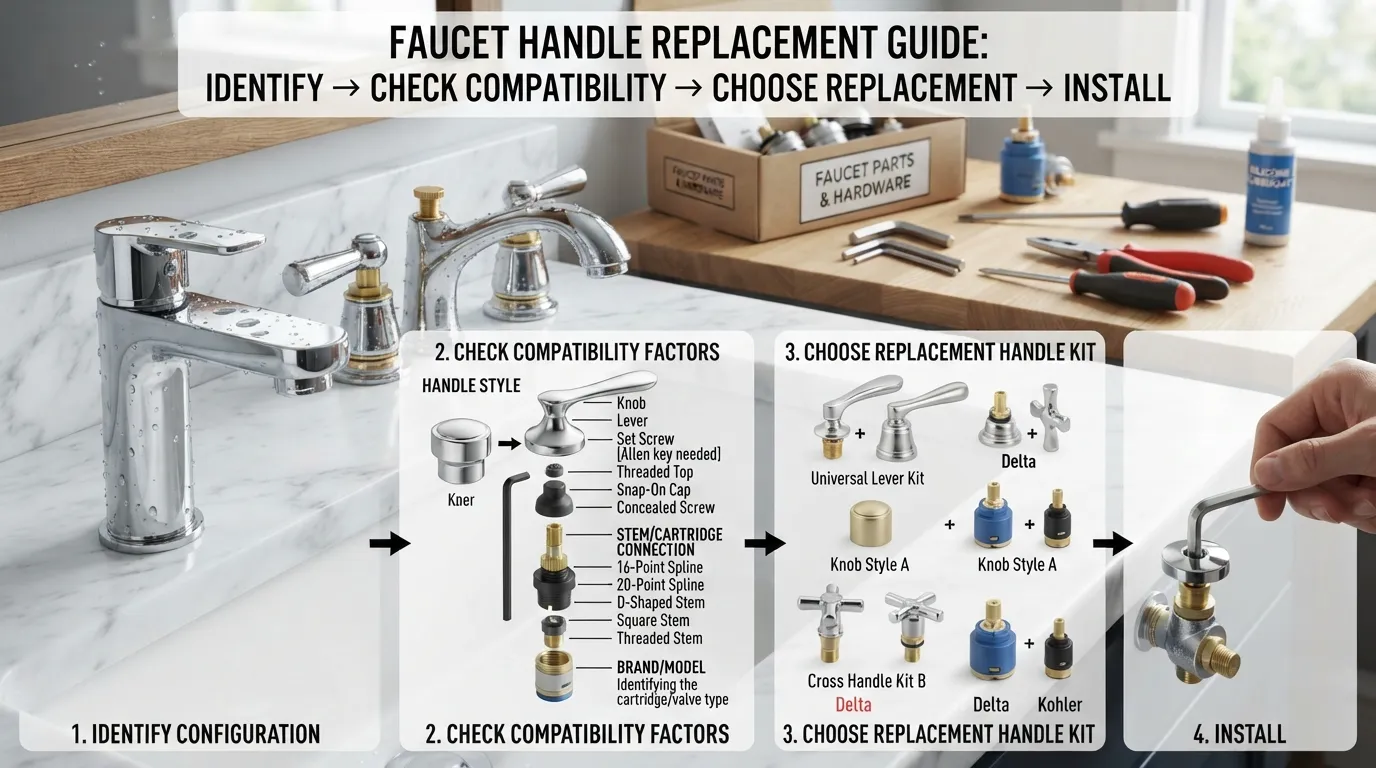
Need a new bathroom faucet handle? You may not need to replace the entire faucet. I’ll show you how to identify your existing handle, choose a compatible replacement, understand the different handle types, and decide when a simple DIY replacement makes sense.
Can You Replace Just the Bathroom Faucet Handle?
Yes, in many cases you can replace only the bathroom faucet handle rather than replacing the entire faucet. The important part is finding a handle that is compatible with your faucet’s brand, model, configuration, and mounting or stem connection.
If the handle itself is cracked, loose, worn, or cosmetically damaged but the rest of the faucet is working properly, a handle replacement may be the simplest solution. If the problem is actually inside the faucet, such as a damaged cartridge or valve component, replacing only the handle may not solve the underlying problem.
A bathroom faucet handle looks like a simple part, but choosing the right replacement is not always as simple as matching its appearance. A lever that looks almost identical to yours may use a different connection, while a product described as “universal” may not fit every faucet.
That is why I recommend treating a replacement as a fit-and-function problem, not just a shopping problem. First identify what you have, then verify compatibility, and only then choose the replacement.
What Is a Bathroom Faucet Handle?
A bathroom faucet handle is the part you operate to control water flow and, depending on the faucet design, water temperature. Bathroom sink faucets can use one handle or two separate handles, and the visible handle can come in several shapes and operating styles.
The handle is only one part of the faucet control system. Underneath it may be a stem, cartridge, fastening screw, adapter, or other connection that determines whether a replacement handle will actually fit.
The key distinction: style vs. configuration
Handle style describes what the handle looks like and how you operate it, such as a lever, knob, or cross handle.
Faucet configuration describes how the faucet controls are arranged, such as a single-handle or two-handle bathroom sink faucet.
Common Types of Bathroom Faucet Handles
The most useful way to compare bathroom faucet handles is to look at both their design and how they operate. The main types you’ll encounter include knobs, levers, and cross handles, with additional designs such as joystick-style and push-button controls.
| Handle type | What it looks like | Typical operation | Replacement consideration |
|---|---|---|---|
| Knob | Rounded or compact | Turn to operate | Match the underlying connection, not just the shape |
| Lever | Straight or curved bar | Lift, pull, push, or turn depending on faucet design | Check model and mounting connection |
| Cross | X-shaped design | Turn through multiple positions | The decorative design does not guarantee compatibility |
| Joystick-style | Small upright control | Moves according to faucet design | Use the faucet model or manufacturer information to verify fit |
| Push-button | Button-style control | Push to operate | Do not assume a generic replacement will match the mechanism |
Single-Handle vs. Two-Handle Bathroom Faucets
Before shopping for bathroom sink handles, determine whether your faucet has one control or two. This is separate from the handle’s visual style.
- Single-handle faucet: One control generally manages both water flow and temperature.
- Two-handle faucet: Separate controls are used for hot and cold water.
For a two-handle faucet, replacing one handle does not necessarily mean replacing the other. However, matching the existing design and confirming compatibility is important if you want the finished faucet to look and operate consistently.
How Do I Know Which Bathroom Faucet Handle I Need?
This is where many replacement projects go wrong. Do not choose a replacement handle based on appearance alone. Before you order anything, collect as much information about your existing faucet as possible.
Bathroom Faucet Handle Identification Checklist
- Find the faucet brand. Look for a name or logo on the faucet, handle, escutcheon, or other visible component.
- Look for the model number. If documentation or a model marking is available, it can make replacement-part identification much easier.
- Count the handles. Determine whether the faucet is a single-handle or two-handle design.
- Identify the handle style. Note whether it is a knob, lever, cross, joystick-style, or another design.
- Inspect how the handle is attached. Look for a visible screw, decorative cap, or other fastening arrangement.
- Consider the stem or cartridge connection. The hidden connection is often more important than the outside shape.
- Take clear photos. A photo of the complete faucet and close-ups of the handle can help when comparing parts.
- Verify manufacturer compatibility. When available, use the manufacturer’s model and replacement-part information instead of guessing.
Are All Bathroom Faucet Handles Interchangeable?
Bathroom faucet handles are not universally interchangeable. Two handles can have a similar appearance while using different fastening systems, stem connections, dimensions, or manufacturer-specific parts.
Even when a replacement is advertised as “universal,” you should still check the manufacturer’s compatibility information and the actual connection on your faucet.
The safest approach is:
- Identify the faucet brand and model if possible.
- Determine the faucet configuration.
- Identify how the existing handle attaches.
- Check the stem, cartridge, or adapter connection when relevant.
- Compare the replacement’s stated compatibility.
- Only purchase when the available information supports the fit.
Remember: “Universal” describes the intended compatibility range of a product; it does not mean every handle fits every faucet.
Universal Faucet Handle Replacement: What Should You Check?
Universal replacement handles can be useful when the original part is discontinued or difficult to find, but they require more careful matching.
Bathroom Sink Handles vs. Shower Faucet Handles
One easy mistake is buying a handle for the wrong application. A bathroom sink faucet handle and a tub or shower handle may both be described as faucet handles, but they are not automatically interchangeable.
When shopping, confirm that the replacement is intended for your specific application. A bathroom sink handle should be matched to the bathroom sink faucet, while a shower or tub control should be matched to the corresponding valve and trim system.
If you are unsure whether the part belongs to the sink faucet or a shower/tub control, stop before forcing the replacement onto the existing connection.
How to Replace a Bathroom Sink Faucet Handle
The exact procedure varies by faucet design, but many handle replacements follow a similar sequence.
- Prepare the work area. Clear the sink area and place a cloth where small screws or parts could fall.
- Identify the fastening method. Look for a decorative cap, visible screw, or other fastener.
- Remove the cap or fastener carefully. Use the appropriate tool for the specific handle design.
- Remove the existing handle. Lift or pull it away according to the faucet’s design. Avoid excessive force.
- Inspect the connection. Check the exposed stem, cartridge interface, adapter, or mounting point for damage or unusual wear.
- Compare the new handle before installing it. Make sure the connection and orientation match.
- Install the replacement. Secure it according to the manufacturer’s instructions.
- Test the handle. Operate it gently and check that the faucet functions correctly.
- Check for leaks. Pay attention to the handle area and other visible connections after the repair.
Do not force a stuck handle
If a handle refuses to come off, excessive force can damage the faucet or the parts underneath it. A stuck handle may need a more careful removal method, and the problem may be more than a simple cosmetic handle replacement.
Should You Repair the Handle or Replace It?
Not every faucet-handle problem requires the same solution. Start by identifying what is actually wrong.
When Is It Better to Call a Plumber?
A handle replacement can be a manageable DIY project when the problem is straightforward and you can confidently identify the correct part. Professional help becomes more reasonable when the repair involves problems you cannot clearly identify or safely address.
- The handle is stuck and will not come off without significant force.
- The faucet stem or cartridge appears damaged.
- You cannot determine which replacement part is compatible.
- The faucet continues leaking after a handle replacement.
- The faucet body itself is damaged.
- You cannot safely isolate the water supply for the work.
- The repair appears to involve more than the handle or its fastening hardware.
If the issue has become a broader plumbing repair rather than a simple handle replacement, you can learn more about available plumbing services before deciding on the next step.
How Much Does a Bathroom Faucet Handle Replacement Cost?
The cost can vary significantly because there are two separate considerations: the replacement part itself and the labor required if you hire a professional.
Replacement handles range from basic parts to manufacturer-specific or decorative handle kits. The price depends on the faucet brand, model, design, materials, finish, and whether you are buying only the handle or a larger repair kit.
For that reason, I would not use one generic price as a reliable estimate for every bathroom faucet handle replacement. If you already know your faucet brand and model, identifying the correct part first is more useful than choosing a replacement based only on price.
Where Can You Find Replacement Bathroom Faucet Handles?
Replacement bathroom faucet handles are commonly sold through home-improvement retailers, plumbing-parts suppliers, manufacturer websites, and online marketplaces. Your best source depends on whether you need an exact manufacturer replacement or a compatible alternative.
For an exact replacement, start with the faucet manufacturer and model information whenever possible. For broader shopping research, you can compare available handle designs and replacement parts from established retailers.
Useful replacement-shopping resources
- Home Depot bathroom sink faucet handles — useful for comparing replacement-handle options.
- Lowe’s guide to bathroom faucet handle types — useful when you are comparing handle styles.
- Lowe’s bathroom sink faucet handle selection — useful for replacement-part research.
- Danco bathroom faucet handles — another source for replacement-handle research.
- FaucetList handle collection — useful for browsing faucet-handle options.
- Signature Hardware faucet handles — useful for comparing handle styles and replacement options.
When using any shopping source, verify the actual product compatibility before ordering. A retailer’s category page can help you browse, but the faucet model and connection still determine whether a specific handle is appropriate.
What Should You Do If You Cannot Identify Your Faucet?
If the brand or model is unknown, do not immediately assume you need a universal bathroom faucet handle.
Instead, start with the faucet itself. Look for a manufacturer’s name or logo, inspect the handle and faucet body, check any original paperwork you have, and take clear photos of the faucet from several angles.
Then compare the physical handle and its attachment method with manufacturer parts information or a reputable replacement-parts source. If the faucet is older or the connection is unclear, professional identification may save you from buying an incompatible part.
Common Bathroom Faucet Handle Replacement Mistakes
- Buying by appearance only. A similar-looking handle can have a different connection.
- Assuming “universal” means every faucet. Always verify compatibility.
- Ignoring the faucet model. Model information can be the quickest path to the correct replacement part.
- Confusing sink and shower handles. Confirm the application before ordering.
- Replacing the handle when the internal mechanism is the problem. A new handle will not fix every faucet malfunction.
- Forcing a stuck handle. Excessive force can turn a small repair into a larger one.
- Ignoring a continuing leak. If water continues to leak after the handle is replaced, investigate the underlying faucet components.
Bathroom Faucet Handle Replacement: A Simple Decision Path
Use this before you buy anything
If yes, investigate a handle replacement. If no, identify whether the actual problem is elsewhere.
Make sure you are not shopping for a tub or shower control.
If yes, use that information to narrow the replacement.
If not, do not assume it will fit just because the handle looks right.
If the repair becomes uncertain or difficult, consider professional help.
Frequently Asked Questions About Bathroom Faucet Handles
Can you replace just the handle on a bathroom faucet?
Yes, often you can replace only the handle when the handle is the damaged component and the underlying faucet mechanism is still suitable for use. You still need to verify compatibility before purchasing the replacement.
Can you just buy faucet handles?
Yes. Faucet handles are sold separately as replacement parts and also as kits. The important question is whether the particular handle is designed to work with your faucet.
Are all faucet handles interchangeable?
No. Handle appearance alone does not establish compatibility. The brand, model, mounting method, stem or cartridge connection, and faucet application can all matter.
What are the most common types of bathroom faucet handles?
Common designs include knob, lever, and cross handles. You may also encounter joystick-style and push-button controls. The exact options depend on the faucet design.
How do I tell what type of bathroom faucet I have?
Start by identifying the brand, model, number of handles, handle style, and visible fastening method. If possible, inspect the connection underneath the handle and compare the faucet with manufacturer information.
Where can I find replacement bathroom faucet handles?
You can look at faucet manufacturers, plumbing-parts suppliers, home-improvement retailers, and online marketplaces. For the best chance of getting the right part, search using the faucet brand and model rather than the appearance alone.
How do I replace the handle on my bathroom sink faucet?
Identify the fastening method, remove the cap or fastener, carefully remove the existing handle, inspect the connection, compare the replacement, install it according to the faucet design, and test the faucet afterward.
How do I replace handles on a shower faucet?
Shower and tub controls can use different valve and trim systems from bathroom sink faucets. Identify the shower valve and handle system first and use the manufacturer’s instructions or compatible replacement parts for that system.
How much will a plumber charge to change a faucet handle?
The cost depends on the local labor rate, faucet design, accessibility, and whether the job is limited to the handle or requires additional repair. A simple handle replacement and a faucet with an internal leak are not necessarily the same job.
Key Takeaway
The best bathroom faucet handle replacement is not necessarily the one that looks most like your old handle. It is the one that matches the faucet’s actual configuration and connection.
Identify first. Verify compatibility second. Buy third. Install last. That simple sequence can help you avoid ordering the wrong bathroom sink handle and discovering the problem only after you take the old one apart.
Need Help With a Faucet or Plumbing Problem?
If your faucet-handle issue turns into a larger plumbing repair, you can explore our plumbing services or contact our plumbing team for the next step.
For more information about the company and its services, you can also visit our home page.