If you are working with PVC pipe, you do not need every plumbing tool in a toolbox. You need the right PVC plumbing tools for the job—and that depends on what you are doing, the pipe size, and whether you are working on a pressurized water line, drain, vent, or another plumbing application.
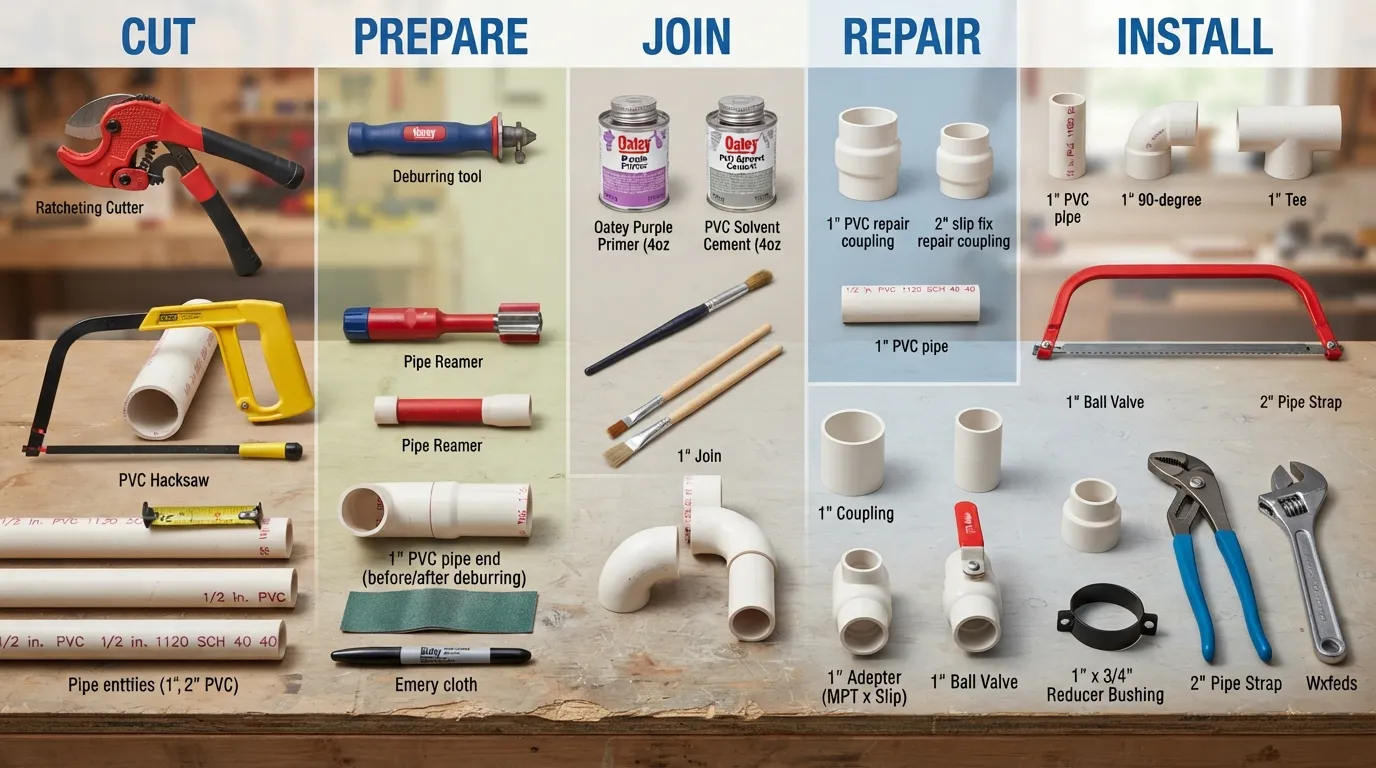
For most PVC plumbing projects, the core toolkit includes a ratcheting PVC pipe cutter or suitable saw, deburring tool, measuring tape, marker, PVC primer, PVC cement, and appropriate fittings. A reamer or socket saver can help with repairs, while a strap wrench or suitable pliers can be useful for compatible threaded PVC connections. The best tool depends on the pipe size and the specific job.
In this guide, I will show you what each tool does, which tools are essential versus optional, how tool selection changes with the project, what fittings and joining materials you may need, and which common mistakes are worth avoiding.
PVC Plumbing Tools at a Glance
Cutting
Ratcheting PVC cutter, PVC saw, or another suitable pipe-cutting tool.
Preparation
Deburring tool, reamer when appropriate, measuring tape, and marker.
Joining
PVC primer, compatible PVC solvent cement, and the correct fittings.
Repair & threaded work
Pipe reamer/socket saver and suitable strap wrench or pliers when the connection calls for them.
What Tools Are Needed to Work With PVC Pipe?
The exact list depends on the project, but these are the main tools and materials you are likely to encounter when cutting, preparing, joining, or repairing PVC plumbing.
1. Ratcheting PVC Pipe Cutter
A ratcheting PVC cutter is useful for making clean cuts on PVC pipe within the cutter’s specified capacity. The ratcheting mechanism lets you apply cutting force progressively instead of trying to cut the pipe in one movement.
For smaller and compatible pipe sizes, it can be one of the quickest and cleanest ways to make a straight cut.
2. PVC Saw or Handsaw
A saw becomes useful when the pipe is too large for your cutter or when the specific pipe and project call for a sawing method. After cutting, the pipe end should be inspected and prepared before it is inserted into a fitting.
Do not assume that one cutting tool works equally well for every PVC diameter. Always follow the tool manufacturer’s stated capacity and use a blade appropriate for the material.
3. Deburring Tool
Cutting PVC can leave a rough edge or burr. A deburring tool helps smooth the cut edge so the pipe is properly prepared for the next step.
This is a small tool, but it can make a noticeable difference in the quality of pipe preparation. A rough, poorly prepared edge can interfere with proper fitting assembly.
4. PVC Pipe Reamer or Socket Saver
A PVC pipe reamer or socket-saver type tool can be useful during repairs when you need to remove remnants of old pipe or solvent cement from a fitting. Some models are designed to work with a drill.
This is more of a repair-specific tool than a basic homeowner tool. You generally do not need one simply to make a new PVC connection.
5. Measuring Tape
Accurate measurement is essential before cutting PVC pipe. Measure the required run, account for the fitting and insertion requirements specified for the connection, and avoid cutting first and trying to solve the measurement problem afterward.
6. Marker
A felt-tip marker or another suitable marking tool lets you clearly mark the cutting point and helps you keep your measurements consistent during installation.
7. PVC Primer
PVC primer is used as part of compatible solvent-cement joining systems. Its role is to prepare the surfaces before the cement is applied.
Do not treat primer as a substitute for cement. They perform different roles in a solvent-welded PVC connection.
8. PVC Solvent Cement
PVC solvent cement is used with compatible PVC pipe and fittings to create a solvent-welded connection. Choose a product appropriate for the pipe material and application, and follow the product instructions for preparation, application, and handling.
9. Strap Wrench or Suitable Pliers
Threaded PVC connections require more care than simply grabbing the fitting with the strongest wrench available. A strap wrench or appropriately sized pliers may provide useful grip while reducing the risk of damaging plastic components.
Important:
Plastic fittings can be damaged by excessive force. When working with threaded PVC, use the manufacturer’s installation guidance and avoid treating a plastic fitting like a heavy-duty metal fitting.
Which PVC Plumbing Tool Do You Need for Your Job?
If you are standing in front of a hardware store shelf wondering which tool to buy, start with the task, not the product name.
Need to cut PVC?
Use a compatible ratcheting cutter for suitable pipe sizes, or a PVC saw when a cutter is not appropriate.
Need to smooth the cut?
Use a deburring tool or another suitable method recommended for the pipe.
Need to make a solvent-welded connection?
Use compatible primer and PVC solvent cement with the correct fitting.
Need to remove broken PVC from a fitting?
A PVC reamer or socket-saver type tool may be useful if the fitting is suitable for reuse.
Need to tighten a threaded plastic connection?
Use an appropriate grip tool and follow the fitting manufacturer’s guidance rather than forcing the connection.
PVC Tools by Job Type
For a New PVC Installation
A basic installation may require measuring and marking tools, a suitable cutter or saw, a deburring tool, compatible primer and cement, and the correct PVC fittings.
The exact kit changes depending on whether you are building a water line, drain, vent, or another system. The pipe material and fitting system should always be compatible with the intended application.
For a PVC Pipe Repair
Repairs can require a different toolkit because you may need to remove damaged pipe, recover a fitting, or work in a confined area. A cutter, deburring tool, measuring tools, replacement fittings, and compatible joining materials are common starting points.
If old pipe remains stuck inside a fitting, a suitable socket-saver or reamer can sometimes help remove the material without replacing the fitting. Whether a fitting should actually be reused depends on its condition and suitability for the application.
For Large-Diameter PVC Pipe
As pipe diameter increases, a small handheld ratcheting cutter may no longer be suitable. A saw or another tool designed for the pipe’s diameter may be required.
Before buying a cutting tool, check its published capacity rather than assuming that a tool advertised for PVC can handle every pipe size.
For Underground PVC Plumbing
Underground work involves more than choosing a cutting tool. You also need to consider the pipe and fitting system, installation requirements, accessibility, bedding or support requirements where applicable, and the intended service.
Because underground repairs can become difficult to access after installation, a connection that is technically possible to assemble is not automatically a connection that is appropriate for every application.
Do PVC Pipe Sizes Change the Tools You Need?
Yes. Pipe size is one of the first things you should check before choosing a PVC cutting tool or fitting.
Your search may involve sizes such as 3/8-inch PVC, 1-inch pipe, 1-1/2-inch plumbing fittings, 2-inch PVC pipe connectors, 3-inch plumbing fittings, or 4-inch plumbing fittings. These size terms do not automatically mean that one universal tool will work for every application.
A better way to choose
- Identify the pipe’s nominal size and material.
- Determine whether you are cutting, joining, repairing, or working on a threaded connection.
- Check the tool’s published size/capacity range.
- Choose fittings that match the pipe and the connection type.
- Follow the manufacturer’s instructions for joining products and fittings.
PVC Pipe Tools and PVC Fittings: What’s the Difference?
One of the most common beginner mistakes is treating tools, fittings, and joining materials as if they are the same thing.
Tools
Cutter, saw, deburring tool, tape measure, marker, reamer, strap wrench, or suitable pliers.
Fittings
Couplings, elbows, tees, reducers, adapters, valves, and other compatible connection components.
Joining materials
Primer and compatible solvent cement where the selected PVC joining system requires them.
Common PVC Plumbing Fittings You May Use
Your tool kit is only part of the job. The fitting must also match the pipe size, material, connection method, and application.
Couplings and Pipe Connectors
A PVC coupling joins compatible pipe sections in a straight run. When you search for terms such as 2-inch pipe connector or 2-inch PVC pipe connector, check that the fitting is actually designed for the pipe and connection system you are using.
Elbows and PVC Pipe Corners
Elbows change the direction of a pipe run. They are sometimes described informally as PVC pipe corners, but the correct fitting type depends on the angle and connection requirements of the installation.
Tees and 3-Way PVC Fittings
A tee fitting creates a branch in a compatible pipe system. A 3-way tee PVC fitting may be useful when one run needs to connect with another branch, but the correct fitting depends on the system design and pipe sizes.
Reducers
A PVC reducer fitting is used when compatible pipe sizes need to transition from one nominal size to another. For example, a reducer may be selected when a larger pipe connects to a smaller branch.
Threaded PVC Fittings
Threaded fittings use a threaded connection rather than a solvent-welded socket connection. Because plastic threads can be damaged by excessive force, select the correct fitting and use an appropriate installation method.
PVC Pipe Fittings and Valves
Valves can control flow in a PVC system, while fittings connect, redirect, reduce, or transition the piping. The valve or fitting should be rated and intended for the specific service rather than selected by size alone.
What Is the Basic PVC Plumbing Tool Kit?
If you are doing occasional PVC work at home, you can usually start with a small set rather than buying every specialized plumbing tool available.
Basic kit
- Suitable PVC pipe cutter or saw
- Deburring tool
- Tape measure
- Marker
- Compatible PVC primer
- Compatible PVC solvent cement
- Correct PVC fittings and connectors
Add when the project requires it
- PVC pipe reamer or socket saver for appropriate repairs
- Strap wrench or suitable pliers for compatible threaded connections
- Additional cutting or specialty tools for larger pipe
PVC Pipe Joining: What Tools and Materials Are Used?
For a typical solvent-welded PVC connection, the process involves more than simply applying glue to the pipe.
- Measure and mark: Determine where the pipe needs to be cut.
- Make the cut: Use a compatible cutter or saw and aim for a clean, square end.
- Deburr: Remove rough edges and inspect the cut.
- Dry-fit where appropriate: Confirm that the components and orientation make sense before permanently joining them.
- Prepare the surfaces: Use the compatible primer when required by the joining system.
- Apply solvent cement: Follow the product manufacturer’s instructions.
- Assemble: Insert the pipe into the fitting using the specified joining procedure.
- Allow appropriate handling/cure time: Follow the product instructions before putting the connection into service.
- Test appropriately: The completed system should be checked according to the requirements of the application.
Do not rush the joining step.
A PVC connection is only as good as its preparation, compatible materials, correct assembly, and appropriate handling. Follow the specific primer and cement instructions instead of relying on a generic “PVC glue” method.
Pressurized Water Line vs. Drain or Vent: Why It Matters
Before choosing tools and materials, identify what kind of PVC work you are actually doing.
Pressurized water
The pipe, fittings, joining method, and other components must be appropriate for a pressurized water application. Product ratings and installation requirements matter.
Drain or vent
Drain and vent installations have different functional requirements. Do not assume that a component suitable for one plumbing application is automatically suitable for another.
This distinction is one reason a shopping list alone is not enough. The same nominal pipe size can appear in very different plumbing situations, so you need to match the product and connection method to the actual application.
PVC Tools You Probably Do Not Need for Every Project
More tools do not automatically mean better work. Specialized tools are valuable when the job calls for them, but unnecessary tools can add cost and complexity.
- Pipe reamer/socket saver: Useful for appropriate repair situations, but unnecessary for a simple new installation.
- Specialty large-diameter cutters: Useful when your pipe size exceeds the capacity of a standard cutter.
- Heavy-duty gripping tools: Not automatically appropriate for every plastic fitting.
- Professional specialty equipment: Worth considering when the installation is large, difficult to access, or outside your practical DIY experience.
Common PVC Plumbing Tool Mistakes to Avoid
Using a cutter outside its rated capacity
Do not force a small cutter through pipe that exceeds its specified capacity. Choose a suitable saw or larger-capacity cutting tool instead.
Skipping pipe preparation
A fast cut is not the end of the job. Inspect and prepare the pipe end before joining it to a fitting.
Confusing primer with cement
Primer and solvent cement have different functions in systems that require both. Follow the joining-product instructions rather than treating them as interchangeable.
Forcing threaded PVC fittings
Plastic threads can be damaged by excessive force. Use a suitable grip method and follow the fitting manufacturer’s instructions.
Choosing fittings by size alone
A fitting that appears to be the right size may still be wrong for the application, pipe material, pressure conditions, or connection type.
Buying every tool before identifying the job
Start with the project. Once you know whether you are cutting, joining, repairing, or installing a particular type and size of PVC, the tool list becomes much easier to determine.
PVC vs. PEX: Do You Need Different Tools?
Yes. PVC and PEX are different piping systems, and the tools and connection methods are not interchangeable simply because both are used in plumbing.
If your project is specifically a PVC installation, choose tools and fittings designed for that PVC system. If you are considering PEX instead, evaluate the entire connection system—including its fittings and required installation tools—rather than comparing pipe material alone.
Do Plumbers Still Use PVC?
Yes, PVC remains a commonly encountered piping material in plumbing and related applications. Whether it is the appropriate choice depends on the specific installation, local requirements, pipe type, and intended service.
The more useful question is not simply whether PVC is “strong” or “best.” It is whether the particular PVC product and connection system are appropriate for the job you are doing.
What Are the Main Types of PVC?
“PVC” is a broad term, and products can differ by formulation, dimensions, pressure rating, application, and standards. Do not select pipe solely because a listing says “PVC.” Check the product markings and manufacturer information for the intended use.
Likewise, color alone is not a reliable way to determine which PVC product is strongest. Identification should come from the product specification and markings rather than appearance.
How to Choose PVC Plumbing Tools Before You Buy
Use this five-question checklist
- What am I doing? Cutting, joining, repairing, replacing a fitting, or installing a new line?
- What pipe am I working with? Confirm material and nominal size.
- What type of connection is required? Solvent-welded, threaded, or another compatible connection method?
- What is the application? Pressurized water, drain, vent, underground work, or another use?
- What does the manufacturer specify? Check tool capacity, fitting compatibility, joining instructions, and product limitations.
Where Can You Find PVC Plumbing Tools and Fittings?
If you are comparing products, major plumbing and hardware suppliers can be useful for checking tool categories, fitting sizes, and manufacturer specifications. Product availability and pricing can change, so verify the current listing before purchasing.
Home Depot PVC plumbing tools
Useful for browsing PVC-related plumbing tool categories.
PVC Fittings Online tools
Useful for comparing PVC-specific tools and related products.
REED plastic pipe tools
Useful for reviewing manufacturer-specific plastic pipe tooling.
General Tools pipe-cutting resources
Useful when researching pipe and tube cutting tools.
PVC Plumbing Tools Video
If you prefer to see PVC cutting and preparation in action, a visual demonstration can make the basic workflow easier to understand.
When Should You Call a Professional Plumber?
DIY PVC work can be reasonable for a straightforward, accessible project when you understand the pipe, fittings, joining method, and application. But not every PVC job is a good DIY project.
Consider professional help when the work involves a difficult-to-access line, a significant leak, extensive repiping, underground plumbing that is difficult to diagnose, a pressurized system you are not comfortable working on, or a repair where an incorrect connection could cause substantial water damage.
If you need help identifying the right plumbing service for a larger repair or installation, you can review the plumbing services available from Miami Florida Plumbing.
Frequently Asked Questions About PVC Plumbing Tools
What are 15 common plumbing tools?
Common plumbing tools can include pipe cutters, pipe saws, wrenches, pliers, measuring tools, deburring tools, reamers, screwdrivers, drills, and other specialty equipment. For PVC specifically, the most relevant tools are those used for cutting, measuring, preparing, joining, and repairing PVC pipe.
What tools are needed to work with PVC pipe?
For many basic projects, you need a suitable PVC cutter or saw, measuring tape, marker, deburring tool, compatible primer and solvent cement when required, plus the correct fittings. Repairs and threaded connections may require additional tools.
What is the best tool for cutting PVC pipe?
There is no single best cutter for every PVC pipe. A ratcheting PVC cutter can be convenient for compatible sizes, while a saw may be more appropriate for larger pipe or situations outside the cutter’s capacity. Check the tool manufacturer’s specifications.
Do I need a PVC pipe reamer?
Not for every project. A reamer or socket-saver type tool is primarily useful for certain repair situations where old pipe or cement needs to be removed from a fitting. For a simple new PVC installation, it may not be necessary.
What tools are used for PVC pipe joining?
For solvent-welded PVC connections, common preparation tools include a cutter or saw, deburring tool, measuring and marking tools, plus compatible primer and solvent cement. The correct joining method depends on the pipe and fitting system.
What are 2-inch PVC plumbing fittings used for?
A 2-inch PVC fitting can connect, redirect, branch, reduce, or transition a compatible 2-inch pipe system depending on the fitting type. Examples include couplings, elbows, tees, reducers, adapters, and valves.
Can I use a pipe wrench on PVC?
A traditional pipe wrench can apply substantial force and may damage plastic components. For compatible threaded PVC connections, use an appropriate gripping method and follow the fitting manufacturer’s instructions.
What is a 3-way tee PVC fitting?
A tee is a branching fitting used to connect compatible pipe runs. The correct tee depends on the pipe sizes, connection type, and system design.
Is PVC better than PEX?
Neither material is automatically better for every application. PVC and PEX use different connection systems and have different installation considerations. Choose based on the requirements of the particular plumbing project.
What color PVC pipe is the strongest?
Color by itself is not a reliable way to determine strength or suitability. Check the pipe’s markings, specifications, rating, material designation, and intended application.
Key Takeaway: Buy the Tool for the Job, Not Just the Keyword
The right PVC plumbing toolkit starts with four questions:
- What PVC pipe and size am I working with?
- Am I cutting, preparing, joining, repairing, or working with a threaded connection?
- Is the system for pressurized water, drainage, venting, underground work, or another application?
- Does the tool and fitting manufacturer specify that product for my particular job?
For a straightforward project, a suitable cutter or saw, deburring tool, measuring and marking tools, compatible joining materials, and the correct PVC fittings may be all you need. More specialized repairs may call for a reamer, socket saver, or other equipment.
If the job is larger than a simple accessible repair—or you are unsure whether the pipe, fitting, or joining method is appropriate—it is safer to get the project evaluated before making a permanent connection.
Need Professional Plumbing Help?
If your PVC plumbing project has turned into a larger repair, installation, leak, or repiping job, you can learn more about Miami Florida Plumbing or review the available plumbing services.