If you are looking for a 1/4 inch pipe, there is one important detail to understand before you buy: 1/4 inch is a nominal pipe size, not necessarily the pipe’s actual outside diameter.
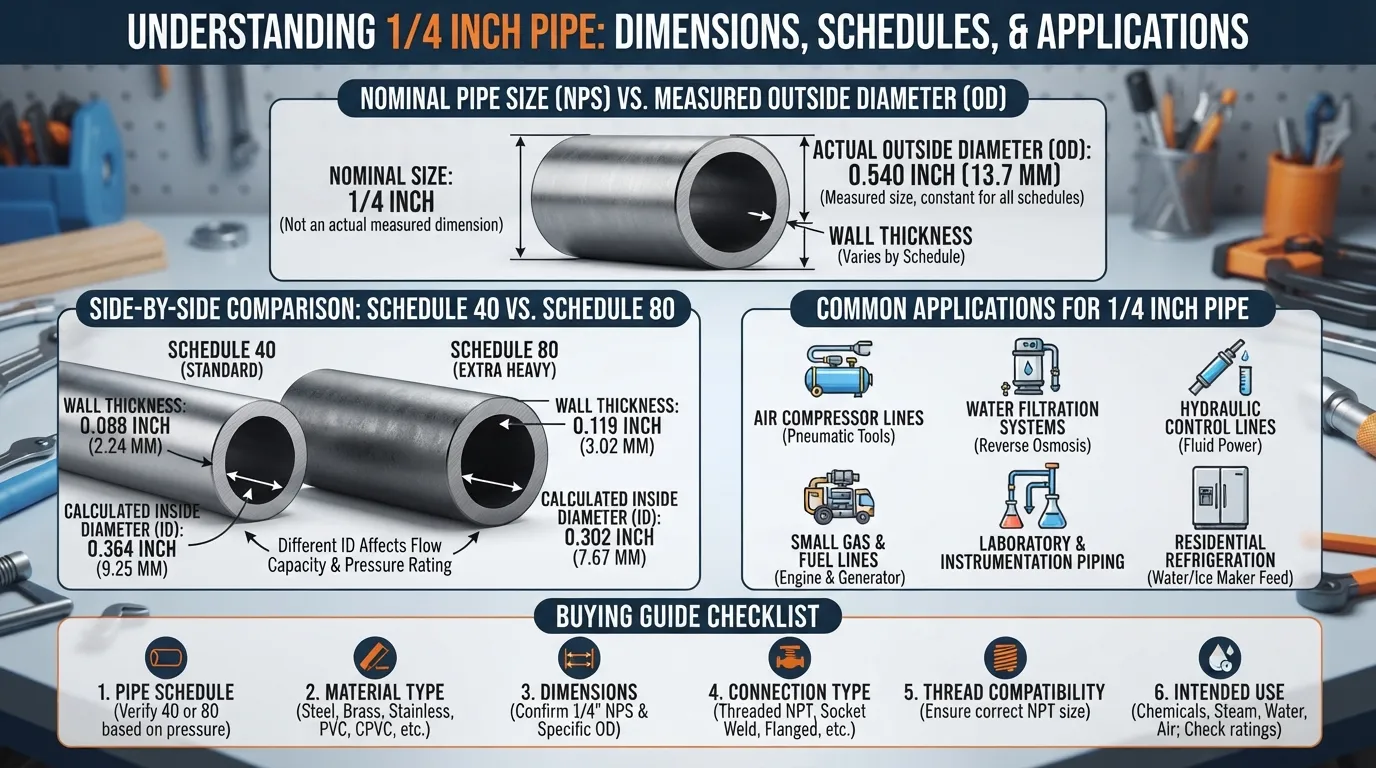
For example, a 1/4 NPS steel pipe has an outside diameter of about 0.540 inches (13.7 mm), not 0.25 inches. The inside diameter and wall thickness then change depending on the pipe schedule.
What Is a 1/4 Inch Pipe?
A 1/4 inch pipe usually refers to a 1/4 NPS (Nominal Pipe Size) pipe. For common steel pipe dimensions, the outside diameter is about 0.540 in (13.7 mm). A Schedule 40 version has an inside diameter of about 0.364 in (9.25 mm) and a wall thickness of 0.088 in (2.24 mm). Schedule 80 keeps the same nominal outside diameter but has a thicker wall and a smaller inside diameter.
This guide explains what 1/4 inch pipe actually means, its dimensions in inches and millimeters, Schedule 40 versus Schedule 80, available materials, pipe versus tubing, common applications, buying considerations, and the questions you should answer before choosing one.
What Does 1/4 Inch Pipe Actually Mean?
The term 1/4 inch pipe can be confusing because the number does not simply describe the pipe’s measured outside diameter.
For standardized steel pipe, 1/4 inch is a nominal pipe size (NPS). The nominal designation identifies the pipe size within a standardized sizing system. The actual outside diameter is larger than 1/4 inch.
That means you should not assume that a 1/4-inch pipe has a 0.25-inch outside diameter.
Important Size Check
A mathematical 1/4 inch = 6.35 mm conversion does not mean a 1/4 NPS steel pipe has a 6.35 mm outside diameter. For a common 1/4 NPS steel pipe, the actual outside diameter is about 13.7 mm. The 6.35 mm figure is simply the conversion of the nominal 1/4-inch measurement.
1/4 Inch Pipe Dimensions
If you need the actual dimensions, you need to know the pipe’s material and schedule. For common steel pipe, Schedule 40 and Schedule 80 are two important specifications to understand.
1/4 Inch Schedule 40 Pipe Dimensions
These dimensions explain why you should identify the pipe standard and schedule before using a size chart or ordering replacement pipe.
1/4 Inch Schedule 80 Pipe Dimensions
Schedule 80 uses the same nominal 1/4-inch pipe size and approximately the same 0.540-inch outside diameter, but its wall is thicker than Schedule 40.
The Key Difference
Moving from Schedule 40 to Schedule 80 does not simply make the outside of a 1/4-inch steel pipe larger. The wall becomes thicker, which reduces the available inside diameter.
What Is the Difference Between 1/4 Inch Schedule 40 and Schedule 80?
The main difference is wall thickness and resulting inside diameter.
- Schedule 40: thinner wall and larger inside diameter.
- Schedule 80: thicker wall and smaller inside diameter.
- Outside diameter: remains about 0.540 inches for this nominal steel pipe size.
- Flow area: is reduced when the thicker Schedule 80 wall reduces the bore.
You should not choose Schedule 80 simply because a thicker pipe sounds better. The correct schedule depends on the system, application, pressure requirements, fittings, applicable standards, and local code requirements.
What Is the Difference Between Schedule 80 and Schedule 80S?
Schedule 80 and Schedule 80S are not interchangeable labels for every pipe material. The “S” designation is used in stainless-steel pipe sizing, while standard Schedule 80 terminology is commonly used for steel and other standardized pipe systems.
When buying replacement pipe, always match the material, nominal size, schedule designation, and applicable standard rather than choosing a pipe based on the schedule number alone.
Is 1/4 Inch Pipe the Same as 1/4 Inch Tubing?
No. This is one of the easiest mistakes to make when shopping for a small pipe or tube.
Pipe and tubing can use different sizing conventions. A 1/4 NPS steel pipe has an outside diameter of about 0.540 inches, while tubing may be identified by its actual outside diameter or by a different tube-size system.
For example, a 1/4-inch copper tube size can have a different actual outside diameter from 1/4 NPS steel pipe. That means you should never substitute a product simply because both listings contain the words “1/4 inch.”
What Size Is 1/4 Inch Pipe in Millimeters?
If you are converting the nominal measurement mathematically, 1/4 inch equals 6.35 mm.
However, that is not the same as the actual outside diameter of a 1/4 NPS steel pipe.
For a common 1/4 NPS Schedule 40 steel pipe:
- Nominal size: 1/4 inch
- Nominal inch-to-mm conversion: 6.35 mm
- Actual outside diameter: about 13.7 mm
- Actual inside diameter: about 9.25 mm
- Wall thickness: about 2.24 mm
This distinction is especially important when you are trying to match an existing pipe, hole, fitting, clamp, or connection.
What Materials Are Available for 1/4 Inch Pipe?
Small pipe and tube products are available in several materials, but the best choice depends on what you are building and the requirements of the system.
Black Steel Pipe
Black steel pipe is commonly available in nominal pipe sizes and schedules and is often used for compatible gas, air, oil, industrial, and other applications where the particular pipe is approved for the intended service.
Do not select black steel pipe for an application solely because the size looks correct. Verify the material, pressure rating, connection method, applicable code, and intended media.
Stainless Steel Pipe
Stainless steel can be useful where corrosion resistance is important. Stainless pipe is available in different grades and schedules, so the term “1/4 inch stainless steel pipe” by itself does not provide enough information to select the correct product.
Copper Tube
Copper is widely used in plumbing systems, but copper tube sizing should not automatically be treated as identical to NPS steel pipe sizing.
PEX and Other Plastic Tubing
PEX and other plumbing tubing products use their own sizing and connection systems. If your project requires PEX, choose the correct PEX size and compatible fittings rather than substituting a 1/4 NPS steel pipe because both products appear under a similar search term.
What Is 1/4 Inch Pipe Used For?
The answer depends on the material, schedule, connection type, pressure requirements, and local requirements.
You may encounter 1/4-inch nominal pipe or similarly sized tubing in applications involving:
- Air and pneumatic connections
- Certain gas or fuel systems where the specific pipe and installation are approved
- Industrial equipment
- Oil or other compatible media
- Specialized plumbing components
- DIY and metalworking projects
- Decorative or industrial-style furniture projects
Safety & Compatibility Warning
Do not determine whether a pipe is suitable for water, gas, fuel, steam, or another medium from its nominal size alone. The material, schedule, pressure/temperature rating, fittings, installation method, applicable code, and product approval all matter. For regulated or pressurized systems, follow the applicable code and manufacturer requirements and use a qualified professional where required.
1/4 Inch Pipe Threading and Fittings
Another source of confusion is the connection itself. A listing for a 1/4-inch pipe may refer to a plain pipe, a threaded pipe, or a pipe nipple with specific thread connections.
For example, a product may be listed as 1/4 NPS, male NPT. That describes a nominal pipe size together with a particular threaded connection. It does not mean that every 1/4-inch pipe or tube uses the same thread.
Before ordering a fitting, check:
- Nominal pipe size
- Material
- Schedule or wall thickness
- Thread standard
- Male or female connection
- Threaded or unthreaded construction
- Connection size on the other end of the fitting
How Much Does 1/4 Inch Pipe Cost?
There is no single price for “1/4 inch pipe.” The cost can vary significantly depending on what you are actually buying.
Price can change based on:
- Material, such as black steel or stainless steel
- Schedule and wall thickness
- Pipe length
- Threaded versus unthreaded construction
- Pipe versus nipple or fitting
- Brand and manufacturer
- Quantity purchased
- Retailer or industrial supplier
- Shipping and availability
For that reason, compare products using their complete specification, not just the words “1/4 inch.” A short threaded nipple and a longer length of unthreaded pipe can have very different prices even though both are described as 1/4 inch.
Where Can You Buy 1/4 Inch Pipe?
You can find 1/4-inch pipe, tubing, nipples, and fittings through major home-improvement retailers, industrial suppliers, plumbing suppliers, and online marketplaces.
Common places appearing in search results for these products include Home Depot, Amazon, Grainger, and Lowe’s. Product availability varies, so verify the exact dimensions and specifications before purchasing.
Before You Buy
If you need to replace an existing pipe, measure the existing part and identify its material, nominal size, schedule or wall thickness, length, and connection type. Do not order based only on the “1/4 inch” label.
How to Choose the Right 1/4 Inch Pipe
If you are unsure which product to buy, work through these questions in order.
- Do you need pipe or tubing?
These can use different sizing conventions. - What material do you need?
Steel, stainless steel, copper, PEX, or another material may be appropriate for different systems. - What schedule or wall thickness is required?
Schedule 40 and Schedule 80 do not have the same inside diameter. - What is the actual outside diameter?
For 1/4 NPS steel pipe, it is about 0.540 inches. - What connection do you need?
Check NPT, threading, fitting type, and male/female configuration where applicable. - What will flow through it?
Verify that the selected product is approved and rated for the intended medium. - What pressure and temperature will the system see?
Use the product’s specifications rather than assuming every pipe of the same size has the same rating. - What length do you need?
Pipe, nipples, and tubing may be sold in very different lengths.
1/4 Inch Pipe: Quick Comparison
Common 1/4 Inch Pipe Questions
What is the ID of a 1/4 inch pipe?
For a common 1/4 NPS Schedule 40 steel pipe, the inside diameter is about 0.364 inches (9.25 mm). Schedule 80 has a thicker wall and an inside diameter of about 0.302 inches (7.67 mm).
What size is 1/4 pipe in mm?
As a direct mathematical conversion, 1/4 inch is 6.35 mm. However, that is the nominal inch measurement converted to millimeters, not the outside diameter of a 1/4 NPS steel pipe. A common 1/4 NPS steel pipe has an outside diameter of about 13.7 mm.
What are the dimensions of 1/4 inch Schedule 80 pipe?
A common 1/4 NPS Schedule 80 steel pipe has an outside diameter of about 0.540 inches, wall thickness of about 0.119 inches, and inside diameter of about 0.302 inches.
Which is thicker, Schedule 40 or Schedule 80?
Schedule 80 is thicker. For 1/4 NPS steel pipe, Schedule 80 has a wall thickness of about 0.119 inches compared with about 0.088 inches for Schedule 40.
What is the outside diameter of 1/4 inch pipe?
For common 1/4 NPS steel pipe, the outside diameter is about 0.540 inches (13.7 mm). The exact product should still be checked against its material and applicable specification.
Is 1/4 inch pipe the same as 1/4 inch tubing?
No. Pipe and tubing can use different sizing systems. A 1/4 NPS steel pipe does not have the same actual outside diameter as every product marketed as 1/4-inch tubing.
What should I check before buying 1/4 inch pipe?
Check the nominal size, actual dimensions, material, schedule or wall thickness, length, connection type, thread standard, pressure and temperature requirements, intended medium, and applicable code or manufacturer requirements.
Final Takeaway
The 1/4-Inch Pipe Number Can Be Misleading
If you remember only one thing, remember this: 1/4 inch is a nominal pipe size, not necessarily the actual outside diameter.
For common 1/4 NPS steel pipe, the outside diameter is about 0.540 inches (13.7 mm). Schedule 40 and Schedule 80 then give you different wall thicknesses and inside diameters. Before buying, identify the complete specification instead of searching by the 1/4-inch label alone.
If your project involves a plumbing system, the correct pipe size is only one part of the decision. If you need professional help with a plumbing installation, repair, or replacement, you can also explore our plumbing services or visit our home page to learn more about the services we provide.
For questions about your specific plumbing project, you can also speak with our plumbing team.
Related Resources
Note: Pipe dimensions and product specifications can vary by material, standard, manufacturer, and product type. Always verify the manufacturer’s specification and applicable requirements before using a pipe in a pressurized or regulated system.