If you’ve ever looked behind your refrigerator, under your kitchen sink, or near your reverse osmosis (RO) filter, you’ve probably seen a thin, flexible tube running to the appliance. That’s almost always a 1/4 inch water line. It’s one of the smallest supply lines in your home, but it’s also one of the most misunderstood — and when it fails, it can cause a slow drip that quietly damages your floors and cabinets for weeks before you notice.
In this guide, we’ll walk through exactly what a 1/4 inch water line is used for, the materials it’s made from, how it compares to other common line sizes, and how to tell whether a DIY fix is safe or whether it’s time to call a licensed plumber.
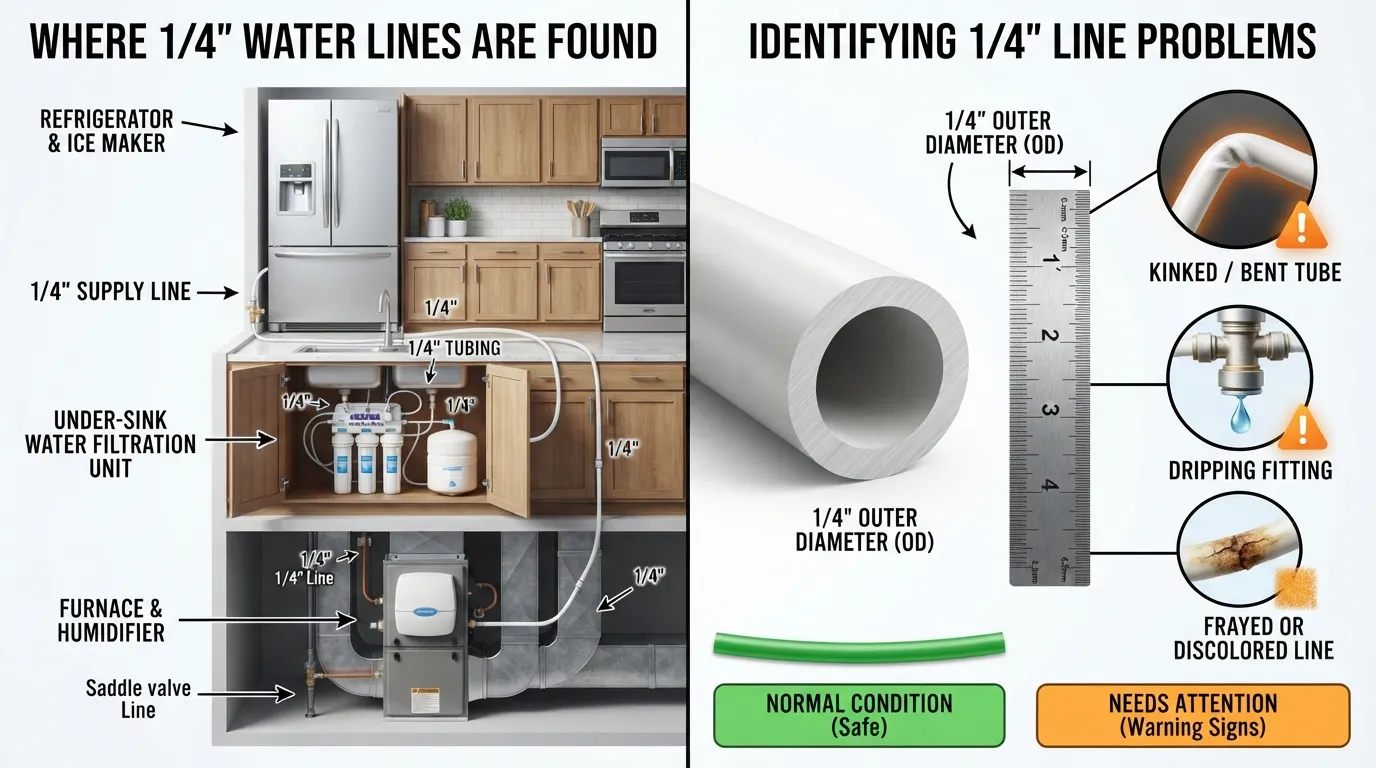
A 1/4 inch water line is a small, flexible supply tube used to feed water to specific appliances rather than the main plumbing in a house. It typically has an inside diameter of about 0.170 inches and an outside diameter of about 0.250 inches, and it’s most commonly used for refrigerators, ice makers, RO filtration systems, and humidifiers.
What Is a 1/4 Inch Water Line Used For?
Unlike the 1/2 inch or 3/4 inch lines that carry water throughout your home, a 1/4 inch line is a low-volume feed line. It’s built to deliver a small, steady amount of water to a single appliance, not to supply an entire fixture or room. You’ll typically find it in these places:
- Refrigerators and ice makers — feeds the ice maker and cold water dispenser.
- Reverse osmosis (RO) and water filtration systems — connects an under-sink filter or distillation unit to the cold water supply.
- Humidifiers — supplies a steady, low-volume drip to whole-home or portable humidifier units.
Because these lines are so thin and are often tucked behind appliances or inside cabinets, they’re easy to overlook during a home inspection — and that’s exactly why small leaks in this line go unnoticed longer than leaks in larger, more visible pipes.
1/4 Inch Water Line Specifications
Before you buy a replacement, it helps to know exactly what “1/4 inch” refers to. The measurement is based on the outside diameter (OD), not the inside diameter (ID) — a detail that trips up a lot of homeowners at the hardware store.
| Specification | Typical Value |
|---|---|
| Outside Diameter (OD) | ~0.250 inches |
| Inside Diameter (ID) | ~0.170 inches |
| Working Pressure Rating | Roughly 100–120 PSI (varies by material and brand) |
| Common Connection Type | Push-to-connect (John Guest style) or compression fittings |
Which Material Should You Use? PE vs. PEX vs. Copper
Not all 1/4 inch water lines are made the same way, and the material you choose affects how easy the line is to install, how long it lasts, and how it holds up to Florida’s water conditions and temperature swings.
| Material | Best For | Things to Know |
|---|---|---|
| Polyethylene (PE) | Refrigerators, RO systems | Flexible, inexpensive, easy to cut — the most common choice for appliance hookups. |
| PEX Tubing | Longer appliance runs, stub-outs | More durable and resistant to temperature swings than PE. |
| Copper | Older installations | Rigid and traditional, but largely replaced by flexible tubing since it can kink or crack if bent sharply during installation. |
How Do I Connect a 1/4 Inch Water Line?
Most 1/4 inch lines use push-to-connect fittings, which don’t require soldering or specialty tools. Here’s the general process:
- Shut off the water supply at the nearest valve before you disconnect anything.
- Cut the tubing square and clean — an angled or rough cut is the most common cause of push-fitting leaks.
- Insert the tubing fully into the fitting until it seats against the internal stop.
- Support the fitting so it isn’t under strain from the appliance or cabinet wall.
- Turn the water back on slowly and check the connection for drips before leaving it unattended.
Watch Out For This
Soft plastic 1/4 inch lines kink easily if they’re bent too sharply behind an appliance. A kink restricts flow immediately, but a partial kink can also weaken the tubing over time and lead to a slow, hidden leak. Always leave a gentle loop of slack rather than a tight bend, and use a support sleeve at the fitting so the tubing doesn’t collapse when tightened.
Water Line Sizes Explained: 1/4″ vs 1/2″ vs 3/4″ vs 1″
One of the most common points of confusion is figuring out which size line you actually have, and whether it’s the right size for what you’re trying to do. Here’s how the common residential sizes break down:
| Line Size | Typical Use |
|---|---|
| 1/4 inch | Single-appliance feeds: refrigerators, RO systems, humidifiers |
| 1/2 inch | Individual fixtures — sinks, toilets, single showers |
| 3/4 inch | Branch lines feeding multiple fixtures, common for whole-house PEX runs |
| 1 inch | Main water lines in larger homes or where higher flow volume is needed |
How Do I Know My Water Pipe Size?
The simplest way is to measure the outside diameter of the pipe with a tape measure or calipers, since pipe sizing is based on OD, not ID. If you’re unsure, comparing the pipe against a known 1/4 inch or 1/2 inch fitting at the hardware store is a reliable low-tech method. For main line sizing specifically, it’s worth confirming with a licensed plumber, since guessing wrong can mean buying the wrong fittings twice.
Should I Use 1/2 or 3/4 PEX for My House, and Can I Go From 3/4 to 1 Inch?
For most single fixtures, 1/2 inch PEX is standard. If you’re running a branch line that feeds several fixtures at once — say, a bathroom with a shower, sink, and toilet — 3/4 inch reduces pressure drop when multiple fixtures run simultaneously. Transitioning from 3/4 inch to 1 inch is usually done at the main line level to improve overall flow to the house, not on individual branch or appliance lines, and it typically requires a licensed plumber to size correctly against your water meter and pressure.
PVC or PEX for a Main Water Line?
PEX has become the more common choice for main and branch supply lines in newer installations because it’s flexible, resists freezing better, and requires fewer joints than rigid PVC. PVC is still used in some main line applications, particularly underground, but for interior supply lines, PEX is generally the more practical option. Local code requirements can affect which material is approved in your area, so it’s worth checking before starting any main line project.
What Is the “135 Rule” in Plumbing — Does It Apply to a 1/4 Inch Water Line?
This is a common search, but it’s often misunderstood in the context of small supply lines like your 1/4 inch tubing. The 135 rule is a drainage (DWV) guideline, not a water supply rule. It states that a drain line shouldn’t have more than 135 degrees of total horizontal direction change before it reaches a vent or cleanout — for example, one 90-degree bend plus one 45-degree bend. The rule exists to keep wastewater and debris moving smoothly and to make sure the line can still be serviced if it clogs.
It doesn’t apply directly to pressurized supply lines like your refrigerator or RO line, but the underlying principle — avoid sharp, repeated bends — is still good practice for any tubing, since excess turns create stress on joints and fittings over time.
Troubleshooting a 1/4 Inch Water Line
- Slow water flow to your ice maker or fridge? The most common cause isn’t the line itself — it’s a clogged inline filter. Check and replace the filter before assuming the tubing needs replacing.
- Dripping at the fitting? This usually means the tube end wasn’t cut straight, or the fitting wasn’t fully seated. Re-cut the tubing squarely and reinsert.
- Reduced pressure after a repair? Check for kinks along the run, especially anywhere the line was pushed behind an appliance.
DIY or Call a Plumber? Here’s How to Decide
Usually safe to DIY
| Call a licensed plumber
|
Watch: 1/4 Inch Water Line Installation
If you’d rather see the process in action before attempting it yourself, this video walks through a typical installation:
Key Takeaways
- A 1/4 inch water line is measured by outside diameter (~0.250″) and is used for single-appliance feeds like fridges, ice makers, RO systems, and humidifiers — not main plumbing.
- Polyethylene (PE) is the most common material; PEX offers more durability for longer runs.
- Most leaks trace back to a bad cut at the fitting or a kink in the line, not a failed tube.
- The “135 rule” applies to drain lines, not pressurized supply lines like this one.
- If you’re unsure about sizing, or the issue involves a wall, floor, or main line, it’s worth having a licensed plumber take a look.
Frequently Asked Questions
How much water can flow through a 1 1/4 inch pipe?
A 1 1/4 inch pipe carries significantly more volume than a 1/4 inch line and is typically used for larger supply or drainage applications rather than single appliances. Actual flow depends on your home’s water pressure and pipe material, which a plumber can calculate for your specific system.
What is the most common water line size?
For individual fixtures inside the home, 1/2 inch is the most common supply line size. For appliance feeds like refrigerators and filtration systems, 1/4 inch is standard.
Is my water line 3/4 or 1 inch?
The only reliable way to know is to measure the outside diameter directly or have it confirmed by a plumber, since the two sizes can look similar at a glance but carry different flow capacities.
Is PVC or PEX better for a main water line?
PEX is generally preferred for interior main and branch lines today due to its flexibility and fewer required joints, though PVC still has valid uses depending on local code and application.
Not Sure What Line Size You Actually Need?
Small appliance lines are easy to fix yourself, but sizing mistakes on branch or main lines can lead to pressure problems down the road. The team at Miami Florida Plumbing can inspect your setup, confirm your correct pipe sizing, and handle the repair or installation safely. If your appliance issue turns out to be connected to a bigger water heater or supply concern, our water heater replacement guide is also worth a look. You can browse our full range of plumbing services or reach out to our licensed plumbers directly for a fast, no-guesswork fix.
Related Resources
If you’re comparing tubing options or fittings before you buy, these sources are useful for checking current specs and product availability: