If you’ve ever stood in a plumbing aisle staring at a wall of elbows, tees, and couplings, you know how confusing pipe fittings can be. There are dozens of shapes, several materials, and a handful of abbreviations that don’t mean much unless someone explains them to you. In this guide, we’ll walk you through every common type of pipe fitting, what each one does, which material fits which job, and how to pick the right size — so you’re not guessing when you’re standing in front of the shelf or under your sink.
A pipe fitting is a component used to connect, redirect, split, reduce, or seal sections of pipe. The most common types are elbows, tees, couplings, reducers, caps/plugs, and nipples — made from PVC/CPVC, copper/brass, black steel, or stainless steel depending on whether the line carries water, gas, or drainage.
What Are Pipe Fittings, Exactly?
Pipe fittings are the connector pieces that join, branch, or terminate sections of pipe in a plumbing system. Instead of running one continuous straight pipe from point A to point B, fittings let you change direction, split a line into two, join pipes of different sizes, or close off an unused line completely. Every plumbing system in your home — water supply, drainage, and gas — relies on fittings to hold everything together and keep it sealed.
Common Types of Pipe Fittings (With What Each One Does)
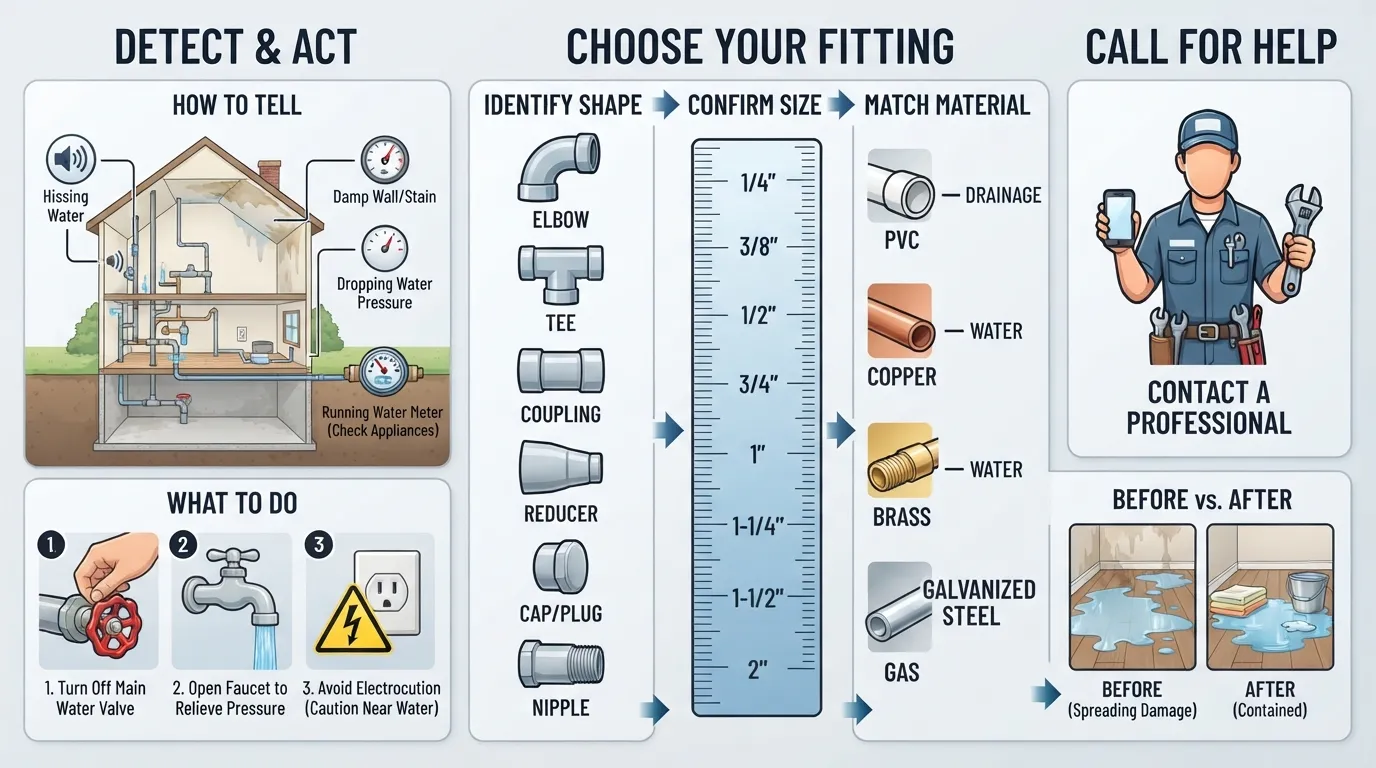
Here’s a simple identification reference for the fittings you’re most likely to come across:
| Fitting | What It Does |
|---|---|
| Elbow | Changes the direction of the pipe run, usually by 45° or 90°. |
| Tee | T-shaped fitting that splits one line into two, or joins two lines into one. |
| Coupling | Connects two straight pipe sections of the same diameter in a straight line. |
| Reducer | Joins a larger pipe to a smaller one when the diameter needs to change. |
| Cap / Plug | Seals the end of a pipe — a cap fits over the outside, a plug fits inside. |
| Nipple | A short threaded piece of pipe used to extend or join two other fittings. |
| Union | Joins two pipes in a way that can be disconnected later without cutting, useful for maintenance access. |
| Bushing | Adapts a fitting with one thread size to accept a different thread size. |
Pipe Fitting Materials: Which One Is Used Where
The material of a fitting matters just as much as its shape. Using the wrong material for the job can lead to leaks, corrosion, or a fitting that simply isn’t rated for the pressure or temperature it’s exposed to.
| Material | Best For |
|---|---|
| PVC / CPVC | Cold water lines (PVC) and hot water pressure lines (CPVC); also common in drainage. |
| Copper / Brass | Water supply lines and fixtures that see higher heat, like near a water heater. |
| Black Steel / Iron | Gas lines, and older water or steam lines. |
| Stainless Steel | Situations that need strong corrosion resistance, including some well water and coastal setups. |
A Note for South Florida Homes
If your property in the Miami area relies on a private well — which is still common in parts of Miami-Dade — well pump fittings need extra attention. Salt air and naturally harder water in this region can accelerate corrosion on unprotected metal fittings faster than you’d see further inland. Brass and stainless steel fittings generally hold up better here than untreated black iron, and it’s worth factoring that into your material choice rather than just going with whatever’s cheapest on the shelf.
Pipe Fitting Abbreviations Explained
MPT (Male Pipe Thread): Threads on the outside of the fitting, designed to screw into a female-threaded fitting.
FPT (Female Pipe Thread): Threads on the inside of the fitting, designed to receive a male-threaded fitting.
NPT (National Pipe Thread): The tapered thread standard used across most U.S. plumbing and gas fittings, which is what MPT and FPT fittings are typically threaded to.
Common Pipe Fitting Sizes and What They’re Typically Used For
| Size | Typical Use |
|---|---|
| 1/4″ – 3/8″ | Small supply lines, like ice maker or fixture connections. |
| 1/2″ – 3/4″ | Standard household water supply lines to faucets, showers, and toilets. |
| 1″ – 1 1/2″ | Main water lines and larger fixture branches. |
| 2″ – 2 1/2″ | Drain lines and larger-volume plumbing runs. |
If you’re not sure which size fitting you need, it’s worth measuring the outside diameter of your existing pipe rather than guessing — fittings that are even slightly off in size won’t seal properly no matter how much thread tape you use.
DIY Fitting Replacement vs. Calling a Plumber
You can usually handle it yourself when:
- You’re replacing a single accessible fitting, like under a sink
- The line isn’t pressurized gas
- You’re comfortable shutting off water and reading a fitting’s thread type correctly
It’s worth calling a licensed plumber when:
- The fitting is on a gas line
- The fitting is behind a wall, under a slab, or otherwise hard to access
- You’ve replaced it once already and it’s still leaking
- You’re dealing with well pump fittings or main supply line fittings, where a mistake affects your whole water system
If your project falls into that second group, our team at Miami Florida Plumbing handles fitting repairs and replacements as part of our regular pipe repair services. And if the fitting in question is tied into your water heater’s supply lines, it’s worth having it checked alongside your water heater to make sure the whole connection is sound, not just the one piece.
Watch: Identifying and Installing Pipe Fittings
Key Takeaways
- Elbows, tees, couplings, reducers, caps, nipples, unions, and bushings cover most household plumbing needs
- Match the material to the job: PVC/CPVC for water, black steel for gas, brass or stainless for corrosion resistance
- MPT threads on the outside, FPT threads on the inside — both usually follow the NPT standard
- Measure your existing pipe before buying a replacement fitting
- Gas lines, well pump systems, and hard-to-access fittings are best left to a licensed plumber
Frequently Asked Questions
What are the four types of fittings?
While there are many types overall, the four most commonly referenced are elbows, tees, couplings, and reducers — covering direction changes, splits, straight joins, and size transitions.
What are the different types of pipe fittings?
The main types are elbows, tees, couplings, reducers, caps, plugs, nipples, unions, and bushings, each serving a different function in directing, joining, or sealing pipe.
What are the abbreviations used for pipe fittings?
The most common are MPT (male pipe thread), FPT (female pipe thread), and NPT (National Pipe Thread), which describes the standard thread type both MPT and FPT fittings use.
What are the three types of plumbing connections?
Plumbing connections are generally made by threading, soldering (sweating), or using compression/push-fit fittings, with the right method depending on the pipe material and location.
What do MPT and FPT stand for?
MPT stands for male pipe thread and FPT stands for female pipe thread — MPT fittings thread into FPT fittings to form a sealed connection.
What are the names of plumbing fittings?
Common names include elbow, tee, coupling, reducer, cap, plug, nipple, union, and bushing — each named for its shape or function.
What are the different types of pipe connections?
Pipes connect through threaded joints, soldered joints, compression fittings, push-fit connectors, or welded joints, depending on the material and application.
What are the four types of plumbing systems?
Most homes have four main plumbing systems: freshwater supply, drainage/waste, venting, and in many cases a separate gas supply line for appliances like water heaters and stoves.
Helpful Resources for Buying Pipe Fittings
If you know exactly which fitting you need and are ready to buy, these retailers carry a wide selection by size and material:
Not Sure Which Fitting You Need — or Worried You’ll Get It Wrong?
Our licensed plumbers handle fitting repairs, replacements, and full repiping across Miami. Browse our full range of plumbing services or reach out and we’ll take care of it for you.