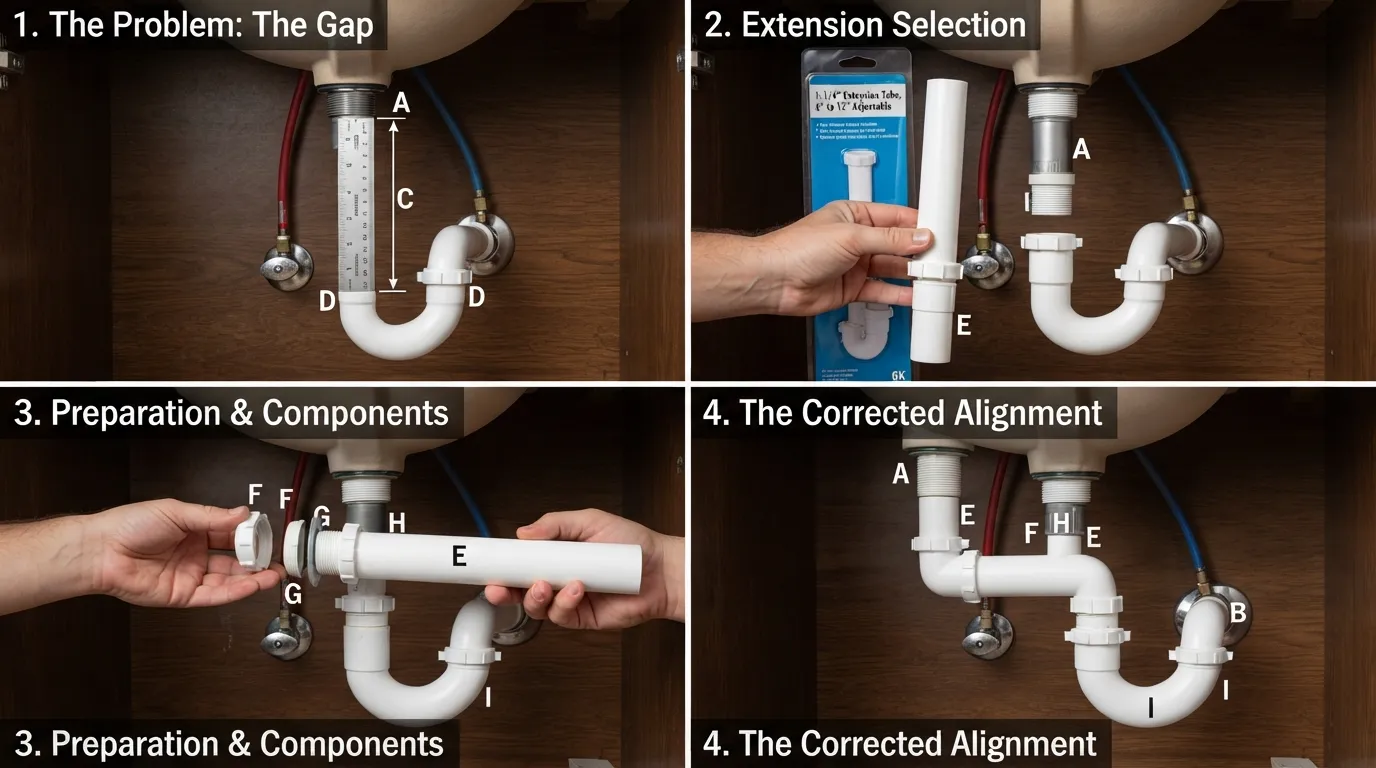
If your sink drain does not reach the P-trap, a P-trap extension or drain extension tube may be the simple fix—but only if the size, connection, and alignment are right. This guide shows you how to identify the problem, choose the right extension, install it correctly, and recognize when an extension is not the right solution.
What Is a P-Trap Extension?
A P-trap extension is an extension tube used in a sink drain assembly when the existing drain or tailpiece does not provide enough length to make the required connection to the P-trap or another drain connection. Depending on the product, an extension can connect a sink drain tailpiece to the P-trap or extend a trap-side tube toward the wall.
The important part: do not buy an extension based only on the words “P-trap extension.” First identify which section is too short, the connection diameter, the direction of the misalignment, and how much additional length you actually need.
If you are standing under a sink looking at a gap between the drain tailpiece and P-trap, you may be tempted to grab the longest extension tube you can find. That can create another problem if the diameter or connection style is wrong, or if the real issue is horizontal alignment rather than a simple lack of length.
That is why the best way to approach a P-trap extension pipe is to diagnose the drain layout first and choose the part second.
What Does a P-Trap Extension Do?
A sink drain normally has several connected components, including the sink drain body or tailpiece, the P-trap, and the drain connection leading toward the wall. A P-trap holds a small amount of water that helps block sewer gases from entering the room. The extension is not a replacement for that trap; it is a way to add usable length where the existing tubular drain components do not line up or reach far enough.
Commercial extension tubes are available in different diameters, lengths, materials, and connection designs. For example, current product documentation includes 1-1/4-inch extension tubes with slip-joint hardware, while other products are available in 1-1/2-inch sizes and different lengths.
Think of the drain assembly like this
An extension tube can add length at the appropriate tubular connection, but the exact location depends on the extension’s design.
Do You Actually Need a P-Trap Extension?
Before buying anything, look underneath the sink and identify exactly what is wrong. A missing few inches of tailpiece is a different problem from a P-trap that is several inches away from the wall drain.
Use this quick decision check
- Is the existing drain or tailpiece simply too short? A suitable extension may solve the problem.
- Is the diameter compatible? Confirm the actual tubular drain size before purchasing.
- Is the problem mainly vertical? If the P-trap and tailpiece are otherwise aligned, additional length may be appropriate.
- Is the problem horizontal? A straight extension may not correct an offset between the trap and wall drain.
- Would the extension force the P-trap into an awkward position? If so, reworking the drain arrangement may be better than forcing a fitting to work.
This distinction matters because an extension tube is designed to solve a length or connection problem—not every possible drain-layout problem.
P-Trap Extension vs. Tailpiece Extension
The terminology can be confusing because manufacturers and retailers may describe similar tubular drain components in different ways. You may see terms such as P-trap extension, tailpiece extension, drain extension tube, or trap extension.
Some products explicitly describe their use as extending a lavatory drain tailpiece to the trap or extending a trap-side tube toward the wall.
How to Choose the Right P-Trap Extension
Do not choose an extension by length alone. You need to match the diameter, connection style, usable length, and application.
1. Confirm the diameter
Common sink drain extension sizes include 1-1/4 inch and 1-1/2 inch. Do not assume the correct size from the sink’s appearance or from the name of the product. Check the existing tubular drain components and the manufacturer’s specifications for the extension you plan to use.
Current products demonstrate why this matters: 1-1/4-inch extension tubes are sold for bathroom sink applications, while 1-1/2-inch extension tubes are also widely available for sink drain assemblies.
2. Measure the gap before you buy
Dry-fit the existing P-trap and drain components first. Then measure the distance that is actually missing. This prevents you from buying a tube that is unnecessarily long or too short to create the required connection.
Many extension tubes come in multiple lengths, and some products are specifically designed to be cut to a desired length. For example, current retail listings include 6-inch, 8-inch, 12-inch, and 16-inch options, depending on the product and diameter.
3. Check the connection type
Look at how the existing pieces connect. Slip-joint extension tubes commonly use a slip-joint nut and washer rather than solvent-welding the connection. Oatey, for example, states that one of its 1-1/4-inch extension tubes uses nuts and washers rather than glue to create the mechanical connection.
Other extension designs can use specific threaded connections. Delta’s documented 1-1/4-inch extension, for example, attaches to a drain body or tailpiece using a 1-1/4-inch threaded connection and includes a nut and washer.
4. Consider the material
Plastic/polypropylene and brass extension tubes are both available. The right choice depends on the existing drain assembly, the required connection, the product specifications, and the appearance or durability requirements of the installation.
Before you buy, write down these four things
- Existing drain/tubular diameter
- Where the gap or misalignment occurs
- Approximate additional length required
- Connection type and required hardware
How to Measure for a P-Trap Extension
The easiest mistake to make is measuring the extension tube you want instead of measuring the gap you actually need to solve.
- Position the P-trap where it needs to sit. Do not force it into place just to make a measurement.
- Dry-fit the existing drain components. This lets you see where the connection falls naturally.
- Identify the missing length. Measure the gap between the components that need to connect.
- Check the diameter. Match the extension to the compatible tubular drain connection.
- Confirm the product’s usable length and cut instructions before trimming anything.
Dry fitting is particularly useful because a product can look like the correct length on its own but become too long once the existing tailpiece and P-trap are assembled. Manufacturer and retailer guidance also shows that some tubular extension products can be cut to suit the installation.
How to Install a P-Trap Extension
The exact procedure varies by product, so use the manufacturer’s instructions for the extension you purchased. For a typical slip-joint tubular extension, the basic workflow is straightforward.
Step 1: Dry-fit the drain assembly
Position the sink drain, tailpiece, extension, and P-trap without fully tightening the connections. Check that the pieces naturally line up and that the extension is actually solving the missing-length problem.
Step 2: Confirm the extension length
If the extension is longer than required and the manufacturer says it can be cut, mark the required length. Do not cut first and measure later. Some products are specifically marketed as cuttable, but you should follow the instructions for your particular tube.
Step 3: Cut cleanly when permitted
Use an appropriate saw when the product permits cutting. Make the cut square and clean, then remove any rough material that could interfere with the connection or washer.
Step 4: Install the nut and washer in the correct order
For slip-joint connections, the nut and washer must be installed according to the fitting’s design. A tapered washer has a specific orientation; reversing it can compromise the seal. Home improvement installation guidance also emphasizes correct washer orientation on tubular drain connections.
Step 5: Seat the extension and tighten the connection
Insert the tube into the mating connection as specified by the manufacturer, then tighten the slip-joint nut appropriately. Do not treat every threaded connection as though it seals in the same way. On many tubular slip-joint connections, the washer provides the seal; the correct sealing method depends on the fitting design.
Step 6: Check for leaks
Run water through the sink and inspect every newly disturbed connection. Check again after the water has drained. If a joint leaks, shut the water off and inspect the washer, alignment, tube seating, and nut before tightening further.
Important: Don’t force the P-trap into alignment
An extension should make the drain connection easier—not put the P-trap or tubular piping under obvious strain. If the parts only connect when you push, twist, or pull them significantly out of their natural position, stop and reassess the layout.
Vertical vs. Horizontal P-Trap Problems
This is one of the most useful distinctions to make before choosing an extension.
Vertical length problem
The sink tailpiece and P-trap are generally positioned correctly, but there is not enough straight tube to make the connection.
Possible solution: a compatible extension tube may provide the additional length you need.
Horizontal alignment problem
The P-trap and the wall drain are offset from one another, so simply adding a longer straight tube may not produce a sound layout.
Possible solution: reassess the trap arm, wall connection, or overall drain configuration rather than automatically adding length.
This is why “Can I extend my P-trap?” does not always have a simple yes-or-no answer. The correct solution depends on where the misalignment occurs.
Can You Extend a P-Trap?
Sometimes, yes. A compatible extension tube can be useful when the existing sink drain assembly needs additional length and the extension is designed for that connection.
But an extension is not automatically the right answer for every drain problem. If the trap is incorrectly positioned, the wall connection is substantially offset, the diameters do not match, or the added tube would create an awkward or strained configuration, replacing or reconfiguring the appropriate drain components may be the better solution.
Current extension products themselves illustrate different applications: some are described as extending a lavatory drain tailpiece to a trap, while others can be used between a trap-side tube and the wall connection.
Common P-Trap Extension Mistakes
P-Trap Extension Troubleshooting
How Far Should a Drain Go Into a P-Trap?
There is no single universal insertion measurement that should be applied blindly to every tubular drain fitting. The required engagement depends on the fitting design, washer, nut, tube dimensions, and applicable installation requirements.
Instead of relying on a generic measurement from a random diagram, follow the manufacturer’s instructions for the specific P-trap and extension you are using. The connection should seat correctly, remain mechanically secure, and seal without forcing the components into an unnatural position.
This approach is safer than assuming every P-trap extension, tailpiece, and washer has identical dimensions.
Can You Connect Two P-Traps Together?
Generally, you should not add a second P-trap simply because one section of the drain is too short. A P-trap extension and a second P-trap are not interchangeable solutions.
If your existing layout appears to require two traps, unusual looping, or multiple unnecessary bends just to reach the wall connection, stop and reassess the drain configuration rather than treating the problem as a simple extension job.
Can You Extend a PVC Drain Pipe to Reach a P-Trap?
It depends on which section of the drain you are trying to extend and what type of pipe and connection you have. A tubular sink drain extension designed for a slip-joint connection is not automatically interchangeable with a solvent-welded PVC pipe system.
Match the extension to the existing connection system. If the repair involves changing concealed or fixed drain piping rather than simply connecting compatible tubular components under the sink, the job may require a different repair approach.
When a P-Trap Extension Is Not the Right Fix
An extension is probably not the answer if you are using it to compensate for a fundamentally incorrect drain layout.
- The P-trap and wall drain are significantly offset.
- The extension does not match the existing connection.
- The assembled drain would be under visible strain.
- You would need excessive bends or improvised adapters to make it work.
- The repair requires modifying concealed plumbing rather than making a straightforward tubular connection.
- You are unsure whether the resulting configuration meets applicable plumbing requirements.
A good rule of thumb
If an extension makes a simple drain connection possible, it may be appropriate. If an extension is being used to force a badly aligned drain into place, step back and diagnose the layout first.
Frequently Asked Questions About P-Trap Extensions
What is a P-trap extension pipe?
A P-trap extension pipe is a tubular drain extension used to add length to a compatible sink drain or trap-side connection when the existing components do not reach far enough. The exact connection point depends on the product design.
What size P-trap extension do I need?
Choose the extension based on the diameter and connection type of the existing drain assembly, then choose a length that provides the required additional reach. Common tubular sink extension sizes include 1-1/4 inch and 1-1/2 inch, but you should verify your actual setup rather than assuming the size.
My sink drain isn’t long enough to reach the P-trap. What should I do?
First dry-fit the P-trap and existing tailpiece, measure the missing distance, and verify the connection diameter. If the problem is simply insufficient straight length, a compatible extension tube may solve it. If the trap is horizontally misaligned or under strain, reassess the drain layout instead.
Can I use a P-trap extension on a bathroom sink?
Yes, compatible extension tubes are commonly available for bathroom sink drain assemblies. Product specifications should be checked for diameter, connection type, material, and intended application.
Can I cut a P-trap extension tube?
Some extension tubes are designed to be cut to the required length, while others may have specific installation requirements. Only cut a product when its instructions permit it, and dry-fit the assembly before making the cut.
Do P-trap extension tubes need glue?
Not every extension uses glue. Many slip-joint tubular extension tubes connect mechanically with nuts and washers. Oatey’s product information, for example, specifically describes a 1-1/4-inch extension as a nut-and-washer connection rather than a glued connection.
Why is my P-trap extension leaking?
Start by checking the washer orientation, tube seating, nut placement, connection compatibility, and alignment. Adding more force to a poorly seated washer or mismatched connection does not necessarily solve the underlying problem.
Should the P-trap be higher than the drain pipe?
The correct arrangement depends on the entire drain configuration and applicable plumbing requirements. The P-trap should not be positioned simply wherever an extension happens to reach. If you are changing the trap’s location or the wall connection, verify the complete layout rather than solving one dimension in isolation.
Can I connect two P-traps together?
A second P-trap is not a normal substitute for a missing-length extension. If your setup appears to require two traps, investigate the drain layout before adding another trap.
P-Trap Extension: The Simple Way to Get the Right Part
Remember these five steps
- Identify exactly where the drain is too short or misaligned.
- Confirm the existing diameter and connection type.
- Measure the actual additional length required.
- Dry-fit before cutting or final tightening.
- Do not use an extension to force an incorrectly configured drain into place.
The biggest mistake with a P-trap extension is treating it as a universal fix. The right extension is the one that matches your existing drain components and solves the actual problem without creating a new alignment or sealing issue.
If you are unsure about the overall plumbing arrangement, especially where the wall drain, trap arm, or fixed piping is involved, having a qualified plumber inspect the configuration can prevent a small under-sink repair from turning into a larger drainage problem.
Need Help With a Plumbing Problem?
If the P-trap, drain connection, or another part of your plumbing is not lining up correctly, you can learn more about available plumbing services or contact a professional for help with the installation.
Explore Plumbing Services
Miami Plumbing Help
Talk to a Plumbing Professional
Related P-Trap Extension Resources
If you are comparing extension tubes or checking manufacturer specifications, these resources can help you verify the exact dimensions, connection design, and available options for the part you are considering.
- Home Depot: Oatey 1-1/4 in. × 6 in. Slip-Joint Sink Drain Extension Tube — product specifications and installation-related questions.
- Home Depot: Westbrass 1-1/4 in. × 8 in. Slip-Joint Extension Tube — example of a brass extension with slip-joint nut and rubber washer.
- Home Depot: Everbilt 1-1/2 in. × 16 in. P-Trap Extension Tube — example of a longer plastic extension designed for sink drain applications.
- Delta Faucet: P-Trap Extension — manufacturer specifications for a 1-1/4-inch brass extension, including connection and included hardware.
Note: Product sizes, availability, materials, and specifications can change. Always verify the current manufacturer’s or retailer’s specifications for the exact extension tube you plan to install.