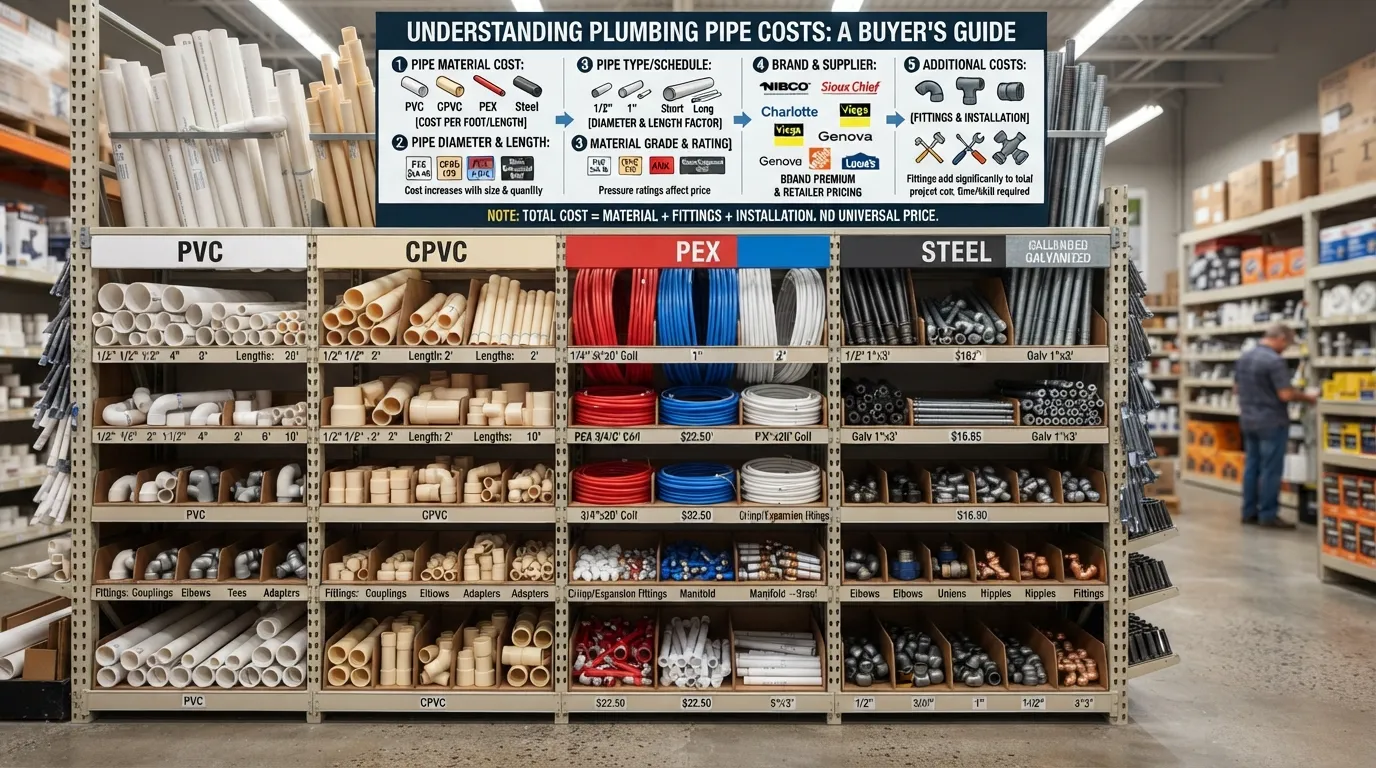
Looking for the price of pipe? The cost depends on the pipe material, diameter, length, schedule or type, brand, supplier, and what the pipe is being used for. Here’s how to compare pipe prices without confusing material cost with the cost of a complete plumbing project.
What Is the Price of Pipe?
There is no single price for plumbing pipe. A short, small-diameter PVC pipe can cost far less than a long, large-diameter pressure pipe, and the price can change again when you compare PVC, CPVC, PEX, steel, or other materials.
The most useful way to compare pipe prices is by material, diameter, length, pipe type or schedule, and price per foot. Retail prices also change by supplier, location, availability, brand, quantity, and date.
What Determines the Price of Pipe?
When you search for price pipe or cost pipe, a generic price number can be misleading. Two pipes with the same nominal diameter can have different prices because they are made for different applications or have different pressure ratings and wall thicknesses.
Before comparing prices, I recommend checking these factors:
- Material: PVC, CPVC, PEX, steel, UPVC, or another pipe material.
- Nominal diameter: The size of the pipe, such as 1/2-inch, 3/4-inch, 1-inch, 2-inch, or larger sizes.
- Length: A 10-foot pipe and a 20-foot pipe should not be compared as though they are the same quantity.
- Schedule or pipe type: For products where schedule matters, Schedule 40 and Schedule 80 can have different specifications and prices.
- Application: Water supply, drainage, DWV, irrigation, or another use may require a different product.
- Brand and supplier: Different manufacturers and retailers can list different prices for comparable products.
- Quantity: Contractor, bulk, or larger-quantity purchases may be priced differently from a single retail piece.
- Location and availability: Local inventory, shipping, delivery, and regional pricing can affect the final amount.
Pipe Price by Material
The material is one of the first things to identify when you are comparing pipe costs. A price for PVC should not automatically be compared with the price of PEX or steel without considering what each product is designed to do.
How Much Does PVC Pipe Cost?
PVC is one of the most common pipe types appearing in searches for pipe prices. However, saying that “PVC pipe costs X dollars” without specifying the product is not a reliable way to price a project.
For a meaningful PVC pipe comparison, identify:
- The nominal pipe diameter.
- The pipe length.
- Whether it is pressure pipe, DWV, or another product type.
- The schedule or specification when applicable.
- The brand and supplier.
- Whether the listed price is for one piece, a quantity, or a bulk purchase.
Why You See Different Prices for the Same Pipe Material
A 4-inch PVC pipe is not automatically equivalent to every other 4-inch PVC product. Length, wall thickness, schedule, application, pressure rating, brand, and fitting compatibility can all change what you should buy and what you should pay.
What Is the Price of a 20-Foot Pipe?
If you are specifically comparing a 20-foot pipe price, compare the entire piece and its price per foot rather than looking only at the total sticker price.
For example, if a 20-foot pipe is listed at a particular price, its basic material cost per foot is:
Price per foot = Total pipe price ÷ Pipe length
Use the same unit when comparing different products.
This makes it easier to compare a 10-foot pipe with a 20-foot pipe. Just remember that the lowest price per foot does not necessarily mean the correct product for your plumbing system.
How Much Does 4-Inch, 6-Inch, or 8-Inch Pipe Cost?
Searches for 4-inch pipe price, 6-inch PVC pipe price, and 8-inch PVC pipe price are more specific because diameter has a major effect on material requirements and product selection.
For larger pipe, do not compare price based on diameter alone. Check the exact product description, length, schedule or pressure specification, application, and manufacturer.
Important: Nominal Size Is Not the Same as Every Physical Dimension
A pipe’s nominal size is a sizing designation, not simply a measurement you can use to assume every dimension. When buying replacement pipe or fittings, verify the actual product specification and compatibility rather than relying only on the number in the name.
Pipe Price vs. Price Per Foot
When shopping for pipe, I recommend recording both the total piece price and the price per foot.
Does Pipe Fittings Cost Extra?
Usually, you should treat fittings as a separate part of your material estimate unless a product or quote explicitly includes them.
A plumbing project may require items such as:
- Couplings
- Elbows
- Tees
- Adapters
- Valves
- Transitions between different pipe materials
- Other application-specific connectors
This is why multiplying the pipe price by the number of feet in a project does not always give you the final material cost.
Pipe Material Cost vs. Plumbing Installation Cost
One of the easiest mistakes to make is confusing the price of pipe with the cost of installing or replacing a plumbing system.
Material Cost
The pipe, fittings, valves, connectors, and other materials required for the job.
Installation Cost
Labor and project-specific work required to install, repair, replace, or reroute the plumbing.
Complete Project Cost
The combined cost of materials, labor, access, removal, permits where applicable, and other project requirements.
If you are pricing a complete plumbing job rather than buying a few pieces of pipe, you should get a project-specific estimate instead of using a retail pipe price as your total budget.
If you need broader plumbing help, you can also explore our plumbing services for related residential plumbing needs.
PVC vs. PEX: Which Pipe Is Cheaper?
There is no universal answer because the comparison depends on the application, pipe size, product specification, fittings, installation method, and local pricing.
If you are choosing between PVC and PEX for a water-line project, do not make the decision on material price alone. Consider whether the product is approved and appropriate for the intended use, how it will be installed, the fittings required, accessibility, and the overall project cost.
The Better Price Is Not Always the Lowest Price
A cheaper pipe can become the more expensive choice if it is the wrong size, wrong application, incompatible with the fittings, or unsuitable for the plumbing system. Compare the complete solution, not just the pipe itself.
How to Check the Current Price of Pipe
Pipe prices change, so a price published on one day should not automatically be treated as a permanent market price. When you need an exact current price, check the actual product listing or supplier price sheet for the pipe you need.
- Choose the material. Start with PVC, CPVC, PEX, steel, or the material specified for your project.
- Confirm the diameter. Do not rely on a general “pipe” price.
- Confirm the length. Check whether the listing is for 10 feet, 20 feet, or another length.
- Check the product type or schedule. Make sure the pipe is designed for your application.
- Compare the same specification. Compare like-for-like products before deciding which price is lower.
- Calculate price per foot. This helps when lengths differ.
- Add fittings. Include couplings, elbows, tees, valves, and other required components.
- Separate material from installation. A retail pipe price is not the same as a plumbing quote.
Where Can You Check Pipe Prices?
For current product pricing, compare listings from established plumbing suppliers, home-improvement retailers, and manufacturers. Manufacturer price lists can be useful for understanding product categories and list pricing, while retail listings are more useful for seeing what a particular supplier is currently charging for an available product.
Useful Pipe-Price Resources
- Home Depot pipe listings for retail product and size comparisons.
- Lowe’s pipe listings for another retail comparison point.
- Charlotte Pipe price lists for manufacturer pricing information and product categories.
- United Pipe PVC price information for additional supplier/manufacturer context.
- Ewing PVC pipe listings for product and irrigation-pipe comparisons.
Important: A manufacturer list price, retailer price, contractor price, and final installed price are not necessarily the same. Always check the exact product, quantity, location, and date when you need an accurate current figure.
Pipe Price Buying Checklist
Before you buy pipe, run through this checklist. It can prevent a low-looking price from turning into an expensive mistake.
Before You Buy
- ☐ Correct pipe material
- ☐ Correct nominal diameter
- ☐ Correct length
- ☐ Correct schedule or product type
- ☐ Correct application
- ☐ Compatible fittings
- ☐ Quantity required for the project
- ☐ Current supplier price
- ☐ Delivery or pickup costs, if applicable
- ☐ Installation cost, if a plumber is doing the work
Why Does Pipe Cost So Much More for Some Projects?
If you are pricing a larger plumbing project, the pipe itself may be only one part of the total cost. A repipe or major plumbing replacement can involve many more materials and substantial labor compared with purchasing a few replacement sections of pipe.
The final project can depend on the amount of pipe required, access to existing plumbing, the number of connections, fittings and valves, removal of old materials, repairs to surrounding areas, permits where applicable, and the complexity of the installation.
That is why a search for “pipe cost” and a search for “cost to repipe a house” represent different levels of pricing intent.
Frequently Asked Questions About Pipe Prices
If you are searching for the price of pipe, the most useful answer is not one universal dollar figure. Start with the material, diameter, length, and application, then check the exact product specification and current supplier price.
For a quick comparison, calculate the price per foot. For a real plumbing project, go one step further and account for fittings, labor, access, removal, and any other project-specific requirements.
The cheapest pipe on the shelf is not necessarily the cheapest solution. The right comparison is the correct pipe for the job at a fair current price, with all required materials and installation considered.
Need Help With a Plumbing Project?
If you are not sure which pipe, fittings, or plumbing solution your project requires, getting advice before purchasing can help you avoid buying the wrong materials.
Pipe prices change by product, supplier, location, availability, and date. Always verify the exact current price and product specification before purchasing materials.