What Is the Humidity Doing to Your Plumbing? Signs, Risks and Fixes for Miami Homes
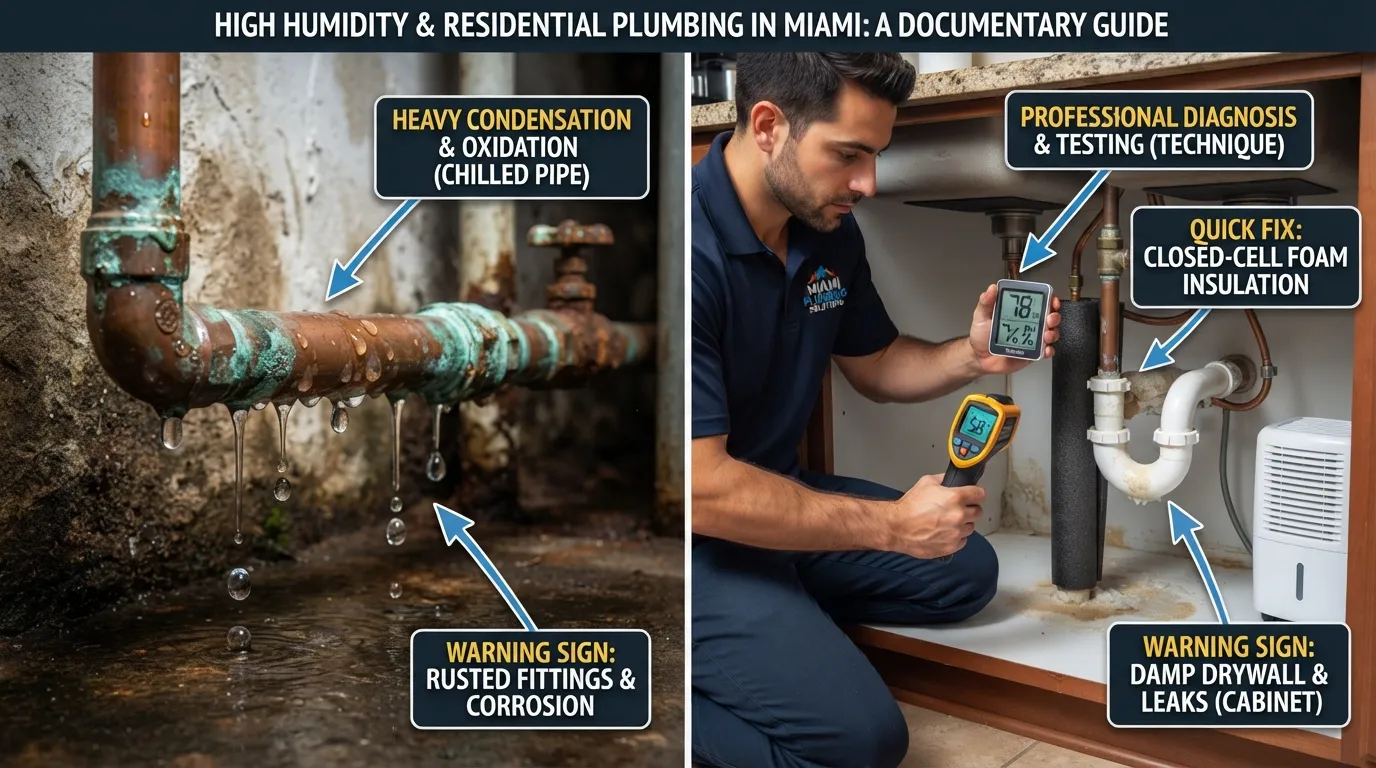
What Humidity Does to Your Plumbing
How High Humidity Impacts Your Plumbing System
High relative humidity directly triggers severe pipe condensation, accelerates exterior corrosion on metal lines, promotes mold growth around damp fixtures, and worsens stubborn drain odors. When warm, moisture-heavy air meets cold water supply lines, it creates constant moisture accumulation throughout your property’s plumbing network.
Why This Matters More in Miami and South Florida
South Florida’s subtropical climate creates a relentless cycle of extreme atmospheric moisture paired with heavy year-round air conditioning use. This sharp temperature contrast causes cold supply pipes to sweat excessively, trapping humidity inside walls, ceilings, and crawlspaces where it rapidly deteriorates infrastructure.
What You’ll Learn in This Guide
How high relative humidity levels drive pipe condensation and hidden water damage.
The direct biological and chemical link between atmospheric moisture, corrosion, and mold.
Proven mitigation strategies to control moisture and eliminate stubborn drain odors in subtropical homes.
How Humidity Damages Your Plumbing
Pipe Sweating (Condensation)
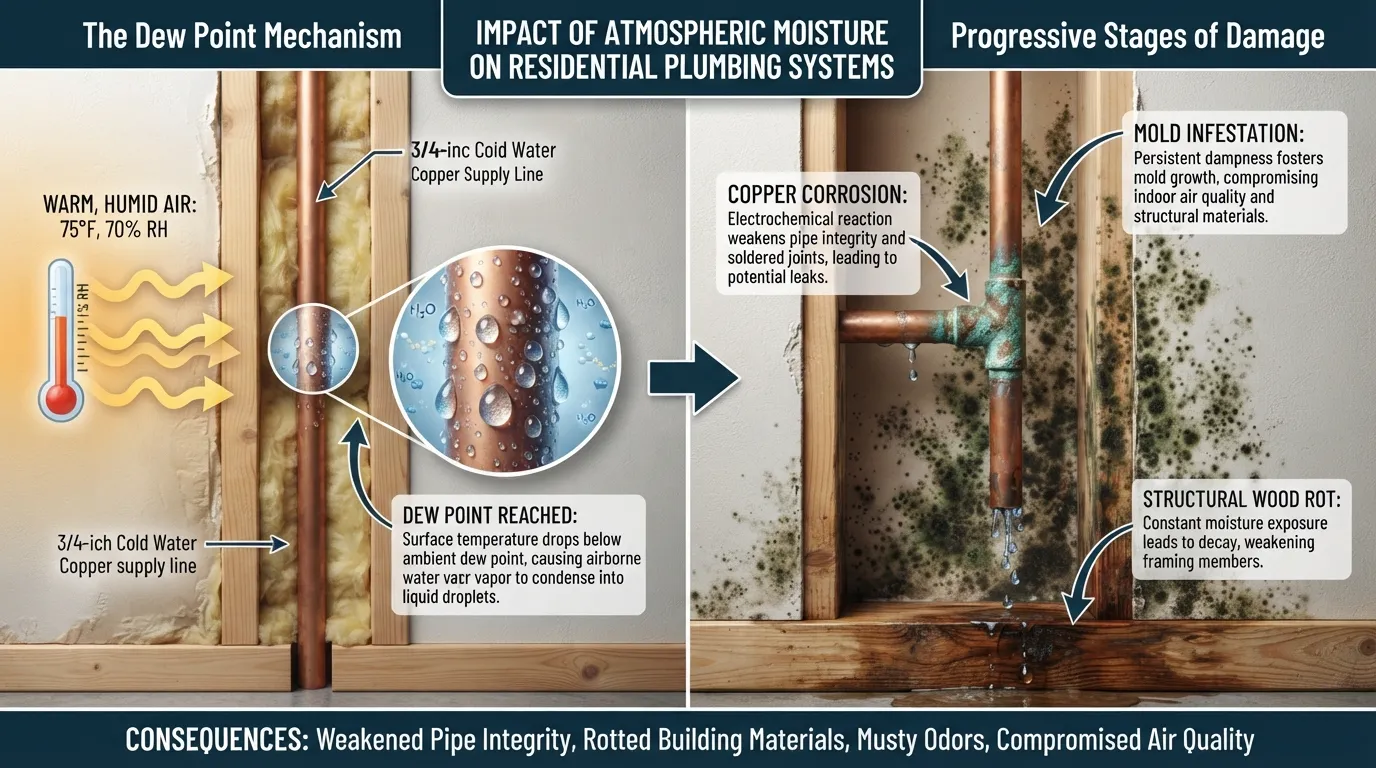
When warm, moisture-laden air contacts cold water supply lines that fall below the local dew point, heavy condensation forms rapidly on the pipe exterior. This moisture originates entirely from the ambient air rather than a leak within the pipe itself, yet it continuously drips onto surrounding structures and insulation.
The Physics: The temperature differential between air-conditioned indoor environments and cold subterranean supply lines creates a perpetual moisture trap.
Technician’s Note: In Miami homes, uninsulated cold water runs in utility rooms and under-sink cabinets are the primary hotspots for heavy sweating and subsequent pooling.
Corrosion and Rust on Pipes, Valves, and Fittings
Persistent surface moisture strips away protective barriers, accelerating galvanic and atmospheric corrosion on exposed metal infrastructure. Over time, rust eats through galvanized steel, degrades copper pipe walls, and locks up shutoff valves.
Vulnerable Components: Threaded joints, brass fittings, and older steel nipples bear the brunt of oxidation in high-humidity atmospheres.
The Risk: Severely corroded fittings lose structural integrity under normal water pressure, frequently resulting in catastrophic joint failure or slow, undetected leaks.
Mold and Mildew Around Plumbing
High humidity combined with minor, unvented plumbing condensation creates ideal microclimates for mold spores to germinate and colonize within 24 to 48 hours. This biological growth thrives in dark, unventilated spaces such as cabinet interiors and wall cavities.
Common Reservoirs: Dark, stagnant spaces beneath kitchen and bathroom sinks serve as primary incubators.
Health Impact: Beyond degrading building materials, hidden colonies behind drywall release airborne spores that compromise indoor air quality throughout the property.
Rotted Wood, Stained Drywall, and Ceiling Damage
Constant exposure to humidity-driven condensation breaks down organic building materials, leading to structural wood rot and crumbling drywall. Subflooring beneath damp fixtures and framing around vertical plumbing chases soften and lose load-bearing capacity.
Visual Indicators: Yellowish water rings, peeling paint, and sagging drywall ceilings often point directly to chronic overhead condensation rather than active pipe bursts.
Technician’s Note: Attic runs and secondary floor utility closets in South Florida properties frequently suffer structural timber degradation before homeowners notice visual surface stains.
Foul Drain Odors in Humid Weather
Stagnant, moisture-heavy air slows down wastewater ventilation and encourages bacterial proliferation within trap seals and drain lines. This dynamic traps foul gases inside the home, creating persistent, musty odors during peak humidity cycles.
Sweating Pipes or a Leak? How to Tell the Difference
Signs It’s Condensation
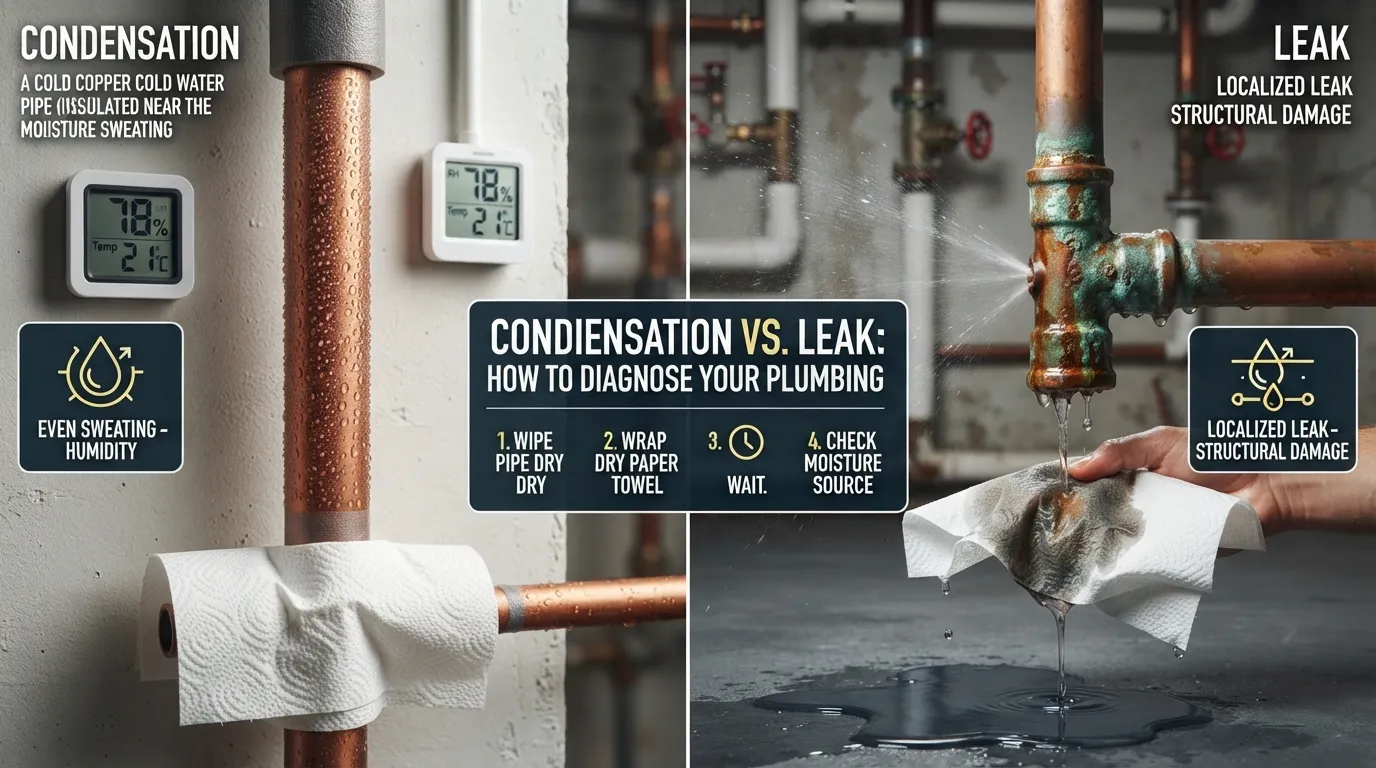
Condensation appears as a uniform film or micro-droplets spread evenly along the entire run of a cold water pipe rather than pooling in one localized spot. This moisture level fluctuates directly with ambient weather conditions, worsening during peak humidity cycles and disappearing completely when the air dries out.
Uniform Moisture: The entire outer wall of the pipe feels damp to the touch, with no clear origin point or single drip line.
Environmental Correlation: The wetness intensifies when bathroom exhaust fans are off, doors are open to humid outdoor air, or air conditioning runtimes spike.
Signs It’s a Leak
A true plumbing leak concentrates water at a distinct point of failure, typically dripping steadily regardless of indoor humidity levels or weather changes. If puddles form beneath a pipe during dry winter days or when windows are closed, atmospheric condensation can be ruled out.
Localized Dripping: Water continuously falls from a single joint, valve, or pinhole regardless of whether the air is dry or humid.
Property Warning Signs: Persistent wet patches, warped surrounding cabinetry, or an unexplained spike in your monthly utility bill indicate a hidden breach. For properties experiencing recurring mystery water loss, professional leak detection services can isolate underground or in-wall failures without destructive exploratory tearing.
The Dry-and-Wait Test
This diagnostic method separates atmospheric moisture from structural pipe failure by systematically resetting surface conditions. Drying the pipe completely allows you to observe whether moisture returns from the air or escapes from a hidden crack.
Step-by-Step Procedure: Wipe the entire pipe surface completely dry with a clean microfiber towel, then use a portable fan or hair dryer on a cool setting to eliminate residual humidity.
Evaluation: If the pipe remains dry until the air turns humid again, it is condensation; if beads of water reappear immediately around a fitting or seam, a leak is present.
The Water Meter Test
The water meter test provides definitive proof of whether water is actively escaping somewhere within your property’s closed supply network. This test removes all guesswork when pipe moisture leaves you uncertain about system integrity.
Execution: Ensure every indoor and outdoor faucet, ice maker, and water-using appliance is completely turned off.
Reading the Dial: Locate your main water meter and check the low-flow indicator triangle or sweep hand; if it is moving, water is escaping through an active leak.
The Insulation Check
Adding closed-cell foam pipe insulation to a suspect cold water line provides both a practical fix and an immediate diagnostic answer.
How It Works: Foam insulation acts as a thermal barrier, keeping warm, moisture-heavy air away from the cold pipe surface.
The Result: If wrapping the pipe completely stops the moisture accumulation, the issue was condensation; if dampness still penetrates or soaks the insulation from behind, you are dealing with a localized leak.
Old Copper Pipes and Pinhole Leaks
In aging copper plumbing systems exposed to aggressive South Florida water and high humidity, tiny pinhole leaks can easily mimic the appearance of heavy condensation.
The Mimicry: Water droplets form across a rough section of old pipe, looking like uniform sweating at first glance.
The Difference: Unlike true condensation, these droplets stay anchored to one exact spot, slowly swelling into a heavy drip that persists even when ambient humidity drops.
Technician’s Real-World Example: A service call in a historic Coconut Grove home involved a kitchen supply line that appeared to be severely sweating due to poor cabinet ventilation. Upon closer inspection, the “condensation” was actually a series of microscopic pinhole leaks caused by acidic water chemistry eating the copper wall from the inside out, weeping water along the pipe’s underside.
Which Pipes and Fixtures Are Most at Risk?
Pipe Material Comparison
| Pipe Material | Humidity Impact | Sweating Risk | What to Watch For |
| Copper | High conductivity accelerates exterior oxidation and pinhole corrosion in humid environments. | High on cold water lines | Blue-green surface buildup (patina), weeping pinhole leaks, and heavy condensation pools. |
| Galvanized Steel | Prone to interior mineral scaling and rapid external rust where protective coatings fail. | High on cold lines | Flaking rust at threaded joints, restricted water flow, and sudden fitting blowouts. |
| PVC / CPVC | Lower thermal conductivity makes plastic less prone to rapid exterior condensation. | Low to Moderate | Brittle cracking in unconditioned spaces, joint separation under vibration, and thermal sagging. |
| PEX | Excellent flexibility and minimal thermal transfer resist sweating effectively. | Very Low | UV degradation if exposed to sunlight, scale accumulation at brass insert fittings. |
| Cast Iron | Heavy mass holds temperature differentials longer, attracting persistent dampness in cellars/utility rooms. | Moderate to High | External rust flaking, structural cracking, and damp soil odors around basement runs. |
Copper Pipes in Humid Climates
Copper lines running cold water through humid spaces frequently develop heavy surface condensation and distinctive blue-green (copper carbonate) corrosion deposits. Because copper is a high-conductor metal, it easily chills the surrounding air past the dew point.
The Insulation Solution: Wrapping vulnerable copper runs with pre-slit closed-cell foam sleeves breaks the thermal transfer loop, keeping warm air away from the chilled metal surface [02:49]. For a practical walkthrough on installing these thermal barriers, check out this guide on How To Insulate Copper Pipes – Stop A Sweating Pipe.
Galvanized Steel
Older properties featuring galvanized steel plumbing face a dual threat: external rust from high atmospheric moisture and internal scaling from mineral-heavy water. As condensation attacks threaded pipe connections from the outside, internal rust narrows the inner diameter, ultimately choking off water pressure and weakening structural joints.
Toilet Tanks Sweating
A toilet tank constantly filled with chilled municipal water acts as a prime condensation magnet during South Florida’s humid summers.
Distinguishing Condensation vs. Failure: If water covers the entire exterior of the porcelain tank uniformly, it is simple atmospheric condensation. However, if a puddle forms exclusively around the floor base, you are likely dealing with a failed wax ring or tank-to-bowl gasket, requiring professional toilet repair to prevent subfloor rot.
Water Heaters and Hot Lines
While hot water lines do not sweat from internal temperature drops, they create microclimate humidity shifts in cramped utility closets that accelerate jacket and fitting corrosion.
Vulnerable Areas: The cold water inlet valve on top of the tank is heavily prone to sweating, while moisture pooling at the tank base often signals condensation run-off or internal tank failure. For persistent pooling or rust streaks around your unit, professional water heater service can verify whether you are dealing with ambient sweating or a failing tank wall.
AC Refrigerant and Condensate Lines Near Plumbing
Air conditioning suction lines and condensate drain pipes run parallel to domestic plumbing in many South Florida utility rooms and drop ceilings. When uninsulated AC refrigerant lines sweat heavily, they drip onto adjacent water supply pipes and electrical conduits, creating false alarms of primary plumbing leaks.
How Much Humidity Is Too Much?
The Ideal Indoor Humidity Range
According to the EPA guidance on mold and moisture, you should keep indoor humidity below 60%, ideally maintaining it between 30% and 50%. This balanced range prevents atmospheric moisture from reaching the critical thresholds where mold spores germinate while keeping the air comfortable for occupants.
Preventing Biological Growth: Keeping humidity under 50% deprives mold and dust mites of the moisture they require to colonize surfaces near plumbing lines.
Protecting Infrastructure: Lower ambient moisture reduces the frequency of condensation pooling on cold water supply pipes and fixtures.
Humidity Level Chart
| Relative Humidity Level | What It Means for Comfort | Plumbing & Condensation Risk | Mold & Mildew Risk |
| Under 30% | Air feels overly dry, causing static shock and dry skin or nasal irritation. | Negligible exterior pipe sweating; low risk of moisture accumulation. | Zero risk of mold germination. |
| 30% – 50% | The Ideal Zone: Comfortable for human occupants and safe for building materials. | Minimal sweating on cold lines under normal indoor temperatures. | Safe zone; mold cannot thrive at these levels. |
| 50% – 60% | Noticeably sticky or warm; acceptable maximum limit in humid climates. | Occasional light sweating on uninsulated cold water pipes during peak use. | Low to moderate risk in stagnant, unventilated areas. |
| 60% – 70% | Uncomfortable, muggy indoor air quality that lingers without continuous AC. | Moderate pipe sweating in utility closets, kitchens, and bathrooms. | High risk; mold spores begin to colonize within 48 hours. |
| 70% – 80% | Oppressive humidity; heavy moisture hangs in the indoor air. | Heavy, continuous pipe dripping and accelerated metal oxidation. | Severe risk; active mold growth spreads rapidly across damp drywall and wood. |
| 90%+ | Extreme saturation; typical of severe subtropical storm events or unconditioned spaces. | Severe condensation pooling; risk of false-alarm leaks and ruined insulation. | Critical infestation zone; extensive biological contamination. |
Why Relative Humidity Isn’t the Whole Story
Relative humidity (RH) measures moisture in the air relative to air temperature, but local surface temperatures dictate whether your plumbing actually sweats. A cold water supply line chilling below the indoor dew point will cause moisture to condense out of the air even if overall room humidity registers at a moderate 55%.
How to Measure It
Accurately tracking your home’s microclimate requires dedicated tools placed strategically near vulnerable plumbing infrastructure.
The Tool: Use a digital hygrometer (humidity monitor) to track real-time indoor levels.
Placement: Position monitors inside problem areas such as under kitchen sinks, inside master bathroom vanities, and near utility room water heaters.
Monitoring Duration: Track readings over a 72-hour cycle to capture daily fluctuations driven by air conditioning runtimes and household water usage.
Is 70% or 90% Humidity Bad?
Yes, indoor relative humidity levels of 70% or 90% are exceptionally destructive and require immediate intervention. At 70%, ambient moisture aggressively fuels mold growth and causes continuous pipe condensation. At 90%, your home operates in a near-tropical microclimate that rapidly rots structural wood, ruins drywall, and accelerates rust across every exposed metal pipe fitting and valve.
Warning Signs of High Humidity Around Your Plumbing
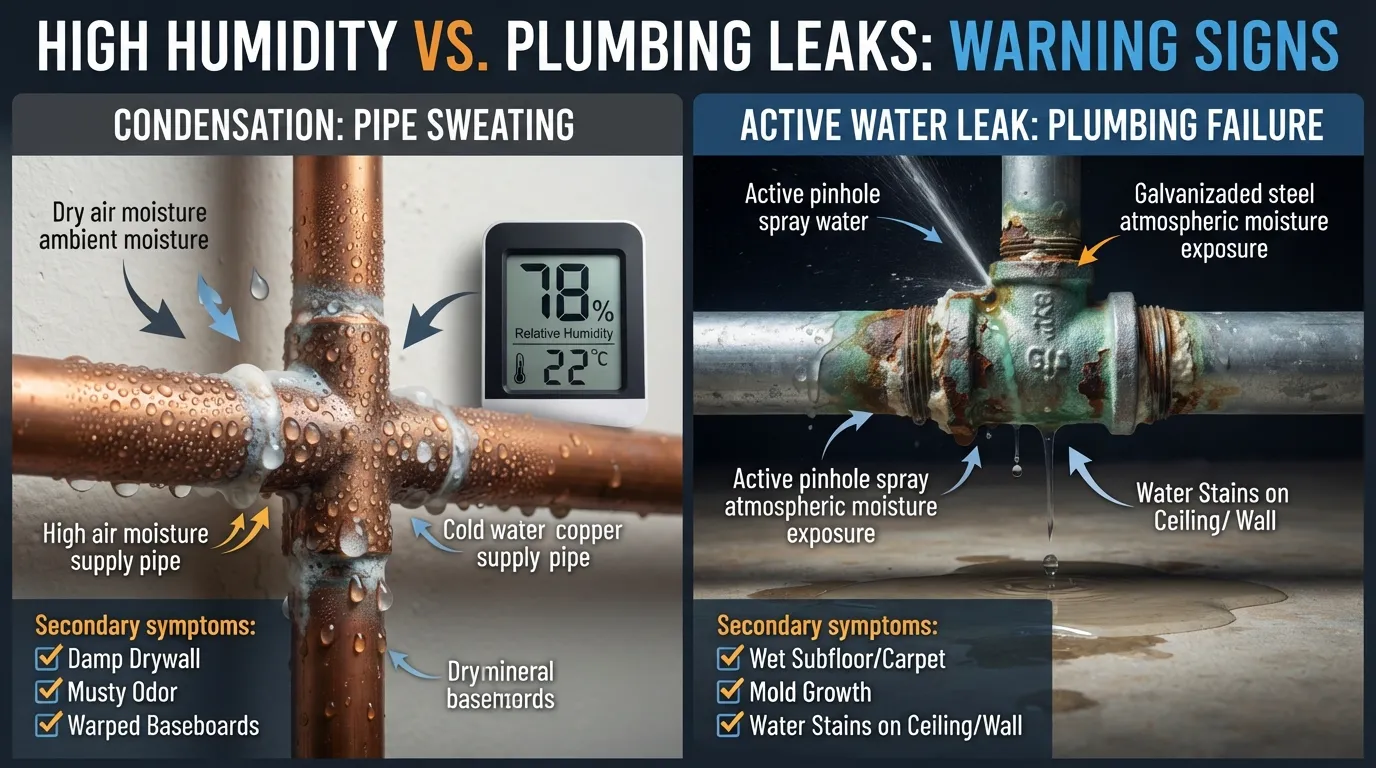
Signs on Your Pipes and Fixtures
Your plumbing infrastructure often serves as the earliest indicator of unmanaged atmospheric moisture before damage spreads to surrounding drywall or flooring.
Wet or Sweating Pipes: Cold water lines slick with water droplets during non-use periods.
Corrosion and Rust: Flaking orange oxidation on metal fittings, valve stems, and steel pipe nipples.
Green Patina Buildup: Blue-green crust accumulating across copper pipe elbows and soldered joints.
Damp Insulation: Foam or fiberglass pipe wraps feeling spongy, wet, or pulling away from the metal surface.
Persistent Drips: Pooling water directly beneath supply lines or fixture connections without an active leak source.
Signs in the Room
When ambient humidity exceeds safe thresholds, the excess moisture alters the physical appearance and air quality of the surrounding living space.
Musty Odors: A persistent damp, earthy smell emanating from closets, utility rooms, or baseboards.
Foggy Mirrors That Linger: Bathroom mirrors that stay fogged long after showers conclude due to stagnant air.
Peeling Paint and Wallpaper: Bubbling paint finishes or curling wallpaper edges near plumbing walls.
Water Stains: Discolored yellowish rings or sagging patches on ceilings and walls without an obvious overhead roof leak.
Warped Cabinet Floors: Swollen wood panels, delaminating particle board, and stuck doors beneath kitchen or bathroom sinks.
Bathroom-Specific Signs
Bathrooms endure the highest moisture spikes in any property, making them prone to accelerated humidity damage if air exchange fails.
Slow-Drying Surfaces: Tile walls, shower curtains, and bathtubs remaining damp hours after use.
Mildew on Grout and Ceilings: Black or pinkish mold spots proliferating along shower grout lines and ceiling corners.
Ineffective Exhaust Fans: Excessive condensation rolling down walls because the ventilation fan lacks the CFM capacity or is clogged with dust.
Humid Bathroom, But No One Is Using It?
If an unused guest bathroom or powder room continuously feels damp and humid when no one has run the shower or sink, it signals an underlying issue.
The Causes: This micro-climate stagnation typically points to a slow, hidden supply or drain leak evaporating inside the vanity cabinet, an unvented plumbing chase drawing warm air from crawlspaces, or complete a lack of cross-ventilation trapping ambient moisture.
Is Your Plumbing Causing the Humidity?
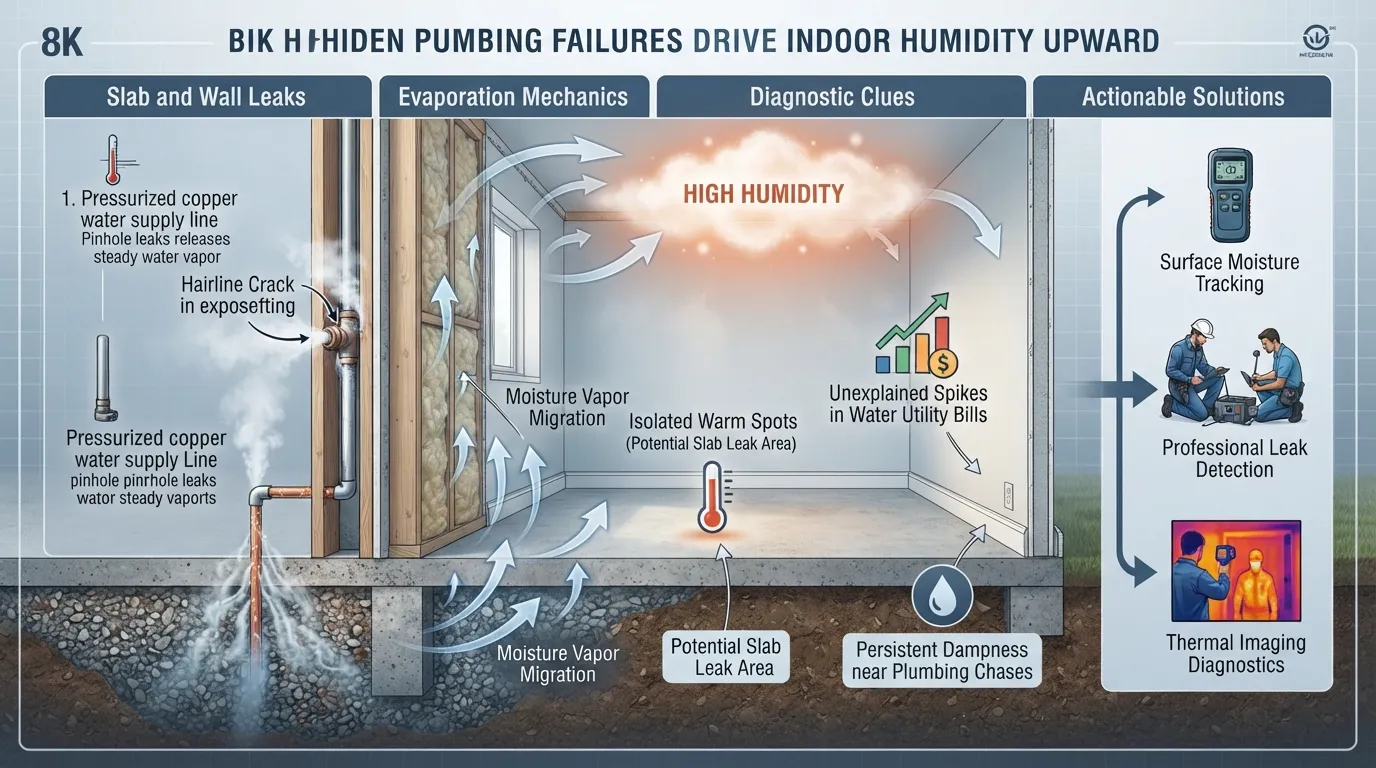
How Hidden Leaks Raise Indoor Humidity
While high atmospheric moisture usually causes plumbing to sweat, the reverse can also happen: failing plumbing can quietly generate severe indoor humidity. When a pipe develops a slow breach inside a wall cavity, beneath a floor, or above a drop ceiling, thousands of gallons of water evaporate into enclosed structural spaces over time.
Constant Evaporation: Unseen weeping joints or pinhole leaks continuously feed moisture into stagnant air spaces, raising relative humidity levels throughout the home.
Trapped Microclimates: Because these leaks occur behind drywall or flooring, the resulting humidity gets trapped inside framing chambers rather than venting outside.
Slab Leaks and Under-Floor Moisture
In South Florida properties built on concrete slab foundations, supply or drain line failures beneath the concrete create unique moisture dynamics.
Capillary Action: Water escaping from a compromised under-slab pipe is wicked upward through porous concrete foundations, saturating the base of interior walls.
The Humidity Effect: As this subterranean moisture evaporates across tile or carpeted floors, it acts as an indoor humidifier, causing localized relative humidity spikes even when outdoor weather conditions are relatively dry.
Clues That the Source Is a Leak, Not the Weather
If your indoor humidity remains persistently high despite running your air conditioning system continuously, the root cause is likely an active internal water source rather than Miami’s outdoor climate.
Weather Mismatch: Dampness persists or worsens inside the home even during dry winter cold fronts when outdoor humidity drops significantly.
Localized Warm Spots: Floor tiles or walls near plumbing chases feel unusually warm or damp to the touch.
Unexplained Utility Spikes: Your monthly water bill creeps upward while household water consumption habits remain completely unchanged.
What to Do First
If diagnostic tests point toward an internal plumbing failure generating your high indoor humidity, taking immediate, organized action prevents structural damage.
Locate the Main Shutoff: Quickly identify and test your property’s main water shutoff valve so you can stop water flow if a pipe ruptures completely.
Check the Meter: Perform a static water meter test to confirm whether water is actively escaping through your closed system.
Call a Professional: For verified underground or hidden structural failures, contact an expert in leak detection and repair to pinpoint the break without destructive exploratory demolition. If you encounter a gushing pipe or catastrophic fitting blow-out, reach out to an experienced emergency plumber immediately to secure your property.
Humid Weather, Drain Odors, and Dry P-Traps
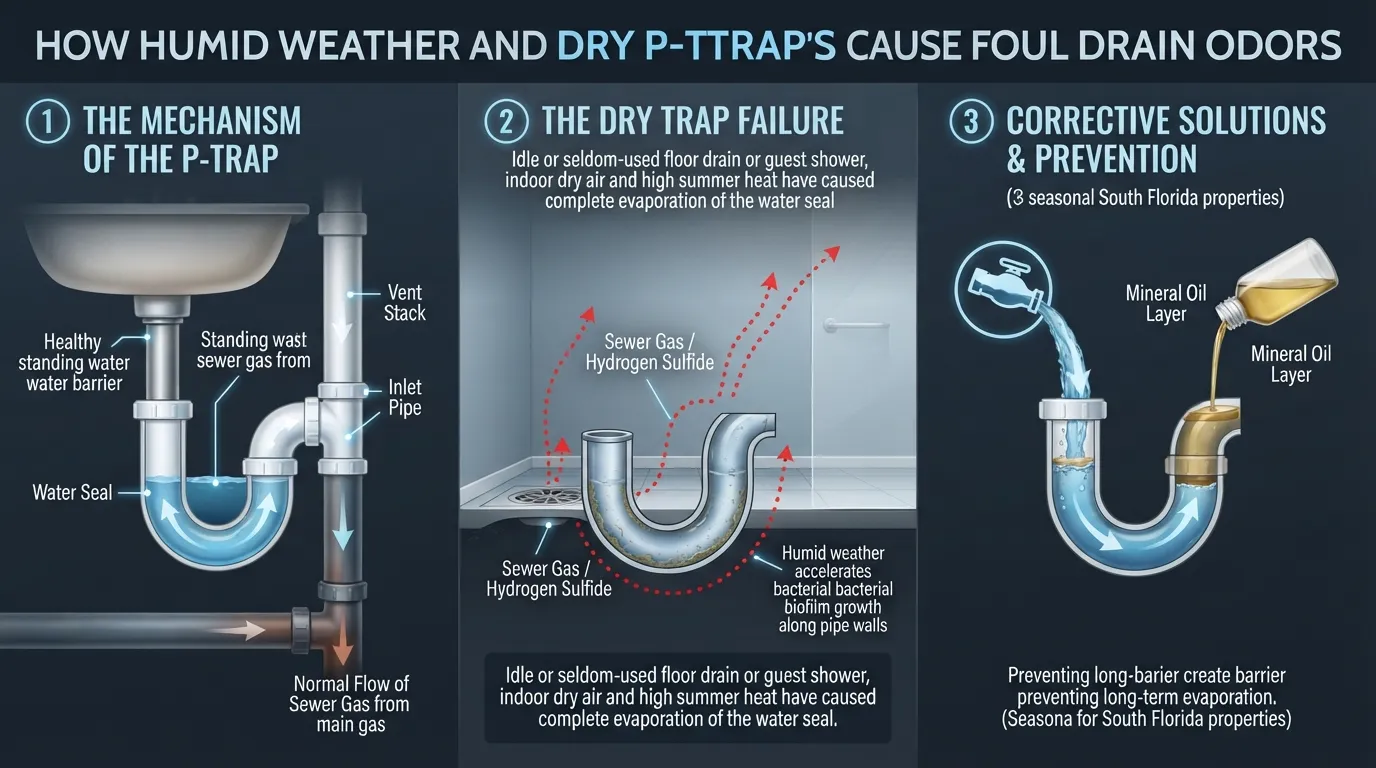
Why Drains Smell Worse in Humid Weather
Warm, moisture-laden atmospheric conditions accelerate bacterial proliferation and organic decay inside residential drain lines. When high humidity combines with stagnant air in your home, trap seals and interior pipe walls foster thick bacterial colonies that release foul-smelling gases up through your fixtures.
Accelerated Decomposition: Organic matter trapped along pipe walls breaks down much faster when surrounding air temperatures and humidity levels peak.
Trapped Gases: Humid air inside the home creates subtle pressure differentials that pull sewer gases out of sluggish, unvented plumbing traps.
The Dry P-Trap Problem
Every plumbing fixture features a curved section of pipe called a P-trap designed to hold a standing barrier of water that blocks sewer gas from entering your living space. When a seldom-used plumbing fixture sits idle, the water seal evaporates rapidly into dry indoor air, leaving an open gateway for strong rotten-egg or sewer smells.
Quick Fix for an Unused Shower, Tub, or Floor Drain
Restoring the vapor barrier in an idle drain takes only seconds, immediately eliminating musty odors caused by an unsealed P-trap.
Immediate Refill: Run water down the shower, tub, or floor drain for a full 60 seconds to completely replenish the water seal inside the P-trap.
Long-Term Prevention: For guest bathrooms or seasonal Miami homes that sit empty for months, pour a small cup of mineral oil down the drain after filling the trap. Because mineral oil does not evaporate like water, it creates a persistent floating barrier that stops evaporation indefinitely.
When the Smell Isn’t a Dry Trap
If flushing water down your P-trap fails to eliminate the foul odor, the source of the problem goes beyond simple evaporation.
Biofilm Buildout: Thick sludge, hair, and soap scum lining the upper walls of the drain pipe rot independently of the water seal; professional drain cleaning can scour away this odor-causing buildup.
Roof Vent Stoppages: Blocked plumbing vent stacks on your roof prevent proper air intake, siphoning water out of traps whenever toilets flush or sinks drain elsewhere in the house.
Compromised Sewer Lines: If persistent sulfur smells continue despite clean traps and clear lines, a professional sewer line inspection can check for hidden cracks, tree root intrusion, or venting failures.
Technician’s Tip: In seasonal South Florida properties, guest bathroom floor drains and seldom-used utility sinks are the #1 source of mystery home odors; keeping a reminder calendar to run every secondary fixture monthly prevents seasonal dry-trap foul air.
How to Protect Your Pipes: Step-by-Step Insulation Guide
What You’ll Need
Proper preparation ensures a seamless installation that completely seals your vulnerable water lines against atmospheric moisture. Gather the following materials before starting your project:
Closed-Cell Foam Pipe Sleeves: Select pre-slit polyethylene or elastomeric foam tubes matching your exact outer pipe diameter [01:12].
Seam Sealer or Foil Tape: Heavy-duty waterproof tape or contact adhesive to secure longitudinal splits and butt joints [01:55].
Tape Measure: Essential for sizing pipe runs accurately before cutting foam.
Utility Knife: A sharp blade for trimming sleeves, notching corners, and fitting around tight elbows [02:13].
Step-by-Step: Insulating Cold Water Pipes
Installing foam sleeves creates an effective thermal barrier that keeps warm, humid air away from chilled metal surfaces [02:51].
1. Measure Pipe Diameter: Measure the outer circumference of your cold water supply line with a tape measure to determine whether you need 1/2-inch, 3/4-inch, or 1-inch insulation.
2. Buy Matching Size: Purchase foam sleeves with an inner diameter that matches your pipe size snugly; loose sleeves will still allow air pockets to form.
3. Cut to Length: Use your utility knife to cut the foam sleeves to the exact measured lengths required for straight runs and fittings.
4. Fit and Seal the Seam: Open the pre-slit foam tube along its factory cut, snap it over the pipe [01:41], and peel away the adhesive strip backing (or apply seam sealer) to lock the edges together.
5. Seal Joints and Gaps: Wrap duct tape or foil tape around butt joints and intersection gaps every few feet to secure the installation [01:55]. For a visual walkthrough on how these sleeves stop condensation drips, watch this guide on Tip To Prevent Cold Water Pipe Sweating, Condensation and Stop Dripping.
One Rule Most Guides Skip: Dry the Pipe First
Never apply insulation over an actively wet or sweating pipe. If you trap moisture inside the foam sleeve, it creates an unventilated microclimate that accelerates corrosion and fosters hidden mold growth directly against the pipe wall. Always wipe down the entire run with a microfiber towel and let it dry completely before snapping the foam in place.
Common Mistakes
Avoiding common installation errors ensures your thermal barrier performs effectively throughout peak South Florida humidity seasons.
Wrong Size Sleeves: Using oversized foam leaves air gaps inside the sleeve, allowing condensation to form continuously on the bare pipe underneath.
Gaps at Fittings: Leaving elbows, T-joints, and valves exposed invites heavy localized sweating. Notch and angle-cut foam pieces to wrap complex fittings tightly [02:45].
Using Wall Insulation: Substituting fiberglass house insulation for closed-cell pipe sleeves fails because fiberglass absorbs ambient moisture like a sponge, holding water against the metal surface.
Pipes That Are Hard to Reach
While exposed basement or utility room runs are easy DIY projects, plumbing lines located inside sealed wall cavities, low-clearance attic spaces, or beneath concrete slabs cannot be retrofitted easily. For inaccessible runs showing signs of chronic sweating or hidden moisture damage, contact a licensed professional to evaluate alternative routing or commercial-grade encapsulation options.
Controlling Humidity In Your Home
Does Running the AC Lower Humidity?
Air conditioning systems naturally remove atmospheric moisture as warm indoor air passes over the freezing evaporator coils, condensing water vapor into the condensate drain line. However, this dehumidifying effect has distinct operational limits.
Short-Cycling Issues: If your AC system is oversized for your square footage, it cools the air too quickly and shuts off before running long enough to pull moisture out of the air.
Extreme Subtropical Days: On peak humid days when outdoor moisture surges, standard cooling cycles may struggle to keep indoor relative humidity below the critical 50% threshold without supplementary systems.
Do Dehumidifiers Help Protect Pipes?
Adding targeted dehumidification provides an effective layer of defense against chronic pipe sweating and hidden structural moisture.
Portable vs. Whole-Home Units: Portable dehumidifiers work well in isolated trouble spots like laundry rooms or under-sink zones, while whole-home ducted units integrate directly with your HVAC system to regulate moisture uniformly across every room.
Target Setting: Adjust your unit to target a continuous relative humidity level between 40% and 45% to keep cold water supply lines safely above the local dew point.
Placement: Position portable units near primary moisture zones such as utility closets, basements, or enclosed crawlspaces.
Do Exhaust Fans Work?
Dedicated mechanical ventilation removes high-volume moisture at the direct point of origin before it can disperse and condense onto cold pipes or cool walls.
Essential Locations: High-CFM exhaust fans must be installed in bathrooms, kitchens, and laundry areas to vent moisture-laden air directly outdoors.
Why Regular Fans Fall Short: Standard circulating fans only move air around and speed up evaporation temporarily; they do not extract moisture from the home.
Unused Bathrooms: Even a powder room or guest bathroom without an active shower requires periodic ventilation to prevent stagnant, humid air from settling into wall chases and plumbing cavities.
Does Opening Windows Help?
Opening windows to “air out” a humid home only works when outdoor atmospheric moisture is significantly lower than your indoor humidity level.
The Miami Summer Reality: Opening windows during South Florida’s warm, wet summers immediately floods your air-conditioned property with heavy outdoor moisture, causing indoor humidity to spike and triggering instant condensation across all cold water lines.
Rule of Thumb: Check your digital hygrometer before opening windows; only ventilate naturally when outdoor relative humidity registers well below indoor levels.
Fix Moisture Sources
Controlling indoor humidity requires eliminating internal moisture generators that feed microclimates around your plumbing infrastructure.
Dryer Vents: Ensure your clothes dryer exhaust duct vents securely outside rather than leaking humid lint-trap air into utility rooms or crawlspaces.
Groundwater Seepage: Address positive grading and exterior drainage issues that allow rainwater to pool against foundation walls. For properties with persistent below-grade moisture intrusion, installing a professional sump pump prevents subterranean water from evaporating upward through the home.
Technician’s View: In homes with chronic pipe sweating, service professionals find that combining a properly sized whole-home dehumidifier with sealed, insulated cold water lines solves 95% of recurring condensation issues permanently.
DIY or Call a Plumber? A Simple Decision Guide
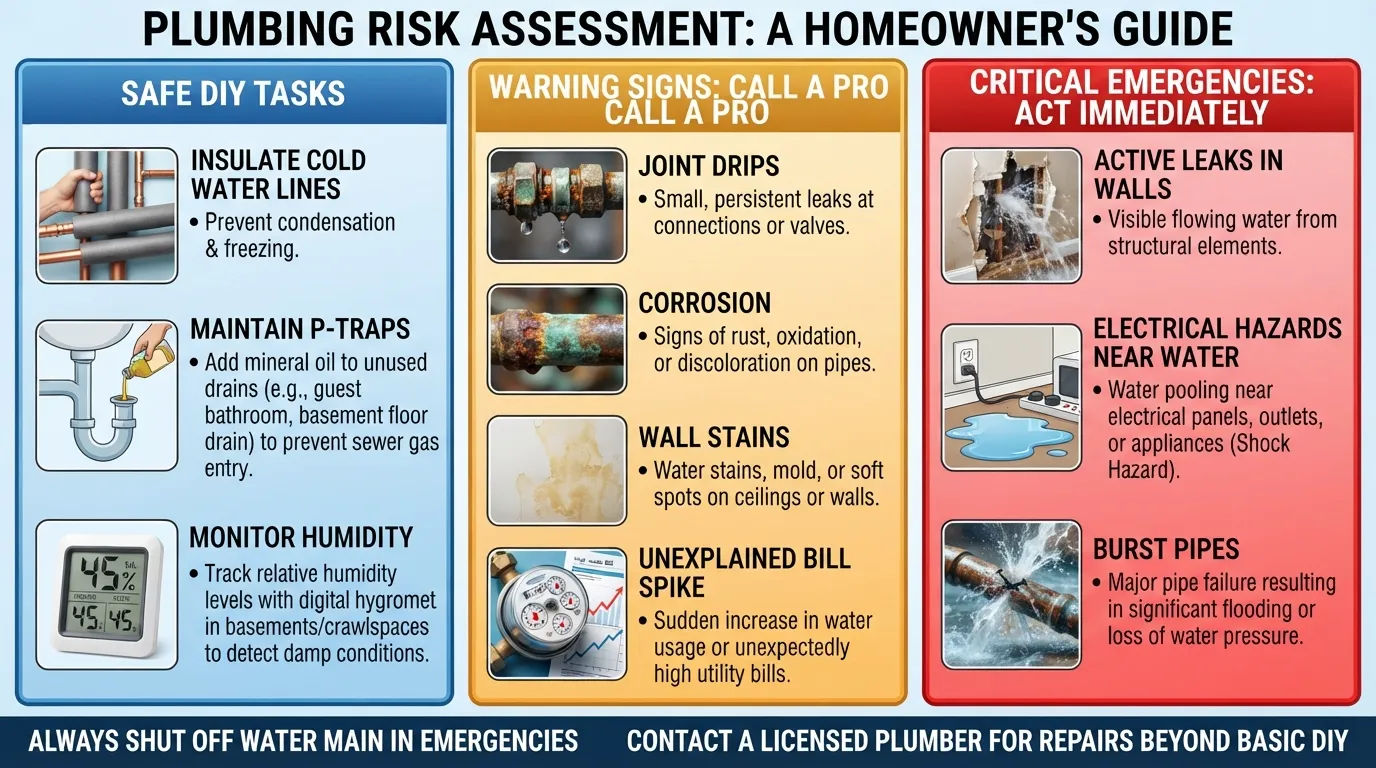
Safe to Handle Yourself
Many routine humidity and condensation maintenance tasks can be managed safely as weekend DIY projects without specialized tools or professional intervention.
Installing Pipe Insulation: Wrapping accessible cold water lines in pre-slit closed-cell foam sleeves.
Clearing Dry Traps: Pouring water or a protective layer of mineral oil into seldom-used floor drains, tubs, and guest shower traps.
Improving Air Circulation: Positioning portable dehumidifiers and running mechanical exhaust fans in high-moisture zones.
Monitoring Microclimates: Placing digital hygrometers throughout utility rooms, bathrooms, and under-sink cabinets to track daily relative humidity levels.
Call a Plumber If You See
When atmospheric moisture issues transition into physical plumbing failures or structural wear, it is time to schedule professional support.
Joint Drips: Persistent water droplets forming on soldered copper elbows, threaded fittings, or valve stems.
Corrosion and Rust: Flaking rust on steel nipples or heavy green buildup encrusting pipe joints.
Wall and Ceiling Stains: Discolored rings or soft, buckling drywall patches near hidden water supply lines.
Unexplained Utility Spikes: Higher water bills that cannot be attributed to changes in household habits.
Persistent Odors: Unresolved sewer smells despite a freshly filled P-trap.
If you notice any of these warning signs in your home, it is best to book a plumbing inspection to identify the root cause before structural damage spreads.
Emergency Signs
Certain plumbing-related moisture scenarios require immediate, round-the-clock professional intervention to protect your property from catastrophic loss.
Active Leaks in Walls or Ceilings: Water actively pooling or streaming down interior framing cavities.
Electrical Hazards: Dripping water coming into direct contact with electrical outlets, breaker panels, or light fixtures.
Burst or Bulging Pipes: Pipes that have ruptured, cracked, or deformed under pressure.
When faced with these critical hazards, contact a licensed 24/7 emergency plumbing specialist immediately to shut off the main supply and secure your home.
What a Professional Inspection Covers
A comprehensive diagnostic visit from an experienced Miami plumbing contractor goes far beyond a casual visual check, utilizing advanced technology to evaluate hidden vulnerabilities.
Pipe and Fitting Condition: Assessing copper, PVC, and galvanized lines for internal wear and external oxidation.
Moisture Mapping: Using thermal imaging cameras and digital moisture meters to scan behind walls and beneath flooring.
Leak Testing: Performing static pressure tests to uncover invisible pinhole leaks or slab line breaches.
System Recommendations: Providing actionable guidance on whole-home insulation upgrades, drainage improvements, and proper ventilation strategies.
Cost Considerations
Investing in professional plumbing repairs and humidity mitigation varies based on the scope of work required. Minor diagnostic inspections and targeted pipe wrapping typically involve standard service call fees, whereas specialized slab leak detection, pipe replacement, or major drain repairs require customized estimates. Addressing moisture issues early prevents expensive structural remediation and mold removal down the road.
Frequently Asked Questions
Can humidity damage plumbing?
Yes, high relative humidity accelerates pipe corrosion, rusts metal fittings, and causes cold water supply lines to sweat continuously. Over time, constant moisture pooling around joints and fixtures weakens structural integrity and encourages mold growth behind walls.
Is it normal for pipes to sweat?
Pipe sweating is common in subtropical climates when warm, humid indoor air contacts cold water supply lines chilled below the local dew point. However, heavy or continuous dripping is not normal and requires insulation or humidity control to prevent water damage.
Is 70% humidity too high in a house?
Indoor relative humidity of 70% is exceptionally high and problematic for any residence. At this level, moisture aggressively feeds mold growth within 48 hours and causes continuous pipe condensation, warped woodwork, and musty indoor odors.
Is 90% humidity in a house bad?
Yes, 90% relative humidity creates a severe microclimate that rapidly rots structural framing, ruins drywall, and accelerates rust across every exposed metal pipe fitting and valve. It demands immediate dehumidification and leak checks.
What humidity level causes mold?
Mold spores begin to germinate and colonize building materials when relative humidity consistently exceeds 60%. Keeping indoor humidity below that threshold—ideally between 30% and 50%—deprives mold of the moisture it needs to grow.
What is the healthiest humidity for a home?
The healthiest indoor relative humidity range is between 30% and 50%. This balanced target prevents biological growth and pipe sweating while maintaining comfortable conditions for human occupants.
Does keeping the AC on help with humidity?
Running your air conditioner lowers indoor humidity because warm air passing over cold evaporator coils condenses water vapor into the condensate drain line. However, oversized or short-cycling systems may struggle to control moisture on peak humid days.
At what humidity should I use AC?
You should run your air conditioning whenever indoor relative humidity rises above 50% to 60%. In humid climates like Miami, continuous or programmed AC runtimes are essential to keep moisture levels in the safe zone.
Does opening windows reduce humidity?
Opening windows only reduces humidity when outdoor air is significantly drier than your indoor air. During humid summer months, opening windows floods an air-conditioned home with ambient moisture and triggers instant pipe sweating.
What are the signs of high humidity in a house?
Common signs include musty odors, fogged mirrors that linger, peeling wallpaper, bubbling paint, warped cabinet floors, and wet or rusting water supply pipes.
What could cause a bathroom to be humid when it isn’t being used?
An unused bathroom that stays humid typically points to a hidden slow leak behind the vanity, an unvented plumbing chase drawing warm crawlspace air, or a complete lack of cross-ventilation trapping ambient moisture.
Does a bathroom without a fan get rid of humidity?
A bathroom without a mechanical exhaust fan cannot efficiently expel high-volume steam. Without ventilation, moisture lingers on tile, grout, and ceiling surfaces, increasing the risk of mildew and pipe condensation.
Can I use a regular fan in the bathroom?
A standard circulating desk or ceiling fan only moves air around and temporarily speeds up surface evaporation; it cannot extract moisture out of the home. True humidity removal requires a dedicated exhaust fan venting directly outdoors.
How do I get an unused shower working again?
To restore an idle or seasonal shower, run water through the fixture for at least 60 seconds to completely refill the P-trap water seal. For long-term vacancies, add a protective layer of mineral oil to stop the water seal from evaporating.
Conclusion and Next Step
Key Takeaways
Managing the unique intersection of indoor humidity and plumbing infrastructure protects your Miami home from costly structural damage and premature pipe degradation.
Condensation Triggers: Subtropical heat and heavy air conditioning cause uninsulated cold water pipes to drop below the dew point, resulting in continuous sweating.
Invisible Threats: High indoor humidity above 60% accelerates exterior pipe corrosion, rusts metal fittings, and creates ideal conditions for hidden mold growth.
Proactive Maintenance: Installing closed-cell foam insulation, maintaining proper ventilation, and monitoring relative humidity levels between 30% and 50% safeguard your plumbing system.
Hidden Leak Indicators: Unexplained utility bill increases or persistent indoor dampness despite running your AC often point to hidden plumbing breaches behind walls or beneath slabs.
Protect Your Pipes Before Damage Spreads
Taking control of your home’s microclimate early prevents minor condensation issues from escalating into major structural repairs. If you notice signs of pipe sweating, corrosion, or unexplained moisture around your property, schedule your appointment with our team today, or explore our plumbing services to learn how we keep South Florida homes protected year-round.
Main Services
Related Posts
Need a Plumber in Miami?
Schedule service online or speak directly with the EZ Plumbing team.
Owner-Led Local Service
Know who is behind the business before you request service. The owners, contact line and Miami service pages are published clearly.
- Named business owners
- Direct phone and social channels
- Local Miami service information
Clear Help Before You Book
Review the relevant service page, contact the team directly and use the booking page when you are ready—without relying on vague claims.
- Service-specific information
- Direct questions before scheduling
- Clear online booking route