What Is a Low Flow Shower Head and Does It Affect Water Pressure? Causes and Fixes
What Is a Low-Flow Shower Head?
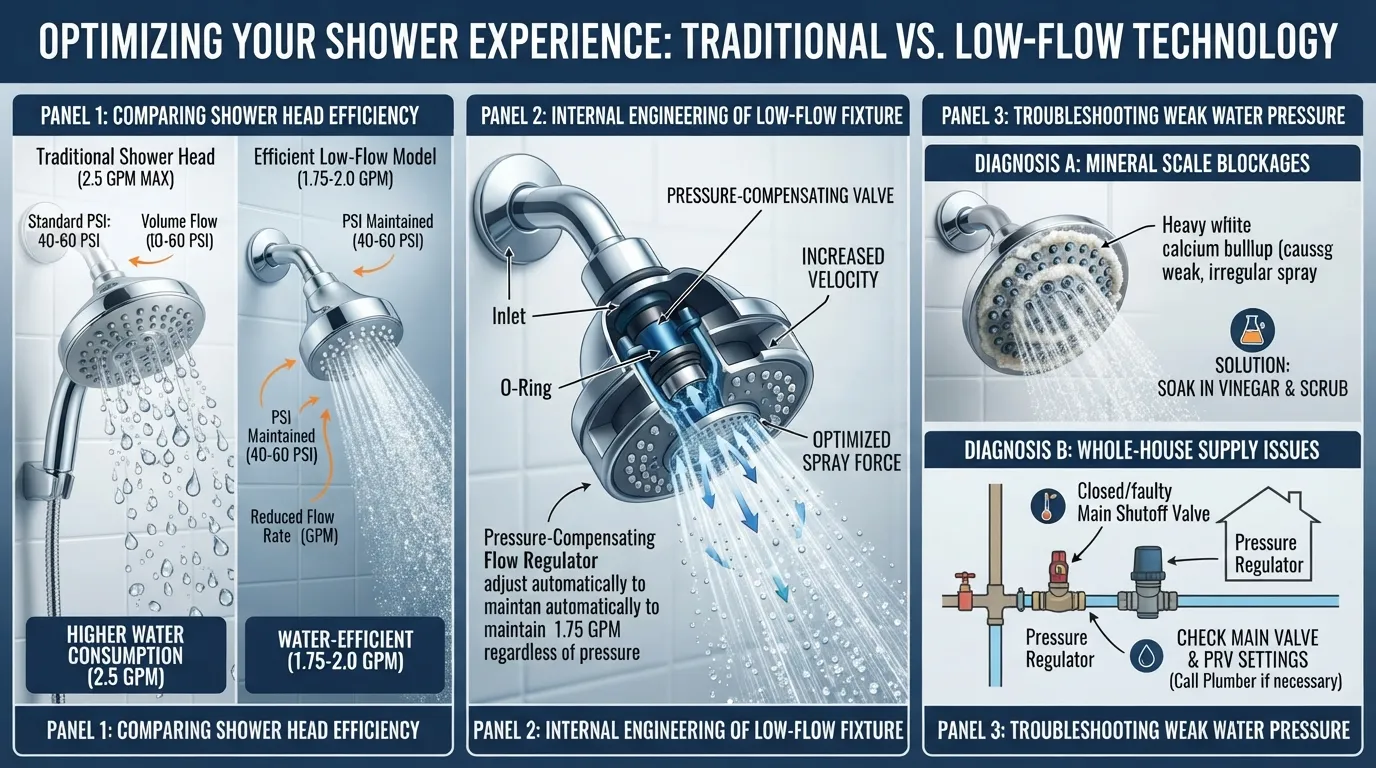
A low-flow shower head is an engineered water-saving fixture designed to consume 2.0 gallons per minute (GPM) or less, contrasting sharply with the traditional federal maximum standard of 2.5 GPM. By reducing the total volume of water passing through the system, these units lower utility costs and resource consumption without sacrificing user experience or force.
Low-Flow Shower Head Definition
A low-flow or water-saving shower head restricts water output to a maximum of 2.0 GPM, achieving at least a 20 percent reduction in water volume compared to conventional fixtures. Certified models utilize advanced internal mechanisms—such as aerators, laminar flow restrictors, or air-induction nozzles—to maintain a drenching, high-performance spray pattern while using significantly fewer gallons.
Designed to operate efficiently at standard residential water pressures.
Often backed by the EPA WaterSense label, ensuring independent testing for force and coverage.
Cuts household indoor water consumption substantially over time.
Low-Flow vs Standard Shower Head Flow Rates
Understanding flow rates—measured in gallons per minute (GPM) or liters per minute—helps clarify how much water different fixtures consume during routine use.
| Shower Head Category | Flow Rate (GPM) | Flow Rate (Litres per Minute) | Description & Standard Reference |
| Traditional Standard | 2.5 GPM | ~9.5 L/min | Maximum allowable standard set by federal regulations for older or conventional fixtures. |
| Efficient Low-Flow | 1.25 to 2.0 GPM | ~4.7 to 7.6 L/min | Encompasses EPA WaterSense certified models and high-efficiency variants balancing conservation and comfort. |
| Ultra-Low Conservation | 1.0 to 1.25 GPM | ~3.8 to 4.7 L/min | Maximum water-saving tier typically utilized in drought-prone regions, off-grid cabins, or strict green builds. |
What “Low-Flow” Does Not Mean
A common misconception is that installing a low-flow fixture automatically results in a weak, disappointing trickle, confusing volume reduction with a drop in pressure. In modern engineering, flow rate (volume) and water pressure (force) are controlled by entirely separate factors.
Pressure vs. Volume: Low-flow shower heads restrict volume (GPM), whereas water pressure is determined by your home’s plumbing psi (pounds per square inch).
Advanced Aeration: Quality water-saving shower head designs infuse air streams into the water droplets, creating a forceful, high-velocity sensation despite the lower water volume.
Performance Standards: Certified fixtures must pass strict spray coverage and force evaluations to ensure the user experience remains uncompromised.
Does a Low-Flow Shower Head Affect Water Pressure?
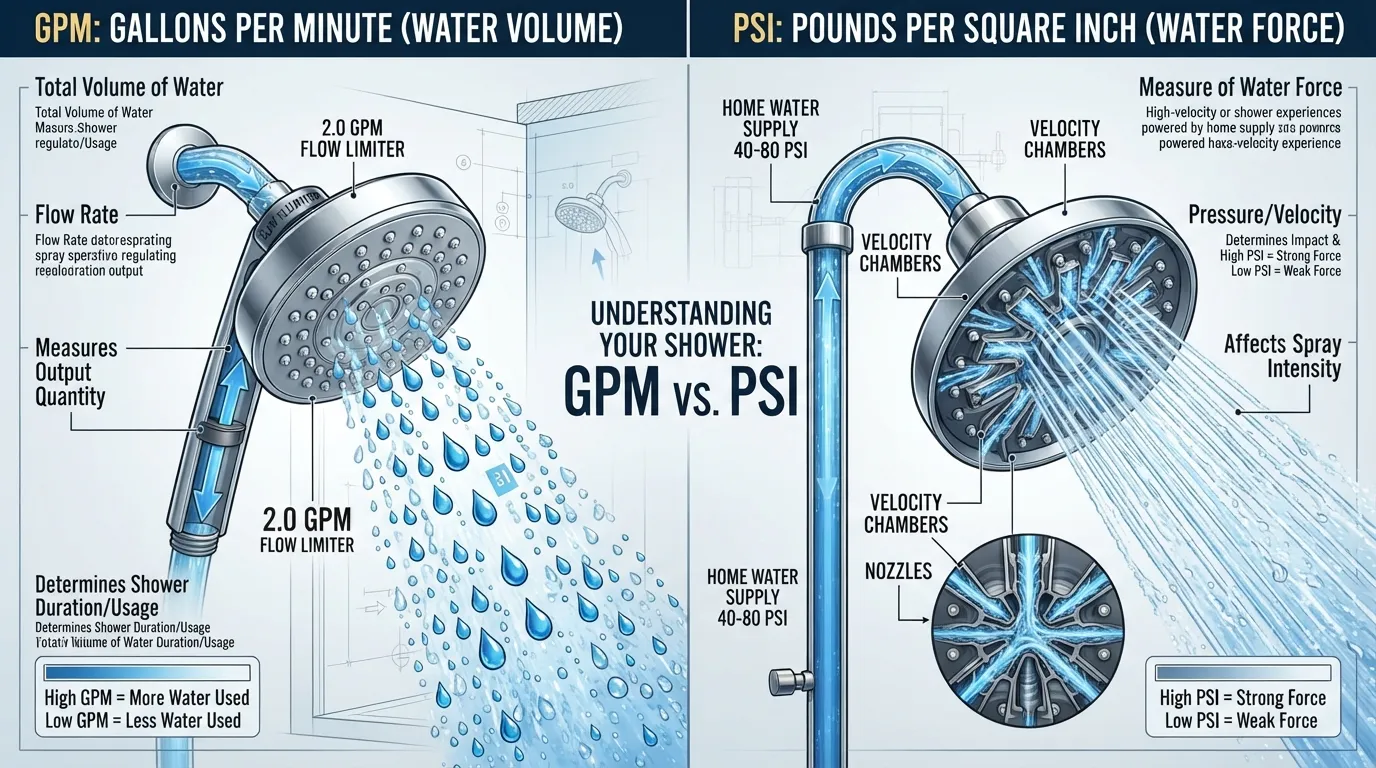
A low-flow shower head does not inherently reduce water pressure, because water volume (gallons per minute) and water pressure (pounds per square inch) are governed by entirely different plumbing mechanics. Modern efficient fixtures are engineered to deliver a vigorous, high-force spray while utilizing significantly less water overall.
Water Volume (GPM) vs Water Pressure (PSI): What’s the Difference?
Water volume measures the total amount of water delivered over time, typically quantified in gallons per minute (GPM). Water pressure measures the force pushing that water through your plumbing lines, quantified in pounds per square inch (PSI).
Independent Controls: Your home’s PSI is determined by municipal supply lines, booster pumps, or gravity tanks, whereas your shower head simply dictates how much volume (GPM) is allowed out.
Conservation Mechanics: Restricting GPM conservation goals does not automatically drain the PSI driving the water stream forward.
Balanced Delivery: A properly designed fixture optimizes the available pressure to maintain full performance despite the lower flow volume.
Why a Low-Flow Head Can Still Feel Strong
Modern water-saving fixtures utilize advanced physics to make lower water volumes feel just as powerful—and often more drenching—than older, wasteful fixtures. Ingenious internal components maximize every drop that passes through the valve.
Nozzle Design: Tapered or narrowed internal ports compress the water pathway, increasing spray force and coverage.
Increased Water Velocity: By restricting the exit area, water shoots out at a higher speed, creating a robust kinetic impact on the skin.
Pressure-Compensating Valves: These clever internal regulators maintain a steady, high-velocity stream regardless of fluctuations in household water supply pressure.
Why the “Weak Trickle” Myth Still Exists
The lingering fear of low-flow fixtures dates back to early government regulations introduced in the 1990s. Early iterations often achieved conservation simply by jamming crude restrictors into outdated shower head bodies, leading to a miserable user experience.
Early Regulations: First-generation standards forced manufacturers to cut water volume without refining internal spray dynamics.
Poor Engineering: These early designs lacked air-induction technology or precision nozzles, causing heavy stream drop-offs.
Modern Evolution: Today’s certified fixtures bear little resemblance to those early models, utilizing aerodynamic and fluid-dynamic breakthroughs to ensure optimal comfort.
When a Low-Flow Head Can Feel Weaker
While premium fixtures perform brilliantly, certain scenarios can cause a low-flow shower head to feel genuinely weak or inadequate. Understanding these limitations helps separate fixture design flaws from external plumbing issues.
Low-Quality Models: Cheap uncertified fixtures often lack pressure-compensating mechanisms, resulting in a limp, uninspired stream.
Inadequate Supply Pressure: Homes experiencing exceptionally low municipal psi or struggling well pumps may lack the baseline force needed to drive an efficient fixture effectively.
Plumbing Obstructions: A common observation among professional plumbers is that complaints of a “weak low-flow shower” frequently trace back to mineral scale buildup, clogged inline screens, or restricted home supply lines rather than the shower head itself.
Types of Low-Flow Shower Heads: Aerating vs Laminar
Choosing the right low-flow fixture depends heavily on how it delivers water, as different internal engineering methods create distinct spray experiences. Understanding the operational differences between aerating and laminar designs helps match your personal comfort preferences with water-conservation goals.
Aerating Shower Heads: How They Work and What They Feel Like
Aerating shower heads mix air directly into the water stream as it passes through the fixture, creating a fine, misty, and voluminous spray. This air-induction process expands the physical volume of the droplets while using fewer total gallons of water.
Fuzzy, Full Spray: The integration of air produces a lighter, cloud-like drenching sensation that feels remarkably soft on the skin.
Slight Heat Loss: Because the water is broken down into fine droplets mixed with ambient air, the spray can cool down slightly faster before hitting your body, especially in drafty bathrooms.
Design Versatility: This technology is commonly integrated into various fixture styles, including a standard wall-mounted unit or a multi-setting handheld shower head with hose.
Laminar-Flow Shower Heads: How They Work and What They Feel Like
Laminar-flow shower heads produce distinct, crystal-clear individual streams of water without mixing air into the flow. Instead of a misty cloud, the water travels in parallel, unbroken ropes or columns from the faceplate.
Vigorous Stream Feel: The individual water streams deliver a heavier, more direct kinetic impact that mimics a traditional high-flow feel.
Superior Heat Retention: Because air is not whipped into the water, the streams retain their thermal energy much longer, keeping the water noticeably warmer.
Reduced Humidity: Laminar technology prevents atomized mist from floating into the air, making it an excellent choice for a rain shower head or enclosed spaces prone to excessive bathroom humidity and mold growth.
Aerating vs Laminar Comparison Table
| Feature / Metric | Aerating Shower Heads | Laminar-Flow Shower Heads |
| Spray Feel | Soft, misty, and voluminous | Heavy, direct, and distinct individual streams |
| Heat Retention | Moderate (water cools slightly faster due to air mixing) | High (streams retain thermal energy efficiently) |
| Bathroom Humidity | Higher (creates more airborne mist) | Lower (minimizes mist and atmospheric moisture) |
| Best For | Standard residential baths preferring a soft, cloud-like spray | Humid climates, modern rain shower setups, or heat-retention needs |
What the WaterSense Label Tells You
Navigating the market for efficient fixtures is much simpler when you look for independent certification verifying performance standards. The EPA WaterSense shower head information outlines rigorous testing protocols that ensure a product cuts water use by at least 20 percent while maintaining or exceeding expected spray force and coverage.
Independent Testing: Certified fixtures undergo strict laboratory evaluations to guarantee they do not sacrifice user comfort for conservation.
Quality Assurance: The label prevents manufacturers from cutting flow rates to unworkable levels, ensuring reliable everyday performance.
How to Tell If You Have a Low-Flow Shower Head
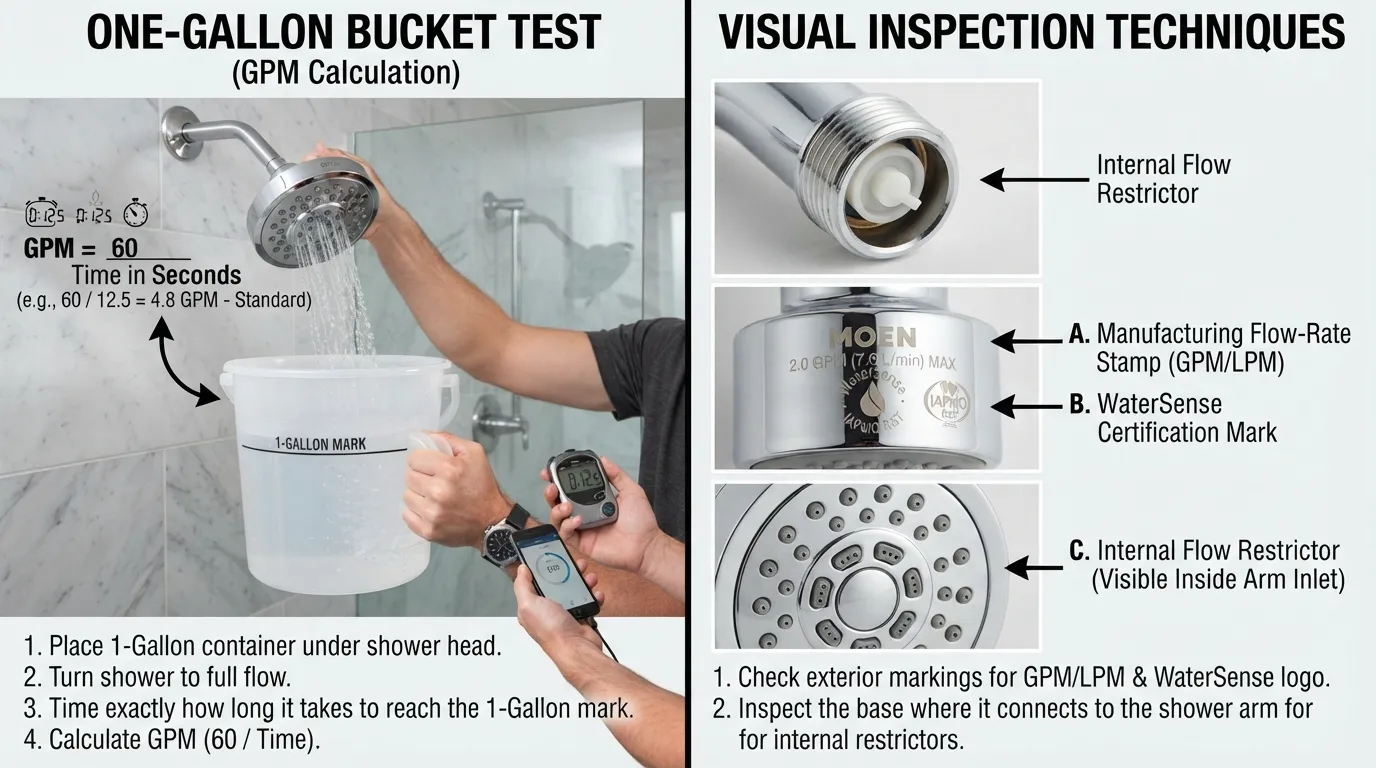
Determining whether your current bathroom fixture is an efficient low-flow model requires a simple diagnostic check. Because flow specifications are rarely obvious from appearance alone, testing the actual water volume or inspecting manufacturing markings provides an immediate, definitive answer.
The One-Gallon Bucket Test
The most accurate DIY method to measure your fixture’s performance is the one-gallon bucket test. This simple procedure calculates your exact gallons per minute (GPM) rate using common household items.
Place a standard one-gallon bucket or container directly under the shower head.
Turn the shower on to your normal running pressure and start a stopwatch or phone timer simultaneously.
Stop the timer the exact second the water container fills to the one-gallon mark.
Calculate your GPM calculation by dividing 60 by the number of seconds it took to fill the bucket (for example, filling it in 30 seconds equals 2.0 GPM).
Check the Shower Head Label or Stamp
Manufacturers are legally required to print or stamp the flow rate directly onto the plumbing fixture. A quick visual inspection can save you from doing math.
Look closely around the metal mounting nut, the outer rim of the faceplate, or the side of the shower head body.
Search for an engraved or laser-etched rating, such as “1.75 GPM,” “2.0 GPM,” or the standard maximum “2.5 GPM”.
Check for an official WaterSense logo stamped on the unit, which guarantees the fixture operates at or below 2.0 GPM.
Look for a Flow Restrictor Inside the Head
If your fixture lacks external markings, inspecting the internal components will reveal if a flow-limiting mechanism has been installed.
Unscrew the shower head from the shower arm using an adjustable wrench wrapped in a cloth to protect the finish.
Look inside the threaded inlet port to see if a small rubber O-ring, colored plastic disk, or brass insert is visible.
This internal flow restrictor or pressure-compensating disk is the primary hardware component responsible for limiting water volume in low-flow designs.
Check Local Rules
Plumbing codes and environmental standards dictate baseline efficiency thresholds depending on your geographic location. While federal guidelines cap standard fixtures at 2.5 GPM, state-level regional GPM rules often mandate stricter conservation targets.
States like California, Colorado, and Washington require maximum flow rates of 1.8 to 2.0 GPM for all new residential installations.
Municipalities facing severe water scarcity frequently adopt green building codes that align directly with 2.0 GPM criteria.
Always check with your local building department if you are unsure of your area’s mandated compliance ceiling.
Why Your Shower Pressure Feels Weak Real Causes
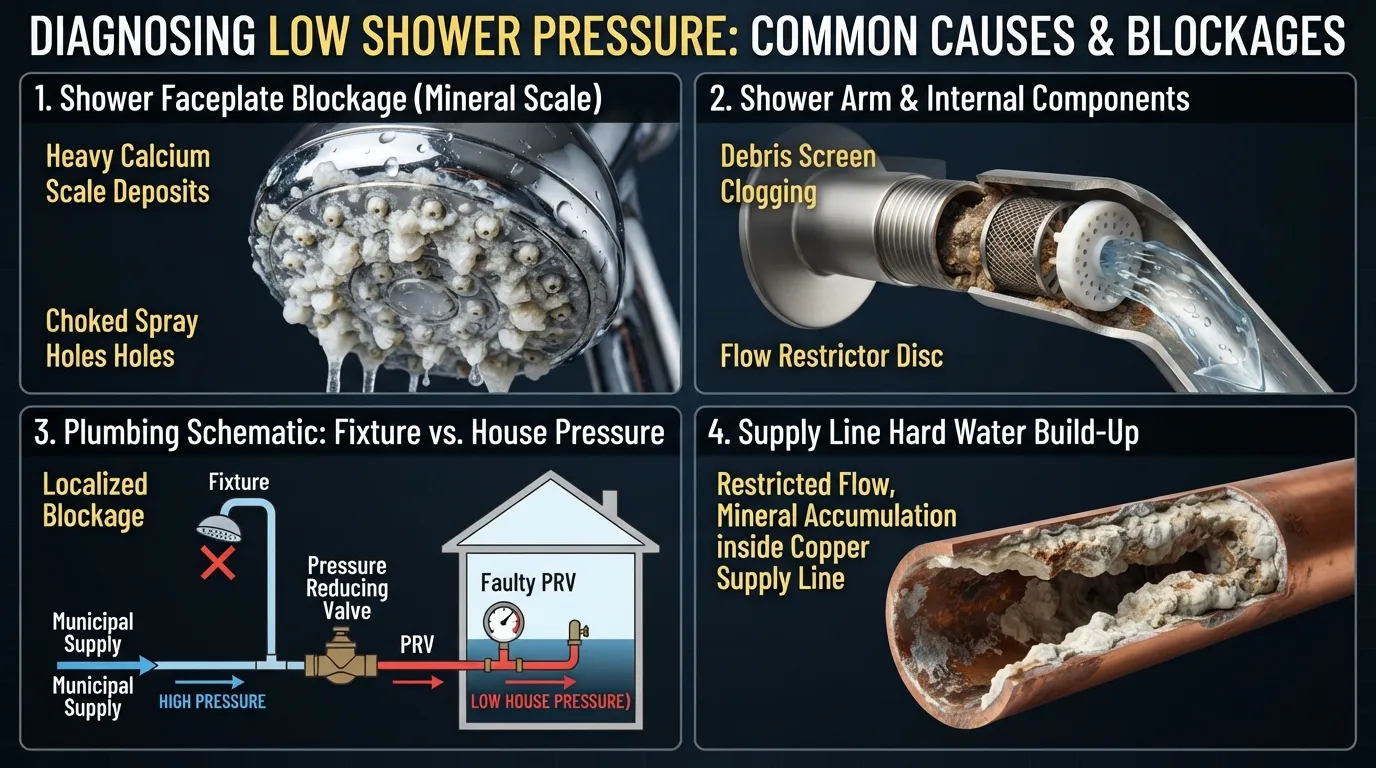
A frustratingly weak shower stream rarely points to a single universal culprit. Pinpointing whether the restriction originates directly at the fixture, within local water conditions, or deep inside your home’s plumbing lines is the key to restoring proper pressure.
Clogged Nozzles and Mineral Buildup
Mineral buildup and limescale accumulation are the single most common cause of restricted spray force. Over time, calcium and magnesium deposits harden inside the tiny spray holes of the shower faceplate.
Partial Blockages: Clogged nozzles deflect water streams haphazardly or block them entirely, drastically cutting the effective output volume.
Cleaning Routine: Soak the fixture in a bag filled with white vinegar overnight to dissolve mineral crusts.
Verification: Turn the shower on fully after cleaning to confirm whether individual streams shoot out straight and strong.
Why Hard Water Makes This Worse in Miami
Properties located in regions with hard water, such as Miami, experience accelerated mineral accumulation due to high concentrations of dissolved limestone in the regional water supply. This ongoing geological factor causes scale to build up rapidly inside both aerators and internal plumbing components.
Accelerated Clogging: High mineral content coats the inside of shower heads much faster than in soft-water areas.
Preventive Maintenance: Routine monthly descaling is often required to keep flow paths open.
Verification: Inspect the faceplate nozzles under a bright light; if white crusting is visible around the ports, hard water is actively restricting your flow.
A Built-In Flow Restrictor or Worn Cartridge
Sometimes the restriction is intentionally engineered or mechanically broken inside the valve assembly. Factory-installed flow regulators or failing internal hardware can choke water flow far beyond standard conservation limits.
Stuck Flow Restrictors: Debris trapped against an internal flow washer can completely choke the line.
Worn Shower Cartridges: A damaged mixing valve cartridge can fail to open the hot and cold ports fully, reducing output pressure.
Verification: Remove the fixture and test the naked shower arm flow; if pressure spikes without the head attached, the fixture or its internal restrictor is the bottleneck.
Problems Only at the Shower vs the Whole House
Diagnosing the scope of the pressure drop helps isolate whether the issue is localized to your bathroom or symptomatic of a broader household infrastructure problem.
Localized Issues: If every other faucet and shower in the house runs strong, the restriction is isolated to that specific shower head, valve, or supply pipe.
Whole-House Issues: If every fixture in the home suffers from low pressure, the root cause lies in your main water supply valve, pressure regulator, or municipal line.
Verification: Turn on the sink closest to the shower; if the sink roars with high pressure while the shower trickles, the problem is entirely localized to the shower setup.
Shower Arm, Valve and Hidden Pipe Issues
When cleaning the faceplate and clearing restrictors fails to resolve the issue, the obstruction may be hidden deep within the physical infrastructure of your walls.
Corroded Pipes: Older galvanized steel supply pipes narrow significantly over decades due to internal rust accumulation.
Faulty Pressure Regulators: A failing main pressure reducing valve (PRV) can starve the entire bathroom of proper psi.
Underlying Leaks: If a drop in pressure across the whole home can point to a hidden leak, professional diagnostic services like Miami Florida Plumbing leak detection and repair can locate compromised supply lines behind walls or underground.
Verification: Monitor your main water meter when all home fixtures are turned off; if the leak indicator dial is spinning, hidden pipe damage is draining your system pressure.
How to Fix Low Shower Pressure Step by Step
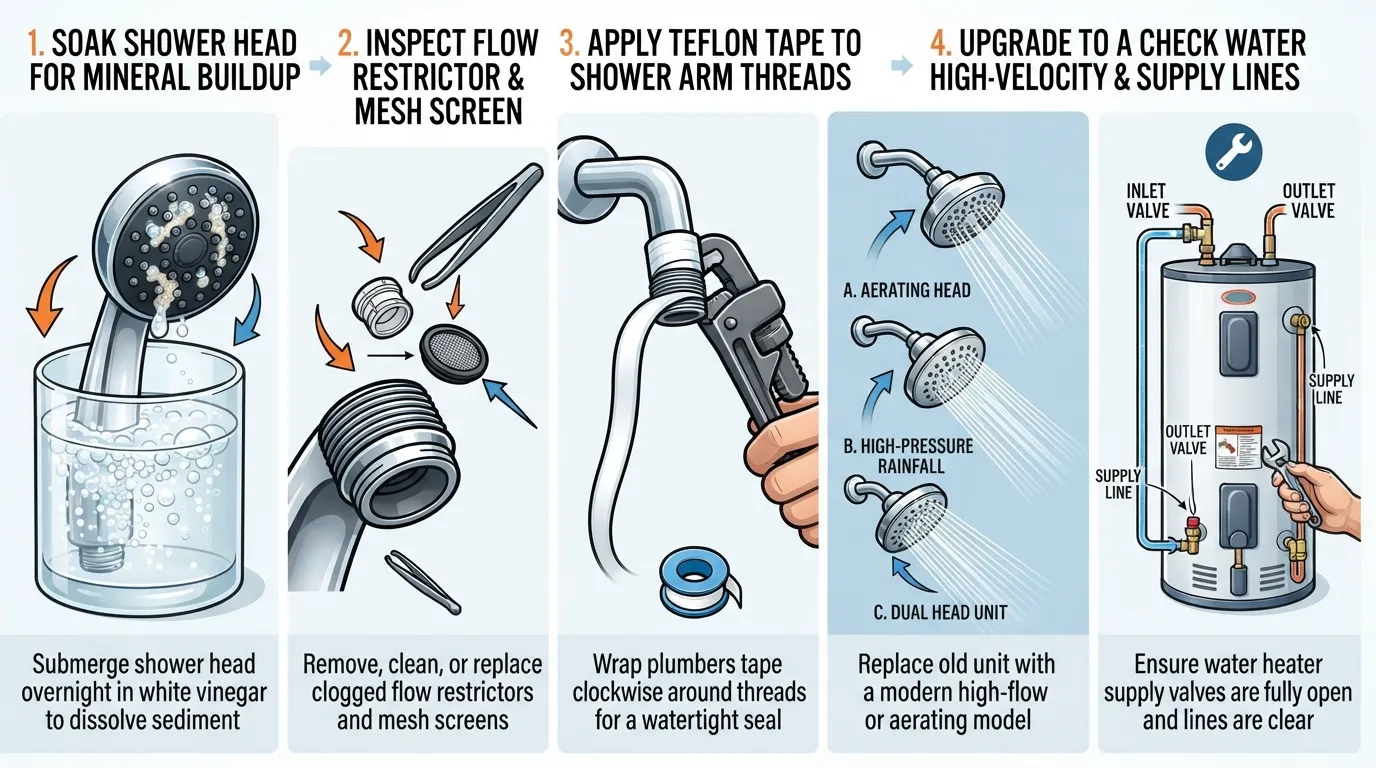
Restoring a robust stream doesn’t always require an expensive plumbing overhaul. Working through a structured diagnostic and repair sequence—from the simplest cleaning task to hardware modifications—lets you troubleshoot safely and efficiently.
When working with plumbing fixtures, always hand-tighten components first and use wrenches gently with a protective cloth wrap to avoid cracking plastic supply arms or damaging chrome finishes. Never force threaded parts cross-wise.
Step 1: Clean the Shower Head and Nozzles
Mineral scale accumulation inside the faceplate nozzles is the most frequent cause of restricted water delivery. Cleaning the unit removes hard-water crusts without requiring replacement parts.
Disassemble: Unscrew the shower head counterclockwise from the mounting arm. If it is stuck, grip the collar with an adjustable wrench cushioned by a cloth.
Soak: Submerge the fixture in a bowl filled with equal parts warm water and white vinegar for several hours or overnight.
Scrub & Rinse: Gently brush the rubber or plastic nozzles with an old toothbrush to clear loosened mineral debris, then rinse thoroughly under a running tap.
Verification: Reattach the shower head using fresh Teflon (PTFE) tape on the threads, turn on the water, and check that every individual nozzle sprays a straight, uniform stream.
Step 2: Check and Clean the Flow Restrictor
If cleaning the faceplate does not restore full force, an internal flow regulator or a trapped sediment screen may be choking the volume.
Locate the Restrictor: Unscrew the shower head from the arm again and look inside the threaded inlet port to find the small plastic or rubber flow-limiting disc.
Inspect or Clean: Use needle-nose pliers to gently pull out the restrictor if it is removable, checking for trapped sand or rust particles blocking the mesh screen.
Verification: Run water briefly through the open shower arm (with a bucket held underneath) to flush out loose line debris before reinstalling the cleaned component.
Step 3: Check the Shower Arm and Connections
Debris can migrate backward or lodge inside the structural shower arm protruding from the wall, choking flow before it ever reaches the fixture.
Inspect the Arm: Unscrew the shower arm from the drop-ear elbow behind the wall if necessary, checking the interior channel for severe scale buildup or internal kinks.
Wrap Threads: Clean old tape residue off the male pipe threads and wrap fresh Teflon tape clockwise 2 to 3 times to ensure a watertight seal.
Verification: Screw the arm and shower head back securely, turn on the supply, and watch for leaks around the wall connection while evaluating the output stream.
Step 4: Try a Different Shower Head Design
If your home has inherently modest municipal water pressure, standard water-saving models may struggle to deliver a satisfying drenching sensation.
Evaluate Alternatives: Switch to a specialized pressure-boosting shower head or an aerating model engineered with narrow internal velocity chambers.
Installation: Wrap thread seal tape around the pipe arm, screw on the new high-efficiency head by hand, and snug it down gently with a wrench.
Verification: Turn on the water to confirm that the new internal spray dynamics create a stronger, more satisfying kinetic impact.
Step 5: Check the Water Heater if Hot Water Feels Weaker Than Cold
If low pressure happens exclusively when you turn the handle toward hot, the restriction originates inside your water heating infrastructure rather than the shower head itself.
Inspect Supply Valves: Ensure the cold water inlet and hot water outlet valves atop your water heater are completely open.
Check for Sediment: Heavy mineral accumulation inside tank bases or failing mixing valves can restrict hot water flow. For complex thermal or appliance restrictions, professional plumbing support such as Miami Florida Plumbing water heater services can safely flush or service the unit.
Verification: Test a nearby bathroom sink tap in both pure cold and full hot positions; if the hot side trickles while the cold roars, your water heater or its supply lines require professional descaling.
Can You Remove the Flow Restrictor?
Many homeowners wonder if removing the internal plastic flow restrictor can artificially boost weak water volume. While popping out the regulator physically increases water flow, it comes with important trade-offs.
Impact on Consumption: Removing the restrictor disables the fixture’s water-saving design, causing it to consume maximum gallons per minute and increasing monthly utility bills.
Legal and Regional Rules: Certain municipal building codes and state laws strictly prohibit tampering with flow-limiting devices on modern residential fixtures.
Alternative Solution: Instead of modifying a restricted fixture illegally, install a certified high-pressure shower head designed to maximize spray velocity within legal conservation limits.
Which Shower Head Is Best for Low Water Pressure?

Finding the ideal fixture when dealing with limited municipal or household water pressure requires focusing on engineering design rather than raw water volume. Choosing the right high-pressure shower head transforms a weak, frustrating trickle into an invigorating, high-velocity spray while remaining compliant with efficiency goals.
What to Look For in a Shower Head if Your Home Has Low Pressure
When evaluating fixtures for low-pressure environments, certain mechanical specifications dictate how well the unit will perform under sub-optimal conditions. Look for specific architectural features rather than relying on marketing labels.
Optimized Nozzle Design: Narrower or tapered internal exit ports compress the water pathway, increasing stream velocity and kinetic impact.
WaterSense Certification: Ensures that even with a constrained flow rate (1.5 to 2.0 GPM), internal pressure-compensating chambers maintain a strong, drenching spray coverage.
Adjustable Spray Settings: Multi-function models allow you to switch to focused jet or massage modes, which concentrate the available water volume across fewer nozzles to maximize perceived pressure.
Do Pressure-Boosting Shower Heads Actually Work?
Pressure-boosting and high-pressure shower heads do not technically alter your home’s underlying water supply PSI, but they genuinely work by manipulating fluid dynamics to maximize the impact of the water available.
The Velocity Trick: By utilizing internal compression chambers or narrowing the nozzle openings, these fixtures force water to exit at a significantly higher speed (measured in meters per second).
Air Induction: Many high-performance models draw ambient air into the water stream, expanding droplet size and creating a fuller, more forceful sensation without consuming extra water.
Perceived Pressure: This clever engineering tricks the senses, making a low-flow stream feel just as powerful and satisfying as a traditional high-volume fixture.
Quick Buying Checklist
Build Material: Prioritize durable brass or high-grade stainless steel with rubberized nozzles that resist mineral scaling.
Flow Rate Tier: Select a model rated between 1.5 and 2.0 GPM to balance water conservation with strong kinetic spray force.
Design Type: Opt for single-function high-velocity fixed heads or multi-setting handheld options with hose attachments for targeted rinsing flexibility.
Are Low-Flow Shower Heads Worth It? Benefits and Trade-Offs
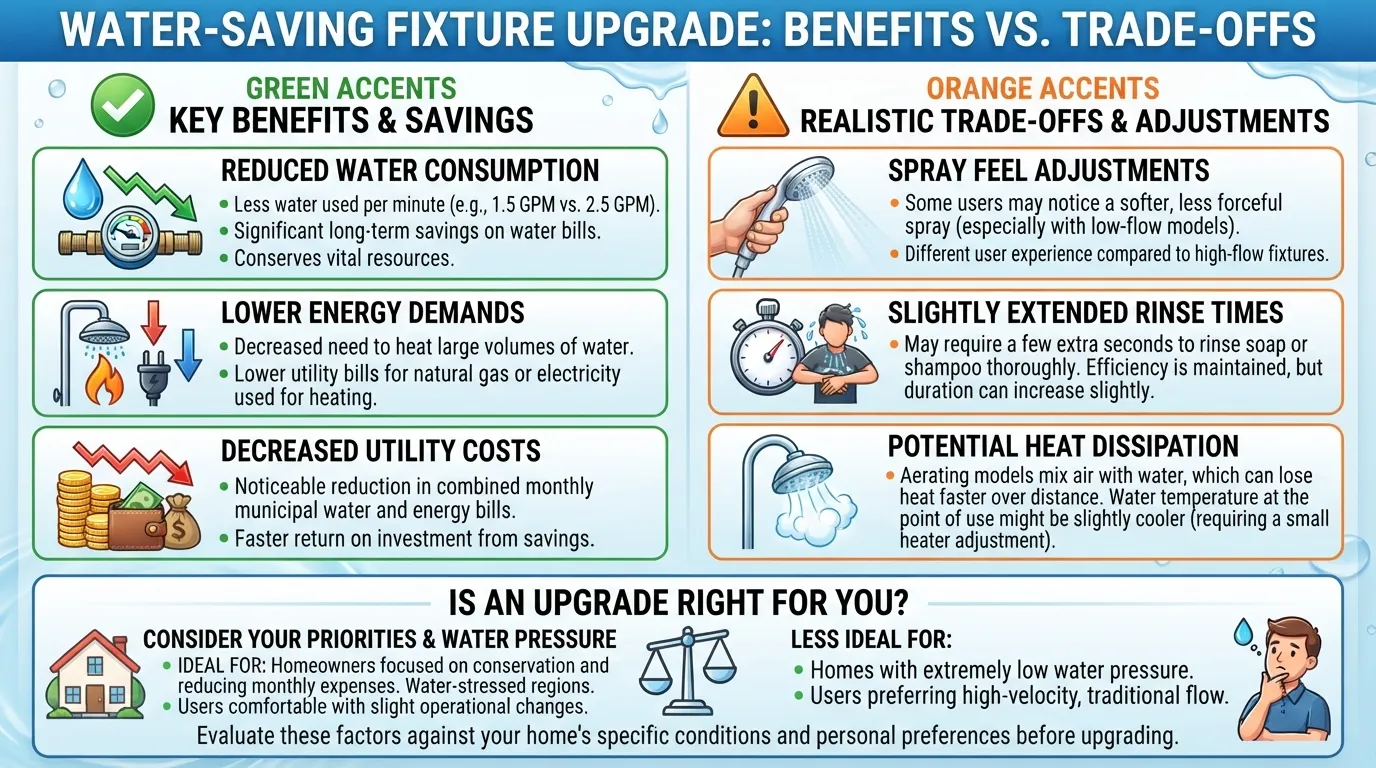
Deciding whether to install an efficient water-saving fixture involves weighing long-term resource conservation against daily personal comfort. Understanding both the tangible advantages and the realistic trade-offs helps determine if a low-flow upgrade aligns with your household needs.
Benefits: Less Water Used, Lower Water Heating Demand, Lower Utility Costs
Modern low-flow fixtures deliver significant operational advantages over traditional, high-volume shower heads without requiring major lifestyle sacrifices.
Water Conservation: Restricting flow rates to 2.0 GPM or lower drastically curtails total residential water consumption during daily routines.
Reduced Energy Demand: Heating less water means your water heater runs less frequently, saving significant electrical or gas energy over time.
Lower Utility Bills: The combination of reduced water volume and lower thermal energy demand directly translates to decreased monthly municipal and energy utility costs.
Trade-Offs: Spray Feel, Rinse Time, Heat Loss With Some Aerating Designs
While engineering advancements have largely closed the performance gap, certain inherent characteristics of water-saving fixtures require minor adjustments.
Spray Feel Adjustments: Homes accustomed to an unrestricted, heavy drenching torrent may notice a lighter, more targeted sensation with high-efficiency units.
Extended Rinse Time: Rinsing thick hair or washing away heavy soap lather can take slightly longer when working with a constrained volume of water.
Heat Dissipation: Aerating models that mix ambient air into the stream can cause the water droplets to cool slightly faster before hitting your skin, particularly in drafty bathrooms.
Who Should Switch and Who Might Skip It
Who Should Switch: Homeowners looking to lower utility bills, residents living in drought-prone regions, and anyone upgrading older 1990s fixtures will see an immediate upgrade in efficiency and performance.
Who Might Skip It: Residents whose homes suffer from critically low baseline water supply pressure, or those who prefer heavy, high-volume torrential streams, may want to check their plumbing psi or opt for specialized high-pressure laminar models before making the switch.
When Low Shower Pressure Means You Need a Plumber
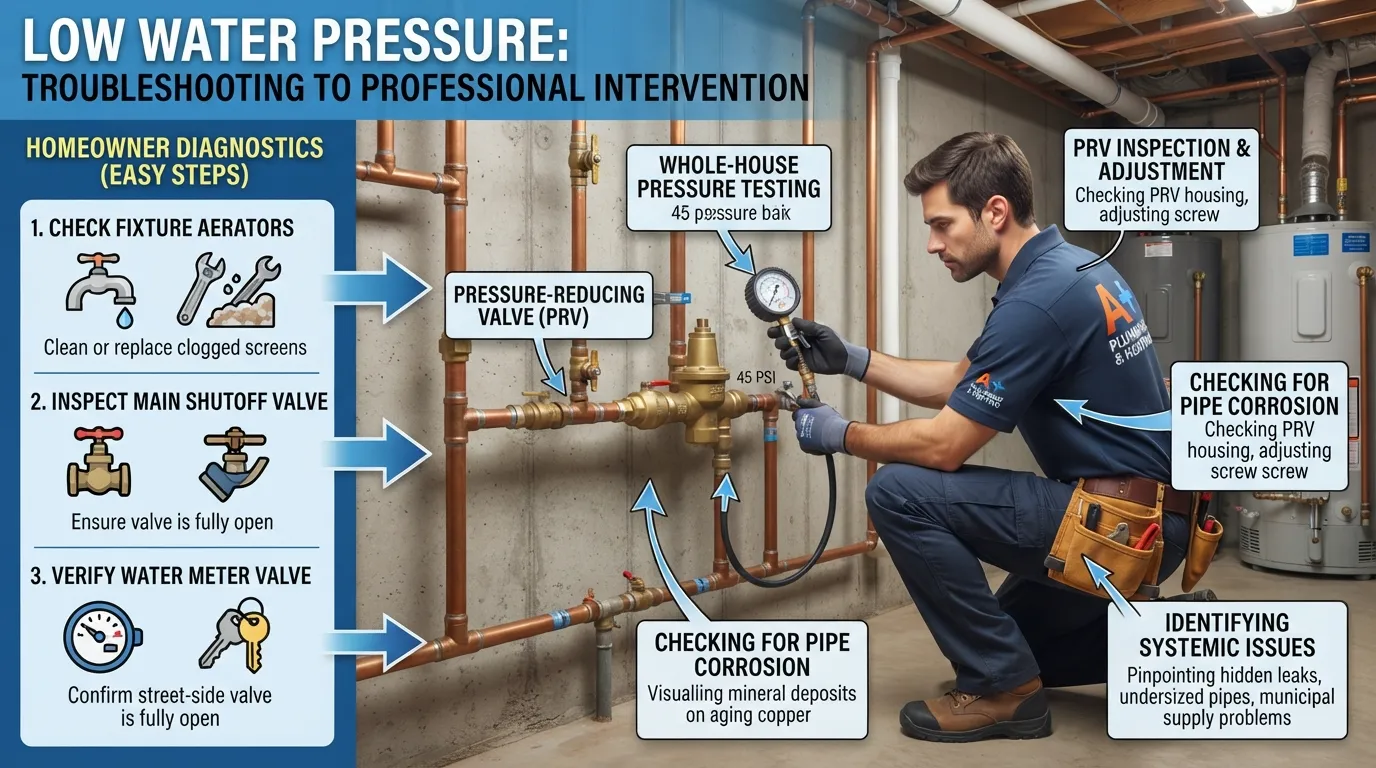
When cleaning your faceplate, clearing internal restrictors, and troubleshooting individual components fails to restore proper water force, the issue likely resides deep within your home’s infrastructure. Recognizing the warning signs of systemic plumbing failures ensures you call a professional before minor restrictions escalate into major property damage.
Warning Signs the Problem Isn’t the Shower Head
If your water pressure issue stems from a systemic problem rather than a localized fixture clog, you will typically notice multiple concurrent symptoms throughout your bathroom or entire house.
Whole-House Low Pressure: Every sink, shower, and tub in the home suffers from a weak, sluggish stream simultaneously.
Sudden Pressure Drops: Pressure disappears overnight or drops abruptly rather than fading gradually from mineral scale accumulation.
Discolored Water: Water runs brown, yellow, or rust-colored when first turned on, indicating heavily corroded or decaying supply lines.
Unusual Noises: Pipes bang, shudder, or whistle loudly whenever a nearby faucet or toilet valve opens and closes.
Damp Spots: Unexplained wet areas on drywall, ceilings below bathrooms, or soggy patches in the yard indicate a hidden plumbing leak drawing pressure away from your fixtures.
What a Plumber Checks
Licensed plumbing professionals utilize specialized diagnostic equipment to trace pressure anomalies back to their root cause behind walls or underground.
Supply Pressure Testing: Attaches a pressure gauge to a hose bib or main valve to measure incoming municipal psi and test the main pressure-reducing valve (PRV).
Valve Inspection: Checks main water shutoff valves and branch line valves to ensure they are fully open and uninhibited.
Hidden Leak Detection: Uses acoustic sensors and thermal imaging to locate compromised pipes leaking behind drywall or concrete slabs.
Pipe Condition Evaluation: Inspects accessible pipe runs for severe mineral scaling, pinhole leaks, or interior corrosion in older galvanized steel lines.
Plumbing Help in Miami
For complex infrastructure challenges or whole-home pressure losses in South Florida, expert assistance is essential. Professional Miami Florida Plumbing general services can accurately diagnose systemic faults and restore proper water delivery safely. When you are ready to have a technician inspect your system, you can book a visit with Miami Florida Plumbing to get professional support.
Low-Flow Shower Head FAQs
Getting familiar with how low-flow fixtures behave during routine use helps clear up common misconceptions about daily operations, installation procedures, and water conservation standards.
Why does water still come out of my shower head after I turn it off?
A minor drip or a brief stream that continues for a few seconds after shutting off the valve is caused by residual water trapped inside the shower head body.
Trapped Water Volume: The internal chambers and faceplate hold a small amount of liquid that drains out naturally via gravity.
Valve Sealing: If the water continues to drip indefinitely rather than stopping quickly, your shower handle cartridge or mixing valve is leaking and needs replacement.
Verification: Watch the fixture after shutoff; if the dripping stops entirely within 10 to 15 seconds, it is just normal residual drainage.
What is a low-flow faucet?
A low-flow faucet is a water-conserving plumbing fixture designed for bathroom or kitchen sinks that restricts water output using an internal aerator or flow restrictor.
Flow Rate Limit: Typically limits water usage to 1.5 gallons per minute (GPM) or lower compared to older, higher-volume residential faucets.
Aeration Process: Mixes air into the stream to maintain a splash-free, high-performance flow while cutting water waste.
Verification: Check the threaded tip of your sink spout for a small removable aerator insert stamped with its specific GPM rating.
Do low-flow shower heads save money?
Yes, low-flow shower heads deliver measurable financial savings over time by reducing both water consumption and the energy required to heat that water.
Resource Reduction: Using 2.0 GPM or less cuts household indoor water volume significantly during every shower cycle.
Energy Savings: Lower hot water demand decreases the workload on your electric or gas water heater.
Verification: Compare your monthly municipal water and energy utility bills before and after installation to track cumulative cost reductions.
Can I install a low-flow shower head myself?
Installing a low-flow shower head is a simple do-it-yourself project that requires basic tools and minimal plumbing experience.
Tool Requirement: An adjustable wrench and fresh Teflon (PTFE) thread seal tape are all you need to complete the swap.
Time Commitment: The replacement process typically takes less than 10 minutes from start to finish.
Verification: Turn on the supply after hand-tightening and wrapping the threads to ensure no water leaks out around the mounting connection.
Is a shower head with a flow restrictor required everywhere?
Flow restrictors or built-in maximum flow limits are legally mandated for new residential fixtures in many regions, but regulations vary depending on local codes.
Federal Standards: The federal maximum standard for standard shower heads is capped at 2.5 GPM nationwide.
State Regulations: Certain states and municipalities enforce stricter green building codes limiting fixtures to 1.8 or 2.0 GPM maximums.
Verification: Consult your local municipal building or water utility department website to confirm specific regional efficiency compliance rules.
Key Takeaways
Flow vs. Pressure: A low-flow shower head limits water volume (measured in GPM), whereas water pressure is driven by your home’s underlying supply force (measured in PSI).
Common Causes Are Not Low-Flow: Most weak-shower complaints trace back to mineral buildup, clogged faceplate nozzles, or closed supply valves rather than the low-flow fixture itself.
Troubleshooting Order: Always start with the simplest fix—soaking the fixture in vinegar to clear mineral crusts—before checking internal restrictors or plumbing lines.
When to Call a Professional: If you experience whole-house low pressure, discolored water, or sudden pressure drops, consult a licensed plumber to inspect for hidden leaks or main valve restrictions.
Main Services
Related Posts
Need a Plumber in Miami?
Schedule service online or speak directly with the EZ Plumbing team.
Owner-Led Local Service
Know who is behind the business before you request service. The owners, contact line and Miami service pages are published clearly.
- Named business owners
- Direct phone and social channels
- Local Miami service information
Clear Help Before You Book
Review the relevant service page, contact the team directly and use the booking page when you are ready—without relying on vague claims.
- Service-specific information
- Direct questions before scheduling
- Clear online booking route