If you are looking for steel pipe fittings, the fitting itself is only one part of the decision. You also need to match the fitting to the pipe size, material, connection method, application, and the requirements of the piping system.
Steel pipe fittings are components used to join, redirect, branch, reduce, or close piping. Common types include elbows, tees, couplings, reducers, caps, and plugs. Depending on the application, you may encounter threaded, welded, or structural fittings made from materials such as carbon or mild steel and stainless steel. The right fitting depends on more than nominal pipe size: you should also confirm the connection type, material compatibility, intended service, pressure and temperature requirements, and applicable codes or standards.
This guide will help you understand the main types of steel pipe and pipe fittings, compare connection methods and materials, and choose a fitting more confidently instead of selecting one by appearance or size alone.
What Are Steel Pipe Fittings?
Steel pipe fittings are components designed to connect sections of piping or change the direction, size, branch configuration, or termination of a piping system. They can be used in plumbing, gas, water, air, industrial piping, and other applications when the fitting is appropriate for the service.
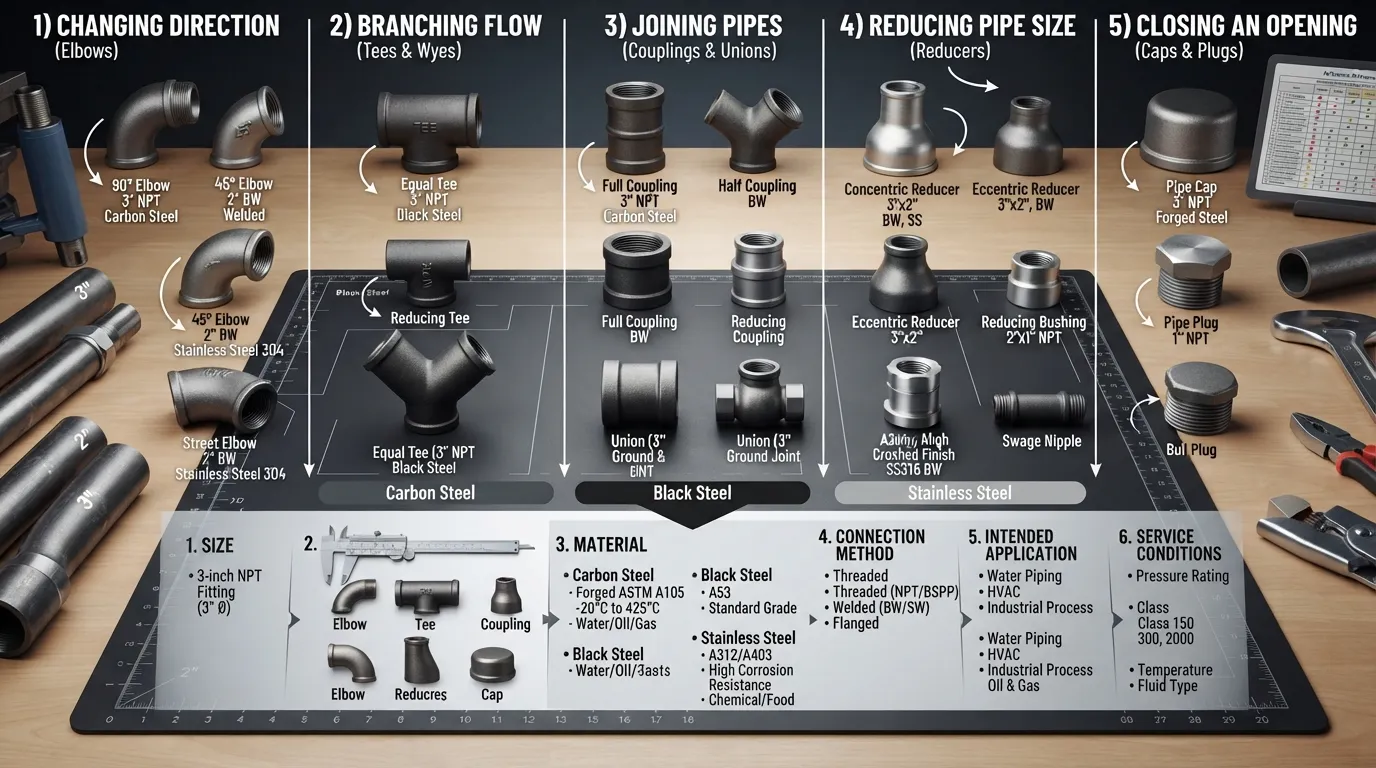
Common steel plumbing fittings and industrial fittings include elbows for changing direction, tees for branching flow, couplings for joining pipes, reducers for connecting different sizes, and caps or plugs for closing openings.
The term metal pipe fittings is broader than steel pipe fittings because metal fittings can be made from different metals. Steel is one important category, while stainless steel is a corrosion-resistant steel family with its own properties and applications.
Steel Pipe Fittings at a Glance
Common Types of Steel Pipe Fittings
1. Steel Pipe Elbows
An elbow changes the direction of a piping run. Common configurations include 45-degree and 90-degree elbows, although the appropriate configuration depends on the system design.
When choosing an elbow, look beyond the angle. You should match the pipe size, connection method, material, and application requirements.
2. Steel Pipe Tees
A tee creates a branch in a piping system. It can be useful when one piping path needs to connect with another, but the correct tee depends on the sizes and configuration of the run and branch.
3. Steel Couplings
A coupling connects two compatible pipe sections in a straight run. Couplings can be threaded or designed for other connection methods, so the connection on the fitting must match the pipe and the intended installation.
4. Steel Reducers
A reducer connects piping of different diameters. It is useful when a system transitions from one pipe size to another. Before purchasing one, confirm both required sizes and the configuration needed for your installation.
5. Caps and Plugs
Caps and plugs both close openings, but they are not interchangeable in every installation. The connection design matters. A cap is generally associated with closing the end of a pipe, while a plug commonly closes an opening through a threaded connection.
Threaded vs. Welded vs. Structural Steel Pipe Fittings
One of the easiest ways to choose the wrong fitting is to focus only on its shape. The connection method is equally important.
Important distinction: Structural pipe fittings should not automatically be treated as interchangeable with fittings intended for plumbing or process piping. A structural connector designed for rails, frames, or shelving has a different purpose from a fitting designed for a piping system carrying water, gas, air, or another service.
Steel, Mild Steel, Black Steel, and Stainless Steel Fittings
The word “steel” covers more than one material category. If you are comparing steel piping and fittings, make sure the material description matches your application.
Mild or Carbon Steel
Mild or carbon steel fittings are common in many piping and industrial contexts. The correct choice depends on the service, environmental conditions, connection method, and applicable requirements.
Black Steel
Black steel fittings have a dark iron-oxide finish and are commonly associated with applications such as natural gas, oil, and air lines. The fact that a fitting is black does not by itself establish that it is suitable for a particular service; always confirm the product’s intended application and requirements.
Stainless Steel
Stainless steel fittings are available in grades such as 304 and 316 and are valued for corrosion resistance. They can be useful in demanding water, chemical, marine, and other environments, but the appropriate grade still depends on the actual service conditions.
How to Choose the Right Steel Pipe Fitting
When you need metal pipe connectors, do not start with the fitting shape alone. Use this sequence instead.
- Identify the application. Determine whether the fitting is for water, gas, air, an industrial process, structural framing, or another purpose.
- Identify the pipe material. Confirm whether the pipe is mild/carbon steel, black steel, stainless steel, or another material.
- Identify the connection method. Decide whether the installation calls for compatible threaded, welded, or structural mechanical connections.
- Identify the required fitting function. Do you need to change direction, create a branch, join two pipes, change size, or close an opening?
- Confirm the pipe size. Match the fitting to the required nominal pipe size and connection dimensions.
- Check service requirements. Consider pressure, temperature, corrosion exposure, and the material being carried.
- Check applicable requirements. For regulated or safety-sensitive applications, verify the applicable codes, standards, ratings, and installation requirements.
The simple selection formula
Application → Material → Connection → Fitting function → Size → Service requirements → Applicable standards
Choosing 3 Inch Steel Pipe Fittings
If you are specifically searching for 3 inch steel pipe fittings, remember that “3 inch” alone is not enough information to identify the correct fitting.
Start by confirming that the pipe’s nominal size is actually the size you need, then determine the connection method and fitting type. For example, a 3-inch elbow, tee, coupling, reducer, cap, or plug can serve completely different purposes.
You should also confirm:
- The required fitting type.
- The pipe and fitting material.
- Thread or weld requirements, where applicable.
- The intended service.
- Pressure and temperature requirements.
- Applicable ratings, codes, or standards.
Don’t choose a 3-inch fitting by size alone. A fitting can have the right nominal size and still be unsuitable because the connection, material, service, rating, or configuration does not match the system.
What Is an Iron Pipe Connector?
The phrase iron pipe connector is sometimes used informally when people are looking for metal or steel pipe fittings. Before buying, identify the actual material and fitting specification rather than relying on the word “iron” alone.
If you are replacing an existing connector, compare the old component’s size, connection type, material, and application with the replacement. A visually similar fitting is not necessarily a compatible fitting.
Steel Pipe Fittings by Application
Water and Plumbing
For water or plumbing work, the fitting must be suitable for the intended water service and compatible with the pipe, connection, and local requirements. Do not assume that every steel fitting is appropriate simply because it physically fits.
Gas
Gas piping is a safety-sensitive application. Use fittings specifically approved or rated for the intended gas service and follow applicable codes and professional installation requirements. A generic structural connector is not a substitute for a fitting designed for gas piping.
Industrial Piping
Industrial pipe fittings require closer attention to service conditions. Material, pressure, temperature, corrosion exposure, connection method, and applicable standards can all affect selection.
Structural Projects
Structural pipe fittings can be used for applications such as handrails, guardrails, frames, and shelving. These fittings are selected based on structural configuration rather than the requirements of a fluid-carrying piping system.
Steel Pipe Fittings vs. Structural Pipe Fittings
This distinction is worth understanding because both product categories can appear in searches for steel or metal pipe fittings.
What Affects Steel Pipe Fitting Prices?
If you are searching for steel pipe fittings price, there is no single price that applies to every fitting. The cost can vary according to the product specification and supplier.
Factors that can affect the price include:
- Fitting type and configuration.
- Nominal pipe size.
- Material and grade.
- Threaded, welded, or other connection design.
- Required rating or specification.
- Quantity being purchased.
- Supplier and availability.
For that reason, comparing two fittings only by their price can be misleading. First make sure they are actually equivalent in size, material, connection, specification, and intended use.
Common Steel Pipe Fitting Buying Mistakes
Choosing by size only
A matching nominal size does not automatically make a fitting suitable. Connection, material, service, and other requirements still matter.
Confusing structural and piping fittings
A structural connector may look similar to a pipe fitting while serving a completely different purpose. Always confirm the intended application.
Ignoring material compatibility
Do not choose a fitting solely because it is steel. Consider the pipe material, environment, fluid or gas being carried, and applicable requirements.
Assuming every threaded fitting has the same thread
Threaded connections must be compatible. Confirm the required thread specification before ordering or installing a threaded metal pipe connector.
Buying from a product photo alone
A product image helps you identify a general shape, but it does not replace checking the technical description, dimensions, material, connection type, and application information.
Steel Pipe Fittings Buying Checklist
- What material is the pipe?
- What material should the fitting be?
- What is the nominal pipe size?
- What type of fitting is required?
- Is the connection threaded, welded, or structural/mechanical?
- If threaded, are the threads compatible?
- What service will the fitting carry or support?
- What pressure and temperature requirements apply?
- Are there corrosion or environmental considerations?
- What codes, standards, ratings, or installation requirements apply?
- Does the product documentation confirm that the fitting is intended for this use?
Where to Compare Steel Pipe Fittings
If you are buying rather than simply researching, compare products using the actual specifications instead of choosing the first fitting that looks right. Large suppliers and specialist fitting catalogs can be useful for checking available sizes, materials, connection styles, and configurations.
- Home improvement retailers: Useful for browsing common steel plumbing and structural fitting categories.
- Industrial fitting suppliers: Useful when you need more detailed product specifications and industrial options.
- Specialist piping catalogs: Useful for comparing fitting configurations, materials, and connection types.
Before purchasing, verify the manufacturer’s or supplier’s current product specifications. Availability, product configurations, and pricing can change.
Useful product-research resources
Frequently Asked Questions About Steel Pipe Fittings
What are steel pipe fittings used for?
Steel pipe fittings are used to connect, redirect, branch, reduce, or close piping. The appropriate fitting depends on the piping application, material, connection method, size, and service requirements.
What are the most common steel pipe fittings?
Common types include elbows, tees, couplings, reducers, caps, and plugs. Each serves a different function within a piping system.
What is the difference between a coupling and a reducer?
A coupling is generally used to join compatible pipe sections in a straight run, while a reducer connects piping of different sizes.
Are steel pipe fittings and metal pipe fittings the same?
Not exactly. Steel fittings are one category of metal fittings. “Metal pipe fittings” can refer to fittings made from several different metals, including steel and stainless steel.
Are structural pipe fittings the same as plumbing fittings?
No. Structural fittings are designed for structural assemblies such as frames, rails, and shelving, while fittings for plumbing or process piping are selected for the requirements of piping systems. They should not be treated as interchangeable without confirming suitability.
How do I choose a 3-inch steel pipe fitting?
First confirm that the pipe is the required nominal size. Then select the fitting type, material, connection method, and service compatibility. Also check applicable ratings, codes, standards, and manufacturer specifications. Size alone does not determine suitability.
What affects the price of steel pipe fittings?
Price can vary according to fitting type, size, material, connection method, specification, quantity, supplier, and availability. Compare equivalent specifications rather than price alone.
Which is better: mild steel or stainless steel fittings?
Neither is universally better. The appropriate material depends on the application, environment, corrosion exposure, service conditions, connection requirements, and applicable specifications.
Need Help With a Plumbing Application?
If you are dealing with a plumbing-related fitting, repair, replacement, or piping project, you can explore our plumbing services to see the types of plumbing help available.
For additional information about our company and service approach, visit the Miami Florida Plumbing home page.
Final Takeaway
The best steel pipe fitting is not simply the one that matches the pipe diameter. You need to match the fitting function, pipe size, material, connection method, application, and service requirements.
If you remember one rule from this guide, make it this: choose steel pipe fittings by compatibility, not appearance or size alone. That simple approach can help you avoid the most common selection mistakes and make a more informed buying or installation decision.