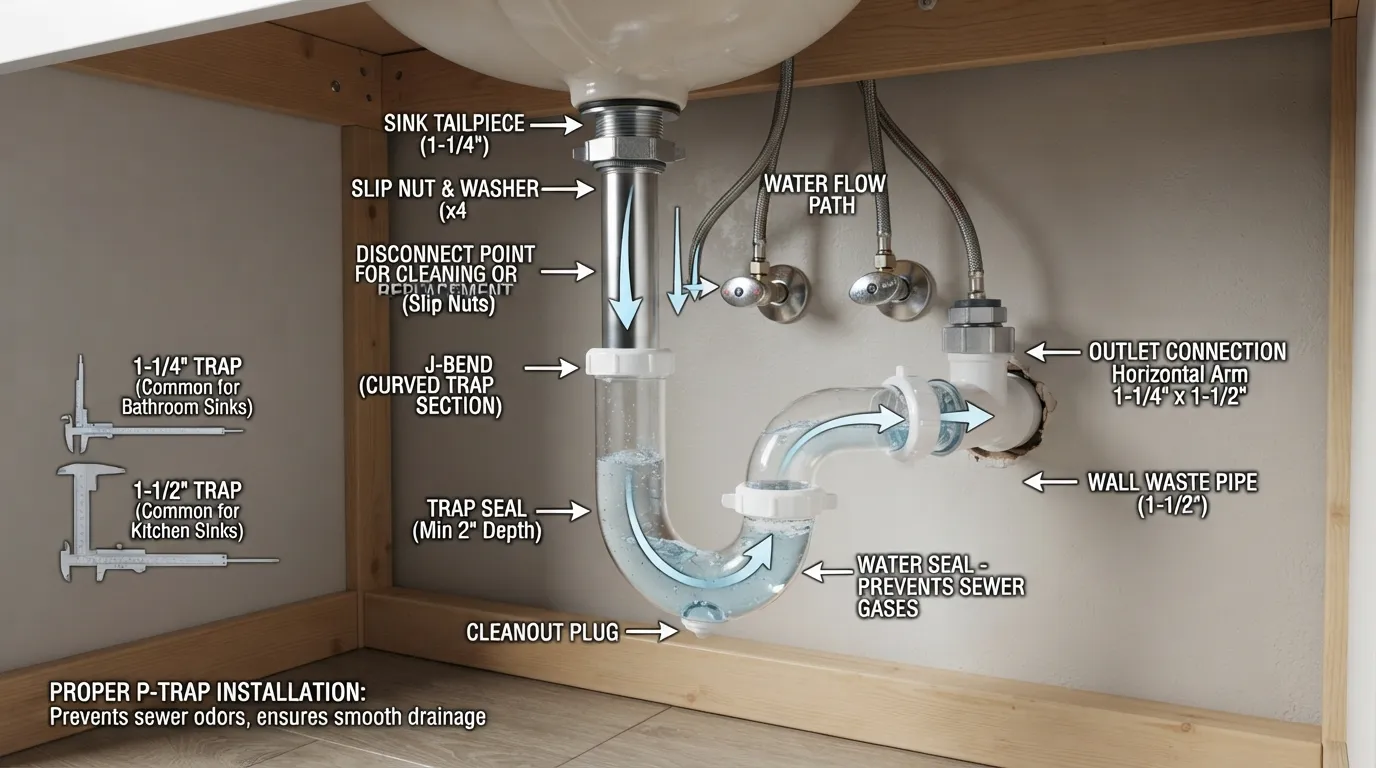
If you are looking at the curved pipe underneath your kitchen or bathroom sink, you are probably looking at a tubular trap, commonly called a tubular P-trap. It is an important part of the sink drain because it holds water in the trap to help block sewer gases and odors from entering your home.
A tubular trap is a tubular drain assembly used beneath a sink. Its curved trap section retains a small amount of water, creating a water seal that helps prevent sewer gases and drain odors from entering the room. Tubular P-traps are commonly available in 1-1/4-inch and 1-1/2-inch sizes and in plastic or metal versions. The correct choice depends on your existing drain size, connection type, sink setup, available space, and applicable plumbing requirements.
What Is a Tubular Trap?
A tubular trap is the curved portion of a sink’s drainage system that sits between the sink drain and the drainpipe leading into the wall. In many residential sink installations, the configuration is a P-trap.
The word tubular describes the type of drain tubing and assembly commonly used under sinks. The term P-trap describes the trap configuration that retains water and provides the necessary trap seal.
That distinction matters because people often use “tubular trap” and “P-trap” as if they mean exactly the same thing. In everyday plumbing discussions they are closely related, but they describe slightly different aspects of the assembly.
Tubular Trap vs. P-Trap
| Term | What it describes |
|---|---|
| P-trap | A trap configuration designed to retain water and provide a trap seal. |
| Tubular P-trap | A P-trap assembly made from tubular drain components, commonly used beneath sinks. |
| S-trap | A different trap configuration. It should not simply be substituted for a P-trap without considering the applicable plumbing requirements. |
How Does a Tubular P-Trap Work?
The trap’s curved section holds a small amount of water after the sink drains. That water forms a trap seal between the drain opening and the drainage system farther downstream.
When everything is working correctly, the seal helps prevent unpleasant sewer gases and odors from traveling back through the sink drain and into your living space.
The trap can also catch heavier debris or small objects that fall into the drain. For example, a ring or other small item may remain in the trap rather than continuing deeper into the drainage system.
The Basic Drain Path
Sink Drain → Tailpiece → Tubular P-Trap → Drain Outlet → Wall Drain
Why Does a Sink Need a Trap?
The trap is not just a curved piece of pipe placed under the sink. Its water seal serves an important purpose in the drainage system.
- Helps block sewer gases: Water retained in the trap creates a barrier against gases and unpleasant drain odors.
- Provides access to trapped debris: The trap can catch heavier material or small objects before they travel farther into the drainage system.
- Allows maintenance: Many tubular assemblies use slip-joint connections, making the components relatively accessible for adjustment, inspection, or cleaning.
Where Are Tubular Traps Used?
Tubular P-traps are commonly found beneath residential sinks, including kitchen sinks and bathroom sinks. The exact configuration depends on the sink, drain opening, existing plumbing, cabinet space, and drainage arrangement.
For a kitchen sink, you may also need to consider the surrounding drain configuration and any connected fixtures. That is why replacing a trap should not be based on appearance alone.
Tubular P-Trap Sizes: 1-1/4 vs. 1-1/2 Inch
Two common tubular trap sizes are 1-1/4 inch and 1-1/2 inch. The right size is not simply a matter of choosing the larger or smaller option. You need to match the trap to the existing drain components and connection requirements.
How to Choose the Correct Size
- Check the size of the existing drain and tailpiece.
- Identify the connection type used by the existing assembly.
- Check whether an adapter or reducing washer is required.
- Consider the available space beneath the sink.
- Confirm that the replacement assembly is compatible with the existing drainage configuration.
- Follow applicable local plumbing requirements when changing the drainage system.
A reducing washer can sometimes allow differently sized tubular components to connect, but you should confirm compatibility rather than assuming any 1-1/4-inch and 1-1/2-inch parts can be mixed together.
What Materials Are Tubular Traps Made From?
Tubular traps are available in several materials and finishes. The most familiar choices for residential sink plumbing include plastic and metal assemblies.
| Material | What to consider |
|---|---|
| Plastic | Common under residential sinks and available in tubular configurations, including PVC or polypropylene products. |
| Chrome-plated brass | Often selected when the visible plumbing finish matters, particularly beneath exposed or decorative sinks. |
| Rough brass or other metal | Used in various plumbing applications and available in different configurations and finishes. |
For a PVC P-trap for a kitchen sink, compatibility with the existing drain assembly is more important than choosing a material based only on appearance.
What Is a Tubular P-Trap Made Of?
A typical tubular sink trap assembly may include several connected pieces rather than one single molded pipe.
- Sink drain tailpiece: The vertical section coming down from the sink drain.
- Trap inlet: The connection where the tailpiece enters the trap.
- Curved trap section: The section that retains water and creates the trap seal.
- Trap outlet: The section connecting toward the wall drain.
- Slip nuts and washers: Components used on many tubular slip-joint connections to create the connection and seal.
- Extension or adapter: May be needed when the existing sink and wall drain require additional reach or a different connection arrangement.
Tubular Trap Installation: What You Should Know
Installing or replacing a tubular P-trap can look simple because many assemblies use adjustable slip-joint connections. However, correct alignment and compatible components matter.
Basic Installation Sequence
- Identify the existing trap and drain configuration.
- Confirm the replacement trap size and connection type.
- Position the tubular components so they align naturally with the sink tailpiece and wall drain.
- Install the appropriate washers and slip nuts in the correct positions.
- Tighten the connections appropriately without forcing or damaging the components.
- Run water through the sink and inspect every connection for leaks.
- Correct any alignment or connection problem before considering the installation complete.
Important Installation Warning
Do not assume that any curved pipe can be substituted for a P-trap. Do not alter the drainage configuration simply because a replacement part appears to fit. If the installation involves changing the drainage layout, follow applicable plumbing requirements and get professional help when the configuration is unclear.
Common Tubular P-Trap Installation Mistakes
Many problems after a trap replacement are caused by small installation details rather than the trap itself.
- Using the wrong size: A trap that does not match the existing drain components may require the wrong adapter or may not connect correctly.
- Incorrect washer placement: A washer that is missing, misplaced, or improperly seated can contribute to leakage.
- Forcing misaligned tubing: Connections should not have to be forced into position.
- Overtightening: Excessive force can damage components or connections.
- Ignoring leaks after installation: Always run water and inspect the complete assembly.
- Choosing a trap based only on appearance: Size, connection type, material, clearance, and compatibility all matter.
How to Clean a Tubular P-Trap
Because the trap can collect debris, it may eventually need cleaning. Tubular assemblies with accessible slip-joint connections can often be opened for inspection and cleaning, provided the configuration and components are suitable for that work.
- Place a container beneath the trap to catch retained water.
- Disassemble the appropriate connection carefully.
- Empty the trap and remove visible debris.
- Inspect the trap, washers, and connections for damage or deterioration.
- Reassemble the components correctly.
- Run water and check for leaks.
If you repeatedly need to open the trap because the sink keeps clogging or draining slowly, the problem may extend beyond the trap itself.
How Often Should You Clean a P-Trap?
There is no single cleaning schedule that fits every sink. A trap that is functioning normally does not necessarily need to be routinely disassembled on a fixed schedule.
Instead, pay attention to symptoms such as:
- Recurring slow drainage
- A trap that repeatedly collects debris
- Persistent unpleasant odors
- Visible leakage
- Damage or deterioration of the trap or its connections
Why Is My Tubular P-Trap Leaking?
A leaking tubular trap does not automatically mean that the entire drainage system needs to be replaced. Start by identifying where the water is coming from.
| Problem | What to check |
|---|---|
| Leak at a slip joint | Check the slip nut, washer, alignment, and condition of the connection. |
| Leak from cracked tubing | Inspect the trap for visible cracks or damage. A damaged component generally needs replacement. |
| Repeated leakage | Look for incorrect sizing, misalignment, damaged threads, worn washers, or an incompatible assembly. |
Why Does My Sink Smell If It Has a P-Trap?
A properly functioning trap is designed to maintain a water seal, so a persistent sewer-like odor deserves investigation.
Possible causes can include a compromised or missing trap seal, buildup in the drain, leakage, drainage problems, or an issue elsewhere in the plumbing system. The odor itself does not prove that the trap is defective.
If adding water to a rarely used fixture temporarily changes the odor but the smell returns, the drainage system may need closer inspection.
When Should You Repair or Replace a Tubular Trap?
A Simple Decision Guide
| Situation | Likely next step |
|---|---|
| Minor buildup | Clean and inspect the trap. |
| Loose connection | Check alignment, washer placement, and connection tightness. |
| Damaged washer | Replace the appropriate sealing component if compatible. |
| Cracked plastic trap | Replace the damaged trap component. |
| Severely corroded metal trap | Replacement may be more appropriate than attempting to repair the damaged section. |
| Repeated leaks after adjustments | Recheck compatibility and the complete assembly; professional evaluation may be appropriate. |
How to Choose a Tubular P-Trap for a Kitchen Sink
If you are replacing a kitchen sink trap, do not choose a product simply because the curved section looks similar to your existing one.
Kitchen Sink Compatibility Checklist
- Size: Check whether the existing assembly uses 1-1/4-inch, 1-1/2-inch, or another configuration.
- Material: Decide whether a plastic or metal assembly is appropriate for your installation.
- Connection: Check the slip-joint and other connection requirements.
- Clearance: Make sure the assembly fits comfortably inside the cabinet or beneath the sink.
- Alignment: The trap should connect naturally to the tailpiece and drain outlet rather than being forced into position.
- Accessories: Determine whether an extension, adapter, washer, or other compatible component is needed.
- Drain configuration: Consider the complete sink drainage setup rather than looking at the trap alone.
If you are unsure which configuration your kitchen sink requires, having the existing plumbing assessed before purchasing replacement parts can prevent an incompatible installation.
Tubular P-Trap vs. S-Trap: Which Is Better?
For a typical modern sink drainage setup, you should not decide between a P-trap and S-trap simply by asking which one looks better. They are different configurations, and plumbing requirements can affect which arrangement is appropriate.
If you are replacing an existing trap, identify the current drainage configuration and confirm what is permitted for the installation rather than converting the setup based solely on the shape of the pipe.
A tubular P-trap is not automatically interchangeable with every other type of trap. The correct configuration depends on the drainage layout and applicable plumbing requirements.
Tubular P-Trap Installation and Replacement Video
If you learn better by seeing the components and connections, this demonstration can help you visualize how a P-trap assembly works.
Use videos as a visual reference, but always match the instructions to your actual plumbing configuration and applicable local requirements.
Tubular P-Trap Kit, Extension, or Individual Trap?
You may see tubular traps sold as individual components, complete kits, or assemblies with extensions and adapters. The right choice depends on what is already installed beneath your sink.
A tubular P-trap kit can be convenient when several compatible components are required, while an individual replacement may be sufficient when only one damaged part needs to be changed.
A tubular extension may be useful when additional reach is required, but adding components simply to make an otherwise incompatible configuration fit is not a good substitute for selecting the correct assembly.
Frequently Asked Questions About Tubular Traps
What is a tubular P-trap?
A tubular P-trap is a tubular sink-drain assembly with a curved trap section that retains water and provides a trap seal. It is commonly installed beneath kitchen and bathroom sinks.
What size tubular P-trap do I need?
Common sizes include 1-1/4 inch and 1-1/2 inch, but the correct size depends on your existing drain and tailpiece, connection type, and sink configuration. Check the existing plumbing before purchasing a replacement.
Is a tubular trap the same as a P-trap?
The terms are closely related but describe different aspects. “P-trap” refers to the trap configuration, while “tubular” commonly describes the tubular drain assembly used in that configuration.
Can I use a PVC P-trap for a kitchen sink?
A plastic or PVC-style tubular P-trap may be appropriate for a kitchen sink when it is compatible with the sink’s drain size, connections, space, and overall drainage configuration. Verify compatibility before installation.
How do I empty a P-trap?
Many tubular traps can be opened at their accessible connections so the retained water and debris can be emptied into a container. Reassemble the trap correctly afterward and check for leaks.
Do P-traps go bad?
Yes. Plastic traps can crack or become damaged, while metal traps can corrode. Washers and connections can also deteriorate or begin leaking. Visible damage, persistent leakage, or repeated connection problems are reasons to inspect the assembly closely.
How often should I clean a P-trap?
There is no universal fixed interval for every sink. Clean or inspect the trap when symptoms such as recurring slow drainage, debris buildup, odors, or other drainage problems indicate that maintenance may be needed.
Which is better, a P-trap or S-trap?
They are different configurations, so the question is not simply which one is better. For a replacement or new installation, use the configuration appropriate to the drainage layout and applicable plumbing requirements.
Why are house traps prohibited in some plumbing systems?
House traps are a different type of plumbing trap and their use can depend on local plumbing rules and the design of the drainage system. Do not assume rules for a house trap apply directly to a sink P-trap.
When a Tubular Trap Problem Needs Professional Attention
A straightforward trap cleaning or component replacement may be manageable when the configuration is clear. However, professional help is worthwhile when you encounter a recurring or unclear problem.
- The replacement trap does not align with the wall drain.
- Leaks continue after checking the connections.
- The sink repeatedly backs up or drains slowly after cleaning the trap.
- There is a persistent sewer odor that cannot be explained by the trap alone.
- The drainage configuration needs to be changed.
- The existing plumbing does not match the replacement parts you purchased.
Need Help With a Sink Drain or Trap?
If you are dealing with a leaking trap, recurring drain problem, or an installation that does not line up correctly, you can explore our plumbing services to find the right type of professional assistance.
You can also learn more about our plumbing company and the solutions available for residential plumbing needs.
Key Takeaway
A tubular trap is more than just the curved pipe under your sink.
It is part of the sink drainage system that helps maintain a water seal, block sewer gases, and provide an accessible point for catching and removing debris. When selecting or replacing one, focus on configuration, size, material, connection type, alignment, and compatibility rather than appearance alone.
Related Tubular Trap Resources
When researching a replacement, product and manufacturer resources can be useful for checking available sizes, materials, components, and installation information. Compare the product specifications with your existing plumbing before purchasing.
- SupplyHouse tubular P-trap product listings
- Home Depot tubular P-trap product information
- Oatey educational information about P-traps
- Manufacturer and plumbing-supply specifications for tubular drain components
Before buying a tubular trap, check your existing drain size, connection type, available space, and complete sink drainage configuration.