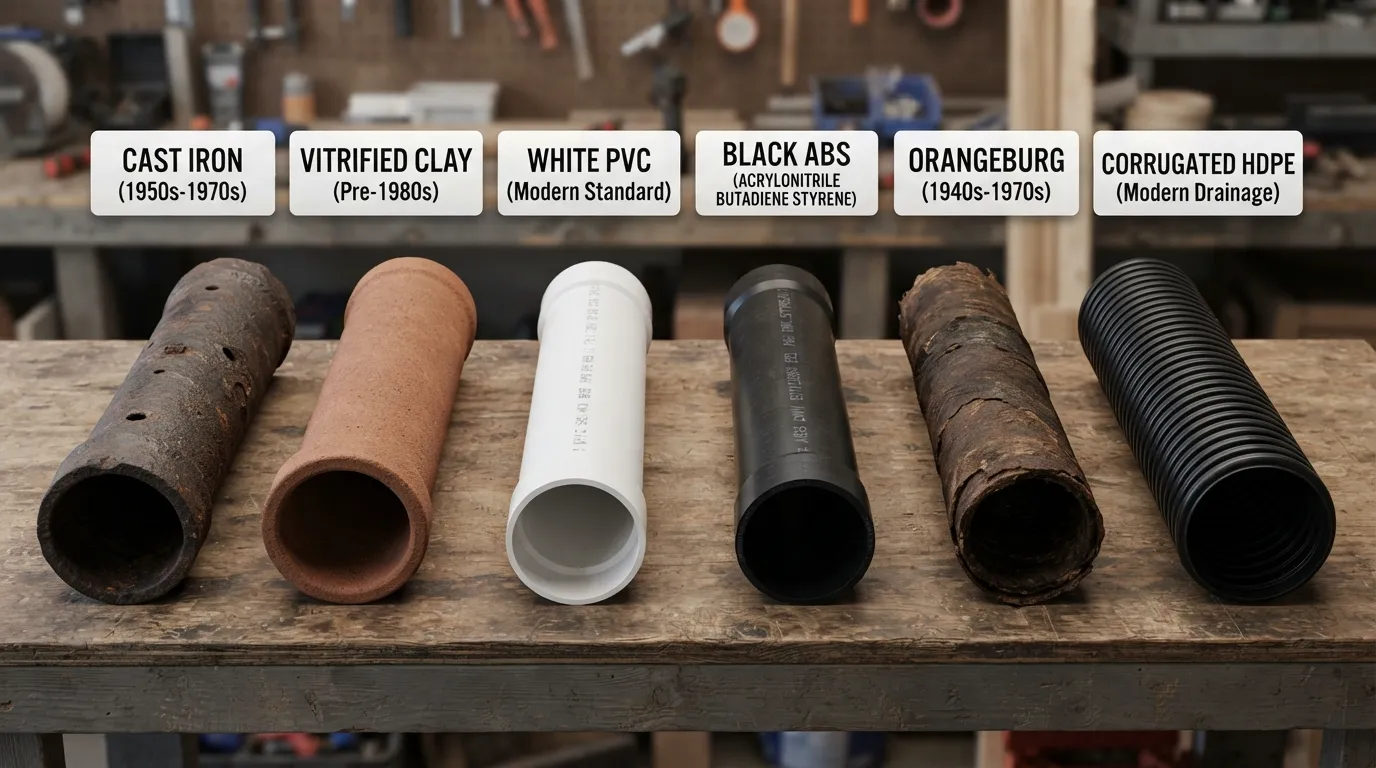
If you are trying to identify an old sewer line, compare materials for a replacement, or simply understand what your sewage pipe may be made of, the terminology can get confusing quickly. A “type of sewer pipe” can describe the pipe material, the way wastewater moves, or even the type of sewage the system carries.
The sewer pipe materials homeowners are most likely to hear about are PVC, ABS, cast iron, vitrified clay, Orangeburg, and HDPE/PE. Other building-sewer or infrastructure applications can also use materials such as polypropylene, concrete, ductile iron, stainless steel, and copper. The right material depends on where the pipe is used, how the system operates, soil and installation conditions, pipe size, and applicable code requirements.
The 2023 Florida Plumbing Code, for example, recognizes multiple materials for building sewers rather than naming one universal “best” pipe. These include ABS, cast iron, concrete, polyethylene, polypropylene, several PVC classifications, stainless steel, copper, PVDF, and vitrified clay.
First, Understand the Three Meanings of “Sewer Pipe Type”
Before comparing materials, I find it useful to separate three classifications that are often mixed together online.
1. By Material
PVC, ABS, cast iron, vitrified clay, Orangeburg, HDPE/PE, polypropylene, concrete, and other approved materials.
2. By How Sewage Moves
Gravity sewers use slope to move wastewater. Pressure sewers use pumps when gravity alone is not practical.
3. By What the Sewer Carries
Sanitary sewers carry wastewater, while storm sewers handle stormwater. A combined sewer carries both in one system.
Gravity and pressure describe the operating system, not what the pipe itself is made from. Likewise, “sanitary sewer pipe” describes the pipe’s function, not a specific material.
For most homeowners searching for the types of sewer pipes, material is the main question, so that is where we will focus.
The Main Types of Sewer Pipe Materials
1. PVC Sewer Pipe
PVC (polyvinyl chloride) is one of the most familiar materials in modern drainage and sewer work. It is a rigid thermoplastic that does not rust like metal, is relatively light to handle, and is manufactured in different dimensions and wall classifications for different applications.
PVC is not automatically problem-free. The performance of a buried PVC sewer line also depends on factors such as correct bedding, proper slope, joint installation, surrounding soil, and whether the line remains properly supported. A poorly installed pipe can develop offsets, joint problems, or a sag even when the material itself is corrosion-resistant.
One identification caution: do not assume every PVC sewer pipe must be white. Visible plumbing PVC is often light-colored, while buried utility products can use other colors. Miami-Dade Water and Sewer Department’s current pre-approved SDR 26 gravity sewer specification, for example, identifies green pipe for sanitary sewer applications.
2. ABS Sewer Pipe
ABS (acrylonitrile butadiene styrene) is another rigid plastic used in drainage and some sewer applications. It is commonly recognized by its black appearance, although you should never identify buried piping by color alone.
Like PVC, ABS avoids the internal rust associated with iron. Depending on the installation, however, joints, movement, physical damage, or other structural conditions can still create drainage problems. ABS remains among the materials recognized by the current Florida Plumbing Code for specified drainage and building-sewer applications.
3. Cast-Iron Sewer Pipe
Cast iron is a strong, heavy metal pipe that is commonly associated with older plumbing systems, although cast-iron drainage pipe remains a recognized material today.
The issue in an aging cast-iron line is often not simply that it is “old.” Iron can develop internal corrosion, rust, scaling, and progressive wall deterioration. Heavy scale can reduce the usable opening inside the pipe, while more advanced deterioration can contribute to leakage or structural failure.
That distinction matters because buildup inside a structurally sound section may call for a different response than a pipe whose wall has significantly deteriorated.
4. Vitrified Clay Sewer Pipe
Vitrified clay pipe is a rigid ceramic sewer material with a long history in underground wastewater systems. You may still encounter it in established properties and older infrastructure, and vitrified clay remains listed as a building-sewer material in the current Florida Plumbing Code.
Clay itself resists corrosion, but the line can be vulnerable to cracking, movement, and problems around joints. Roots can exploit openings in deteriorated or separated joints, which is why recurring root intrusion in an older clay sewer deserves more attention than simply removing the roots again and again.
Age does not automatically mean a clay line must be replaced. Its actual condition should be evaluated rather than guessed from the construction date alone.
5. Orangeburg Sewer Pipe
Orangeburg is a legacy bituminized fiber pipe associated with older sewer installations. Unlike clay or cast iron, it is not a conventional rigid mineral or metal pipe. As it deteriorates, it can blister, deform, flatten, lose its circular shape, and eventually collapse.
If you hear someone refer to an old “fiber,” “tar,” or bituminous sewer pipe, Orangeburg may be what they mean.
Important: Orangeburg is a legacy material you may still find underground, but it does not appear among the current building-sewer pipe materials listed in Table 702.3 of the 2023 Florida Plumbing Code. Finding Orangeburg on an older property is therefore very different from selecting material for a new code-compliant installation.
6. HDPE / PE Sewer Pipe
HDPE (high-density polyethylene) belongs to the polyethylene family of thermoplastic piping. Unlike rigid PVC, polyethylene systems can offer significant flexibility and are used in applications where ground movement, pressure, long continuous pipe lengths, or trenchless installation methods may influence the design.
Fused polyethylene joints can create a continuous pipeline, which is one reason PE/HDPE is common in pressure and specialized wastewater applications. The Florida Plumbing Code also recognizes polyethylene for specified underground drainage and building-sewer uses.
7. Other Sewer Pipe Materials You May Encounter
A homeowner guide often stops after five or six materials, but “sewer pipe” covers a much wider range of applications. Depending on the project, codes and engineered sewer systems can also include:
- Polypropylene (PP) — another thermoplastic used in sewer and drainage applications.
- Concrete — particularly relevant to larger infrastructure and municipal applications.
- Ductile iron — a strong engineered iron pipe used in utility applications where project conditions call for it.
- Copper or copper-alloy tubing — recognized for certain building-sewer applications under the Florida code.
- Stainless steel and other specialized materials — used where the application and approved standards support them.
This is why a list of “the five sewer pipes” can be useful for identifying common residential materials but is not a complete list of everything used in wastewater infrastructure.
Sewer Pipe Types at a Glance
PVC
Category: Rigid plastic
Main advantage: Corrosion resistance and smooth interior
Watch for: Joint, bedding, slope, sagging, or soil-movement issues
ABS
Category: Rigid plastic
Recognition clue: Commonly black
Watch for: Joint or structural problems depending on installation
Cast Iron
Category: Metal
Main advantage: Strength
Watch for: Corrosion, scaling, wall deterioration
Vitrified Clay
Category: Ceramic
Main advantage: Corrosion resistance
Watch for: Cracking, joint separation, root intrusion
Orangeburg
Category: Bituminized fiber
Status: Legacy material
Watch for: Blistering, deformation, flattening, collapse
HDPE / PE
Category: Flexible thermoplastic
Main advantage: Flexibility and fused-joint options
Common context: Pressure, trenchless, and engineered applications
How Can You Tell What Type of Sewer Pipe You Have?
The age of your home can provide a clue, but it cannot reliably identify an underground pipe by itself. A property may have been repaired, partially repiped, extended, or connected using more than one material.
You may even have one material inside the building and another material farther downstream.
If you want to identify your sewer line, use these clues in order:
- Check accessible piping. Look near cleanouts, crawl spaces, utility areas, or locations where the building drain exits the structure.
- Review permits and repair records. Previous sewer or plumbing work may document pipe material.
- Consider the property’s construction era. Use age only as a clue, not proof.
- Look at material and joint characteristics. Metal, ceramic, rigid plastic, and fiber pipe have different appearances and textures.
- Use a sewer camera when confirmation matters. An inspection can help reveal the condition of the line as well as clues about material, joints, roots, offsets, cracks, corrosion, and deformation.
Visual identification clues
- PVC: rigid plastic; color varies by application.
- ABS: usually recognizable as black rigid plastic.
- Cast iron: heavy, dark metal with a solid metallic wall.
- Clay: rigid ceramic material, often brown, orange, or earth-toned.
- Orangeburg: dark fiber-like bituminous material rather than conventional plastic or metal.
- HDPE: flexible thermoplastic commonly supplied as black pipe, although markings and color conventions vary.
Do not identify a sewer pipe from color alone. Manufacturing standards, pipe markings, age, coatings, dirt, repairs, and application can all affect what you see. An inspection is more reliable when the material or condition will affect a repair decision.
What Sewer Pipes Are Common in Older Homes?
Older properties can contain cast iron, vitrified clay, Orangeburg, or a mixture of old and newer piping. The exact material depends on the location, original construction, later repairs, and when individual sections were installed.
A useful general timeline is:
- Clay: widely associated with older underground sewer systems and still present in many established properties.
- Cast iron: extensively used in older building drainage and sewer connections.
- Orangeburg: associated particularly with mid-20th-century installations and commonly described in the 1940s-through-1970s era.
- PVC: entered North American use during the 1950s and became increasingly established as standards and adoption developed.
- ABS: may be found in later plastic drainage installations depending on local practice and code.
For PVC specifically, the PVC Pipe Association reports that PVC pipe was introduced in North America in 1951, with the first North American PVC wastewater-pipe installation in 1952. ASTM D3034, a standard specifically for PVC sewer pipe, was published in 1972.
If your home was built in the 1960s: do not assume there is one automatic answer. Cast iron, clay, and Orangeburg can all be relevant possibilities depending on the property, while PVC had already entered North American wastewater use but had not yet reached the later level of standardization and adoption. Past replacement work can further change what is underground today.
What Is the Best Type of Pipe for a Sewer Line?
There is no single sewer pipe material that is best for every application.
If someone gives you a universal answer without asking where the pipe will be installed, how wastewater will move, what loads it must handle, or what code applies, the answer is incomplete.
Material selection can depend on:
- Whether the line is a gravity or pressure system
- Residential, commercial, or municipal use
- Expected wastewater flow
- Required pipe diameter
- Slope and elevation
- Soil stability and trench conditions
- Groundwater conditions
- External loads
- Corrosion and chemical exposure
- Joint requirements
- Open-trench versus trenchless installation
- Existing pipe connections
- Florida and local requirements
For many modern gravity sewer applications, PVC is a common material because it is corrosion-resistant and available in sewer-specific classifications. HDPE/PE can be valuable where flexibility, pressure, fused joints, or trenchless installation influence the design. Larger engineered sewer systems may use PP, concrete, ductile iron, PVC, PE, or other materials based on project requirements.
The better question is not “Which pipe wins?”
Ask: Which approved material fits this specific section of sewer, installation method, site condition, and design requirement?
Should a Sewer Pipe Be 3 Inches or 4 Inches?
This question needs context because 3-inch and 4-inch do not represent a universal either-or rule for every sewer installation.
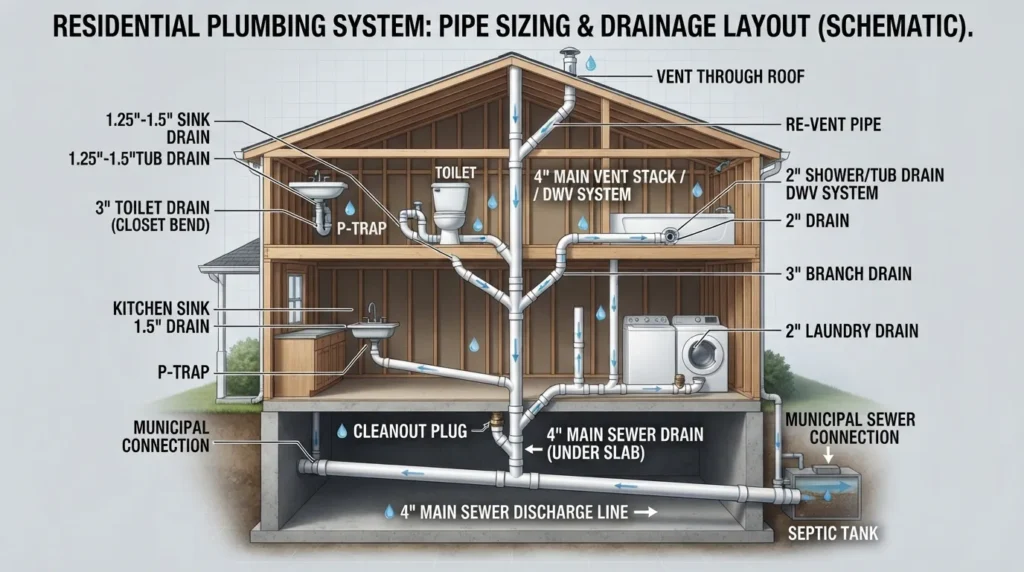
Under the 2023 Florida Plumbing Code, building drains and building sewers are sized according to drainage fixture-unit load and slope. The code states that the minimum size of a building drain serving a water closet is 3 inches. Its sizing table also gives different capacities for 3-inch and 4-inch building drains and sewers.
That does not mean every Miami sewer lateral should automatically be 3 inches. Utility standards are a separate layer. Miami-Dade Water and Sewer Department’s current pre-approved SDR 26 PVC specification covers gravity sewer applications and gravity sewer laterals, with listed sewer-pipe sizes beginning at 4 inches.
do not choose 3-inch versus 4-inch pipe from a generic internet rule. The answer depends on which part of the drainage/sewer system you are sizing, fixture load, slope, and the standards that govern that particular installation.
A Miami-Specific Detail Worth Knowing About PVC Sewer Pipe
Miami homeowners should be careful when reading national articles because a material can be generally permitted while a local utility has more specific requirements for its own sewer infrastructure.
The Miami-Dade Water and Sewer Department states that it stopped approving PVC SDR 35 pipe and fittings for WASD sewer mains and laterals after September 1, 2017, and identifies SDR 26 as the minimum PVC classification for its gravity sewers under that standard. Its currently published SDR 26 product sheet was revised in January 2026.
Do not overapply this rule: Miami-Dade WASD utility standards for sewer mains and laterals are not the same thing as saying every piece of private drainage piping in every Miami property must be SDR 26. Material and sizing requirements should be checked for the exact portion of the system and authority governing the work.
Sewer Pipe vs. Drain Pipe: Are They the Same?
People often use “drain pipe,” “sewer pipe,” “sewage pipe,” and “sewer line” interchangeably, but they can describe different parts of the wastewater path.
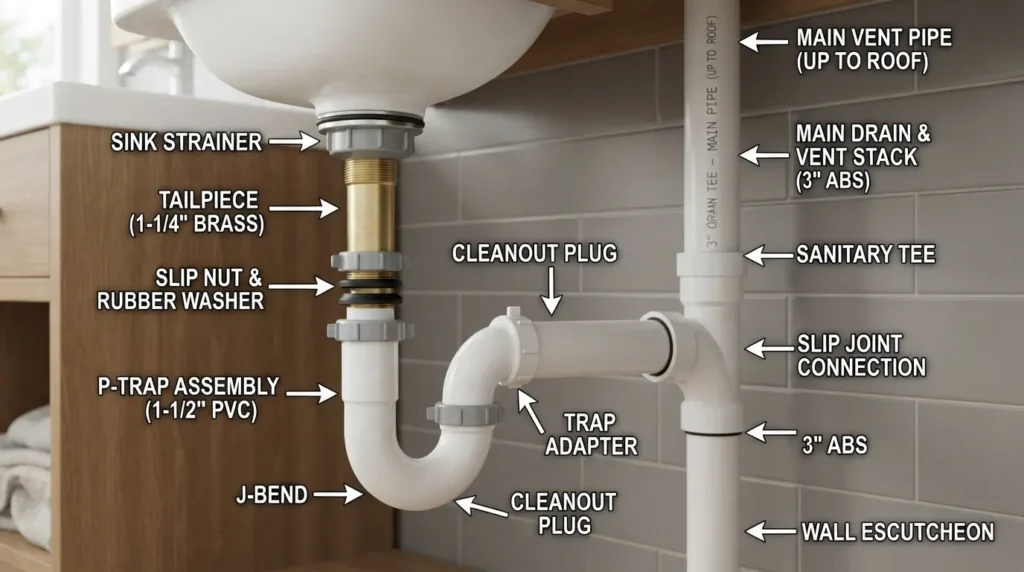
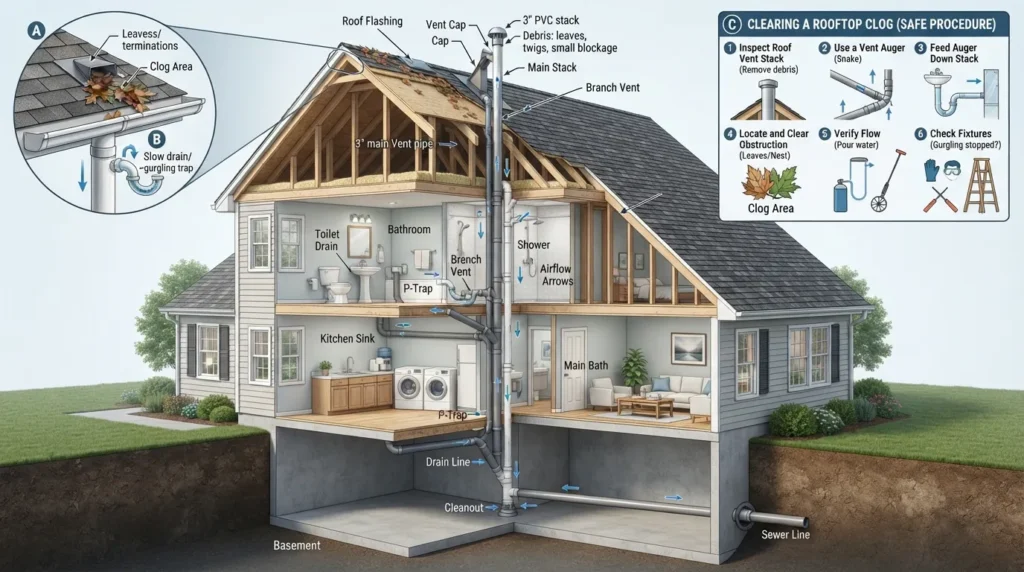
Inside and around a home, wastewater may move through fixture drains, branch drains, stacks, a building drain, and finally a building sewer or lateral toward a public sewer or an approved onsite system.
If you want to see how those components connect, our guide to the home drainage system explains the complete wastewater path in more detail.
This distinction matters during diagnosis. One slow sink may point to a local fixture or branch issue, while several fixtures backing up together can indicate a problem farther downstream.
Different Sewer Materials Fail in Different Ways
Knowing what the sewer line is made of becomes especially useful when problems keep returning. Different materials have different failure patterns.
Clay
Cracks, movement at joints, separation, and root intrusion can become important concerns.
Cast Iron
Internal corrosion, scaling, narrowing, and progressive wall deterioration can affect flow and structure.
Orangeburg
Deformation, blistering, flattening, and collapse are characteristic concerns as the material deteriorates.
PVC / ABS
Material corrosion is not the main concern, but poor installation, damaged joints, settlement, offsets, or sagging can still affect performance.
That is why two homes with the same symptom may not need the same solution. A recurring blockage caused by debris is different from recurring obstruction caused by roots entering a separated joint or a pipe that is losing its shape.
Does the Pipe Need Cleaning, Repair, or Further Inspection?
A clogged sewer line does not automatically mean the pipe has failed, and a damaged sewer pipe cannot be structurally repaired simply by removing a clog.
Cleaning may address
- Accumulated debris
- Grease or organic buildup
- Certain removable obstructions
- Some root-related blockages as part of a broader diagnosis
Cleaning cannot rebuild
- A collapsed pipe
- A severely deformed Orangeburg line
- A broken or badly displaced section
- Major structural wall loss
If the problem is an obstruction rather than structural failure, professional drain cleaning services can help restore flow and determine whether a recurring blockage needs further investigation.
Four Warning Signs a Sewer Line May Need Closer Evaluation
No single symptom proves that a sewer pipe is broken, but these patterns deserve attention:
- Several drains back up or drain slowly at the same time. A problem affecting multiple fixtures can be farther downstream than an isolated sink or tub clog.
- The same sewer blockage keeps returning. Recurring trouble after the line has been cleared can indicate roots, a sag, an offset, deformation, or another underlying condition.
- You notice persistent sewage odors, unusual gurgling, or wastewater appearing where it should not. These symptoms can indicate that wastewater or air is not moving through the system normally.
- An inspection shows cracks, severe corrosion, displaced joints, deformation, or collapse. Direct evidence from the line is much more useful than judging condition from age alone.
When symptoms suggest a deeper main-line issue, the goal should be to determine why the problem is occurring before repeatedly treating the symptom.
How Long Does a Sewer Line Last?
There is no responsible single lifespan number that applies to every sewer pipe.
Service life depends on much more than material. Important factors include:
- Quality of the original installation
- Soil support and movement
- Pipe joints
- Corrosion or chemical exposure
- Root intrusion
- External loading
- Groundwater conditions
- Previous repairs
- Maintenance history
- Whether the pipe was correctly selected for the application
A newer line can develop problems if it was poorly installed, while an older line may remain functional if it is structurally sound. This is why pipe age is most useful as a risk clue, not a replacement verdict. Site and installation conditions materially affect sewer-pipe performance and selection.
Frequently Asked Questions About Sewer Pipe Types
A Simple Decision Guide for Homeowners
If you only want to know what pipe you have:
Start with visible pipe, records, and the home’s history. Use an inspection when confirmation matters.
If one fixture is slow:
Investigate the local fixture or branch before assuming the main sewer is failing.
If several fixtures back up:
A downstream building drain or sewer-line obstruction becomes more likely and deserves prompt diagnosis.
If roots or blockages repeatedly return:
Find out why they are returning rather than treating every recurrence as a standalone clog.
If a camera shows collapse, major deformation, cracks, or severe wall deterioration:
The issue is structural, and cleaning alone will not restore the pipe itself.
The main sewer pipe materials you are likely to encounter are PVC, ABS, cast iron, vitrified clay, Orangeburg, and HDPE/PE, but sewer piping is not limited to those six materials. Concrete, polypropylene, ductile iron, stainless steel, and other materials also have legitimate applications.
The most useful question is not simply, “What is my sewer pipe called?” You want to understand what it is made of, where it is located, what job it performs, what condition it is in, and whether the problem is a blockage or a structural defect.
For Miami homeowners, that final point is especially important because statewide plumbing-code provisions and Miami-Dade utility requirements can apply to different portions of the system. Material and sizing decisions should therefore be based on the actual installation rather than a generic national recommendation.
If you need professional help determining whether a sewer or drainage problem is a simple obstruction or needs further investigation, you can learn more about Miami plumbing services for homeowners or speak with a plumbing professional about the symptoms you are seeing.
One final rule: diagnose the pipe, not just the symptom.
Knowing the sewer-pipe material helps you understand likely failure patterns, but the material name alone does not tell you whether the line needs cleaning, repair, monitoring, or replacement. Condition and cause should drive the decision.
Official References for Florida and Miami-Dade Sewer Requirements
For installation-specific decisions, current requirements should always be checked directly. Useful official references include: