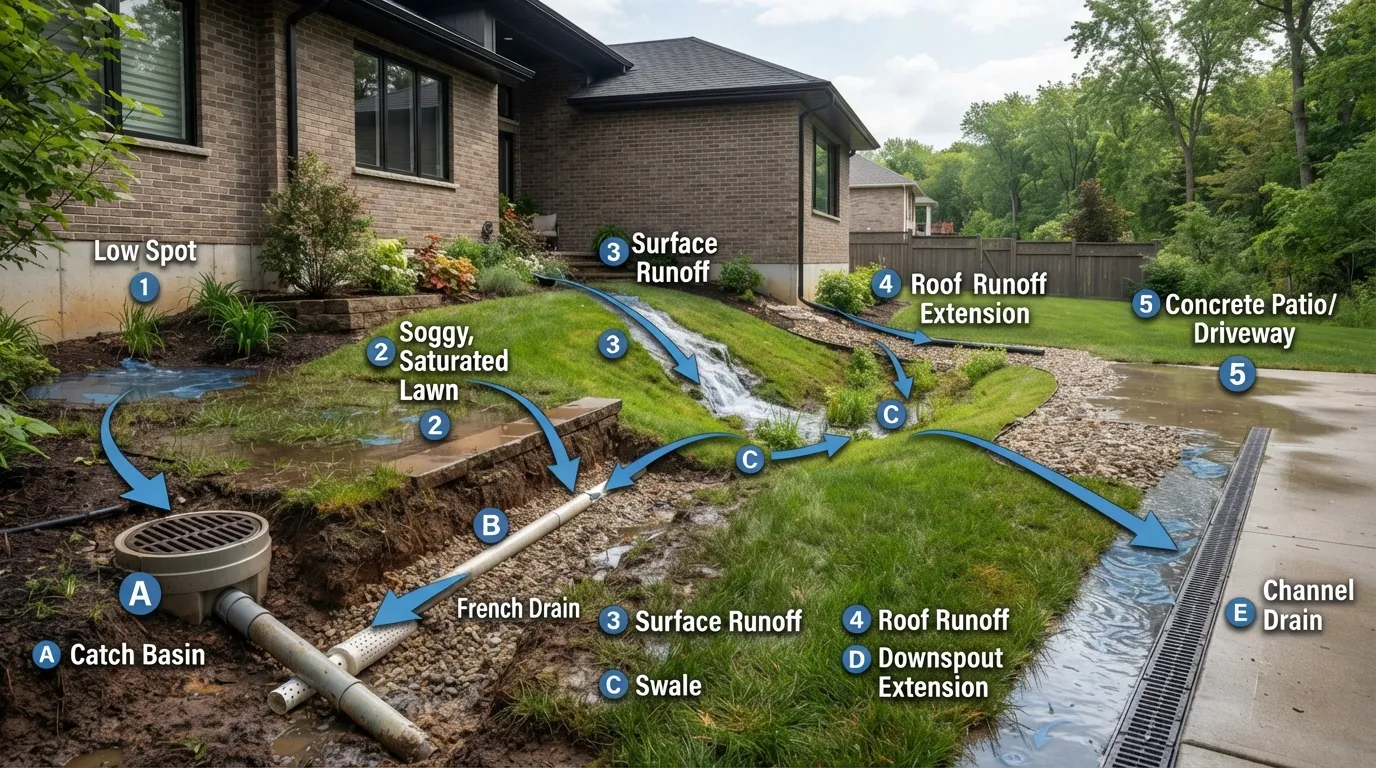
If water keeps pooling in your yard after rain, the first question is not, “Should I install a French drain?” The better question is, “Where is this water coming from, how is it moving across my property, and where can it safely go?”
That distinction matters because different drainage problems need different fixes. A catch basin may work well for one low spot, while a French drain may be more appropriate for persistently soggy ground. Roof runoff may only need better downspout routing, while water flowing across an entire yard may call for grading, a swale, or a combination of systems.
The best yard drainage solution depends on the source of the water:
- French drain: often useful for subsurface water and persistently soggy areas.
- Catch basin or yard inlet: useful where surface water collects in a specific low point.
- Swale or regrading: useful when runoff is moving across the property in the wrong direction.
- Downspout extension: useful when roof runoff is being dumped beside the house or into the lawn.
- Channel or trench drain: useful for water moving across patios, driveways, walkways, and other hard surfaces.
- Aeration or soil improvement: may help when compacted soil is reducing normal infiltration.
The key is to diagnose the cause before spending money or digging up the yard. Below, I’ll walk you through that process so you can narrow down the right solution instead of treating every puddle the same way.
Start With the Water, Not the Drain
When I think through a yard drainage problem, I start by tracing the water backward. Standing water is usually a symptom. The actual cause may be several feet—or an entire property section—away from the puddle you see.
Look for possible water sources such as:
- roof runoff from gutters and downspouts;
- water flowing downhill from another part of the property;
- runoff from a neighboring lot;
- a driveway, patio, pool deck, or other hard surface;
- a low spot caused by poor grading or settled soil;
- compacted soil that cannot accept rainfall quickly;
- irrigation problems;
- an existing drainage line that is clogged or no longer discharging properly;
- groundwater or a seasonally high water table.
This source-first approach is important because moving water away from one spot without understanding its path can simply move the problem somewhere else.
Match the Symptom to the Most Likely Drainage Problem
Use the examples below as a starting point. They are not a substitute for a site inspection, but they can help you determine what type of solution deserves attention first.
One puddle in a low spot
Possible cause: local depression, settled soil, or poor surface grading.
Start by considering: regrading, filling the low area correctly, or a catch basin if water needs to be collected and conveyed elsewhere.
Most of the lawn stays soggy
Possible cause: saturated soil, poor subsurface movement, compaction, or groundwater conditions.
Start by considering: soil conditions, drainage elevation, and whether a subsurface system such as a French drain is actually appropriate.
Water collects beside the foundation
Possible cause: downspout discharge, roof runoff, or ground sloping toward the house.
Start by considering: gutters, downspout routing, and positive surface drainage away from the building.
Water flows through the yard during storms
Possible cause: concentrated surface runoff from an uphill area or neighboring property.
Start by considering: a swale, grading changes, or another system designed to intercept and redirect surface flow.
Driveway or patio floods
Possible cause: runoff from an impervious surface with nowhere to drain.
Start by considering: channel drains, trench drains, grading, or another surface-water collection system.
An existing drain is present but water still pools
Possible cause: blocked inlet, sediment, roots, damaged pipe, insufficient fall, poor outlet, or an undersized/wrongly designed system.
Start by considering: inspection and troubleshooting before installing another drain.
The Most Useful Yard Drainage Solutions—and When Each One Makes Sense
1. French Drains for Subsurface Water
A French drain is typically built around a gravel-filled drainage trench containing perforated pipe. Its purpose is to intercept water moving through saturated ground and provide a controlled path away from the problem area.
A French drain can be useful when:
- the ground remains soggy beyond the immediate rain event;
- water is moving through the soil rather than simply across its surface;
- a section of the lawn repeatedly stays wet;
- subsurface water needs to be intercepted before reaching another area.
However, a French drain is not automatically the best solution for every puddle. If the real issue is one surface depression, a disconnected downspout, or water flowing over a patio, another system may solve the problem more directly.
Important: A French drain still needs a workable drainage path and an appropriate destination for the collected water. A trench that collects water but has nowhere effective to send it may not solve the underlying problem.
2. Catch Basins for Specific Low Spots
A catch basin or yard inlet collects surface water through a grated opening and routes it into underground piping.
This is often a better fit when water consistently gathers in one identifiable location, such as:
- a low point in the lawn;
- the bottom of a slope;
- an area near a patio;
- a spot receiving concentrated runoff.
The catch basin only solves part of the problem, though. The connected pipe and discharge location matter just as much as the inlet.
3. Swales for Redirecting Surface Runoff
A swale is a broad, shallow depression designed to guide surface water along a controlled route. It can be landscaped with grass or suitable vegetation so it functions as part of the yard rather than looking like an open ditch.
Swales are particularly useful when water naturally flows across a larger portion of the property and needs to be redirected without immediately putting it underground.
In many situations, managing water at the surface can make the drainage path easier to see, inspect, and maintain.
4. Regrading to Correct the Root Cause
Sometimes the most effective yard drainage solution is not another pipe. If the land slopes toward the house or contains pronounced low areas, correcting the grade may address the reason water is pooling in the first place.
Regrading can help:
- encourage water to move away from the home;
- remove depressions that hold rainfall;
- direct runoff toward a planned drainage route;
- reduce the amount of water another drainage system needs to handle.
Major grading work should be planned carefully because changing the direction of runoff can affect neighboring property, landscaping, structures, utilities, and existing drainage features.
5. Downspout Extensions for Roof Runoff
If a downspout empties directly beside the foundation or into a low area of the lawn, roof runoff can overwhelm that small section during heavy rain.
Extending or properly routing the downspout may be one of the simplest fixes when the roof is clearly the source of the problem.
The important part is not simply adding pipe. You still need to know where the water will safely discharge.
6. Channel and Trench Drains for Hard Surfaces
Patios, driveways, walkways, and pool decks do not absorb water the way soil does. When their slope sends water toward a house, garage, doorway, or low lawn area, a linear channel or trench drain may help intercept the flow.
These systems are different from French drains because they primarily collect surface water at the top rather than subsurface moisture moving through soil.
7. Lawn Aeration for Compacted Soil
If your grass is healthy enough but rain sits on top of hard, compacted soil, core aeration may improve the way water enters the upper soil layer.
This can be useful for a compaction problem, but it is not a substitute for drainage infrastructure when large volumes of runoff are entering the yard or groundwater is keeping the soil saturated.
8. Rain Gardens, Dry Creek Beds, and Other Landscape-Based Options
Some yards can manage appropriate amounts of runoff through landscape-based solutions such as rain gardens, shallow planted depressions, or dry creek beds.
These approaches can slow, redirect, or temporarily hold surface runoff while integrating drainage into the landscape. Their suitability depends on available space, soil conditions, groundwater, plant selection, and where excess water can go during a large storm.
Surface Water and Groundwater Are Not the Same Problem
This distinction can save you from choosing the wrong system.
Surface-water problem
You can usually see where the water travels during rain.
- roof runoff;
- driveway runoff;
- poor grading;
- low spots;
- water flowing downhill;
- blocked surface inlets.
Subsurface or groundwater problem
The soil may remain saturated even after visible runoff has stopped.
- persistently soggy grass;
- wet areas without an obvious surface source;
- seasonal groundwater conditions;
- water moving laterally through soil.
A catch basin may collect surface water very effectively but do little for an entire lawn affected by groundwater. Likewise, a French drain may be unnecessary if the only problem is a roof downspout dumping water into one corner of the yard.
What to Check During the Next Heavy Rain
You can learn more about your drainage problem during one storm than by staring at a dry lawn for a week. From a safe location, observe the yard while rain is falling and again afterward.
- Find where the water first appears. Is it falling directly into the low area or arriving from somewhere else?
- Watch the direction of flow. Note whether runoff is coming from the roof, driveway, neighbor’s side, or an uphill section.
- Inspect downspouts. See whether they are discharging beside the foundation or overwhelming one patch of lawn.
- Compare one puddle with the whole yard. A single low spot points to a different problem than widespread saturation.
- Check how long the area stays wet. Water that remains long after surface runoff is gone may indicate a deeper drainage issue.
- Inspect existing inlets and outlets. If you already have a yard drain, see whether water is entering it and whether the discharge point is flowing freely.
A better rule than “install a drain”
Trace the full water path: where the water comes from → where you intercept it → how you move it → where it safely ends up. If one part of that path is missing, the drainage plan is incomplete.
Yard Drainage in Miami Requires Extra Attention to Local Conditions
National drainage advice can be helpful, but South Florida conditions make local diagnosis especially important. Heavy rain, relatively flat properties, developed lots, neighborhood swales, paved surfaces, and seasonally high groundwater conditions can all affect how a drainage solution performs.
That means you should not automatically assume that a solution that works well on a steep property in another part of the country will behave the same way on a Miami lot.
Miami soil conditions are not as simple as “sand drains well”
Florida is known for sandy soils, and many sandy soils can accept water quickly. But real properties may also contain compacted areas, fill material, different soil layers, hardscape, disturbed construction soil, and groundwater conditions that limit how much water can actually move downward.
That is why an infiltration-based solution should be selected based on the conditions at the property rather than a general assumption about Florida soil.
Pay attention to swales and stormwater routes
Swales and other stormwater features may be part of the drainage pattern serving the surrounding area. Blocking, filling, or redirecting an established drainage route can create new problems.
Before making major drainage changes, check the requirements that apply to your property and municipality. Miami-Dade provides public guidance on heavy-rain flooding and protecting drainage features.
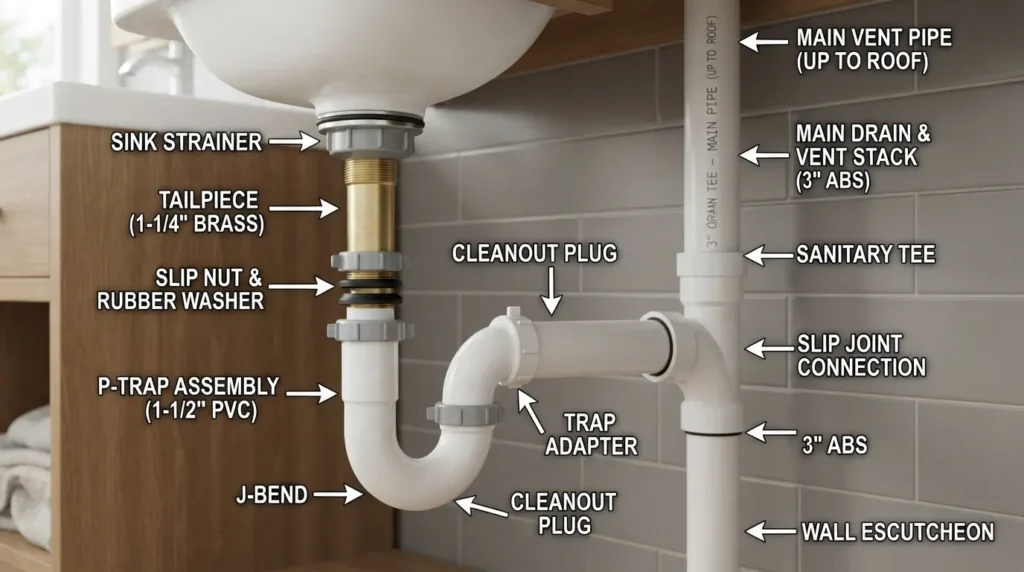
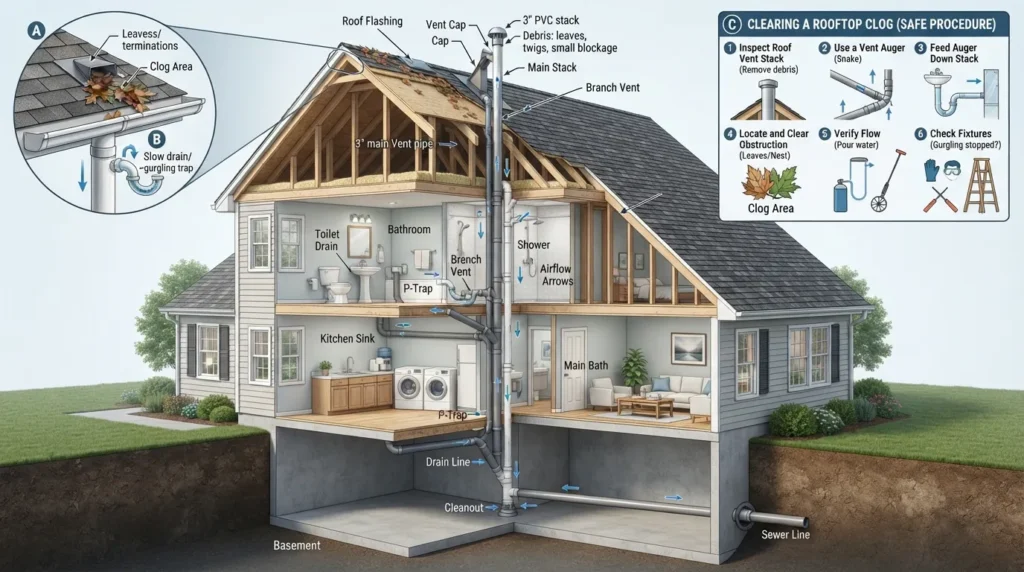
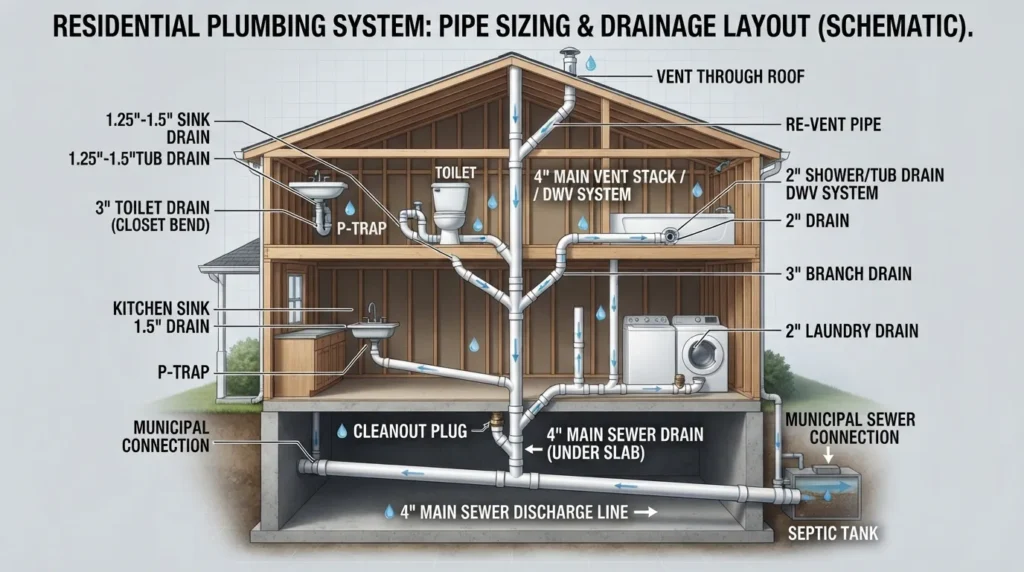
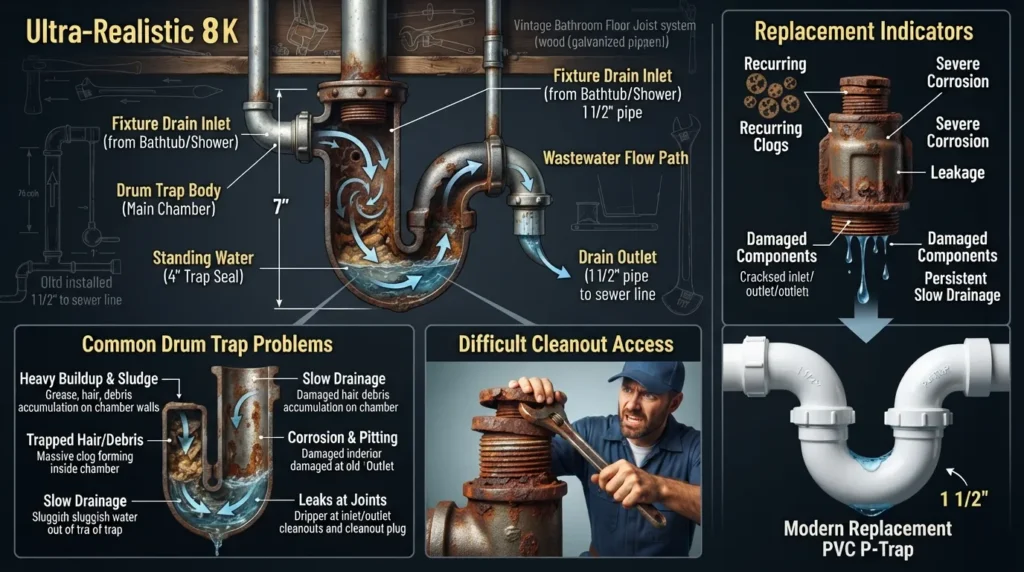
If you want to understand the difference between rainwater drainage and the plumbing systems that handle wastewater inside a property, our guide to how home drainage systems handle different types of water explains the distinction in more detail.
Can You Just Dig a Hole and Fill It With Gravel?
Sometimes people try to fix standing water by digging a deep hole, filling it with gravel, and expecting the water to disappear underground.
The problem is simple: the water still needs somewhere to go.
If the surrounding soil accepts water slowly, groundwater is already high, or the hole fills faster than it can drain, you may simply create a gravel-filled underground reservoir that eventually becomes saturated.
Before relying on a dry well, gravel pit, or other infiltration solution, consider:
- where the water is coming from;
- how much runoff reaches that location;
- whether the surrounding soil can accept the water;
- groundwater conditions;
- how the system behaves during repeated heavy rainfall;
- local drainage and permitting requirements.
What If You Want to Get Rid of Standing Water Without Installing a Drain?
Not every wet-yard problem requires underground drainage pipe.
Depending on the cause, non-pipe options may include:
- correcting low spots;
- regrading the surface;
- redirecting downspouts;
- creating a vegetated swale;
- core-aerating compacted lawn areas;
- using an appropriately designed rain garden;
- reducing unnecessary runoff from hard surfaces;
- repairing irrigation problems.
The right choice still depends on the volume of water and where it can safely move.
Do Rocks Help With Yard Drainage?
Rock and gravel are useful components in many drainage systems because void spaces between aggregate can allow water to move through a drainage zone more easily than through compacted soil.
But rocks are not a complete drainage plan on their own.
Dumping gravel into a wet area will not necessarily solve:
- poor grading;
- high groundwater;
- roof runoff;
- a blocked outlet;
- water arriving from an uphill property;
- a clogged underground pipe.
Think of gravel as a component of a properly designed system, not as a universal cure for standing water.
Does Forking or Aerating a Lawn Improve Drainage?
Creating openings in compacted soil can help water enter the upper soil layer more easily, which is why core aeration is often recommended for lawns affected by compaction.
However, lawn aeration has limits.
If your yard is receiving concentrated runoff, has a major grading problem, or remains saturated because water has nowhere to leave, making holes in the soil will not correct the larger drainage issue.
What About Retaining Wall Drainage?
Retaining walls create a special drainage situation because water can accumulate in the soil behind the wall.
A proper wall drainage design may include free-draining material, drainage pipe, outlets, and grading that keeps unnecessary surface runoff from being directed behind the structure.
If an existing retaining wall shows drainage problems, do not assume that drilling a random outlet or adding a surface drain will solve the cause. The wall, surrounding grade, discharge route, and structural condition should be evaluated together.
What Is a “Vertical Drainage System”?
The term vertical drainage is used in different ways online. In residential DIY discussions, it may describe a deep gravel-filled or piped column intended to move water downward into more permeable soil.
That does not make it an automatic solution for a wet yard.
Before digging deeply, you need to understand groundwater, soil layers, underground utilities, nearby structures, and local rules. Where groundwater is shallow or the receiving soil cannot accept additional water, a deep vertical feature may accomplish very little.
Why Existing Yard Drainage Systems Stop Working
If you already have drains but the yard still floods, do not immediately install a second system. Find out why the existing one is failing.
Common possibilities include:
- leaves, mulch, or debris blocking a grate;
- sediment collecting inside a basin or pipe;
- roots entering or obstructing a line;
- a buried or damaged outlet;
- settled or damaged underground piping;
- an inadequate drainage route;
- a system designed for the wrong type of water;
- new landscaping or construction changing the direction of runoff;
- more water entering the area than the original layout was designed to manage.
The goal is to determine whether you have a maintenance problem, a blockage, or a design problem.
Maintenance Matters After Yard Drainage System Installation
Even a well-planned drainage system needs occasional attention.
After major storms and periodically throughout the year:
- clear leaves, grass, mulch, and debris from grates;
- inspect catch basins for sediment buildup;
- make sure downspouts are still connected and directed correctly;
- check visible outlets for blockage;
- watch for soil settlement along underground pipe routes;
- confirm water is actually leaving the problem area;
- investigate recurring slow drainage rather than waiting for complete failure.
If an underground plumbing or drain line is suspected to be blocked, inspection may make more sense than adding another landscape drain. Our professional drain cleaning in Miami page explains options used for clogged plumbing lines, including situations where further inspection may be needed.
DIY Yard Drainage vs. Calling a Professional
Some drainage tasks are reasonable homeowner projects. Others become complicated quickly because excavation, elevations, underground utilities, discharge routes, structures, and local stormwater requirements may all be involved.
A simpler DIY fix may be reasonable when
- a grate only needs cleaning;
- a downspout has an obvious discharge problem;
- minor compaction needs aeration;
- a small surface depression can be corrected safely;
- basic maintenance restores normal drainage.
Professional evaluation makes more sense when
- water is repeatedly reaching the foundation;
- you cannot identify an appropriate outlet;
- most of the property remains saturated;
- significant excavation or grading is required;
- a retaining wall is involved;
- an underground line may be damaged or blocked;
- the problem appears even when it has not recently rained;
- several drainage systems may need to work together.
When the Problem May Be Plumbing Rather Than Landscape Drainage
Rainwater pooling in the lawn is not automatically a plumbing problem. Stormwater drainage and sanitary plumbing serve different purposes.
However, call attention to the plumbing system if yard water appears alongside symptoms such as:
- multiple slow indoor drains;
- gurgling fixtures;
- sewage odors;
- wastewater backing up through a drain;
- a suspected blocked or damaged underground sanitary line;
- wet ground that appears without recent rainfall or irrigation.
If you are trying to determine whether the issue is related to your plumbing system, you can start with our Miami plumbing team for help evaluating the plumbing side of the problem.
Common Yard Drainage Mistakes to Avoid
- Installing a French drain for every wet spot. Diagnose the water first.
- Collecting water without planning an outlet. Water that enters a pipe still needs somewhere appropriate to go.
- Assuming gravel alone solves drainage. Aggregate is a component, not a complete strategy.
- Treating high groundwater like surface runoff. These are different hydraulic problems.
- Ignoring downspouts. Roof runoff may be creating the problem you are trying to fix underground.
- Blocking an existing swale. Established surface-drainage routes may serve more than one portion of the property.
- Sending water onto a neighboring property. A drainage fix should not create a new problem elsewhere.
- Digging without locating utilities. Underground work requires proper planning.
- Ignoring maintenance. Even a correctly installed system can lose performance when inlets and outlets become blocked.
See a Yard Drainage Project in Practice
If you learn better visually, this yard-drainage walkthrough can help you see how drainage components and water movement are approached in a real project. Use it as general educational material rather than a substitute for site-specific design.
Frequently Asked Questions About Yard Drainage
Diagnose First, Then Choose the Drainage Solution
Good yard drainage is not about installing the most complicated system. It is about understanding the water well enough to choose the simplest solution that addresses the actual cause.
Before you install anything, answer four questions:
- Where is the water coming from?
- Is it moving across the surface or through saturated soil?
- Where should it be intercepted?
- Where can it safely and appropriately go?
If you can answer those questions, it becomes much easier to decide whether you need grading, a swale, downspout correction, a catch basin, French drain, channel drain, soil improvement, maintenance—or a combination of approaches.
Not Sure Whether the Water Problem Is Drainage or Plumbing?
If recurring water problems are accompanied by slow drains, underground pipe concerns, backups, or other plumbing symptoms, it makes sense to rule out a plumbing problem before changing the landscape.