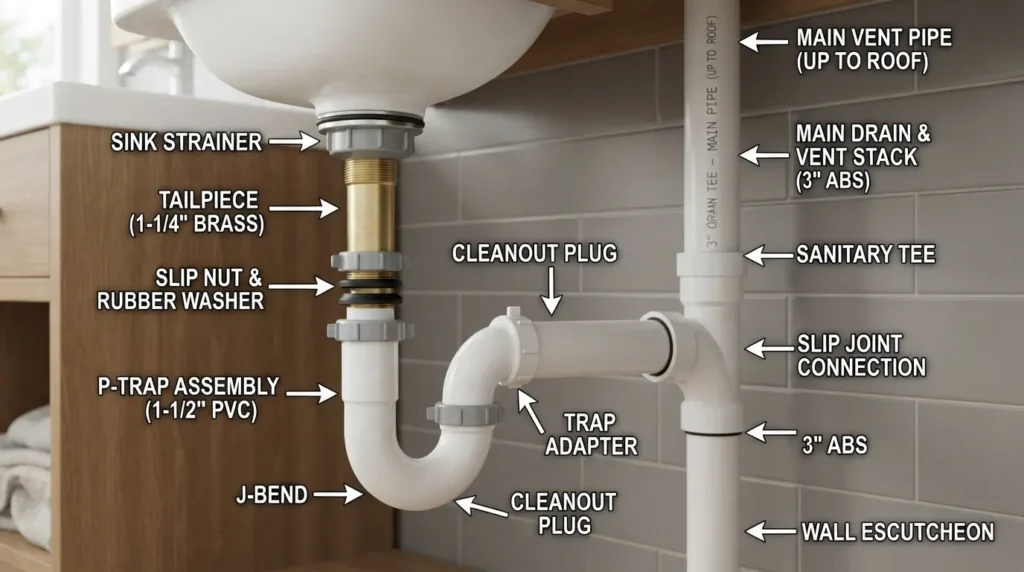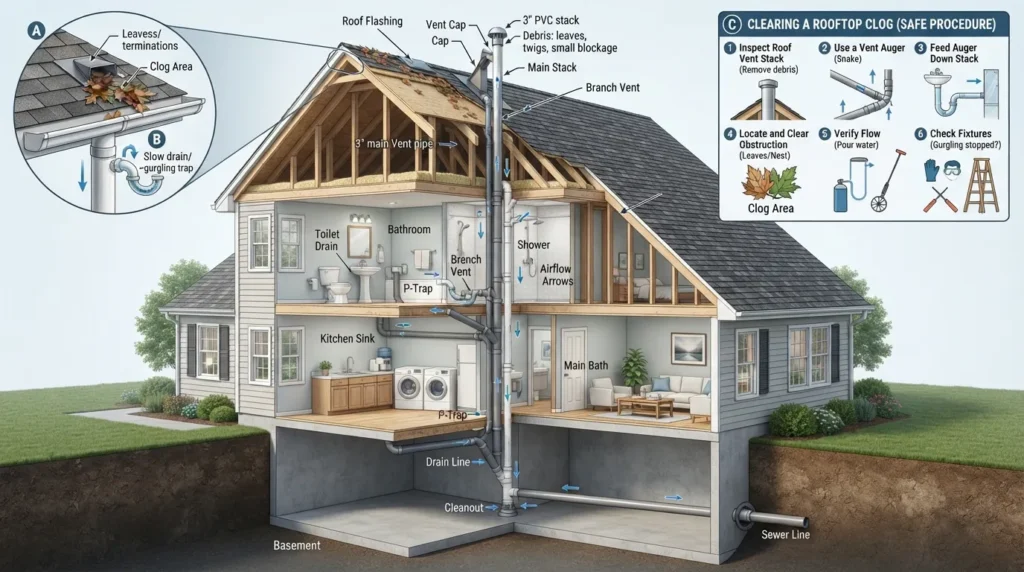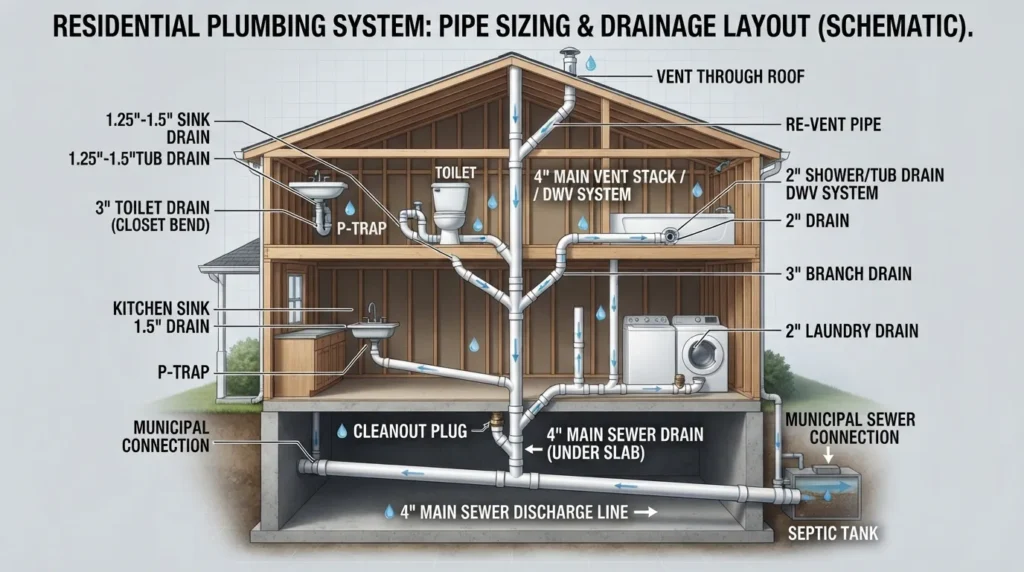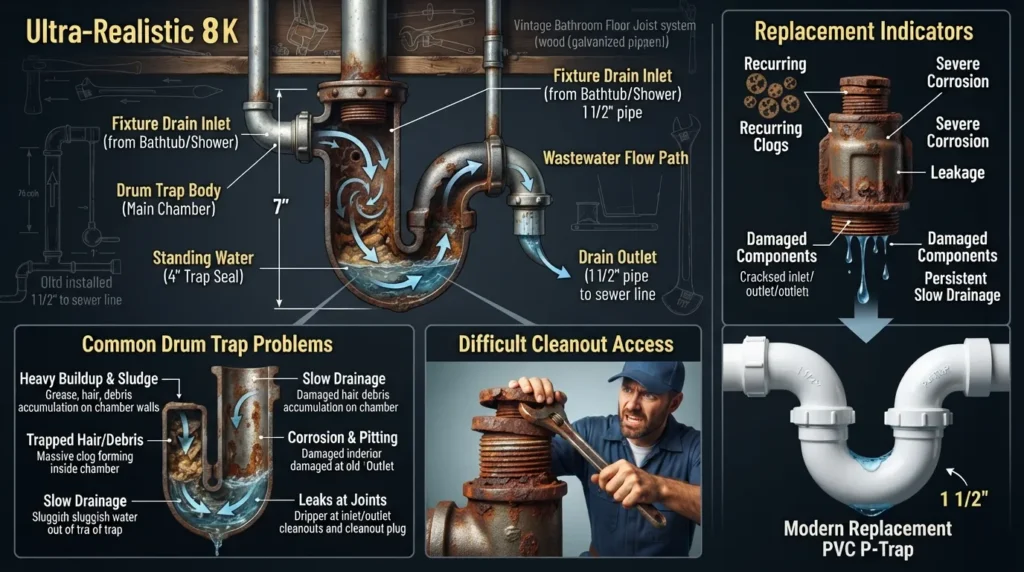
 A sewer machine is powered drain-cleaning equipment used to clear obstructions from drain and sewer pipes. Depending on the machine, it may rotate a flexible cable, sectional cable, rod, chain-knocker system, or use high-pressure water. The right choice depends on much more than pipe diameter: you also need to consider the type of blockage, pipe condition, access point, distance, and whether your goal is simply opening the flow or cleaning buildup from the pipe wall.
Those are different questions, but they all lead to one important principle: do not choose a drain cleaning machine by size or power alone. A machine that is appropriate for a grease-filled line may not be the best tool for roots, a foreign object, or a pipe with a structural defect.
In this guide, I’ll help you understand the major machine types, cables and cutting tools, what each method is designed to accomplish, what a sewer machine cannot repair, and how to decide whether you should buy, rent, or bring in professional help.
What Is a Sewer Machine?
A sewer machine is a powered tool used to remove or break through blockages in drain and sewer piping. In everyday plumbing language, you may also hear terms such as drain cleaning machine, sewer snake machine, plumbing snake machine, power auger, professional plumbing snake, or simply drain machine.
Traditional machines rotate a flexible cable or connected cable sections through the pipe. A compatible auger, cutter, retrieving tool, or other head can be attached to the working end according to the obstruction and equipment design.
But cable machines are only one part of professional drain-cleaning equipment. Manufacturers also offer sink machines, drum machines, sectional machines, rodders, water jetters, and flexible-shaft systems for different applications.
Important terminology:
A sewer-cleaning machine is not the same thing as a sewage pump. Sewage and grinder pumps move wastewater; they do not perform the same job as a cable-based drain cleaner. Likewise, a municipal combination sewer cleaner is much larger equipment that can combine high-pressure water with vacuum collection. Search results sometimes place these related entities near one another, so knowing the distinction prevents you from comparing completely different equipment.
How Does a Sewer Machine Work?
The exact operation varies by design, but a conventional plumbing snake machine usually works through a controlled rotating cable.
- The appropriate machine and cable are selected for the line and manufacturer-rated application.
- The cable is introduced through a suitable drain or cleanout access point.
- The machine rotates the cable while the operator advances it through the piping.
- A compatible head or cutter interacts with the obstruction.
- The operator may penetrate, cut, break apart, or retrieve material depending on the clog and tool.
- The line is checked afterward to determine whether normal flow has been restored and whether additional cleaning or inspection is needed.
That last step matters. Getting water to move again does not automatically prove that the underlying problem has been solved.
The Main Types of Sewer and Drain Cleaning Machines
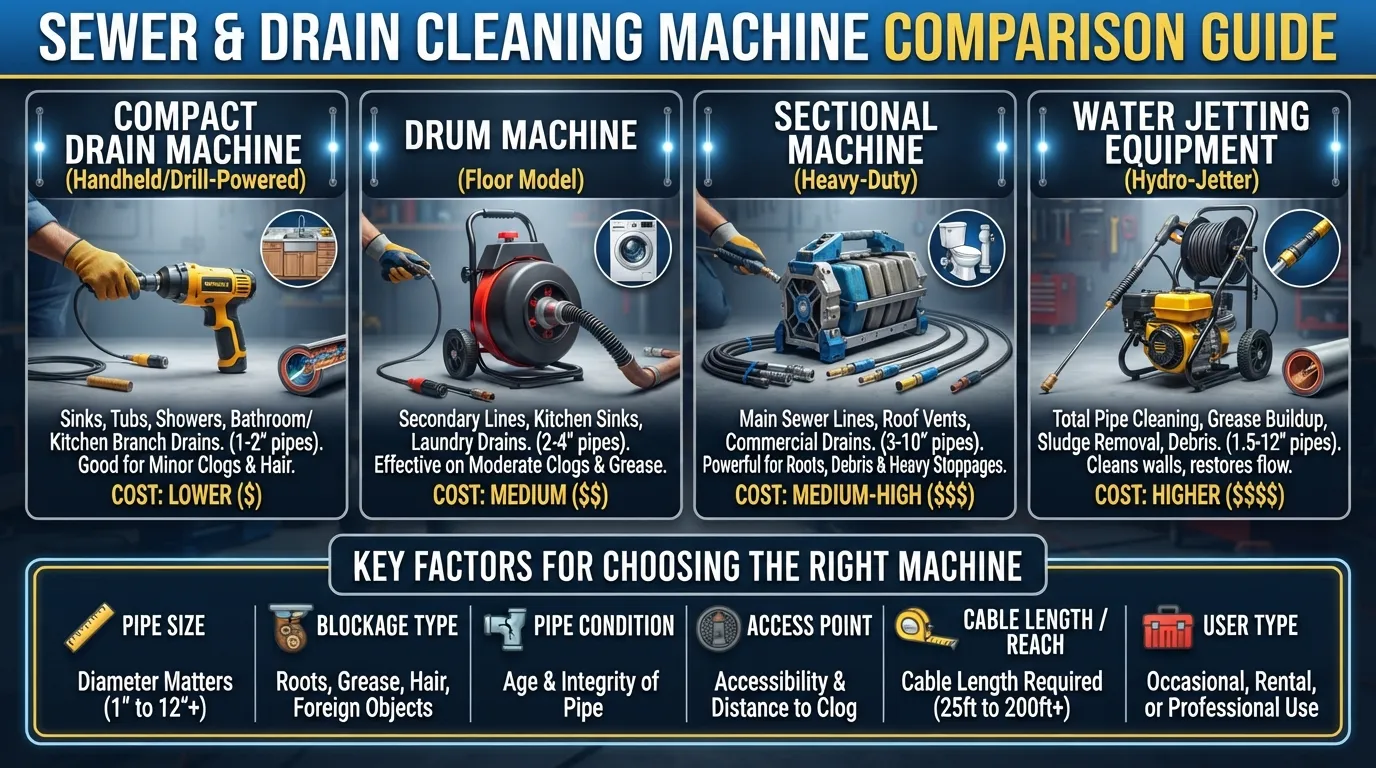
One of the biggest mistakes in sewer-machine guides is reducing the subject to only “small machine” versus “big machine.” Professional drain cleaning has several distinct equipment families.
Sink / Compact Machines
Smaller machines intended for comparatively small fixture and branch drains such as sinks, tubs, and showers, within the specific machine’s rated capacity.
Drum Machines
A continuous cable is stored inside or around a drum. Drum machines are available in different capacities, from smaller drain units to professional main-line equipment.
Sectional Machines
These use detachable cable sections instead of keeping one long cable in a drum. They are common professional machines where portability, cable control, and heavier drain or sewer work are priorities.
Rodder Machines
Rodding machines drive connected sewer rods rather than a conventional flexible drain cable. Heavy rodders are particularly associated with long, relatively straight runs and larger-line institutional or municipal work.
Water Jetters
Jetters use high-pressure water rather than a rotating sewer cable. They are useful when the cleaning objective includes removing grease, sludge, sediment, or accumulated material from more of the pipe’s internal surface.
Flexible-Shaft Machines
Flexible-shaft systems use an enclosed rotating cable with specialized chain knockers or accessories. Depending on the model and attachment, they can target grease, buildup, soft blockages, scale, or lighter root intrusion.
What Is a Sectional Sewer Machine?
A sectional sewer machine spins shorter cable sections that are coupled together as the operator progresses farther into the line. Instead of carrying the entire working cable inside a drum, the operator adds or removes sections as needed.
This design can make sectional equipment easier to transport than some large drum machines, and professional models may be designed for substantial drain and main-line work. The exact cable size, line capacity, speed, and compatible cutters depend on the machine.
Watch: RIDGID Sectional Machine Overview
This manufacturer video is useful for understanding the sectional-machine concept visually. Always follow the manual and safety instructions for the exact equipment you use.
How to Choose the Right Sewer Machine: Use This 5-Part Decision
This is the part I would focus on before comparing horsepower, cable length, or price.
The useful selection formula
Pipe size + blockage type + pipe condition + access + cleaning objective
Two homes can have sewer lines with a similar diameter and still require completely different approaches. One line may contain roots. Another may have heavy grease buildup. A third may have an offset joint or damaged section where repeatedly forcing a larger cable is not the right answer.
1. Pipe and Drain-Line Size
Every professional drain machine has a manufacturer-rated line-capacity range. Smaller sink machines are built for smaller fixture piping, while larger drum and sectional machines can serve larger drain and sewer lines.
Do not assume that a thicker cable is automatically better. A cable that is too large or too stiff for a particular line can be difficult or inappropriate to use, while a cable that is too small for a heavy main-line obstruction may lack the characteristics required for the job.
Use the actual machine manufacturer’s pipe-capacity and cable recommendations rather than a generic internet sizing chart.
2. Type of Blockage
The obstruction tells you as much as the pipe diameter does.
Hair & soft debris
Often associated with fixture or branch drains and may respond to smaller mechanical equipment when accessible.
Grease & sludge
A cable may restore an opening, but broader pipe-wall cleaning may require a different method where the line condition allows it.
Roots
May require professional cutting equipment and should raise the question of how roots entered the sewer in the first place.
Foreign objects
The goal may be retrieval rather than simply breaking material into smaller pieces.
Scale & buildup
The objective may shift from punching through a blockage to cleaning material from around the pipe wall.
Structural failure
A sewer machine cannot repair a cracked, collapsed, offset, or badly deformed pipe.
3. Pipe Condition
A powerful machine is not a substitute for knowing what condition the pipe is in.
If a line has recurring problems, significant age-related deterioration, suspected root entry, an offset, belly, crack, or other structural concern, a camera inspection may provide information that a blind mechanical cleaning cannot.
This is especially important when a drain repeatedly clogs after it has already been opened. At that point, the better question may no longer be “Which bigger sewer snake should I use?” but “Why does this line keep failing?”
4. Access Point and Distance
Machine selection also changes according to where the pipe can safely be accessed and how far the obstruction is from that point.
A cleanout with a practical approach path is different from a cramped fixture location, crawlspace, roof access, or an area where moving a heavy drum machine is difficult. Portability, cable length, machine weight, guide systems, and sectional versus continuous cable design can all matter.
5. Your Real Cleaning Objective
Ask one simple question:
Am I trying to open a passage through the blockage, remove a specific obstruction, or clean accumulated material from the pipe wall?
Those are not always the same job.
Opening a Clog Is Not Always the Same as Cleaning the Pipe
Mechanical Snaking
A rotating cable and suitable tool can penetrate, cut, break, or retrieve many obstructions. It may restore drainage quickly, but it does not automatically remove all residue from the complete circumference of a pipe.
Hydro Jetting
High-pressure water can be useful when the objective is removing grease, sludge, sediment, and accumulated material from a broader portion of the internal pipe surface, provided the pipe is suitable for jetting.
Camera Inspection
A sewer camera does not clear a clog by itself. Its value is diagnosis: locating or identifying conditions such as recurring root entry, cracks, offsets, bellies, or other issues that change the repair decision.
If you want a deeper explanation of how fixture drains, branch drains, building drains, and the sewer connection relate to one another, see our guide to how a home drainage system works.
What Cutting Heads and Cable Tools Do
Professional plumbing snakes are not limited to one universal tip. Manufacturers offer different augers, retrieving tools, grease cutters, saw-style cutters, root-cutting tools, and other attachments.
The names and intended applications vary by manufacturer, but the general logic is useful:
- Starter or straight augers: may help probe or begin working through an obstruction.
- Funnel or retrieving augers: can be useful when the goal includes catching or retrieving material.
- Grease cutters: are designed around softer or greasy deposits.
- Sawtooth or root-oriented cutters: are associated with tougher obstructions such as root intrusion, when appropriate for the machine and pipe.
- Specialized chain or flexible-shaft tools: may target buildup, grease, scale, or light root conditions depending on the equipment.
A common mistake is choosing an aggressive cutter simply because the blockage is difficult. The tool still has to match the machine, cable, pipe, obstruction, and manufacturer instructions.
When a Sewer Machine Will Not Fix the Real Problem
This is one of the most important limitations to understand before renting or buying equipment.
Do not confuse restored flow with a repaired sewer.
A sewer machine can remove many obstructions, but it cannot repair a broken pipe. If the underlying defect remains, the blockage can return.
A different diagnostic or repair step may be needed when there is:
- a cracked sewer pipe;
- a separated or offset joint;
- a sag or belly that repeatedly holds waste;
- significant corrosion or deterioration;
- a collapsed section;
- recurring root intrusion through a defective joint or crack;
- repeated backups soon after previous cleaning.
In these situations, running the machine again may address the symptom without answering why the problem keeps returning.
How to Unclog a Severely Clogged Sewer Line
A severe main sewer blockage should be approached as a diagnosis problem, not simply a competition to find the strongest machine.
- Limit wastewater use. Repeated flushing or running multiple fixtures can make an active backup worse.
- Look at the pattern. One slow sink suggests a different problem from several fixtures backing up together.
- Determine whether the obstruction is local or main-line related.
- Consider pipe history and recurrence. A line that has been cleaned repeatedly may warrant inspection rather than another blind attempt.
- Select the cleaning method according to the obstruction and pipe condition. Mechanical cable, hydro jetting, flexible-shaft cleaning, retrieval tools, or another method may be appropriate in different circumstances.
- Inspect when the cause remains uncertain. A camera can help distinguish an ordinary blockage from roots or structural defects.
If you are dealing with a recurring or significant backup in South Florida, our professional drain cleaning service in Miami explains how snaking, hydro jetting, and camera inspection fit different drain problems.
Sewer Machine Buying Guide: What Should You Compare?
If your search is really about finding a sewer machine for sale, do not compare listings by cable length and motor power alone.
Rated Pipe Capacity
Start with the line sizes the manufacturer says the machine is designed to clean. Do not extrapolate beyond that rating because another machine looks similar.
Cable Type, Diameter and Length
Compare whether the machine uses continuous drum cable, sectional cable, rods, or another system. Also check which cable sizes and lengths are approved for that model.
Available Cutters and Accessories
The machine is only part of the system. Look at compatible augers, cutters, retrieving tools, guide hoses, cable feeds, replacement cables, and other components required for the work you expect to perform.
Manual Feed vs. Powered Cable Feed
Some machines use a powered or automatic feed mechanism to advance and retrieve cable. Others require more manual cable handling. Compare control, maintenance requirements, and the manufacturer’s operating instructions—not just convenience.
Portability
A commercial sewer machine that works well in an open mechanical room may be frustrating to move through stairs, narrow halls, roofs, or other tight access points. Weight, wheels, handles, frame design, and whether the cable is stored separately can matter on real jobs.
Electrical and Operator Safety Features
Review the equipment’s supplied safety devices and manual. Depending on the model, features can include GFCI protection, foot controls, cable-control systems, guide hoses, clutches, and manufacturer-specific drain-cleaning gloves or mitts.
Replacement Parts and Serviceability
A cheap machine is not necessarily inexpensive to own if replacement cables, cutters, bearings, feeds, or other parts are difficult to obtain. For professional use, downtime and parts availability can matter as much as the purchase price.
How Much Does a Sewer Machine Cost?
There is no useful single price for a sewer machine because the term covers everything from compact drain machines to professional drum and sectional equipment and much larger commercial systems.
Prices also change frequently, so a fixed figure in an informational article can become outdated quickly.
When calculating real cost, compare:
- the machine itself;
- included versus optional cable;
- cable length and type;
- cutters and tool sets;
- guide hoses or cable-feeding accessories;
- replacement cable cost;
- maintenance and repairs;
- transport and storage requirements;
- how often you realistically expect to use it.
If you only need to clear one problem, the better comparison may be rental cost versus professional service rather than purchase price.
Should You Buy, Rent, or Call a Plumber?
Buy
Usually makes more sense when:
- you regularly perform drain-cleaning work;
- you know the applications and lines you need to service;
- you can justify maintenance, storage, cables, and accessories;
- the machine will be used often enough to offset ownership cost.
Rent
May make sense when:
- the problem and access point are reasonably well understood;
- you know which machine fits the line;
- you are competent to operate that exact equipment safely;
- you do not need the machine regularly.
Call a Plumber
Usually the safer decision when:
- sewage is backing up;
- multiple fixtures are affected;
- the clog keeps returning;
- roots or pipe damage are suspected;
- there is no practical or safe access point;
- you do not know the pipe condition;
- you are unfamiliar with powered drain-cleaning equipment.
Not sure whether your sewer line needs a snake, jetter, camera, or repair?
Instead of guessing with a larger machine, start by identifying what is actually causing the backup.
Sewer Machine Safety: What You Should Know Before Operating One
Powered drain-cleaning equipment can produce significant torque and involves a rotating cable working in wet, contaminated plumbing environments. A machine that looks straightforward in a rental aisle can still cause serious injury if it is handled incorrectly.
- Read the operator’s manual for the exact machine before use.
- Use the protective equipment specified by the manufacturer.
- Use only compatible cables, cutters, and accessories.
- Do not defeat GFCI, clutch, guarding, foot-control, or other safety systems supplied with the machine.
- Keep control of the cable according to the manufacturer’s procedure.
- Do not force equipment through a condition you cannot identify.
- Stop if the cable binds, kinks, behaves unexpectedly, or the machine cannot be controlled as described in its manual.
- Do not treat professional-grade drain equipment as a substitute for training.
Can Salt, Boiling Water, Dawn, or Chemicals Replace a Sewer Machine?
These home-remedy searches often appear alongside sewer-machine questions, but the scale of the problem matters.
Why Pour Salt Down the Drain Every Night?
There is no good reason to treat nightly salt as a substitute for diagnosing a drain problem. Salt will not remove tree roots, repair a damaged sewer, retrieve a foreign object, or correct a collapsed line.
If a drain needs repeated home remedies to remain usable, that pattern itself is worth investigating.
Does Pouring Boiling Water Down a Drain Help?
Hot water may sometimes help with minor greasy residue, but boiling water is not a main-sewer treatment and should not automatically be poured into every plumbing system. Guidance for some household drain applications specifically warns against boiling water when plastic piping may be affected.
It will not solve roots, substantial solid obstructions, pipe offsets, or structural defects.
Does Dawn Really Unclog Drains?
Dish soap can interact with grease in normal household cleaning, but pouring dish detergent into a drain should not be confused with mechanically removing a serious obstruction. It is not a reliable solution for a severely clogged sewer line, root intrusion, lodged objects, or damaged piping.
What Is the Best Chemical to Unclog a Sewer Line?
There is no universal “best chemical” for a sewer-line blockage because the cause may be roots, wipes, solids, grease, scale, a foreign object, or a structural defect. Some consumer drain cleaners are formulated for specific organic clogs, but they should only be used exactly as labeled and where the product is approved for the plumbing application.
Chemical safety: Never mix drain cleaners or combine household cleaning chemicals in an attempt to create a stronger treatment. Some drain cleaners contain corrosive ingredients, and mixing incompatible cleaning products can create dangerous reactions or fumes.
Professional Sewer Machine vs. a Basic Plumbing Snake
A simple hand snake and a professional drain cleaning machine both use the general concept of getting a tool into a clogged pipe, but their capability is not interchangeable.
Professional equipment can differ in:
- cable diameter and construction;
- working length;
- motor and drive system;
- available cutters;
- clutch and cable control;
- automatic feed systems;
- guide equipment;
- rated drain diameter;
- portability;
- ability to handle heavier recurring work.
That is why searching for a “big sewer machine” or simply buying the longest plumbing snake does not necessarily give you the right tool. Capability has to match the application.
Commercial Sewer Machines and 150-Foot Sewer Snakes
Commercial searches frequently include phrases such as commercial sewer machine, commercial sewer snake machine, professional plumbing snake, and 150-foot sewer snake rental.
Long reach can be useful, but cable length alone does not tell you whether a machine is suitable. A professional buyer should also evaluate line-size rating, cable construction, access, bends, intended blockage types, cutter compatibility, portability, cable handling, and the manufacturer’s limitations.
For example, a heavy sectional machine may be designed around a different working method than a drum machine carrying a similar total cable length. Two machines that both appear capable of reaching a distant obstruction may therefore behave very differently on the job.
Sewer Machine vs. Sewage Pump vs. Combination Sewer Cleaner
Because these terms can overlap in search results, here is the simple distinction:
Sewer / Drain Cleaning Machine
Used to clear or clean obstructions and buildup in drain or sewer piping using cable, rods, flexible shafts, water jetting, or related cleaning technology.
Sewage / Grinder Pump
Moves wastewater and solids from one location or elevation to another. It is pumping equipment, not a sewer-snake substitute.
Combination Sewer Cleaner
Large municipal or industrial equipment that can combine high-pressure sewer cleaning with vacuum collection for sewer-system maintenance.
The Best Sewer Machine Is the One That Matches the Problem
If you take only one idea from this guide, make it this:
Do not start with the machine. Start with the pipe and the obstruction.
Identify the line size, likely blockage, pipe condition, access point, distance, and desired cleaning result. Then choose the equipment that fits those conditions.
A cable machine may be exactly right for one clog. A jetter may be more useful where pipe-wall buildup is the real issue. A camera may be the smarter next step when backups repeatedly return. And if the sewer is structurally damaged, no larger snake will substitute for the repair the pipe actually needs.
That problem-first approach is also how the broader plumbing system should be understood. You can explore more practical plumbing and drainage guidance from EZ Plumbing Repair.
Frequently Asked Questions About Sewer Machines
What is a sewer machine?
A sewer machine is powered drain-cleaning equipment used to remove or work through obstructions in drain and sewer lines. Common versions include drum machines, sectional machines, sink machines, rodders, jetters, and flexible-shaft systems.
What is a sectional sewer machine?
A sectional machine rotates detachable cable sections that are connected as more reach is needed. Professional sectional machines are used for various drain and sewer applications depending on their cable size and manufacturer-rated pipe capacity.
What is the name of the plumber’s drain cleaner machine?
Common names include sewer machine, drain cleaning machine, sewer snake machine, plumbing snake machine, power auger, drum machine, or sectional machine. The exact name depends on the equipment design.
What type of machine is used to unclog pipes?
Plumbers may use a sink machine, drum snake, sectional machine, flexible-shaft cleaner, rodder, or water jetter. The correct tool depends on pipe diameter, obstruction type, pipe condition, access, and the intended cleaning result.
How do you unclog a severely clogged sewer line?
Start by limiting wastewater use and determining whether multiple fixtures are affected. Severe or recurring main-line clogs may require professional mechanical cleaning, hydro jetting, retrieval equipment, or camera inspection depending on the cause. Structural defects require repair rather than repeated snaking.
What is the best chemical to unclog a sewer line?
There is no universal best chemical because main sewer clogs can be caused by roots, foreign material, grease, scale, or structural damage. Use consumer drain products only as labeled and never mix cleaning chemicals. Serious sewer problems usually require diagnosis rather than stronger chemicals.
Does boiling water help unclog a drain?
Hot water may help minor greasy residue in some situations, but boiling water is not a solution for a serious sewer blockage and may be inappropriate for some plastic plumbing. It will not remove roots or repair pipe damage.
Does Dawn really unclog drains?
Dish soap may interact with small amounts of grease, but it is not a substitute for a sewer machine or professional diagnosis when the line has a substantial blockage, roots, a foreign object, or structural damage.
Should you pour salt down the drain every night?
Salt should not be relied on as routine treatment for an unresolved drain problem. It does not correct root intrusion, damaged piping, solid sewer obstructions, or other causes that require mechanical cleaning or repair.
Related Sewer Machine Resources for Buyers and Professionals
If your intent is to compare equipment, specifications, machines for sale, or professional drain-cleaning systems, the following resources can help. Product availability, specifications, packages, rental inventory, and prices can change, so verify the current manufacturer documentation and seller listing before buying or renting.
- RIDGID Drain Cleaning Equipment — useful for comparing professional drum, sectional, sink, rodder, water-jetting, flexible-shaft, cable, and tool categories.
- Home Depot Sewer Machines — useful for viewing current retail equipment, specifications, brands, and product availability.
- RIDGID K-1500SP-B Listing — an example of a professional sectional sewer-machine package and the types of cables, augers, cutters, and accessories buyers may encounter.
- Amazon Sewer Snake Machine Listings — useful for seeing the broad consumer marketplace, but compare manufacturer ratings and support rather than relying only on marketplace titles.
- Gorlitz Sewer & Drain Equipment — professional drain machines, jetters, cables, blades, knives, and related sewer-cleaning equipment.
- Duracable Drain Machines — useful for comparing sink, sled, upright main-line machines, cable configurations, and professional accessories.
- Vactor Combination Sewer Cleaner Guide — useful if you are researching large municipal or industrial combination sewer-cleaning equipment rather than a conventional plumbing snake.
- Pentair Hydromatic Sewage & Grinder Pumps — useful for understanding the separate sewage-pump equipment category that can sometimes appear in sewer-related search results.
“`