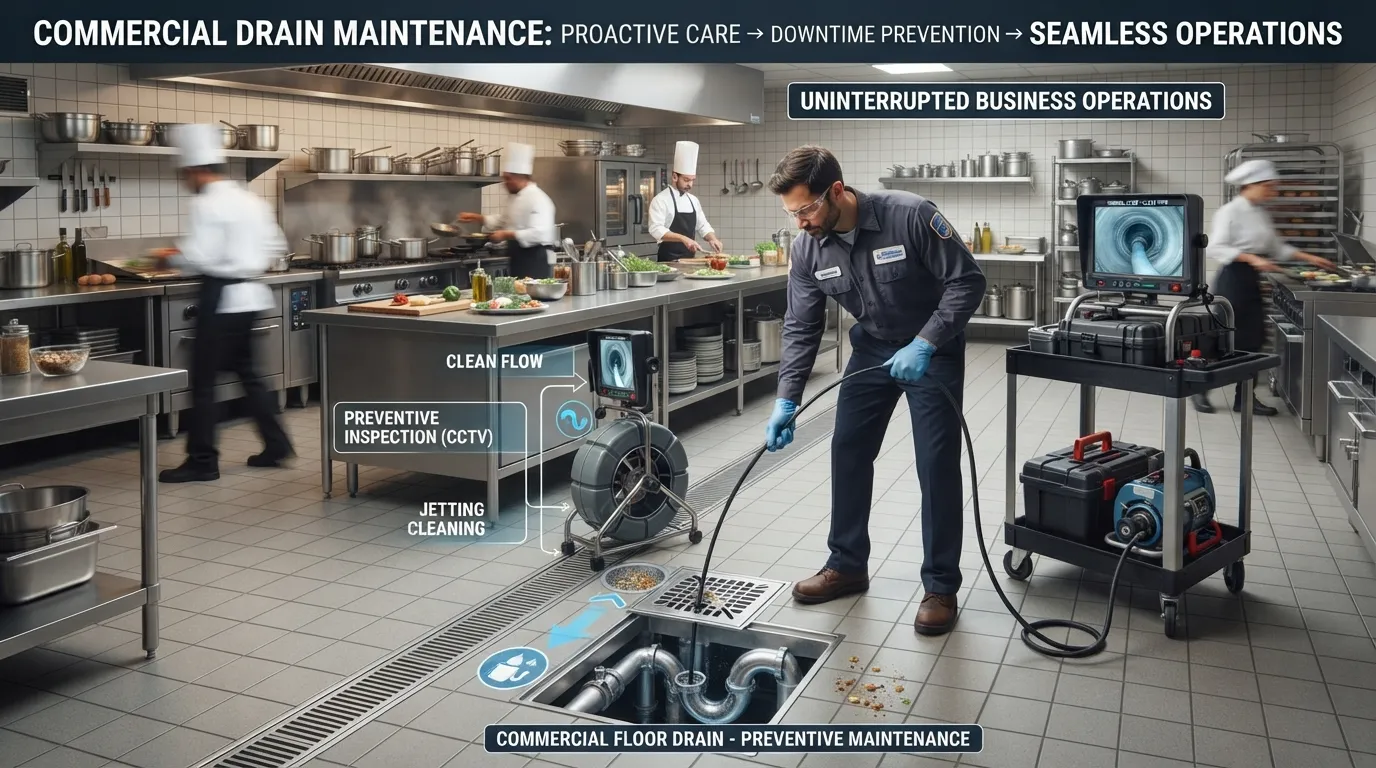
Commercial drain maintenance is not just about clearing a drain after it clogs. A good maintenance plan prevents grease, food waste, sludge, debris, and other buildup from becoming a disruption in the first place. It also helps you recognize when routine upkeep is no longer enough and professional drain cleaning or inspection is the better next step.
Whether you manage a restaurant, office, hotel, retail property, healthcare facility, or another commercial building, the right schedule depends on how heavily each drain is used, what enters the drainage system, and whether the property has a history of slow drains or backups.
Effective commercial drain maintenance combines four things:
- Keeping grease, food, hair, solids, and debris out of drains wherever possible.
- Cleaning strainers, drain covers, floor drains, and other accessible components routinely.
- Watching for slow drainage, odors, gurgling, standing water, and recurring clogs.
- Scheduling professional cleaning or diagnostic inspection before a developing restriction turns into a backup.
What Is Commercial Drain Maintenance?
Commercial drain maintenance is the ongoing process of keeping drain lines and related components clean, open, and functioning properly. It can include everyday housekeeping, grease-control practices, floor-drain cleaning, monitoring problem drains, biological maintenance products where appropriate, and scheduled professional services.
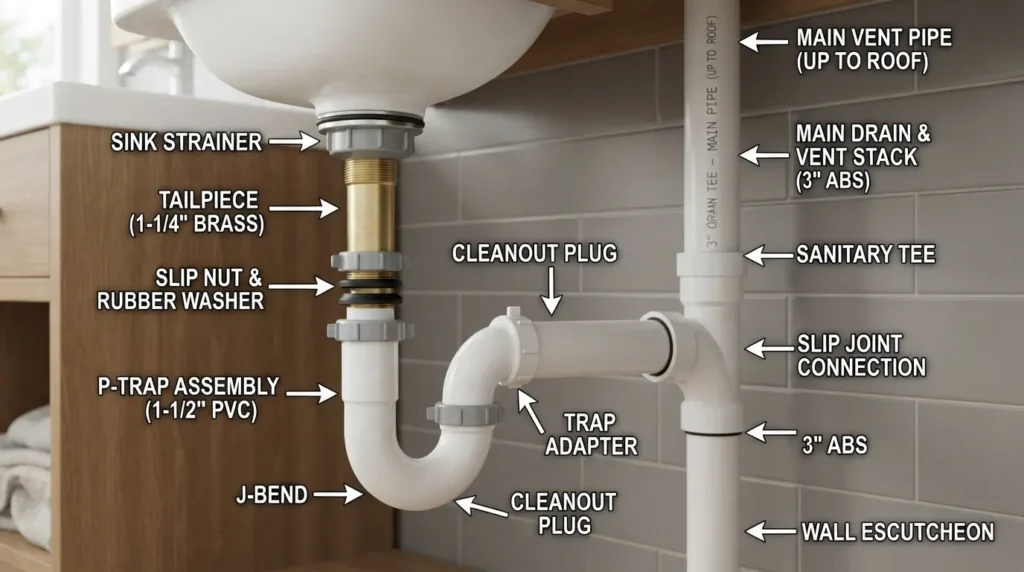
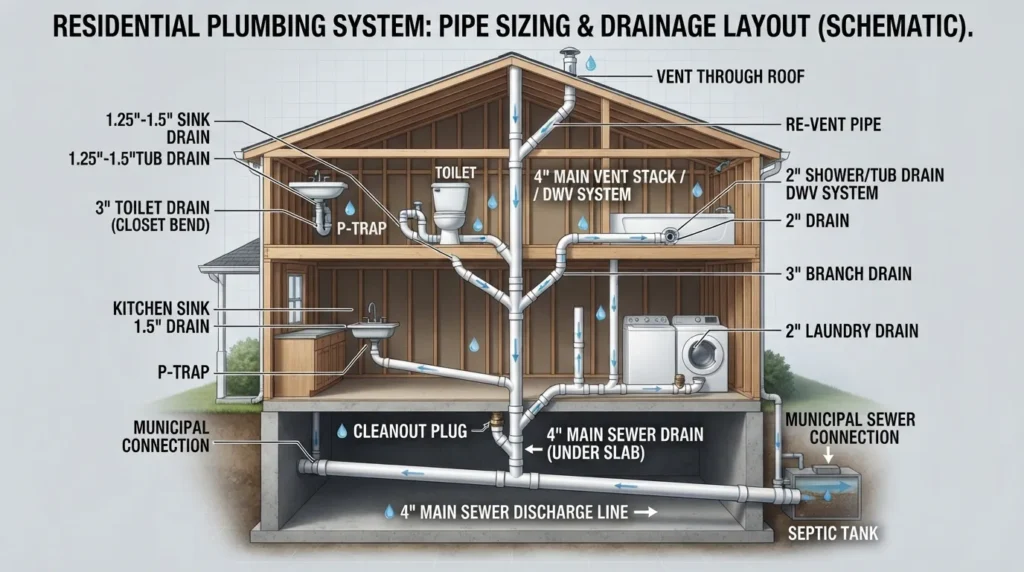
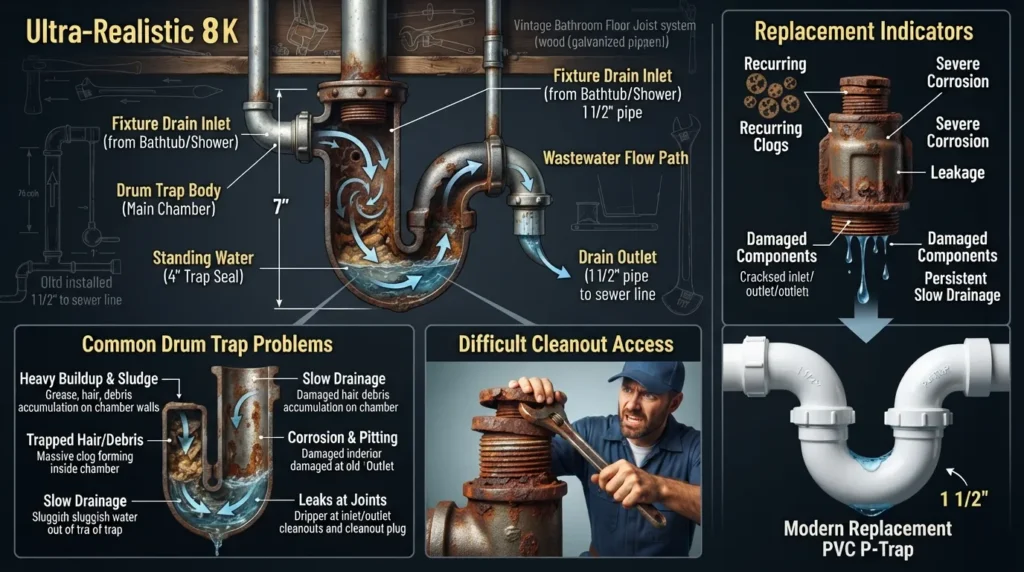
A commercial drainage system can include kitchen sinks, floor drains, mop sinks, restroom drains, grease waste lines, branch drains, cleanouts, traps, and the building sewer. If you want a basic explanation of how traps, branch drains, vents, and sewer lines work together, our guide to how a drainage system works provides useful background.
The important distinction is that maintenance, drain cleaning, and emergency service are not the same thing.
Preventive Maintenance
Reduces the chance of buildup through routine cleaning, waste-control practices, inspections, and an appropriate maintenance schedule.
Professional Drain Cleaning
Removes an existing or developing restriction using methods such as mechanical augering, snaking, or hydro jetting when appropriate.
Diagnostic or Emergency Service
Addresses repeated backups, multiple affected drains, suspected sewer-line problems, structural issues, or an active overflow.
A Practical Commercial Drain Maintenance Schedule
There is no single cleaning interval that is correct for every commercial property. A high-volume restaurant kitchen can place very different demands on its drainage system than an office building with limited food preparation.
Instead of choosing an arbitrary interval, start with a structured routine and adjust it based on drain usage, grease and solids exposure, previous problems, manufacturer requirements, professional inspection findings, and any applicable local rules.
Daily
- Empty and clean sink strainers and drain baskets.
- Remove food, hair, solids, and visible debris before they enter drain lines.
- Keep fats, oils, and grease out of sinks and floor drains.
- Check high-use drains for slow flow or standing water.
- Clean visible spills and residue around floor drains.
Weekly
- Clean accessible drain covers, baskets, and surrounding surfaces thoroughly.
- Inspect floor drains for organic buildup and odors.
- Review problem areas that repeatedly drain more slowly than others.
- Confirm staff are following waste and grease-disposal procedures.
Monthly
- Review your drain-maintenance log for recurring symptoms.
- Inspect lower-use drains that may be overlooked during daily cleaning.
- Check whether maintenance-product dosing, if used, matches its label and actual facility needs.
- Review grease-control equipment servicing records where applicable.
Periodically or When Symptoms Appear
- Have problem lines professionally evaluated and cleaned.
- Consider hydro jetting when buildup coats pipe walls and the method is appropriate for the line.
- Use camera inspection when recurring problems suggest a deeper obstruction or pipe defect.
- Adjust your future maintenance interval based on what the inspection finds.
Adjust the Schedule to Your Type of Business
The most useful maintenance plan is based on risk rather than a generic calendar.
Restaurants and Commercial Kitchens
Restaurants and other food-service operations usually need the most attention because their drains can be exposed to food particles, oils, grease, sauces, detergents, and heavy water use. Prevention starts before anything reaches the drain.
- Scrape food waste into the trash before washing cookware and dishes.
- Keep strainers and baskets installed and clean.
- Train staff not to pour cooking oil or grease into sinks, floor drains, or garbage disposals.
- Maintain grease-control equipment according to applicable requirements and actual loading.
- Track recurring slow drains instead of repeatedly treating the symptom.
Offices and Retail Properties
Office and retail drains often have a lower grease load, but that does not mean they can be ignored. Restroom sinks, break-room drains, floor drains, and building sewer lines can still develop soap residue, organic buildup, foreign-object blockages, or other restrictions.
For lower-use properties, routine inspection and responding early to a change in drainage speed may be more useful than unnecessarily aggressive cleaning.
Hotels and High-Occupancy Properties
Hotels and other high-occupancy properties have many fixtures operating across different parts of the building. A recurring issue in one room may be local, while several fixtures showing symptoms at the same time can point to a larger branch or main-line problem.
Maintenance records become especially useful here because they help facilities teams see whether the same location or drain line is failing repeatedly.
Healthcare, Institutional, and High-Use Facilities
Facilities with high daily occupancy should prioritize reliable drainage, sanitation procedures, clear maintenance responsibilities, and early professional diagnosis when a problem keeps returning. Maintenance procedures should also remain consistent with the facility’s own sanitation, safety, and regulatory requirements.
Maintain Different Types of Commercial Drains Differently
Floor Drains
Floor drains can collect dirt, food particles, mop water residue, and other debris from the surrounding area. Keep the grate and basket clean, remove visible solids, and clean the surrounding drain body with materials and cleaning products appropriate for the drain’s construction.
If a floor drain smells but is not clogged, do not automatically assume the solution is a powerful drain chemical. Organic residue or a dry trap can be among the possible causes, so identifying the source is more useful than masking the odor.
Cleaning a Commercial Floor Drain
The following demonstration can help staff visualize the physical cleaning process. Adapt any procedure to your facility’s drain material, sanitation policies, chemical labels, and safety requirements.
Kitchen and Grease Waste Lines
The best strategy for grease-related drain problems is source control. Keep as much fat, oil, grease, and food waste out of the plumbing system as possible rather than relying on a product to deal with it after it enters the pipe.
A biological or enzymatic maintenance product may be intended to help manage certain organic material under suitable conditions, but a maintenance treatment should not be confused with physically removing an established obstruction.
Restroom Drains
Commercial restroom drains may collect soap residue, hair, paper products, or foreign objects. A single slow fixture can indicate a localized issue. If multiple fixtures begin draining poorly at the same time, the restriction may be farther downstream.
Main Drain and Sewer Lines
Repeated backups, several affected drains, persistent gurgling, or problems that return soon after clearing deserve closer investigation. A video camera inspection can help a professional see obstructions and potential pipe defects rather than repeatedly guessing at the cause.
Know When Routine Maintenance Is No Longer Enough
A common mistake is continuing the same maintenance treatment even though the symptoms have changed. Use the pattern of the problem to decide your next step.
One drain is getting slower
Check accessible strainers and visible debris first. If the slowdown continues, the line may need cleaning.
Several drains are slow
A shared branch or larger drain line may be involved. This is a stronger reason for professional diagnosis.
A clog keeps returning
Repeatedly reopening a small passage may not remove buildup from the pipe wall or identify the underlying problem.
Persistent foul odor
Check housekeeping and trap conditions, but investigate persistent sewer-like odors instead of covering them with fragrance or chemicals.
Gurgling or bubbling
Persistent gurgling can accompany drainage or venting problems and deserves attention if it continues or affects multiple fixtures.
Standing water or active backup
Treat this as an active drainage problem rather than routine preventive maintenance, especially if wastewater is backing up into the facility.
Snaking, Hydro Jetting, Camera Inspection, or Drain Maintainer?
These methods do different jobs. Choosing the right one is more important than choosing the most aggressive one.
Mechanical Snaking or Augering
Best suited for: many localized physical clogs where a mechanical tool can break through, retrieve, or clear the obstruction.
Hydro Jetting
Best suited for: situations where an appropriate drain or sewer line has substantial grease, sludge, scale, or other buildup coating the interior walls and professional assessment indicates water jetting is suitable.
Video Camera Inspection
Best suited for: recurring problems, suspected main-line issues, uncertainty about the location or nature of a blockage, or situations where pipe condition needs to be evaluated.
Bio-Enzymatic or Microbial Drain Maintenance
Best suited for: preventive programs where the specific product is designed for the type of organic waste present and is used according to its label. It is not a universal replacement for mechanical cleaning of a blocked line.
Commercial Drain Maintenance and FOG Rules in Miami-Dade
If you operate a food-related business in Miami-Dade County, grease control is not only a maintenance issue.
According to Miami-Dade County, a non-residential facility that handles, prepares, or processes food and discharges or has the potential to discharge fats, oils, and grease into the applicable wastewater system can be classified as a FOG generator. The County states that covered facilities require a FOG Discharge Control operating permit and an approved operational FOG control device, such as a grease interceptor or trap. Examples listed by the County include restaurants, cafeterias, supermarkets, schools, banquet halls, and food courts.
Requirements can depend on the facility and wastewater arrangement, so property owners and operators should review the current Miami-Dade County Fats, Oils and Grease guidance rather than relying on a generic maintenance schedule.
Important: Hot Water Is Not a Grease-Disposal Strategy
Do not intentionally send fats, oils, or grease into a commercial drain and assume hot water will make the practice safe. Miami-Dade County advises keeping FOG out of drains because it can adhere to and harden inside sewer piping. Scraping, wiping, capturing, and properly disposing of grease before washing is a better first line of prevention.
Should You Use Commercial Drain Cleaner Chemicals?
A stronger chemical is not automatically a better maintenance solution. Commercial drainage problems can involve grease, organic sludge, mineral scale, food solids, foreign objects, roots, damaged piping, or combinations of these conditions. One chemical cannot solve every cause.
Before using any drain product:
- Confirm what the product is actually designed to do.
- Follow the manufacturer’s label and safety instructions.
- Check compatibility with the piping and facility environment.
- Never mix drain-cleaning chemicals.
- Do not use repeated chemical treatments to postpone diagnosis of a recurring blockage.
In many professional drain-cleaning situations, the main solution is not a liquid at all. Mechanical equipment, hydro jetting, and camera inspection can be more appropriate depending on the problem.
A Simple Decision Rule
If the drain still flows and you are preventing organic buildup: an appropriate maintenance program may help.
If the drain is already slow or clogged: determine why before repeatedly adding products.
If the problem repeatedly returns, affects multiple fixtures, or causes a backup: move from routine maintenance to professional diagnosis.
Use a Drain Maintenance Log Instead of Relying on Memory
A simple maintenance log can reveal patterns that are easy to miss during day-to-day operations. You do not need complicated software. Record enough information to answer these questions:
- Which drain or area had the problem?
- When did the symptom begin?
- Was it slow flow, odor, gurgling, standing water, or a complete backup?
- What maintenance or cleaning was performed?
- Did the problem fully disappear?
- How quickly did it return?
- Was professional cleaning performed?
- Was a camera inspection completed, and what did it show?
- When was grease-control equipment last serviced, if applicable?
If one line appears repeatedly in the log, that is useful information. Instead of shortening the interval between temporary fixes forever, investigate why that particular drain keeps failing.
Who Should Handle Each Part of Drain Maintenance?
Front-Line Staff
- Keep food and solids out of drains.
- Clean baskets and strainers.
- Follow grease-disposal procedures.
- Report slow drains and odors early.
Facility Manager
- Maintain the inspection schedule.
- Track recurring symptoms.
- Review service records.
- Coordinate grease-control and professional maintenance requirements.
Professional Plumber
- Clear established blockages.
- Determine the appropriate cleaning method.
- Perform hydro jetting where suitable.
- Use camera inspection to investigate recurring or deeper problems.
When Should You Call a Commercial Drain Professional?
Routine staff maintenance makes sense when the drains are functioning normally and you are preventing buildup. Professional service becomes more appropriate when you notice:
- Recurring clogs in the same drain or drain line.
- Several slow drains at once.
- Standing wastewater or an active backup.
- Persistent gurgling or sewer-like odors.
- A drain that remains slow after accessible debris has been removed.
- A grease-related restriction that repeatedly returns.
- A suspected main sewer or underground line problem.
- A need to determine pipe condition before choosing a more aggressive cleaning method.
At that point, the goal should be to identify and remove the cause rather than repeatedly mask the symptom. Our professional drain cleaning service in Miami is the relevant next step when a commercial drain needs more than routine upkeep.
Commercial Drain Maintenance FAQs
How often should commercial drains be cleaned?
There is no universal interval for every commercial property. High-use food-service drains generally need closer attention than low-use office drains. Set the frequency according to usage, the type of waste entering the system, grease exposure, previous clogs, inspection findings, and any applicable facility or local requirements.
How often should I have drains professionally cleaned?
Use the history of the system rather than an arbitrary date. A property with repeated grease buildup or recurring slow drains may need a shorter preventive interval, while a low-use facility with no recurring symptoms may not require the same schedule. A professional can adjust the interval after seeing what is actually accumulating in the line.
What dissolves sludge in drains?
It depends on what the “sludge” contains. Some bio-enzymatic or microbial maintenance products are designed for certain organic wastes, but grease deposits, mineral scale, solids, or a dense obstruction may require mechanical cleaning or hydro jetting. Diagnose the material before choosing a treatment.
How do professionals clean commercial drains?
The method depends on the cause and location of the restriction. Professionals may use mechanical snakes or augers, hydro jetting, and video camera inspection. A good approach matches the tool to the pipe and problem instead of using the same method for every blockage.
How much does professional commercial drain cleaning cost?
There is no accurate universal price because cost depends on factors such as the location and accessibility of the drain, severity and type of blockage, line size, cleaning method, whether camera inspection is needed, and whether the job is routine or urgent. Ask for an assessment based on the actual drain problem rather than comparing one flat number across different services.
How much do plumbers charge for a cleanout?
A cleanout is an access point, so the final cost depends on what service must be performed through it. Clearing a simple obstruction, hydro jetting a heavily coated line, performing a camera inspection, or repairing a damaged cleanout are different jobs. A plumber should determine the scope before giving a reliable price.
What liquid do plumbers use to unclog drains?
Professional drain cleaning does not necessarily involve a liquid chemical. Many blockages are cleared mechanically with an auger or snake, or with water through hydro jetting. If a chemical or biological treatment is appropriate, the choice should depend on the waste, pipe material, and product instructions.
What is the strongest chemical to unclog a commercial drain?
“Strongest” is not the right way to choose a drain treatment. A highly aggressive chemical can still be ineffective if the problem is a foreign object, mineral scale, roots, pipe damage, or a major grease obstruction. Choose the method according to the cause, and never mix drain-cleaning chemicals.
Why do people pour salt down drains at night?
Salt is sometimes promoted as a household drain-maintenance trick, but it should not replace proper commercial waste control, physical cleaning, or professional diagnosis. If a commercial drain repeatedly develops grease or sludge, find the source of the buildup instead of depending on a home remedy.
Why isn’t baking soda and vinegar a reliable solution for commercial drain clogs?
The fizzing reaction may look active, but it does not reliably remove heavy grease deposits, compacted solids, roots, or structural drainage problems. It should not delay proper cleaning or inspection when a commercial drain is slow, repeatedly clogged, or backing up.
Build a Maintenance Plan Around the Cause, Not Just the Calendar
The best commercial drain maintenance plan is one your staff can actually follow and your facility manager can adjust when conditions change.
Keep solids and grease out of drains. Clean accessible strainers and floor-drain components routinely. Track recurring symptoms. Use drain-maintenance products only for the purpose they were designed for. And when a drain repeatedly slows, clogs, gurgles, smells, or backs up, stop treating it as routine housekeeping and determine what is happening inside the line.
For Miami businesses that need local plumbing support beyond routine facility maintenance, you can learn more about our Miami plumbing services.
Is a Commercial Drain Already Slow, Clogged, or Backing Up?
Preventive maintenance works best before a drain fails. If you are already dealing with recurring clogs, several affected drains, standing wastewater, or a problem that keeps coming back, professional diagnosis can help identify the next step.