 Yes, Drano can work—but it depends on what is clogging your drain. A product such as Drano Max Gel is designed for clogs involving hair, soap scum, grease, and similar organic buildup in compatible kitchen and bathroom drains. It is not a universal fix for foreign objects, damaged plumbing, recurring drainage problems, or every severe blockage.
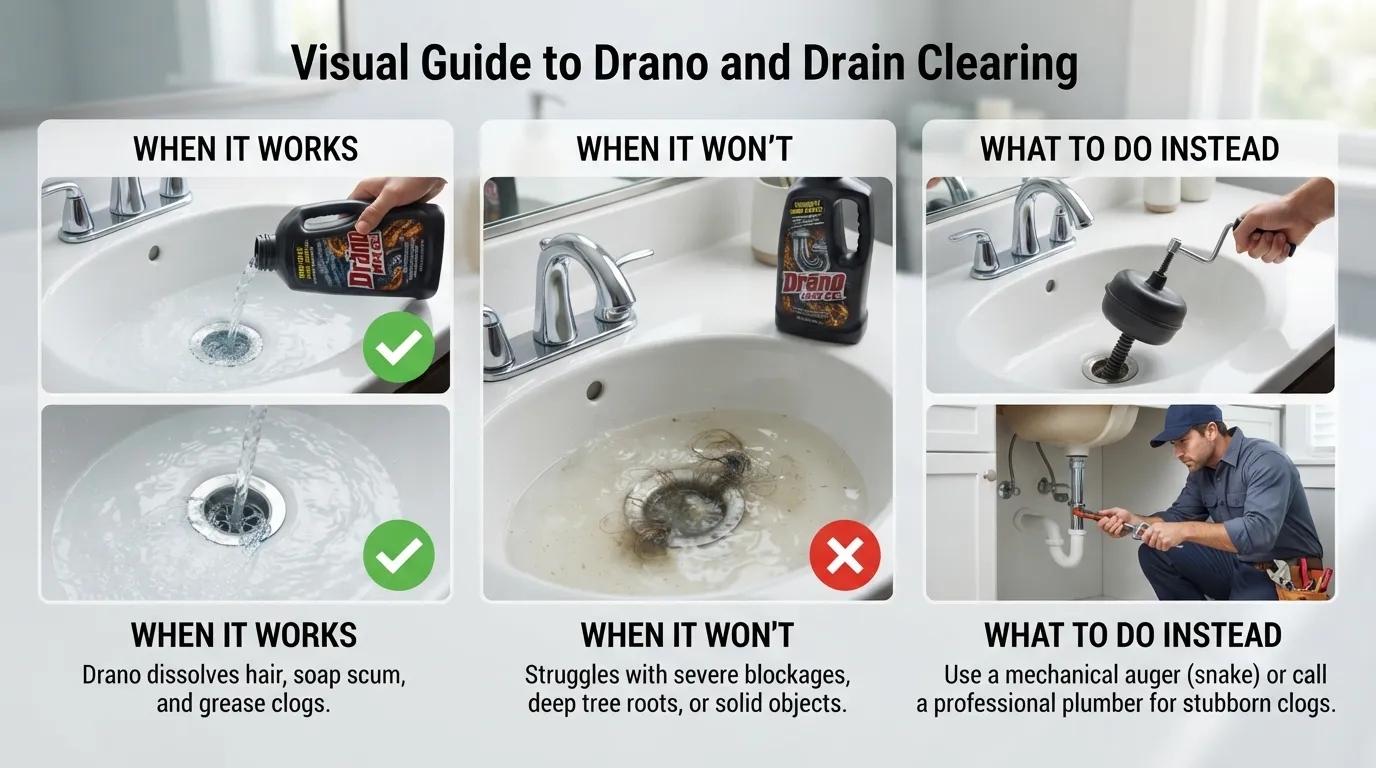 Yes, Drano can work—but it depends on what is clogging your drain.
Before you pour anything down the drain, I recommend answering three questions: Where is the clog? What probably caused it? Is the drain slow, or completely blocked? Those answers tell you much more than the name on the bottle.
If you searched “does Drano work,” you probably do not want a chemistry lesson before getting an answer. You have a sink, shower, tub, or another drain that is not moving water properly, and you want to know whether Drano is worth trying—or whether it could make your situation more complicated.
I would treat Drano as a targeted clog-removal option, not a cure for every drain problem. The current Drano Max Gel directions say the product works in kitchen and bathroom drains, can pass through standing water, and is intended to break down clogs including hair, soap scum, and grease. The same directions specifically say not to use Max Gel in toilets. You can review the current manufacturer directions here.
Will Drano Work on Your Clog? Start Here
The fastest way to make a good decision is to match the product to the actual problem. Use this guide before assuming that every clogged drain should get the same treatment.
These are among the clog types Drano Max Gel is designed to break down.
A chemical cleaner may attack greasy organic buildup, but a severe or recurring kitchen clog may need physical cleaning.
Max Gel is specifically formulated to pass through standing water. What caused the blockage still matters.
A chemical cannot retrieve a cap, toy, jewelry item, or another physical object stuck in the drain.
The manufacturer’s current directions specifically exclude toilets.
A recurring problem can indicate buildup or another issue farther into the drainage system.
How Does Drano Actually Work?
It is important not to talk about “Drano” as though every product carrying the name has exactly the same formula. Drano is a brand with multiple products designed for different drain problems.
For example, the current U.S. ingredient disclosure for Drano Max Gel lists a proprietary surfactant blend, sodium silicate, sodium hydroxide, sodium hypochlorite, and water. SC Johnson identifies sodium hydroxide as a caustic ingredient that can help dissolve organic matter, sodium hypochlorite as bleach that helps break down clogs, and sodium silicate as a corrosion inhibitor. See the current ingredient disclosure.
Why this distinction matters
You may see articles describing “Drano” with one generic chemical explanation. Product formulas and product types are not interchangeable. When deciding how a drain cleaner works or whether it belongs in a particular fixture, check the label for the specific product you actually have.
Does Drano Work on Kitchen Sinks?
Yes, certain Drano products are intended for kitchen drains, and Max Gel specifically lists kitchen drains among its uses. Whether it clears your kitchen sink depends on the cause.
A slow kitchen drain caused by greasy organic buildup is a more logical chemical-cleaner candidate than a sink blocked by a solid piece of food, a foreign object, or a problem farther down the line.
What about food clogs?
“Food clog” can mean several different things. Soft organic residue mixed with grease is different from a large mass of food or an object physically lodged in the trap or piping. If something solid is blocking the waterway, dissolving surface residue may not remove the obstruction itself.
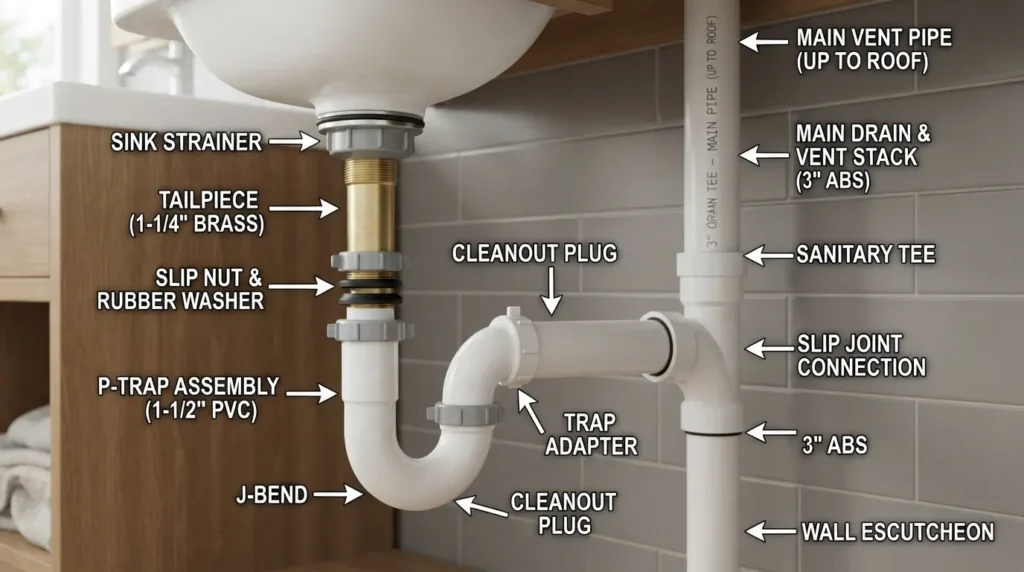
If your kitchen sink repeatedly slows down after temporary fixes, it is worth looking beyond the immediate drain opening. Understanding how your home drainage system works can help explain why a clog that appears to be local may actually be part of a larger drainage issue.
Can You Use Drano in a Garbage Disposal?
The current Max Gel directions list garbage disposals as an approved application. However, there is an important safety instruction: if the drain does not clear after treatment, do not turn the disposal on because cleaner may remain in the drain and splash back. The manufacturer advises consulting a plumber in that situation.
Does Drano Work in Showers and Bathroom Sinks?
Hair and soap residue are two common reasons bathroom drains slow down, and these are specifically among the materials Max Gel is designed to attack. That makes a slow bathroom sink, tub, or shower with organic buildup a more appropriate situation for this type of cleaner than a drain blocked by a non-dissolvable object.
That does not mean chemical treatment is always the best first choice. If you can clearly see a wad of hair close to the drain opening, physically removing it can solve the cause directly instead of trying to dissolve it farther down the pipe.
Does Drano Work for Hair?
It can. The manufacturer specifically identifies hair as one of the clog materials Max Gel is formulated to remove. For a large, tightly packed hair clog, however, mechanical removal with a drain tool may be more direct because you are physically pulling the material out instead of relying entirely on chemical breakdown.
Does Drano Work in Standing Water?
Standing water does not automatically mean Drano Max Gel cannot work. This is one area where online advice can become confusing. The current manufacturer information specifically says Max Gel is thick enough to move through standing water and reach the clog.
The better question is why the water is standing there.
- If hair, soap scum, grease, or similar buildup is restricting the drain, the product may be able to act on that material.
- If a solid object is lodged in the pipe, a chemical will not retrieve it.
- If the drain repeatedly backs up after being cleared, the underlying cause deserves further investigation.
- If multiple fixtures are backing up, the problem may extend beyond one sink or shower.
The key point
Drain condition is not the same thing as clog type. Standing water tells you the drain is badly restricted. It does not tell you what is creating the restriction—and that is what determines whether a chemical cleaner can solve it.
How Long Does Drano Take to Work?
For Drano Max Gel, the current instructions say to allow the product to work for 15 minutes. For tougher problems, the directions say to allow 30 minutes, then flush with hot—but not boiling—water. The directions also allow the treatment steps to be repeated if necessary.
Do not assume that leaving a chemical cleaner sitting indefinitely makes it more effective. Follow the directions on the exact product in your hand rather than making up a stronger dose or longer treatment time.
Why Do Plumbers Say Not to Use Drano?
The most useful answer is not simply “because it ruins pipes.” The current manufacturer states that Drano products are safe for compatible plastic and metal plumbing when used according to label directions, and Max Gel includes a corrosion-inhibiting ingredient.
There are still several practical reasons a plumber may prefer that you solve a clog mechanically or professionally instead of repeatedly adding chemicals:
- A drain cleaner cannot diagnose the cause. It may attack organic material, but it cannot tell you whether the actual problem is a foreign object, recurring buildup, damaged drainage, or another obstruction.
- The chemical may still be present if the drain does not clear. That creates a splash and exposure hazard for anyone working on the drain afterward.
- It can delay a more direct solution. Hair, objects, and some stubborn blockages may be better addressed by physically removing or breaking up the obstruction.
- Repeated symptoms deserve investigation. Temporarily improving flow does not necessarily correct the reason a drain keeps clogging.
Poison Control notes that corrosive drain cleaners can cause irritation and chemical burns through skin contact or splashback and recommends careful handling and protective equipment.
Before You Pour Drano: A 30-Second Safety Check
The manufacturer specifically warns against mixing Max Gel with other cleaners or chemicals because hazardous fumes or a violent reaction may result. It also warns against plunging during or after use because chemical may remain if the drain does not clear.
What Should You Do If Drano Doesn’t Work?
This may be the most important part of the article. If you have already used Drano and the water still is not moving, do not keep randomly adding household products to the drain.
1. Stop mixing products
Do not add vinegar, bleach, another drain cleaner, or another chemical on top of a product already in the drain.
2. Do not plunge after Max Gel
The current label warns that chemical may remain in the drain and splash back.
3. Think about the obstruction
If the clog may involve an object, heavy hair mass, or recurring blockage, physical removal or professional diagnosis may make more sense.
4. Tell the plumber what you used
If someone will work on the drain, tell them which chemical was added and that it may still be present.
If a stubborn or recurring blockage needs more than a DIY treatment, professional drain cleaning lets the problem be approached based on the actual obstruction rather than continuing to guess with chemicals.
What Do Plumbers Use to Unclog Drains Instead?
There is no single plumber’s tool for every clog. The method should match the location and cause of the blockage.
Depending on the situation, a plumber may use a plunger, hand snake, drain auger, powered drain-cleaning equipment, trap access, a drain camera, or other mechanical cleaning methods. The advantage of a mechanical approach is straightforward: instead of only trying to chemically break down the obstruction, you can physically remove, open, or identify it.
A simple rule I would use
If the likely clog material can dissolve, a compatible chemical cleaner may help. If something needs to be physically removed, diagnosed, or repaired, reach for a mechanical solution instead.
Drano vs. Common Home Remedies
Search results are full of DIY alternatives, but not every bubbling mixture is actually clearing the obstruction. Here is how I would think about the most common suggestions.
Watch: What Does Drano Do Inside a Clogged Drain?
If you prefer seeing the process instead of only reading about it, this plumbing demonstration provides a useful visual look at how a chemical drain cleaner interacts with buildup.
When Should You Skip Drano and Call a Plumber?
You do not need professional drain service for every slow sink. But continuing to pour chemicals into a drain that is giving you warning signs is not a good diagnostic strategy.
I would consider professional help when:
- The same drain repeatedly clogs after temporary fixes.
- Several fixtures are draining slowly or backing up at the same time.
- You suspect an object is lodged in the drain.
- The clog remains after you have followed the product directions.
- You have already used a chemical cleaner and are uncomfortable working around what may still be in the pipe.
- You hear unusual gurgling or see drainage problems appearing in other fixtures.
- You need the actual cause identified instead of another temporary attempt.
Still dealing with a drain that won’t clear?
If a DIY treatment has not solved the problem, the next step should be identifying the blockage instead of repeatedly adding more chemicals. Miami Florida Plumbing can help you move from guessing to a proper plumbing solution.
Frequently Asked Questions About Drano and Clogged Drains
Does Drano really work?
Yes, it can work on compatible clogs such as hair, soap scum, grease, and organic buildup. It is much less useful when the problem is something a chemical cannot physically remove or repair.
How fast does Drano work?
Current Drano Max Gel directions specify 15 minutes for normal clogs and up to 30 minutes for tougher problems before flushing with hot, not boiling, water. Always follow the directions on your specific product.
Why do plumbers say not to use Drano?
A chemical cleaner cannot diagnose every blockage, and if it fails, caustic product may remain in the drain and create a splash hazard for anyone who works on it next. Repeated or unusual clogs often need mechanical clearing or diagnosis instead.
What do plumbers recommend instead of Drano?
The right method depends on the clog. Mechanical approaches can include plunging before chemicals have been used, removing accessible hair, using a drain snake or auger, cleaning a trap, or having the line professionally cleared and inspected.
Can I pour vinegar down a clogged drain?
Vinegar is not a dependable fix for a severe clog. More importantly, never add vinegar or another household cleaner to a drain when Drano or another chemical drain cleaner is present.
Does Dawn really unclog drains?
Dish soap may help with light greasy residue, but it is not a reliable way to remove a true obstruction such as packed hair, a foreign object, or a significant blockage farther down the pipe.
Does pouring boiling water down a drain unclog it?
It should not be treated as a universal clog solution. If you have used Drano Max Gel, follow its directions, which call for hot but specifically not boiling water.
Why pour salt down the drain every night?
I would not make this a regular drain-maintenance habit. Salt does not replace removing hair, grease, food residue, or another material that is physically restricting the pipe.
Why shouldn’t I rely on baking soda and vinegar to unclog a drain?
The bubbling reaction does not necessarily translate into clog-removing power. Poison Control explains that because a drain is not airtight, the carbon dioxide can escape, and the mixture is unlikely to be strong enough to dissolve a tough grease clog.
Can Epsom salt unclog a drain?
I would not depend on Epsom salt for a blocked drain. If water is not moving, identify whether the obstruction is hair, grease, food, an object, or a deeper drainage problem and choose a method that actually addresses that material.
Can you use Drano in a toilet?
Do not use Drano Max Gel in a toilet. The manufacturer’s current directions explicitly exclude toilets, and its FAQ explains that standard Drano clog removers are ineffective there because of toilet trap configuration.
Does Drano Work?
Yes—but the better question is whether Drano is appropriate for the clog you have.
For compatible kitchen or bathroom drains clogged by hair, soap scum, grease, or similar organic buildup, a product such as Drano Max Gel may clear the restriction when used exactly as directed. Standing water alone does not automatically rule it out because Max Gel is specifically designed to pass through water.
But Drano cannot retrieve a foreign object, repair a plumbing defect, tell you why a clog keeps returning, or guarantee that every severe blockage will disappear. If the first question you ask is “What is actually blocking this drain?”, you are much more likely to choose the right solution.
And if the clog keeps returning—or the chemical is already in the drain and nothing has changed—the smart next move is to stop experimenting and address the actual obstruction.