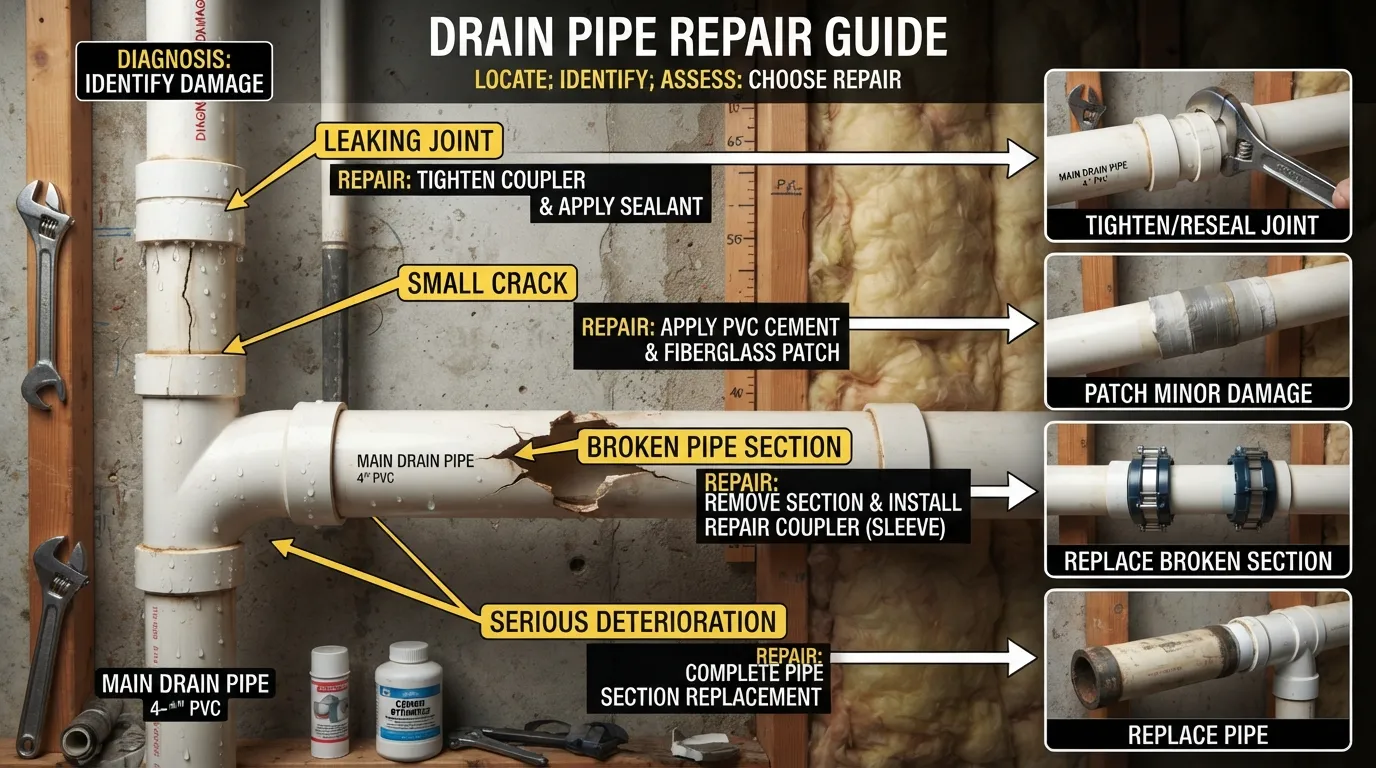
If you need to fix a drain pipe, do not start by reaching for tape, epoxy, or a random repair sleeve. First identify what type of drain pipe you have, where it is leaking, what material it is made from, and how serious the damage is. A loose under-sink connection needs a very different repair from cracked PVC inside a wall, corroded cast iron, or a collapsed underground drain.
For a small accessible drain leak, you may be able to reseat a loose connection, replace a worn washer, or temporarily contain a minor crack with a compatible repair product. A permanently cracked or broken PVC section is usually better repaired by removing the damaged section and installing correctly sized replacement pipe and fittings. Underground, concealed, badly corroded, repeatedly leaking, or collapsed drain pipes should be diagnosed before you decide whether to patch, replace, excavate, or use another professional repair method.
First, Make Sure You Are Actually Fixing a Drain Pipe
This distinction matters because a household drain pipe is not the same thing as the pressurized water-supply pipe that brings clean water to your faucets.
- Water-supply piping carries water toward fixtures and is normally pressurized.
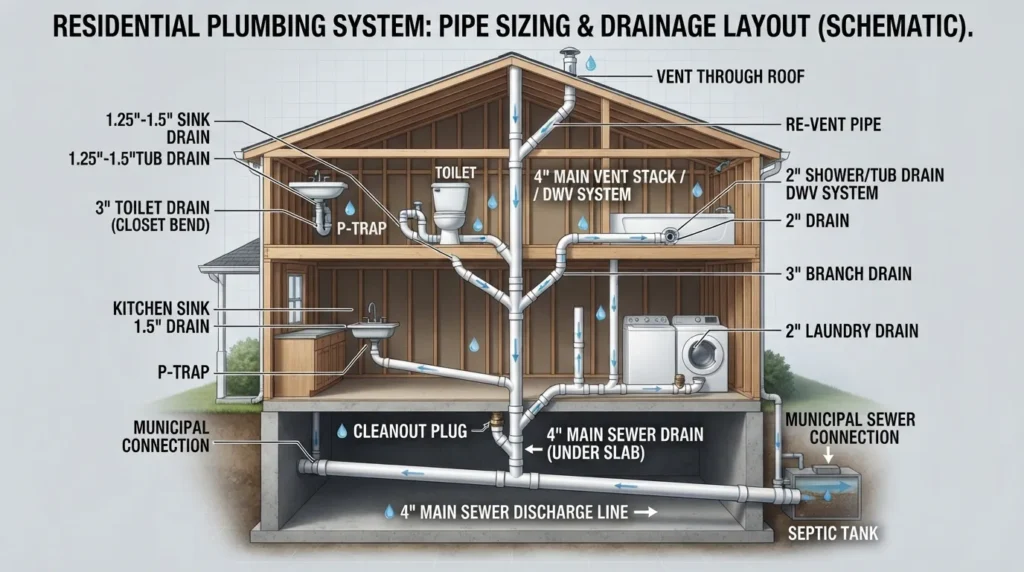
- Drain-waste-vent, or DWV, piping carries wastewater away from sinks, tubs, showers, toilets, and appliances, primarily by gravity.
- Storm drainage handles rainwater and exterior runoff and may use different materials and repair requirements.
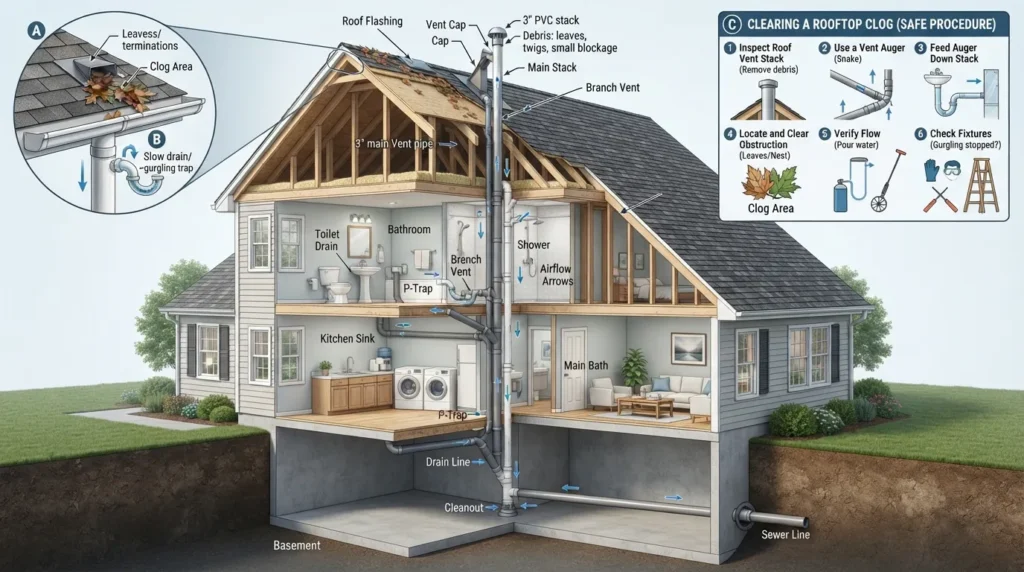
If you are unsure where the damaged pipe fits into the rest of the house, our guide to the home drainage system and its major parts explains how fixture drains, traps, branch lines, stacks, building drains, and sewer laterals work together.
Important: If the line is part of a sewage ejector or another pressurized system, do not assume a repair intended for ordinary gravity DWV piping is suitable.
Drain Pipe Repair Selector: Start With the Problem, Not the Product
Use this decision guide before choosing a pipe fix. It helps narrow the problem by damage type, location, material, and severity.
Loose Joint Under a Sink
Check first: Alignment, slip nut, washer, trap connection.
Likely direction: Reseat or replace the sealing component instead of patching the pipe.
Small Accessible Crack
Check first: Material, crack length, surrounding pipe condition.
Likely direction: Temporary containment may be possible, but structural damage may require section replacement.
Broken PVC Section
Check first: Pipe size, access, alignment, fitting type.
Likely direction: Remove the damaged section and install compatible replacement pipe and fittings.
Cast-Iron Corrosion or Hole
Check first: Whether deterioration is isolated or extends farther along the pipe.
Likely direction: Repair sleeve, approved coupling, or section replacement depending on condition.
Underground Leak or Break
Check first: Exact location, depth, material, structural condition.
Likely direction: Inspect and locate the failure before deciding between localized repair, excavation, or another repair method.
Collapsed or Repeatedly Failing Drain
Check first: Internal pipe condition and extent of failure.
Likely direction: Structural repair or replacement rather than another surface patch.
Before You Repair the Pipe, Make These 5 Checks
- Find the exact source. Water often travels along the outside of a pipe before dripping, so the wettest spot is not always the actual failure point.
- Identify the pipe material. PVC, ABS, cast iron, copper DWV, and tubular sink components do not all use the same repair products or connection methods.
- Identify the damage. Look for a loose joint, failed washer, hairline crack, puncture, split, corrosion, separated connection, deformation, or complete break.
- Check accessibility. An exposed P-trap is very different from a pipe buried under a slab or several feet underground.
- Decide whether you need containment or a permanent repair. Stopping a drip for a short period and restoring the structural integrity of the drainage system are not necessarily the same job.
How to Fix a Leaking Drain Pipe Under a Sink
If the leak is below a kitchen or bathroom sink, start with the connections before assuming the actual pipe is cracked.
1. Dry the assembly and locate the drip
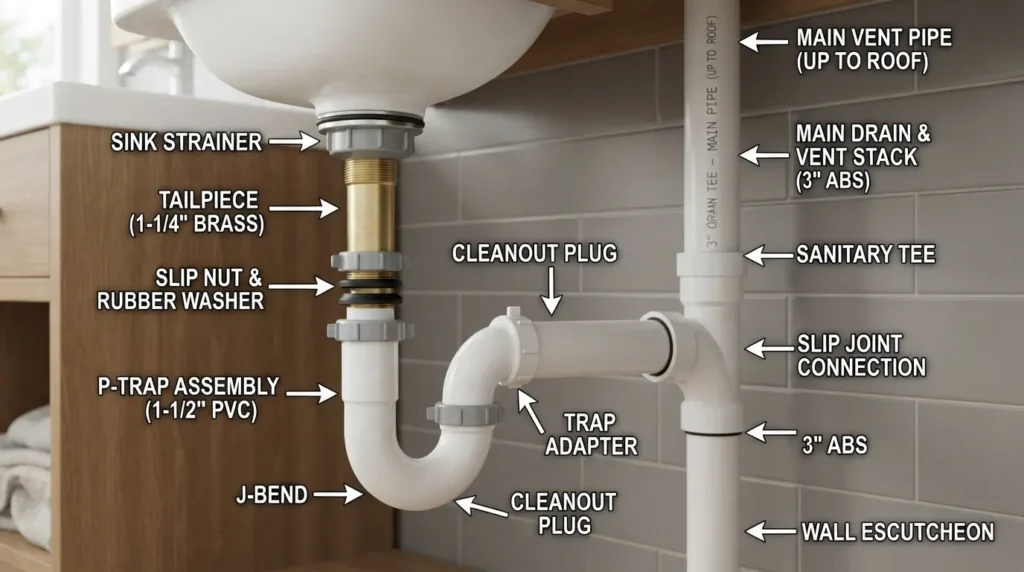
Place a container or towel below the trap, dry the pipe completely, then run water and watch each connection. Check the tailpiece, P-trap, slip-joint connections, and the point where the trap arm enters the wall.
2. Check the slip nut and washer
If a slip-joint connection leaks, make sure the pipe is aligned and the washer is correctly seated. Tighten the nut carefully; overtightening can damage plastic components or deform a washer.
A useful detail many quick-repair guides miss is that a typical tubular P-trap slip joint seals with its washer, not because thread-seal tape fills the slip-nut threads. If tightening does not stop the leak, disconnect the joint and inspect or replace the washer rather than automatically wrapping the slip nut with tape.
3. Test the repair
After reassembly, run water through the fixture and watch every joint. For a sink, filling the basin and then releasing a larger volume of water can help reveal a connection that only leaks under heavier drainage flow.
How to Fix a Cracked PVC Drain Pipe
The correct PVC drain pipe repair depends on whether you are dealing with a superficial defect that can be temporarily contained or a section that has actually lost structural integrity.
For a temporary leak-control repair
A manufacturer-approved epoxy repair product, compatible pipe wrap, clamp, or self-fusing repair tape may temporarily control some small accessible leaks on suitable low-pressure applications. The surface normally needs to be clean and prepared according to the product instructions.
Do not treat a temporary patch as proof that the damaged pipe no longer needs attention. A crack can continue to spread, and a patch does not correct poor pipe support, movement, severe deterioration, or a failed connection.
For a permanent PVC section repair
When the pipe itself is split, badly cracked, punctured, or broken, a more dependable approach is often to remove the damaged section and restore the line with correctly sized compatible pipe and fittings.
A proper solvent-welded PVC repair involves more than simply putting glue on two pieces of plastic. Manufacturer guidance includes cutting the pipe square, removing burrs, preparing the edges, checking alignment, cleaning the mating surfaces when required, applying the correct PVC primer and solvent cement, assembling the joint properly, and observing the product’s cure requirements before service.
PVC repair checklist
- Confirm the exact pipe material and diameter.
- Remove enough damaged material to reach sound pipe.
- Make square, clean cuts.
- Deburr and prepare the cut ends.
- Dry-fit the replacement before cementing.
- Use products approved for the pipe and application.
- Keep the drain aligned and properly supported.
- Allow the joint to cure according to the cement manufacturer’s instructions.
- Test for leakage before closing a wall or covering an excavation.
What if there is not enough movement to install a normal coupling?
Some repairs require a repair coupling, telescoping/slip-fix fitting, shielded transition coupling, or another connection designed for the specific pipe and installation. Do not select one by appearance alone. Confirm pipe material, outside diameter, location, and whether the product is approved for above-ground or underground use.
For example, some shielded transition couplings are specifically intended for above-ground use and are not approved by their manufacturer for underground installation. The correct coupling must match the application.
How to Fix a Leaking PVC Drain Pipe Joint
If the leak is at a solvent-welded PVC fitting rather than in the middle of the pipe, smearing additional cement over the outside of a failed joint is not the same as rebuilding a sound joint.
First determine whether the moisture is actually coming from that connection. If the solvent-welded joint has failed, the dependable repair may involve removing the defective fitting or pipe section and rebuilding the connection with compatible components. How much pipe must be replaced depends on access and the surrounding layout.
Do not confuse a patch with a joint repair. Coating the outside of a poorly assembled or separated connection may hide the symptom without restoring the original joint integrity.
How to Fix a Hole or Crack in a Metal or Cast-Iron Drain Pipe
With an older metal drain, the visible hole may not be the entire problem. Corrosion can thin a larger section of pipe around the opening.
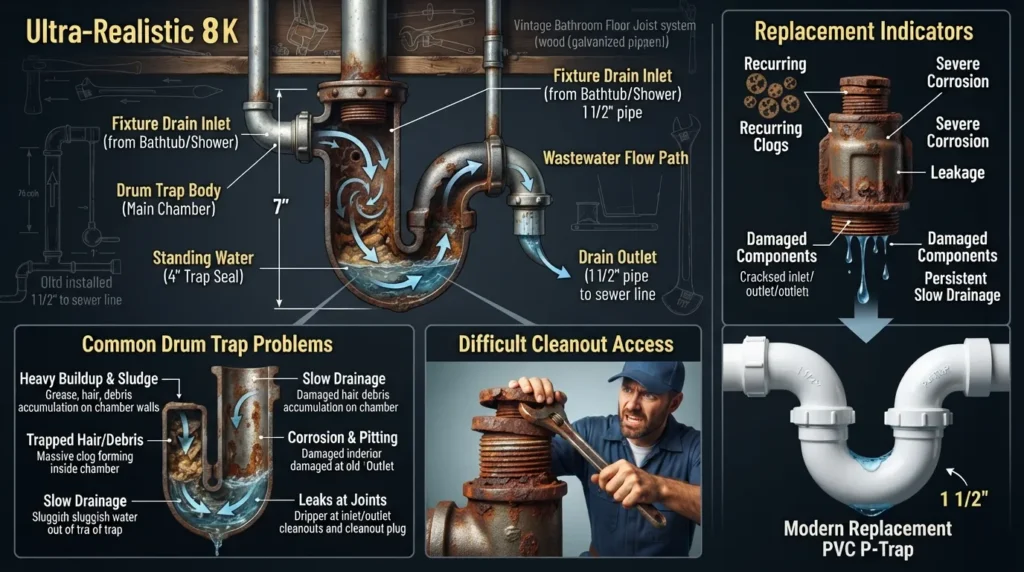
Before choosing an epoxy patch, pipe repair sleeve, clamp, coupling, or replacement section, check whether the surrounding pipe is still structurally sound. If the metal is heavily corroded, flaking, cracking in multiple places, or leaking repeatedly, replacing the affected section may make more sense than continuing to patch isolated holes.
Transitions between cast iron and plastic may use purpose-built couplings, but the exact coupling must match the pipe materials, dimensions, support requirements, and installation location.
How to Fix an Underground Drain Pipe
An underground drain repair should begin with location and diagnosis, not excavation.
Possible signs of an underground drain or sewer problem can include recurring backups affecting more than one fixture, persistent sewer odors, unusual wet or soft areas outside, recurring blockages at the same point, or drainage problems that return soon after the line has been cleared. Those symptoms can suggest a deeper problem, but they do not prove the pipe is broken.
A better underground repair sequence is:
- Confirm that the problem is not simply a localized fixture clog.
- Determine which section of the drainage system is affected.
- Locate the suspected failure as accurately as possible.
- Inspect the pipe condition where appropriate, such as with a sewer camera.
- Identify the pipe material and extent of damage.
- Then compare localized excavation, section replacement, or an appropriate no-dig/trenchless option if the existing pipe condition allows it.
Planning to dig in Florida? Contact Sunshine 811 before excavation so participating underground utility operators can mark facilities near the work area. Do not assume you know what is buried beside a drain or sewer line.
Can a Drain Pipe Be Repaired Without Digging It Up?
Sometimes, yes—but not every underground drain is a candidate for a no-dig repair.
The answer depends on what failed and what condition the existing pipe is in. Certain underground pipe defects may be suitable for trenchless rehabilitation or a limited-access repair. A severely collapsed, badly displaced, incorrectly graded, extensively deteriorated, or otherwise unsuitable line may still require excavation or replacement.
This is why diagnosis comes before choosing the technique. “No digging” sounds attractive, but it should not become the goal if it prevents the correct structural repair.
Temporary Drain Pipe Fix vs. Permanent Repair
Temporary Leak Control
- Compatible repair tape
- Epoxy repair product
- Approved patch
- Repair clamp or sleeve in a suitable application
Purpose: Control leakage while you plan the proper repair.
Permanent Repair
- Correct failed sealing component
- Replace a damaged pipe section
- Rebuild a failed joint
- Install a compatible approved coupling
- Replace structurally unsound piping
Purpose: Restore a reliable drainage path rather than simply covering the leak.
The safest way to think about epoxy, silicone repair tape, and pipe patches is as application-specific tools, not universal solutions. Always follow the repair-product manufacturer’s limitations and do not use a temporary method where the pipe needs structural replacement.
Can You Fix a Leaking Drain Pipe Without Replacing It?
Yes, if the problem is something that can legitimately be corrected without replacing the pipe itself.
Examples may include:
- a loose accessible connection;
- a displaced or damaged slip-joint washer;
- a serviceable fitting that needs correct reassembly;
- certain small defects where an approved repair system is appropriate;
- a localized transition that can be repaired with the correct coupling.
Replacement becomes more likely when the pipe is split, structurally weakened, extensively corroded, collapsed, badly displaced, cracked repeatedly, or damaged over a longer section.
How Do You Tell If a Drain Pipe Is Broken Underground?
No single symptom confirms an underground break. I would look for a pattern of clues instead:
- multiple fixtures backing up or draining poorly;
- the same blockage returning after it has been properly cleared;
- sewer odor around the suspected route of the line;
- unexpected wet, soft, or settling areas outside;
- evidence of root intrusion or debris during camera inspection;
- a visible crack, separation, deformation, or collapse on an internal inspection.
A sewer camera can help determine whether you are dealing with buildup, roots, a displaced joint, a damaged section, or another obstruction before major digging begins.
When Does a Drain Need Cleaning Instead of Pipe Repair?
A clogged drain and a damaged drain pipe can produce similar symptoms, but they are not the same problem.
If the pipe itself is intact and the problem is grease, hair, scale, sludge, roots, or another obstruction, the right next step may be professional drain cleaning in Miami rather than cutting out pipe.
On the other hand, if inspection reveals a crack, collapse, separation, severe corrosion, or another structural defect, clearing the blockage may restore flow temporarily without fixing the damaged pipe.
Repair the Drain Pipe or Replace It?
This is usually a better question than asking which patch is strongest.
A localized repair may make sense when:
- the damage is isolated;
- the surrounding pipe is still in sound condition;
- the repair location is accessible;
- the pipe remains correctly aligned and supported;
- an approved repair fitting or method is available for the application.
Replacement deserves stronger consideration when:
- there are several failures along the same line;
- corrosion extends beyond the visible hole;
- the pipe is collapsed or badly deformed;
- joints have shifted significantly;
- patches repeatedly fail;
- the damaged material no longer provides a sound connection point;
- a concealed or underground section requires extensive corrective work anyway.
How Much Does It Cost to Fix a Drainage Leak?
There is no single useful price for “drain pipe repair” because an under-sink washer replacement and an underground collapsed sewer line are completely different projects.
The final cost can depend on:
- pipe material and diameter;
- location of the damage;
- whether walls, concrete, flooring, or soil must be opened;
- whether the problem is a clog, leaking joint, cracked section, corrosion, or collapse;
- how much pipe needs replacement;
- whether camera inspection or other diagnosis is needed;
- access to the damaged section;
- permit or inspection requirements;
- restoration work after the plumbing repair.
A useful estimate should therefore come after the failure has been identified, not from a generic drain-repair price range that assumes every pipe problem is the same.
Miami-Dade Permit Note: A Leak Fix and Pipe Replacement May Be Treated Differently
For Miami-Dade homeowners
Miami-Dade’s permit-exemption guidance distinguishes between stopping certain plumbing leaks and replacing defective concealed piping. It states that stopping leaks in drain, water, soil, waste, or vent piping can fall within an exemption, but when a defective concealed trap or pipe has to be removed and replaced with new material, that work is considered new work requiring a permit and inspection under the cited county requirements.
Also remember that Miami-Dade contains separate municipalities. The County notes that cities have their own Building Officials, so the exact permitting process depends on where the property is located.
Before opening a concealed line, replacing underground sanitary piping, or making a significant drainage alteration, verify the requirements that apply to your property rather than assuming a small DIY repair and a pipe replacement are regulated the same way.
Can You Repair Your Own Sewer Line?
That depends on the work, the property location, permitting requirements, and your ability to perform the repair correctly and safely.
For unincorporated Miami-Dade, the County says building permits are issued in the name of licensed contractors or qualifying owner-builders. Concealed drain, soil, waste, or vent pipe replacement can require a permit and inspection. If your property is inside a municipality, check that city’s requirements instead.
Even when a repair is legally possible as a homeowner project, underground excavation, sanitary waste exposure, slab work, major cast-iron replacement, difficult transitions, or uncertain pipe condition can make professional diagnosis the safer choice.
Who Is Responsible for a Cracked Sewer Pipe?
Responsibility depends on where the damaged section sits relative to the private plumbing system and the public utility system. Do not assume that every pipe outside the house belongs to the utility.
Miami-Dade Water and Sewer has stated that clogs or backups occurring within private-side wastewater lines are the homeowner’s responsibility. For a cracked or broken sewer pipe, confirm the exact location of the failure and the utility/property responsibility boundary before arranging repair work.
Does Homeowners Insurance Cover a Broken Sewer Pipe?
Do not assume it does. Coverage depends on your policy, the cause of the damage, exclusions, and any endorsements you purchased.
The Florida Department of Financial Services notes that homeowners policies may not include sewer-backup coverage and that additional water-backup coverage may be available by endorsement. That is not the same as saying every broken pipe or sewer-line repair is covered. Review the policy and ask the insurer how the specific cause and damage are treated before relying on coverage.
When Should You Stop the DIY Repair and Call a Plumber?
A simple accessible sink-drain connection may be manageable for a careful homeowner. I would move toward professional diagnosis when any of these apply:
- the pipe is inside a wall or beneath a slab;
- sewage is actively leaking;
- the damage is underground;
- several fixtures are backing up;
- the line appears collapsed or displaced;
- cast iron is extensively corroded;
- the pipe has already been patched and failed again;
- you cannot identify the pipe material or correct fitting;
- a permit or inspection may be required;
- the repair requires excavation near buried utilities;
- you are unsure whether the problem is a clog or structural pipe failure.
If you need local help, the Miami plumbing team at EZ Plumbing Repair Services can help diagnose whether the problem is an obstruction, leaking joint, damaged drain section, or a larger sewer-line issue.
See a PVC Drain Pipe Section Repair
If you learn better by watching the process, this video demonstrates a DIY-oriented replacement of a damaged PVC drain pipe section. Use it as a visual reference only; your pipe material, fitting type, access, and local requirements may be different.
Frequently Asked Questions About Drain Pipe Repair
How do you fix a leaking drain pipe without replacing it?
You first identify whether the leak comes from a joint, washer, fitting, crack, or hole. A loose or serviceable connection may be repaired without replacing the pipe. Certain small defects may also accept an application-specific patch, clamp, sleeve, or epoxy repair, but a cracked or structurally weakened pipe may still need section replacement.
Do plumbers fix drains?
Yes. Plumbers can diagnose leaking or damaged drain piping, distinguish a structural failure from an obstruction, repair or replace damaged sections, and address drainage problems that require professional equipment or access.
Can a drain be repaired without digging it up?
Sometimes. The answer depends on where the failure is, what material the pipe is made from, and whether the existing pipe is structurally suitable for a trenchless or limited-access repair. A collapsed or severely displaced line may still require excavation.
How do I repair PVC drain pipe in the ground?
Locate the failure first, identify the pipe type and size, and determine whether the damage is isolated. If excavation is necessary, locate underground utilities before digging. A damaged section can then be repaired using compatible pipe and fittings appropriate for underground service, with correct joint preparation, alignment, support, and testing.
Can you use a drain pipe repair sleeve?
A repair sleeve or coupling can be appropriate for some pipe repairs, but it must match the material, diameter, location, and application. Do not assume every flexible or shielded coupling is approved for underground use.
Can epoxy permanently fix a cracked drain pipe?
Epoxy products can be useful for certain small repairs when the manufacturer allows the application, but they should not automatically be treated as a permanent substitute for replacing structurally damaged, badly corroded, separated, or collapsed piping.
How much does it cost to repair a drain?
The cost varies too widely for one number to be meaningful without diagnosis. Accessibility, pipe material, damage length, excavation, wall or slab access, inspection, permits, and restoration work can all change the scope significantly.
How can I tell whether I have a clog or a broken pipe?
A single slow fixture often points toward a localized obstruction, while recurring problems across several fixtures can indicate an issue farther downstream. A camera inspection can help distinguish buildup or roots from cracks, separated joints, deformation, or collapse.
Are you allowed to repair your own sewer line?
Rules depend on the jurisdiction and scope of work. In unincorporated Miami-Dade, concealed defective drainage piping that must be replaced with new material can require a permit and inspection, while municipalities within the county have their own Building Officials and permitting processes.
The Best Drain Pipe Fix Starts With the Right Diagnosis
The biggest mistake you can make is choosing the repair product before understanding the failure.
Start with four questions:
- What material is the pipe?
- Where is the damage?
- What exactly failed?
- Is the surrounding pipe still structurally sound?
A loose under-sink washer may take a simple correction. A cracked PVC section may need to be cut out and rebuilt. Corroded cast iron should be evaluated beyond the visible hole. An underground or collapsed drain should be located and inspected before you commit to digging or another repair method.
Not sure whether the drain needs cleaning, repair, or replacement?
A proper diagnosis can prevent you from repeatedly patching the wrong problem. If the leak is concealed, underground, recurring, or affecting several fixtures, get the pipe evaluated before the damage spreads.