If you are asking, “How many GPM do I need for a tankless water heater?” the short answer is that most whole-house systems fall somewhere around 5–9 GPM, but there is no single GPM number that is right for every home.
The correct size depends mainly on two things:
- How much hot water you need at the same time (your peak flow demand in GPM)
- How much the incoming water must be heated (the required temperature rise)
The most important sizing rule
Do not choose a tankless water heater by its advertised GPM alone. First calculate your maximum simultaneous hot-water demand, then make sure the heater can deliver that GPM at the temperature rise your home actually requires.
That distinction matters because a tankless water heater’s available flow can change significantly as the required temperature rise increases. A unit advertised at a particular maximum GPM may deliver less flow when it has to heat colder incoming water to your desired hot-water temperature.
This guide will show you how to calculate the GPM you need, how temperature rise affects tankless performance, whether 7, 9, 9.5, or 11 GPM makes sense, and how to avoid the most common sizing mistakes.
Quick Answer: How Many GPM Does a Tankless Water Heater Need?
For a typical whole-house application, a tankless water heater in the 7–9 GPM range can be a reasonable starting point. However, your actual requirement may be lower or higher depending on which fixtures you use simultaneously and the temperature of your incoming water.
Important: These are practical starting estimates, not a substitute for checking the selected unit’s performance chart. Actual fixture flow rates vary, and the required temperature rise can change the heater’s available GPM.
What Does GPM Mean on a Tankless Water Heater?
GPM means gallons per minute. On a tankless water heater, it describes how much water the unit can heat while maintaining a specified temperature rise.
That last part is easy to overlook.
For example, a manufacturer may advertise a tankless water heater at 9.5 GPM under a particular test condition. That does not mean the heater will always provide 9.5 GPM regardless of incoming water temperature.
If the incoming water is relatively warm, the heater may be able to deliver more GPM at a particular outlet temperature. If the incoming water is much colder, the heater has to add more heat, so its available GPM can decrease.
Remember this
GPM rating + temperature rise tells you much more about real tankless performance than the GPM number printed in a product title.
How Do You Calculate the GPM You Need?
The first step is to determine which hot-water fixtures you are likely to operate at the same time.
You do not normally size a tankless water heater by adding every fixture in the house. Instead, focus on your realistic maximum simultaneous demand.
Step 1: List Your Hot-Water Fixtures
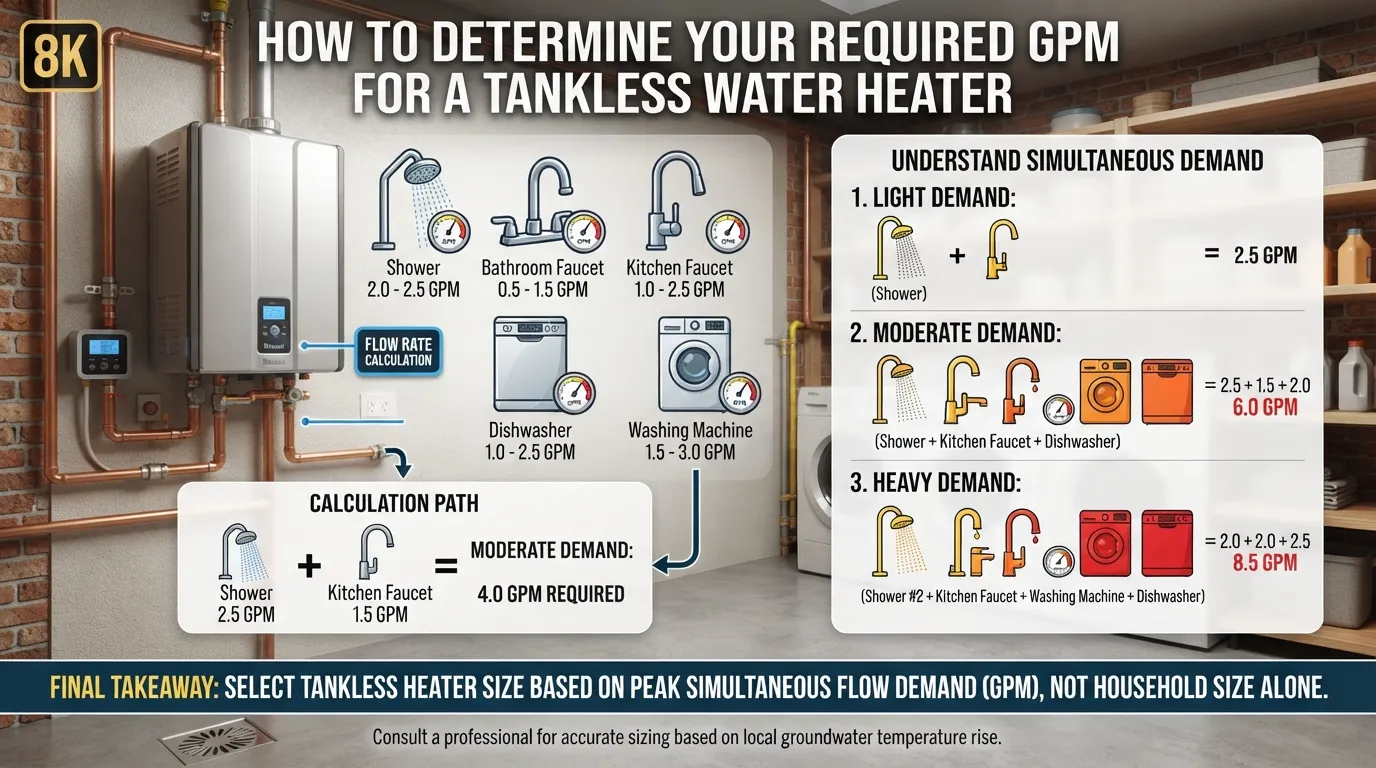
Typical fixture flow rates can look like this:
- Standard shower: about 1.5–2.5 GPM
- Low-flow showerhead: about 1.0–1.5 GPM
- Bathroom sink faucet: about 0.5–1.5 GPM
- Kitchen faucet: about 1.0–2.2 GPM
- Dishwasher: about 1.5–3.0 GPM
- Washing machine: about 1.0–2.0 GPM
Your actual fixtures may use less or more water, so use the flow rate of your specific fixtures whenever that information is available.
Step 2: Identify Your Peak Simultaneous Use
Ask yourself:
- Will two people shower at the same time?
- Will someone regularly use the kitchen faucet while another person showers?
- Could the dishwasher run while two showers are operating?
- Does your household have several bathrooms that may be used at once?
- Do you have high-flow showerheads, body sprays, or other high-demand fixtures?
This is more useful than simply counting the number of people in the home.
Step 3: Add the Fixture Flow Rates
For example, imagine you want to run:
- Two showers at 2.5 GPM each = 5 GPM
- Kitchen faucet at 1.5 GPM = 1.5 GPM
- Dishwasher at 1.5 GPM = 1.5 GPM
Your estimated peak demand would be:
5 + 1.5 + 1.5 = 8 GPM
So you would start by looking for a tankless water heater capable of meeting approximately 8 GPM at your required temperature rise.
Notice the wording: at your required temperature rise. That is the part many basic tankless sizing articles leave out.
Why Temperature Rise Matters So Much
Temperature rise is the amount of heating required to bring incoming water up to your desired hot-water temperature.
The basic calculation is:
Temperature Rise = Desired Water Temperature − Incoming Water Temperature
For example, if your target hot-water temperature is 120°F and your incoming water is 60°F:
120°F − 60°F = 60°F temperature rise
If the incoming water is 40°F:
120°F − 40°F = 80°F temperature rise
The second situation requires the heater to add substantially more heat to each gallon of water.
Why This Changes the GPM You Can Get
Consider a tankless heater whose performance changes with temperature rise. A model might produce a higher GPM at a lower temperature rise and a lower GPM at a higher temperature rise.
That means a product listed as a “9.5 GPM tankless water heater” should not automatically be treated as a 9.5 GPM solution for every home.
Always check the manufacturer’s GPM-versus-temperature-rise performance chart for the exact model you are considering.
Is a 9.5 GPM Tankless Water Heater Enough?
It can be, but it depends on your peak demand and temperature rise.
A 9.5 GPM unit may be appropriate for a home with several simultaneous hot-water uses if the heater can actually deliver the required flow at the home’s design temperature rise.
For example, if your estimated peak demand is around 7–8 GPM, a properly selected 9.5 GPM-class unit may provide useful capacity. But if your home regularly requires 9 GPM or more under a high temperature-rise condition, you need to examine the manufacturer’s performance data rather than relying on the 9.5 GPM headline number.
Instead of asking only “Is 9.5 GPM enough?”, ask “Can this specific 9.5 GPM-rated unit deliver my required GPM at my required temperature rise?”
Is There an 11 GPM Tankless Water Heater?
Yes. Tankless water heaters are available in higher-capacity configurations, including models and systems in the 11 GPM class and beyond.
However, the same rule applies: an 11 GPM label does not mean the unit will always deliver 11 GPM at every temperature rise.
If your home has unusually high simultaneous demand, the right solution may be a larger-capacity unit or, depending on the equipment and application, multiple tankless units working together.
How Many GPM Do You Need Based on Household Size?
Household size can help you estimate demand, but it should not be the only sizing factor.
A four-person household that rarely uses more than one shower at a time may require less capacity than a two-person household with two high-flow showers and several appliances operating simultaneously.
People count tells you about potential demand. Simultaneous fixture flow tells you about actual peak demand.
Tankless Water Heater GPM Chart by Common Usage
Here is a practical way to think about tankless GPM sizing:
Use this chart as a starting point only. Your final selection should always be based on actual fixture demand and the selected heater’s performance at the required temperature rise.
How to Choose the Right Tankless Water Heater
If you are shopping for a tankless water heater, use this process rather than choosing the biggest GPM number you can find.
- List the fixtures you may use at the same time.
- Find the flow rate of each fixture.
- Add those flow rates to calculate peak GPM demand.
- Determine your coldest expected incoming-water temperature.
- Choose your desired hot-water temperature.
- Calculate the required temperature rise.
- Check the manufacturer’s performance chart.
- Verify gas, electrical, plumbing, and venting requirements.
- Determine whether one unit is sufficient or a multiple-unit system is more appropriate.
This process is much more reliable than choosing a heater based on household size or the largest GPM number shown in a product listing.
How to Read a Tankless Water Heater Performance Chart
When comparing tankless water heaters, look for a chart showing GPM at different temperature rises.
For example, a hypothetical performance table might look like this:
The exact numbers depend on the model. The important lesson is that higher temperature rise generally means lower available GPM for the same heating capacity.
That is why you should compare heaters using the performance data for your actual application, not just the maximum GPM specification.
Why Miami and Florida Homes May Have Different Tankless GPM Requirements
Your location can affect tankless sizing because incoming water temperature changes the required temperature rise.
For example, suppose your target outlet temperature is 120°F:
- If incoming water is 70°F, the temperature rise is 50°F.
- If incoming water is 60°F, the temperature rise is 60°F.
- If incoming water is 40°F, the temperature rise is 80°F.
That does not mean every home in Miami has the same incoming-water temperature. Actual water temperature varies by location, season, water source, plumbing conditions, and other factors.
It does mean that climate should be considered when sizing a tankless water heater.
For a Miami-area home, the best approach is to use a realistic local incoming-water temperature for the installation rather than blindly applying a cold-climate assumption.
7 GPM vs. 9 GPM vs. 9.5 GPM vs. 11 GPM
Gas vs. Electric Tankless Water Heater GPM
GPM alone does not tell you whether a gas or electric tankless water heater is right for your home.
Gas Tankless Water Heaters
Gas units can provide high heating input and are commonly used for whole-house applications with substantial simultaneous hot-water demand.
However, the installation still needs to be properly sized for the gas supply, venting, water flow, and required temperature rise.
Electric Tankless Water Heaters
Electric units can also provide on-demand hot water, but electrical capacity becomes an especially important part of the sizing process as demand increases.
A homeowner can calculate a high GPM requirement and discover that the available electrical service is not appropriate for the selected system. That is why the heater’s electrical requirements must be evaluated alongside GPM.
Do not size an electric tankless heater by GPM alone. Electrical service, breaker capacity, wiring, voltage, heating power, flow, and temperature rise all matter.
What If You Need More Than 10 or 11 GPM?
Very high hot-water demand does not always mean you need one enormous tankless water heater.
Depending on the application, manufacturers offer systems that can use multiple tankless units together. These systems can provide much greater combined flow for homes or applications with unusually high simultaneous demand.
For example, a large home with several bathrooms may have a peak demand that is better handled through a properly designed multi-unit system rather than trying to force one heater to handle everything.
The right choice depends on the actual load calculation and the equipment manufacturer’s approved configuration.
Can a 7 GPM Tankless Water Heater Replace a 50-Gallon Tank?
There is no simple “50-gallon tank equals X GPM tankless” conversion.
A storage water heater and a tankless water heater operate differently. A storage tank holds a reserve of heated water, while a tankless unit heats water as it flows through the system.
For a tankless replacement, you should calculate the home’s peak simultaneous hot-water demand and then select a unit capable of meeting that demand at the required temperature rise.
That is much more reliable than trying to convert the old tank’s gallon capacity directly into a tankless GPM rating.
Common Tankless Water Heater Sizing Mistakes
1. Choosing a Heater by GPM Label Alone
A maximum GPM number without its temperature-rise context can be misleading.
2. Sizing by Number of People Only
Two homes with four residents can have completely different peak hot-water demands.
3. Adding Every Fixture in the House
You usually need to focus on realistic simultaneous use, not assume every faucet, shower, and appliance operates at the same moment.
4. Ignoring Incoming Water Temperature
A colder inlet temperature means a larger temperature rise and can reduce available GPM.
5. Ignoring Fixture Flow Rates
A high-flow shower can change the calculation significantly compared with a low-flow showerhead.
6. Choosing the Biggest Heater “Just to Be Safe”
Oversizing does not automatically make a system better. The goal is to select equipment that properly meets the home’s actual demand while satisfying the installation requirements.
7. Ignoring the Home’s Water Supply
A heater cannot magically provide more water than the home’s plumbing system can supply. Incoming pipe sizing, water pressure, and overall plumbing conditions can affect actual flow.
8. Ignoring Gas or Electrical Requirements
The heating capacity required for high GPM can place significant demands on the gas or electrical infrastructure. Those requirements should be checked before purchasing the equipment.
How to Know If Your Tankless Water Heater Is Properly Sized
Use this five-question check
- What is my maximum simultaneous hot-water demand in GPM?
- What is my coldest realistic incoming-water temperature?
- What outlet temperature do I need?
- Can the specific heater deliver my required GPM at that temperature rise?
- Can my gas, electrical, plumbing, and venting systems support that heater?
If you cannot confidently answer those questions, professional sizing is worthwhile before purchasing a unit.
Tankless Water Heater GPM: A Simple Example
Let’s put everything together.
Suppose you have a home where the following fixtures may operate simultaneously:
- Shower #1: 2.5 GPM
- Shower #2: 2.5 GPM
- Kitchen faucet: 1.5 GPM
- Dishwasher: 1.5 GPM
Your estimated peak demand is:
2.5 + 2.5 + 1.5 + 1.5 = 8 GPM
Now suppose your desired water temperature is 120°F and your design incoming-water temperature is 60°F.
Your temperature rise is:
120°F − 60°F = 60°F
At this point, you should not simply buy any heater labelled “8 GPM.” You should find a model whose manufacturer performance data shows that it can deliver the required flow at approximately a 60°F temperature rise.
If the selected unit cannot deliver 8 GPM under those conditions, you need to consider a higher-capacity model or another approved system configuration.
What GPM Tankless Water Heater Is Best for You?
There is no universal best GPM size. The right tankless water heater is the one that matches your home’s actual peak demand and temperature-rise requirement.
The decision in one sentence
Calculate your maximum simultaneous GPM, calculate your required temperature rise, and then choose a tankless water heater that can deliver that GPM at that temperature rise.
If your calculation lands around 5 GPM, a 7 GPM-class unit may be worth evaluating. If your demand is closer to 7–8 GPM, a 9 GPM or 9.5 GPM-class system may make more sense. If your demand exceeds 9–10 GPM, look carefully at higher-capacity equipment or a properly designed multi-unit system.
The final selection should always be based on the manufacturer’s performance data for the exact model, not just a general GPM chart.
Frequently Asked Questions About Tankless Water Heater GPM
How many GPM does a tankless water heater need?
Many whole-house applications fall in the 7–9 GPM range, but your actual requirement depends on the maximum number of hot-water fixtures operating simultaneously and the required temperature rise. A smaller home may need less, while a high-demand home may need 9–11+ GPM or multiple units.
How do I calculate the GPM for a tankless water heater?
List the hot-water fixtures you expect to use simultaneously, find their individual flow rates, and add them together. The resulting number is your estimated peak hot-water demand. Then verify that the selected heater can deliver that GPM at your required temperature rise.
Is a 9.5 GPM tankless water heater enough?
It can be enough for many homes, but it depends on the actual peak demand and temperature rise. Always check the manufacturer’s performance chart for the exact model instead of assuming the heater will deliver 9.5 GPM under all conditions.
Is there an 11 GPM tankless water heater?
Yes. Higher-capacity tankless water heaters and multi-unit systems are available. Whether you need 11 GPM depends on your calculated peak demand and the heater’s performance at your required temperature rise.
Is 7 GPM enough for a tankless water heater?
It can be for a home with moderate simultaneous hot-water demand. For example, it may be appropriate when the calculated peak demand is comfortably below 7 GPM and the selected unit can maintain the required temperature rise. It may not be enough for several high-flow fixtures operating simultaneously.
Does the number of people in my home determine the GPM I need?
Not by itself. Household size helps estimate potential demand, but tankless sizing is primarily concerned with how much hot water you need at the same time. A smaller household with two simultaneous high-flow showers may require more capacity than a larger household with staggered usage.
Does cold incoming water reduce tankless water heater GPM?
Yes. Colder incoming water requires a greater temperature rise to reach the desired hot-water temperature. As the required temperature rise increases, the available flow from a given tankless heater can decrease.
Should I buy the largest GPM tankless water heater available?
No. Bigger is not automatically better. The goal is to select a properly sized system that meets your actual peak demand at the required temperature rise and is compatible with your home’s gas, electrical, plumbing, and venting requirements.
Can one tankless water heater handle multiple showers?
Yes, provided the unit has enough heating capacity to supply the combined flow at the required temperature rise. Two high-flow showers can create significantly more demand than one shower, so calculate their combined GPM rather than assuming any whole-house unit will handle them.
What happens if my tankless water heater is too small?
If demand exceeds the heater’s available capacity, the system may not maintain the desired water temperature and flow when several fixtures operate simultaneously. Proper sizing helps prevent this problem.
What if I need more than 11 GPM?
Depending on the application, you may need a higher-capacity unit or multiple tankless units operating together. A professional load calculation can determine the appropriate system configuration.
Need Help Choosing the Right Tankless Water Heater?
Getting the GPM calculation right before buying a tankless water heater can save you from choosing a system that is either undersized for your household or larger than necessary.
If you are in the Miami area and need help evaluating your hot-water demand, a professional can review your fixtures, incoming water conditions, fuel or electrical requirements, and installation requirements before recommending a system.
For broader plumbing needs, you can also explore our plumbing services or return to our Miami plumbing home page.
Planning a Tankless Water Heater Replacement?
Before choosing a GPM rating, make sure the system is sized for your actual simultaneous demand and temperature rise.
Related Tankless Water Heater Resources
If you are researching tankless water heater sizing in more detail, our water heater replacement guide is a useful next step when you are ready to move from sizing research to replacement planning.
For the most accurate final selection, always compare your calculated GPM and temperature rise against the manufacturer’s specifications for the exact tankless water heater model you plan to install.