A point of use electric tankless water heater heats water close to the fixture where you need it instead of sending hot water from a central water heater through a long run of pipe. That makes it especially useful for a remote sink, bathroom, kitchen fixture, or another location where waiting for hot water is inconvenient or where a central system loses heat before the water reaches the tap.
A point-of-use tankless heater can be an excellent choice when you want hot water close to a specific fixture without maintaining a storage tank. But the right unit depends on where you will use it, required flow rate, incoming water temperature, desired outlet temperature, voltage, available electrical capacity, and the heater’s rated performance. A small 120V unit may be appropriate for a low-flow sink, while higher-output 240V equipment may be needed for more demanding applications.
The important part is not simply buying a heater labeled “point of use.” You need to match the heater to the job. In this guide, I’ll show you how to think about that choice, including the questions people commonly ask about 120V models, showers, kitchen sinks, GPM, temperature rise, electrical requirements, and point-of-use versus whole-house systems.
What Is a Point of Use Electric Tankless Water Heater?
A point-of-use (POU) electric tankless water heater is a compact, on-demand electric water heater installed near the fixture or area where hot water is needed.
Unlike a traditional storage water heater, it does not keep a large tank of hot water waiting for you. When water flows through the heater, electric heating elements raise the water temperature as it passes through the unit.
The “point of use” part is important. Instead of heating water at one central location and transporting it through the home’s hot-water piping, the heater is positioned much closer to the point where the water will actually be used.
That can be particularly helpful when a fixture is far from the main water heater. ENERGY STAR notes that point-of-use water heaters can reduce heat lost in the distribution system because water is heated near the sink, shower, or bath instead of being transported from a central heater.
Think of it this way:
A central water heater is like having one kitchen across the house and carrying every cup of hot water from there. A point-of-use heater moves the heating closer to the “workstation.”
How Does a Point of Use Tankless Water Heater Work?
The basic process is straightforward:
- You open a hot-water fixture.
- Water begins flowing through the point-of-use heater.
- The unit detects the flow and activates its electric heating system.
- The heating elements transfer heat to the water as it passes through.
- The heated water travels a short distance to the fixture.
- When the water flow stops, the heater stops heating.
Because there is no large storage tank to keep hot continuously, tankless operation can avoid the standby losses associated with storing hot water. At the same time, point-of-use placement can reduce some distribution losses between a central heater and a distant fixture.
That does not mean every point-of-use installation will automatically produce a large reduction in your utility bill. The actual benefit depends on how the system is used, the existing plumbing layout, the distance from the central heater, the unit’s efficiency, and your hot-water demand.
Why Use a Point of Use Electric Tankless Water Heater?
For the right application, the biggest advantage is simple: you can put hot-water production close to the fixture that needs it.
- Less waiting: A heater located close to a fixture can reduce the distance hot water has to travel.
- Compact installation: Electric tankless units can be much smaller than storage tanks.
- No storage tank: You are heating water on demand rather than maintaining a tank full of hot water.
- No combustion venting: Electric units do not need the combustion venting required by fuel-burning water heaters.
- Useful for remote fixtures: A POU heater can make sense when a sink or other fixture is far from the central water heater.
- Flexible applications: Depending on the model, POU electric tankless heaters can serve anything from a low-flow sink to higher-demand applications.
The last point is important. Not every point-of-use heater has the same capability. Some models are designed specifically for single sinks or small loads, while higher-output models can support substantially greater flow when conditions and sizing are appropriate.
Point of Use Does Not Automatically Mean “Sink Only”
This is one of the easiest mistakes to make when researching these systems.
Some manufacturers position their point-of-use electric tankless models specifically for single applications and small-load commercial sink applications. Other manufacturers offer higher-output POU units designed for multiple sinks and, in suitable warm climates, even shower applications.
For example, Stiebel Eltron’s DHX Select line states that certain models can deliver up to 3 GPM in warm climates such as Florida, Texas, and Southern California and can support applications including a bathroom sink and, depending on the model and conditions, up to two showers simultaneously.
So the correct question is not:
“Is a point-of-use heater suitable for a shower?”
The better question is:
“Is this specific point-of-use heater capable of producing the flow and temperature rise my shower requires?”
Important
Never choose a POU heater based only on its name, voltage, or physical size. Check the manufacturer’s performance specifications for flow rate, temperature rise, power input, voltage, and intended application.
Can You Use a Point of Use Tankless Water Heater for a Shower?
Sometimes—but not every model.
A shower usually demands considerably more continuous hot-water flow than handwashing or a bathroom sink. That means the heater must have enough electrical heating capacity to raise the incoming water temperature while maintaining the required flow.
Some lower-output POU heaters are intended for single sinks and small loads. For example, A. O. Smith lists POU models with different electrical inputs and publishes their flow performance at a specified temperature rise. A 120V, 2.4 kW model is rated at 0.2 GPM at a 67°F temperature rise, while a 240V, 9 kW model is rated at 0.8 GPM at the same stated temperature rise.
Those numbers illustrate why you should not assume that all POU heaters behave alike.
On the other hand, higher-output POU systems are available. Stiebel Eltron describes certain DHX Select models as capable of supporting shower applications in suitable warm climates.
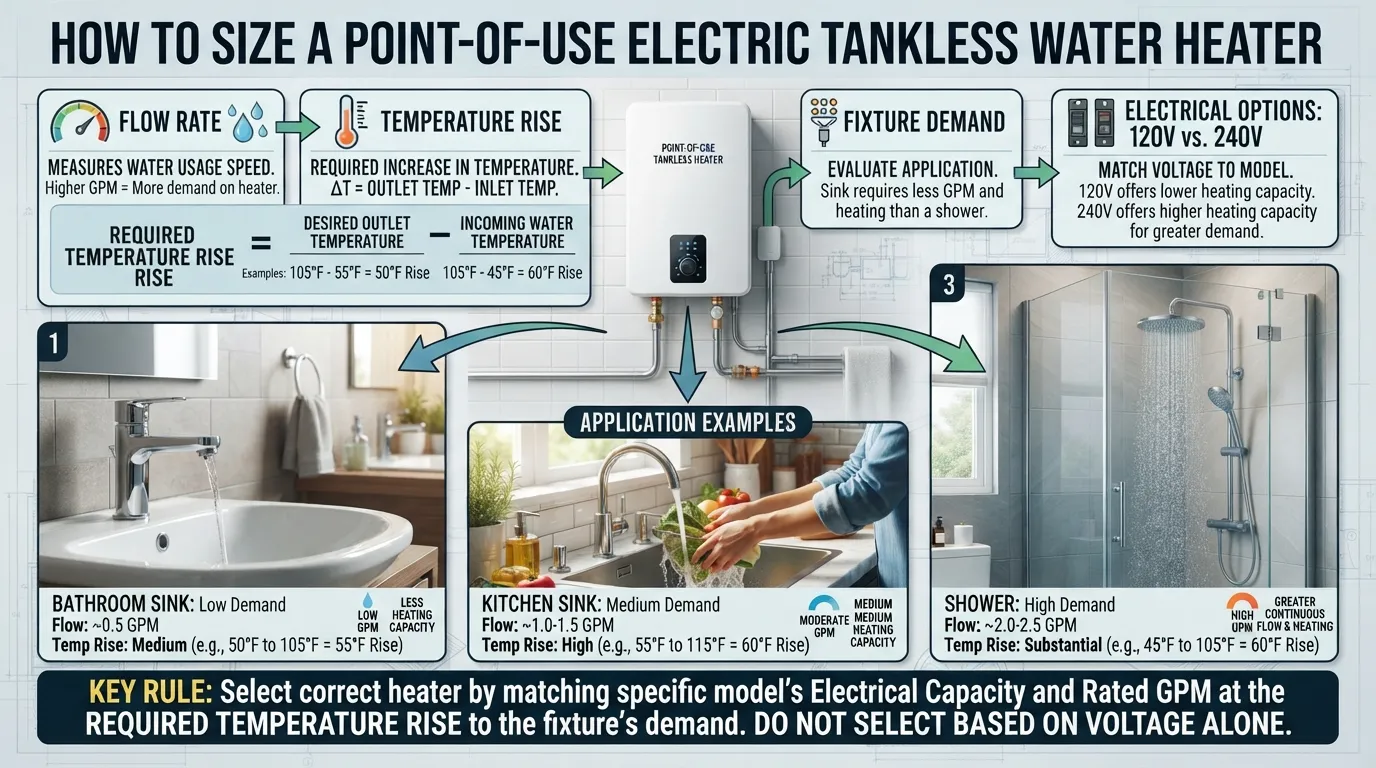
So if your goal is a shower installation, start with the shower’s required GPM and the required temperature rise, then compare that requirement with the heater’s published performance.
Can a Point of Use Water Heater Work for a Kitchen Sink?
Yes, a kitchen sink can be an excellent POU application, but the heater still needs to be sized correctly.
Kitchen faucets can have higher flow requirements than bathroom faucets, and your actual flow depends on the faucet, aerator, water pressure, and how you use the fixture.
If the kitchen sink is located far from your main water heater, a POU system may also reduce the amount of time you wait for hot water and reduce some heat loss through a long hot-water pipe run.
Before choosing a unit, check:
- Actual faucet flow rate
- Incoming water temperature
- Desired hot-water temperature
- Required temperature rise
- Heater GPM rating at the relevant temperature rise
- Available voltage and electrical capacity
What About a Bathroom Sink or Handwashing Sink?
This is where smaller POU electric tankless heaters can make a lot of sense.
Handwashing and bathroom-sink applications generally require less continuous flow than a shower. That can make a lower-output heater suitable, provided its minimum activation flow and performance specifications match the fixture.
This is also why point-of-use electric tankless heaters are commonly used in applications such as bathrooms, break rooms, utility sinks, and other locations where hot water is needed close to the fixture.
120V vs. 240V Point of Use Tankless Water Heaters
One of the most important buying questions is whether you need a 120V or 240V unit.
Voltage by itself does not tell you how much hot water a heater can produce. What matters is the combination of voltage, electrical power, flow, and temperature rise.
Current A. O. Smith POU products demonstrate how wide the range can be. Its product line includes 120V models such as 2.4 kW units as well as 240V models at substantially higher power levels.
That is why “I have 120V” is not enough information to determine whether a heater will work for your fixture.
What Does GPM Mean on a Tankless Water Heater?
GPM means gallons per minute. It tells you how much water the heater can heat while raising the water temperature by a specified amount.
This second part is critical.
You may see a manufacturer list a heater as providing a certain GPM at a 67°F temperature rise. That does not mean the heater will deliver that same GPM under every possible water-temperature condition.
If your incoming water is colder, the heater has to add more heat to reach the same outlet temperature. If the incoming water is warmer, the required temperature rise is smaller.
The basic sizing relationship
Required temperature rise = Desired outlet temperature − Incoming water temperature
The heater then needs enough power to provide the required temperature rise at the required flow rate.
This is why a heater that works well for one sink may not provide the same result for a shower.
How to Size a Point of Use Electric Tankless Water Heater
Instead of starting with the heater, start with the fixture.
Step 1: Identify the fixture
Are you heating water for:
- A handwashing sink?
- A bathroom sink?
- A kitchen sink?
- A utility sink?
- A shower?
- More than one fixture?
Step 2: Determine the required flow
Check the actual fixture flow rather than relying on a generic number. A faucet’s flow can vary based on the fixture and aerator, while shower flow depends on the showerhead and user preference.
Step 3: Determine incoming water temperature
The colder the incoming water, the greater the temperature rise the heater must provide.
Step 4: Determine the desired outlet temperature
Your required outlet temperature depends on the application and the system’s controls and safety requirements. A professional should verify the appropriate setpoint and any required anti-scald protection for the installation.
Step 5: Calculate the temperature rise
Subtract the incoming water temperature from the desired outlet temperature.
Step 6: Match the heater’s published performance
Now compare the required flow and temperature rise with the manufacturer’s specifications.
Step 7: Check the electrical requirements
Finally, verify voltage, amperage, breaker requirements, wiring, and available electrical capacity for the specific model. Electric tankless heaters can require substantially more electrical capacity than conventional tank-style water heaters.
Do not size an electric tankless heater from voltage alone.
A 120V label does not tell you whether a unit can handle your sink or shower. Always compare the model’s rated GPM at the required temperature rise and verify the electrical requirements.
Why Temperature Rise Matters So Much
Imagine two homes using the same heater.
In the first home, the incoming water is relatively warm. In the second, the incoming water is significantly colder. Both homeowners want the same outlet temperature.
The second heater has to add more heat to every gallon of water. If the electrical input stays the same, the achievable flow can be lower.
This is one reason location matters when sizing an electric tankless water heater.
It also explains why some high-output POU systems can be attractive in warm climates. Stiebel Eltron specifically describes its DHX Select products in the context of warm states such as Florida, Texas, and Southern California, where warmer incoming water can improve the achievable performance of an appropriately sized system.
Is a Point of Use Tankless Water Heater a Good Choice in Florida?
It can be, particularly when the heater is being used to solve a specific hot-water distribution problem or when the selected model is designed for the required application.
Florida’s warmer incoming water temperatures can reduce the temperature rise required compared with colder climates. That can improve the practical flow performance of some electric tankless systems.
But Florida does not eliminate the need for proper sizing.
You still need to consider:
- Incoming water temperature at the installation
- Required outlet temperature
- Fixture flow rate
- Number of fixtures operating at the same time
- Heater power and voltage
- Electrical service capacity
- Manufacturer-rated performance
If you are in Miami or the surrounding area and are unsure whether a point-of-use system makes sense for your application, professional sizing can prevent an expensive mismatch.
Point of Use Tankless vs. Point of Use Mini-Tank
“Point of use” describes where the water heater is installed. It does not tell you whether the heater uses a tank.
There are both POU tankless and POU mini-tank water heaters.
The better choice depends on your application, available electrical service, desired flow, fixture location, and how you use hot water.
Point of Use vs. Whole-House Tankless Water Heater
A whole-house tankless water heater is designed around the home’s overall hot-water demand. A point-of-use system is typically installed close to a particular fixture or group of fixtures.
That creates a useful decision framework:
Choose POU when:
- You have a remote fixture that takes too long to receive hot water.
- You need hot water at a specific sink or location.
- You have a small or isolated hot-water demand.
- A compact installation is important.
Consider a whole-house system when:
- You need to supply many fixtures throughout the property.
- Your hot-water demand is spread across multiple bathrooms, kitchen fixtures, or appliances.
- You want one central system designed around the property’s total demand.
There are also higher-output POU systems that can serve multiple fixtures in appropriate conditions, so the distinction is not simply “one fixture versus the entire house.” The manufacturer’s intended application and performance data should determine the decision.
Does a Point of Use Tankless Water Heater Save Energy?
It can reduce certain types of energy loss, but it is better to understand why rather than assume that every installation will produce the same savings.
A storage water heater periodically uses energy to maintain stored hot water. A tankless system heats water when it is being used instead of continually maintaining a large volume of stored hot water.
POU placement can also reduce heat lost while hot water travels through a long pipe from a central heater to a distant fixture.
However, the savings depend on the application. If a fixture is already very close to an efficient central water heater, moving the heating point may provide less benefit than it would for a remote fixture with a long hot-water run.
question than “Will it save money?”: Ask, “Which losses am I eliminating or reducing with this installation?”
Electrical Requirements: What You Need to Know
Electrical planning is one of the areas where a seemingly simple POU installation can become more complicated.
Small 120V units can have relatively modest power requirements, while higher-output 240V models can require much greater electrical capacity.
For example, A. O. Smith publishes a 240V, 9 kW POU model with a 37.5-amp draw and a specified 40-amp breaker and #8 AWG wire requirement. That is a model-specific requirement—not a universal rule for every tankless water heater.
Other models have different voltage, amperage, breaker, and wiring requirements.
Before installation, a qualified professional should verify:
- The heater’s exact voltage
- Rated power in kW
- Amperage
- Required breaker
- Required conductor size
- Available panel capacity
- Local electrical and plumbing requirements
- Proper grounding and protection
Safety warning
Do not choose a breaker or wire size from a generic internet chart. Use the exact manufacturer’s installation documentation and have the electrical requirements verified for the specific installation.
Do Point of Use Tankless Water Heaters Need Venting?
Electric tankless water heaters do not produce combustion gases, so they do not require the combustion venting associated with gas-fired water heaters.
That is one reason electric POU systems can be convenient in locations where adding a fuel-burning water heater and its venting would be difficult.
That does not mean installation is automatically a simple plug-in project. Water connections, electrical requirements, mounting, local codes, flow requirements, and the manufacturer’s installation instructions still matter.
Common Mistakes to Avoid
1. Choosing by voltage alone
A 120V heater is not automatically the right choice for every sink, and a 240V heater is not automatically right for every shower. Look at actual performance.
2. Ignoring temperature rise
GPM without the associated temperature-rise condition can be misleading. Always look at both.
3. Assuming all POU heaters are sink-only
Some are designed for single sinks and small loads. Others have substantially higher output and broader applications.
4. Assuming every POU heater can run a shower
The opposite mistake is just as serious. A low-output sink heater should not be treated as a shower heater.
5. Buying the heater before checking the electrical service
Higher-output electric tankless units can place significant demand on an electrical panel.
6. Focusing only on energy savings
The value of a POU heater may be less about dramatically reducing the entire home’s energy use and more about solving a specific distribution problem, avoiding storage losses, and putting hot water where you need it.
A Simple Point of Use Water Heater Decision Guide
Start with your fixture
→ Handwashing or low-flow sink?
Look at smaller POU tankless models and verify minimum activation flow, GPM, temperature rise, and electrical requirements.
→ Bathroom or kitchen sink?
Measure or confirm the fixture flow and match the heater’s performance at your required temperature rise.
→ Shower?
Do not assume a small POU unit will work. Select a model specifically capable of the required continuous flow and temperature rise.
→ Multiple fixtures?
Calculate simultaneous demand and compare it with the heater’s rated performance. A whole-house system or higher-output POU design may be more appropriate.
→ Remote fixture far from the central heater?
A POU system may be particularly useful because it moves hot-water production closer to the point of demand.
Frequently Asked Questions
When a Professional Should Help With the Installation
A point-of-use heater may look small, but the installation still involves water and electricity. Professional help is especially valuable when:
- You are installing a higher-output 240V model.
- Your electrical panel may not have enough capacity.
- You are changing wiring or adding a dedicated circuit.
- You are installing the heater for a shower or multiple fixtures.
- You are unsure about flow rate or temperature rise.
- You are replacing an existing water heater.
- You need the installation checked against applicable local requirements.
If your project involves replacing an existing water-heating system, you can also review our water heater replacement service to see how professional replacement can fit into your project.
Point of Use Water Heater Installation in Miami
If you are trying to solve a specific hot-water problem in your Miami home or property, the best solution is not always the biggest heater. It is the system that matches the actual demand.
We can help you evaluate the fixture, flow requirements, temperature rise, electrical needs, and installation location before you commit to equipment.
Whether the project is limited to a water heater or involves a broader plumbing issue, you can also explore our full range of plumbing services.
Not Sure Which POU Heater You Need?
Before buying a point-of-use electric tankless water heater, let the application determine the equipment. The right choice starts with the fixture, flow rate, temperature rise, electrical capacity, and manufacturer specifications.
Key Takeaways
- A point of use electric tankless water heater heats water close to the fixture where it is needed.
- It can be especially useful for remote fixtures and applications where hot water takes too long to arrive from a central heater.
- 120V does not automatically mean sink-only, and point-of-use does not automatically mean shower-capable. Always check the specific model’s performance.
- Proper sizing depends on GPM, incoming water temperature, desired outlet temperature, and temperature rise.
- Higher-output electric tankless heaters can require substantial electrical capacity.
- Some POU models are designed for single sinks, while higher-output models can serve multiple fixtures or showers in suitable conditions.
- Warm Florida conditions can improve the practical performance of appropriately sized electric tankless systems, but they do not eliminate the need for correct sizing.
- The best system is not necessarily the largest or most powerful one. It is the one that matches your actual application.
Related Resources
If you want to compare technical information from established water-heating manufacturers and energy-efficiency organizations, these resources can help:
- A. O. Smith point-of-use electric water heater information
- State Water Heaters point-of-use electric water heater information
- Stiebel Eltron DHX Select point-of-use electric tankless water heaters
- Hubbell point-of-use electric tankless water heater information
- ENERGY STAR point-of-use water heater information
Helpful
Visual demonstrations can make the basic operation and installation concept easier to understand. The videos below are provided as supplemental educational resources; always follow the installation manual for the exact heater you choose.
For product-specific performance, always use the manufacturer’s current specification sheet and installation manual. Product capabilities, electrical requirements, and application ratings can vary by model.