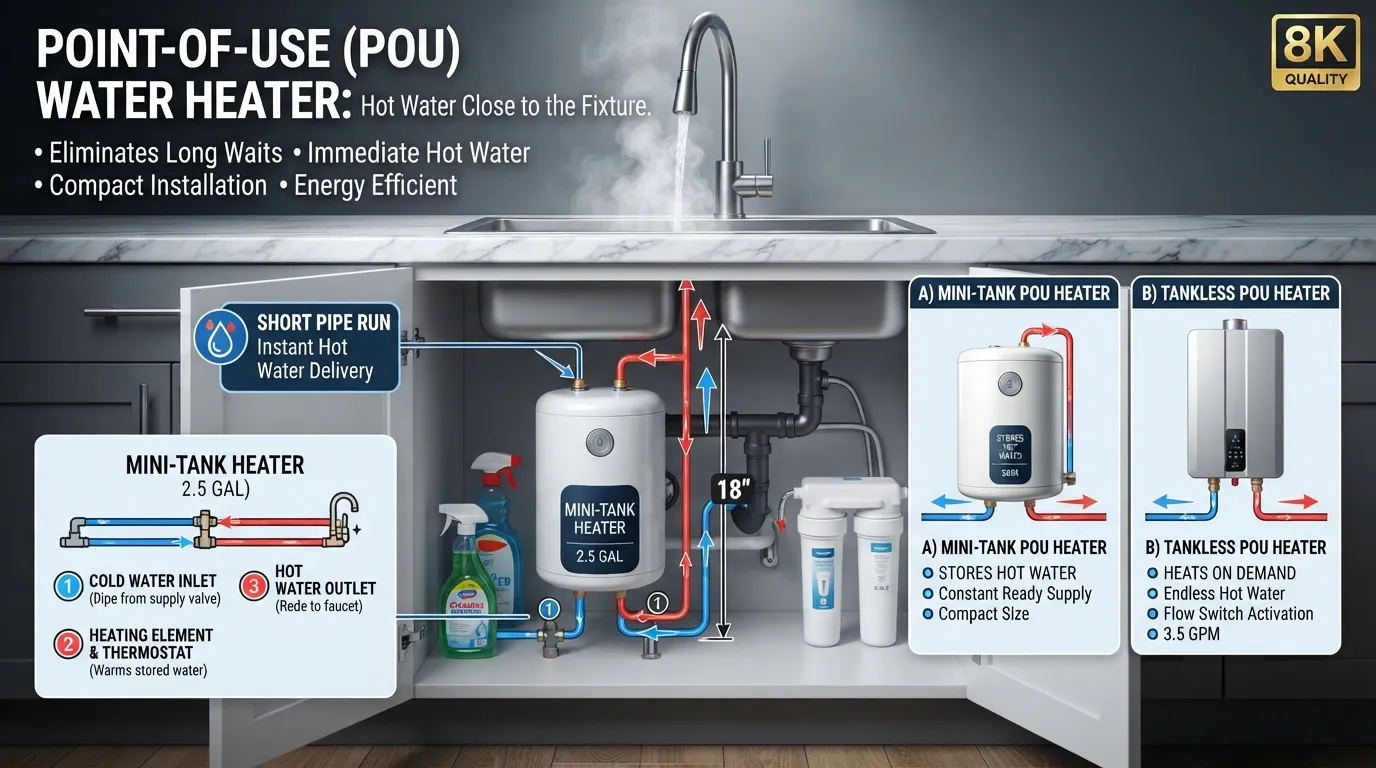
If you are tired of waiting for hot water at a kitchen or bathroom sink, a point-of-use water heater may be a practical solution. Instead of sending hot water through a long pipe from a central water heater, a point-of-use (POU) unit heats water close to the fixture where you actually use it.
A point-of-use water heater is a compact water-heating system installed near a specific fixture, such as a sink, shower, or bath. The two main electric options are mini-tank and tankless. The right choice depends on the fixture, expected hot-water demand, flow rate, available electrical capacity, installation space, and how far the fixture is from the central water heater.
For a simple under-sink application, a small mini-tank can be convenient. For other applications, especially higher-flow fixtures, a tankless POU system or a different water-heating approach may make more sense.
What Is a Point-of-Use Water Heater?
A point-of-use water heater is a water heater installed close to the fixture that needs hot water. Instead of relying entirely on a central water heater located elsewhere in the home, the POU unit heats water near the point where you use it.
Common applications include kitchen sinks, bathroom sinks, remote bathrooms, room additions, garages, detached structures, and other fixtures located a significant distance from a central water heater. ENERGY STAR explains that POU heaters can reduce heat loss in the hot-water distribution system by heating water near the point of use.
That makes a point-of-use system different from a conventional whole-house water heater. A central heater is designed to serve a larger portion of the home, while a POU heater is generally intended for a specific fixture or smaller hot-water load.
How Does a Point-of-Use Water Heater Work?
The basic idea is simple: move the heating point closer to the fixture.
- The unit receives cold water from the plumbing system.
- The water is heated inside the POU system.
- Hot water travels only a short distance to the faucet or fixture.
- The fixture receives hot water without depending entirely on a long hot-water pipe run from a central heater.
With a mini-tank, the heater stores a small amount of heated water so it is ready when needed. With a tankless unit, the heating elements heat water as it passes through the system when there is demand.
Important: “Instant hot water” does not mean unlimited hot water under every condition. A mini-tank has a finite stored volume, while a tankless system is limited by factors such as its heating capacity, incoming-water temperature, and flow rate.
Point-of-Use Water Heater Types
For residential electric applications, two configurations are especially important: mini-tank and tankless.
1. Point-of-Use Mini-Tank Water Heater
A mini-tank water heater stores a relatively small amount of heated water near the fixture. Because the hot water is already stored close to the faucet, it can provide a short wait time for many small-load applications.
Mini-tank POU heaters are commonly considered for under-sink installations, small apartments, room additions, garages, and other applications where the hot-water demand is relatively limited.
2. Point-of-Use Tankless Water Heater
A tankless POU water heater does not keep a tank of hot water waiting for you. Instead, it heats water on demand as it flows through the unit.
This can be useful when space is limited or when the application benefits from on-demand heating. However, tankless systems require careful attention to flow rate, temperature rise, electrical requirements, and the manufacturer’s specifications.
Mini-Tank vs. Tankless Point-of-Use Water Heater
Neither type is automatically “best.” The correct choice depends on what you are trying to accomplish at the fixture.
Can You Install a Point-of-Use Water Heater Under a Sink?
Yes, many point-of-use water heaters are specifically designed for under-sink or under-counter applications. Compact mini-tank models are commonly used where a sink needs a nearby source of hot water.
But the phrase “under sink” does not automatically tell you which heater to buy. Before selecting an under sink hot water heater, you should consider the available cabinet space, the plumbing connections, the expected water demand, and the electrical requirements of the specific model.
If you are looking for an instant hot water heater under the sink, remember that “instant” may refer to either a small stored reserve that is already hot or a true tankless, on-demand system. Those are different technologies and should be evaluated differently.
Is a Point-of-Use Water Heater Good for a Kitchen Sink?
A kitchen sink can be a good application for a POU water heater when the sink is far from the central water heater, when waiting for hot water is inconvenient, or when a separate small hot-water supply better fits the layout.
Kitchen Sink Decision Guide
- If the sink is far from the central heater, a POU system may reduce the wait associated with a long hot-water run.
- If the sink has relatively modest hot-water demand, a compact mini-tank may be worth considering.
- If you want tankless operation, verify the unit’s flow and electrical requirements before choosing it.
- If several fixtures need hot water at the same time, evaluate the total demand rather than sizing the heater only for one faucet.
What Size Point-of-Use Water Heater Do You Need?
There is no single POU water heater size that works for every sink, bathroom, or shower. The correct size depends on the application.
For a tank-style POU heater, storage capacity is one consideration. For a tankless model, flow rate and temperature rise become particularly important.
A Practical Sizing Process
- Identify the fixture. A kitchen sink, bathroom sink, and shower can have very different hot-water requirements.
- Estimate the flow. Determine how much water the fixture actually uses rather than guessing based only on the name of the fixture.
- Consider incoming-water temperature. The heater has to raise the water from its incoming temperature to the desired hot-water temperature.
- Consider the desired output. Your target temperature and expected usage affect the required heating performance.
- Check the electrical requirements. Verify voltage, wattage, amperage, and circuit requirements for the exact model.
- Confirm the physical installation. Make sure there is adequate space and that the plumbing connections and installation requirements can be met.
Don’t size a POU heater by gallon capacity alone. Two units with similar storage capacity can have different heating performance, electrical requirements, recovery characteristics, and intended applications. Always compare the manufacturer’s specifications with your actual fixture demand.
What About a Point-of-Use Water Heater for a Shower?
A point-of-use water heater can be used for some shower applications, but you should not assume that a small under-sink mini-tank is suitable for a conventional shower.
Showers can require substantially more continuous hot-water flow than a handwashing or kitchen-sink application. That means the heater’s capacity, flow rate, temperature rise, and electrical requirements become much more important.
If your goal is a point-of-use shower water heater, start with the shower’s actual demand and then match the equipment to that demand. Do not choose a small under-sink model simply because it is compact.
Electrical Requirements Matter
Because many POU water heaters are electric, electrical capacity is an important part of the installation decision.
Depending on the model, you may need to consider:
- Voltage
- Wattage
- Amperage
- Circuit requirements
- Grounding and electrical safety
- Applicable electrical codes
- The existing electrical capacity at the installation location
Do not assume that an available outlet is automatically suitable for every water heater. The electrical requirements vary by model, especially between smaller mini-tank units and higher-output tankless systems.
Does a Point-of-Use Water Heater Save Water or Energy?
It can help, but the reason matters.
When a central water heater is far from a faucet, hot water has to travel through the pipe before it reaches the fixture. During that wait, the water in the line can cool. You may also let water run while waiting for the desired temperature.
ENERGY STAR notes that some heat is lost between a central water heater and the faucet and explains that POU water heaters can reduce distribution-system losses by heating water near the fixture.
However, a POU heater should not be marketed as an automatic guarantee of lower utility bills. The result depends on the home’s existing system, the distance to the fixture, how the POU is used, the heater’s efficiency, and the installation.
Point-of-Use Water Heater Benefits
- Shorter hot-water path: The heater is close to the fixture.
- Less waiting: You may get hot water at the fixture more quickly.
- Compact installation: Some models are designed for small spaces such as cabinets and under-sink areas.
- Useful for remote fixtures: POU systems can be considered for fixtures that are far from the central heater.
- Flexible applications: They can be useful for certain additions, garages, detached spaces, bathrooms, and individual sinks.
- Independent operation: A POU unit can supplement the central water-heating system instead of requiring the entire home to depend on one heating point.
Point-of-Use Water Heater Disadvantages
A POU heater is not the perfect solution for every home. Understanding its limitations is just as important as understanding its benefits.
- A mini-tank has limited stored capacity.
- A tankless model may require significant electrical capacity depending on its output.
- The unit still requires proper plumbing and electrical installation.
- Cabinet or under-sink space may be limited.
- Incorrect sizing can lead to disappointing performance.
- A POU system may not be appropriate when several high-demand fixtures need hot water simultaneously.
- Adding a POU heater does not automatically make sense when the fixture is already close to an adequately sized central water heater.
When Is a Point-of-Use Water Heater a Good Choice?
A POU System May Be Worth Considering If:
- Your fixture is a long distance from the central water heater.
- You regularly wait for hot water at a particular sink.
- You want a compact hot-water solution for an addition or remote space.
- You need supplemental hot water at a specific fixture.
- The expected demand matches the capacity and performance of the selected unit.
When Is a POU Water Heater Probably Not the Right Solution?
Sometimes the best answer is not to install one.
- If you are trying to supply the entire home, a small POU heater is not a substitute for a properly designed whole-house water-heating system.
- If multiple fixtures need large amounts of hot water at the same time, the total demand needs to be evaluated before choosing a POU unit.
- If the fixture is already very close to the central water heater, the benefit of adding a separate heater may be limited.
- If the required electrical capacity is not available, the installation may require additional electrical work or a different solution.
- If there is not enough physical space for safe installation and service access, an under-sink heater may not be practical.
How to Choose the Right Point-of-Use Water Heater
- Start with the fixture. Decide whether the heater is for a kitchen sink, bathroom sink, shower, bath, or another application.
- Measure the problem. Is the problem long wait times, insufficient hot water, lack of a central supply, or a remote fixture?
- Determine demand. Consider how much hot water the fixture uses and whether other fixtures will operate at the same time.
- Choose the technology. Compare mini-tank and tankless options based on the actual application.
- Check electrical requirements. Verify the exact model’s voltage, wattage, amperage, and circuit requirements.
- Check installation space. Confirm the dimensions, connections, access, and manufacturer’s installation requirements.
- Consider the central system. A POU heater should solve a specific problem without creating a larger system-design problem.
- Have the installation evaluated when necessary. Plumbing and electrical requirements should be checked before purchasing a unit.
Point-of-Use Water Heater Installation: What Should Be Checked?
Installing an under-counter or under-sink water heater involves more than connecting two water lines. A proper evaluation should consider the complete installation.
Plumbing
- Cold-water supply
- Hot-water outlet connection
- Shutoff arrangements
- Pressure and safety requirements applicable to the selected system
- Leak prevention and service access
Electrical
- Correct voltage and power supply
- Required circuit capacity
- Grounding and electrical protection
- Compliance with applicable electrical requirements
Physical Space
- Cabinet or mounting dimensions
- Manufacturer-required clearances
- Access for maintenance
- Protection from conditions that are unsuitable for the specific unit
Installation note: Always follow the manufacturer’s installation instructions and applicable local plumbing and electrical requirements. The correct installation details can vary significantly between models.
Point-of-Use vs. Replacing the Main Water Heater
If you are considering a POU heater because your home is struggling to provide hot water, first identify the actual problem.
If one remote sink has a long wait while the rest of the system works well, a POU solution may address that specific problem. If the entire home has insufficient hot water, repeated failures, leaks, poor recovery, or an aging central water heater, replacing or upgrading the main system may deserve consideration instead.
If your central water heater needs replacement, you can learn more about water heater replacement options before deciding which approach makes sense for your home.
Is a Point-of-Use Water Heater Right for Your Home?
The best way to answer that question is to work backward from the fixture rather than starting with a particular product.
Your POU Decision Checklist
- Which fixture needs hot water?
- How far is that fixture from the central water heater?
- How much hot water does the fixture actually require?
- Will more than one fixture use hot water at the same time?
- Would a mini-tank or tankless design better match the application?
- Does the electrical system support the selected model?
- Is there enough space for installation and future service?
- Would improving or replacing the central system solve the underlying problem better?
Frequently Asked Questions
What is the point of use of a water heater?
“Point of use” means the water heater is installed close to the fixture where hot water is needed. Instead of heating water only at a central location, the POU system heats water near the sink, shower, bath, or another selected fixture.
What are the best point-of-use water heaters?
There is no single best POU water heater for every application. The right model depends on the fixture, flow rate, desired temperature, storage or tankless design, electrical requirements, installation space, and expected demand. Start by matching the heater to the application rather than choosing a model based only on brand or capacity.
What is a point-of-use electric water heater?
It is a compact electric water heater designed to heat water close to the fixture where it will be used. Electric POU systems are commonly available in mini-tank and tankless configurations.
What is a point-of-use shower water heater?
It is a POU water-heating system intended to serve a shower or another higher-demand fixture. Because showers can require more continuous flow than a sink, the heater must be selected based on the actual flow, temperature rise, heating capacity, and electrical requirements. A small under-sink heater should not automatically be assumed to be suitable for a shower.
Can I use a point-of-use water heater under a kitchen sink?
Yes. Many compact POU water heaters are designed for under-sink or under-counter applications. The specific model still needs to match the available space, plumbing configuration, electrical supply, and expected hot-water demand.
Does a point-of-use heater replace my main water heater?
Usually, a POU heater is better viewed as a fixture-specific or supplemental solution rather than an automatic replacement for a whole-house water heater. If your entire home has a hot-water problem, evaluate the central system before adding several small heaters.
Is a mini-tank or tankless POU heater better?
It depends on the application. A mini-tank provides a small reserve of heated water, while tankless heats water as it flows. For many small under-sink applications, a mini-tank can be a straightforward option; tankless may be appropriate when its flow and electrical requirements match the application.
Why Professional Evaluation Can Make a Difference
Choosing a point-of-use water heater is easier when you know exactly what problem you are trying to solve. A professional evaluation can help identify whether the issue is the distance from the central heater, insufficient capacity, an electrical limitation, a plumbing problem, or simply the wrong type of water-heating system for the fixture.
If you need help with the plumbing side of a POU installation or want to evaluate the broader water-heating system, you can explore our plumbing services.
Need Help Deciding?
If you are unsure whether an under-sink mini-tank, tankless POU heater, central water-heater replacement, or another plumbing solution is right for your home, getting the application evaluated before buying equipment can help you avoid choosing a heater that is too small, too powerful, or simply unsuitable for the fixture.
Final Takeaway
A point-of-use water heater can be an excellent way to bring hot water closer to a sink, shower, or other fixture, especially when distance from the central water heater creates unnecessary waiting or distribution losses.
The key is not simply finding the smallest or most powerful unit. Start with your fixture, understand the demand, compare mini-tank and tankless designs, check flow and temperature requirements, verify electrical capacity, and make sure the installation space and plumbing configuration are appropriate.
If a POU system solves the specific problem you have, it can be a practical addition to your water-heating setup. If the real problem is your central system, however, replacing or improving that system may be the better long-term solution.
Related Resources
- ENERGY STAR: Point-of-Use Water Heaters — background on POU systems and hot-water distribution losses.
- A. O. Smith: Point-of-Use Electric Mini-Tank Water Heaters — explanation of mini-tank and tankless POU configurations.
- Rheem: Point-of-Use Water Heaters — manufacturer information on compact POU applications.
Sources and technical note: Product specifications, electrical requirements, installation procedures, and applicable code requirements vary by model and location. Always verify the current manufacturer’s documentation and applicable local requirements before purchasing or installing a water heater.