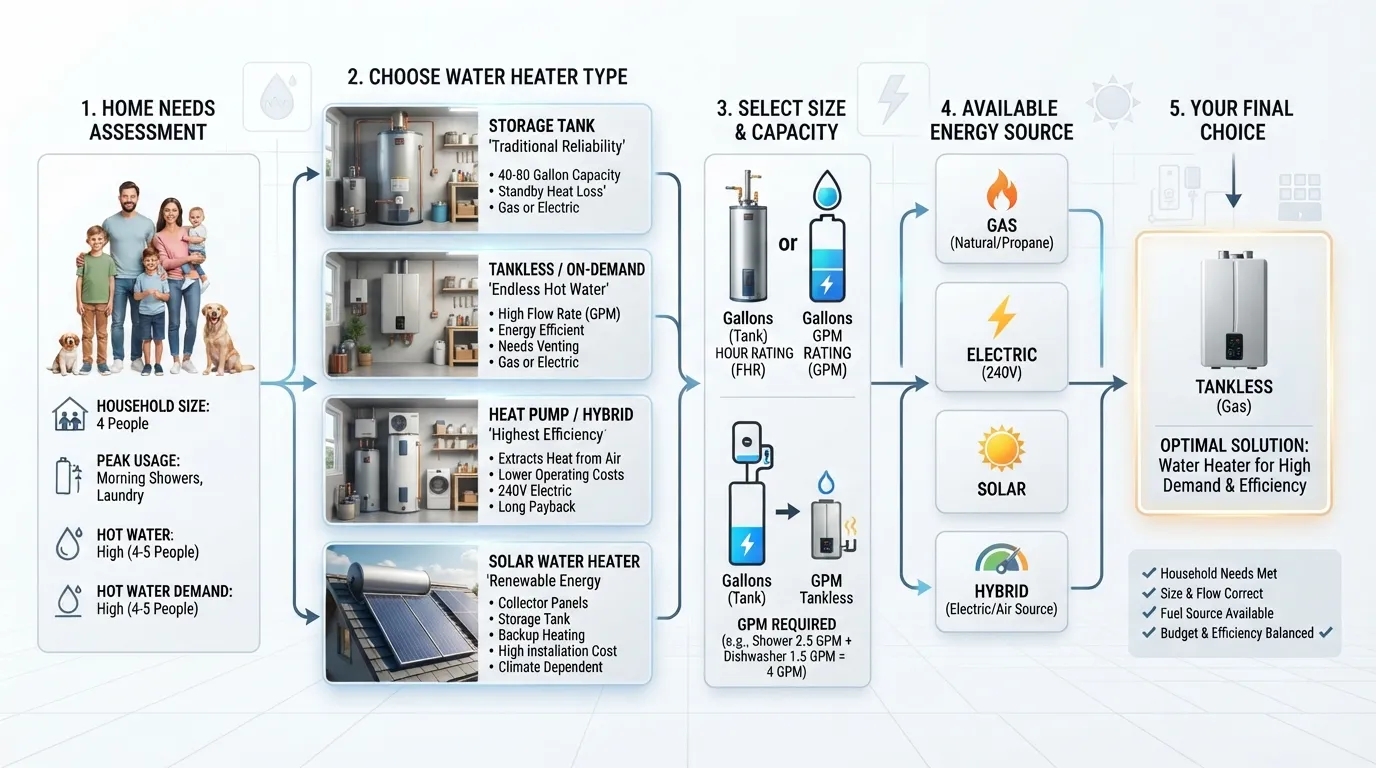
Choosing a water heater is not simply a matter of picking the biggest tank or the newest technology. The right choice depends on how much hot water you use, when you use it, which energy sources are available, how much installation space you have, and whether you care more about lower upfront cost or lower operating costs over time.
In this guide, I’ll walk you through how to choose a water heater step by step. You’ll learn how to compare tank, tankless, heat pump, solar, and point-of-use systems, how to think about sizing, what FHR, GPM, and UEF mean, and what to check before you buy.
How do you choose the right water heater?
Start with five things: your household’s hot-water demand, peak simultaneous usage, available fuel or power, installation space, and long-term operating costs. For a storage tank, compare the First-Hour Rating (FHR) rather than relying on tank gallons alone. For a tankless system, compare GPM and temperature rise. For efficiency, compare the UEF shown on the product information.
The Best Water Heater Depends on Your Home
There is no single water heater that is best for every household. A conventional storage tank can make sense when you want a familiar system and lower initial cost. A tankless unit can be attractive when space is limited and you want hot water produced on demand. A heat pump water heater can make sense when energy efficiency is a priority and the installation location is suitable.
The important part is matching the system to your actual hot-water use instead of choosing based on marketing claims alone.
A conventional storage tank is often the starting point to compare.
A tankless or point-of-use system may be worth considering, depending on demand and installation requirements.
Compare heat pump water heaters and other high-efficiency models using their published efficiency ratings.
Step 1: Estimate How Much Hot Water Your Home Actually Needs
Household size is useful, but it should not be the only sizing factor. Two people who take long showers at the same time can create more peak demand than four people who spread their hot-water use throughout the day.
Before choosing a water heater, think about your busiest hour. Ask yourself:
- How many people regularly use hot water?
- How many showers might run at the same time?
- Do you regularly use a bathtub?
- Does the dishwasher run while someone is showering?
- Does the washing machine use hot water?
- Are there periods in the morning or evening when several fixtures are used close together?
- Do you frequently run out of hot water with your current system?
This is your peak hot-water demand. It is one of the most useful starting points for choosing the right system.
Why household size alone can be misleading
A simple “one size for two people, another size for four people” chart can be a useful starting point, but it cannot account for every household. Water-heater performance also depends on recovery, first-hour capacity, fixture flow, usage timing, incoming water temperature, and the type of system you choose.
That is why I recommend treating household-size charts as a starting point—not the final answer.
Step 2: Choose the Right Type of Water Heater
The main residential options include storage tank, tankless, heat pump, solar, and point-of-use systems. Some homes may also use specialized condensing or combination systems. Each solves a slightly different problem.
1. Conventional Storage Tank Water Heater
A storage water heater heats water and keeps it in an insulated tank until you need it. These systems are widely used and are available in different capacities and fuel configurations.
A storage tank may be a good fit if you:
- Want a familiar whole-home system.
- Have enough space for a tank.
- Want to compare lower upfront-cost options.
- Need stored hot water available during periods of demand.
The trade-off is that the tank occupies space and must continually manage stored hot water. Electric and gas storage models also have different installation and operating requirements. :contentReference[oaicite:0]{index=0}
2. Tankless Water Heater
A tankless water heater heats water as it flows through the unit instead of storing a large volume of hot water in a tank. This can save installation space and avoids keeping a large tank of water hot when it is not being used.
A tankless system may be a good fit if you:
- Have limited installation space.
- Prefer on-demand water heating.
- Want to avoid the physical footprint of a large storage tank.
- Are willing to evaluate the required flow rate and installation requirements carefully.
3. Heat Pump Water Heater
A heat pump water heater uses electricity to move heat from surrounding air into the water instead of relying only on electric resistance heating. Many residential heat pump systems combine the heat pump with a storage tank and backup resistance elements.
This technology can be significantly more efficient than conventional electric resistance water heating, but the installation location matters. Heat pump water heaters need appropriate air volume, service clearance, and conditions specified by the manufacturer. :contentReference[oaicite:1]{index=1}
A heat pump water heater may be worth considering if you:
- Want to prioritize energy efficiency.
- Have an appropriate installation location.
- Can accommodate the unit’s space, airflow, electrical, and manufacturer requirements.
- Are thinking about long-term operating costs rather than only the purchase price.
4. Solar Water Heater
Solar water-heating systems use solar energy to help heat domestic water and commonly incorporate storage and backup heating. They can be attractive where the property has suitable solar exposure and the homeowner is interested in renewable energy.
The decision requires more than simply looking at sunlight. You also need to consider roof or collector space, system design, backup heating, installation complexity, and the economics of the project.
5. Point-of-Use Water Heater
Point-of-use water heaters are designed to serve a particular fixture or small demand point. They can be useful when a remote sink, bathroom, or other fixture needs dedicated hot-water delivery without changing the entire home’s water-heating system.
They are generally not the first choice for replacing a whole-home water heater because their purpose is more localized.
6. Condensing and Combination Water-Heating Systems
Condensing systems and combination boiler/water-heating systems can be appropriate in specific applications. They are more specialized than the conventional tank, tankless, or heat pump choices most homeowners compare.
If you are considering one of these systems, the home’s existing heating equipment, fuel source, venting, demand, and installation requirements should be evaluated before choosing the equipment.
Water Heater Decision Guide: Which Type Fits Your Situation?
You want a conventional whole-home solution, have adequate space, and want to compare systems based on capacity, FHR, fuel type, efficiency, and purchase cost.
Space is limited and your home can support a properly sized system based on simultaneous flow and temperature-rise requirements.
Energy efficiency is a major priority and your installation location meets the equipment’s space, airflow, temperature, and electrical requirements.
You have a specific fixture or small demand point that needs dedicated hot-water delivery.
Step 3: Choose the Right Fuel or Energy Source
Your home’s existing energy infrastructure can narrow your options. Depending on the system, water heaters may use electricity, natural gas, propane, solar energy, or a combination of technologies.
Electric water heaters
Electric systems can be practical where adequate electrical service is available. However, different water-heater technologies have different electrical requirements, so you should never assume that an existing circuit will automatically support a new model.
Natural gas water heaters
Gas systems can offer fast heating and may make sense where the home already has an appropriate gas supply. Gas appliances also require the correct venting and installation configuration.
Propane water heaters
Propane can be an alternative where natural gas is not available. The equipment must be designed for the correct fuel, and the installation needs to meet the applicable requirements.
Solar-assisted systems
Solar systems depend on the property, solar resource, system design, available collector space, and backup heating strategy. They should be evaluated as a complete system rather than simply as a water-heater tank.
Step 4: Size a Storage Water Heater Correctly
If you are choosing a tank-style water heater, one of the biggest mistakes is looking only at the number of gallons printed on the tank.
The more useful question is:
What is First-Hour Rating (FHR)?
First-Hour Rating (FHR) estimates how much hot water a storage water heater can supply during the first hour of use, starting with a fully heated tank. It accounts for both stored hot water and the heater’s ability to recover while water is being used.
That is why a tank’s nominal gallon capacity and its FHR are not the same thing. When comparing storage water heaters, check the manufacturer’s published FHR and compare it with your estimated peak-hour demand. :contentReference[oaicite:2]{index=2}
A practical way to estimate your peak hour
- Choose the busiest one-hour period in your normal routine.
- List every hot-water activity during that hour.
- Estimate how much hot water each activity uses.
- Add the demand together.
- Compare the result with the water heater’s FHR.
If your demand is close to or above the heater’s rated first-hour delivery, the system may not provide the comfort you expect.
Step 5: Size a Tankless Water Heater by GPM
Tankless sizing works differently from storage-tank sizing. Instead of asking how many gallons the tank holds, you need to determine how much hot-water flow you may need at the same time.
What is GPM?
GPM means gallons per minute. For a tankless water heater, the required flow depends on the fixtures that may operate simultaneously and the temperature rise the unit needs to provide.
For example, if two fixtures are likely to operate together, you need to consider their combined flow rather than sizing the tankless unit for only one fixture. ENERGY STAR defines GPM for instantaneous water heaters using a specified temperature-rise test condition, so compare manufacturer ratings using the same basis. :contentReference[oaicite:3]{index=3}
Tank vs. tankless sizing in one sentence
Storage tank: think about FHR and peak-hour demand.
Tankless: think about simultaneous GPM and temperature rise.
Step 6: Compare Energy Efficiency Using UEF
When comparing models, don’t rely only on labels such as “high efficiency.” Look at the published Uniform Energy Factor (UEF).
UEF is a standardized measure used to compare water-heater energy efficiency. In general, a higher UEF indicates greater efficiency under the applicable test conditions. ENERGY STAR uses UEF as a key certification criterion for residential water heaters. :contentReference[oaicite:4]{index=4}
Don’t compare efficiency without considering hot-water delivery
The most efficient-looking model is not automatically the best choice if it cannot meet your household’s demand or cannot be installed correctly.
Think of your decision as three questions:
- Can it deliver enough hot water?
- Can it be installed correctly in my home?
- How efficiently does it operate?
Only after those questions should you compare features and purchase price.
Step 7: Think About Upfront Cost vs. Long-Term Cost
A cheaper water heater is not necessarily the cheaper choice over its entire service life. Likewise, a more expensive high-efficiency system is not automatically the right choice for every household.
When comparing options, consider:
- Purchase price.
- Installation requirements and labor.
- Expected energy consumption.
- Maintenance requirements.
- Available warranty.
- Replacement-part availability.
- Your expected length of ownership.
- Any current utility incentives or rebates for which the specific model may qualify.
For example, the U.S. Department of Energy notes that high-efficiency heat pump water heaters can have substantially lower energy use than less-efficient alternatives, but the economics depend on the specific model, energy prices, installation conditions, and purchase price. :contentReference[oaicite:5]{index=5}
Step 8: Check the Installation Requirements Before Buying
This is where a lot of buying guides stop too early. You can find a water heater that looks perfect on paper and still discover that your home needs different electrical, gas, venting, drainage, clearance, or other installation work.
Before purchasing, check:
- The available installation space.
- Electrical service and circuit requirements.
- Gas availability and compatibility, if applicable.
- Venting requirements for applicable gas systems.
- Water and piping connections.
- Manufacturer-required service clearances.
- Drainage and safety components required by the installation.
- Local building and plumbing requirements.
The installation location needs adequate air volume and service space. ENERGY STAR guidance notes that heat pump water heaters can require substantial free air volume and that the manufacturer’s installation instructions should be followed for the specific model. :contentReference[oaicite:6]{index=6}
Choosing a Water Heater in Miami: What Should You Consider?
If you live in Miami or elsewhere in Miami-Dade County, local installation requirements should be part of your planning. Do not assume that a replacement is automatically exempt from permitting simply because you are replacing an existing unit.
Miami-Dade County states that replacement of a hot-water heater is among the types of work that can require a permit, while the City of Miami lists water-heater replacement under its easy-permit categories. Because requirements can depend on the municipality and exact scope of work, verify the current requirements for your property before starting the project. :contentReference[oaicite:7]{index=7}
Your local conditions also make professional sizing useful. Incoming water temperature, available fuel, electrical service, installation location, household demand, and existing plumbing can all affect the practical choice.
If you need help evaluating your options, you can speak with our local plumbing team before purchasing equipment.
Don’t Automatically Replace Your Old Water Heater With the Same Type
If your current water heater is failing, it can be tempting to buy the same type and size without asking whether your household has changed.
Before replacing it, ask:
- Has the number of people in the home changed?
- Do you now use more hot water than you did before?
- Does your current system run out of hot water?
- Have you added another bathroom or appliance?
- Has your energy usage become a concern?
- Is the existing installation space still the best location?
- Would another water-heating technology solve a problem your current system has?
A replacement is an opportunity to reassess the system—not simply reproduce the old installation.
What If Your Current Water Heater Keeps Running Out of Hot Water?
Running out of hot water does not automatically mean that you need a much larger tank.
Possible reasons can include:
- Your household demand has increased.
- Peak usage is higher than the system was designed to handle.
- The storage heater’s FHR does not match your peak demand.
- A tankless system is being asked to provide more simultaneous flow than it can support.
- The unit has a performance or maintenance problem.
- The heating components or controls are no longer working properly.
That is why diagnosing the actual problem before buying a replacement can save you from installing another system that does not solve the underlying issue.
What Should You Look for on a Water Heater Label?
Important when comparing storage water heaters. It indicates how much hot water the system can deliver during the first hour under the applicable test conditions.
Important for tankless systems. It helps you compare hot-water flow under a specified temperature-rise condition.
A standardized efficiency measure. A higher UEF generally indicates greater efficiency under the applicable test conditions.
Check what the warranty covers and whether the equipment has special installation, electrical, gas, ventilation, or service requirements.
ENERGY STAR’s current water-heater criteria use UEF, FHR, GPM, warranty, and other requirements depending on the type of water heater. :contentReference[oaicite:8]{index=8}
A Simple Water Heater Selection Process
- Count the people using hot water.
- Identify your busiest hot-water period.
- List the fixtures and appliances that may operate together.
- Check your available fuel or electrical service.
- Measure the available installation space.
- Choose the technology that fits your priorities.
- For a tank, compare FHR with peak-hour demand.
- For tankless, compare simultaneous GPM and temperature rise.
- Compare UEF and other published performance information.
- Check installation, permit, warranty, and maintenance requirements.
- Compare total ownership considerations—not only the purchase price.
The goal is not to buy the biggest or most expensive water heater.
The goal is to choose a system that can reliably meet your household’s hot-water demand, fits your home, works with your available energy source, and makes sense for your budget and long-term priorities.
Water Heater Buying Checklist
- ☐ Household size
- ☐ Peak hot-water demand
- ☐ Number of simultaneous fixtures
- ☐ Existing fuel or electrical supply
- ☐ Available installation space
- ☐ Storage tank FHR, if applicable
- ☐ Tankless GPM and temperature rise, if applicable
- ☐ UEF and efficiency information
- ☐ Installation and venting requirements
- ☐ Warranty
- ☐ Maintenance requirements
- ☐ Local permit and code requirements
- ☐ Upfront installation cost
- ☐ Long-term operating cost
Frequently Asked Questions About Choosing a Water Heater
What are the main types of water heaters?
The main residential categories include conventional storage tank, tankless, heat pump, solar, and point-of-use water heaters. Specialized systems such as condensing and combination systems may also be appropriate for particular homes.
How do I choose the right size water heater for my family?
Start with household size, but do not stop there. Estimate your busiest hour of hot-water use and compare the demand with the storage heater’s FHR. For tankless systems, calculate the likely simultaneous flow and compare it with the unit’s GPM rating.
Is a 40-gallon or 50-gallon water heater better?
Neither is automatically better. The right choice depends on your household’s peak demand, the heater’s FHR, recovery performance, installation conditions, and usage habits. A 50-gallon tank is not automatically the correct solution simply because your household is larger.
Is a tankless water heater better than a tank water heater?
It depends on the home. Tankless systems can save space and heat water on demand, but they must be properly sized for simultaneous flow and may require different installation work. Storage tanks can provide a familiar whole-home solution and stored hot-water capacity.
What is the most energy-efficient type of water heater?
Heat pump water heaters are designed to use electricity to move heat rather than relying solely on electric resistance heating, and they can achieve high efficiency. However, the most appropriate system for your home depends on installation conditions, demand, electrical service, and the specific model’s performance ratings. :contentReference[oaicite:9]{index=9}
What does FHR mean on a water heater?
FHR means First-Hour Rating. It estimates how much hot water a storage water heater can supply during an hour beginning with a fully heated tank. It is an important number to compare with your household’s busiest-hour demand. :contentReference[oaicite:10]{index=10}
What does GPM mean for a tankless water heater?
GPM means gallons per minute. For tankless water heaters, it describes hot-water flow under a specified temperature-rise condition. You should compare the required simultaneous fixture flow with the manufacturer’s rated capacity. :contentReference[oaicite:11]{index=11}
What does UEF mean on a water heater?
UEF stands for Uniform Energy Factor. It is a standardized efficiency measure used for comparing water heaters. A higher UEF generally represents higher efficiency under the applicable test conditions. :contentReference[oaicite:12]{index=12}
Should I choose gas or electric?
Start with what your home can support. Compare fuel availability, installation requirements, electrical service, venting, equipment efficiency, operating costs, and your household’s demand. There is no universal winner for every property.
Can a tankless water heater run multiple showers?
It can, but only if the unit is properly sized for the combined flow and required temperature rise. Multiple simultaneous showers can create substantially more demand than a single fixture, so check the manufacturer’s performance specifications rather than assuming every tankless unit can handle the same load.
Should I choose a water heater based only on the number of people in my home?
No. Household size is a useful starting point, but usage timing and peak demand matter too. Two households with the same number of residents can have very different hot-water requirements.
Do I need a permit to replace a water heater in Miami?
Permit requirements depend on the municipality and the exact work being performed. Miami-Dade County states that replacement of a hot-water heater can require a permit, and the City of Miami lists water-heater replacement among its easy-permit categories. Verify the current requirement for your specific property before work begins. :contentReference[oaicite:13]{index=13}
When should I talk to a plumber before buying a water heater?
Consider getting professional input when you are changing fuel types, switching from tank to tankless or heat pump technology, adding capacity, dealing with repeated hot-water shortages, changing the installation location, or unsure about electrical, gas, venting, plumbing, or permit requirements.
Ready to Choose the Right Water Heater?
The right water heater starts with your home’s actual needs—not a generic “best water heater” list. If you know your household size, peak usage, available energy source, installation space, and budget, you can narrow the options much more confidently.
If you’re replacing an existing system or need help deciding which option fits your home, explore our water heater replacement service for help with the next step.
Not sure which water heater fits your home?
Get professional guidance before you buy so your new system is matched to your home’s hot-water demand and installation requirements.
You can also explore our complete plumbing services if your water-heater project involves other plumbing work.
Helpful Water Heater Resources
For product-efficiency criteria, installation considerations, and local permitting information, these resources can help you verify details before making a purchase:
- ENERGY STAR Water Heater Product Criteria — UEF, FHR, GPM, warranty, and certification information.
- U.S. Department of Energy Water Heater Guidance — efficiency and purchasing information.
- ENERGY STAR Heat Pump Water Heater Guidance — installation and buying considerations for heat pump systems.
- Miami-Dade County Permit Information — current local permit guidance.
- City of Miami Easy Permit Information — water-heater replacement permit categories.
Final takeaway
The best water heater is the one that matches your demand, peak usage, energy source, installation space, efficiency goals, and budget. Don’t choose by tank gallons or marketing claims alone. Compare the right performance measurements—especially FHR for storage systems, GPM and temperature rise for tankless systems, and UEF for efficiency—then confirm that the equipment can actually be installed correctly in your home.