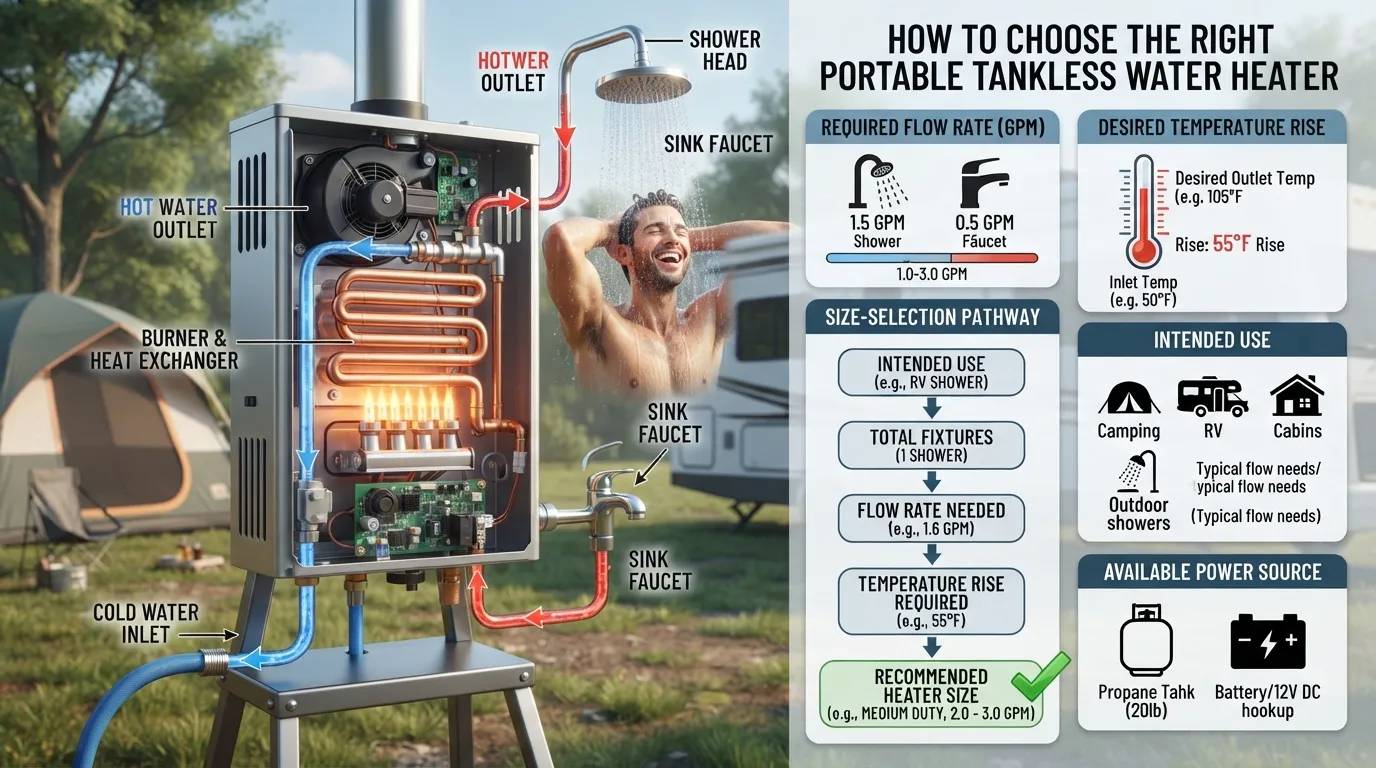
A portable tankless water heater heats water as it flows through the unit instead of storing hot water in a tank. Portable models are commonly used for camping, RVs, outdoor showers, remote cabins, off-grid applications, and other situations where a permanent water heater is impractical. The right model depends on more than its advertised GPM: you also need to consider fuel type, BTU output, incoming water temperature, water pressure, power requirements, and how you plan to use it.
If you are searching for a portable hot water heater, you probably want more than a definition. You want to know whether a portable unit will actually give you comfortable hot water, what size you need, whether propane or electric makes more sense, whether you need a pump, and whether the heater is appropriate for your particular setup.
That is what this guide is designed to answer. I will also explain an important point that is easy to miss when comparing portable on-demand water heaters: GPM alone does not tell you how well a heater will perform. Your incoming water temperature, desired temperature, heat output, and available water pressure all matter.
What Is a Portable Tankless Water Heater?
A portable tankless water heater is a compact water-heating system that warms water on demand as it passes through a heat exchanger or heating element. Unlike a traditional storage water heater, it does not keep a large tank of hot water ready for use.
Many portable models are designed around outdoor use and can be connected to a pressurized water supply, hose, portable water tank, or pump depending on the model. Propane-powered units are common because they can provide substantial heat without requiring a large electrical supply, while electric portable models are available for situations where suitable electrical power is already available.
Important distinction
Portable does not automatically mean suitable for indoor or permanent installation. Always follow the specific manufacturer’s installation instructions, fuel requirements, ventilation requirements, and local codes. A portable outdoor propane heater should never be treated as a permanent indoor water-heating system unless the specific product is designed, approved, and installed for that application.
How Does a Portable Tankless Water Heater Work?
The basic process is simple:
- Cold water enters the heater.
- The unit detects water flow.
- A burner or electric heating element transfers heat to the moving water.
- The heated water leaves through the outlet and travels to your showerhead, faucet, or other fixture.
Because there is no large storage tank to refill and reheat, a tankless system can provide hot water whenever the unit has adequate water flow, heat input, and power or fuel.
Does “Instant” Mean the Water Is Always Instantly Hot?
Not necessarily. “On demand” means the heater begins heating water when there is flow. You may still experience a short delay as water travels through the plumbing or hose, and the final temperature depends on the heater’s capacity and the temperature of the incoming water.
This matters especially in cold weather. If the incoming water is very cold, the heater has to add more heat to reach the same outlet temperature. You may therefore need to reduce the flow rate to achieve a comfortable temperature.
Portable Tankless Water Heater vs. a Regular Tank Water Heater
Where Can You Use a Portable On-Demand Water Heater?
Portable units are most useful when you need hot water away from a conventional water-heating system. Common applications include:
- Camping: Use a compatible water source and shower setup for an outdoor shower.
- RV trips: A portable unit can be useful when the specific RV setup and heater requirements are compatible.
- Remote cabins: Portable heating can be useful where a permanent system is impractical.
- Off-grid use: Propane models can be useful when substantial electrical power is unavailable, subject to the manufacturer’s requirements.
- Outdoor showers: A portable heater can provide warm water for showers, changing areas, pools and similar outdoor applications.
- Pet and equipment washing: Warm water can be useful for washing pets, tools or equipment when an appropriate outdoor setup is available.
- Temporary or emergency applications: A portable heater may provide a temporary hot-water option, but it should not automatically be treated as a permanent replacement for a properly designed building water-heating system.
Propane vs. Electric Portable Tankless Water Heaters
One of the first decisions you will make is the energy source. Neither fuel type is automatically best for everyone.
My practical rule: If you are planning an off-grid or outdoor setup and do not have substantial electrical capacity, propane may be the more practical category to investigate. If you already have an appropriate electrical supply and want to avoid combustion fuel, an electric model may make more sense. Always compare the actual electrical or fuel requirements of the specific heater rather than choosing based on the label alone.
How Many GPM Do You Need?
GPM means gallons per minute. It tells you how much water the heater can heat at a stated operating condition. It is an important specification, but it should not be the only specification you use to choose a portable water heater.
Do not choose a heater by GPM alone
The useful question is not simply “How many GPM does this heater advertise?” The better question is: How much water can it heat to my desired temperature under my actual conditions?
That depends on several factors:
- Flow rate: How much water you want to use per minute.
- BTU or electrical heating capacity: How much heat the unit can provide.
- Incoming water temperature: Colder water requires more heat to reach the same outlet temperature.
- Desired outlet temperature: The hotter you want the water, the greater the required temperature rise.
- Water pressure and minimum activation flow: The heater must be able to detect and maintain the required water flow.
What Size Portable Water Heater Do You Need?
Start with the application rather than the product box.
- One outdoor shower: A modest-flow portable unit may be sufficient if its heating capacity matches your water temperature and desired shower temperature.
- Higher-flow showering: Look for a unit with enough heat capacity to maintain your desired temperature at the flow you actually want.
- Two fixtures at once: Add the expected flow requirements of the fixtures and compare that total with the heater’s real operating capability.
- Very cold incoming water: Give extra attention to temperature rise and the manufacturer’s performance specifications.
If a manufacturer gives performance information for a particular temperature rise, use that information rather than assuming the maximum advertised GPM will provide the same temperature under every condition.
Why Incoming Water Temperature Matters
Imagine that your target shower temperature is comfortable and warm. If your incoming water is already fairly warm, the heater does not need to add as much heat. If the incoming water is very cold, the heater has a much larger temperature increase to create.
That is why the same portable tankless water heater can behave differently in different seasons or locations.
Think of it this way
Colder inlet water + higher flow + higher desired outlet temperature = greater heating demand.
If the heater cannot provide enough heat for all three conditions at once, reducing the flow may be necessary to achieve a comfortable outlet temperature.
Do You Need a Water Pump?
It depends on your water source.
If You Have a Pressurized Water Supply
A suitable pressurized supply may be connected directly to the heater if it falls within the manufacturer’s specified pressure and flow requirements.
If You Are Using a Portable Water Container
You may need a compatible 12V or other suitable pump to move water from the container through the heater. The pump needs to provide enough flow and pressure for the specific heater to activate and operate correctly.
What About Gravity-Fed Water?
Do not assume that a gravity-fed container will work with every portable water heater. Some units have minimum flow or pressure requirements. Always check the product’s specifications before designing a gravity-fed setup.
What Do You Need Besides the Heater?
A portable heater is only one part of a portable hot-water system. Depending on the model and application, you may also need:
- A compatible propane cylinder and regulator for a propane model
- A suitable electrical connection for an electric model
- A water hose or other approved water connection
- A portable water container if you do not have a pressurized supply
- A compatible water pump when required
- A showerhead, faucet or outlet hose
- Batteries where the heater’s ignition system requires them
- A stable location and appropriate outdoor setup where required
A useful buying mindset: Do not ask only, “How much does the heater weigh?” Ask, “How portable is the complete setup?” A heater can be compact while the complete system still requires a propane cylinder, water container, pump, hoses and other equipment.
Portable Tankless Water Heater Setup: Basic Steps
The exact procedure varies by model, so your owner’s manual always takes priority. In general, a portable setup involves the following:
- Place the heater correctly. Use a stable location and follow the manufacturer’s clearance and outdoor-use requirements.
- Connect the water supply. Attach the incoming water connection using the fittings specified by the manufacturer.
- Connect the outlet. Attach the shower hose, faucet or other approved outlet connection.
- Connect the fuel or power source. For propane models, use the specified regulator and hose. For electric models, use the electrical supply specified by the manufacturer.
- Install batteries if required. Some portable propane units use batteries for electronic ignition.
- Turn on the water and verify flow. Make sure the heater receives the required flow before ignition or operation.
- Check connections for leaks. Follow the manufacturer’s leak-check procedure before operating a fuel-burning unit.
- Adjust the temperature carefully. Make changes according to the manufacturer’s instructions and avoid excessively hot water.
A manufacturer’s manual should always take priority over a generic setup guide because connection types, pressure requirements, fuel fittings, controls and safety procedures differ between models.
Portable Water Heater Safety: What You Should Check
Safety comes before convenience
Combustion appliances can produce carbon monoxide and other combustion gases. Never use a fuel-burning portable water heater in an enclosed space unless the specific appliance is designed and approved for that location and is installed exactly as required by the manufacturer and applicable codes.
Look for Appropriate Safety Features
Depending on the model, useful safety features may include:
- Flame-failure protection
- Overheat protection
- Automatic shutoff functions
- Freeze protection or procedures for preventing freeze damage
- Over-pressure protection where provided
- Stable mounting or positioning requirements
Do not assume that because one portable heater has a particular safety feature, every model has it. Check the exact specifications and manual for the unit you are considering.
Check for Propane Leaks
If you are using a propane model, inspect the hose, regulator and connections before operation. Manufacturer guidance commonly recommends checking fuel connections for leaks using an appropriate soapy-water solution before lighting the heater. Never operate a heater if you suspect a gas leak.
For detailed model-specific instructions, use the manufacturer’s manual rather than relying on a generic online checklist.
Video resource: a practical portable water heater setup demonstration. Always follow your own heater’s manufacturer’s instructions.
Can You Use a Portable Tankless Water Heater Indoors?
Do not assume you can. Many portable propane water heaters are intended for outdoor use. A combustion appliance that is not designed for indoor installation can create a serious carbon-monoxide hazard if used in an enclosed or inadequately ventilated space.
If you want a water heater for an indoor bathroom, kitchen or permanent residential application, look for a system specifically designed and approved for that application and have it installed according to applicable requirements.
Can a Portable Tankless Water Heater Be Used in a Mobile Home or RV?
It can be useful in some RV or mobile applications, but the word portable is important. A portable outdoor heater is not automatically a direct substitute for a permanently installed RV or mobile-home water heater.
Before using one, check the heater’s approved application, fuel type, water connections, pressure requirements, electrical requirements, ventilation rules and the requirements of your RV or mobile-home plumbing system.
If your goal is a permanent replacement rather than a temporary portable solution, it makes more sense to evaluate a properly sized replacement system. You can learn more about water heater replacement services when a permanent installation is what you actually need.
What Is the Smallest Tankless Water Heater?
There is no single answer because “smallest” can mean several different things.
- Smallest physical size: The unit with the smallest dimensions.
- Lightest: The unit that is easiest to carry.
- Lowest flow: A heater designed for a smaller water demand.
- Smallest electric unit: A compact point-of-use electric heater.
- Smallest propane portable unit: A compact outdoor propane model.
The smallest unit is not necessarily the best unit. If you choose based only on physical size, you may end up with a heater that cannot provide the flow or temperature rise you need.
Portable Tankless Water Heater Buying Checklist
- Use case: Camping, RV, cabin, outdoor shower, emergency use or another application?
- Fuel: Propane or electricity?
- Flow: What GPM do you actually need?
- Heat output: Is the BTU or electrical capacity appropriate for your desired temperature rise?
- Inlet temperature: How cold will your source water be?
- Water pressure: Does your supply meet the heater’s minimum and maximum requirements?
- Pump: Will you need a pump to move water from a portable tank?
- Power: Does the unit require batteries, 12V power or another electrical source?
- Safety: What safety controls are built in?
- Location: Is the model approved for the place where you intend to use it?
- Maintenance: How will you drain, protect and store it between uses?
Which Portable Water Heater Is Right for You?
For Camping
Prioritize portability, simple setup, an appropriate outdoor-use design, a compatible water source and enough heating capacity for your shower flow.
For an RV
Start with your RV’s plumbing, water-pressure, electrical and fuel setup. Make sure the portable heater is actually compatible with the way you intend to use it.
For an Off-Grid Cabin
Consider fuel availability, water source, pump requirements, cold-weather conditions and how the heater will be safely positioned and stored.
For a Permanent Home
A portable heater is usually not the first choice for a permanent residential water-heating system. A properly selected and installed residential water heater is a better approach when the goal is a long-term home installation.
Portable Tankless Water Heater Maintenance and Storage
Portable units often spend more time stored than permanently installed equipment, so storage matters.
- Follow the manufacturer’s procedure for shutting down the unit.
- Drain the water from the heater when the manual requires it.
- Take freeze conditions seriously because trapped water can damage internal components.
- Inspect hoses, connectors and fuel fittings before future use.
- Keep the heater protected from unnecessary moisture and physical damage during storage.
- Follow the manufacturer’s instructions for cleaning and descaling where applicable.
Common Mistakes to Avoid
- Choosing by GPM alone. Always consider temperature rise and inlet water temperature.
- Assuming every portable heater works indoors. Check the exact manufacturer’s installation requirements.
- Ignoring water pressure. A heater may not activate or operate correctly if the supply does not meet its requirements.
- Forgetting the pump. A portable water tank may need a compatible pump.
- Ignoring cold weather. Cold inlet water can substantially change the heater’s practical performance.
- Comparing maximum specifications without checking test conditions. Manufacturer specifications should be read in context.
- Leaving water inside the unit during freezing conditions. Follow the manufacturer’s draining and storage procedure.
- Using a combustion heater in an inappropriate location. Never compromise on ventilation and carbon-monoxide safety.
- Treating a portable heater as a permanent residential installation. Portable and permanent systems have different design and installation requirements.
Portable Tankless Water Heater: Pros and Cons
Frequently Asked Questions
What is a tankless water heater?
A tankless water heater heats water as it flows through the unit instead of storing a large volume of hot water in a tank. Portable versions are designed for applications where a compact, movable hot-water source is useful.
What size tankless water heater is suitable for a mobile home?
The correct size depends on the number of fixtures, expected simultaneous flow, incoming water temperature, desired outlet temperature, fuel type and available energy supply. A portable outdoor unit should not automatically be substituted for a permanent mobile-home water heater.
What are some examples of small portable water heaters?
Small portable water heaters include compact propane on-demand units and small electric point-of-use heaters. The best option depends on whether you have access to propane or adequate electrical power, how much water you need, and where you plan to operate the heater.
What is the smallest tankless water heater?
There is no universal smallest model because size can refer to physical dimensions, weight, flow capacity or power requirements. A physically smaller heater may also provide less hot-water capacity, so portability should be balanced against your actual water demand.
Are portable tankless water heaters good for camping?
They can be very useful for camping when the heater is designed for the intended outdoor application and you have a compatible water and fuel or power source. For a camping setup, portability, water pressure, pump requirements, temperature rise and safety are more important than simply choosing the highest advertised GPM.
Do portable tankless water heaters need electricity?
It depends on the model. Some propane portable heaters use batteries or another small electrical source for ignition and controls, while electric tankless heaters require a suitable electrical supply to produce their heat. Check the exact model’s power requirements before buying.
How long does a propane portable water heater run?
There is no single runtime that applies to every heater. Propane consumption varies with burner output, how long the heater operates, water temperature, flow and the specific fuel setup. Use the manufacturer’s fuel-consumption information for the model you are considering rather than relying on a generic runtime estimate.
Can I connect a portable water heater to a bucket?
A portable water container can be part of a setup, but the heater may require a pump capable of meeting its minimum flow and pressure requirements. Do not assume that simply placing a hose in a bucket will provide enough flow for the heater to operate.
Can I use a portable propane water heater inside my house?
Never assume that you can. Many portable propane water heaters are designed for outdoor use. Combustion produces exhaust gases, including carbon monoxide, and an inappropriate indoor installation can create a serious hazard. Follow the specific manufacturer’s instructions and applicable installation requirements.
Is a portable tankless water heater the same as a permanent tankless system?
No. A portable unit is designed around portability and particular temporary or outdoor applications. A permanent residential tankless system is designed as part of a building’s plumbing, fuel, electrical and ventilation infrastructure. If you need a permanent home installation, choose a system designed for that purpose.
Related Plumbing Resources
If you are researching portable water heating because you are dealing with a broader water-heating or plumbing problem, these resources can help you take the next step.
- Explore water heater replacement services if you are considering a permanent water-heating solution.
- Browse our plumbing services if your water-heating project is part of a larger plumbing issue.
Need Help With Your Water Heater?
If you are not sure whether you need a portable solution, a replacement water heater, or another plumbing service, getting the application evaluated first can save you from choosing the wrong system.
Final Takeaway
A portable tankless water heater can be an excellent solution when you need hot water for camping, an RV, an outdoor shower, a remote cabin or another situation where a permanent water heater is not practical.
The biggest mistake is choosing one based only on its advertised size or GPM. Instead, match the heater to your actual use case, water flow, incoming water temperature, desired temperature, heating capacity, water pressure, fuel or electrical supply, and installation location.
If you approach the purchase that way, you are much more likely to end up with a portable hot water system that works for the conditions you actually face—not just one that looks good on a product listing.