Need to identify a sink pipe, find the right replacement, or figure out why the drain is leaking? This guide explains bathroom and kitchen sink drain pipes, common sizes, P-traps, tailpieces, materials, replacement options, costs, and when you should call a plumber.
What Is a Sink Pipe?
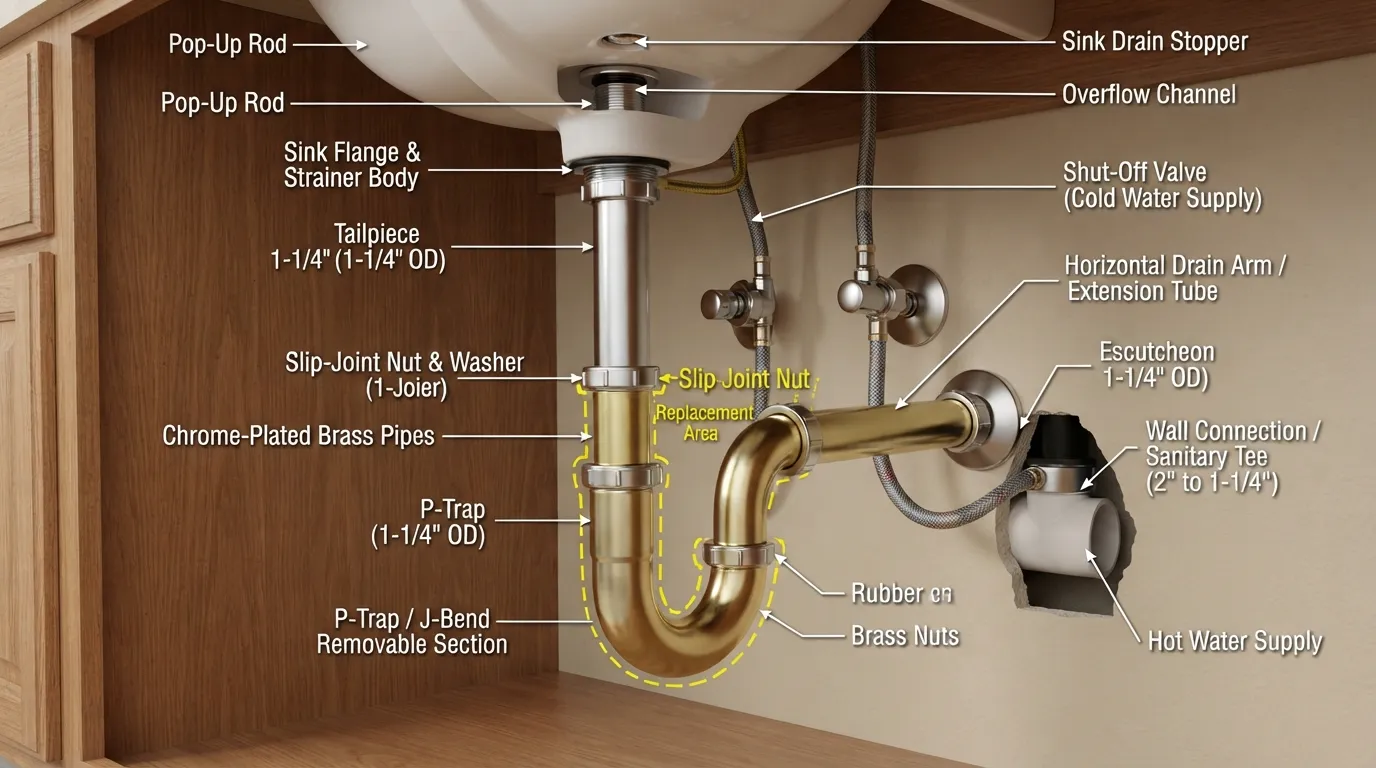
A sink pipe usually refers to the drain piping underneath a sink that carries wastewater away from the basin. The visible assembly commonly includes a tailpiece, P-trap, slip-joint connections, and a drain or trap arm leading toward the wall drain.
For sizing, 1-1/4 inches is a common bathroom sink drain size, while 1-1/2 inches is common for kitchen sinks. However, do not buy a replacement based only on the sink type. Check the existing drain assembly, connection type, dimensions, and configuration before purchasing parts.
If you searched for sink pipe because something underneath your sink is leaking, clogged, broken, or simply needs replacing, you may have noticed that several different parts are called a “sink pipe.” That can make a simple repair surprisingly confusing.
The good news is that you usually do not need to replace the entire sink. In many cases, the problem is limited to one accessible section of the sink drainage pipe, a P-trap, a washer, a slip-joint connection, or another replaceable component.
Below, I’ll show you how the pieces fit together, how bathroom and kitchen drain sizes differ, how to identify the part you need, and how to decide whether a repair is suitable for DIY work or better handled by a professional.
What Is a Sink Drain Pipe Called?
There is not always one single name for the entire pipe assembly beneath a sink. Plumbers and retailers use different names for individual components.
So if you are shopping for a bathroom sink drain pipe replacement, do not assume the item you need will simply be labeled “sink pipe.” You may actually need a tailpiece, P-trap, trap extension, tubular drain section, washer, nut, or a complete drain kit.
Sink Drain Anatomy: How the Pipes Fit Together
A typical under-sink drainage system is easier to understand when you follow the water’s path.
Sink Basin
↓
Drain / Strainer
↓
Tailpiece
↓
P-Trap
↓
Trap Arm / Drain Connection
↓
Building Drain
The tailpiece is the first visible section below the sink drain. It connects downward to the P-trap. The P-trap then connects to the pipe leading toward the wall or other drainage connection.
Once you understand this layout, it becomes much easier to determine where a leak is occurring and whether you need a complete sink drain piping replacement or only one component.
What Size Pipe Does a Sink Use?
The most common sizes you’ll encounter are 1-1/4 inches for many bathroom sink drain assemblies and 1-1/2 inches for many kitchen sink drain assemblies.
Important: “1-1/4 inch” or “1-1/2 inch” is a nominal drain size, not necessarily the outside measurement you will get by putting a tape measure across every part of the assembly. Different components and connection types can make measurements confusing. When replacing a part, compare the existing component and its connection rather than relying only on a generic size label.
Bathroom Sink Pipe vs. Kitchen Sink Pipe
Bathroom and kitchen sinks use similar basic drain principles, but their assemblies can differ in size, configuration and available space.
Bathroom Sink Pipes
A typical bathroom vanity drain uses a smaller drain size than a kitchen sink. You will commonly encounter 1-1/4-inch tubular drain components, including a tailpiece and P-trap.
Vanity cabinets can also have limited room around the plumbing, so measuring the available length and checking the position of the wall connection can matter when selecting a replacement.
Kitchen Sink Pipes
Kitchen sink drains commonly use 1-1/2-inch components. A kitchen setup may also have a more complicated configuration, particularly with multiple sink bowls or additional equipment connected to the drain system.
For that reason, a kitchen sink drain replacement should be based on the actual configuration rather than simply buying the first 1-1/2-inch pipe or P-trap you find.
What Types of Pipes Are Used for Sink Drains?
Under-sink drain assemblies can use several materials and product styles. The right choice depends on the existing installation, connection compatibility, durability requirements and local plumbing requirements.
- Tubular plastic: Common under sinks because these components are lightweight and designed for accessible connections and replacement.
- PVC or ABS drain components: These may be used in portions of a drainage system depending on the installation and local practices.
- Metal tubular components: Chrome-plated or other metal drain parts can be found in some installations, particularly older or decorative assemblies.
- Flexible drain products: Flexible sections and kits are available, but flexibility does not automatically make a product the best choice for every sink configuration.
- Complete drain kits: Kits can package several compatible tubular components together, which can simplify replacement when multiple accessible parts need attention.
Should You Use a Flexible Sink Drain Pipe?
Flexible drain products can make certain awkward connections easier, but you should not choose one simply because it is easier to bend. The drain still needs a proper, reliable configuration and adequate flow.
If your existing setup can be repaired correctly with properly sized tubular components, replacing a damaged section with a compatible part may be preferable to changing the entire configuration unnecessarily.
How to Identify the Sink Pipe You Need
Before buying a bathroom sink drain pipe replacement or kitchen sink drain parts, identify the existing assembly first. This can save you from buying a component that has the right name but the wrong dimensions or connection.
- Identify the sink type. Determine whether you have a bathroom vanity sink, kitchen sink, utility sink, or another configuration.
- Find the leaking or damaged section. Look at the tailpiece, P-trap, trap arm, slip-joint connections and the area where the drain enters the wall.
- Check the connection style. Determine how the existing parts connect and whether the connection uses slip-joint nuts and washers or another fitting arrangement.
- Check the size. Identify the nominal drain size rather than assuming every visible section has the same outside dimension.
- Measure the length you need. A replacement pipe that is the correct diameter can still be too short or too long for the existing configuration.
- Compare the replacement part with the old part. If possible, take the old component with you when shopping for a replacement.
- Inspect the wall connection. If the problem appears to extend into the wall or the existing connection is damaged, the repair may be more involved than replacing an accessible tubular section.
Before You Buy: Sink Pipe Checklist
- Bathroom or kitchen sink identified
- Damaged component identified
- Existing drain size checked
- Connection type checked
- Replacement length checked
- P-trap configuration checked
- Wall connection inspected
- Replacement part compared with the existing component
Which Sink Pipe Part Should You Replace?
A common mistake is to assume that a leak means the entire sink drain needs to be replaced. Start by identifying the actual failure point.
Can You Replace a Sink Drain Without Replacing the Whole Sink?
Yes. In many cases, the drain piping can be repaired or replaced without replacing the sink itself.
The sink basin and the drainage assembly are separate components. If the sink is structurally sound but a tailpiece, P-trap, tubular section, washer, or other accessible drain component has failed, you may only need to replace the affected part.
A broader repair may be appropriate when several components are deteriorated, the drain connection is damaged, the existing configuration is incorrect, or the problem extends beyond the accessible piping beneath the sink.
Do not replace the sink just because the drain leaks. First identify whether the failure is in the drain assembly or the sink itself. A leaking drain pipe is often a plumbing-component problem rather than a sink-basin problem.
How to Replace a Sink Drain Pipe
The exact process depends on the type of sink, drain assembly and replacement part, but an accessible tubular drain repair generally follows this sequence.
- Clear the cabinet area. Remove stored items so you can see the complete drain assembly.
- Place a container underneath the trap. Water can remain inside the P-trap even when the sink is not running.
- Identify the section being replaced. Do not remove unrelated components unless necessary.
- Disconnect the appropriate connection. Many accessible tubular assemblies use removable slip-joint connections, but do not force a connection that appears fixed or damaged.
- Compare the old and new parts. Confirm size, length, configuration and connection style before installing the replacement.
- Install the replacement component. Keep the assembly aligned and use the appropriate washer and connection components.
- Reconnect the drain assembly. Avoid forcing pipes into a position that creates unnecessary stress on the connections.
- Run water and inspect every connection. Check for active leakage around the replaced component and nearby joints.
If the drain does not align naturally, the wall connection is damaged, or the repair requires cutting or modifying concealed plumbing, stop rather than forcing the assembly into place.
Common Sink Pipe Problems
Leaking Sink Pipe
A leak can originate at a joint, washer, cracked pipe, P-trap or connection near the wall. Water often travels along the outside of a pipe, so the wettest point is not always the exact source.
Clogged Sink Drain
A slow or clogged sink does not automatically mean the drain pipe needs replacement. Debris can collect in the trap or elsewhere in the drain system. If repeated clearing does not solve the problem, the blockage may be farther downstream.
Cracked or Corroded Pipe
A visibly cracked, severely corroded or deteriorated component is generally a stronger replacement candidate than a pipe that simply has a loose connection.
Recurring Leaks After Replacement
If a new component still leaks, do not keep tightening connections indefinitely. Misalignment, the wrong washer, an incompatible component, damaged threads, or a problem elsewhere in the assembly may be responsible.
Repair or Replace the Sink Drain?
Can You Replace a Sink Pipe Yourself?
Some accessible sink drain repairs are suitable for a confident DIY homeowner, particularly when the problem is limited to a clearly identifiable tubular component with a compatible replacement.
The decision changes when the plumbing is concealed, connections are damaged, the configuration does not align, or the source of the leak is uncertain.
How Much Does It Cost to Replace a Sink Drain Pipe?
The cost depends on what actually needs to be replaced. A small accessible repair can require only a replacement component, while a professional repair can cost more because of labor, access, complexity and additional parts.
For that reason, a product price you see online should not be treated as the total cost of a professional sink drain repair. A complete drain kit, for example, may contain several parts, while a simple damaged washer or extension may require only one small component.
What Can Affect the Final Cost?
- Which sink drain component has failed
- Whether one part or several parts need replacement
- Accessibility underneath the sink
- Condition of existing connections
- Whether the problem extends toward the wall
- Replacement parts and materials required
- Professional labor when a plumber is needed
Common Sink Pipe Replacement Mistakes
Most replacement problems happen because the new component is selected before the existing assembly is properly identified.
- Buying by sink type alone: A bathroom sink commonly uses 1-1/4-inch drainage, but you should still verify the existing assembly.
- Confusing nominal size with measured outside diameter: Drain sizing terminology can be different from what a tape measure shows.
- Replacing the whole assembly unnecessarily: A single damaged section may be the only part that needs attention.
- Ignoring the P-trap configuration: The replacement needs to work with the existing layout.
- Forcing misaligned pipes together: A connection should not be stressed simply to make an incompatible component fit.
- Overlooking the wall connection: A leak may not be limited to the visible section beneath the sink.
- Continuing to tighten a leaking joint: Excessive tightening is not a substitute for correct alignment and sealing components.
- Assuming flexible is always better: A flexible product can be convenient, but the final drainage configuration still matters.
How Often Do Sink Drain Pipes Need to Be Replaced?
There is no universal replacement interval that applies to every sink drain pipe. A better approach is to judge the condition of the components.
Replace or repair a drain component when you find problems such as cracking, significant corrosion or deterioration, persistent leakage, damaged connections, or a component that can no longer maintain a reliable seal.
A properly functioning drain does not necessarily need replacement simply because it has reached a particular age.
When Should You Call a Plumber for a Sink Drain?
A professional can be especially useful when you cannot confidently identify the source of the problem or when the repair goes beyond an accessible under-sink component.
Professional Help Makes Sense When:
- The leak appears to come from the wall or concealed plumbing.
- You cannot determine which component is causing the leak.
- The existing drain connection is damaged or badly deteriorated.
- The replacement parts do not align with the existing configuration.
- A repair continues to leak after the component has been replaced.
- You suspect a larger drainage problem rather than a single sink pipe issue.
If you need help beyond a simple accessible drain repair, you can learn more about our professional plumbing services and determine whether your sink problem needs a broader plumbing solution.
Sink Pipe Replacement: A Simple Decision Guide
Start here:
- Is the sink itself damaged? If not, focus on the drain assembly.
- Can you see exactly where the leak starts? If yes, inspect that component first.
- Is the damaged part accessible? If yes, a targeted replacement may be possible.
- Do you know the size and connection type? If not, identify them before buying a replacement.
- Does the new part align correctly? Never force an incompatible configuration.
- Is the problem inside the wall or still unresolved? Consider professional plumbing help.
Frequently Asked Questions About Sink Pipes
Related Sink Pipe Resources
If you are comparing replacement parts before starting a repair, these types of resources can help you see the range of sink drain components, P-traps, extensions and complete kits available from major retailers and plumbing suppliers.
Lowe’s Under-Sink Plumbing
Sink Drain Pipe Parts
Kitchen Sink Pipe Options
Sink Drain Pipe Videos
Visual demonstrations can make the under-sink drain assembly easier to understand, especially if you are trying to identify the P-trap, connections or replacement process.
Need Help With a Sink Drain Problem?
If your sink pipe is leaking, repeatedly clogging, damaged near the wall, or you are unsure which component needs replacement, getting the problem properly identified can prevent an unnecessary repair.
You can also visit our Miami plumbing resource or explore our plumbing services for help with a broader drain or plumbing issue.
Key takeaway: A sink pipe is not always one single component. Identify the tailpiece, P-trap, drain connection and damaged section first, then match the replacement to the existing size and configuration. For many sinks, 1-1/4 inches is common for bathroom drains and 1-1/2 inches is common for kitchen drains, but the existing assembly should always be checked before buying replacement parts.