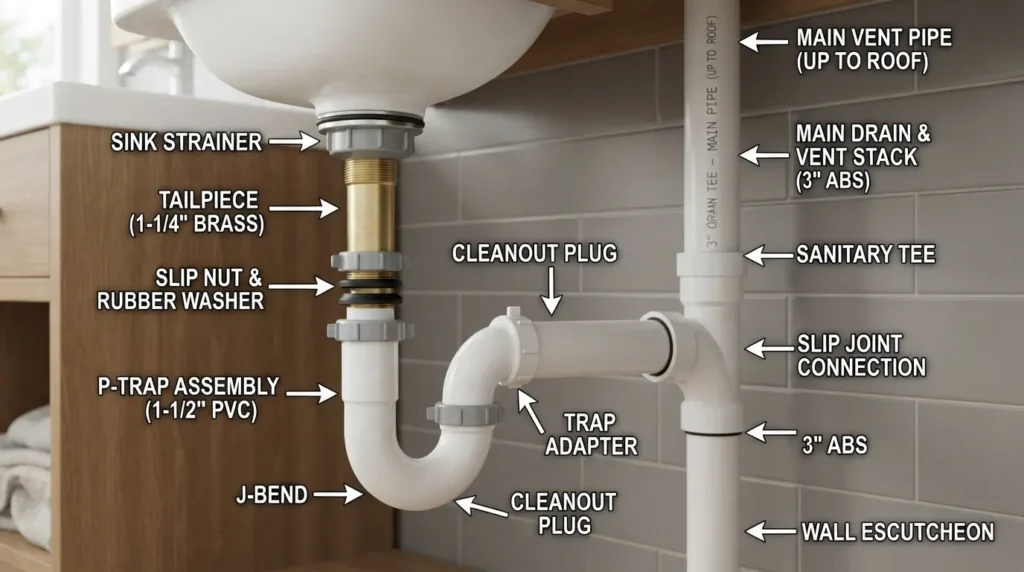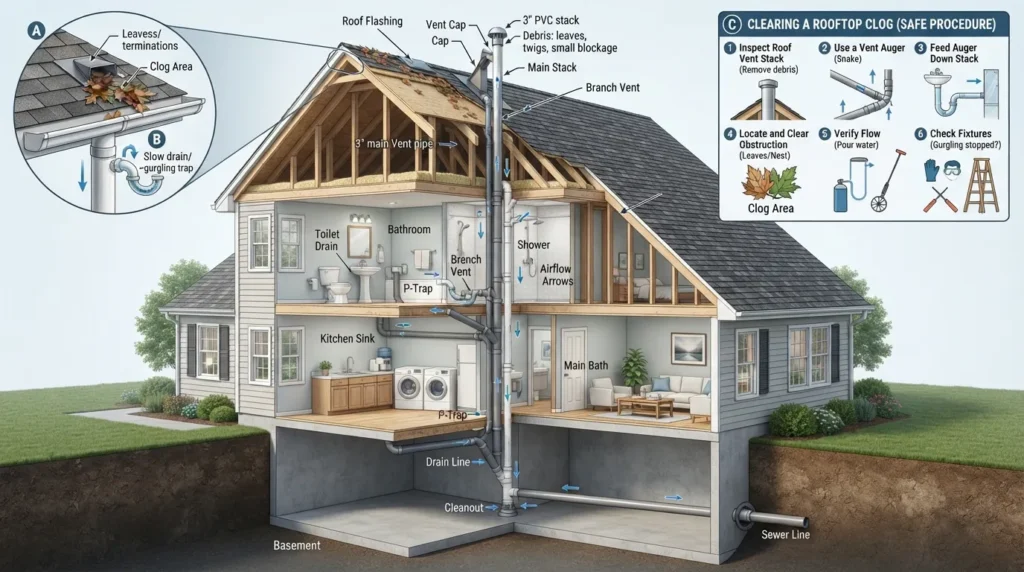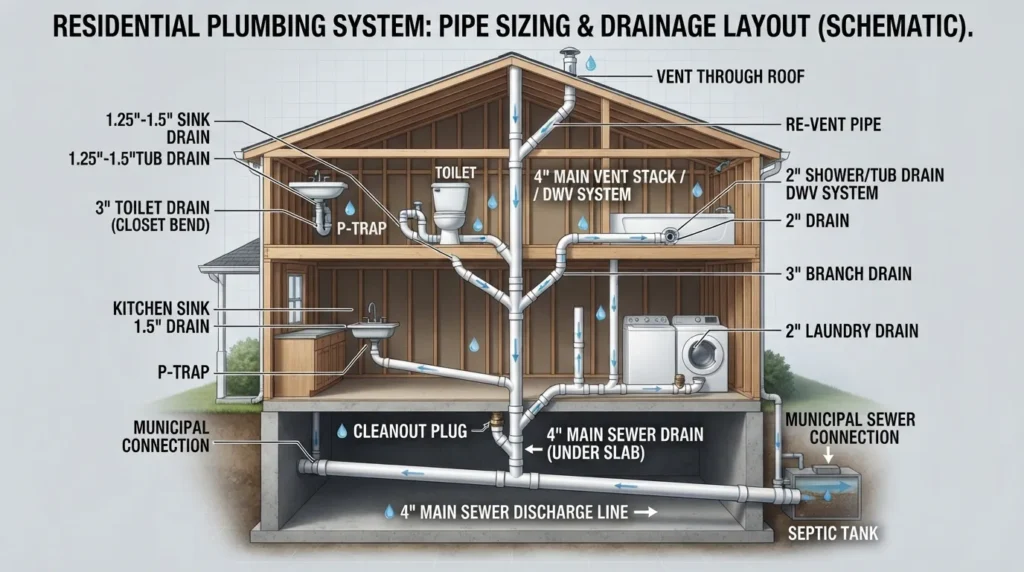
If you are trying to understand a sewer drain pipe, the most important thing to know is that not every drain pipe does the same job. The smaller drain lines inside your home collect wastewater from sinks, toilets, showers, tubs, and appliances. Those lines eventually join a larger building drain, which then connects to the private sewer line that carries wastewater away from the house toward a municipal sewer system or another approved wastewater system.
A sewer drain pipe is part of the wastewater pathway that moves used water and sewage away from your home. The right pipe depends on where it is being used, its required diameter, the plumbing code, the connection type, and whether the pipe is carrying sanitary wastewater, stormwater, or groundwater.
This guide will help you understand what a residential sewer system looks like, how drain pipes and sewer lines differ, which materials and sizes are commonly encountered, what fittings and cleanouts do, how to recognize trouble, and how to decide whether a line needs cleaning, repair, or replacement.
How a Home Sewer Drain System Works
The easiest way to understand a house sewer line is to follow the wastewater from the fixture where it starts.
Typical residential wastewater path
The exact layout varies from house to house, but the basic concept is the same. Wastewater moves from small fixture drains into progressively larger pipes until it leaves the building.
If you want a broader explanation of the pipes that move water into and out of a house, our guide to how a home drainage system works explains the overall layout in more detail.
Sewer Pipe vs. Drain Pipe: What Is the Difference?
People often use the words drain and sewer interchangeably, but they can refer to different sections of the plumbing system.
Terminology can vary by contractor, municipality, plumbing code, and product manufacturer. That is why it is usually more useful to identify where the pipe is located and what it carries rather than relying on the label alone.
What Does a Residential Sewer Line Look Like?
A home sewer line usually looks much less dramatic than the large sewer tunnels people sometimes imagine. At the residential level, you are typically dealing with a buried pipe that runs from the building toward a public sewer connection.
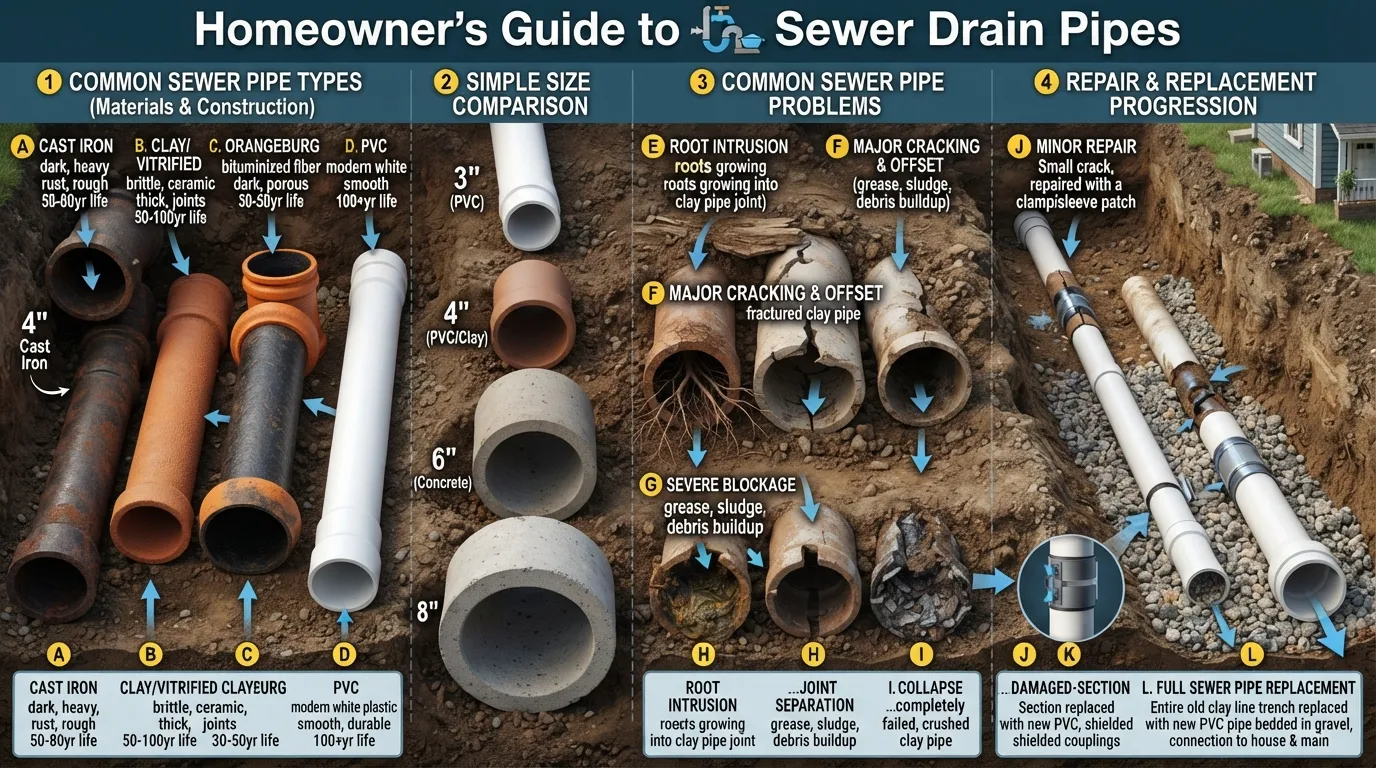
Depending on the age and construction of the property, you may encounter pipe made from materials such as PVC, ABS, cast iron, clay, Orangeburg, or other approved piping systems. The pipe may also include fittings, joints, transitions, and one or more cleanout access points.
The municipal sewer main is a different part of the system. It generally receives wastewater from multiple properties through individual sewer laterals.
Where is the main sewer line in a house?
The main building drain usually runs below or through the lowest part of the home before exiting the structure. Outside, the building sewer or private lateral continues toward the public sewer connection.
If you cannot determine where the line runs, useful clues may include:
- An exterior sewer cleanout.
- The direction of the plumbing fixtures and main building drain.
- Property or utility records.
- A sewer camera equipped with locating equipment.
- The known location of the municipal connection.
Do not guess before digging. Buried utilities may be present near a sewer line. Any excavation should account for utility-location requirements and local rules before work begins.
Do Not Confuse Sanitary Sewer Pipe With Every Product Labeled “Sewer and Drain”
This is one of the most important distinctions for anyone shopping for pipe.
Retailers may place several products under broad categories such as sewer and drain pipe. Some products may be designed for sanitary wastewater, while others may be intended for landscape drainage, groundwater management, storm drainage, septic applications, or other uses.
A product name alone does not tell you whether it is appropriate for your house sewer connection.
Before buying sewer or drain pipe, verify:
- What the pipe will carry.
- Whether the installation is sanitary sewer, storm drainage, groundwater drainage, or another application.
- The required pipe diameter.
- The required pipe material and rating.
- The connection type and fitting compatibility.
- Whether the product is approved for the intended installation.
- Applicable local plumbing and building requirements.
Solid vs. Perforated Sewer and Drain Pipe
Solid and perforated pipes may appear next to each other in store listings, but they serve very different purposes.
For a sanitary sewer carrying household wastewater, you should never assume a perforated pipe is appropriate simply because it appears in a “sewer and drain” product category.
Common Sewer Drain Pipe Materials
There is no single pipe material that is automatically best for every property. The right choice depends on the existing system, installation conditions, local requirements, connection method, and the type of repair or replacement being performed.
PVC
PVC is widely used in modern drainage and sewer applications because it is lightweight, smooth inside, resistant to many forms of corrosion, and available in a large range of fittings and sizes.
However, you still need the correct product specification for the application. Two white or green plastic pipes that look similar may not be interchangeable.
ABS
ABS is another plastic piping material used in some drain, waste, and vent systems. Its acceptance and use vary by location, so replacement decisions should be based on the requirements that apply to the property.
Cast Iron
Cast iron has been used in plumbing systems for many years. Older houses may still contain cast-iron drain or sewer piping. When evaluating older cast iron, the condition of the pipe matters more than its age alone. Corrosion, scaling, cracking, leaking joints, or structural deterioration may affect the repair decision.
Clay or Terra-Cotta Pipe
Clay sewer pipe can still be found in older underground systems. Individual sections are joined together, and problems may develop around joints or damaged sections. Tree roots may also exploit openings where moisture escapes.
Orangeburg
Orangeburg is an older pipe material that may be encountered in some existing sewer systems. When found in a failing line, its physical condition should be evaluated carefully rather than assuming that clearing a blockage alone will solve the underlying problem.
HDPE and Other Modern Piping Systems
Other materials, including HDPE, may be used in certain sewer and trenchless applications. Suitability depends on the project design, joining method, code requirements, and the type of installation.
What Size Sewer Drain Pipe Do You Need?
Search results often show 3-inch, 4-inch, and 6-inch sewer and drain pipe, but size should not be selected simply by choosing the most common item on a store shelf.
Four-inch pipe is commonly encountered in residential building sewer applications, but that does not mean every sewer installation should automatically use a 4-inch pipe.
The correct diameter can depend on factors such as:
- The function of the pipe.
- The number and type of fixtures it serves.
- The existing piping system.
- The connection it must tie into.
- The required drainage capacity.
- Applicable plumbing requirements.
Should I use a 3-inch or 4-inch sewer pipe?
If you are replacing or installing a main sewer line, this should be treated as a design and code question rather than a shopping preference. Do not reduce a required pipe size simply because a smaller pipe costs less or is easier to handle.
For an existing system, a plumber can identify the current pipe diameter and determine whether the proposed repair or replacement needs to match it or meet another requirement.
Sewer Pipe Fittings You May Encounter
A sewer line is more than a straight length of pipe. Depending on the system, you may see several types of fittings and access points.
- Couplings: connect two sections of compatible pipe.
- Elbows or bends: change the direction of the piping.
- Wyes: create a smoother branch connection into a main line.
- Adapters: connect different pipe systems or fitting styles where an approved transition is needed.
- Cleanouts: provide access for inspection and clearing blockages.
- Gasketed or hub connections: allow certain sewer piping systems to join securely while accommodating the intended installation method.
Compatibility matters. Pipe diameter, material, fitting type, and connection method all need to work together.
What Is a Sewer Line Cleanout?
A sewer cleanout is an access point that allows a plumber to reach the drainage or sewer line without opening a wall or immediately excavating the yard.
Depending on the property, the cleanout may be located outside the home, near the foundation, in a yard, or at another accessible point in the drainage system.
Why a cleanout is useful
- Provides access for drain-cleaning equipment.
- Can allow a sewer camera to enter the line.
- Helps determine whether a blockage is inside or farther downstream.
- May reduce the amount of disruption required during diagnosis.
How to Tell Whether the Problem Is a Drain Clog or Main Sewer Line Problem
One slow fixture does not automatically mean the sewer line is damaged. The pattern of symptoms is often more useful than a single symptom.
If the issue appears to be a blockage rather than a structural failure, a professional drain cleaning service may be the appropriate starting point.
Common Sewer Drain Pipe Problems
Blockages
Grease, debris, paper products, foreign objects, buildup, or other material can restrict wastewater flow. A blockage may develop in a smaller drain or farther downstream in the main line.
Tree Root Intrusion
Roots may grow toward moisture and enter a sewer line through vulnerable joints, cracks, or openings. Removing roots may restore flow temporarily, but the condition of the pipe should also be considered if an opening allowed the roots to enter.
Cracked or Broken Pipe
Pipe can be damaged by soil movement, deterioration, impact, installation problems, or other conditions. The location and severity of the damage help determine whether a localized repair is practical.
Separated or Offset Joints
If pipe sections move out of alignment, wastewater may not flow as intended and debris can collect around the defect.
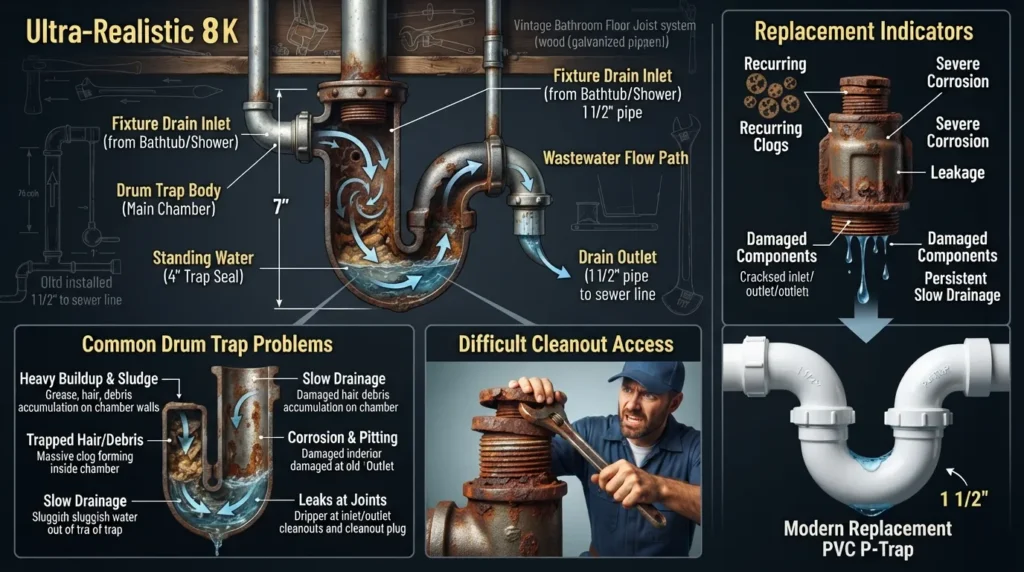
Corrosion and Internal Deterioration
Some older metallic piping can deteriorate internally. A line may still be open but have a reduced internal diameter, rough surfaces, damaged sections, or weakened walls.
Collapsed Sewer Line
A fully or partially collapsed line is a structural problem. Cleaning alone cannot restore a section of pipe that no longer provides an open pathway for wastewater.
Should You Clean, Repair, or Replace the Sewer Line?
The best decision comes from diagnosing the reason for the failure rather than choosing a service first.
Cleaning may make sense when:
- The pipe is structurally intact.
- The main problem is an obstruction or buildup.
- Normal flow can be restored without repairing the pipe itself.
Repair may make sense when:
- The defect is localized.
- Most of the remaining pipe is in usable condition.
- The damaged section can be accessed and corrected reliably.
Replacement may make sense when:
- Damage is extensive or repeated.
- The line has collapsed or deteriorated significantly.
- Multiple defects make isolated repairs impractical.
- The existing pipe condition creates an ongoing reliability problem.
A sewer camera inspection can be particularly useful when the same line keeps clogging. Instead of assuming that another cleaning will solve the problem, the camera can help reveal whether roots, damaged joints, cracks, offsets, or another structural condition is contributing to the blockage.
Can a Sewer Pipe Be Replaced Without Digging?
Sometimes. Trenchless sewer methods can reduce the amount of open excavation needed, but they are not suitable for every line.
Two terms you may hear are:
- Pipe lining: creates a new lining within an existing pipe when the condition and geometry of the line allow it.
- Pipe bursting: replaces a line by breaking or displacing the old pipe while pulling a new pipe through the existing path.
A collapsed section, severe misalignment, access limitations, connection configuration, or other site conditions may change which options are practical.
Decision rule: Do not choose trenchless or conventional excavation based only on which sounds less disruptive. Start with the actual condition, route, depth, connections, and failure mode of the sewer line.
Can You Replace a Sewer Line Yourself?
Replacing a main residential sewer line is not the same as replacing a trap under a sink. The work may involve excavation, buried utilities, pipe sizing, drainage design, connection requirements, inspections, property boundaries, and local permitting rules.
Even when a homeowner is capable of physical excavation, an incorrectly installed sewer line can create expensive drainage problems later.
For a main line repair or replacement, it is usually smarter to determine:
- Where the failure is located.
- Who is responsible for that section of pipe.
- Whether cleaning, repair, or replacement is actually necessary.
- What pipe and fittings are approved for the work.
- What local requirements apply before installation begins.
Is It Cheaper to Repair or Replace a Sewer Line?
A localized repair normally involves less work than replacing an entire sewer line, but the cheapest immediate option is not always the lowest-cost long-term decision.
For example, repairing one isolated defect can make sense when the surrounding pipe is in good condition. Repeatedly repairing different sections of a badly deteriorated line may become inefficient.
Instead of comparing repair and replacement by headline price alone, compare:
- The number of known defects.
- The overall pipe condition.
- The length and depth of the affected section.
- Accessibility.
- Surface restoration requirements.
- Whether trenchless work is feasible.
- Whether another failure is likely nearby.
How Much Does Sewer Line Repair Cost?
There is no single responsible price that applies to every sewer repair. A simple accessible spot repair and a deep line replacement under finished surfaces are fundamentally different jobs.
Important cost factors include:
- Length of damaged pipe.
- Depth of the sewer line.
- Pipe material and diameter.
- Type of failure.
- Excavation requirements.
- Driveways, patios, landscaping, or other surfaces above the line.
- Accessibility for equipment.
- Repair versus full replacement.
- Trenchless versus open-trench work.
- Permitting, inspection, and restoration requirements where applicable.
A useful estimate should explain what work is included, not just give you one number.
Will Homeowners Insurance Pay for Sewer Line Replacement?
Coverage depends on the policy, the cause of the damage, exclusions, and whether any optional service-line or sewer-related coverage applies.
Do not assume that normal wear, aging pipe, root intrusion, collapse, or every underground sewer failure will automatically be covered. If insurance may be involved, review your policy and ask the carrier how the specific cause and affected portion of pipe are treated.
Helpful tip: If a claim is being considered, document the problem before major work begins when it is safe and practical to do so. Camera footage, photographs, and a written diagnosis may help explain what failed.
How Often Do Residential Sewer Lines Need to Be Replaced?
There is no universal replacement schedule that applies to every residential sewer pipe.
A sewer line should be evaluated based on its material, condition, installation, symptoms, previous repairs, surrounding soil, root exposure, and actual structural integrity rather than replacing it simply because it has reached a certain age.
A properly functioning older pipe does not necessarily need replacement just because it is old. Likewise, a newer line with installation or structural problems may need attention much sooner.
A Practical Sewer Pipe Decision Guide
If you are trying to identify what to do next, use this sequence:
- Identify the symptom. Is one fixture affected or several?
- Locate the affected part of the system. Fixture drain, branch drain, building drain, or sewer lateral?
- Check for cleanout access. This can make diagnosis easier.
- Determine whether the problem is a blockage or structural damage.
- Use camera inspection when recurring problems suggest a deeper issue.
- Compare cleaning, localized repair, trenchless options, and replacement based on the diagnosis.
- Verify pipe specifications and local requirements before buying material or excavating.
Miami Homeowners: Check These Things Before Sewer Work Begins
If your property is in Miami or Miami-Dade County, local conditions and utility responsibility add another layer to the decision.
Before replacing or excavating a sewer line, it is useful to verify:
- Whether the property is connected to public sewer or another wastewater system.
- Where the private sewer lateral runs.
- Whether the problem appears to be on the property side or public-system side.
- What current permitting or inspection requirements apply to the planned work.
- Whether buried utilities need to be located before excavation.
Miami-Dade provides an online Water and Sewer property lookup resource that may help homeowners verify utility information for a property.
If you are unsure whether you are dealing with a household drain, a main sewer restriction, or another plumbing issue, our Miami plumbing team can help you determine the most sensible next step.
What to Look for When Buying Sewer Drain Pipe
If your search started because you are shopping for pipe, fittings, or replacement material, do not make the decision by price and diameter alone.
1. Application
Confirm whether the pipe is intended for sanitary sewer, DWV, storm drainage, landscape drainage, septic use, or another application.
2. Diameter
Match the required system size instead of assuming the most common store size is correct.
3. Pipe specification
Look beyond the material name and verify the actual product standard, wall type, and intended installation.
4. Fitting compatibility
Couplings, wyes, bends, adapters, and cleanouts need to be compatible with the pipe system.
You may see product terms such as SDR 35, D2729, DWV, bell end, hub, gasketed connection, solid wall, perforated, coupling, wye, cleanout, and sewer fitting. These terms describe different product characteristics and should not be treated as interchangeable.
Understanding Sewer Pipe Materials
If you prefer a visual explanation, the following video from the research set can help you see how common sewer pipe materials differ.
Sewer Line Installation
This video provides additional visual context for how a sewer line is routed and installed.
Frequently Asked Questions About Sewer Drain Pipes
What is the difference between a sewer pipe and a drain pipe?
A drain pipe usually carries wastewater from one or more fixtures within the building. The building sewer or sewer lateral carries the combined wastewater away from the structure toward the public sewer connection. Terminology can vary, so location and function are the best ways to identify the pipe.
Can I buy sewer pipe from Home Depot or Lowe’s?
Yes, major home-improvement retailers sell sewer and drain pipe, fittings, couplings, and related products. The important step is verifying that the exact product is approved and suitable for your intended application rather than buying by size or category name alone.
What type of pipe is best for sewer lines?
There is no universal best material for every sewer line. PVC is widely used in modern systems, while existing properties may contain cast iron, clay, ABS, Orangeburg, or other materials. The right choice depends on the existing system, installation conditions, connection method, and applicable requirements.
Is 4-inch sewer pipe standard for a house?
Four-inch pipe is commonly encountered in residential sewer applications, but the required diameter should be confirmed for the actual installation. Fixture load, existing piping, system design, and local requirements can affect sizing.
Can I replace a sewer line myself?
A main sewer replacement can involve excavation, buried utilities, drainage design, pipe connections, permits, inspections, and code requirements. For most homeowners, this is a project that should be evaluated and completed with professional guidance.
Can sewer pipe be replaced without digging up the whole yard?
In some cases, yes. Pipe lining or pipe bursting may reduce excavation, but the existing pipe condition, alignment, access, connections, and failure type determine whether a trenchless method is practical.
How do I know if my main sewer line is clogged?
When several fixtures begin draining poorly or backing up around the same time, the restriction may be farther downstream in the main drainage system. A professional diagnosis can help distinguish a local drain clog from a main sewer problem.
How often should a residential sewer line be replaced?
There is no fixed replacement interval for every property. Sewer lines should be evaluated according to their material, condition, symptoms, previous repairs, and structural integrity.
When It Is Time to Call a Plumber
Some sewer problems begin as a simple clog. Others are caused by damaged, deteriorated, or misaligned pipe. The fastest way to make a good decision is to identify which type of problem you actually have before paying for the wrong solution.
You should consider professional help when:
- Several fixtures are backing up at the same time.
- The same main line keeps clogging after being cleared.
- Sewage is backing up into the home.
- You suspect roots or structural pipe damage.
- A camera inspection is needed to locate the problem.
- You are considering excavation or sewer replacement.
- You are unsure which sewer pipe or fittings are appropriate.
Need Help Figuring Out What Your Sewer Line Needs?
Before replacing pipe or repeatedly clearing the same blockage, identify the cause. A proper diagnosis can help you determine whether the problem calls for cleaning, a localized repair, or a larger sewer-line solution.
Related Sewer Pipe and Product Resources
If you are comparing pipe materials, sizes, fittings, or product categories, the following external resources can help you see what is currently available. Product availability and specifications can change, so always confirm that a specific item is appropriate for the intended installation before purchasing it.
- Home Depot sewer and drain pipe products
- Lowe’s sewage pipe and fittings
- AC&B plastic sewer pipe products
- Reinders PVC sewer and drainage pipe information
- John’s Sewer guide to residential sewer lines
- Arrow Sewer guide to sewer pipe vs. drain pipe
Final Takeaway
A sewer drain pipe should not be chosen, diagnosed, or replaced based on one keyword, one store listing, or one symptom. First determine which part of the drainage system you are dealing with. Then identify what the pipe carries, its size and material, whether it is blocked or structurally damaged, and what local requirements apply.
If only one fixture is affected, the problem may be local. If several fixtures back up together, the main drainage or sewer line deserves closer attention. If a pipe repeatedly clogs, a camera inspection may reveal whether you are dealing with roots, damaged joints, cracks, deterioration, or another structural condition.
The goal is not simply to get wastewater moving again today. It is to understand why the problem happened and choose the least disruptive solution that actually addresses the cause.