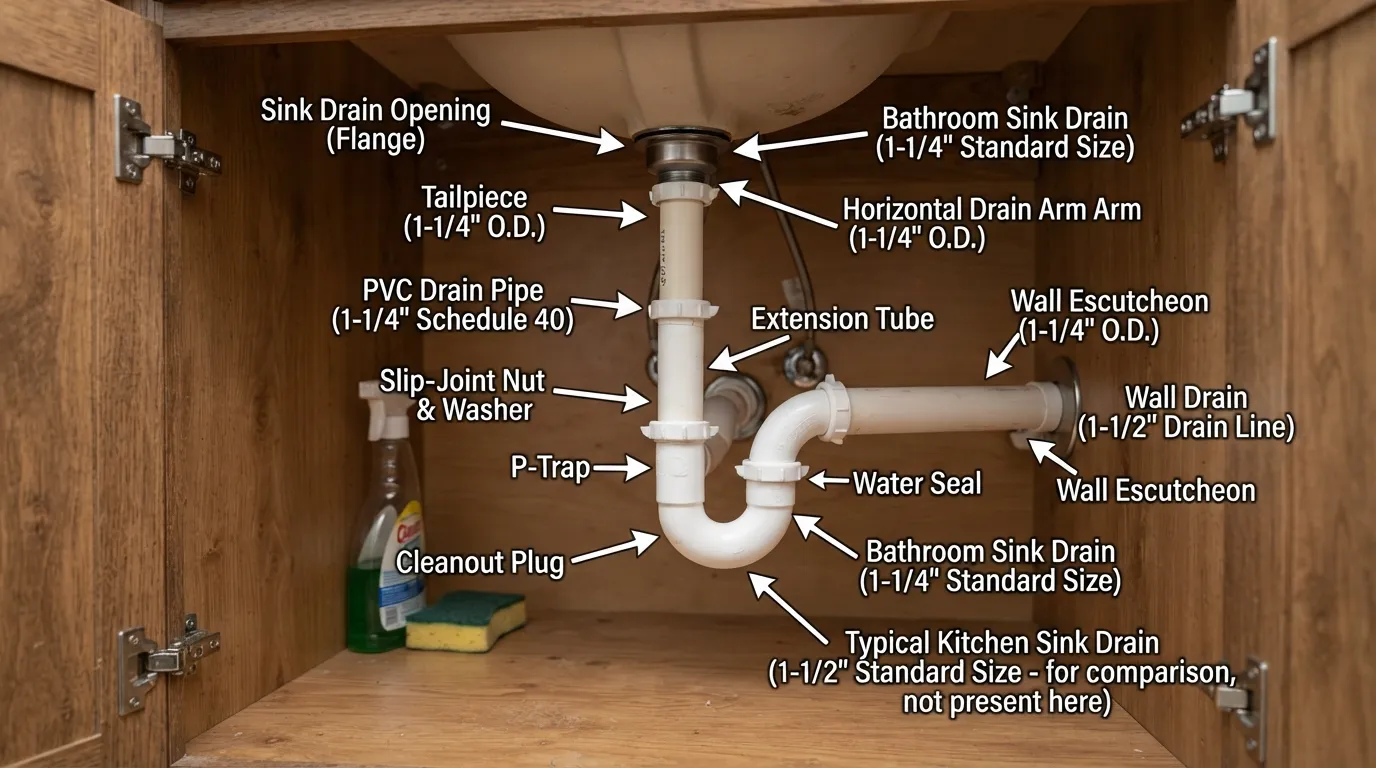
Need to replace or understand the PVC pipe under your sink? This guide explains common sink drain sizes, P-traps, tailpieces, fittings, PVC versus tubular drain parts, kitchen and bathroom configurations, and what to check before you buy replacement plumbing.
What PVC Pipe Is Used for a Sink Drain?
A sink drain commonly uses 1-1/4-inch or 1-1/2-inch drain components, depending on the sink and existing plumbing configuration. Bathroom sinks commonly use 1-1/4-inch drain connections, while kitchen sinks commonly use 1-1/2-inch connections. However, you should not choose a replacement based on sink type alone.
The safest approach is to identify the existing tailpiece, P-trap, drain arm, wall connection, and fitting sizes before buying replacement parts. Under-sink plumbing may also use tubular plastic components rather than rigid PVC pipe, so a part being labeled “PVC” does not automatically mean it will connect directly to every sink drain.
If you are searching for a sink PVC pipe, you may actually be looking for one of several different components under the sink. The visible assembly can include a tailpiece, P-trap, extension tube, drain arm, slip-joint nuts, washers, adapters, and other connectors.
That is why replacing one piece can be more complicated than simply buying a length of PVC pipe. You need the right size, connection type, configuration, and fitting for the existing drain.
This guide is designed to help you identify what you have, choose compatible parts, replace under-sink plumbing when appropriate, and avoid the common mistakes that cause leaks or poor drainage.
What Is the PVC Pipe Under a Sink Called?
There is not always one name for the pipe under a sink. Different sections of the drain assembly have different jobs.
Tailpiece
The mostly straight section that drops from the sink drain or basket strainer toward the trap.
P-Trap
The curved section that retains water and helps prevent sewer gases from entering the room through the drain.
Extension Tube
A straight section used when the existing tailpiece and trap need additional reach.
Drain Arm
The section extending from the trap toward the wall drain connection.
The easiest way to understand the layout is to follow the water path:
On a kitchen sink, the configuration can become more involved if you have two basins, a garbage disposal, or a dishwasher drain connection. The exact arrangement therefore matters when replacing parts.
What Size PVC Pipe Should You Use for a Sink Drain?
The two sizes you are most likely to encounter in common residential sink drain assemblies are 1-1/4 inch and 1-1/2 inch.
Important: Nominal Size Is Not the Same as a Quick Tape-Measure Answer
Sink drain components are identified by plumbing sizes and connection standards, so the outside measurement of a component may not match the number printed on the package. If you are replacing an existing part, identify the connection and compare the replacement specifications rather than relying only on an outside-diameter measurement.
Kitchen Sink PVC Pipe vs. Bathroom Sink PVC Pipe
Kitchen and bathroom sinks use similar basic drain principles, but their under-sink configurations can be different.
These are common configurations, not a substitute for checking your actual plumbing. If you are replacing an existing drain, matching the current connections is usually more reliable than choosing a part based only on whether the sink is in a kitchen or bathroom.
PVC vs. Tubular Sink Drain Pipe: What Is the Difference?
One of the biggest sources of confusion is the assumption that every plastic pipe under a sink is simply a piece of rigid PVC pipe.
In many under-sink assemblies, you will encounter tubular drain components connected with slip-joint nuts and washers. These parts are designed to be assembled and serviced relatively easily.
Rigid drain piping can use different connection methods and may be connected to the building’s drainage system differently. Because of that, you should not assume that a random piece of rigid PVC will directly replace a tubular sink drain component.
Why This Matters When You Buy a Replacement
- Two components can have similar-looking diameters but different connection types.
- A tubular connection may require a slip-joint nut and the correct washer.
- A rigid-pipe section may require a different fitting or transition arrangement.
- The wall connection may not be identical to the sink-side connection.
- A complete replacement kit may contain parts you do not need—or may still require a correctly sized adapter.
Before buying, identify the connection at both ends of the part you are replacing. That single step can prevent many compatibility problems.
Sink PVC Drain Parts and Fittings You May Need
A typical under-sink drain assembly can contain several parts. Knowing what each one does makes replacement much easier.
How to Choose the Right Sink PVC Pipe
Instead of starting with a product listing, start with your existing plumbing. Use this checklist before you buy anything.
7-Point Sink Drain Compatibility Checklist
- Identify the sink: Is it a bathroom sink, single-basin kitchen sink, or double-basin kitchen sink?
- Identify the part: Are you replacing the tailpiece, P-trap, extension tube, drain arm, washer, nut, or another connector?
- Check the existing size: Determine whether the relevant drain components are commonly sized at 1-1/4 inch, 1-1/2 inch, or another configuration.
- Inspect the connection type: Determine whether the part uses a slip-joint or another connection arrangement.
- Check the wall connection: The sink-side component may fit perfectly while the opposite end does not match the existing drain connection.
- Check available space: Make sure the replacement components can fit inside the cabinet without forcing the pipes into an awkward position.
- Check the complete configuration: For kitchen sinks, account for multiple basins, a garbage disposal, dishwasher connections, and the existing trap arrangement where applicable.
This approach is much safer than searching for “1-1/2 PVC pipe” and choosing the first product that looks similar to your existing plumbing.
How to Replace Under-Sink Plumbing
If you are replacing a leaking or damaged sink drain component, take your time during removal and identify every connection before installing the new parts.
1. Photograph the Existing Assembly
Before taking anything apart, take a clear photo of the entire under-sink layout. Include the sink drain, trap, horizontal drain arm and wall connection. This gives you a reference if you need to recreate the original arrangement.
2. Identify the Part You Actually Need
Do not automatically replace the entire assembly. First determine whether the problem is a washer, nut, tailpiece, P-trap, extension, drain arm, or another component.
3. Match the Size and Connection
Compare the replacement part with the existing component. Check both ends, not just the diameter of the pipe. A correct-looking sink-side connection does not guarantee that the wall-side connection will fit.
4. Assemble the Components Without Forcing Them
For slip-joint assemblies, make sure the nut and washer are positioned correctly and the pipe is seated properly. The components should align naturally rather than being pulled into position by excessive tightening.
5. Check the Drain Arm Alignment
The horizontal section leading toward the wall should be arranged so water can drain properly. Avoid configurations that create unnecessary low spots, sharp misalignment, or strain on the connections.
6. Tighten Carefully
Slip-joint connections are generally designed to seal through the washer and compression of the connection. Excessive force can damage components or create alignment problems, so do not treat the nut like a connection that needs to be tightened as hard as possible.
7. Test for Leaks
Run water through the sink and inspect each connection. Check the underside of the trap, tailpiece connection, drain arm and wall-side connection. If a leak appears, identify the exact joint before disassembling everything again.
Do Not Force a Mismatched Connection
If two parts do not naturally match, stop and identify the correct fitting or transition. Forcing components together can damage threads, distort washers, create leaks, or leave the drain improperly aligned.
Why Does My New Sink PVC Drain Leak?
A new drain assembly can leak even when the pipe itself is not damaged. The problem is often at a connection.
Check the Washer
A slip-joint washer must be the correct type and properly positioned. A damaged, missing, incorrectly positioned, or mismatched washer can prevent the joint from sealing.
Check the Nut and Threads
Make sure the nut is engaging the threads correctly. Cross-threading can prevent proper compression and may damage the connection.
Check Alignment
If the pipes are under stress because they are being forced into an awkward position, the joint may not seal correctly. Reposition the components so they line up naturally.
Check for the Wrong Fitting
A part can appear close enough to fit while still being incompatible. Verify the size and connection type at both ends.
Check for Overtightening
Tighter is not always better. Excessive tightening can distort plastic components or washers and make the connection harder to align correctly.
Should You Replace One Sink Pipe or the Whole Under-Sink Assembly?
The right choice depends on the condition of the existing plumbing and whether the remaining components are compatible with the replacement.
Replace the Individual Part
- One washer is damaged.
- One slip-joint nut is damaged.
- A single extension tube is cracked.
- The P-trap is leaking but the surrounding components are compatible.
- The remaining assembly is in good condition.
Consider a Larger Replacement
- Several components are damaged.
- The assembly contains mismatched parts.
- Repeated leaks occur at multiple joints.
- The existing configuration is badly aligned.
- Replacement parts cannot be matched reliably to the existing setup.
If you are unsure which components are actually causing the problem, it may be more practical to have the entire under-sink arrangement assessed rather than repeatedly replacing individual parts.
What About a Double Kitchen Sink?
A double-basin kitchen sink can require a different under-sink arrangement from a single-basin sink because both drains need to connect into the drainage system.
Before replacing parts, look at the complete configuration rather than focusing on one visible pipe. The arrangement may include two drain outlets, connecting drain sections, a shared trap configuration, and additional connections depending on the sink setup and appliances.
If a garbage disposal or dishwasher drain connection is present, take those connections into account before selecting replacement parts.
Can You Use Any PVC Pipe for a Sink Drain?
No. You should not assume that any PVC pipe will work simply because it is plastic and has a similar diameter.
A sink drain is a system of components. The replacement must match the relevant size, connection type, configuration, and intended drainage application.
This is particularly important when replacing tubular components with rigid piping or connecting new components to an existing wall drain. If the two systems do not match directly, the correct transition fitting or configuration needs to be determined rather than forcing the parts together.
Common Sink PVC Pipe Mistakes to Avoid
- Buying by keyword alone: Searching for “1-1/2 PVC pipe” does not tell you which sink drain component you actually need.
- Assuming kitchen always means 1-1/2 inch: Common sizing is useful as a starting point, but verify your actual configuration.
- Ignoring the wall connection: The sink-side fitting may match while the wall-side connection does not.
- Confusing rigid PVC with tubular drain parts: Similar materials or appearance do not guarantee interchangeability.
- Reusing a damaged washer: A small sealing component can be the reason a newly installed drain leaks.
- Forcing misaligned pipes: A drain assembly should not depend on excessive pressure to stay connected.
- Overtightening slip joints: Excessive force can damage plastic components or washers.
- Replacing everything without diagnosing the problem: Sometimes a single washer, nut, trap, or extension is the actual problem.
Sink PVC Pipe Decision Guide
Start With Your Problem
My sink drain is leaking → Identify the leaking joint → Check the washer, nut, alignment and fitting → Replace the failed component if the rest is compatible.
I am replacing the P-trap → Identify the trap size and connection type → Check the tailpiece and wall-side connection → Choose a compatible trap.
I am replacing the entire under-sink drain → Photograph the existing layout → Identify every connection → Measure/verify sizes → Select a compatible assembly.
I am installing a new sink → Identify the sink configuration first → Confirm the drain outlet and existing wall connection → Build the drain assembly around those connections.
Frequently Asked Questions About Sink PVC Pipe
What is the PVC pipe under a sink called?
The visible drain assembly may include a tailpiece, P-trap, extension tube, drain arm, and other connectors. The curved section is generally the P-trap, while the straight section directly below the sink drain is the tailpiece.
What size PVC pipe should I use for a sink drain?
Common residential sink drain sizes include 1-1/4 inch and 1-1/2 inch. Bathroom sinks commonly use 1-1/4 inch, while kitchen sinks commonly use 1-1/2 inch, but you should verify the actual drain and connection sizes before buying replacement parts.
What type of pipe is commonly used for sink drains?
Sink drains can use tubular plastic components as well as other drainage piping depending on the installation. Do not assume that every plastic component under a sink is interchangeable with rigid PVC.
What PVC pipe fittings are available for sinks?
Common under-sink components include P-traps, tailpieces, extension tubes, drain arms, slip-joint nuts, slip-joint washers, connectors and adapters. The exact parts needed depend on the existing sink and drain configuration.
What is the best material for a kitchen sink drain pipe?
There is no single material that is automatically best for every kitchen sink. The correct choice depends on the existing drainage system, connection type, local requirements, sink configuration and compatibility with the surrounding components.
How do I choose the right sink drain pipe?
Identify the sink type, component being replaced, size, connection type, wall connection, available cabinet space and overall configuration. For a kitchen sink, also account for multiple basins and appliance connections where applicable.
Can I replace only the P-trap?
Often, yes, if the surrounding tailpiece, drain arm and wall connection are in suitable condition and the replacement trap matches the existing connections. If several components are damaged or mismatched, a larger replacement may make more sense.
Why does my sink drain leak after I replace the pipe?
Common causes include an incorrectly positioned washer, damaged washer, cross-threaded nut, incorrect fitting, poor alignment or excessive tightening. Check the exact leaking joint rather than assuming the pipe itself is defective.
What should I check before buying an under-sink connector?
Check the connector’s size, connection type, the part it needs to attach to, and the opposite connection. Also verify whether the existing assembly uses tubular components, rigid drain piping, or a transition between systems.
Key Takeaways
- A sink drain commonly uses 1-1/4-inch or 1-1/2-inch components, depending on the installation.
- Bathroom sinks commonly use 1-1/4-inch drain connections, while kitchen sinks commonly use 1-1/2-inch connections.
- The pipe under a sink may actually be a combination of a tailpiece, P-trap, extension tube, drain arm and connectors.
- Tubular drain components should not automatically be treated as interchangeable with rigid PVC pipe.
- Always check both the sink-side and wall-side connections before purchasing replacement parts.
- If a new drain leaks, inspect the washer, nut, threads, alignment and fitting before replacing additional components.
- For complicated or repeatedly leaking configurations, professional plumbing help can prevent repeated trial-and-error repairs.
Need Help With an Under-Sink Plumbing Problem?
If your sink drain has a persistent leak, mismatched connections, damaged piping, or a configuration you cannot identify confidently, getting professional help can be more practical than repeatedly buying replacement fittings.
For broader plumbing needs, you can explore our plumbing services or visit our local plumbing resource for more information.
If you would rather speak with a plumbing professional about your situation, speak with a plumbing professional for assistance.
Helpful Sink Drain Resources
If you are comparing replacement parts, these resources can also help you understand the types of under-sink components and fittings available:
- PVC under-sink plumbing parts
- Bathroom sink PVC drain parts
- PVC sink drain fittings
- Kitchen sink pipe options
One Last Tip Before You Buy
Take a photo of the complete plumbing under your sink and identify every connection before ordering a replacement. Knowing the sink type and nominal pipe size is helpful, but matching the complete configuration is what determines whether the new sink drain components will actually fit and work correctly.