If you are researching sewer pipe, you are probably trying to answer more than one question. You may want to know what pipe carries wastewater away from a house, whether 3-inch or 4-inch pipe is appropriate, which PVC pipe can be used underground, what older sewer lines are made from, or whether a recurring backup means the pipe needs cleaning or replacement.
I’ll walk you through those decisions in practical order so you can understand the pipe, recognize the important specifications, compare materials and sizes, and know what to check before buying or repairing anything.
A sewer pipe carries wastewater away from a building toward a public sanitary sewer or an approved onsite wastewater system such as a septic system. Modern residential systems often use PVC, while existing properties may contain cast iron, vitrified clay, ABS, or other materials. The correct pipe is not selected by material or diameter alone: application, pipe standard, drainage load, slope, fittings, existing connections, and local code all matter.
What Is a Sewer Pipe?
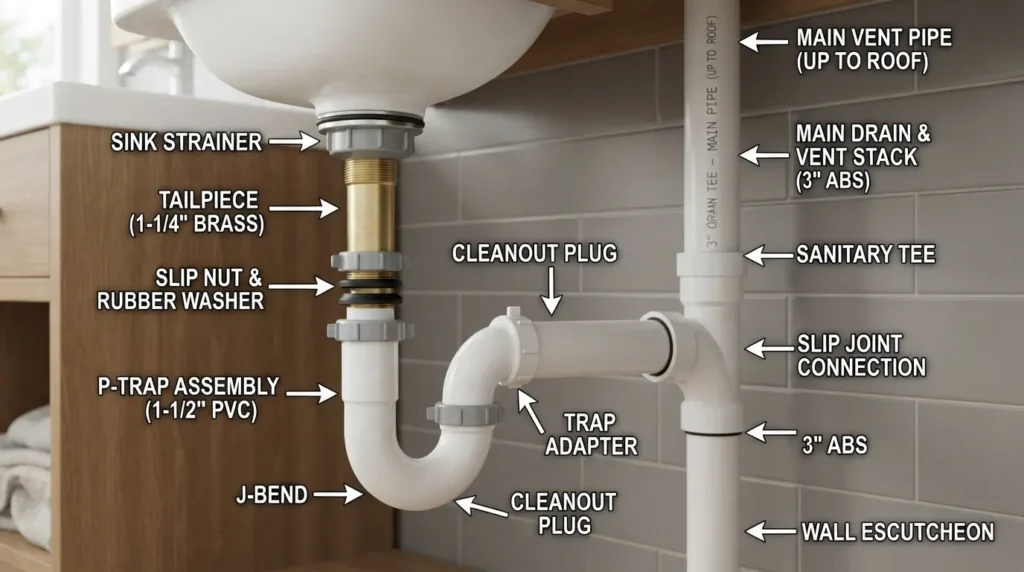
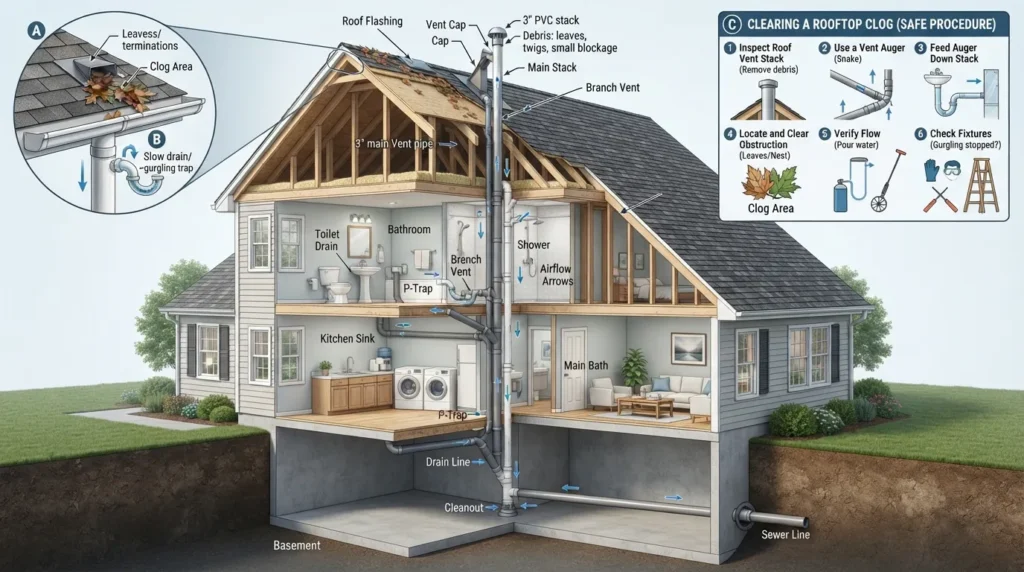
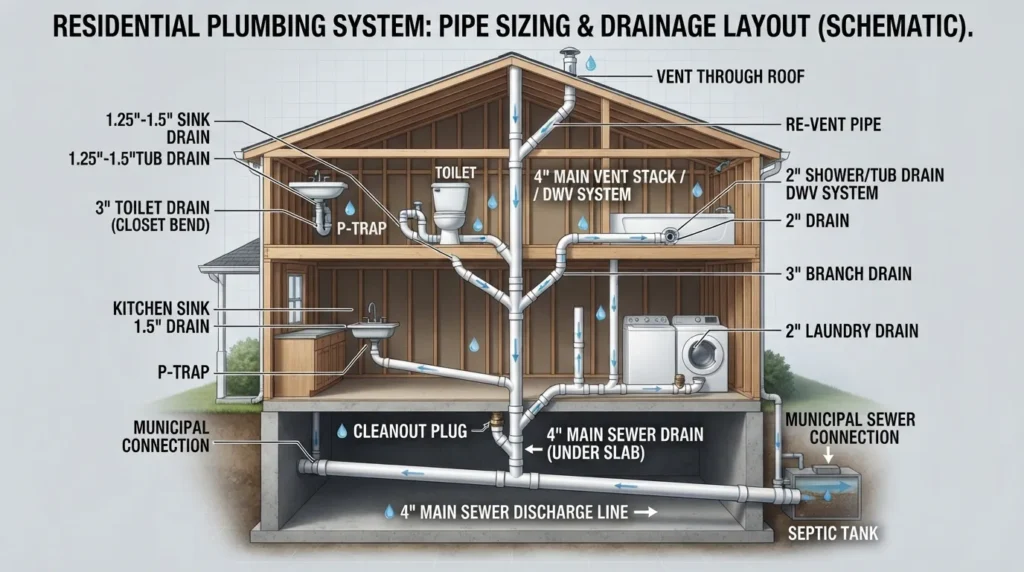
A sewer pipe is part of the sanitary drainage system that moves wastewater away from toilets, sinks, showers, tubs, laundry fixtures, and other connected plumbing. In a typical gravity system, wastewater moves through progressively larger drainage pipes until it leaves the building and reaches the public sewer connection or an onsite wastewater system.
A simple way to picture the path is:
If you want to see how that pipe fits into traps, vents, branch drains, stacks, cleanouts, and the rest of the DWV network, my complete home drainage system guide explains the full wastewater path.
Sewer Pipe vs. Drain Pipe vs. Sewer Lateral vs. Sewer Main
These terms are often used loosely in everyday conversation, which can make shopping and troubleshooting confusing. At a practical homeowner level, think of them this way:
Drain Pipe
A broad term for piping that carries wastewater from fixtures or other drainage points.
Building Drain
The larger drainage piping that receives wastewater from branches inside or beneath the building.
Building Sewer / Lateral
The downstream pipe carrying the building’s wastewater toward the public sewer or approved disposal system.
Sewer Main
The larger public or utility sewer receiving wastewater from multiple properties.
This distinction becomes important when someone says they have a “sewer clog.” A blocked bathroom branch drain and a problem in the buried sewer lateral can produce very different symptoms and require different equipment.
What Kind of Pipe Is Used for Sewer Lines?
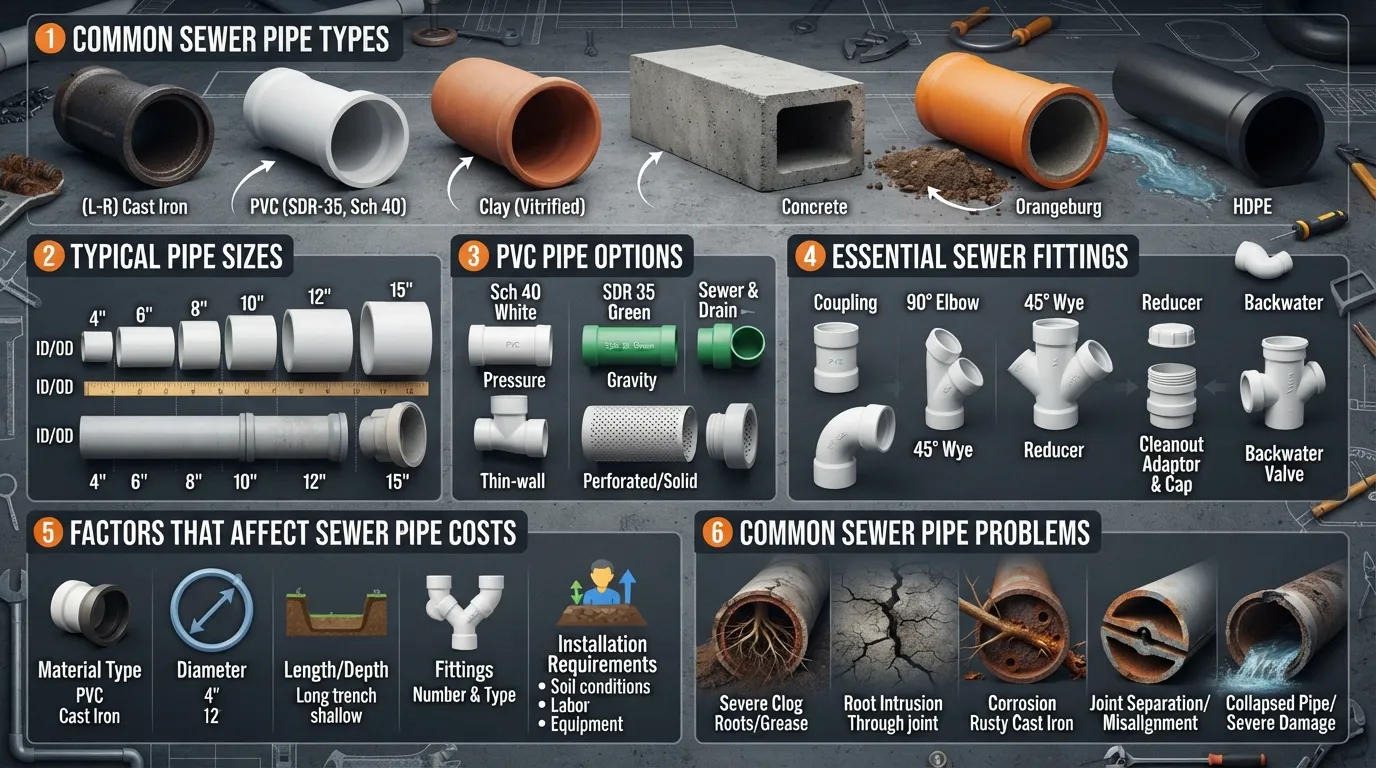
There is no single sewer-pipe material used in every home. What you find depends on the property’s age, previous repairs, the part of the system being inspected, local requirements, and the original construction.
PVC
PVC is widely used in modern sanitary drainage and building-sewer applications. It is lightweight, does not rust like ferrous metal, and is available in different dimensional systems and specifications. The important point is that not every PVC pipe is interchangeable.
ABS
ABS is another plastic drainage material you may encounter. It is typically black and is used in approved DWV or sewer applications where the applicable code and system design allow it.
Cast Iron
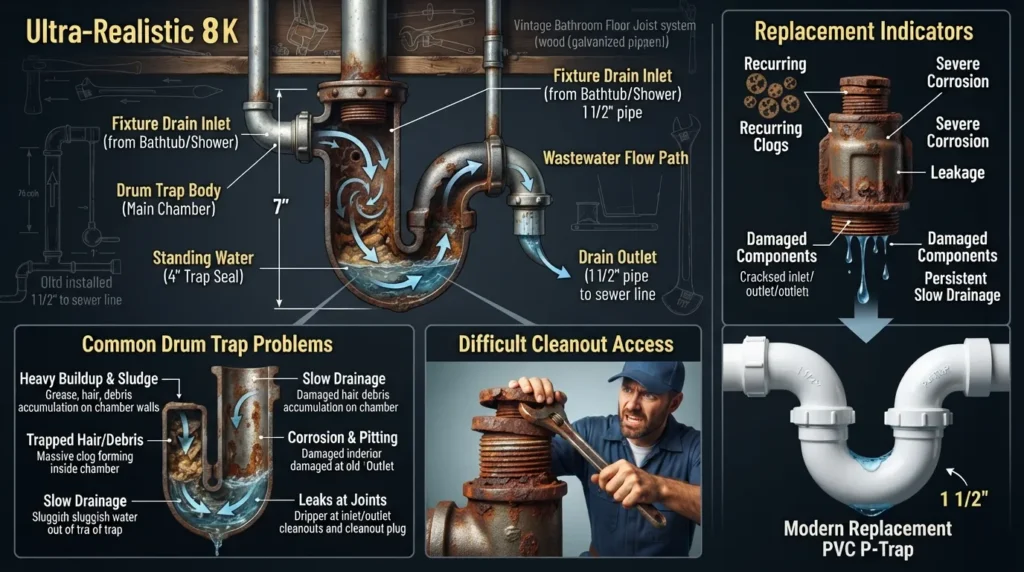
Cast iron appears in many existing drainage systems. It is strong, but older pipe can develop corrosion, internal scale, roughness, cracking, or deterioration that deserves evaluation when backups become repetitive.
Vitrified Clay
Clay sewer pipe exists in older systems and remains a recognized sewer-pipe material. Individual pipe sections and joints can become vulnerable to displacement, cracking, leakage, or root entry.
Orangeburg
Orangeburg is a legacy fiber-based pipe material found in some older properties. If it is discovered during an inspection, its condition matters because aging sections can deform or deteriorate.
Other Sewer Materials
Larger utility, commercial, or specialized systems can also use materials such as concrete, polyethylene, polypropylene, ductile iron, or other approved pipe systems. They are not all direct substitutes for residential sanitary piping.
The useful question is not simply “Which material is best?”
Ask which material and specification are approved for the exact application, compatible with the existing system, correctly sized, and suitable for the installation conditions.
Sewer Pipe Sizes: Is a Sewer Line 3 Inch or 4 Inch?
Both 3-inch and 4-inch drainage sizes exist, but there is no rule that every house automatically receives the same diameter. Building drains and sewers are sized according to drainage load, system configuration, slope, applicable code, and other design requirements.
Four-inch pipe appears frequently in residential sewer discussions and retail sewer-pipe listings, while 6-inch and larger pipe may be used where greater capacity or a different application requires it.
3-inch
Used in portions of sanitary drainage systems where the calculated load and applicable requirements permit it.
4-inch
A very common size encountered in residential sewer products and many building-sewer applications, but not automatically correct for every project.
6-inch
Used where system capacity, property type, design, or downstream conditions call for a larger diameter.
8–12 inches+
More commonly associated with larger commercial, site, utility, or municipal infrastructure than a basic single-family lateral.
For additional context, the 2023 Florida Building Code, Plumbing lists a minimum horizontal drainage slope of 1/8 inch per foot for pipe sizes from 3 through 6 inches. That does not mean you should size or install a sewer line from one number found online; drainage load, route, connections, code provisions, and project-specific conditions still have to be evaluated.
PVC Sewer Pipe Is Not One Universal Product
This is one of the most important points to understand before buying pipe.
Walk into a plumbing aisle or browse online and you may encounter labels such as:
- Schedule 40 PVC
- DWV PVC
- SDR 35 sewer pipe
- ASTM D3034
- D2729 sewer and drain pipe
- gravity sewer pipe
- solid pipe
- perforated pipe
- belled-end pipe
- sewer-and-drain fittings
Those labels are not decorative. They tell you something about the pipe’s dimensions, performance standard, intended system, or connection method.
Schedule 40 vs. SDR 35
Schedule 40 and SDR 35 are different piping systems. Both types of PVC can appear in drainage or sewer work when the applicable standard and installation permit them, but you should not assume fittings are interchangeable just because both pipes are labeled with the same nominal diameter.
Retailers even sell transition adapters specifically designed to connect certain DWV/Schedule 40 components with sewer-and-drain systems. That is a useful reminder to match the pipe, fitting, joint method, and standard instead of buying by diameter alone.
What Does ASTM D3034 Mean?
ASTM D3034 is a standard associated with PVC sewer pipe and fittings. The Florida plumbing-code material tables reference D3034 for PVC sewer-and-drain applications, including building-sewer piping and compatible fittings.
If you are shopping for a sanitary sewer project, checking the actual markings printed on the pipe is much more useful than relying only on a shelf label that says “PVC.”
What About D2729 Sewer and Drain Pipe?
You may see D2729 PVC sold by major retailers under “sewer and drain” terminology. That does not mean it is automatically the correct pipe for every sanitary building-sewer installation.
For example, the 2023 Florida Plumbing Code references ASTM D2729 in its subsoil-drain provisions, while ASTM D3034 appears in sanitary building-sewer and sewer-fitting material tables. The exact application therefore matters.
Do not buy sewer pipe by color or store category alone.
Verify the pipe markings, dimensional system, intended application, fitting compatibility, and requirements that apply to your project.
Solid vs. Perforated Sewer/Drain Pipe
Another easy mistake is assuming solid and perforated pipe perform the same job. Perforated pipe is designed for applications where water needs to enter or leave through openings in the pipe wall, such as certain subsurface drainage systems.
A sanitary sewer carrying wastewater is a different application. Do not choose perforated pipe for a sanitary sewer simply because the product appears in a “sewer and drain” shopping category.
What Sewer Pipe Fittings Do?
A sewer system is not made from straight pipe alone. Fittings control direction, join sections, connect branches, provide transitions, and create access for future service.
Common sewer and drainage fittings you may encounter include:
- Couplings for joining compatible pipe sections
- Wyes for directional branch connections
- Long-turn or drainage elbows for appropriate changes in direction
- Reducers or increasers where an approved size transition is needed
- Adapters for compatible transitions between different pipe systems
- Caps and plugs for terminating approved openings
- Cleanout adapters and plugs for service access
A fitting that physically slides onto a pipe is not automatically the correct drainage fitting. Flow direction, fitting geometry, pipe standard, joint type, and code requirements all matter.
What Is Inside a Sewer Pipe?
During normal use, a sanitary sewer carries wastewater and the waste discharged through approved plumbing fixtures. Depending on the building, that can include toilet waste, toilet paper, wash water, soap residue, food-related wastewater, laundry discharge, and other normal household wastewater.
Over time, unwanted material can also collect in the line. Examples include:
- Grease and residue
- Scale and corrosion products
- Non-flushable objects
- Roots entering damaged joints or openings
- Sediment
- Foreign objects
- Debris caught on a rough, damaged, or offset section
This distinction matters because a blockage inside an otherwise sound pipe is a different problem from a cracked, offset, collapsed, deformed, or severely deteriorated sewer pipe.
How to Tell What Sewer Pipe You Have
If part of the line is exposed at a cleanout, crawlspace, mechanical area, or previous repair, visual clues can sometimes narrow down the material.
May be PVC; read the printed markings rather than relying on color.
May be ABS, although identification should still be based on markings and construction.
May be cast iron.
May indicate vitrified clay.
Buried pipe cannot always be identified reliably from one exposed fitting. Previous repairs can also leave a property with more than one sewer-pipe material. When pipe condition is the real question, a sewer camera can provide much more useful information than guessing from the age of the house.
Warning Signs of a Sewer Pipe Problem
A single slow sink does not automatically mean your underground sewer pipe has failed. The pattern of symptoms matters.
Pay closer attention when you notice:
- Several fixtures draining slowly at the same time
- Repeated main-line backups
- A toilet gurgling when another fixture drains
- Wastewater appearing in a tub, shower, or floor drain
- Recurring sewer odors
- A problem that returns soon after the line was cleared
- Evidence of root intrusion during previous service
- Visible cracking, corrosion, deformation, or pipe movement
- Unexpected wet areas around the route of a buried sanitary line
These symptoms narrow the possibilities, but they do not prove the cause. A severe clog, roots, damaged fittings, an offset joint, pipe corrosion, poor grade, a belly, or structural failure can produce overlapping symptoms.
Sewer Clog or Broken Pipe? Decide Before You Replace Anything
One of the most expensive mistakes a property owner can make is jumping directly from “my sewer backed up” to “I need a new sewer line.” The opposite mistake is repeatedly cleaning a line that has a structural defect.
Cleaning May Be the Next Step When
- The pipe is structurally serviceable
- The main problem is grease, sludge, debris, or another obstruction
- A mechanical cable can remove the blockage
- Hydro jetting is appropriate for the pipe condition and buildup
Repair or Replacement May Need Evaluation When
- The pipe is cracked or collapsed
- Joints are substantially displaced or offset
- A section is severely deteriorated or deformed
- Recurring roots are entering a structural opening
- A pipe belly or other defect repeatedly traps waste
For an obstruction rather than a structural pipe failure, professional drain and main sewer line cleaning may restore flow. Repeated or unexplained problems are where a camera inspection becomes especially valuable because it helps distinguish material inside the pipe from damage to the pipe itself.
Sewer Camera Inspection: What It Can Tell You
A sewer camera is useful when you need evidence instead of assumptions. Depending on access and pipe conditions, an inspection may reveal:
- Roots
- Heavy buildup
- Cracks
- Offsets or separated joints
- Deformation
- Collapsed areas
- Standing water or a possible belly
- Obstructions
- Changes in pipe material
A camera does not make every repair decision by itself. The footage still needs to be interpreted alongside symptoms, pipe location, access, material, grade, and the condition of the surrounding system.
Cleaning vs. Repair vs. Replacement
A practical decision sequence
- Identify how many fixtures are affected.
- Locate the likely restriction or damaged section.
- Determine whether the problem is an obstruction, structural defect, or both.
- Identify the pipe material, diameter, and condition.
- Use the least-disruptive effective solution that actually addresses the cause.
- Verify restored flow or completed repair before treating the problem as resolved.
Drain or Sewer Cleaning
Appropriate when the pipe itself remains serviceable and the main problem is an obstruction or buildup that can be safely removed.
Spot Repair
May make sense when damage is isolated and the surrounding pipe remains suitable for continued service.
Trenchless Rehabilitation or Replacement
Some sewer defects can be addressed with methods such as lining or pipe bursting where the existing conditions, access, code, and chosen system make the method suitable. “Trenchless” does not mean zero excavation in every project.
Traditional Excavation and Replacement
Excavation may still be the correct solution when the pipe is badly collapsed, access or alignment requires it, connections must be exposed, or the selected repair system cannot reliably correct the defect.
What to Check Before Buying Sewer Pipe
If your search intent is partly transactional and you are comparing sewer pipe for sale at Lowe’s, Home Depot, a plumbing supplier, or another retailer, use this checklist before putting a pipe in the cart.
- Confirm the application. Sanitary sewer, stormwater, foundation drainage, and other underground drainage systems are not interchangeable simply because they all move water.
- Confirm the required diameter. Do not select 3-inch, 4-inch, or 6-inch pipe by guesswork.
- Read the pipe markings. Look for the material and applicable ASTM or other specification.
- Check solid vs. perforated construction. The wrong choice can completely change how the system functions.
- Match the fittings. Couplings, wyes, cleanouts, transitions, and elbows must be compatible with the actual pipe system.
- Check the joint type. Solvent-weld, gasketed, mechanical, or transition joints require the correct components and installation method.
- Verify the route and slope. Gravity sewer performance depends on proper installation, not just pipe diameter.
- Check local code and permit requirements. A retailer selling a product does not automatically make that product correct for your specific permitted sanitary installation.
How Much Does Sewer Pipe Cost?
There is no useful single price for “sewer pipe” because you may be comparing completely different products.
Pipe-only cost changes with:
- Diameter
- Length
- Material
- Pipe specification
- Wall class or dimensional system
- Solid vs. perforated construction
- Fittings and adapters
- Supplier
- Local inventory and delivery
That is why the price of a 4-inch PVC sewer pipe cannot be treated as the cost of replacing a 4-inch sewer line.
Pipe price is not project price.
A sewer replacement can also involve diagnosis, excavation or trenchless access, fittings, transitions, cleanouts, labor, equipment, permits, inspection, backfill, concrete or slab work, landscaping, pavement, and other restoration.
How Much Does 4-Inch Sewer Pipe Cost?
Check current retailer or plumbing-supply listings rather than relying on a fixed online number. Even within 4-inch PVC, you can find different products such as gravity sewer pipe, sewer-and-drain pipe, solid pipe, perforated pipe, and different specifications. Their prices and intended applications are not necessarily the same.
How Much Does 6-Inch Sewer Pipe Cost?
The same rule applies to 6-inch pipe. Diameter is only one variable. Material, length, pipe specification, fittings, local availability, and shipping can materially change the purchase cost.
Can You Use Regular PVC for a Sewer Line?
Not simply because it is PVC.
PVC is a material, not a complete installation specification. Different PVC pipe systems are manufactured for different applications and standards. Florida’s plumbing-code tables recognize multiple approved PVC categories for sanitary drainage and building-sewer applications, including IPS/DWV-type PVC and sewer-and-drain dimensional systems such as products conforming to ASTM D3034.
So the safer decision process is:
- Determine the exact sanitary application.
- Determine the required diameter and drainage capacity.
- Check which pipe standards are accepted for that application.
- Match compatible fittings and joining methods.
- Verify local permitting and project requirements before installation.
A label such as “PVC,” “sewer pipe,” or “sewer & drain” by itself is not enough information.
Can I Replace My Own Sewer Pipe?
Possibly in some jurisdictions and circumstances under applicable owner-builder rules, but replacing a buried sanitary sewer line is not a good trial-and-error DIY project.
You are dealing with issues such as:
- Sanitary wastewater exposure
- Excavation and buried utilities
- Pipe sizing
- Required grade
- Approved pipe and fittings
- Connections to existing systems
- Cleanout requirements
- Trench and backfill conditions
- Slab or concrete repair
- Permitting and inspections
Miami-Dade County, for example, publishes specific requirements for sanitary-line replacement permits, including application requirements and provisions related to trench backfill and concrete-slab repair. Properties inside individual municipalities can be subject to that municipality’s permitting authority, so verify the jurisdiction before starting work.
What Miami Property Owners Should Know About Sewer Pipe Work
For a Miami property, I would not choose a sewer repair method or replacement pipe from a national article alone. The project still has to fit the actual property, existing piping, site conditions, applicable Florida code, and the permitting authority responsible for that address.
Miami-Dade’s plumbing permit information specifically includes sanitary line replacement requirements. The Florida plumbing code also addresses approved sanitary drainage materials, fittings, cleanouts, sizing, slope, pipe bursting, relining, and rehabilitation of building sewers.
Before a Miami sewer-line replacement, confirm:
- Which authority has jurisdiction over the property
- Whether a plumbing permit is required
- The condition and material of the existing sewer
- The actual route and depth of the affected section
- The correct replacement pipe and fittings
- Whether conventional excavation or a trenchless method is appropriate
- Required inspection, trench, backfill, slab, or restoration details
If you need local diagnosis before deciding whether you are dealing with a clog, damaged sewer pipe, or a larger plumbing problem, our Miami plumbing team can evaluate the symptoms and help identify the appropriate next step.
How to Reduce Sewer Pipe Problems
You cannot prevent every structural failure, but you can avoid making the system’s job harder.
- Do not treat toilets as trash cans for wipes, hygiene products, paper towels, or other non-flushable material.
- Keep cooking grease and fats out of drains.
- Pay attention when several fixtures begin slowing at once.
- Do not ignore a backup that keeps returning after cleaning.
- Keep known cleanouts accessible.
- Consider camera inspection when recurring symptoms suggest roots or structural defects.
- Do not repeatedly use aggressive clearing methods without considering the condition of an older pipe.
- Address confirmed leaks, offsets, cracks, or collapsed sections instead of repeatedly treating only the symptoms.
Understanding Sewer Pipes and Sewer Lines
If you prefer a visual explanation, this sewer-pipe and sewer-line overview can help you see how the buried portion of a wastewater system fits together.
Frequently Asked Questions About Sewer Pipe
What kind of pipe is used for sewer lines?
PVC is widely used in modern sewer and sanitary drainage systems, but ABS, cast iron, vitrified clay, and other approved materials can also be encountered. The correct material depends on the application, code, existing system, and installation conditions.
Is sewer pipe 3 inch or 4 inch?
Both sizes exist. Four-inch pipe is common in residential sewer products and applications, but pipe size must be based on drainage load and applicable requirements rather than a universal “every house uses 4-inch” rule.
Can you use regular PVC for sewer lines?
Do not select pipe simply because it is PVC. Verify the pipe standard, dimensional system, application, diameter, fittings, and local requirements. Schedule 40/DWV PVC and SDR sewer pipe are not just interchangeable versions of the same product.
Does Home Depot sell PVC sewer pipe?
Yes. Major home-improvement retailers including Home Depot and Lowe’s list PVC sewer-and-drain pipe, gravity sewer pipe, and related fittings. Inventory and pricing vary by location, and a product being sold as sewer/drain pipe does not automatically make it correct for every sanitary installation.
Where can I find drainage pipes for sale?
Home-improvement retailers, plumbing-supply houses, pipe suppliers, and specialty drainage suppliers sell sewer and drainage pipe. Compare specification and intended application before comparing price.
What is in a sewer pipe?
A sanitary sewer normally carries household or building wastewater and approved waste. Problem lines can also contain grease, scale, roots, debris, foreign objects, or material trapped by a damaged section.
How do I know if my sewer pipe is clogged or broken?
Symptoms alone may not tell you. Multiple backups can result from either a major obstruction or structural damage. Recurring problems often justify a camera inspection to look for roots, cracks, offsets, deformation, standing water, or collapse.
Can I replace my own sewer pipe?
Local owner-builder rules may allow certain work, but sanitary sewer replacement involves excavation, wastewater hazards, pipe sizing, slope, approved materials, permits, and inspections. Check the authority having jurisdiction before beginning work.
If you remember only one thing from this guide, make it this: do not choose or replace a sewer pipe based only on the words “PVC,” “4 inch,” or “sewer and drain.”
The right decision connects several pieces of information:
- What the pipe is supposed to carry
- Where it sits in the drainage system
- Its required capacity and diameter
- Its material and pipe standard
- The fittings and joints it requires
- The condition of the existing sewer
- Whether the problem is blockage or structural damage
- The installation route and grade
- Local code, permit, and inspection requirements
When several fixtures are backing up or the same sewer problem keeps returning, diagnosing the cause before buying pipe or approving a replacement can save you from solving the wrong problem.
Not Sure Whether Your Sewer Needs Cleaning or Repair?
If you are dealing with recurring backups, gurgling drains, sewer odors, root intrusion, or a suspected damaged line in the Miami area, start with diagnosis rather than guessing at the repair.
Sewer Pipe Buying & Reference Resources
Use these resources to compare current products, specifications, and local requirements. Retail inventory and prices can change, and retailer links are provided for research rather than as a substitute for verifying the correct pipe for your application.