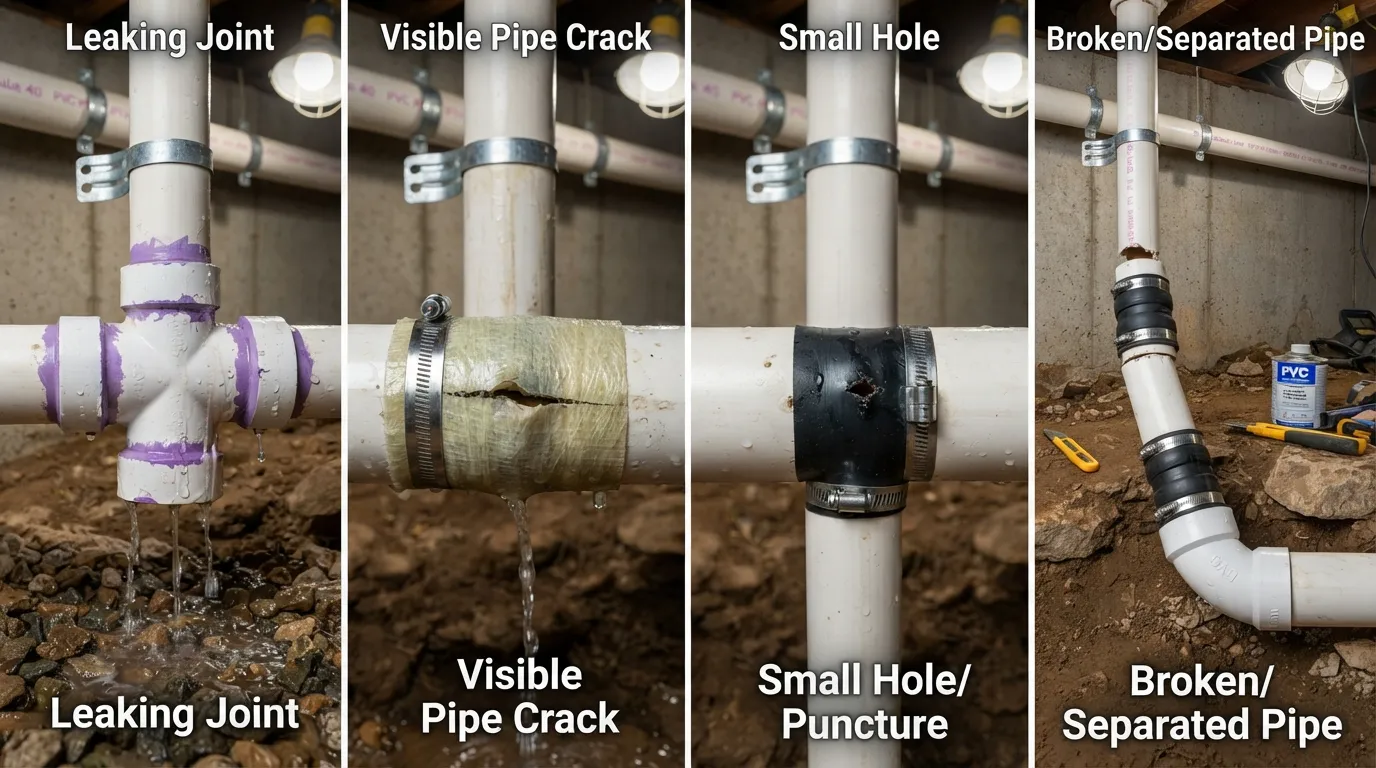
The right drain pipe repair depends on what the pipe is made of, where it is damaged, what type of damage you have, and whether the pipe is accessible. A loose drain joint may only need to be reseated or have its washer replaced. A small crack or hole in an exposed pipe may be temporarily controlled with a compatible epoxy, repair tape, sleeve, or clamp. But a cracked fitting, deteriorated pipe, collapsed drain, or repeatedly failing underground line usually needs the damaged section repaired or replaced rather than simply covered with another patch.
If you searched for drain pipe repair, you probably do not want a long explanation of what a drain pipe is. You want to know what failed, what will actually stop the leak, whether you can handle the problem yourself, and when a quick patch will create more trouble later.
That is how I recommend approaching this problem. Instead of choosing a repair product first, diagnose the pipe first. The same tape, epoxy, sleeve, or fitting is not right for every PVC, ABS, cast-iron, underground, or exterior drainage problem.
This guide walks you through that decision from the first sign of a leak to a permanent repair.
First: Diagnose the Drain Pipe in About 60 Seconds
Before you buy a drain pipe repair kit or start wrapping the pipe, answer these four questions.
PVC, ABS, cast iron, clay, corrugated plastic, or another material? The repair product and connection method must be compatible with the pipe.
Look for a loose joint, worn washer, pinhole, straight crack, cracked fitting, separated pipe, corrosion, crushed section, or collapsed line.
An exposed pipe below a sink is a very different repair from a drain inside a wall, below a slab, or underground in the yard.
One dripping connection usually points to a localized defect. Several slow drains, gurgling fixtures, sewage odors, or recurring backups can point to a deeper drainage-line problem.
Drain Pipe Repair Method Selector
This is the part many quick-repair guides miss: the best repair is determined by the damage, not by whichever product happens to be easiest to buy.
Loose or Leaking Drain Joint
Best first move: Clean, align, reseat, and inspect the washer, gasket, or seal.
Permanent approach: Replace the failed washer, gasket, nut, fitting, or joint component if damaged.
Small Hole or Crack in Exposed PVC
Emergency option: A compatible repair epoxy, wrap, or properly sized sleeve may control the leak.
Permanent approach: Replace the damaged pipe section or fitting with a compatible repair connection.
Cracked PVC or ABS Fitting
Best approach: Replacement is usually more dependable than coating the outside of a structurally cracked fitting.
Key point: Use products and joining methods approved for the actual pipe material.
Localized Cast-Iron Leak
Short-term option: Certain properly sized repair clamps or sleeves may control a localized leak.
Before deciding: Inspect the surrounding pipe for wider corrosion or deterioration.
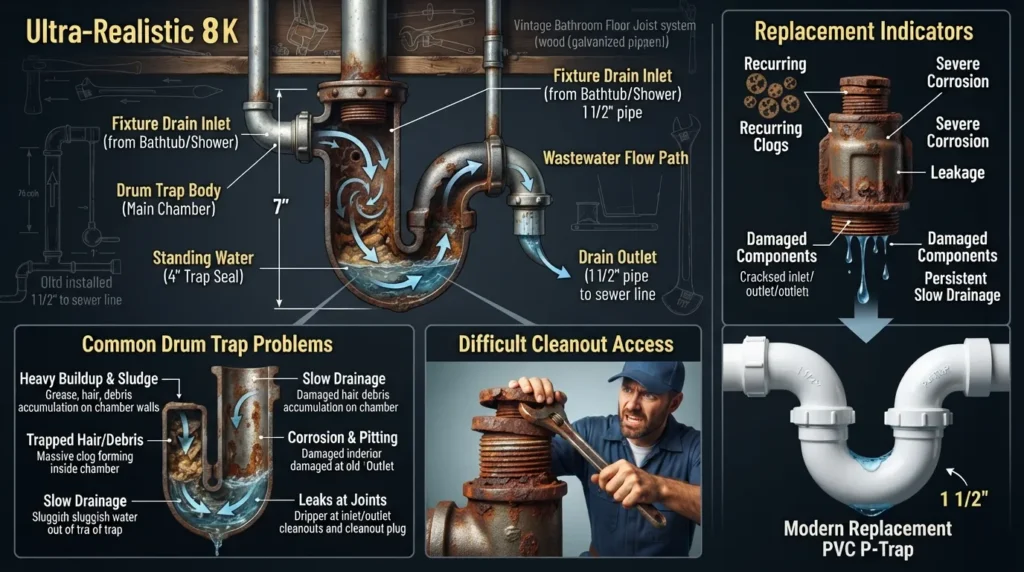
Repeated Holes or Heavy Corrosion
Do not keep chasing leaks: Repeated pinholes can indicate that more of the pipe is deteriorating.
Better decision: Compare section replacement with continued patching.
Underground, Bellied, or Collapsed Drain
Do not diagnose this from the surface alone. The location and extent of the defect should be identified before repair.
Likely next step: Inspection followed by cleaning, localized repair, or replacement depending on what is found.
How to Find the Exact Source of a Drain Leak
A wet pipe does not automatically tell you where the leak started. Water can run along the outside of a pipe and drip several inches away from the actual failure.
- Stop using the affected fixture. Give the pipe time to stop dripping.
- Dry the entire area. Wipe the pipe, fittings, cabinet floor, and nearby surfaces completely dry.
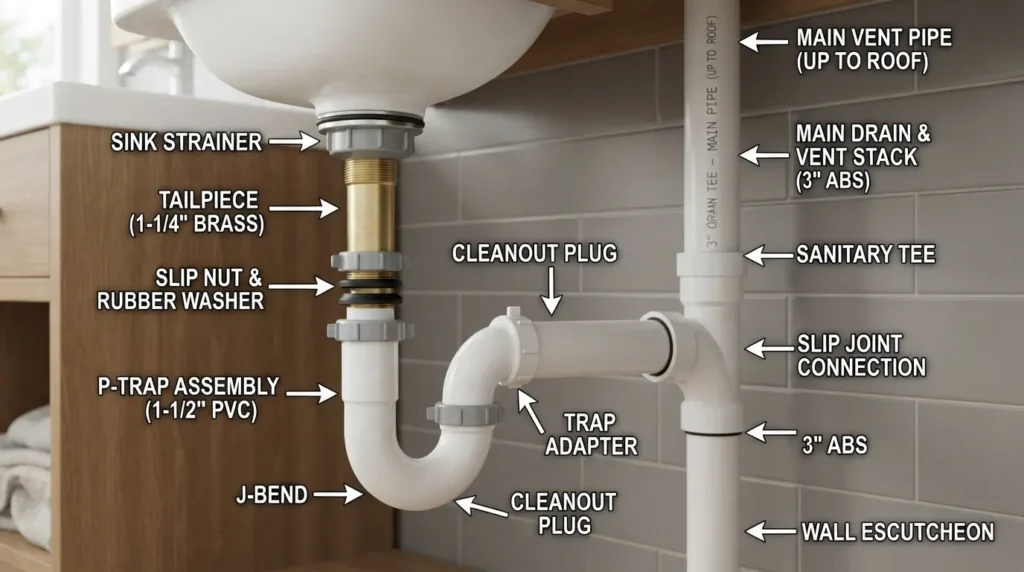
- Inspect joints before pipe walls. Loose nuts, shifted washers, cracked fittings, and P-trap connections are common leak points.
- Run a controlled test. Use a small amount of water and watch the highest point where moisture first appears.
- Mark the source. Do not assume the lowest visible drip is the defect.
- Check the surrounding pipe. One visible hole may not be the only deteriorated area.
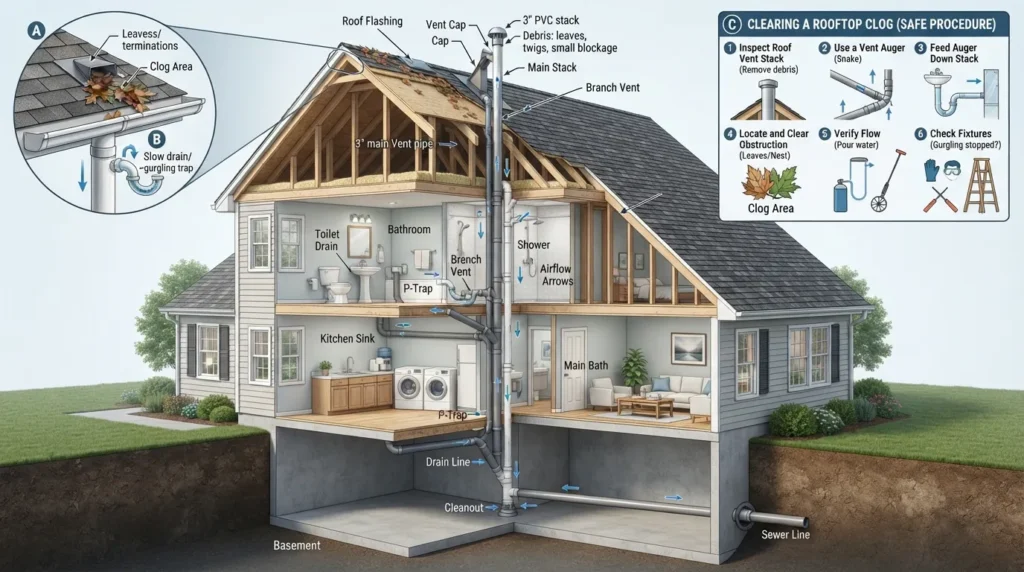
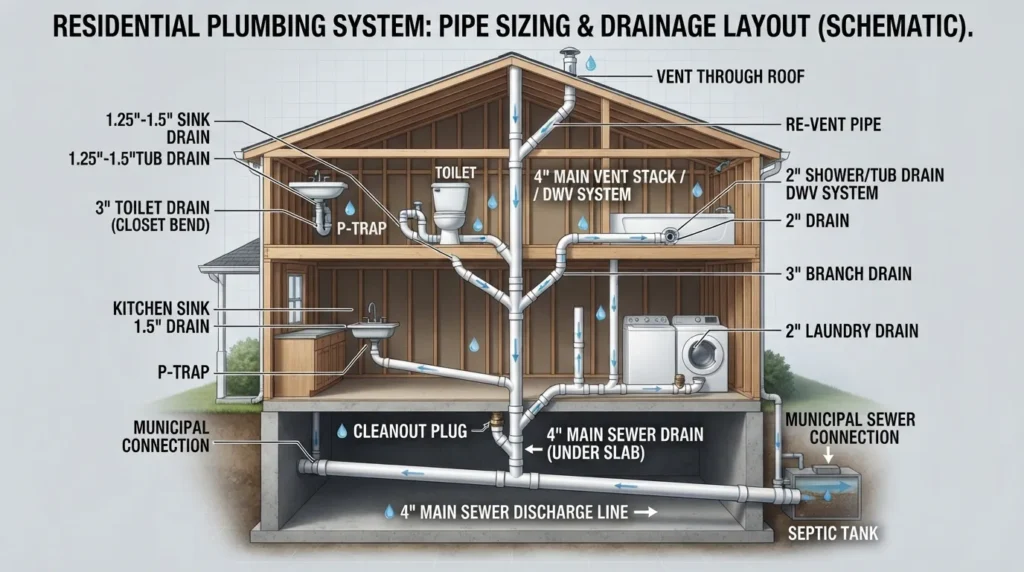
If you want to understand how individual fixture drains, branch drains, traps, vents, and the main drain work together, see our guide to how a home drainage system works.
How to Repair an Exposed PVC Drain Pipe
PVC drain pipe repair can be simple when the defect is visible and accessible, but first separate an emergency patch from a permanent pipe repair.
For a Minor Leak You Need to Control Temporarily
- Stop sending wastewater through the affected drain.
- Clean the outside of the pipe around the defect.
- Dry the surface thoroughly unless the repair product specifically allows wet application.
- Check the repair product for compatibility with PVC and the type of drain you are repairing.
- Apply the epoxy, wrap, sleeve, or clamp exactly as its manufacturer directs.
- Allow the specified set or cure time rather than guessing.
- Run a controlled leak test and inspect all edges of the patch.
- Plan the permanent repair if the product is intended only as an emergency or temporary fix.
Home Depot’s leaky-pipe guidance, for example, describes repair tape, pipe putty, and clamps as temporary approaches and recommends planning a permanent repair after the immediate leak is controlled. See the Home Depot repair guide. :contentReference[oaicite:0]{index=0}
Temporary Patch vs. Permanent Repair
Temporary: The damaged pipe remains in place and another material is placed over or around the leak.
Permanent: The actual failed component, fitting, seal, or damaged pipe section is corrected or replaced using a connection suitable for the drainage system.
A patch stopping today’s drip does not automatically mean the underlying pipe is healthy.
For a Permanent PVC Drain Pipe Repair
If the pipe wall or fitting is physically cracked, I would generally favor correcting the damaged section rather than building repeated layers over it.
A typical permanent repair may involve:
- removing the damaged fitting or section of pipe;
- cutting back to sound material;
- using pipe and fittings compatible with the existing system;
- using the correct joining method for PVC, ABS, or the transition between materials;
- supporting and aligning the repaired drain correctly;
- allowing solvent-welded joints to cure according to the cement manufacturer’s instructions;
- testing for leaks before closing a wall, cabinet, trench, or other access area.
Do not assume every plastic pipe uses the same cement. Manufacturers provide different joining products for PVC, CPVC, and ABS, and the selected cement must be suitable for the material and application. :contentReference[oaicite:1]{index=1}
Drain Pipe Repair Tape, Epoxy, Sleeves & Kits: What Each One Is Really For
Repair Tape
Self-fusing repair tape can be useful when you need to control a small accessible leak quickly and the product is compatible with the pipe. It should not become an excuse to ignore a cracked fitting, badly deteriorated pipe, or underground failure.
Also distinguish repair wrap from PTFE thread-seal tape. PTFE tape is designed for appropriate threaded connections; it is not a structural patch for a hole in the wall of a drain pipe.
Epoxy Putty
A pipe-compatible two-part epoxy can fill or cover certain small cracks and holes. Surface preparation and material compatibility matter, and the product’s cure instructions should control when you test the repair.
J-B Weld states that its WaterWeld product is intended for applications including drains and can bond to many rigid plastics such as PVC and CPVC, while it is not recommended for polyethylene or polypropylene. That is a useful reminder that saying “plastic pipe” is not enough—you need to identify the actual plastic. Check the manufacturer’s WaterWeld information. :contentReference[oaicite:2]{index=2}
Repair Sleeve or Clamp
A repair sleeve or clamp surrounds a damaged area rather than simply coating its surface. The important details are pipe material, outside diameter, condition of the surface, size of the damaged area, and whether the particular product is approved for your application.
Do not buy a sleeve because the package looks approximately the right size. Confirm the dimensions and application first.
Drain Pipe Repair Kit
A kit may combine wrap, resin, epoxy, or another patch system. Before using one, check:
- the pipe materials it can bond to;
- the minimum and maximum pipe size;
- whether the surface must be completely dry;
- whether it is intended for drain, waste, vent, pressure, or general-purpose applications;
- its working and cure time;
- whether the manufacturer presents it as an emergency repair or a long-term solution.
How to Repair a Hole in a Drain Pipe
A hole can have very different meanings depending on the pipe.
A clean puncture in otherwise healthy exposed PVC is different from a hole that has opened in severely corroded cast iron. In the first situation, a patch may control the leak until the damaged section is replaced. In the second, the visible hole may be evidence that the surrounding pipe is thin or deteriorated too.
If the answer is impact damage to otherwise sound pipe, localized repair may make sense. If the answer is corrosion, repeated leaks, structural movement, crushing, or an unknown underground problem, simply covering the visible opening may hide a larger failure.
How to Repair PVC Drain Pipe in the Ground
An underground drain repair requires more diagnosis than an exposed pipe because you cannot see the full failure before excavation.
A sensible sequence is:
- Confirm the problem is actually pipe damage. A blockage, root intrusion, offset joint, belly, or collapsed section can produce different symptoms.
- Locate the affected area. Avoid digging a long trench based only on where symptoms appear inside the house.
- Have buried utilities identified before excavation.
- Expose enough pipe to see sound material on both sides of the defect.
- Determine whether localized replacement is practical.
- Use compatible drainage pipe and approved connections.
- Maintain the drainage configuration and support required for the installation.
- Test before backfilling.
- Confirm permit and inspection requirements before work that falls under local code.
If the pipe has collapsed, shifted significantly, or developed a belly, wrapping the outside is not going to restore the pipe’s shape or drainage path.
What About an Outside or Stormwater Drain Pipe?
Outdoor drainage pipes can fail from cracking, crushing, soil movement, root interference, disconnected joints, or impact. A downspout or stormwater drain should not automatically be treated like a sanitary waste line just because both are called “drains.”
For an exterior pipe, first determine what the line carries and where it discharges. Then identify whether the problem is a simple cracked section, a blockage, a crushed pipe, or an installation problem before choosing the repair.
Drain Pipe Repair vs. Replacement: Which One Makes More Sense?
Repair Is More Reasonable When…
- the defect is localized;
- the surrounding pipe is sound;
- the location is accessible;
- a joint, gasket, or fitting is clearly responsible;
- only a short section needs correction;
- the pipe has not repeatedly failed.
Replacement Deserves Serious Consideration When…
- the pipe is heavily corroded or brittle;
- new pinholes keep appearing;
- a section has collapsed or deformed;
- the line has a significant belly or displacement;
- several areas are damaged;
- a cracked fitting cannot be reliably restored;
- the cost of repeated temporary repairs is adding up.
The key question is not, “Can I stop water from coming through this spot?” It is, “Is the pipe around this spot still capable of doing its job reliably?”
How Much Does Drain Pipe Repair Cost?
There is no responsible way to price a drain pipe repair from the keyword alone. Accessibility can change the job dramatically.
An exposed drain below a sink can be reached immediately. A pipe behind tile, inside a wall, below concrete, or several feet underground can require access work before the actual pipe repair even begins.
A loose fitting, localized leak, collapsed pipe, and long deteriorated section do not involve the same work.
Under-sink access is different from wall, slab, crawlspace, yard, or underground access.
PVC, ABS, cast iron, clay, and transition connections can require different materials and labor.
Opening and restoring walls, flooring, concrete, cabinets, landscaping, or other surfaces can affect total cost.
For general context—not a Miami quote—HomeGuide’s February 2026 national cost guide reports approximately $100 to $800 for minor drain-pipe repairs and an average of about $150 to $250 per linear foot for drain-pipe replacement, while complex or difficult-to-access work can cost substantially more. Your actual price should be based on the specific pipe, location, access, and repair plan. Review the HomeGuide cost data. :contentReference[oaicite:3]{index=3}
Is It a Broken Drain Pipe or Just a Clogged Drain?
This distinction can save you from repairing the wrong thing.
A visible leak, cracked pipe, wet cabinet, or water appearing directly from a pipe joint is strong evidence of a localized pipe problem.
But symptoms such as these can point toward a blockage or deeper drain-line issue instead:
- multiple fixtures draining slowly;
- recurring backups after the drain has already been cleared;
- gurgling from more than one fixture;
- water backing up in another drain when a toilet or fixture is used;
- persistent sewage odors with no visible fixture leak;
- a suspected underground obstruction.
In that situation, covering an accessible pipe with epoxy will not solve a blockage farther down the system. A deeper diagnosis or professional drain cleaning in Miami may be the more relevant next step.
Signs a Drain Pipe May Need Professional Inspection
- A leak is inside a wall, ceiling, slab, or another concealed area.
- The pipe is cast iron with visible corrosion around the leak.
- Several leaks have appeared along the same drainage line.
- The pipe repeatedly clogs after being cleared.
- Multiple fixtures are backing up.
- You suspect roots, collapse, separation, or an underground break.
- Wastewater is escaping into a living space or onto the property.
- You cannot confidently identify the pipe material or failure.
- The repair requires removing or replacing concealed drainage piping.
A Simple Rule
If you can clearly see one healthy, accessible pipe with one localized defect, a focused repair may be reasonable. If you cannot see the full problem—or the symptoms involve several fixtures or a buried line—diagnosis should come before patching.
Will Flex Seal Fix a Pinhole Leak?
A rubberized coating or sealing product may be able to reduce or stop a small surface leak when the manufacturer approves the product for that material and application. I would not treat a surface coating as a substitute for evaluating why the pinhole developed.
If the hole comes from corrosion or material deterioration, sealing that one opening does not restore the missing pipe wall or tell you whether another weak spot is about to open nearby.
Use any such product according to its label and view an emergency surface patch separately from a permanent drainage repair.
Will Plumber’s Putty Stop a Drain Pipe Leak?
Usually not in the way many homeowners mean. Traditional plumber’s putty is commonly used to create seals around certain non-pressurized plumbing fixtures and flanges. It should not be confused with two-part epoxy repair putty, and it is not a universal material for filling cracks or holes in pipe walls.
Oatey also warns that conventional plumber’s putty is not suitable for every material and specifically advises checking compatibility with plastic components. See Oatey’s plumber’s putty guidance. :contentReference[oaicite:4]{index=4}
Can I Patch a Hole in PVC Pipe?
Yes, certain products can patch a small hole in compatible rigid PVC, but the better question is whether the patch is appropriate as an emergency measure or a permanent repair.
If the pipe is otherwise healthy and you need to control a small accessible leak, a compatible repair product can be useful. If the PVC is split, distorted, badly supported, or damaged across a larger section, replacing the damaged pipe or fitting is usually the stronger solution.
Will J-B WaterWeld Work on PVC Drain Pipe?
The manufacturer lists WaterWeld for plumbing and drain applications and states that it works with many rigid plastics, including PVC and CPVC. It does not recommend the product for every plastic, including polyethylene and polypropylene. :contentReference[oaicite:5]{index=5}
So identify the material first, prepare the surface as directed, follow the product’s cure requirements, and do not assume a branded epoxy makes replacement unnecessary when the pipe itself is structurally damaged.
What Type of Putty Should I Use to Fill a Hole Around a Pipe?
If you mean a gap around a pipe penetration through a wall, cabinet, or floor, that is different from a hole in the pipe itself.
The correct sealing material depends on the surrounding surface, moisture exposure, pipe material, movement, and whether the penetration is part of a fire-rated assembly or another code-regulated construction detail. Do not automatically pack ordinary plumber’s putty into every wall or floor penetration.
If you mean an actual hole in the drain pipe wall, use a repair method designed and rated for that pipe material—or replace the damaged section.
How Can I Fix a PVC Pipe Leak Without Replacing the Whole Pipe?
You often do not need to replace an entire drainage system for one localized PVC defect.
Depending on the failure, your options may include:
- reseating or replacing a leaking joint washer;
- replacing one cracked fitting;
- temporarily patching a small accessible defect;
- cutting out and replacing only the damaged section;
- using an appropriate repair or transition coupling where permitted and suitable.
The key distinction is between not replacing the whole pipe run and not replacing the damaged piece at all. A localized section replacement can be a permanent repair without replacing every drain pipe in the house.
Miami-Dade Drain Pipe Repair & Permit Considerations
If the property is in Miami-Dade County, permit requirements depend on what work is actually being performed and the applicable jurisdiction.
Miami-Dade’s published permit exemptions state that stopping leaks in drain, soil, waste, or vent pipes may be exempt in qualifying repair situations. However, the same guidance states that when a concealed defective drain pipe must be removed and replaced with new material, the work is considered new work and requires a permit and inspection under the applicable code. Review Miami-Dade’s current permit exemptions. :contentReference[oaicite:6]{index=6}
A repair that looks like “just another section of pipe” can become a different permitting situation when concealed drainage piping is removed, rearranged, or replaced. Confirm the requirements that apply to your property before starting code-regulated work.
Watch: A Practical PVC Drain Pipe Replacement
If you want to see what replacing a damaged PVC drain section looks like rather than simply covering a leak, this DIY demonstration provides useful visual context.
The video demonstrates a DIY-friendly PVC drain-pipe replacement. :contentReference[oaicite:7]{index=7}
Quick Drain Pipe Repair Checklist
- Identify whether the leaking line is actually a drain pipe.
- Stop using the affected fixture and dry the area.
- Find the highest point where the leak starts.
- Identify the pipe material.
- Determine whether the failure is a joint, gasket, fitting, crack, hole, corrosion, or structural damage.
- Choose a repair product specifically compatible with that material and application.
- Know whether the repair is temporary or permanent before relying on it.
- Follow manufacturer cure times rather than guessing.
- Test the repair before closing access.
- Do not keep patching a pipe that is repeatedly failing.
- Investigate recurring backups or several affected fixtures as a drainage-system problem, not just a surface leak.
- Confirm local permit requirements when concealed piping is being replaced or rearranged.
Frequently Asked Questions About Drain Pipe Repair
How much should it cost to replace a drain pipe?
Cost depends heavily on material, length, access, and what must be opened or excavated to reach the pipe. A 2026 national HomeGuide estimate lists drain-pipe replacement at roughly $150 to $250 per linear foot on average, but that should not be treated as a local quote for your home. :contentReference[oaicite:8]{index=8}
How can I fix a hole in my drain pipe?
For a small accessible defect in otherwise sound pipe, a material-compatible epoxy, wrap, sleeve, or clamp may control the leak. For a permanent repair, replace or properly repair the damaged fitting or section when the pipe wall itself has failed.
How do I cover a hole in a drain pipe?
Do not choose the covering method until you know the pipe material. A product suitable for rigid PVC may not be suitable for polyethylene, polypropylene, cast iron, or another material. The condition of the surrounding pipe matters as much as the hole itself.
Can a drain pipe repair sleeve fix a leak?
A correctly sized and compatible repair sleeve may be useful for certain localized defects. Check the product’s pipe-size, material, installation, and application requirements and determine whether the manufacturer intends it as a temporary or long-term repair.
Should I repair or replace a cracked drain pipe?
A small localized defect in otherwise sound pipe may justify a localized repair. Replacement becomes more compelling when the pipe is brittle, heavily corroded, deformed, collapsed, repeatedly leaking, or damaged across multiple areas.
When should I call a plumber for drain pipe repair?
Get professional help when the pipe is concealed, underground, badly deteriorated, repeatedly failing, or connected to multiple backed-up fixtures—or whenever you cannot confidently identify the cause and correct repair method.
Need Help With a Damaged Drain Pipe in Miami?
If your repair has moved beyond an accessible loose joint or simple localized issue, the safest next step is to identify the real failure before spending money on repeated patches.
You can explore local Miami plumbing help from EZ Plumbing or speak with our plumbing team.
The best drain pipe repair is not the product that covers the leak fastest. It is the repair that matches the pipe material, damage type, location, and condition of the surrounding drainage line.
If you have one healthy exposed pipe with one clearly identified defect, a localized repair can be straightforward. If you have recurring leaks, corrosion, a cracked fitting, a collapsed line, an underground problem, or multiple drainage symptoms, stop thinking only about how to cover the visible leak. Find out why the pipe failed and correct the underlying problem.
That difference—between stopping today’s drip and fixing the failed drainage component—is what turns a quick patch into a reliable drain pipe repair.
Sources & Further Reading
- The Home Depot: How to Fix a Leaky Pipe :contentReference[oaicite:9]{index=9}
- HomeGuide: 2026 Drain Pipe Repair & Replacement Cost Guide :contentReference[oaicite:10]{index=10}
- Miami-Dade County: Permit Exemptions :contentReference[oaicite:11]{index=11}
- Oatey: How to Properly Use Plumber’s Putty :contentReference[oaicite:12]{index=12}
- J-B Weld: WaterWeld Epoxy Putty :contentReference[oaicite:13]{index=13}