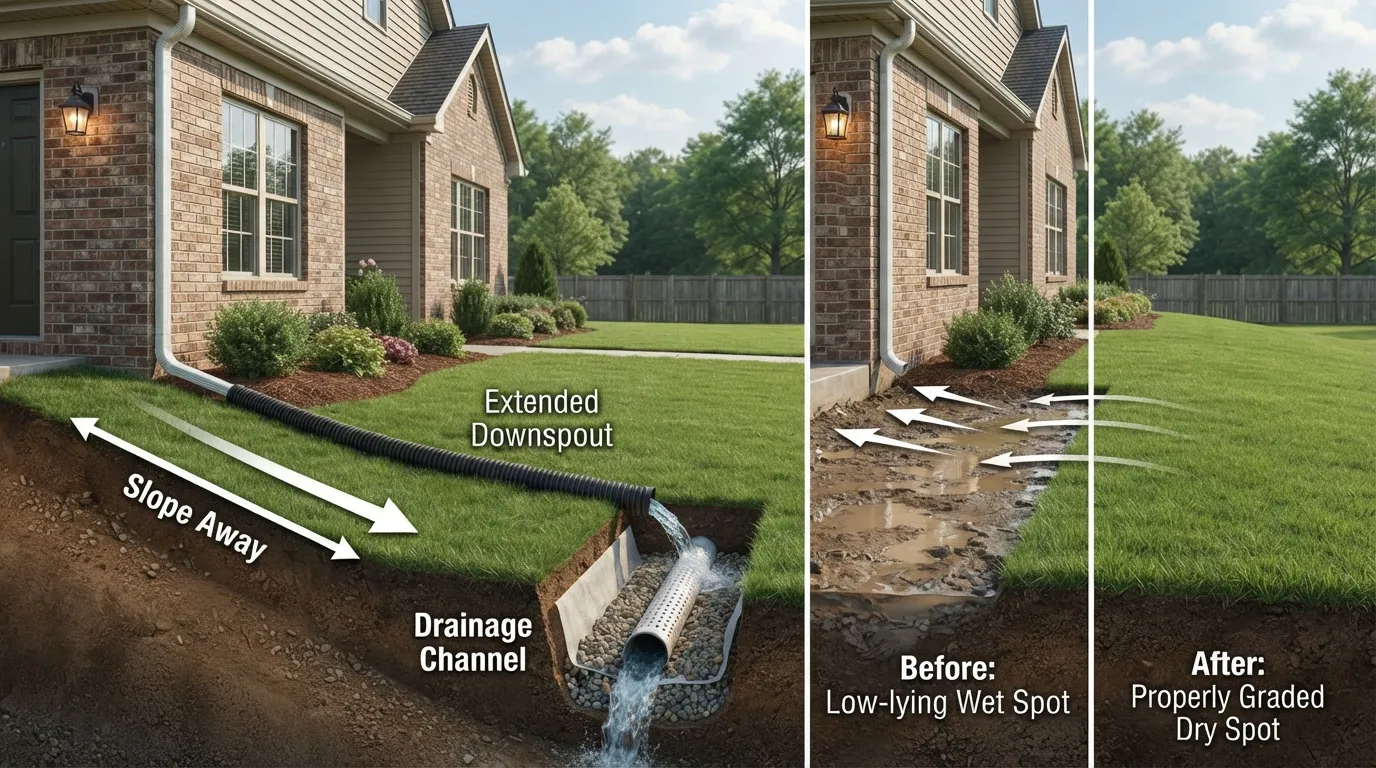
If water keeps pooling near your foundation, soaking your yard, or backing up after every heavy rain, you’re not alone — and you don’t need to guess your way through a fix. The right solution depends on where your water is actually coming from, how much space and budget you have, and what your yard looks like. Below, I’ll walk you through every practical option, from the cheapest weekend fixes to more involved drainage systems, so you can pick the one that actually solves your problem instead of just moving it somewhere else.
The fastest, cheapest fixes are extending your downspouts 4–6 feet away from the house and re-grading the soil so it slopes away from your foundation. If that’s not enough, a swale or channel drain handles surface pooling, while a French drain, dry well, or catch basin is better for water that’s already soaking into the ground near your foundation.
First, Figure Out Where Your Water Is Actually Coming From
Before you pick a fix, it helps to know which of these three situations you’re dealing with — because the wrong solution can waste your time and money without solving anything.
- Roof and downspout runoff — water pools right where your gutters empty out, usually right after it rains.
- Surface pooling in the yard — low spots in your lawn or driveway collect water and stay soggy for days.
- Sloped or graded yard issues — your property naturally tilts toward the house instead of away from it, so every rain sends water straight to your foundation.
Some yards deal with a mix of all three. If that’s you, start with the cheapest fixes first (downspouts and grading), then layer in a drainage system if water is still a problem.
Cheap, Easy Ideas You Can Do in a Weekend
If your budget is tight or you just want to try the basics before digging up your yard, start here. These fixes solve the majority of minor pooling issues on their own.
1. Extend Your Downspouts
Most downspouts dump water just a foot or two from your foundation, which is often the entire problem. Attaching a flexible or rigid extension to push that water at least 4 to 6 feet away can noticeably cut down on pooling near the house — and it takes about 15 minutes per downspout.
2. Re-Grade the Soil Near Your Foundation
Add soil close to the house so the ground slopes downward and away from your foundation, ideally dropping about 6 inches over the first 10 feet. This is one of the most effective fixes because it stops water from ever reaching the foundation in the first place, rather than trying to carry it away after the fact.
3. Use Splash Blocks
A simple concrete or plastic splash block placed under each downspout spreads water out and pushes it further from the wall, reducing erosion and puddling right at the base of your house.
Heads Up
Before you regrade or dig anywhere on your property, make sure you’re directing water toward your own drainage path — not onto a neighbor’s yard or the street in a way that violates local drainage rules. It’s worth a quick check with your city or HOA if you’re unsure.
More Involved DIY Drainage Projects
If the basics aren’t cutting it, these projects take more time and effort but solve bigger or more persistent water problems.
Swales
A swale is a shallow, wide, grass-lined ditch that guides surface water around your house instead of through it. It’s a good option if you have a low spot in the yard and enough room to create a gentle channel that leads water toward a lower point on your property.
Channel Drains
These are linear trench drains placed across driveways, patios, or walkways that slope toward the house. Water flows into a grated channel and gets carried away underground instead of running straight toward your foundation.
French Drains
A French drain intercepts water below the surface. You dig a trench along the problem area, line it with geotextile fabric, add a perforated pipe, and fill it with gravel. This is one of the most effective options for water that’s soaking into the soil near your foundation rather than just sitting on top of it.
Dry Wells
A dry well is a buried, perforated container surrounded by gravel that collects water from a pipe and lets it slowly soak into the ground over time. It’s a solid choice when you have a large volume of water to handle but don’t have anywhere nearby to direct it above ground.
Catch Basins
If you have a specific low spot where water always collects, a catch basin — a low-profile basin connected to an underground discharge pipe — can grab that water right at the source and carry it away before it has a chance to spread.
Which Material Should You Use?
Here’s how the most common drainage materials compare, since this trips people up more than you’d expect.
| Material | Best For | Note |
|---|---|---|
| River Rocks / Gravel | Surface channels, decorative drainage paths | Slows water and looks tidy, but won’t stop water on its own without proper grading underneath |
| Plastic Sheeting / Barriers | Temporary foundation protection | Can trap moisture against the foundation if not installed and vented correctly — a short-term fix, not a permanent one |
| Geotextile Fabric + Gravel | French drains | The fabric keeps soil from clogging the pipe over time — skipping it is the most common reason French drains fail |
How to Build a Simple Berm to Redirect Water
A berm is a raised strip of soil that acts like a small levee, redirecting water around a specific area instead of letting it flow straight through. Here’s the basic process:
- Map out the path you want water to follow, curving it around the trouble spot toward a lower area of your yard.
- Mound and compact soil along that path, building it up gradually rather than all at once so it holds its shape.
- Cover the berm with sod, mulch, or ground cover plants to prevent erosion once the rain starts hitting it.
- Check it after the first few heavy rains and add soil to any spots where water is cutting through.
Diverting Water on a Sloped Yard
If your property slopes toward your house instead of away from it, gravity is working against you — but you don’t necessarily need major regrading to fix it. A swale or a shallow channel drain placed across the slope, uphill from your foundation, can intercept water before it ever reaches the house and redirect it along the contour of the land to a lower exit point. For steeper slopes, terracing with retaining walls can slow water down enough that it soaks in gradually instead of rushing straight toward your foundation.
Landscaping That Actually Helps Absorb Water
Plants can do a surprising amount of the work for you. Native grasses, deep-rooted perennials, and shrubs planted in a rain garden — a shallow, planted depression positioned to catch runoff — soak up water that would otherwise pool or run toward your house. This works especially well paired with a swale, since the plants slow the water down while their roots help it soak into the ground instead of pooling on the surface.
A Note for Homeowners in South Florida
If you’re dealing with this in Miami or anywhere in South Florida, a few local factors change the equation. Our flat terrain means water doesn’t naturally drain away the way it does in hillier regions, so grading and swales often matter even more here than the general advice suggests. Sandy, porous soil can actually help water soak in faster near a French drain or dry well — but a high water table in many parts of the county can also limit how much extra water the ground can absorb, especially during the rainy season. And with hurricane season bringing intense, fast-moving rainfall, systems that rely on slow percolation alone can get overwhelmed quickly, which is why combining surface solutions (grading, swales) with subsurface ones (French drains, dry wells) tends to hold up better here than relying on just one method.
When It’s Time to Call a Professional
Most of the ideas above are genuinely doable on a weekend. But there are a few signs that it’s worth bringing in a professional instead of continuing to DIY:
- Water is pooling against your foundation no matter what you try, which can point to a bigger grading or home drainage system issue than a single fix can solve
- You notice standing water that’s slow to clear, which can sometimes mean a clogged or damaged underground drain line rather than a surface problem
- You’re not confident about local grading rules, utility lines, or how deep you can safely dig
If standing water keeps coming back even after you’ve tried grading and downspout extensions, it’s also worth ruling out a slow or blocked drain line contributing to the problem — our team handles drain cleaning for exactly these situations.
Key Takeaways
- Start cheap: downspout extensions and re-grading solve most minor pooling issues on their own
- Surface pooling calls for a swale or channel drain; water soaking in near the foundation calls for a French drain, dry well, or catch basin
- Use geotextile fabric with any French drain — skipping it is the most common reason they clog and fail
- In South Florida, combine surface and subsurface solutions rather than relying on one method alone
Frequently Asked Questions
What are some cheap ways to drain water away from my house?
Extending your downspouts, adding splash blocks, and re-grading soil near the foundation are the lowest-cost options, and they solve the majority of minor water problems without any digging or drainage system.
What is the cheapest drainage method?
Downspout extensions are typically the cheapest and fastest fix, followed by re-grading, since both use materials you likely already have or can pick up for very little.
How can I drain water away from my house foundation?
Re-grade the soil so it slopes away from the foundation, extend your downspouts well past the wall, and if water is still soaking in near the base of the house, add a French drain or dry well to intercept it below the surface.
What can you put around the house to keep water away?
Sloped soil, a gravel-filled French drain lined with geotextile fabric, or a shallow swale planted with water-absorbing landscaping are all effective barriers depending on how much water you’re dealing with.
Do rocks help keep water away from the foundation?
Rocks or gravel help direct and slow water along a channel, but on their own they don’t stop water from reaching your foundation — they need to sit on top of proper grading or a French drain to actually work.
How can I redirect downspout water away from my house?
Attach a downspout extension to push water at least 4 to 6 feet from the wall, or connect the downspout to a solid underground pipe sloped slightly downhill to carry water further away and “daylight” it in a lower part of the yard.
What landscaping absorbs water?
Native grasses, deep-rooted perennials, and shrubs planted in a rain garden absorb runoff effectively, especially when placed in a shallow depression designed to catch water as it flows through your yard.
Still Dealing With Standing Water?
If DIY fixes aren’t cutting it, the team at Miami Florida Plumbing can help you figure out what’s really going on and get it fixed for good.