If you just walked downstairs and found water pooling on your basement floor, your first reaction is probably panic — and that’s completely normal. The good news is that most basement water problems follow a predictable pattern, and once you know what to look for, you can stop the damage quickly and figure out whether this is a quick fix or something that needs a professional. In this guide, we’ll walk you through what to do right now, why basements in Miami tend to flood, and exactly who you should call depending on what’s causing the problem.
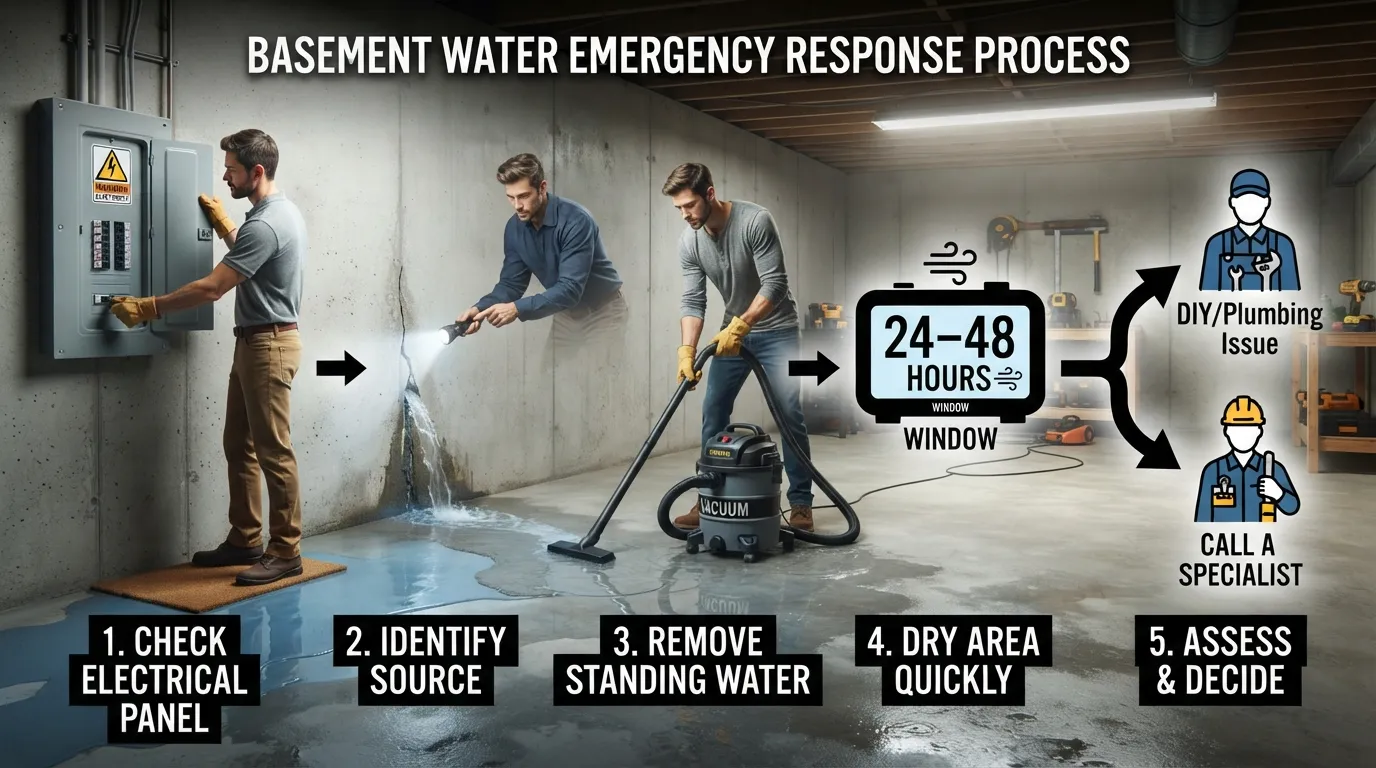
If you find water in your basement, stay out of it if the power is still on and shut off electricity to the area if you can safely reach the panel. Once it’s safe, find where the water is coming from, remove it with a pump or wet vac, and dry the area within 24–48 hours to prevent mold. Then figure out the source — plumbing issue, foundation crack, or outside drainage problem — before deciding who to call.
⚠️ Safety First: Never step into standing water in a basement if there’s any chance electrical outlets, cords, or appliances are submerged or nearby. Water and electricity are a dangerous combination. If you’re unsure, shut off power at the main panel — but only if the panel itself is dry and safely reachable — or wait for a professional.
Is It Normal to Have Water in a Basement?
A small amount of dampness after a heavy storm isn’t unusual, especially in older homes or areas with high water tables — which is common across South Florida. But standing water, recurring puddles after every rain, or water that shows up even when it hasn’t rained is not something you should treat as “just how basements are.” Ignoring it long enough usually turns a small fix into a bigger, more expensive one.
Clean Water or Dirty Water? Figure This Out First
Before you do anything else, take a close look at the water itself. This one detail changes both how urgent the situation is and what your next step should be — and it’s the first thing worth checking.
Clean or Clear Water
Usually points to rainwater, groundwater seepage, or a leaking supply line. It’s not immediately hazardous to touch, but it can still cause structural and mold problems if it sits too long.
Dirty, Gray, or Foul-Smelling Water
This usually signals a sewage backup or a drainage failure. Treat it as a health hazard — avoid direct contact, keep kids and pets away, and call a professional rather than handling it yourself.
What to Do Right Now: Step by Step
- Check for electrical hazards. If the panel is dry and reachable, shut off power to the basement.
- Identify where the water is coming from — a specific wall crack, the floor itself, a window well, or a fixture/pipe.
- Remove the water using a wet/shop vac for smaller amounts, or a pump for larger volumes.
- Move belongings off the floor and away from the wet area to prevent further damage.
- Start drying the space within 24–48 hours. This window matters — the longer moisture sits, the higher the risk of mold taking hold.
- Decide whether this is a DIY fix or a call-a-professional situation based on the source and how much water you’re dealing with.
Common Causes of Water in a Miami Basement
South Florida’s heavy rain patterns, high humidity, and elevated water table make basements and lower-level spaces more prone to water intrusion than in drier climates. Here are the causes that show up most often:
Clogged or Overflowing Gutters
When gutters are blocked, rainwater spills over the edge and pools right next to your foundation instead of draining away from it — which is one of the most common and easiest-to-fix causes.
Poor Grading Around the Foundation
If the ground or pavement around your home slopes toward the house instead of away from it, every heavy rain sends water straight to your foundation walls.
Hydrostatic Pressure
After sustained heavy rain, saturated soil builds up pressure against your foundation and can force water through cracks or floor joints — this is especially common during Miami’s rainy season and hurricane season.
Plumbing Failures
A leaking water heater, a burst washing machine hose, a failed supply line, or burst pipes can all send water into a basement fast. Clogged drains are an often-overlooked contributor too — when a drain line is blocked, water has nowhere to go but back up. A thorough drain cleaning service can rule this out or fix it if it’s the culprit.
Where Is the Water Coming From: Floor, Wall, or Foundation?
Yes, water can come up through a concrete basement floor — this typically happens through hairline cracks or porous concrete when hydrostatic pressure pushes groundwater upward. Water entering along a wall usually points to an exterior grading, gutter, or foundation-crack issue, while water spreading evenly across the floor after rain often means the problem is coming from beneath the slab. Understanding your home’s drainage system — how water is supposed to move around and away from your foundation — makes it much easier to pinpoint exactly where things are going wrong.
Quick Fixes You Can Do Today
- Extend your downspouts so roof runoff drains several feet away from your foundation instead of right next to it.
- Seal small interior cracks with hydraulic cement or a masonry sealer as a short-term stop-gap.
- Clean out window wells so leaves and debris don’t trap water against the window.
- Soak up standing water with a wet/shop vac, old towels, or absorbent floor socks for smaller amounts — a shop vac is generally the fastest option for anything beyond a light puddle.
These are genuinely useful for stopping the immediate problem, but keep in mind they’re often short-term patches. If the same spot keeps leaking after every rain, that’s a sign the underlying cause hasn’t actually been fixed yet.
Do You Need a Sump Pump?
If your basement floods repeatedly — especially from groundwater rising beneath the slab — a sump pump is usually the most reliable long-term solution. It collects subsurface water in a small pit and automatically pumps it away from the house before it has a chance to pool.
Who Should You Call: Plumber, Waterproofing Company, or Restoration Service?
This is where most guides leave you guessing. Here’s a simple way to decide:
Call a Plumber If…
The water is tied to a specific fixture, appliance, or pipe — a water heater, washing machine hose, burst pipe, or a clogged drain causing backup. This is the most common cause and often the fastest to resolve.
Call a Waterproofing Specialist If…
The water shows up after heavy rain, comes through the floor or foundation walls, or you suspect grading and hydrostatic pressure are the real cause.
Call a Restoration Company If…
There’s significant standing water, visible mold, or the water has been sitting for more than 24–48 hours. This is about damage cleanup, not just stopping the source.
If you’re not sure which category you fall into, that’s completely fine — most people aren’t. Our licensed Miami plumbing team can help you figure out whether the source is plumbing-related before you call in a specialist for anything else.
How Much Does It Cost to Have Water Pumped Out of a Basement?
Cost depends on a few real variables: how much water is involved, how accessible your basement is, whether the source has already been stopped, and whether you’re renting equipment yourself or hiring it out. Because these factors vary so much from home to home, the most accurate way to get a real number is to have someone assess your specific situation rather than rely on a generic estimate.
How Long Can Water Sit in a Basement?
Key Takeaway: Standing water should be removed and the area dried within 24–48 hours. Beyond that window, the risk of mold growth rises quickly — even after the visible water is gone.
Frequently Asked Questions
What do I do if there is water in my basement?
Stay out of standing water if power is on, shut off electricity if safe, locate the source, remove the water, and dry the area within 24–48 hours.
Is it normal to have water in a basement?
Occasional dampness can happen, but standing or recurring water is not something to ignore — it usually points to a fixable cause.
Can water come up through a concrete basement floor?
Yes — hydrostatic pressure can push groundwater up through hairline cracks or porous concrete, especially after heavy rain.
What can I put in my basement to soak up water?
For small amounts, old towels or absorbent floor socks work. For anything more than a light puddle, a wet/shop vac is faster and more effective.
What soaks up water quickly?
A wet/shop vac is the quickest option for moderate amounts of water. For very small spills, absorbent towels or floor socks can work in the moment.
How much does it cost to have water pumped out of your basement?
It depends on the volume of water, accessibility, and whether the source has been addressed — an on-site assessment gives you the most accurate number.
What can I buy to absorb water?
Absorbent floor socks, towels, and shop vacs are the most practical options for homeowners dealing with basement water on their own.
- Check for electrical hazards before touching any standing water.
- Note whether the water is clean or dirty — it changes what you do next.
- Dry the area within 24–48 hours to avoid mold.
- Match the cause to the right professional: plumber, waterproofing specialist, or restoration company.
- Don’t ignore recurring water — it rarely fixes itself.
Not sure if it’s a plumbing issue?
Our Miami team can help you find the source before it turns into a bigger problem.