If you need to drain the pipes in your house, the first thing to determine is which pipes you actually mean. Draining the pressurized water-supply lines is different from clearing a clogged sink or shower drain, and both are different from working on sewer or outdoor drainage pipes.
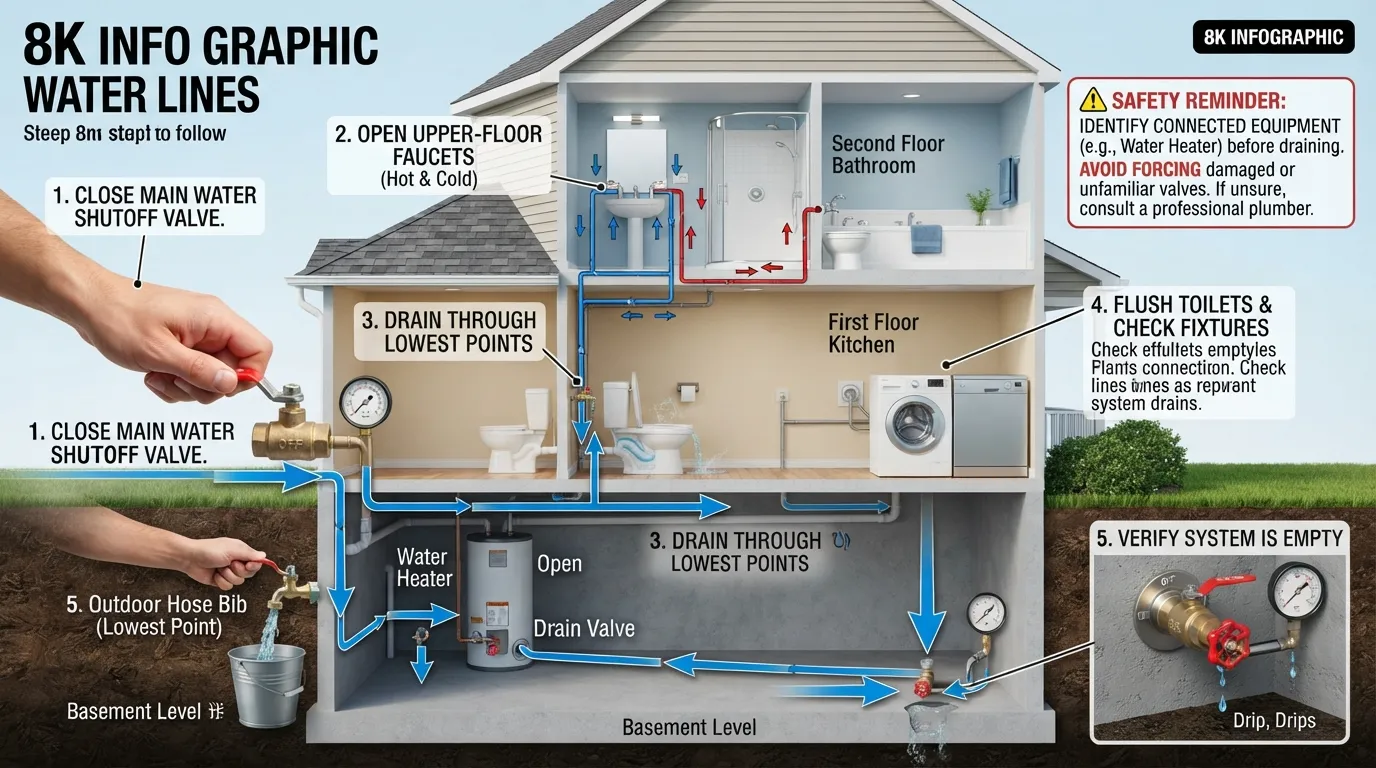
To drain household water lines, shut off the main water supply, open faucets so air can enter the system, work from upper fixtures toward lower ones, flush toilets, address connected appliances according to their manufacturer instructions, and let water leave through the lowest available outlets. Before turning the water back on, make sure any equipment you drained is ready to be refilled, then restore water slowly and check the system for leaks or abnormal flow.
First, Make Sure You Are Draining the Right Pipes
The phrase draining pipes can describe several completely different plumbing situations. Choosing the right procedure matters more than the wording of the search.
You want water out of the whole house
You are probably trying to drain the water-supply lines. Continue with the steps in this guide.
A sink or shower drains slowly
That points more toward a clog or drainage restriction, not a need to empty the water-supply pipes.
You mean sewer or waste pipes
You are dealing with the home’s drain-waste-vent system, which carries used water away rather than supplying clean water.
Water is collecting in your yard
That is normally an outdoor or stormwater drainage issue and requires a different diagnosis.
If you want a deeper explanation of sanitary drains, traps, vents, branch pipes, building drains, sewer connections, and stormwater systems, see our guide to how a home drainage system works.
Why Would You Need to Drain Water Lines in a House?
Completely draining your home’s supply piping is not part of ordinary daily plumbing maintenance. It is usually done for a specific reason.
- Pipe repairs: A section of plumbing may need to be empty before it can be opened, replaced, or repaired.
- Plumbing renovations: Adding or changing fixtures can require part or all of the supply system to be isolated and drained.
- Extended shutdowns: A property may need its plumbing prepared when the water will remain off for an extended period.
- Freeze protection: In climates where pipes can freeze, removing water from vulnerable lines can be part of a broader winterization procedure.
- Specific maintenance: Certain plumbing or appliance work may require a water line to be depressurized and emptied first.
You do not always need to empty every pipe in the building. If the work affects only one fixture or branch, a local shutoff may be sufficient. Whole-house draining makes more sense when the entire supply is being shut down or the work involves multiple parts of the system.
Before You Start: Identify the Main Shutoff and Your Lowest Outlets
Before turning anything off, take a minute to understand how water will leave the system.
Your home’s water-supply network normally operates under pressure. Once the main supply is shut off, opening faucets allows that pressure to fall and lets air enter while gravity moves water toward lower points in the piping.
Locate these items before starting:
- Your main water shutoff valve
- Upper-floor faucets, if your home has multiple levels
- Lower-level faucets or other suitable low outlets
- Outdoor hose bibs or faucets connected to the domestic supply
- Toilets
- Water-using appliances that may need separate attention
- Your water heater and its manufacturer instructions if your work affects it
Important safety boundary
Do not improvise with a water heater, boiler, fire-sprinkler system, well equipment, water-treatment equipment, or other specialized system. If your draining procedure affects one of these, follow its manufacturer instructions or have a qualified professional handle it. A domestic water-supply line and a hydronic heating system are not the same plumbing system.
How to Drain Water Lines in a House
The exact arrangement varies from one home to another, but this sequence gives you a practical framework for draining ordinary domestic water-supply lines.
1. Turn Off the Main Water Supply
Close the main shutoff valve that controls water entering the house. Once it is closed, the plumbing should no longer receive a continuous supply of fresh water.
If a valve is badly corroded, damaged, extremely difficult to move, or unfamiliar to you, do not force it. Breaking a main shutoff can turn a routine job into an active leak.
You should also avoid operating utility-owned valves or meter components unless your local utility specifically allows homeowners to do so.
2. Address Equipment That Should Not Operate Without Water
Before emptying connected equipment, determine whether your water heater or any other appliance needs to be shut down or placed in a safe mode.
If the job requires draining a water heater, use the manufacturer’s shutdown and draining procedure. Do not assume that turning off the house water alone makes every type of heater safe to drain or restart.
3. Open Faucets So Air Can Enter the Plumbing
Open both the hot and cold sides of the faucets that are part of the system you are draining.
In a multi-story house, working from upper fixtures downward is useful because opening high fixtures gives air a path into the supply network while water moves toward lower points.
Include sinks, tubs, showers, utility sinks, and other connected faucets that are relevant to the section being drained.
4. Open an Appropriate Low Outlet
Water needs somewhere to leave. A lower-level faucet, utility faucet, or suitable outdoor hose bib may function as a low draining point, depending on how your plumbing is arranged.
You may initially get a steady flow. As pressure disappears and the system empties, that flow should slow considerably.
Why the lowest point matters
Once the main supply is off, gravity does much of the work. Water in higher piping tends to move toward lower available outlets. However, pipe routing can create low spots where some residual water remains, so gravity draining should not automatically be interpreted as removing every last drop from every section.
5. Flush the Toilets
Flush each toilet to empty water from its supply-side reservoir as far as the normal fixture operation allows. The tank may refill only partially or not at all once the main water supply is shut off.
Remember that the toilet bowl and drain trap are part of the sanitary drainage side of the plumbing system. They are not the same thing as the pressurized water-supply line you are draining.
6. Check Connected Appliances and Specialty Lines
A whole-house shutdown can affect more than faucets. Depending on your home, water may also be connected to:
- Washing machines
- Dishwashers
- Refrigerators and ice makers
- Water filtration equipment
- Water softeners
- Outdoor fixtures
- Other permanently connected appliances
Do not disconnect or attempt to blow out these components just because the main house lines are being drained. Use the appliance manufacturer’s instructions when a connected line must also be emptied.
7. Let the System Drain and Check the Low Points Again
Give the remaining water time to leave. Check the lower outlets again rather than assuming the system is empty as soon as the first faucet stops flowing.
A large or complex home can take longer than a small one, and the layout matters as much as the number of fixtures.
How Do You Know When the Pipes Are Drained?
This is one of the most useful questions to ask because “I turned the water off” and “the lines are drained” are not the same thing.
Practical completion check
- The main water supply is fully shut off.
- Upper faucets have been opened so air can enter.
- The expected low outlets have stopped producing a meaningful flow of water.
- Toilet tanks and other relevant reservoirs have been addressed.
- Any appliances involved in the work have been handled according to their own instructions.
- You have considered whether your pipe layout contains special low points or systems that cannot be emptied by ordinary gravity draining.
If you are draining the lines for a repair, you generally need the affected section dry enough to perform that specific work safely. If you are winterizing a building against freezing, the standard is different because residual water trapped in vulnerable areas can still matter.
Do You Need an Air Compressor to Drain House Pipes?
Usually, not for a basic water-supply shutdown and gravity drain.
Compressed air is sometimes used in specialized winterization or blowout procedures to remove water that gravity does not clear. However, it should not be treated as a universal next step.
Do not guess at air pressure
Different plumbing components and connected equipment can have different pressure limitations. Using an arbitrary compressor setting can damage fittings, valves, appliances, or other components. If a blowout is actually required, use a procedure and pressure limit specified for the system or have a plumber perform it.
Compressed air is particularly poor territory for trial and error when you are unsure which valves isolate which equipment.
How to Turn the Water Back On After Draining the Pipes
Restarting the plumbing deserves the same care as draining it. Do not simply snap the main valve fully open and walk away.
- Confirm the repair or maintenance work is complete. Recheck fittings, valves, appliance connections, and anything that was opened or disconnected.
- Prepare any drained equipment for refilling. Follow the manufacturer’s instructions for your water heater and other connected equipment.
- Close outlets as appropriate. Make sure you are not about to send water through an open repair point.
- Restore the main water supply gradually. Let the plumbing fill rather than introducing full flow abruptly.
- Open faucets deliberately. Allow trapped air to escape until the flow becomes steady.
- Refill toilets and connected equipment. Check each part of the system you previously drained.
- Inspect for leaks. Look around repaired joints, shutoff valves, appliance connections, visible piping, and other areas that were disturbed.
Some sputtering at faucets can occur while trapped air leaves a recently refilled water line. Persistent pressure problems, ongoing unusual noises, or leaking connections deserve further investigation.
Draining Pipes for Freezing Weather: What Changes?
If your goal is freeze protection, draining the supply lines is only one part of winterizing a property.
Water can remain in fixture traps, toilets, appliances, low spots, exterior lines, irrigation components, and specialized systems even when household faucets have stopped flowing.
That means a winterization plan should be based on the actual property rather than the assumption that opening a few faucets makes the entire building freeze-safe.
If a home has a boiler or hydronic heating system, do not use domestic water-line instructions as a boiler-draining procedure. Heating loops, boilers, pumps, expansion components, and their controls require system-specific handling.
South Florida note
For Miami-area properties, whole-house draining is more likely to be associated with a repair, renovation, shutdown, or specific maintenance need than routine cold-weather winterization. If your actual symptom is a slow drain, sewage backup, or storm-related drainage problem, shutting off and draining the clean-water supply will not correct the underlying blockage.
What If Water Is Taking a Long Time to Drain From a Sink or Shower?
This is where the meaning of draining pipes changes completely.
If water remains in a sink, bathtub, shower, floor drain, or other fixture during normal use, you are probably dealing with the wastewater side of the plumbing system rather than trying to empty the home’s supply lines.
Common warning signs of a drain restriction include:
- One fixture draining noticeably slower than normal
- Water pooling around a sink, tub, or shower drain
- Recurring clogs
- Gurgling from drains or toilets
- Unpleasant drain odors that keep returning
- Several fixtures becoming slow at the same time
- Wastewater rising through a shower, tub, floor drain, or toilet
One slow drain vs. several slow drains
A single slow fixture can point to a localized restriction near that fixture. If several drains back up together, wastewater appears in another fixture, or a toilet gurgles when water runs elsewhere, the restriction may be farther downstream in a shared drain or sewer line.
For recurring or multi-fixture problems, see our professional drain cleaning in Miami service for diagnosis and appropriate clearing options.
What Are Drainage Pipes Actually Called?
If you were searching for drain pipes rather than instructions for emptying your water lines, the terminology is different.
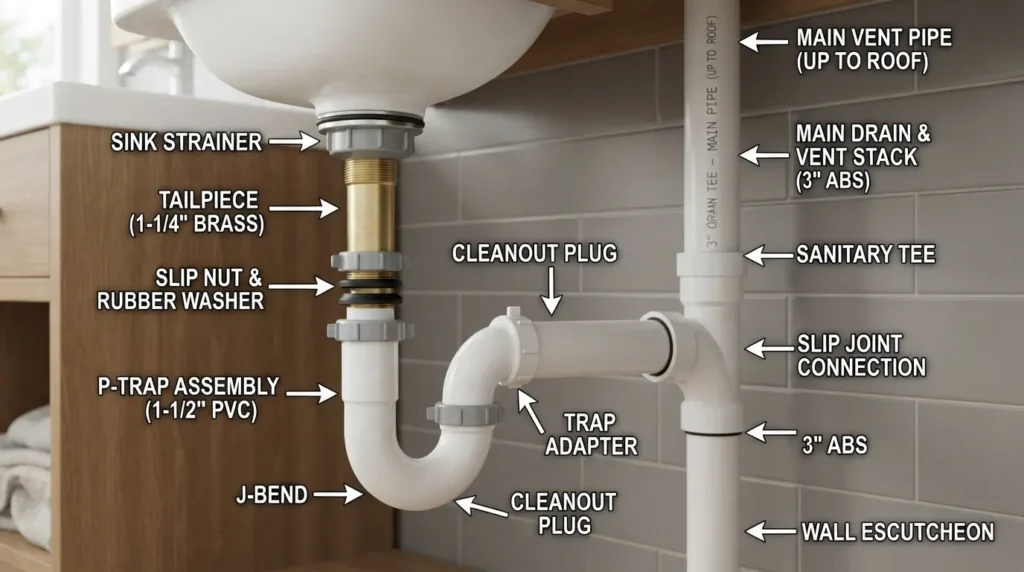
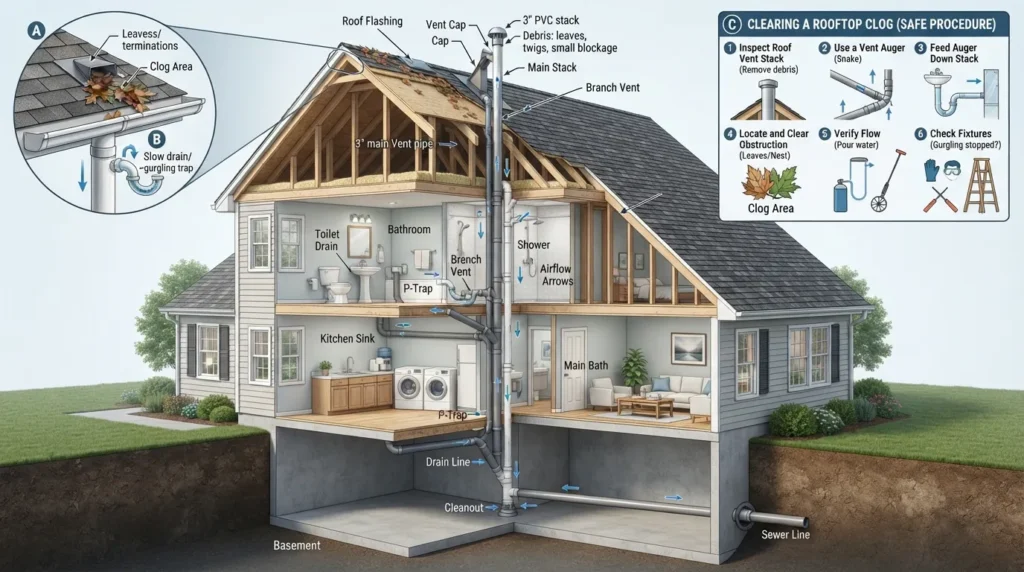
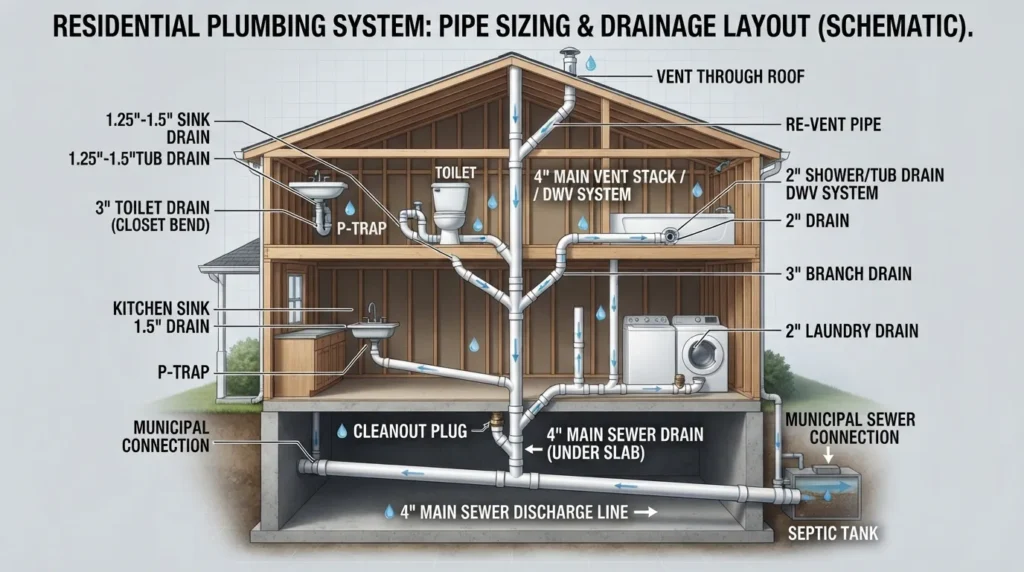
Indoor wastewater piping is commonly discussed as part of the drain-waste-vent system, or DWV system. Depending on the location and purpose, you may hear terms such as:
- Fixture drain: Receives wastewater directly from a fixture.
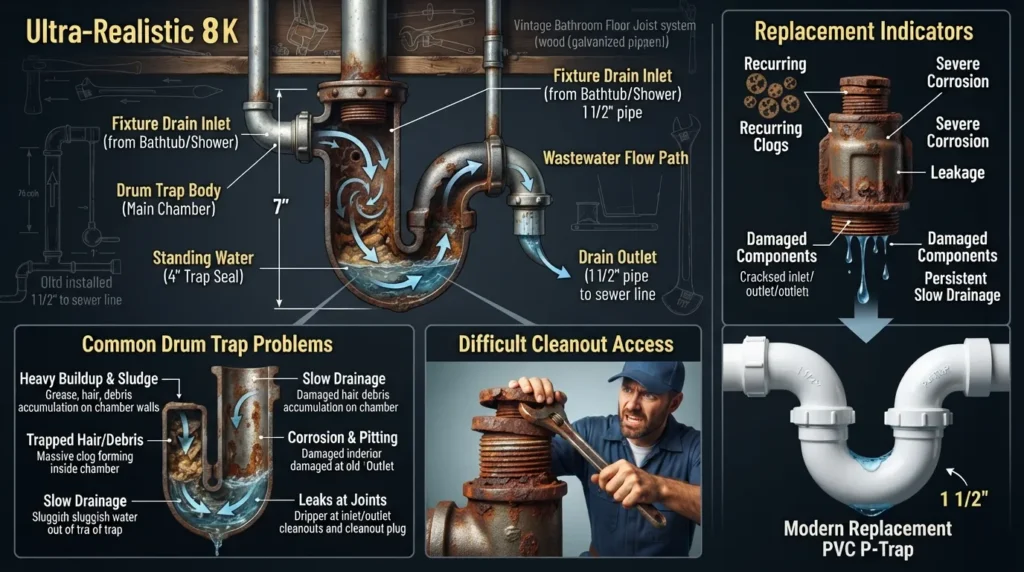
- P-trap: Retains a water seal that helps keep sewer gases from entering the room.
- Trap arm: Connects the trap to the drainage network.
- Branch drain: Collects wastewater from one or more fixtures.
- Waste or soil stack: Provides a vertical drainage path in many multi-level plumbing layouts.
- Building drain: Receives combined wastewater flow inside or near the lower part of the building.
- Building sewer or sewer lateral: Carries discharge from the building toward the public sewer or other approved wastewater system.
- Vent pipe: Provides the airflow needed for the drainage network to function correctly and protect trap seals.
- Cleanout: Provides access for inspection or clearing parts of the drainage system.
Common drainage materials can include PVC, ABS, cast iron, and other materials depending on the building, age of the plumbing, and application.
Outdoor rainwater drainage is another category again. Corrugated pipe, solid drainage pipe, perforated pipe, French drains, yard drains, and downspout drainage are intended to manage site water rather than household sanitary wastewater.
When Should You Stop and Call a Plumber?
Draining straightforward household supply lines can be manageable when you know the plumbing layout and the equipment involved. The situation changes when the task starts requiring diagnosis, specialized equipment, or work on unfamiliar systems.
Professional help is the safer next step when:
- You cannot identify or operate the main shutoff safely.
- The main valve leaks or appears damaged.
- Water continues flowing when it should be isolated.
- You need to work on a boiler, well system, specialized heating loop, or complex equipment.
- You need compressed air but do not know the correct procedure for the system.
- You suspect a hidden leak or damaged pipe.
- Several drains are backing up together.
- Sewage or wastewater is rising through a fixture.
- The original plumbing problem remains after water service is restored.
If you are in Miami-Dade and the procedure is becoming more involved than a simple shutdown, our Miami plumbing team can help identify whether you are dealing with a supply-line, fixture, drain, or sewer problem.
Frequently Asked Questions About Draining Pipes
How do you properly drain pipes in a house?
For ordinary household water-supply lines, shut off the main supply, safely prepare connected equipment, open faucets to admit air, allow water to leave through lower outlets, flush toilets, address relevant appliances according to their instructions, and wait until meaningful flow has stopped. Restore the supply gradually after the work is complete and check for leaks.
How long does it take to drain water from pipes in a house?
There is no universal time. It depends on the size and layout of the plumbing, how many fixtures and appliances are involved, the location of the low points, and how completely the system must be drained. A small system can empty much faster than a large multi-story property with complex piping.
How do you empty a pipe completely?
First isolate the water source, then open a path for air to enter and a lower point for water to exit. Gravity can remove much of the water, but pipe routing may leave residual water in low spots. If complete removal is essential, such as for specialized winterization, use a system-specific procedure rather than assuming every pipe is empty when one faucet stops dripping.
Can I drain house water lines with an air compressor?
Compressed air can be used in some specialized blowout procedures, but it is not automatically required and there is no universal pressure setting that is appropriate for every plumbing system. Follow system and equipment requirements or use a professional if a blowout is necessary.
How long does a 50-gallon water heater take to drain?
Tank capacity alone cannot give you an accurate drain time. The result depends on factors such as the drain path, valve condition, hose setup, sediment, and how easily air can enter the tank. Follow the water heater manufacturer’s draining procedure instead of estimating the process from gallon capacity alone.
How can I tell if a drain is clogged?
Look for slow drainage, standing water, recurring backups, gurgling, persistent drain odors, or wastewater appearing through another fixture. Several fixtures backing up at the same time can indicate a restriction in shared drainage piping rather than a simple clog at one sink.
Why is water taking so long to drain?
If you mean a sink, shower, or tub during normal use, slow drainage commonly points to a partial restriction in the drain path. If you mean a house you have intentionally shut down, the draining speed depends on the plumbing layout, available low outlets, and whether air can enter the system.
Will a clogged drain go away on its own?
Do not rely on it. A partial blockage may appear to improve temporarily as water slowly passes it, but hair, grease, debris, scale, foreign material, or a deeper obstruction can remain and cause the problem to return.
Will pouring boiling water down a drain unclog it?
Boiling water should not be treated as a universal drain-clearing method. It will not remove many common obstructions such as hair, foreign objects, roots, or serious buildup, and you may not know how heat will affect the piping and connections in an older or unfamiliar system. Diagnose the type and location of the blockage instead of repeatedly pouring extreme-temperature water into the drain.
What can unclog a drain quickly?
For a minor localized clog, removing accessible debris, cleaning the stopper or strainer, or using an appropriate plunger may restore flow. If the clog repeatedly returns, several fixtures are affected, or sewage is backing up, stop treating it as a simple surface clog and have the drainage system diagnosed.
How much does a plumber charge to unclog a drain?
There is no single price that applies to every clog. Cost depends on where the blockage is located, how accessible the pipe is, whether one or several fixtures are affected, the clearing method required, and whether inspection or additional repair is needed. Ask for the scope of work and pricing before authorizing service.
Properly draining pipes starts with identifying which plumbing system you are actually working on.
If your goal is to empty your home’s clean-water supply lines, shut off the incoming water, give air a path into the system, let water move toward suitable lower outlets, account for toilets and connected equipment, verify that meaningful flow has stopped, and restore the system gradually when the work is finished.
If your real problem is that a sink, shower, toilet, or floor drain is not carrying wastewater away, draining the supply lines will not solve it. That is a drainage diagnosis problem and may require clog removal or sewer-line service instead.
Not sure which side of the plumbing system is causing the problem?
If you are dealing with a shutoff problem, leaking pipe, persistent clog, wastewater backup, or a system you are not comfortable draining yourself, getting the problem identified first can prevent the wrong repair.