If you are dealing with recurring commercial drain backups, grease buildup, sludge, scale, or a sewer line that keeps clogging after ordinary clearing, commercial hydro jetting may be the deeper cleaning method you need.
Commercial hydro jetting uses controlled streams of high-pressure water and specialized nozzles to break apart obstructions and wash buildup from the inside of drain and sewer pipes. It can be particularly useful for grease-heavy lines, sludge, accumulated residue, mineral scale, and some root intrusion. But it is not automatically the right solution for every clog. If a pipe is collapsed, badly deteriorated, offset, or structurally damaged, cleaning alone cannot repair it. The right decision starts with diagnosing the line rather than simply choosing the most powerful machine.
That distinction matters in commercial plumbing. A restaurant kitchen, apartment property, retail building, office, healthcare facility, school, or other high-use property may have multiple fixtures feeding larger shared drain lines. A temporary opening through a clog may restore flow today without removing the material that is still coating the pipe walls.
In this guide, I’ll help you determine when commercial drain jetting makes sense, when another method may be better, what affects cost and downtime, how professionals reduce pipe-damage risk, and what Miami businesses should know about grease-heavy drainage systems.
Best fit
Recurring grease, sludge, scale, residue, and buildup along pipe walls.
Diagnose first
Old, damaged, repeatedly blocked, or structurally questionable drain and sewer lines.
Not a repair
Hydro jetting cleans a suitable pipe; it does not fix a collapsed, broken, or badly displaced line.
What Is Commercial Hydro Jetting?
Commercial hydro jetting, also called commercial water jetting or commercial drain jetting, is a professional drain and sewer cleaning process. A high-pressure hose is inserted through an appropriate access point, and a nozzle directs water into the line to break up material and flush loosened debris through the drainage system.
Different nozzle patterns can serve different jobs. Forward-directed water can help penetrate an obstruction, while side and rear jets can clean more of the internal pipe surface and help propel the hose through the line. Commercial systems can operate at very high pressure; some professional services describe equipment capable of pressures up to 4,000 PSI. The important point, however, is not to use the highest pressure possible. The equipment, nozzle, and operating pressure should be selected for the specific pipe and obstruction.
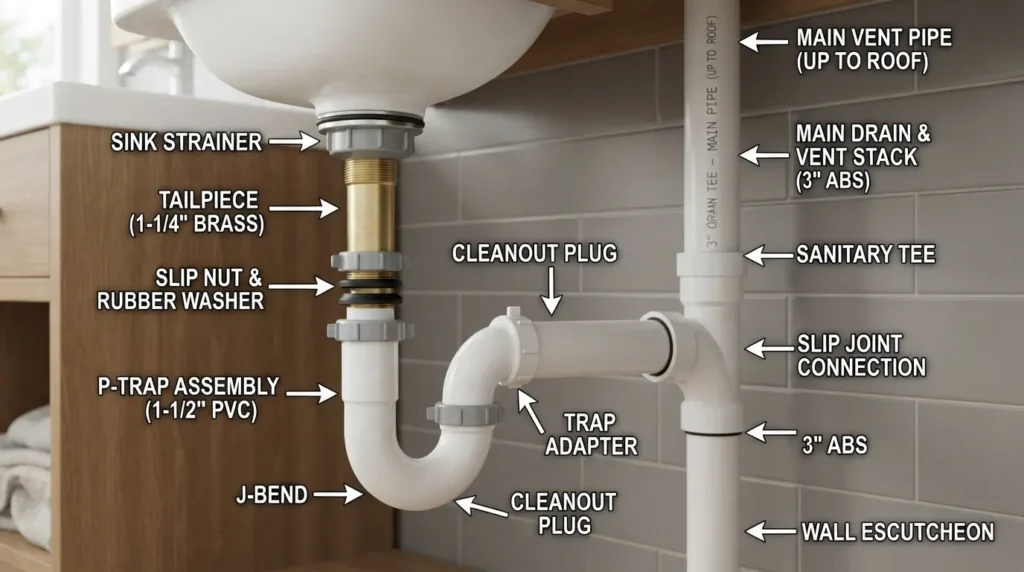
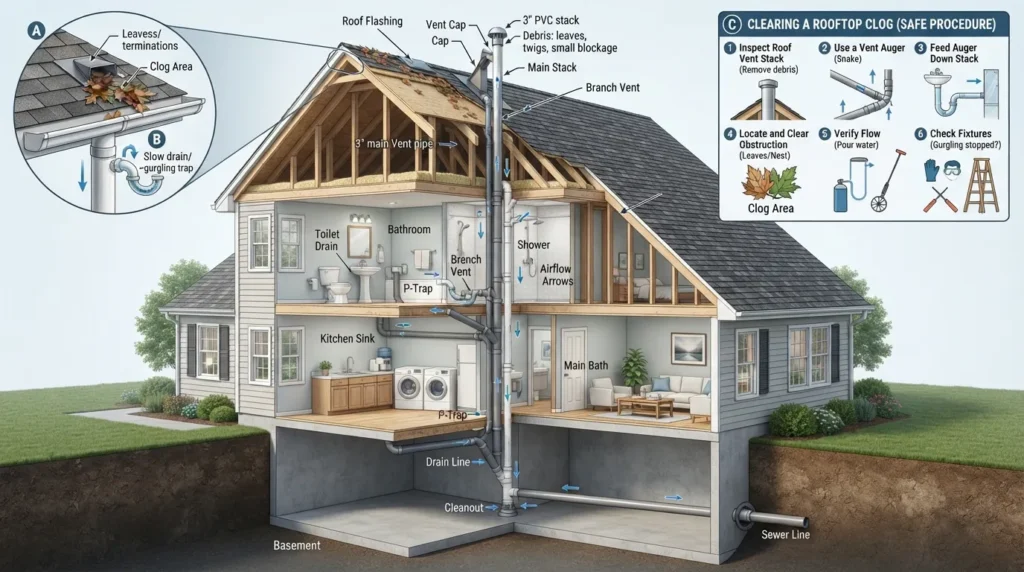
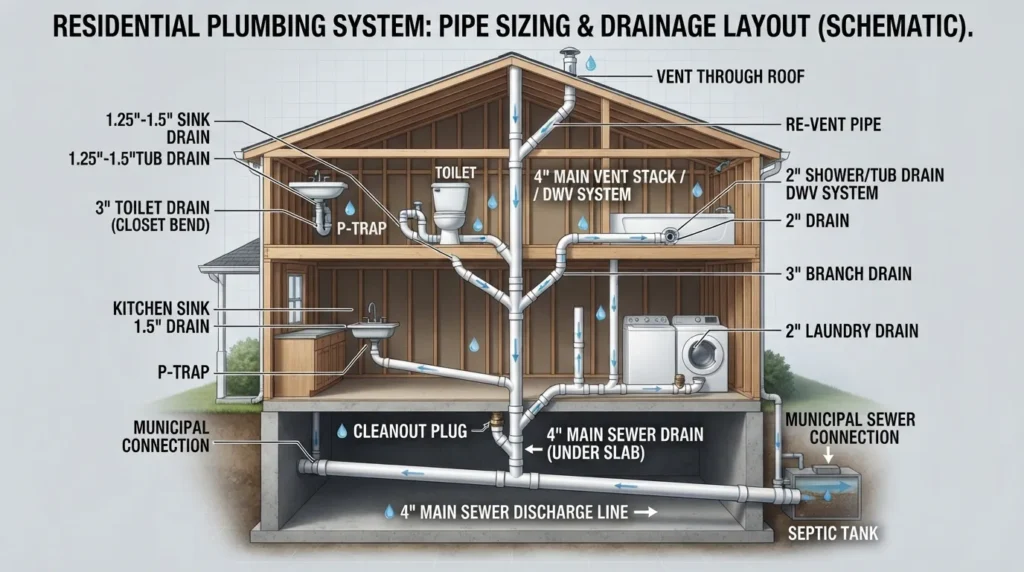
If you want a broader explanation of how branch drains, building drains, sewer lines, cleanouts, and other components connect, see our guide to how a drainage system works.
Do You Actually Need Commercial Hydro Jetting?
This is a better question than simply asking whether hydro jetting is powerful. I would look at the type of problem inside the pipe first.
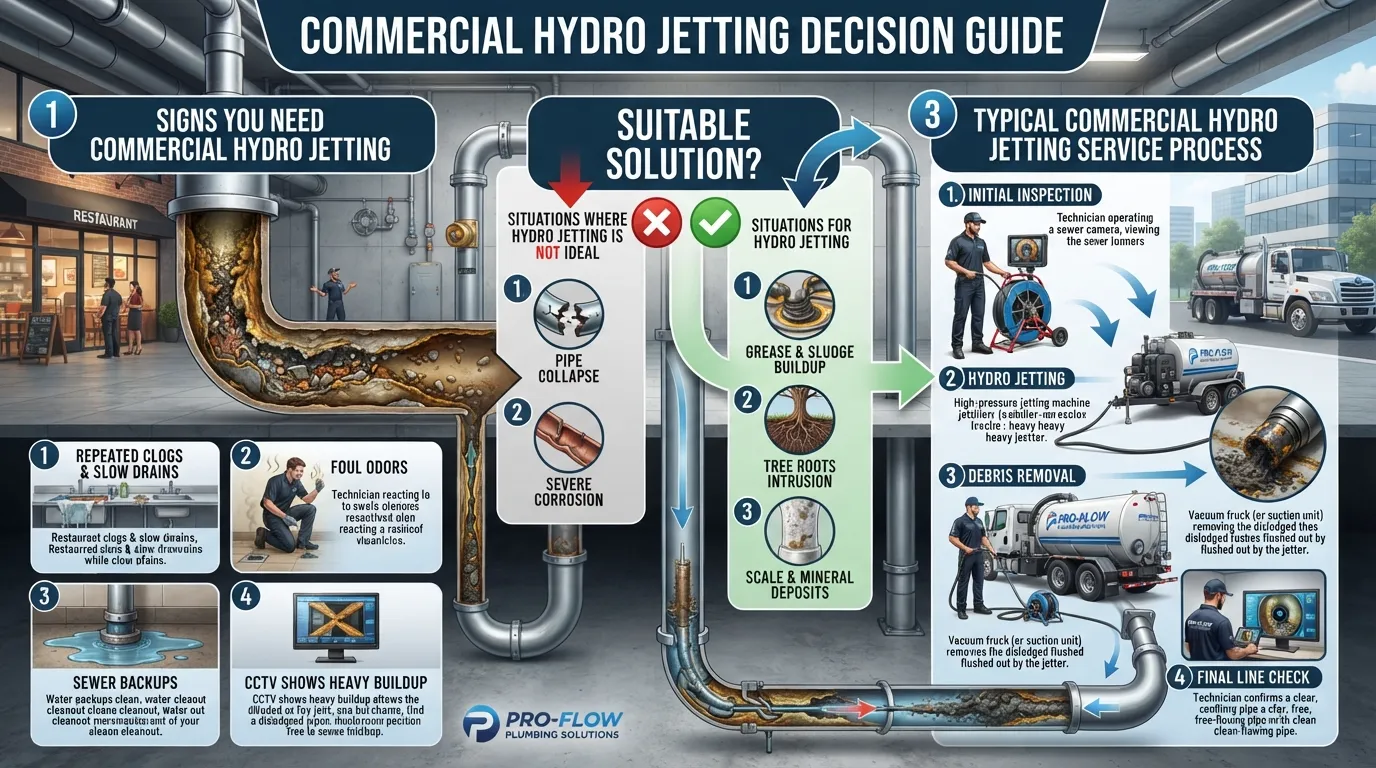
Commercial Hydro Jetting Decision Guide
Recurring grease buildup
Strong candidate. Jetting can remove accumulated material from more of the pipe wall instead of only opening a narrow passage.
Clog returns after snaking
Worth evaluating. A cable may have restored flow without removing grease, sludge, or scale lining the pipe.
Slow commercial floor drains
Possible candidate. First determine whether the restriction is localized, shared downstream, or caused by another drainage problem.
Root intrusion
Depends on severity. Jetting equipment may remove some root intrusion, but roots often indicate an opening or defect that also needs evaluation.
Single localized obstruction
Hydro jetting may be unnecessary. A mechanical snake or another targeted method can sometimes be more appropriate.
Collapsed or severely damaged pipe
Not a cleaning problem. Structural damage requires a repair strategy rather than higher-pressure cleaning.
What Can Commercial Hydro Jetting Remove?
Hydro jetting is valuable because the water does more than push against the center of a clog. With the appropriate nozzle, it can wash material from a much larger portion of the pipe’s internal surface.
Depending on the line, pipe condition, equipment, and obstruction, professional water jetting may be used against:
- Fats, oils, and grease buildup
- Sludge and organic residue
- Food-related accumulation in commercial kitchen drains
- Soap and other pipe-wall deposits
- Sand, silt, mud, and loose debris
- Mineral scale and hardened deposits
- Some tree-root intrusion
- Recurring buildup in main drains, branch lines, and suitable sewer lines
Commercial hydro-jetting providers commonly identify grease, sludge, debris, scale, and roots as major applications for high-pressure water cleaning.
What Hydro Jetting Cannot Fix
A useful rule: cleaning and repair are different jobs.
If the pipe itself is failing, repeatedly blasting the blockage away does not correct the structural cause.
Hydro jetting should not be presented as a universal answer for:
- A collapsed sewer or drain pipe
- A badly cracked or deteriorated line
- Major pipe offsets or separation
- A sewer belly or improper drainage geometry
- A recurring root problem caused by an unrepaired pipe defect
- A blockage where the pipe condition makes jetting unsuitable
This is why a recurring commercial blockage deserves diagnosis. If you keep clearing the same line without asking why it keeps closing again, you may be treating the symptom rather than the problem.
Commercial Hydro Jetting vs. Snaking vs. Camera Inspection
These methods are often discussed as if one must always be better than the others. In practice, they solve different parts of the problem.
Hydro Jetting
Think: deep cleaning.
- Useful for grease and sludge
- Removes more pipe-wall buildup
- Useful for recurring residue
- Can address some scale and roots
- Requires a suitable pipe condition
Drain Snaking
Think: targeted clearing.
- Useful for many localized obstructions
- Can restore a pathway through a clog
- Often practical for fixture-level problems
- May leave pipe-wall residue behind
- Can be the right first tool in some situations
Camera Inspection
Think: diagnosis.
- Shows conditions inside accessible lines
- Useful for recurring backups
- Can reveal cracks, roots, offsets, or damage
- Helps determine whether cleaning is appropriate
- Does not itself clear the clog
A commercial line that repeatedly blocks after snaking is a classic reason to investigate whether residue remains on the pipe walls. Conversely, a camera inspection may show that your real problem is structural and that additional cleaning will not deliver a lasting solution. Roto-Rooter and other commercial providers specifically distinguish water jetting from mechanical cable cleaning for grease and sludge buildup.
If you need professional diagnosis rather than guessing which method to use, see our drain cleaning service in Miami.
How the Commercial Hydro Jetting Process Works
The exact procedure depends on the property and line, but a responsible process generally follows a diagnose-first approach.
- Review the symptoms. Are you dealing with one slow drain, multiple backed-up fixtures, floor-drain trouble, grease buildup, odors, or a recurring main-line blockage?
- Locate the affected line and access point. The technician determines which branch, main, sewer, or other drain section needs attention and how it can be safely accessed.
- Evaluate the pipe and obstruction. A camera inspection can be useful when the clog is recurring, the pipe condition is uncertain, or structural damage is possible.
- Select the equipment and nozzle. The nozzle should match the type of debris, pipe diameter, access, and condition of the line.
- Jet the line. High-pressure water breaks apart the obstruction and washes loosened debris through the pipe.
- Check the result. Flow should be tested after cleaning. Where warranted, a follow-up camera inspection can help confirm cleaning results and reveal damage that had been hidden behind buildup.
Commercial hydro-jetting guides commonly describe inspection, cleanout access, hose/nozzle insertion, controlled cleaning, and post-cleaning verification as important parts of the process.
Can Hydro Jetting Damage Sewer Pipes?
It can create problems if the pipe is already compromised or the equipment is used incorrectly. That is why “Is hydro jetting safe?” should really be reframed as “Is this particular pipe suitable for hydro jetting?”
A plumber may need to consider:
- Pipe material
- Age and visible deterioration
- Cracks or breaks
- Corrosion
- Joint condition
- Root intrusion
- Previous repairs
- Pipe diameter
- Type and location of the obstruction
Commercial hydro-jetting guidance notes that very brittle or damaged lines should be evaluated before high-pressure cleaning.
Pressure is not the goal. Controlled cleaning is.
A higher PSI number does not automatically mean a better job. The useful result is removing the obstruction while protecting a pipe that is suitable for cleaning.
How Much Does Commercial Hydro Jetting Cost?
There is no responsible universal price for every commercial hydro jetting job. A restaurant branch line, a multi-unit property’s main sewer, and a large commercial drainage system can require very different access, equipment, cleaning time, and diagnostic work.
The most important cost factors usually include:
- Severity of the blockage: light residue is different from a heavily restricted line.
- Length and size of the line: larger or longer systems may require more work.
- Number of affected lines: one branch drain is not the same scope as multiple commercial drains.
- Access: an accessible cleanout can make the job simpler than a difficult-to-reach line.
- Type of material: grease, sludge, scale, roots, and solid debris may require different tools or passes.
- Pipe condition: suspected damage can create a need for camera inspection or a different repair plan.
- Urgency and scheduling: emergency or operational constraints can affect the scope of service.
- Additional work: some blockages require preliminary mechanical clearing, inspection, or repair.
Published commercial hydro-jetting providers likewise identify blockage severity, pipe length, location, and accessibility as important pricing variables.
Want a more useful estimate?
When you contact a plumber, explain what type of business you operate, which drains are affected, whether multiple fixtures back up together, how often the problem returns, what previous clearing has been attempted, and whether a sewer camera has already been used.
How Long Does Commercial Hydro Jetting Take?
There is no reliable single timeframe for every commercial property. Service duration depends on what the plumber finds.
A straightforward accessible line with ordinary buildup may require less work than a long sewer line with severe grease, scale, roots, difficult access, or multiple problem areas. Camera inspection, preliminary clearing, repeated passes, and post-cleaning verification can also affect the total time.
For a business, I would focus on a better operational question:
“Which fixtures or areas will need to be out of service, and for how long?”
Ask this before work starts so you can plan around kitchens, restrooms, tenants, customers, employees, or other operations affected by the drain line.
How Often Should a Commercial Sewer Line Be Hydro Jetted?
There is no single maintenance interval that is correct for every business.
A restaurant with heavy grease exposure may need a different maintenance plan from an office building with relatively light drain usage. Rather than choosing an arbitrary schedule, base preventive commercial drain jetting on actual system conditions.
Consider these maintenance signals:
- How quickly grease or residue builds up
- How frequently the drains have backed up in the past
- Whether snaking provides only temporary relief
- Business type and daily drain usage
- Inspection findings
- Pipe material and condition
- Previous root or scale problems
- Whether a backup would cause serious business interruption
Even large commercial providers note that businesses with heavier grease and waste loads may need more frequent service than low-use systems, which is why a property-specific maintenance schedule is more useful than a blanket rule.
Which Businesses Commonly Benefit From Commercial Drain Jetting?
Any commercial property can develop drain or sewer buildup, but hydro jetting is especially relevant where plumbing receives frequent use or recurring materials accumulate inside the lines.
Grease, food residue, floor drains, and high daily usage can create recurring buildup.
Multiple rooms, kitchens, laundry areas, and public fixtures can place heavy demands on shared lines.
One downstream restriction may affect multiple occupants or common drainage lines.
Recurring restroom or main-line problems can disrupt staff, customers, and tenants.
High fixture counts and operational requirements make reliable drainage especially important.
Larger or specialized drainage systems may need professional cleaning matched to their particular waste stream and pipe design.
A Miami Commercial Plumbing Issue That Deserves Special Attention: FOG
For Miami restaurants, cafeterias, supermarkets, banquet facilities, food courts, schools, and other food-handling businesses, fats, oils, and grease deserve more attention than a generic “clog prevention” paragraph.
Miami-Dade County explains that FOG can stick to and harden along sewer pipe walls, restricting wastewater flow and contributing to sewer blockages. The County also states that qualifying non-residential facilities that handle or process food and discharge or have the potential to discharge FOG require a FOG Discharge Control operating permit and an approved operational FOG control device.
Important distinction for food-service businesses
Hydro jetting can clean suitable drain and sewer piping, but it should not be treated as a replacement for required grease-control practices, grease interceptors or traps, maintenance responsibilities, or applicable Miami-Dade FOG requirements.
The better strategy is prevention plus appropriate maintenance: control what enters the drain, maintain required grease-control equipment, and address recurring line buildup before it turns into a full backup.
For official local guidance, review the Miami-Dade County Fats, Oils and Grease guidance.
Can You Do Commercial Hydro Jetting Yourself?
For a commercial main drain or sewer line, DIY hydro jetting is generally not a sensible default.
The challenge is not simply getting access to a high-pressure machine. You also need to understand what is blocking the pipe, whether the pipe is suitable for jetting, where the line can be safely accessed, which nozzle should be used, and how much pressure is appropriate.
A structurally damaged pipe can also look like “just another recurring clog” until it is inspected.
For simple fixture-level problems, a plunger or other ordinary maintenance may be reasonable. A recurring commercial sewer or main-drain problem deserves professional diagnosis rather than trial-and-error high-pressure cleaning.
Watch Commercial Hydro Jetting in Action
If you have never seen the process, this third-party educational video gives you a useful visual example of high-pressure water jetting for commercial, industrial, and municipal drain and sewer cleaning.
Third-party educational video: Roto-Rooter Hydro-Jetting Service. :contentReference[oaicite:8]{index=8}
Questions to Ask Before Approving Commercial Hydro Jetting
If you are comparing plumbers or reviewing a service recommendation, these questions are more useful than asking only for the PSI of the equipment:
- What do you believe is causing the blockage?
- Why is hydro jetting a better fit than snaking for this line?
- Do you recommend a camera inspection before or after cleaning?
- Is there any sign the pipe may be structurally damaged?
- Which drain or sewer lines are included in the scope?
- Is access through an existing cleanout available?
- What could make the final price change?
- Will parts of the property need to stop using water during service?
- What should we change to reduce the chance of the same buildup returning?
- If you find pipe damage, what happens next?
Quick Takeaway: Jet the Problem, Not the Keyword
If your commercial drain keeps clogging, the goal is not simply to order “hydro jetting.” The goal is to identify why the line is restricted and choose the least-disruptive effective solution.
- Use hydro jetting when pipe-wall buildup needs deeper cleaning.
- Use mechanical clearing when it better fits a localized obstruction.
- Use a camera when you need evidence about the cause or pipe condition.
- Repair the line when the underlying problem is structural.
Commercial Hydro Jetting FAQs
How much does it cost to hydro jet a main line?
The price depends on the line length and diameter, severity and type of blockage, access, pipe condition, required diagnostics, and amount of work involved. Commercial properties vary too much for one price to accurately represent every main-line jetting job.
Is commercial hydro jetting worth the cost?
It can be worth it when recurring grease, sludge, scale, or residue remains along a suitable pipe’s interior and ordinary clearing keeps providing only temporary relief. It is less useful when the real problem is a collapsed or badly damaged pipe that needs repair.
Is hydro jetting better than snaking?
Neither method is automatically better. Snaking can be effective for many localized obstructions. Hydro jetting is often more useful when the goal is to remove heavier buildup from a larger portion of the pipe wall. The blockage and pipe condition should determine the method.
How long does it take to hydro jet a sewer line?
It depends on access, line length, blockage severity, pipe condition, number of lines involved, and whether camera inspection or preliminary clearing is required. Ask your plumber how the planned work will affect your particular business operations.
How long will hydro jetting last?
There is no fixed lifespan for a hydro-jetting service. A cleaned line can begin accumulating material again if the underlying source—such as heavy grease discharge, scale, roots, or another drainage problem—continues. Prevention and condition-based maintenance matter.
Can hydro jetting damage old sewer pipes?
Old age alone does not answer the question. The actual pipe condition matters. Brittle, corroded, cracked, or otherwise compromised lines should be evaluated before high-pressure cleaning is used.
How often should I hydro jet my commercial sewer line?
Base the schedule on your business type, grease and waste load, clog history, inspection findings, pipe condition, and consequences of a backup. A high-use restaurant may need a different maintenance plan from a low-use office property.
Does Roto-Rooter do hydro jetting?
Yes. Roto-Rooter currently publishes commercial hydro-jetting and high-pressure water-jetting services on its website. More important when comparing providers is whether the proposed service includes proper diagnosis, suitable equipment selection, clear scope, and consideration of pipe condition.
Is Roto-Rooter more expensive than a local plumber?
You cannot reliably determine that from the company name alone. Compare written scopes for the same problem: inspection, access, cleaning method, number of lines, emergency fees if any, follow-up camera work, and any repair recommendations. Two quotes may look different because they include different work.
Can I rent hydro jetting equipment and do it myself?
Equipment availability does not make commercial sewer jetting a good DIY job. High-pressure equipment must be matched to the pipe, access, obstruction, and condition of the line. For commercial main drains and recurring sewer problems, professional evaluation is the safer approach.
Recurring Commercial Drain Problem in Miami?
If a drain keeps backing up, you do not have to guess whether you need a snake, hydro jetting, a sewer camera, or a repair. Start with the symptoms and the condition of the line.
The EZ Plumbing Miami team works with drain and plumbing problems across Miami-Dade, and our goal is to match the clearing method to what is actually happening inside the system. :contentReference[oaicite:10]{index=10}
Related Resources
- Miami-Dade County: Fats, Oils and Grease (FOG) — official local guidance for residential and non-residential FOG management.
- Miami-Dade FOG Discharge Control Operating Permit — permit information for qualifying non-residential FOG generators.
- Commercial Hydro-Jetting Technical Overview — an external reference covering commercial water-jetting equipment, applications, and maintenance considerations.