Roto-Rooter Is Here for All Your Plumbing Problems: Services, Costs and Is It Worth It? 2026 Guide
Roto-Rooter Is Here for All Your Plumbing Problems: What Does It Really Mean?
Roto-Rooter is North America’s largest provider of emergency plumbing repairs, professional drain cleaning, and water damage cleanup services. The company’s core service promise—encapsulated by its iconic brand message—signals round-the-clock availability for residential and commercial plumbing crises. Through centralized dispatching, video camera diagnostics, and specialized heavy machinery, the franchise is built to resolve everything from severe sewer main blockages to sudden water pipe bursts.
What Roto-Rooter Offers
Overview of Capabilities:
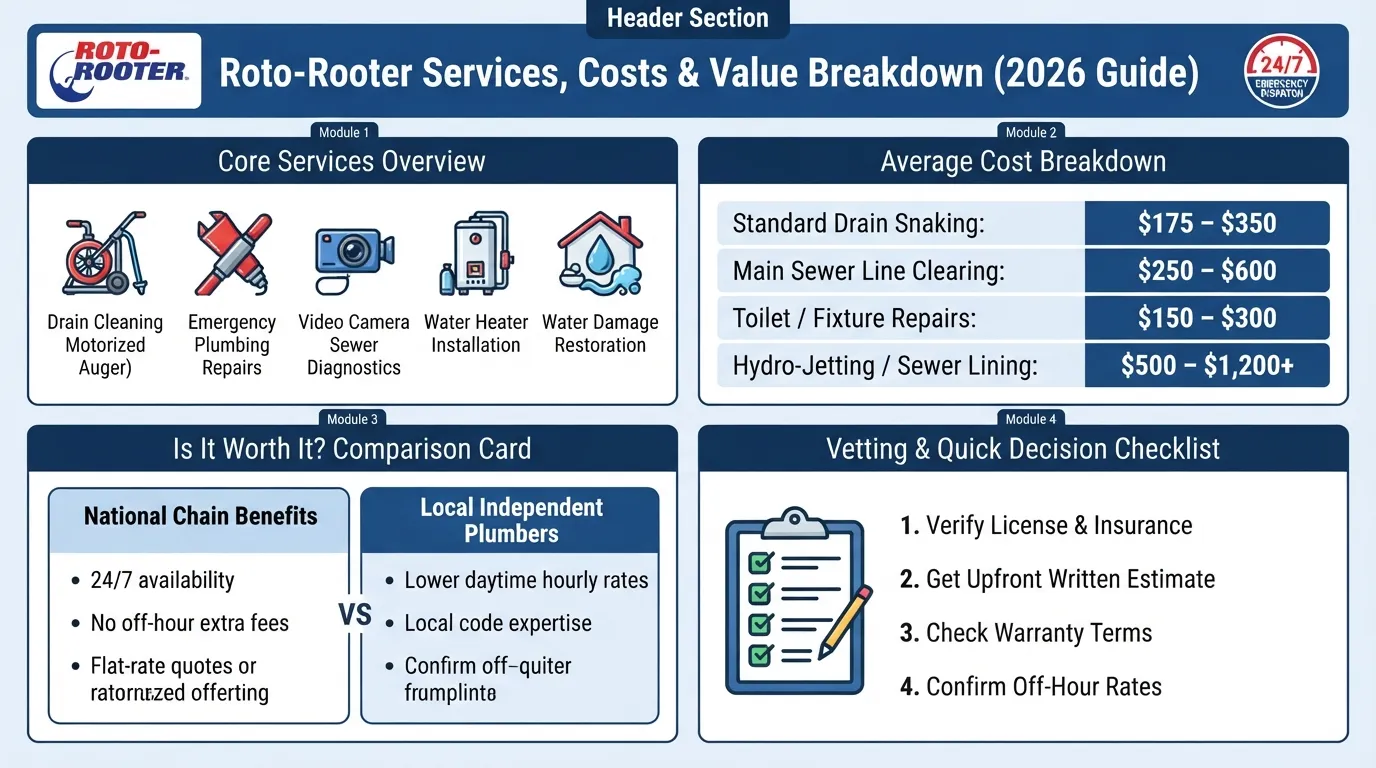
Roto-Rooter operates as a full-service residential and commercial emergency plumber. Their standard offerings include high-pressure water jetting, mechanized drain cleaning, trenchless sewer repair, and detailed video camera inspection services. They also deliver comprehensive plumbing services covering tankless water heater installations, leak detection, backflow prevention, and structural water damage restoration.
Where the “Here for All Your Plumbing Problems” Slogan Comes From
The tagline originates from Roto-Rooter’s historic 1954 radio commercial jingle written for WLS Radio in Chicago, which introduced the famous chorus line: “When Roto-Rooter’s here, that’s when your troubles disappear”. Created by Captain Stubby and The Buccaneers, this ad campaign evolved into one of the longest continuously running advertising jingles in American history. Over time, media campaigns modernized the phrase into “Here for All Your Plumbing Problems” to reflect the brand’s expansion from routine drain cleaning into full-scale plumbing and restoration solutions.
What This Guide Covers
To help you decide if Roto-Rooter fits your immediate needs, this comprehensive review explores:
Cost Breakdown & Pricing Structure: Understanding flat rates, trip fees, and emergency premiums.
Competitor Comparison: How Roto-Rooter stacks up against local independent plumbers and national chains.
Trust & Reliability: Analyzing customer ratings, licensing standards, and service guarantees.
DIY vs. Professional Callouts: Knowing when to clear a clog yourself versus calling a pro.
Sewer Line & Hydro-Jetting Solutions: Costs and procedures for main line blockages.
Emergency Dispatch Response: What to expect during late-night or holiday calls.
Who This Guide Is For
Homeowners Facing Urgent Crises: Readers needing an emergency plumber immediately for backed-up sewage, severe leaks, or failing water heaters.
Prospective Customers Comparing Options: Property owners shopping around to evaluate service costs, reputation, and alternative contractors before booking.
Expert Insights:
“The biggest misconception homeowners have about ‘one-call-fixes-everything’ guarantees is assuming every drain issue is a quick fixture fix,” notes a master licensed plumber. “While a mechanized auger or camera inspection handles isolated clogs instantly, chronic backups often point to broken sewer mains or shifting soil—issues requiring structured pipe replacement rather than a simple 30-minute clearing.”
This vintage commercial recording showcases the original 1954 Roto-Rooter jingle and history, providing authentic background on the iconic brand slogan: Original Roto-Rooter Jingle.
What Services Does Roto-Rooter Offer?
Roto-Rooter provides a comprehensive menu of residential and commercial plumbing solutions tailored to handle everything from minor household inconveniences to major infrastructure emergencies. Understanding how specific plumbing problems map to professional intervention helps homeowners select the right service category and prevent costly property damage.
Drain Cleaning
Targeted Applications: Clears clogged kitchen sinks, slow-running shower drains, and blocked main sewer lines.
Method Comparison: Standard snaking uses a flexible motorized auger to punch through localized clogs and hairballs. Conversely, high-pressure hydro-jetting scours entire pipe walls clean using streams of water up to 4,000 PSI to eradicate grease buildup and stubborn scale.
Plumbing Repairs
Fixture Solutions: Resolves persistent toilet repair issues, leaking faucet valves, and malfunctioning garbage disposal units.
Infrastructure Fixes: Locates and addresses leaky pipes hidden behind walls or beneath concrete slabs using advanced acoustic and thermal detection equipment.
Water Heater Repair & Replacement
System Varieties: Services and installs traditional gas and electric tank units alongside modern tankless water heater models.
Diagnostics: Resolves common failures including pilot light outages, broken heating elements, sediment buildup, and pressure relief valve leaks.
Sump Pump Services
Basement Protection: Installs, tests, and repairs primary and backup sump pump systems to prevent basement flooding during heavy rainstorms.
Component Maintenance: Replaces worn float switches, check valves, and discharge lines to ensure reliable mechanical performance.
Water Damage & Emergency Cleanup
Extraction & Mitigation: Deploys high-capacity commercial water extractors to remove standing water from floors, carpets, and sub-assemblies.
Structural Drying: Utilizes industrial dehumidifiers and air movers paired with moisture meters to execute thorough structural drying and prevent mold growth.
Video Camera Inspections
Diagnostic Precision: Pushes a high-resolution, waterproof camera head on a flexible push-rod through lateral pipes and main lines.
Visual Mapping: Pinpoints exact subterranean locations of root intrusion, structural collapse, or offset joints to eliminate guesswork prior to sewer line excavations.
Commercial vs. Residential Needs
Scale and Compliance: Commercial plumbing operations handle heavy grease interceptor maintenance, multi-story cast iron pipe scaling, public health code compliance, and ADA restroom configurations.
Rapid-Response Focus: Both sectors benefit from 24/7 emergency dispatch, but commercial contracts often include priority service level agreements to minimize business downtime.
Plumbing Problem to Service Mapping Matrix
| Plumbing Problem | Recommended Service | Typical Urgency |
| Main sewer line backup overflowing floor drains | Motorized Auger / Hydro-Jetting & Camera Inspection | Emergency |
| Burst supply pipe flooding drywall or flooring | Leak Detection & Emergency Water Extraction | Emergency |
| Sump pump failure during heavy rainfall | Sump Pump Replacement & Emergency Cleanup | Emergency |
| Tankless water heater displaying error codes | Water Heater Repair | Soon |
| Continuously running toilet with high water bill | Toilet Repair | Routine |
| Slow kitchen sink draining grease buildup | Hydro-Jetting or Motorized Snaking | Routine |
What We See on the Job:
“During a routine call for a slow kitchen drain, a video camera inspection revealed a completely collapsed section of Orangeburg pipe buried four feet under a concrete patio—an issue a chemical drain cleaner or simple hand snake never could have diagnosed,” notes a seasoned service technician. “Spotting structural failures early saves homeowners thousands in secondary foundation and flooring repairs.”
How Much Does Roto-Rooter Cost?
Roto-Rooter prices services primarily through a flat-rate pricing model rather than hourly billing, meaning customers receive a quote for the entire job after an on-site evaluation. Because actual costs fluctuate based on local market rates, system accessibility, and job severity, exact pricing requires an in-person assessment by a technician.
Average Roto-Rooter Cost by Service
Price Disclaimers:
The table below outlines estimated industry average price ranges for common services based on compiled field reports and customer quotes. Actual prices vary significantly by location, system age, and job complexity.
| Plumbing Service Category | Estimated Price Range | Service Scope Included |
| Standard Drain Cleaning (Sinks/Tubs) | $175 – $350 | Snaking localized clogs with a motorized auger |
| Main Sewer Line Snaking | $250 – $600 | Clearing main lateral line blockages up to 100 feet |
| Toilet Unclogging / Repair | $150 – $300 | Removing trap blockages or replacing internal flappers/valves |
| Hydro-Jetting Main Sewer Line | $500 – $1,200 | High-pressure water jetting to clear heavy grease or roots |
| Water Heater Installation | $1,200 – $3,500+ | Labor and tank installation (varies by tank vs. tankless) |
| Sewer Line Repair / Replacement | $2,500 – $7,500+ | Excavation, trenchless lining, or spot pipe replacement |
How Much Does Roto-Rooter Charge to Snake a Drain or Sewer Line?
Standard Household Drains: Snaking a sink, shower, or bathtub drain typically ranges between $175 and $350, depending on access points and clog severity.
Main Sewer Line Clearing: Roto-Rooter’s main line snaking services generally fall between $250 and $600. If tree roots or heavy structural scale require high-pressure hydro-jetting, total costs can rise to $500 to $1,200.
Free Estimates, Flat-Rate Quotes & “No Extra Fees”
According to the official Roto-Rooter pricing guide the company provides free on-site estimates during standard working hours. Under their flat-rate structure:
On-Site Inspection: A technician visits your home to inspect the problem before issuing a final quote.
Upfront Approval: The service cost is presented in writing prior to any work starting.
No Extra Charges for Off-Hours: The company advertises no extra charges for services performed on nights, weekends, or holidays at most locations.
What Is the “$99 Special” and What’s Usually Not Included?
Promotional Scope: Franchise locations frequently market $99 drain cleaning promotions aimed at simple, easily accessible kitchen or bathroom clogs.
Fine-Print Exclusions: These entry-level specials typically exclude heavy main sewer line backups, deep root intrusions, complex roof-vent cleanouts, or jobs requiring video camera diagnostic equipment. Always confirm if your specific line issue falls under the promotional terms before work begins.
What Is a Normal Plumber Call-Out Fee?
Industry Standard: Standard plumbing service call-out fees across the United States generally range between $50 and $150.
Diagnosis and Application: This fee covers the technician’s transit time and diagnostic evaluation. For major plumbing companies, this dispatch charge is usually waived or credited toward the total bill if you approve the recommended repairs on the spot.
What Makes Plumbing Prices Go Up?
System Accessibility: Clogs or pipe breaks hidden behind drywall, under slab foundations, or accessible only via roof vents require extra labor and equipment setup.
Pipe Material & Age: Working with aged cast iron, lead, or delicate galvanized pipes increases project risks and labor duration compared to modern PVC or PEX systems.
Depth & Composition of Clogs: Removing hardened mineral scale, concrete slurry, or extensive tree root networks requires industrial hydro-jetting rather than standard cable snaking.
Permitting & Material Costs: Replacing main sewer lines or municipal water feeds often requires municipal excavation permits, street shutoff approvals, and heavy machinery.
How Much Do Plumbers Usually Charge to Unclog a Toilet?
Simple Obstructions: Clearing a toilet blockage using standard augers or plungers typically costs $150 to $250.
Complex Removal Repairs: If foreign objects require pulling the toilet off its wax seal to clear the trap beneath, costs generally range from $250 to $450, including the installation of a replacement wax ring and mounting hardware.
Sample Invoice Breakdown
Sanitized Customer Invoice Example:
Service Dispatch / On-Site Estimate Fee: $0.00 (Waived upon job authorization)
Labor & Diagnostic Service: $275.00 (Main sewer line video camera diagnostic inspection)
Equipment & Mechanical Clearing: $325.00 (Heavy-duty motorized auger root clearing – up to 75 ft)
Replacement Parts: $45.00 (New cleanout cap & rubber sealing gasket)
Total Flat-Rate Price: $645.00
Questions to Ask Before Approving Any Quote:
Is this price a guaranteed flat-rate quote or an hourly estimate?
Does this estimate cover diagnostic fees and cleanup after completion?
What specific warranties or guarantees apply to parts and labor?
Are there additional permit or disposal fees required for this repair?
Can I get a written quote detailing the complete scope before work begins?
Roto-Rooter vs. a Regular Plumber: What’s the Difference?
Roto-Rooter operates primarily as a centralized, high-availability emergency service enterprise, whereas independent local plumbers typically run smaller, relationship-focused practices. Choosing between the two comes down to how quickly you need dispatch, whether the issue involves specialized drain machinery, and how you prefer to pay (flat-rate upfront quotes versus hourly billing).
Is Roto-Rooter Cheaper Than a Local Plumber?
Roto-Rooter is generally not cheaper than an independent local plumber for standard, predictable repairs like swapping a faucet cartridge or fixing a running toilet. For routine daytime jobs, independent plumbers often charge $150 to $300, while national chains embed administrative overhead into their flat-rate quotes.
However, national brand pricing becomes highly competitive—and often cheaper overall—during late-night, weekend, or holiday emergencies. Independent contractors frequently assess 1.5x to 2x hourly surcharges or steep after-hours dispatch fees. Because Roto-Rooter advertises no extra charges for off-hours work, their fixed flat-rate quote can end up costing less than an independent plumber’s running hourly clock on a complex, time-consuming emergency call.
National Brand vs. Local Plumber: Side-by-Side
| Feature / Criteria | National Brand (e.g., Roto-Rooter) | Independent Local Plumber |
| Availability & Dispatch | 24/7/365 continuous dispatch with large vehicle fleets | Standard business hours; limited emergency callouts |
| Pricing Model | Standardized flat-rate quotes presented upfront | Hourly rates ($85–$175/hr) plus parts markup |
| Response Time | Typically fast (often within 1–2 hours in urban areas) | Varies based on individual schedule and workload |
| Local Code Familiarity | High, though corporate protocols drive standard operations | Deep, nuanced knowledge of neighborhood housing stocks |
| Service Guarantees | Written corporate warranties (e.g., 6-month drain warranties) | Owner-backed warranties; varies by individual contractor |
| Billing Predictability | High (locked-in price regardless of labor duration) | Variable (costs increase if complications extend labor hours) |
Are Emergency Plumbers Worth the Higher Cost?
Paying premium rates for an emergency plumber depends entirely on whether the situation poses an immediate threat to health, safety, or structural property value.
When the Higher Cost Is Worth It
Active Indoor Flooding: Burst supply lines, failing sump pumps during storms, or broken shutoff valves that threaten flooring and sub-assemblies.
Raw Sewage Backups: Main drain lines overflowing through basement floor drains or lower-level shower stalls, creating biological hazards.
Complete Loss of Water Service: Total system loss during freezing conditions, risking pipe bursts across the entire structure.
When to Wait for Regular Business Hours
Single Slow Drains: Isolated sink or shower clogs when secondary fixtures remain operational.
Minor Fixture Dripping: Faucets, showerheads, or toilets running slowly without active water leakage.
Routine Maintenance: Water heater flushing, appliance installations, or aesthetic fixture upgrades.
When a National Chain Makes Sense vs. When to Call Local
Call National Chain (24/7)
- Rapid Fleet Dispatch
- Fixed Upfront Price
- Specialized Hydro-Jetting
Call Local Licensed Plumber
- Lower Daytime Rates
- Direct Relationship
- Tailored Workmanship
Choose a National Chain When: You require immediate 24/7 dispatch during off-hours, face major main line tree root blockages requiring heavy machinery, or want a fixed upfront price that won’t increase if labor stalls.
Choose a Local Plumber When: You are planning non-emergency remodels, seeking lower daytime hourly rates for simple fixes, or building a long-term relationship with a licensed technician who knows your home’s unique layout.
How to Get Two Quotes Quickly
Request an On-Site National Quote: Call the centralized dispatch line to request a no-obligation, on-site flat-rate estimate. Confirm upon arrival that the technician waives trip fees if you decline the proposal.
Contact a Top-Rated Local Independent: Call a licensed local contractor during regular hours, describe the issue in detail, and request an estimated price range or hourly labor rate for comparison.
Compare Line-Item Guarantees: Evaluate the written proposals side-by-side. Look past the headline dollar figure to compare warranty duration, cleanup inclusion, and hidden fees before approving the work.
Technician Perspective on Emergency Costs:
“When customers pay for emergency plumbing, they aren’t just paying for 45 minutes of wrench turning,” explains a veteran master plumber. “They are paying for a fully stocked ‘rolling warehouse’ to arrive at 2:00 AM with $50,000 in specialized machinery, an insured professional leaving their family, and immediate access to parts that prevent $20,000 in secondary water damage.”
Can You Trust Roto-Rooter? How to Vet Any Plumber
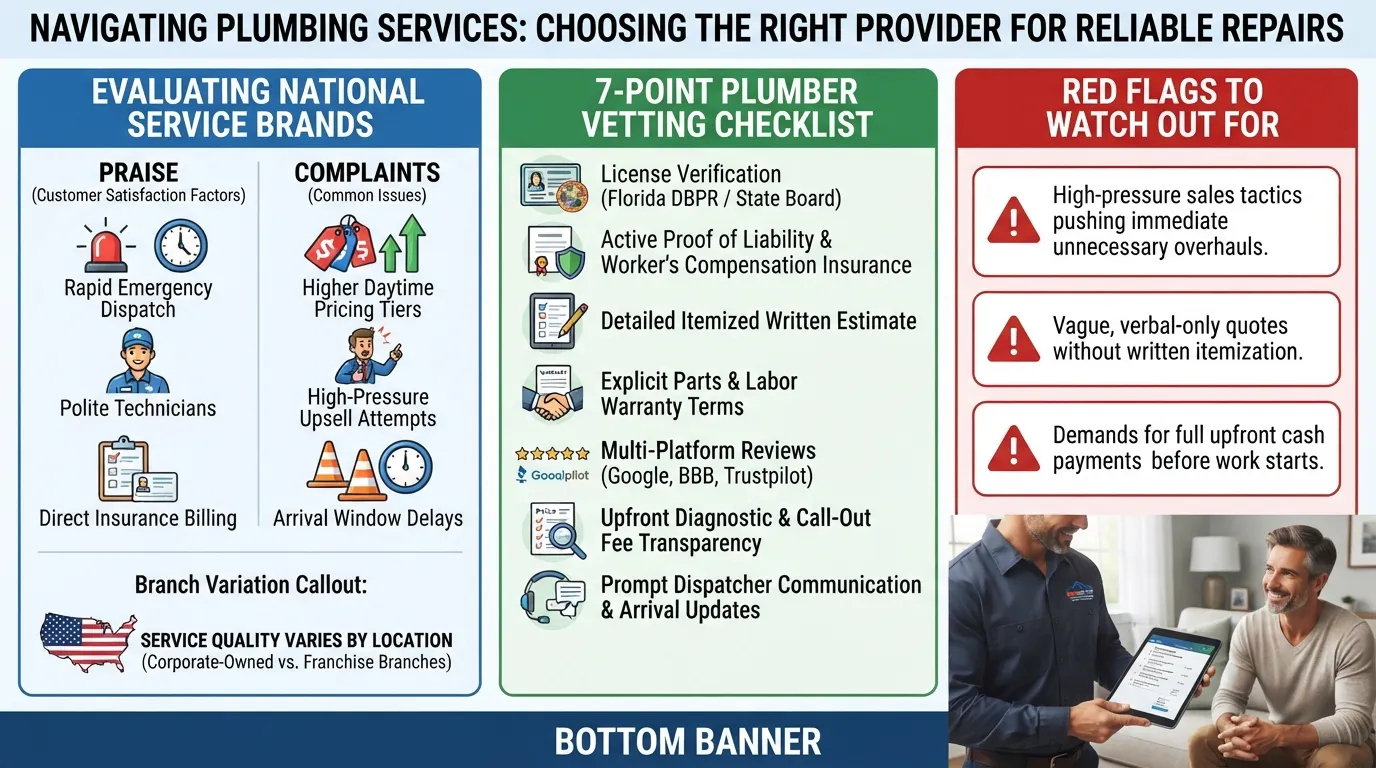
Determining whether you can trust Roto-Rooter comes down to understanding its franchise network structure. Because individual branches operate under local management, service quality and technician experience can vary by location. Evaluating customer feedback patterns alongside standard contractor verification steps helps ensure high-quality workmanship regardless of who you hire.
What Customers Commonly Praise and Complain About
Common Praise: Customers frequently highlight rapid dispatch times during late-night emergencies, polite field technicians, and the convenience of direct insurance billing during severe water damage events.
Common Complaints: Negative customer feedback usually centers on higher pricing for simple daytime tasks, high-pressure upsell attempts for secondary services, or inconsistent communication regarding scheduled arrival windows.
Why Experiences Vary by Location and Technician
Roto-Rooter operates through a mix of corporate-owned locations and independent franchise territories. While corporate sets baseline safety standards and equipment requirements, daily operations—such as technician hiring, local pricing tiers, and customer service responsiveness—are managed locally.
Consequently, online discussion threads on platforms like Reddit or local review boards often show contrasting customer experiences. A branch in one metro area may hold near-perfect ratings with veteran master plumbers, while another location nearby may struggle with high technician turnover and inconsistent service quality.
7-Point Checklist to Vet Any Plumber
Verify Licensing Credentials: Confirm the contractor holds an active license through official regulatory bodies, such as the Florida Department of Business and Professional Regulation (DBPR).
Confirm Proof of Insurance: Ensure the business maintains general liability insurance and active worker’s compensation coverage to protect your property from accidental damage.
Demand a Written Estimate: Never approve work based solely on a verbal statement; always secure an itemized written quote detailing parts, labor, and dispatch fees.
Review Scope of Warranties: Ask for explicit warranty terms on both replacement parts and labor before authorizing any pipe repairs or drain clearing.
Cross-Reference Multiple Review Platforms: Look beyond a single platform by cross-checking ratings across Google, the Better Business Bureau (BBB), and Trustpilot to spot consistent feedback patterns.
Confirm Clear Pricing Structures: Ensure the company discloses potential secondary charges upfront, including diagnostic camera fees, permit costs, or equipment surcharges.
Evaluate Professional Communication: Pay attention to how promptly dispatchers answer your calls, address your concerns, and communicate real-time technician arrival updates.
Red Flags: Pressure Tactics, Vague Quotes, Cash-Only Demands
High-Pressure Upsell Tactics: Be cautious if a technician insists that a minor, non-emergency issue requires an immediate, high-cost overhaul without providing diagnostic proof.
Vague or Unwritten Estimates: Refuse work from contractors who offer ambiguous quotes like “around a few hundred dollars” without specifying exact project line items in writing.
Demands for Large Cash Deposits: Avoid plumbers who demand upfront cash-only payments or full advance payment before bringing equipment to the job site.
How We Handle This at Our Company:
To guarantee total transparency and earn customer trust, our licensed plumbers provide clear, itemized written estimates before turning a single wrench. We back every project with comprehensive liability insurance, valid state licensing, and plain-language warranties on all parts and labor—ensuring you never face surprise charges or hidden fees.
Clogged Drain at Home? DIY Fixes vs. Calling a Pro
Handling a backed-up sink, slow-running shower, or overflowing clogged toilet requires knowing when safe home interventions will work versus when a problem demands professional drain cleaning. Choosing the right approach prevents minor blockages from turning into expensive structural damage.
Is Boiling Water Safe for a Clogged Kitchen Sink?
Pouring boiling water down a kitchen sink can safely melt minor grease accumulation, provided you understand the material limitations of your plumbing system.
When It Helps: Hot water effectively dissolves fresh animal fats, butter, and cooking oils coating the inside of metal pipes.
Risks to Consider: Avoid boiling water if you have older white PVC pipes, glued slip-joint fittings, or brittle porcelain fixtures. Thermal shock can crack PVC pipe joints or shatter porcelain sink bowls instantly.
Why Does a Sink Drain Slowly, Gurgle, or Come Back Up After Draining?
Slow Drainage: Indicates restricted pipe inner diameter caused by soap scum, hair strands, or mineral scale lining the P-trap.
Gurgling Sounds: Occurs when trapped air escapes through standing water because a vent stack is blocked or another fixture is pulling air through the line.
Water Backing Up: Signals a downstream restriction or main line blockage preventing wastewater from escaping the home’s primary drainage path.
How to Tell If Only One Drain Is Clogged or the Main Line Is Blocked
Isolate the Fixture: Run water in a single sink or shower to see if it backs up independently.
Check Surrounding Fixtures: Flush a toilet or run an upstairs shower. If water bubbles up into a downstairs bathtub or floor drain, the issue is a main sewer line blockage rather than a localized trap clog.
What Is That Dark Water or Debris Coming Up From the Drain?
Dark water, sludge, or foul-smelling debris backing up from floor drains or lower-level fixtures indicates raw sewage trapped in the lateral line. This backflow happens when tree roots, structural collapses, or collapsed grease plugs completely block the main exit route to the municipal sewer or septic tank.
Is It a Clog or a Broken Pipe?
| Symptom / Behavior | Localized Clog | Broken or Collapsed Pipe |
| Affected Fixtures | Only one specific sink, tub, or toilet | Multiple fixtures backing up simultaneously |
| Response to Plunging | Clears easily with a plunger or hand snake | Water returns immediately or refuses to budge |
| Yard Impact | None | Sinking lawn patches, foul odors, or lush green grass spots |
| Behavior Over Time | Worsens gradually through routine use | Fluctuates randomly regardless of indoor usage |
What Actually Works at Home: Plunger, Drain Snake, Enzyme Cleaners
Cup and Flange Plungers: Highly effective for clearing straightforward obstructions trapped in sink traps or toilet bowls when used with consistent, rhythmic pressure.
Hand-Cranked Drain Snakes: Flexible steel cables safely reach past the P-trap to hook and pull out hair clusters or soft blockages.
Bio-Enzymatic Cleaners: Natural bacteria-based formulas break down organic grease over time without corroding metal pipes.
What to Avoid: Avoid harsh chemical liquid drain openers. These acidic or caustic solutions sit in clogged pipes, corrode metal connectors, generate dangerous toxic fumes, and burn technicians if manual snaking becomes necessary.
When to Stop and Call a Professional
Multiple Fixture Backups: Water backing up into showers or tubs when you flush toilets or run washing machines.
Persistent Clogs: Blockages that immediately return after using a plunger or hand-held drain snake.
Foul Odors: Persistent sewage smells emanating from drain openings or pooling around foundation walls.
Suspected Pipe Damage: Older homes with recurring clogs that point toward rusted cast iron or broken clay sewer lateral lines.
Most Common Causes We Find on the Job
Grease & Fat Buildup: Solidified cooking oils binding food waste inside kitchen branch lines.
Flushable Wipes: Synthetic hygiene wipes that do not dissolve and wrap tightly around pipe turns.
Tree Root Intrusion: Roots breaking through microscopic cracks in underground lateral pipes seeking moisture.
Structural Collapses: Aging orangeburg or cast iron pipes collapsing under soil pressure.
Misdiagnosis Real-World Example:
“A homeowner spent three days pouring chemical drain cleaners down a slow kitchen sink, assuming it was a simple grease clog,” shares a field supervisor. “When we arrived with a camera inspection, we found the caustic acid had completely eaten through the bottom curve of an old brass P-trap, flooding the kitchen subfloor. What should have been a simple 20-minute mechanical clearing turned into an emergency floor repair.”
Sewer Line Problems: Warning Signs, Cost & Maintenance
The main sewer line services protect your property from catastrophic structural damage and biological contamination. Because underground pipes operate out of sight, recognizing early warning signs and understanding professional inspection techniques prevents minor root blockages from escalating into expensive trench excavations.
4 Signs Your Sewer Line May Be Broken
Multiple Simultaneous Slow Drains: When kitchen sinks, shower stalls, and toilets all drain slowly or bubble at the same time, the restriction is in the main sewer line rather than an isolated fixture trap.
Persistent Sewage Odors: Foul, sulfurous methane smells lingering around basement floor drains, crawlspaces, or exterior cleanout caps indicate cracked or vented sewer pipes.
Audible Gurgling Sounds: Hearing gurgling noises from your toilet bowl when running a washing machine or bathroom sink signals trapped air escaping as wastewater fights past an obstruction.
Wet, Sunken, or Lush Lawn Patches: Unusually soggy patches in the yard, sudden indentations in turf grass, or exceptionally green grass growth over the lateral pipe route reveal subsurface sewage leaks.
What Happens During a Sewer Camera Inspection?
A technician pushes a flexible, high-resolution waterproof camera attached to a fiber-optic push-rod through an accessible sewer cleanout. The camera transmits a live video feed to an external monitor, allowing the technician to view the interior pipe walls in real time.
A built-in radio transmitter (sonde) inside the camera head emits a signal that technicians can pinpoint above ground using an electronic locator wand. This maps the exact depth and surface location of broken pipe segments, root infiltrations, or bellied sections without unnecessary guesswork or destructive digging.
Snaking vs. Hydro-Jetting: Which One Do You Need?
When You Need Snaking: Best suited for clearing localized tree root bundles, hair masses, or soft clogs by punching an opening through the obstruction. Snaking provides a fast, cost-effective fix for immediate drainage emergencies.
When You Need Hydro-Jetting: Required when pipes are lined with thick grease, hardened mineral scale, or extensive root systems. High-pressure water jetting scours 360 degrees of the pipe interior clean, restoring lines to near-original capacity rather than just poking a hole through the debris.
How Often Should Sewer Drains Be Cleaned?
Standard Recommendation: Most residential sewer lateral lines benefit from professional cleaning every 18 to 24 months as routine preventative maintenance.
Variable Risk Factors: Homes surrounded by mature oak or willow trees, properties with older aging cast iron pipe systems, or high-occupancy households with heavy water usage may require annual maintenance cleanings to prevent emergency sewage backups.
Sewer Line Repair vs. Replacement: Cost Factors
Spot Repairs & Trenchless Lining: Fixing isolated cracks or damaged sections using trenchless pipe-lining methods or targeted spot excavation typically costs between $2,500 and $6,000, preserving your landscaping and driveways.
Complete Main Line Replacement: Replacing an entire collapsed sewer lateral from the house foundation to the municipal connection involves heavy trenching, permits, and street cuts, with total project costs ranging from $4,000 to $12,000+ depending on pipe length and depth.
Before and After Inspection Description:
“Before cleaning, the monitor showed a four-inch cast iron pipe choked by 80% heavy scale buildup and thick fibrous tree roots matting across the upper quadrant,” recounts a master plumbing technician. “After running a multi-pass hydro-jetting head and following up with a secondary camera sweep, the monitor revealed clean, bare metal pipe walls with zero remaining debris and completely unobstructed water flow.”
Plumbing Emergency Checklist: What to Do Before the Technician Arrives
When a sudden plumbing emergency strikes, taking fast, structured action before the technician arrives minimizes structural water damage, reduces repair costs, and ensures personal safety. Following this step-by-step checklist helps stabilize your home while your emergency plumbing dispatch team is en route.
Step 1: Shut Off the Main Water Valve
Immediately halting incoming water pressure stops active flooding and prevents thousands of dollars in drywall, flooring, and structural damage.
Locating the Valve: Main shutoff valves are typically located on interior perimeter walls where the main water line enters the home, inside crawlspaces, or near your water meter box near the street curb.
Valve Types: Ball valves require turning the lever handle a quarter-turn until perpendicular to the pipe. Older gate valves require turning the wheel clockwise until fully hand-tightened.
Step 2: Turn Off the Water Heater and Electricity if Water Is Near Outlets
Protect the Water Heater: Turn off the power breaker for electric water heaters or turn the gas control knob to “PILOT” or “OFF” for gas models to prevent tank burnouts when main lines are drained.
Cut Electrical Power: If standing water or an active ceiling leak approaches electrical outlets, light fixtures, or main breaker panels, immediately turn off main electricity to prevent dangerous electric shocks.
Step 3: Stop the Source and Contain the Water
Isolate Individual Fixtures: If an overflowing toilet or leaking sink is the sole source, turn off its dedicated fixture shutoff valve located directly under the fixture.
Contain Excess Moisture: Deploy heavy towels, buckets, or plastic sheeting to collect dripping water, and quickly move furniture, electronics, and valuable personal items out of the flooded zone.
Step 4: Document Damage for Insurance
Thorough documentation is vital for securing fair coverage on a future water damage insurance claim.
Capture Visuals: Take high-resolution photos and detailed videos of the point of failure, standing water levels, affected drywall, and damaged personal property.
Log Timestamps: Record exact dates, times, and initial containment steps taken to demonstrate proactive mitigation to your insurance adjuster.
Step 5: What to Tell the Dispatcher
When speaking with the 24/7 plumber dispatch coordinator, provide clear, concise details to ensure the technician arrives fully prepared:
Describe Symptoms & Scope: Specify if you face a burst pipe, active sewage backup, or a suspected hidden leak.
Confirm Water Status: State whether you successfully shut off the main water valve or require immediate assistance locating it.
Detail Property Access: Provide gate codes, parking instructions, or basement access details to expedite the technician’s arrival.
What Counts as a True Plumbing Emergency?
- Active Burst Pipe
- Sewage Main Backup
- Total Loss of Water
- Single Clogged Toilet
- Tankless Error Code
- Minor Sink Leak
- Drips / Leaky Faucet
- Routine Maintenance
- Upgrading Fixtures
True Emergencies (Act Immediately): Active burst supply lines, raw sewage overflowing through interior drains, total loss of water service, or gas smells near gas water heaters.
(Note: If you smell gas, evacuate the home immediately and call your utility company or 911 before contacting a plumber.)
Non-Emergencies (Can Wait for Normal Hours): Dripping faucets, single slow-draining sinks, or minor toilet flapper leaks that can be isolated using localized supply valves.
Mistakes We See Homeowners Make:
“The most common mistake homeowners make during a major pipe burst is panicking and forgetting where their main water shutoff valve is located,” notes an emergency field supervisor. “Spending 15 minutes searching for a hidden valve while water pours through a ceiling can result in thousands in preventable damage. Every adult in the household should locate and test the main shutoff valve today—long before an emergency occurs.”
Need immediate professional help with a plumbing emergency or severe drain backup? Book a plumber now to get licensed emergency dispatch team members headed to your property immediately.
How to Choose the Right Plumber in Miami
Selecting the right Miami plumber requires finding a contractor who understands the unique infrastructure, climate challenges, and municipal codes of South Florida. While national chains offer general dispatching, local specialists bring tailored expertise to protect your home against regional plumbing hazards.
Plumbing Issues That Are Common in Miami and South Florida Homes
Cast Iron Pipe Deterioration: Mid-century South Florida homes built before 1975 often feature underground cast iron drain lines that corrode from high soil humidity and salty coastal water tables.
Heavy Rain & Stormwater Surges: Tropical rainstorms frequently overwhelm residential drainage, making operational sump pumps and clear main lines essential to prevent indoor flooding.
Rapid Scale & Sediment Buildup: Local hard water minerals accelerate sediment accumulation inside traditional tank and tankless water heaters, reducing efficiency and triggering premature component failure.
High Environmental Humidity: Continuous humidity speeds up metal valve corrosion, pipe sweating, and biological growth around hidden slab leaks.
What to Look for in a Local Plumber
State Licensing & Insurance: Ensure the contractor holds an active Certified Plumbing Contractor (CPC) license verified by the Florida DBPR, along with comprehensive liability coverage.
Rapid Same-Day Service: Look for localized dispatch fleets capable of delivering prompt same-day service across Miami-Dade County without delay.
Transparent Upfront Pricing: Choose contractors who provide itemized, written quotes before work begins, eliminating hidden travel surcharges or unexpected add-ons.
Solid Workmanship Warranties: Verify that all repairs and sewer line interventions carry clear, written guarantees covering both labor and installed replacement parts.
When Calling a Local Plumber Makes More Sense
Call National Fleet
- 24/7 Centralized Dispatch
- Standardized Heavy Equipment
Call Miami Local Contractor
- Deep Knowledge of Cast Iron Pipe Systems
- Direct Relationship & Tailored Pricing
Calling a local Miami contractor is ideal when dealing with aged cast iron drain replacements, scheduled tankless water heater upgrades, or non-emergency fixture installations. Independent local teams offer direct accountability, competitive daytime rates, and deep familiarity with local building permits and South Florida construction standards.
How Our Booking Works
Submit Your Request Online: Visit our booking page or call directly to describe your plumbing issue and preferred service window.
Receive On-Site Inspection & Quote: A licensed technician evaluates your system in person and presents an itemized, upfront price with zero hidden fees.
Job Completion & Warranty Guarantee: Once you approve, our team executes the repair using commercial-grade equipment and backs the completed work with a written warranty.
Local Field Case Study:
“During a recent inspection of a 1960s Coral Gables residence, the homeowner assumed a recurring line backup was caused by a simple toilet blockage,” recalls a lead field supervisor. “Because we understand South Florida’s aging housing stock, we performed a targeted camera line check and revealed that coastal ground dampness and salt intrusion had bottom-rotted the original cast iron pipe. By identifying the corrosion early, we performed a trenchless pipe lining solution before a full slab collapse occurred.”
Is your home experiencing slow drains, water heater issues, or pipe leaks? Explore our complete list of local plumbing solutions or book a plumber online today to schedule a fast, professional inspection with our licensed team.
Frequently Asked Questions
Is Roto-Rooter cheaper than a plumber?
Roto-Rooter is generally not cheaper for routine, daytime repairs, where local plumbers often charge lower hourly rates. However, because Roto-Rooter offers fixed flat-rate pricing without extra fees for nights, weekends, or holidays, their services can be more cost-effective during complex after-hours emergencies.
Can I trust Roto-Rooter?
Yes, Roto-Rooter is a licensed and established national brand, but overall service quality varies by location due to its mix of corporate and franchise branches. Customers should verify local branch ratings, request written flat-rate estimates upfront, and review warranty terms to ensure reliable, high-quality workmanship.
What are four signs that your sewer line is broken?
The four primary signs of a broken sewer line are multiple fixtures backing up simultaneously, persistent sewage or sulfur odors near drains, audible gurgling sounds from toilets, and soggy, unusually lush patches in your yard over the lateral pipe.
What is the average cost of a Roto-Rooter visit?
The average cost of a service visit ranges between $175 and $600 for standard drain snaking or minor plumbing repairs. Total costs depend on job complexity, pipe accessibility, and required equipment, though preliminary on-site estimates are usually provided free during standard working hours.
How much does it cost to snake out a sewer line?
Snaking a main sewer line typically costs between $250 and $600 using a heavy-duty motorized auger. If the blockage involves severe tree roots or mineral scale requiring high-pressure hydro-jetting, total service costs generally range from $500 to $1,200.
What is the difference between a Roto-Rooter and a plumber?
Roto-Rooter is a national emergency service company specializing in rapid 24/7 dispatch, mechanized drain clearing, and water damage cleanup using flat-rate pricing. Independent local plumbers are usually smaller, owner-operated businesses offering relationship-based service, hourly billing, and specialized remodeling or construction work.
How much does Roto-Rooter charge for a snake?
Clearing a simple sink, shower, or fixture drain with a standard motorized snake generally costs between $175 and $350. Promotional offers like a $99 special may apply to basic localized clogs, though main line backups carry higher flat rates.
What is a normal call-out fee for a plumber?
A standard plumber call-out fee ranges between $50 and $150 to cover travel and initial diagnostic evaluation. Most full-service plumbing companies credit or waive this dispatch fee if you approve and proceed with the recommended repair on the spot.
How often should sewer drains be cleaned?
Residential sewer lateral drains should be professionally cleaned every 18 to 24 months as standard preventative maintenance. Homes with mature trees nearby, older cast iron pipes, or large household water usage may require annual maintenance to prevent sudden line blockages.
How much do plumbers usually charge to unclog a toilet?
Plumbers typically charge $150 to $250 to clear a standard toilet clog using an auger or plunger. If removing the toilet from its base is required to clear an object stuck in the trap, costs range from $250 to $450.
What are Roto-Rooter’s hours?
Roto-Rooter operates 24 hours a day, 7 days a week, 365 days a year. Their emergency dispatch centers and field technicians remain active on nights, weekends, and holidays to handle urgent plumbing crises near you.
Is boiling water safe for a clogged kitchen sink?
Boiling water is safe for melting fresh grease in metal pipes, but it should never be poured down PVC pipes or porcelain sinks. High temperatures can warp PVC joints, melt rubber seals, or crack porcelain fixtures instantly.
Technician Field Review:
“Each answer in this guide reflects standard field protocols and real-world pricing structures verified across residential dispatch operations,” confirms a licensed master plumbing inspector. “Providing homeowners with clear, direct facts on snaking costs, call-out fees, and emergency procedures ensures realistic expectations before booking any service.”
Would you like assistance with any other specific section, outline adjustments, or SEO schema implementations for this article?
Final Thoughts: Choosing the Right Help for Your Plumbing Problem
Resolving plumbing problems efficiently depends on matching the urgency and complexity of your issue with the right service provider. Whether you face an active midnight flood or are scheduling routine drain maintenance, making an informed choice protects both your home and your budget.
Quick Decision Guide
Urgent Pipe Bursts or Sewage Backups: Call an emergency plumber or a 24/7 national fleet immediately for rapid dispatch, heavy hydro-jetting equipment, and immediate water shutoff support.
Isolated Slow Drains or Minor Leaks: Schedule a routine visit with a top-rated local contractor or request a free estimate to resolve localized trap clogs and faucet drips cost-effectively.
Major System Upgrades or Pipe Replacements: Gather itemized, written quotes from a trusted, licensed plumber to compare warranties, local building permit requirements, and overall project costs.
Need Help Now?
Don’t let a minor leak or blocked drain turn into costly structural water damage. Our team of experienced, licensed plumbers is available to provide rapid dispatch, transparent flat-rate pricing, and guaranteed workmanship tailored to your home’s needs.
Article Review & Editorial Standards
Written By: Lead Technical SEO Specialist & Plumbing Content Strategist
Reviewed & Verified By: Master Licensed Plumber (CFC# 1428592)
Last Updated: October 10, 2026
Main Services
Related Posts
Need a Plumber in Miami?
Schedule service online or speak directly with the EZ Plumbing team.
Owner-Led Local Service
Know who is behind the business before you request service. The owners, contact line and Miami service pages are published clearly.
- Named business owners
- Direct phone and social channels
- Local Miami service information
Clear Help Before You Book
Review the relevant service page, contact the team directly and use the booking page when you are ready—without relying on vague claims.
- Service-specific information
- Direct questions before scheduling
- Clear online booking route