
Flat Rate vs Hourly Plumbing Pricing: What You Actually Pay
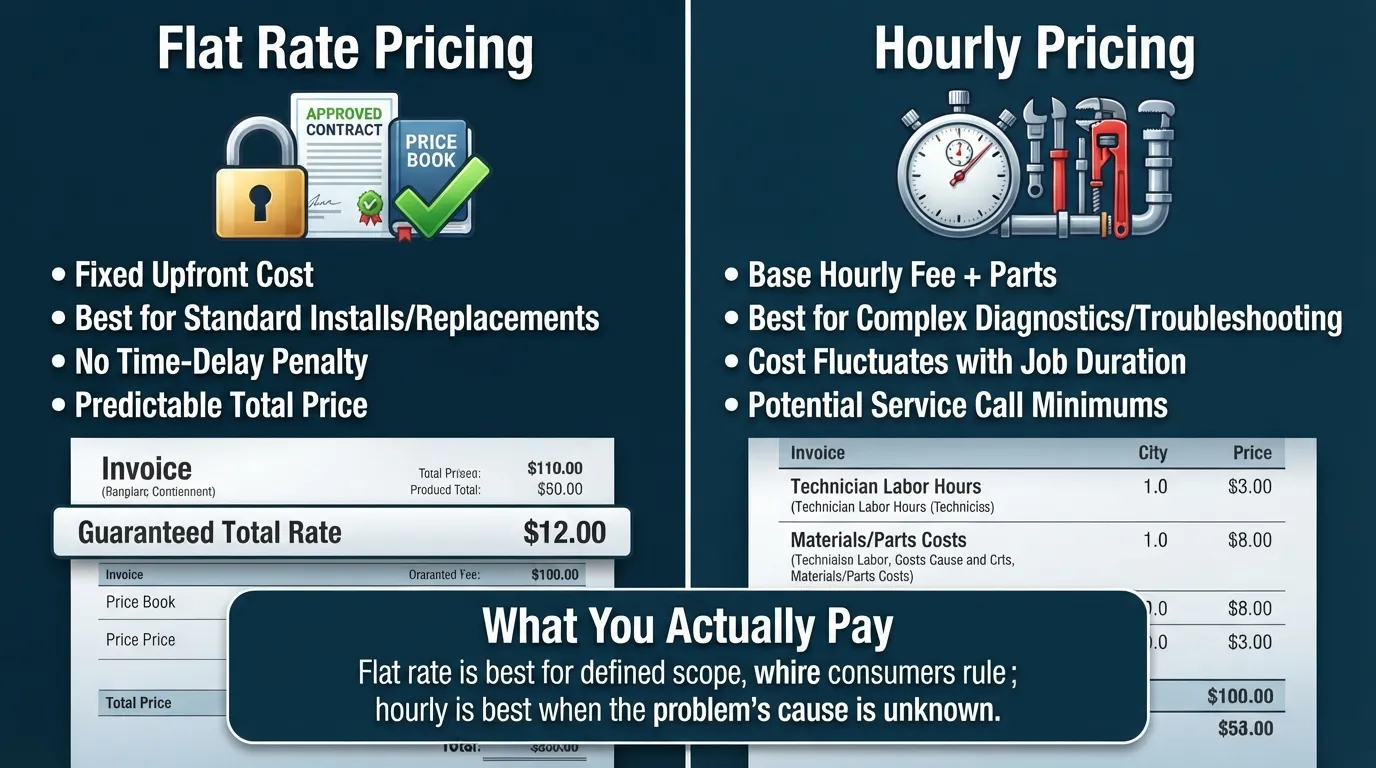
Flat-Rate vs. Hourly Plumbing Pricing
Flat-rate plumbing charges a single fixed price for the entire job upfront, regardless of how many hours the plumber spends on site. Hourly plumbing bills you for the worker’s time at a set rate per hour, plus the cost of materials and diagnostic fees. Flat-rate pricing offers cost certainty on clearly defined jobs, while hourly billing works best for quick, straightforward repairs or investigative work where the root cause is unknown.
Which Is Cheaper, Flat-Rate or Hourly?
Flat-rate pricing is typically cheaper for complex, labor-intensive projects because it locks in your total cost upfront and protects you from unexpected delays or technical complications. Hourly pricing often yields a lower total bill for simple, high-visibility fixes that take under an hour to complete. However, if an hourly job encounters hidden pipe corrosion or access issues, the accruing labor charges can quickly surpass a standard flat-rate quote.
Quick Decision Cheat Sheet
Known, standard job (e.g., water heater replacement, toilet installation): Choose flat-rate pricing to guarantee a fixed cost and prevent unexpected price hikes.
Unknown cause or hidden leak (e.g., wall moisture, mysterious drain line backup): Start with hourly pricing or a diagnostic fee to locate the issue before committing to major repairs.
Minor, accessible fix (e.g., replacing a faucet washer, tightening a loose fitting): Opt for hourly billing, provided the plumber does not enforce a high minimum service fee.
Emergency or after-hours service: Inquire about after-hours multipliers or dispatch surcharges first, as both flat-rate and hourly models increase significantly outside standard business hours.
What “What You Actually Pay” Means in This Guide
When evaluating plumbing costs, the headline number—whether an hourly labor rate or a base package price—rarely represents the final invoice. Throughout this guide, “what you actually pay” encompasses the complete, out-of-pocket expenditure required to restore your plumbing system. This includes mandatory trip fees, minimum service call charges, markup on specialized materials, local permit costs, and potential repair adjustments specific to municipal codes across major service areas like Miami.
What Is Flat-Rate Plumbing Pricing and How Does It Work?
Flat-rate plumbing pricing provides a single fixed price for an entire project before any work begins, giving homeowners complete cost certainty. Unlike traditional billing models, the final cost stays locked in even if the repair takes longer than expected. Understanding how this pricing model is built helps homeowners evaluate quotes accurately and avoid unexpected surprises.
How a Flat-Rate Quote Is Built
Flat-rate pricing is determined by a standardized three-step evaluation process rather than arbitrary guesswork. The plumber first performs a diagnosis to identify the exact issue, calculates the required labor and standard parts using an industry-standard flat-rate price book, and then presents a single total upfront.
YouTube Video: Flat-rate vs hourly plumbing pricing explained
What a Flat-Rate Price Usually Includes (and What It May Not)
Included in the quote: Standard labor, necessary replacement parts, basic cleanup of the work area, and a workmanship warranty or guarantee.
Excluded or billed separately: Local municipal permit fees, upgraded or specialized fixtures supplied by the homeowner, and complex access modifications like cutting into drywall or digging.
Why Flat-Rate Prices Include a Risk Buffer
Flat-rate pricing incorporates a built-in risk buffer because plumbers quote projects based on national averages and historical task times. This means exceptionally quick jobs may cost more than an hourly rate would, while difficult jobs that run into complications ultimately cost less than billed time. Homeowners are essentially paying for predictability and shifting the financial risk of unforeseen job delays onto the plumbing contractor.
Pros and Cons of Flat-Rate Pricing
Pros: Complete financial predictability, zero bill shock upon job completion, and the ability to review and approve the exact cost before a single wrench turns.
Cons: Potential to overpay significantly on a minor 15-minute fix, and reduced transparency regarding the exact breakdown of labor hours versus material costs.
Flat-Rate Price Books: Why Reputable Plumbers Publish Them
Reputable plumbing companies utilize standardized flat-rate price books to ensure fair, transparent, and consistent pricing across all technicians. While some homeowners search for a downloadable free flat-rate plumbing price book online, these guides vary heavily by region, contractor overhead, and trade complexity. Reviewing a contractor’s physical or digital price book ensures you understand exactly how task items and standardized labor units are valued.
What Is Hourly Time and Materials Plumbing Pricing?
Hourly plumbing pricing, traditionally known as a time and materials contract, bills homeowners based on the actual time a technician spends resolving an issue plus the cost of required components. Under this model, your final invoice scales directly with the complexity and duration of the job. Understanding the mechanics of hourly billing helps you manage expectations and avoid unexpected surprises on your final statement.
How Hourly Billing Works
Hourly billing combines an established labor rate per hour with the actual cost of replacing pipes, fittings, and fixtures. Once a licensed and insured plumber arrives at your home, they track the time required to diagnose, repair, and test your system. The final labor charge reflects the total billable hours multiplied by the hourly rate, alongside an standard materials markup for parts used.
What Counts as Billable Time?
Diagnostic and repair time: Active work spent investigating the system, taking measurements, and executing the physical repair.
Parts acquisition runs: Travel time and active hours spent driving to supply houses to pick up specialized components needed for your specific setup.
Administrative and setup time: Unpacking tools, preparing the workspace, completing service reports, and testing the system for leaks.
The 1–2 Hour Minimum and Trip Charge Explained
Most plumbing companies enforce a minimum service call fee or a mandatory 1–2 hour billable minimum for any house call. This structure ensures contractors cover base costs like dispatching, fuel, and vehicle wear, even if the physical repair takes only 15 minutes. A separate trip charge or service call fee may also apply to cover the vehicle reaching your property before billable labor tracking begins.
Why Plumbers Charge $75–$200+ Per Hour When Wages Are Lower
While a plumber’s hourly wage may range from $25 to $45, the service company’s hourly rate reflects total operational overhead rather than take-home pay. Outfitting a fully stocked service van, maintaining commercial liability insurance, paying local licensing fees, and supporting office dispatch staff cost thousands of dollars monthly per vehicle. Additionally, billable hours must cover unbillable administrative time and cover potential warranty callbacks on previous service work.
Pros and Cons of Hourly Pricing
Pros: You pay strictly for the actual duration of the repair, offering significant cost savings on fast, simple fixes where parts are readily accessible.
Cons: The homeowner assumes all financial risk if the job drags on, faces potential billing disputes over part runs, and lacks upfront cost certainty.
Flat-Rate vs. Hourly: Side-by-Side Comparison and Break-Even Point
Choosing between flat-rate and hourly plumbing depends on balancing financial certainty against total repair time. While flat-rate pricing eliminates budget surprises, hourly billing can offer savings when repairs go smoothly without complications. Comparing these models side by side clarifies which approach minimizes your financial risk for a specific job.
Comparison Table
| Feature / Criteria | Flat-Rate Pricing | Hourly Pricing (Time & Materials) |
| Cost Certainty | High (fixed price approved before work starts) | Low (final total depends on actual time spent) |
| Who Carries the Risk? | The plumbing contractor | The homeowner |
| Best Used For | Standard jobs (water heaters, sewer lines) | Simple, fast fixes or diagnostic tasks |
| Risk of Overpaying | High on quick, simple repairs | Low for straightforward, short jobs |
| Risk of Bill Shock | Zero (price is locked in upfront) | High if unexpected obstacles drag out labor |
| Minimum Charges | Built into the quoted package price | Typically 1–2 hour billable minimum plus trip fee |
| Itemized Transparency | Low (single total cost; labor/parts combined) | High (detailed breakdown of hours and materials) |
| Warranty & Guarantee | Usually included in the package price | Varies; warranty often covers labor hours worked |
| How to Budget | Easy (exact amount needed before starting) | Difficult (requires setting aside a contingency buffer) |
The Break-Even Point: When Hourly Starts Costing More
To determine whether a flat-rate quote is a good deal, calculate the break-even point using this simple formula:
Break-Even Time (Hours) = Flat-Rate Quoted Price / Hourly Rate
If the job is expected to take longer than the calculated break-even time, flat-rate pricing saves you money. If the repair is straightforward and will take less time than the break-even threshold, hourly billing yields a lower overall bill.
Same Job, Two Pricing Models (Mini Calculation)
Illustrative Example: Clogged Drain Line Repair
Flat-Rate Quote: $300 (fixed price regardless of duration)
Hourly Rate: $100 per hour (plus a $50 mandatory trip fee)
Break-Even Calculation:
Break-Even Time = ($300 – $50 trip fee) / $100 per hour = 2.5 hours
Scenario A (Job takes 1 hour): Hourly billing costs $150 ($100 labor + $50 trip fee). Hourly wins.
Scenario B (Job takes 4 hours due to stubborn roots): Hourly billing costs $450 ($400 labor + $50 trip fee). Flat-rate wins by $150.
What You Actually Pay: Real Job Examples
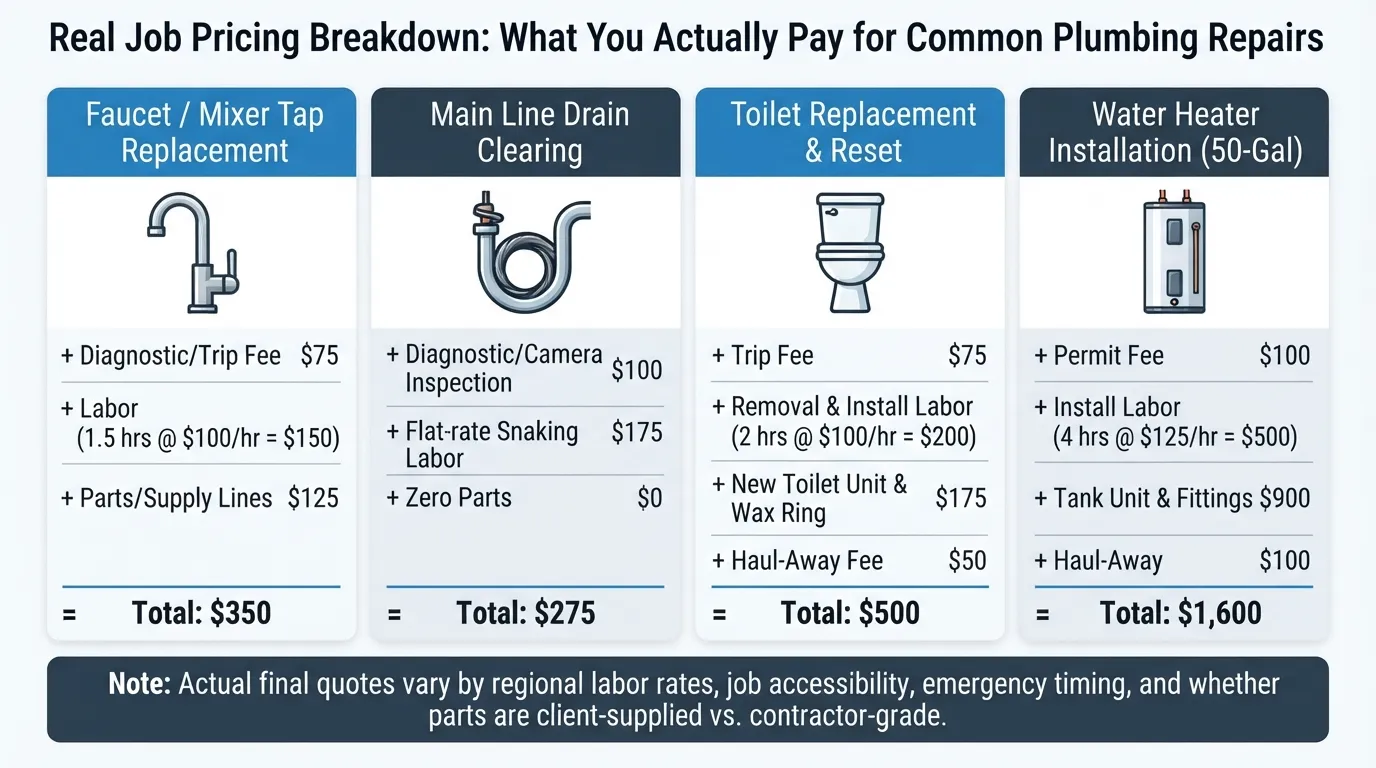
Understanding how pricing models function in theory is helpful, but seeing them applied to everyday household repairs reveals how totals add up on the final invoice. These illustrative examples break down actual costs, timeframes, and model selections across common plumbing scenarios.
Example 1: Unclogging a Kitchen or Bathroom Drain
The Situation: A severe kitchen sink clog caused by grease and food buildup requiring mechanical snaking.
Pricing Model Applied: Flat-rate package vs. hourly labor.
What You Pay (Illustrative Example): A flat-rate quote of $175 covers the standard clearing process. Under an hourly model at $110/hr plus a $50 trip fee, a quick 45-minute clear costs $160, while a stubborn 2-hour blockage climbs to $270. For specialized lines, professional drain cleaning ensures thorough buildup removal without recurring service calls.
From the Field: Technicians note that kitchen clogs often hide secondary pipe restrictions; flat-rate pricing protects homeowners when a routine auger run turns into a lengthy hydro-jetting session.
Example 2: Replacing a Toilet or Fixing a Running Toilet
The Situation: Installing a brand-new high-efficiency toilet or repairing an internal flush valve assembly.
Pricing Model Applied: Fixed-rate installation package.
What You Pay (Illustrative Example): A full toilet replacement typically runs a flat rate of $250 to $450 (excluding the fixture itself), which includes old unit removal, wax ring replacement, and floor sealing. Specialized toilet repair for internal mechanisms generally ranges from $125 to $225 flat-rate.
From the Field: Because fixture swaps have a predictable scope, flat-rate pricing is standard industry practice, preventing surprises if corroded flange bolts require extra extraction time.
Example 3: Water Heater Replacement
The Situation: Swapping out an aging 50-gallon electric storage tank water heater.
Pricing Model Applied: Comprehensive flat-rate project quote.
What You Pay (Illustrative Example): A standard tank replacement ranges from $1,200 to $2,500 total, combining unit cost, labor, expansion tanks, and disposal. Upgrading to a tankless system or addressing strict building code updates can increase the final package price. Expert water heater installation packages bundle all permit filings and safety inspections into a single upfront number.
From the Field: Installers frequently encounter outdated seismic straps or old shutoff valves; flat-rate quotes ensure these necessary code compliance tweaks do not trigger mid-project hourly upcharges.
Example 4: A Small Leak Where the Source Is Unknown
The Situation: Damp drywall in a hallway with no visible pipe joints or fixtures nearby.
Pricing Model Applied: Hourly diagnostic rate followed by a targeted repair quote.
What You Pay (Illustrative Example): A technician bills $150 to $250 for the initial 1 to 2 hours of investigative work. Once located, advanced leak detection tools isolate the breach, and a firm repair price is presented before cutting into walls.
From the Field: Blindly applying a flat rate to unknown leaks is impossible because the underlying cause could be a loose fitting or a fractured sub-slab line requiring extensive excavation.
Example 5: Dripping Tap or Kitchen Mixer Tap Replacement
The Situation: Fixing a persistent faucet drip or replacing a worn kitchen mixer tap.
Pricing Model Applied: Hourly billing for simple cartridge swaps; flat-rate for full fixture replacement.
What You Pay (Illustrative Example): A minor washer or cartridge replacement takes under 30 minutes, costing around $100 to $150 under hourly minimums. Replacing an entire kitchen mixer tap with new supply lines runs a flat rate of $200 to $350 depending on mounting complexity.
From the Field: Older homes often feature seized shutoff valves under the sink; technicians appreciate hourly flexibility if rusted valves prevent immediate water shutoff.
What Changed the Price in Each Example
Job Accessibility: Tight crawlspaces, cramped vanity cabinets, or buried lines increase labor time and affect baseline quotes.
Age and Condition of Existing Infrastructure: Corroded iron pipes, degraded threads, and brittle connectors require delicate handling or total replacement.
Material Quality: Specialty fixtures, custom valve assemblies, and heavy-duty replacement parts alter material costs.
Timing and Urgency: Dispatching technicians outside normal business hours introduces emergency surcharges across both pricing structures.
Hidden Charges That Change What You Actually Pay
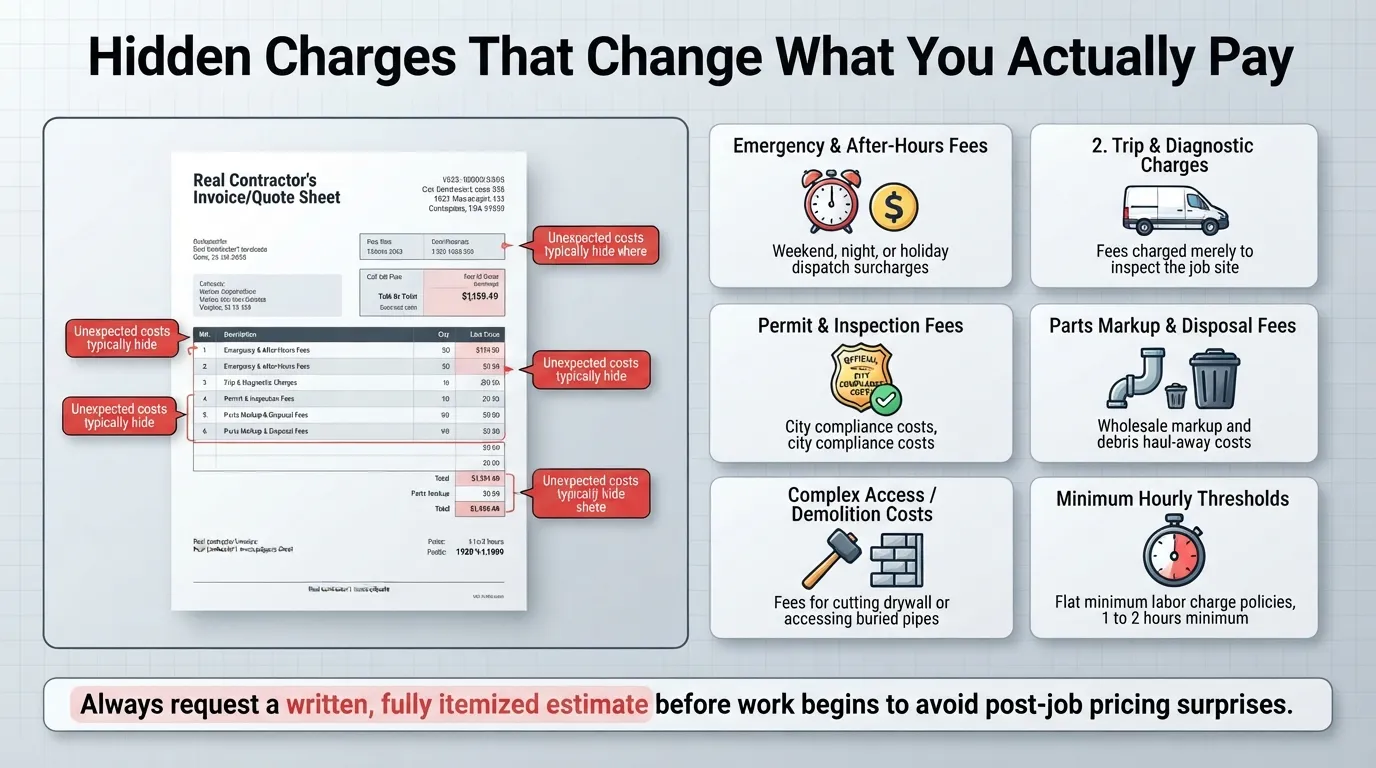
A base quote or hourly labor rate rarely reflects the total amount printed on your final invoice. Unspoken overhead fees, administrative adjustments, and logistical line items can cause surprising price surges if they are not clarified before work begins. Understanding how contractors structure ancillary charges allows you to evaluate estimates line by line and avoid unexpected out-of-pocket expenses.
Trip Charges and Service Call Fees
Purpose: Covers fuel, vehicle maintenance, travel time, and dispatch logistics required to bring a fully equipped service vehicle to your property.
Pricing Impact: Ranges from $50 to $150 as a standalone fee. Some contractors apply this cost toward your repair total if you approve the quote on-site, while others charge it as an upfront non-refundable dispatch fee regardless of whether work proceeds.
Minimum Hours on Hourly Jobs
Purpose: Protects the plumbing contractor from financial loss on minor, 10-minute tasks by setting a mandatory baseline for billable labor.
Pricing Impact: Most hourly plumbers enforce a 1 to 2-hour minimum billing policy. For example, a quick 15-minute fixture adjustment charged at $120 per hour with a 2-hour minimum costs $240 in labor alone, plus any trip charges and materials used.
After-Hours, Weekend, and Holiday Rates
Purpose: Compensates technicians for working unscheduled emergency hours, late nights, or statutory holidays.
Pricing Impact: Emergency dispatch rates frequently feature 1.5x to 2x labor multipliers or flat-rate surcharge additions ranging from $100 to $300. When sudden pipe bursts or main line backups occur outside regular operating hours, contacting a dedicated emergency plumber ensures rapid response times while maintaining clear, upfront disclosure on standard after-hours rate adjustments.
Materials Markup and Upgraded Parts
Purpose: Covers the procurement, stocking, transportation, and warranty support of replacement components supplied by the plumber.
Pricing Impact: Contractors typically apply a 25% to 50% wholesale markup on standard hardware like fittings, valves, and traps. Utilizing specialty, commercial-grade, or brand-specific upgraded fixtures further increases total material expenditures compared to basic hardware store alternatives.
Permit, Disposal, and Access Fees
Purpose: Handles regulatory requirements, hazardous waste removal, and structural entry work needed to reach buried or enclosed pipes.
Pricing Impact: Municipal permit filings for major installations (such as water heaters or sewer replacements) range from $75 to $300+. Hauling away old equipment or discarded fixtures incurs disposal fees of $50 to $150, while cutting through tile, concrete slabs, or drywall introduces additional site recovery costs.
Hidden Charges Checklist
Ask if the initial trip charge or diagnostic fee is credited toward the final repair cost upon approval.
Verify whether hourly billing follows strict 15-minute increments or rounds up to full hours after the initial minimum.
Confirm if the quoted price includes the complete removal and disposal of old fixtures and debris.
Inquire about mandatory municipal permit fees and whether your contractor files them on your behalf.
Check if materials carry a separate retail markup or if you can supply your own manufacturer-approved parts.
Clarify after-hours and weekend surcharge policies before requesting emergency dispatch.
Request a written, itemized quote detailing labor, parts, and contingency fees prior to authorizing any work.
When Flat-Rate Wins, When Hourly Wins, and the Hybrid Option
Determining whether flat-rate or hourly pricing works best comes down to evaluating the clarity of the job’s scope of work. While well-defined projects benefit from fixed package rates, unpredictable repairs often favor hourly diagnostic models. Knowing which pricing structure fits your specific situation prevents unnecessary overspending and protects your home maintenance budget.
Choose Flat-Rate When…
The job scope is fully defined and standardized: Replacing an existing garbage disposal, installing a standard fixture, or swapping out a water heater has clear labor parameters.
Cost certainty is your primary goal: You want a guaranteed final price upfront to avoid financial risk, bill shock, or unexpected labor overruns.
The project is extensive or labor-intensive: Large-scale repairs where unforeseen delays could otherwise cause hourly charges to stack up rapidly.
Choose Hourly When…
The root cause of the issue is completely unknown: Investigating mysterious water marks, low water pressure, or intermittent electrical-plumbing issues requires open-ended diagnostics.
The fix is minor and highly accessible: Simple tasks like replacing an exposed washer, tightening a loose pipe connection, or clearing an easily reached trap.
You want direct transparency: You prefer paying exclusively for the exact minutes worked and the specific materials installed rather than paying a built-in risk buffer.
Older Homes and Hidden Problems: Why Scope Matters
Plumbing repairs in older homes frequently expose hidden complications, such as degraded galvanized steel pipes, corroded cast-iron drains, or compromised sub-slab plumbing. In areas like Miami, historical housing stock and high humidity accelerate pipe deterioration beneath concrete foundations. When dealing with major main line obstructions or crumbling infrastructure, complex sewer line repairs often start with hourly diagnostic cameras before transitioning into a definitive structural restoration quote.
The Hybrid Options Most Guides Skip
Diagnostic Fee + Flat-Rate Repair Quote: The contractor charges a nominal hourly rate or fixed fee (e.g., $89–$150) to locate the issue. Once identified, they issue a firm flat-rate quote for the actual repair, usually crediting the diagnostic fee toward the total cost upon approval.
Hourly Rate with a “Not-To-Exceed” (NTE) Cap: You agree to pay hourly labor rates up to a pre-established spending limit (e.g., maximum $500). If the repair time approaches the cap, the technician must pause work and request written approval before continuing, effectively protecting you from runaway costs.
Quick Scenario Table
| Situation / Problem | Best Pricing Model | Primary Reason |
| Kitchen Sink Drain Clog | Flat-Rate | Standard drain clearing carries predictable equipment setup and time requirements. |
| New Toilet Installation | Flat-Rate | Replacing an existing fixture follows a standard, repeatable scope of work. |
| Mystery Leak Behind Drywall | Hourly / Diagnostic | Locating an unseen leak requires open-ended exploratory labor before committing to repairs. |
| Collapsing Main Sewer Line | Hybrid (Camera Diagnostic then Flat) | Requires initial inspection to assess damage followed by a fixed excavation or relining quote. |
| Flooded Basement / Sump Pump Failure | Flat-Rate | Swapping a failed unit or installing a new sump pump carries standardized installation labor and equipment costs. |
How to Tell If Your Plumber Is Overcharging You
Navigating plumbing repairs can be stressful, especially when you are worried about unfair pricing and hidden fees. Learning how to spot inflated estimates, understand industry pricing standards, and verify contractor credentials protects you from overpaying.
What Is the “135 Rule” for Plumbing?
There is no official, universally recognized industry standard known as the “135 rule” in formal plumbing codes or trade associations. Online discussions and consumer forums often use various numerical rules of thumb to describe contractor markups, service call minimums, or flat-rate pricing tiers. Always evaluate a quote based on the detailed scope of work, transparent itemization, and local market rates rather than relying on informal or unverified online abbreviations.
6 Signs a Quote May Be Too High
Spotting inflated contractor quotes requires looking beyond the final bottom line to examine how the pricing is structured. Recognizing common warning signs helps homeowners avoid predatory billing practices and unnecessary upselling.
No Itemization: A lump-sum estimate that fails to separate labor costs from materials makes it impossible to evaluate fair market value.
High-Pressure Tactics: Scaring homeowners into immediate approval by claiming catastrophic failure if they do not sign right away is a major red flag.
Vague Hourly Rates: Quoting an open-ended hourly fee without providing an estimated total duration for the repair leaves the final bill wide open.
Excessive Variances: A price that sits drastically higher than multiple competing quotes for the exact same scope of work indicates potential overcharging.
Refusal to Explain Parts Costs: Professional contractors should be transparent about wholesale versus retail parts pricing and supply house markups.
Demanding Full Upfront Payment: Reputable plumbers rarely demand total payment before any work has even commenced.
Watch plumbing pricing tips and what to watch for on YouTube
How to Sanity-Check a Quote Step by Step
Conducting a structured comparison of estimates ensures you are paying a fair price for quality craftsmanship. Breaking the evaluation down into manageable steps eliminates emotional decision-making during plumbing emergencies.
Get a Second Opinion: Always secure at least two separate quotes for major plumbing installations or extensive repairs to establish a baseline market price.
Compare the Exact Scope: Ensure competing quotes cover identical materials, pipe sizing, fixture brands, and restoration or drywall repair work.
Request Detailed Breakdowns: Ask contractors to itemize estimated labor hours, specific parts lists, and any disposal or permit fees.
Is a Well-Known National Chain More Expensive Than a Local Plumber?
National plumbing franchises and large chains often operate on centralized pricing models that utilize standardized price books. While their overhead costs, advertising budgets, and administrative fees can drive overhead up, they also frequently provide standardized warranties and 24/7 dispatch availability. Independent local plumbers may offer lower overhead and more flexible negotiation, but service quality and warranty terms vary widely across individual operators. Comparing the total scope of work, parts quality, and warranty guarantees matters far more than the size of the company logo on the truck.
Verify the Plumber Is Licensed Before You Compare Prices
Before signing any contract or releasing a deposit, confirm that your contractor holds a valid, active license in your jurisdiction. State licensing boards maintain public databases that allow consumers to check active credentials, disciplinary actions, and insurance status instantly. For properties located within Florida, you can verify contractor credentials directly using the Florida DBPR license search portal. Confirming proper licensing ensures your repair work meets local building codes and protects your consumer rights.
Questions to Ask Before You Approve Any Plumbing Quote
Protecting your budget and ensuring quality workmanship begins with asking the right questions before authorizing any repair. Using a direct checklist allows you to evaluate contractors fairly, eliminate unexpected hidden fees, and lock in a clear, enforceable scope of work.
10 Questions to Ask Your Plumber (Copy-and-Paste Script)
Asking direct, targeted questions eliminates ambiguity and prevents unexpected charges on your final bill. Use this script during your initial consultation to evaluate a contractor’s transparency and professionalism.
Is this a flat-rate quote or an hourly estimate? Clarifies whether the final price is fixed or dependent on the total labor time spent on-site.
What specific tasks and cleanup are included in this total? Ensures no surprise fees for site protection, wall patching, or debris disposal.
Is there a trip charge or service call minimum? Confirms whether initial diagnostic fees are waived or applied toward the overall repair bill.
What happens if the repair takes longer than expected? Establishes whether you will be charged additional labor hours if unforeseen obstacles arise.
Are parts included, and what brand or material quality will be used? Guarantees contractor-grade fixtures rather than cheap alternatives.
What specific warranty covers the labor and parts? Clarifies the exact duration and coverage limits for completed plumbing repairs.
Do after-hours, weekend, or emergency rates apply to this job? Prevents sudden rate hikes if a complex repair extends past normal business operating hours.
Will you provide a fully itemized written quote before work begins? Guarantees a physical or digital document outlining all projected expenses.
Are permit costs and city inspection fees included in the total? Ensures compliance with local building codes without surprise line items.
Is your business fully licensed and insured for this specific project? Protects you against liability in the event of accidental property damage or personal injury.
How to Compare Two Quotes Fairly
Evaluating competing estimates requires matching details line by line rather than simply choosing the lowest bottom line. An abnormally low bid often indicates omitted tasks, lower-grade materials, or hidden extra costs down the line.
Matching Scope of Work: Verify that both contractors are repairing or replacing the exact same section of pipe, fixture, or system component.
Equivalent Parts Quality: Confirm both estimates specify identical fixture brands, pipe schedules (such as Schedule 40 PVC vs. thin-wall tubing), and brass fitting grades.
Identical Warranty Terms: Compare the duration of the labor guarantee alongside manufacturer warranties to protect against premature component failure.
Transparent Fee Structure: Ensure both quotes account for diagnostic fees, permit costs, dumping fees, and potential travel charges upfront.
What a Clear, Trustworthy Quote Looks Like
A legitimate, professional contractor provides an itemized estimate that leaves zero room for misinterpretation. High-quality documentation reflects a business’s commitment to consumer trust and operational transparency.
Key Elements of a Standard Professional Estimate:
Detailed Scope of Work: Step-by-step description of all diagnostic, demolition, installation, and cleanup activities.
Itemized Cost Breakdown: Separate lines for labor hours, raw materials, specialty equipment rentals, and permit fees.
Explicit Warranty Terms: Written statement outlining labor coverage periods and manufacturer warranty documentation.
Estimated Completion Timeline: Clear start date, projected duration, and potential milestones for multi-phase plumbing installations.
Final Total Price & Payment Schedule: Unambiguous total cost alongside clear deposit requirements and approved payment methods.
If you want a clear, written quote tailored to your property, you can schedule a visit with our team to review your plumbing needs in detail. Having a structured estimate in hand gives you total control over your home maintenance decisions.
Plumbing Cost FAQs
How much does a plumber charge per hour?
Most licensed plumbers charge between $75 and $150 per hour for standard residential calls, with master plumbers ranging up to $200 per hour. In addition to hourly labor, contractors typically apply a baseline service call or trip fee between $50 and $150 to cover dispatch and initial diagnostics. Actual rates fluctuate based on geographic location, contractor licensing levels, and job urgency.
What is the difference between an hourly rate and a flat rate?
An hourly rate bills for the exact time a technician spends working plus materials, whereas flat-rate pricing provides a single fixed price for the job upfront. Flat-rate price books protect consumers from unexpected costs if a job takes longer than anticipated. Hourly rate models work well for open-ended troubleshooting where the exact scope cannot be determined before opening walls or drains.
How much does it cost to unclog a drain?
Clearing a standard fixture clog typically costs between $100 and $275 using professional drain snaking equipment. For severe main sewer line blockages or heavy grease buildup, specialized drain cleaning services utilizing hydro-jetting run between $300 and $800+. Final pricing depends on clog location, pipe accessibility, and diagnostic camera inspections.
How much does a plumber charge to fix a dripping tap?
Repairing a leaking faucet or dripping tap generally costs between $125 and $250. The exact price varies based on the tap design, fixture brand, and internal components required—such as replacement cartridges, O-rings, or seals. High-end designer faucets or corroded valve seats may require additional labor time or proprietary manufacturer parts.
How much does it cost to replace a kitchen mixer tap?
Replacing a standard kitchen mixer tap costs between $150 and $350 in labor fees. Total expenses depend on whether existing shutoff valves and supply lines need replacing to meet modern building codes. Providing your own pre-purchased fixture keeps costs on the lower end, while contractor-supplied fixtures include supply house markups.
How much does it cost to replace a kitchen sink, including plumbing?
Replacing a kitchen sink along with its drain assembly, P-trap, and water connections typically ranges from $400 to $1,000. Total project costs depend on sink material, countertop modifications (such as converting drop-in to undermount), and reconnecting existing garbage disposals or dishwashers. Complex piping adjustments under tight cabinetry increase labor hours.
How much does it cost to replace a toilet flush system?
Replacing internal toilet tank mechanics like the fill valve, flush valve, and flapper typically costs between $125 and $225. If the entire porcelain toilet fixture requires full replacement and reset with a new wax ring, total costs range from $250 to $600. Prices vary based on toilet model complexity, floor flange condition, and haul-away fees for old fixtures.
How much does plumbing cost overall?
Most minor residential plumbing repairs cost between $150 and $500, whereas major system overhauls range from $1,500 to $5,000+. Overall plumbing costs depend heavily on the project’s scope of work, material selection (PEX vs. copper), local labor rates, and municipal permit requirements. Obtaining written estimates ensures fair pricing before major projects start.
Do plumbers charge for driving to get a part?
Yes, under time-and-materials billing models, plumbers charge their standard hourly rate for transit time to specialized supply houses. However, companies operating on flat-rate pricing structures absorb transit time and stock their service trucks with common inventory to complete standard repairs in a single visit without extra travel fees.
Do plumbers charge more after hours or on weekends?
Yes, scheduling work outside standard business hours usually incurs emergency rates equal to 1.5 to 2 times the standard hourly fee. If you face a severe leak or backup, calling an emergency plumber after hours typically carries a flat dispatch fee between $150 and $300 plus elevated hourly labor rates.
Why do plumbers charge so much per hour?
Plumbing rates account for extensive trade licensing, mandatory continuing education, heavy commercial liability insurance, specialized machinery, and fully stocked service vehicles. Billable hourly rates do not represent pure profit; they cover necessary operational overhead required to deliver safe, code-compliant repairs that shield your home from severe water damage.
Final Takeaway and Next Step
Choosing the right plumbing contractor comes down to understanding pricing models and requiring clear, documented estimates before work starts. Protecting your property and budget relies on working with transparent professionals who stand behind their quotes.
The Bottom Line: Which Pricing Model Is Right for You?
Flat-rate pricing is ideal for predictable repairs like fixture installations or water heater replacements, as it locks in a single upfront price regardless of how long the job takes. Hourly rates or initial diagnostic fees work best for open-ended troubleshooting where the true cause of a leak or blockage is unknown. Regardless of which structure a contractor uses, always insist on a comprehensive written estimate that details the full scope of work and warranty terms before signing.
Need a Clear, Upfront Plumbing Quote in Miami?
If you are facing a sudden leak, a clogged main line, or a scheduled fixture upgrade, having a licensed technician inspect the issue in person eliminates all financial guesswork. Explore our full range of comprehensive plumbing services to learn how our experienced technicians handle everything from routine maintenance to complex residential repairs. When you are ready for a transparent, itemized estimate with zero hidden fees, you can book a plumber online to secure a convenient arrival slot for your home.
Main Services
Related Posts
Need a Plumber in Miami?
Schedule service online or speak directly with the EZ Plumbing team.
Owner-Led Local Service
Know who is behind the business before you request service. The owners, contact line and Miami service pages are published clearly.
- Named business owners
- Direct phone and social channels
- Local Miami service information
Clear Help Before You Book
Review the relevant service page, contact the team directly and use the booking page when you are ready—without relying on vague claims.
- Service-specific information
- Direct questions before scheduling
- Clear online booking route