If your drain is slow, smelly, completely blocked, or keeps clogging again, the best drain cleaning method depends on what is blocking the pipe, where the blockage is, how severe it is, and whether one or several drains are affected.
For a light, accessible blockage, you may only need to remove visible debris, use a plunger, or try a small drain snake. Hair clogs often respond better to physical removal, while grease and residue may require a different approach. A recurring clog, multiple slow drains, wastewater backup, or a blockage deep in the drain system usually calls for professional diagnosis rather than stronger DIY chemicals.
What Is the Best Drain Cleaning Method?
There is no single best method for every drain. Start with the least aggressive method that matches the likely cause. Remove accessible debris first, use the correct mechanical tool for a localized clog, and move to professional inspection or cleaning when the blockage is deep, recurrent, affects multiple fixtures, or may involve the main drain or sewer line.
Choose a Drain Cleaning Method Based on the Problem
I would not choose a method simply because it is the strongest option. A better approach is to first identify the fixture, symptoms, likely clog material, and severity.
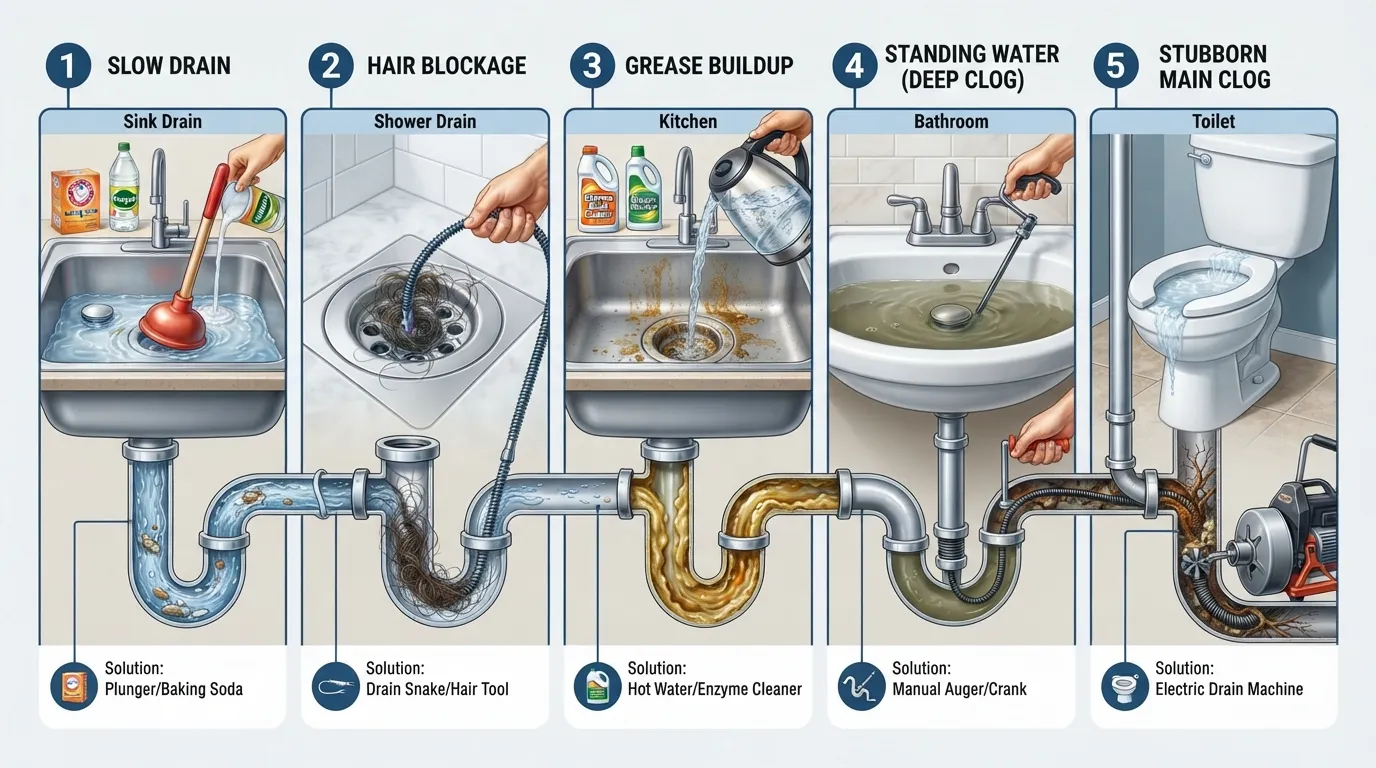
Slow Shower or Bathroom Sink
Likely causes: Hair, soap residue, personal-care buildup.
Start with: Remove visible hair and debris, then use a suitable hair-removal tool or small drain snake if needed.
Escalate when: The clog returns repeatedly or water stops draining completely.
Slow Kitchen Sink
Likely causes: Grease, food residue, organic buildup, or a local obstruction.
Start with: Clear accessible debris and use an appropriate plunger or mechanical method.
Escalate when: The drain repeatedly slows after temporary improvement.
One Completely Blocked Drain
Likely causes: Localized hair, food debris, foreign material, or compacted buildup.
Start with: A fixture-appropriate plunger or mechanical drain-cleaning tool.
Escalate when: The blockage is beyond the reach of a basic tool or standing water does not move.
Several Drains Are Slow
Likely causes: A shared branch drain, main drain, or sewer-line restriction.
Start with: Diagnosis rather than treating each fixture separately.
Escalate when: Multiple fixtures back up, gurgle, or affect one another.
If you want to understand how fixture drains, traps, branch lines, and the main drain connect, our guide to the home drainage system explains the full path wastewater takes through a house.
Drain Cleaning vs. Drain Unclogging: They Are Not Exactly the Same
These terms are often used interchangeably, but the distinction helps you choose the right solution.
- Drain cleaning removes residue, buildup, and material that is narrowing the pipe or contributing to recurring drainage problems.
- Drain unclogging or clearing focuses on opening an existing obstruction so water can flow again.
- Professional drain-line cleaning may involve powered equipment, hydro jetting, camera inspection, or another method selected after identifying the location and nature of the blockage.
A drain can therefore be open but still dirty or partially restricted. That is one reason a quick DIY fix may restore flow temporarily without solving a recurring problem.
8 Common Drain Cleaning Methods and When Each One Makes Sense
1. Remove Visible Hair and Debris by Hand or With a Hair Tool
For a bathroom sink, bathtub, or shower, the simplest solution is often the most appropriate. Hair can collect around a stopper or just inside the drain opening where it is easy to reach.
Remove the stopper if it is designed to come out, inspect the opening, and pull out accessible hair and residue with an appropriate drain hair-removal tool. This is usually more targeted than pouring a cleaner into the pipe when the blockage is sitting directly beneath the drain opening.
Best for: Visible hair, soap-coated hair, and debris near a bathroom drain opening.
Not enough for: A deep clog, a main-line restriction, roots, or a blockage that repeatedly returns.
2. Hot Water Flush
Hot water can help move light soap residue, soft organic material, or minor grease film, especially as a maintenance step rather than a cure for a serious blockage.
Use sensible water temperatures for your plumbing. I would avoid assuming that pouring a kettle of boiling water into every type of drain is automatically safe. Pipe material, joints, fixtures, and manufacturer limitations can vary.
Best for: Light residue and routine maintenance when appropriate for the plumbing system.
Not enough for: Hair plugs, foreign objects, heavy grease masses, roots, or deep mechanical obstructions.
3. Plunger
A plunger uses pressure changes to move a localized blockage. It can be useful when water is standing in a sink, tub, or other compatible fixture and the clog is close enough for pressure to affect it.
- Use the correct type of plunger for the fixture.
- Create a good seal around the drain opening.
- Use controlled, firm plunging rather than violent force.
- Test the drain afterward with a moderate amount of water.
Best for: Some localized clogs that can be moved by pressure.
Not enough for: Heavy pipe-wall buildup, roots, damaged piping, or a persistent blockage farther down the line.
Important safety note:
If a strong chemical drain cleaner is already sitting in the fixture, avoid plunging or taking apart the trap where splashing could expose you to the chemical. Do not mix drain cleaners or household chemicals.
4. Drain Snake or Hand Auger
A drain snake or auger physically enters the pipe to break through, retrieve, or move a blockage. This makes it one of the most useful mechanical methods for hair and other localized obstructions that are deeper than the drain opening.
Small hand-operated snakes can work for certain fixture drains. Professional plumbers use more powerful and specialized cable machines when a blockage is farther into the drain system.
Best for: Hair, some compacted debris, and localized physical obstructions.
Limitations: A snake may open a path through buildup without fully cleaning the pipe wall. If the same drain quickly clogs again, the underlying problem may require more than another pass with a cable.
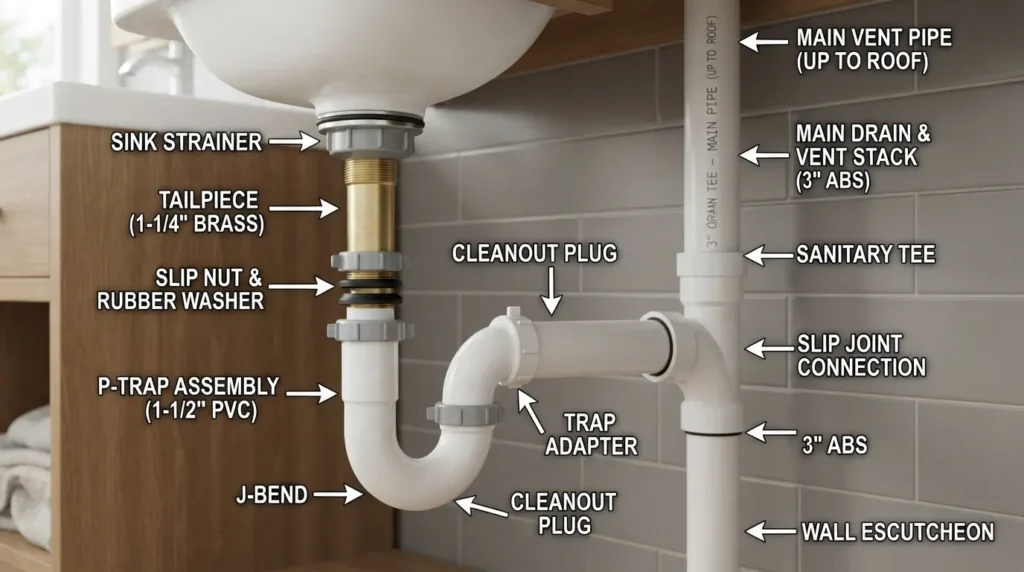
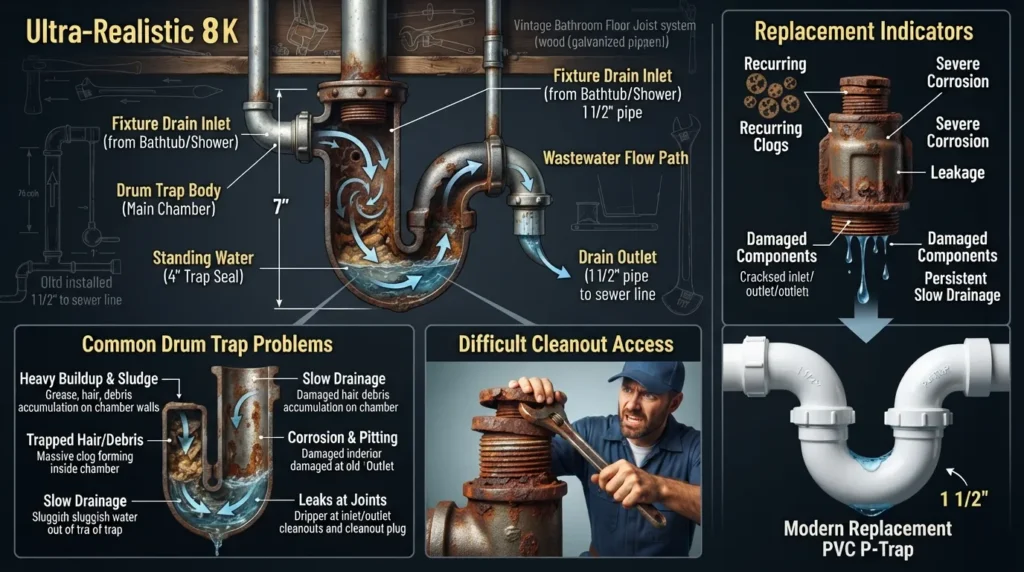
5. Clean the P-Trap
The curved section of pipe under many sinks is the P-trap. It can collect debris, food particles, sludge, or small objects.
Cleaning the P-trap can make sense when the problem appears localized to one sink and the trap is safely accessible. Place a container underneath before disassembly because the trap normally contains water.
Best for: Accessible sink clogs located in or near the trap.
Not enough for: A blockage deeper in the branch drain or main drainage system.
6. Enzymatic or Biological Drain Cleaners
Enzyme-based products are generally positioned more as slow-acting maintenance solutions for certain organic residues than as emergency tools for a completely blocked drain.
They do not physically retrieve hair, remove a foreign object, correct damaged piping, or solve a root intrusion.
Best for: Certain maintenance situations involving organic residue when used according to the product directions.
Not best for: Standing-water emergencies, solid objects, roots, or severe mechanical blockages.
7. Chemical Drain Cleaners
Commercial drain cleaners can dissolve or react with certain types of material, but “strongest” does not mean “best.” Their suitability depends on the clog, plumbing material, product directions, and what has already been used in the drain.
I would not repeatedly pour stronger chemicals into a drain that keeps clogging. A recurring problem is useful diagnostic information. It may point to buildup, a deeper obstruction, roots, a damaged line, or another condition that chemical cleaner cannot correct.
Never Mix Drain-Cleaning Chemicals
- Do not combine different commercial drain cleaners.
- Do not mix cleaners with bleach, acids, ammonia, or other household chemicals.
- If you call a plumber, tell them what product was put into the drain and approximately when it was used.
- Follow the product label for protective equipment, ventilation, contact time, and rinsing.
8. Professional Cabling, Hydro Jetting, and Camera Inspection
When a clog is deep, recurrent, severe, or affecting multiple fixtures, professional equipment becomes more appropriate.
Professional augering or cabling can reach obstructions beyond the practical range of basic homeowner tools.
Hydro jetting uses pressurized water to clean suitable drain or sewer lines and can remove substantial buildup from pipe walls when the method is appropriate for the line.
Sewer camera inspection helps identify the location and nature of a recurring or difficult drainage problem. A camera may reveal conditions such as heavy buildup, roots, an obstruction, or a structural issue that cannot be diagnosed accurately from the fixture alone.
The right professional method should be chosen based on the pipe, access, blockage, and condition of the line rather than automatically using the most aggressive equipment.
Which Drain Cleaning Method Works for Which Type of Clog?
“`
Hair
Start with visible removal or a hair tool. Use a drain snake if the clog is deeper.
Grease and Food Residue
Avoid relying on repeated quick fixes. Light residue may respond to maintenance, but recurring grease buildup may require mechanical or professional cleaning.
Soap Scum
Remove accessible hair first because soap often coats hair and debris. Persistent pipe-wall buildup may require more thorough cleaning.
Foreign Object
Physical retrieval or professional mechanical removal is usually more logical than trying to dissolve an object with chemicals.
Roots
Root intrusion is a professional drain or sewer-line issue and may require specialized cutting, cleaning, inspection, and possibly repair.
Heavy Scale or Pipe-Wall Buildup
A simple plunger may restore little or no long-term improvement. Professional cleaning and inspection may be more appropriate.
“`
What Do Plumbers Use Instead of Drano?
Professional plumbers do not rely on one universal substitute for a chemical drain cleaner. They choose tools according to the location and type of blockage.
Depending on the situation, a plumber may use:
- A hand or powered drain auger
- Professional cable machines
- Specialized cutters or rooter equipment
- Hydro jetting when appropriate
- A sewer camera to inspect recurring or difficult problems
- Manual trap or fixture disassembly when the obstruction is accessible
The key difference is diagnosis. Instead of asking, “What is the strongest thing I can pour down the drain?” the better question is, “What is actually causing this blockage, and what method can remove it safely?”
Do Baking Soda and Vinegar Actually Unclog Drains?
Baking soda and vinegar can create fizzing action and may be useful for light residue, odor control, or routine cleaning in some situations. However, that does not make the mixture a reliable solution for every clogged drain.
It should not be expected to remove:
- A dense hair plug
- A foreign object
- Tree roots
- A deep main-line blockage
- A damaged or collapsed pipe
- Heavy mechanical buildup that requires physical cleaning
If the drain is completely blocked or repeatedly clogs, mechanical removal and proper diagnosis are usually more useful than repeating a fizzing home remedy.
Does Dawn Dish Soap Unclog Drains?
Dish soap can help lubricate or loosen some greasy residue, particularly when combined with appropriately hot water, but it is not a universal unclogging method.
It will not physically remove hair, roots, a toy or other foreign object, or a serious blockage deep in the pipe. If water is not draining at all, adding more liquid to the fixture can also leave you with more standing water to manage.
What Happens If You Mix Vinegar and Dish Soap?
Vinegar and dish soap are sometimes used together for household cleaning, but combining them does not create a professional-strength drain cleaner. Dish soap can help with oily residue, while vinegar is acidic, but this mixture should not be confused with a method capable of clearing every type of blocked pipe.
More importantly, do not start combining household ingredients when a commercial drain chemical is already present. Avoid chemical experimentation inside a blocked drain.
Why Do People Pour Salt Down the Drain?
Salt appears in many home-cleaning recipes, sometimes combined with hot water, baking soda, or vinegar. It may help as part of light surface or residue cleaning, but there is no reason to treat pouring salt down every drain every night as a substitute for proper drain maintenance.
Preventing hair, grease, food scraps, and inappropriate materials from entering the drainage system is more important than routinely adding a household ingredient after the fact.
What Dissolves Soap Buildup in a Drain?
Soap buildup often combines with hair, body oils, minerals, and other debris rather than existing as a clean layer of soap by itself.
For bathroom drains, I would first remove hair and accessible debris. Light residue may respond to warm or hot water that is appropriate for the plumbing, while persistent buildup deeper in the pipe may need mechanical cleaning.
If soap-related buildup repeatedly narrows the same drain, cleaning only the visible drain opening may not address the full restriction.
Can You Use Boiling Water and Dish Soap to Unclog a Drain?
Dish soap and hot water can sometimes help with light greasy residue, but I would not automatically pour boiling water into every drain. Some plastic piping and fixture components can have temperature limitations.
A safer rule is to use a method that matches both the clog and the plumbing material. If you do not know what piping you have or the drain is fully blocked, choose a mechanical approach or professional assessment instead of escalating the water temperature.
How to Clear a Clogged Drain With Standing Water
Standing water changes the situation because you cannot easily inspect the drain opening and adding more liquid may make the mess worse.
- Stop running more water into the fixture.
- Remove some standing water if necessary so you can safely work around the drain.
- Remove visible debris or hair.
- Use a fixture-appropriate plunger if it is safe to do so.
- If that does not work, consider an appropriate mechanical drain snake.
- Stop DIY attempts if the blockage is recurrent, unusually deep, or accompanied by problems at other fixtures.
Stop Before Plunging If Chemicals Are in the Water
If chemical drain cleaner has already been added, splashing becomes a safety concern. Do not blindly plunge, snake, or disassemble the drain without accounting for the chemical that is present.
What If the Clog Is Deep in the Pipe?
A deep clog often behaves differently from debris sitting directly under the drain stopper.
Signs that the obstruction may be farther down the line include:
- The drain stays blocked after visible debris has been removed
- A short hand tool cannot reach the obstruction
- The same clog repeatedly returns
- More than one nearby fixture drains slowly
- Using one fixture causes gurgling or water movement in another
A longer auger may be required, but if the problem involves a shared branch, main drain, or sewer line, professional diagnosis is more useful than continuing to push a small homeowner snake deeper into an unknown system.
Different Fixtures Need Different Drain Cleaning Strategies
Bathroom Sink
Bathroom sink clogs commonly involve hair, soap residue, toothpaste, grooming products, and material collecting around the stopper or P-trap. Start by checking the accessible components before assuming the clog is deep in the drainage system.
Shower and Bathtub
Hair is a common mechanical problem in shower and tub drains. Physical hair removal often makes more sense as the first step than treating the problem as a chemical clog.
Kitchen Sink
Kitchen drains can collect grease, food residue, and organic buildup. Avoid sending cooking fats, oil, and grease down the drain even if they are liquid while hot. They can cool and contribute to buildup farther inside the system.
Toilet
A toilet is not simply another sink drain. Use tools intended for toilets, and do not assume every sink-drain technique belongs in a toilet trapway. If an object has been flushed or the toilet affects other fixtures, professional diagnosis may be appropriate.
Main Drain or Sewer Line
If multiple drains are slow, wastewater comes up through a shower or tub, or several fixtures react to one another, the problem may be downstream of the individual fixture.
At that point, treating every sink separately can waste time because the actual restriction may be in a shared line.
Why Does a Drain Keep Clogging After You Clean It?
A recurring clog is one of the most useful clues you can give a plumber. It means the immediate opening of the drain may have improved, but the underlying condition may still be present.
Possible reasons include:
- Only a narrow opening was made through the buildup
- Hair or debris remains farther down the pipe
- Grease or scale continues to coat the pipe wall
- A foreign object is partially obstructing the line
- Roots are entering a buried drain or sewer line
- The pipe has a structural, alignment, or drainage problem
- The blockage is in a shared line rather than the individual fixture
Repeatedly using the same quick fix without asking why the clog returns can turn a diagnostic problem into a cycle of temporary relief.
When Should You Stop DIY Drain Cleaning?
Call a Plumber When:
- Several drains are slow or blocked at the same time
- Wastewater backs up into another fixture
- The clog returns soon after being cleared
- You suspect a blockage deep in the drain or sewer line
- A foreign object may be lodged in the pipe
- You suspect roots or structural pipe damage
- You have already tried an appropriate basic method without improvement
- You are unsure what chemical has already been used in the drain
For homeowners in the Miami area who need deeper diagnosis or professional equipment, our professional drain cleaning service explains the methods used for more difficult drain and sewer-line problems.
How to Prevent Drain Blockages From Coming Back
Preventing the material from entering the drain is usually more effective than repeatedly cleaning it out later.
- Use hair catchers in showers and tubs.
- Remove hair from sink and tub stoppers before it travels deeper.
- Keep cooking grease, fats, and oils out of kitchen drains.
- Scrape food waste into the trash rather than washing large amounts into the sink.
- Do not flush wipes, paper products, hygiene products, or foreign materials that are not intended for the toilet.
- Pay attention when a drain begins slowing instead of waiting for a complete blockage.
- Treat repeated clogging as a symptom that deserves diagnosis.
A Simple Drain Cleaning Decision Process
Use This Order Before Choosing a Method
- Identify the fixture: kitchen sink, bathroom sink, shower, tub, toilet, or multiple fixtures.
- Identify the symptom: slow flow, standing water, complete blockage, smell, gurgling, or backup.
- Estimate the likely cause: hair, grease, soap residue, food, foreign object, roots, or deeper buildup.
- Start with the least aggressive suitable method.
- Check the result: normal flow should return without affecting another fixture.
- Watch for recurrence: if the clog comes back, stop treating it as a one-time blockage.
- Escalate when needed: shared-line symptoms, backups, deep clogs, roots, or repeated problems need proper diagnosis.
Drain Cleaning Myths: What Helps and What Does Not
“The strongest cleaner is always best.”
No. The correct method depends on the clog. Physical objects, roots, damaged pipes, and many deep clogs cannot be solved by using a stronger liquid.
“Baking soda and vinegar fix every drain.”
They may help with light residue or odor in some situations, but they are not a substitute for physically removing a serious obstruction.
“If the drain flows again, the problem is solved.”
Not necessarily. A narrow opening through a clog can restore temporary flow while buildup remains behind.
“Every slow drain is a fixture problem.”
A single slow drain may be local, but multiple affected fixtures can point to a restriction farther downstream.
See a Basic Drain-Cleaning Demonstration
If you prefer seeing a drain-cleaning process before trying a simple home method, this video provides a visual demonstration. Remember that a video cannot diagnose the material, depth, or condition of the blockage in your own plumbing system.
Frequently Asked Questions About Drain Cleaning Methods
What do plumbers recommend to clean drains?
Plumbers generally choose a method based on the blockage rather than recommending one product for every drain. That may mean manual removal, plunging, an auger, powered cabling, hydro jetting, or camera inspection depending on the problem.
What is the best tool to unclog a drain?
The best tool depends on the fixture and clog. A hair tool can be ideal for a shower drain, a plunger may work for a localized blockage, and a snake can reach deeper obstructions. Professional equipment is more appropriate for main-line or recurring problems.
Can a drain snake damage pipes?
Improper use can damage components or fail to solve the real problem. Use a tool that is appropriate for the fixture and pipe, and avoid forcing equipment when you do not know the condition or route of the drain line.
Should I use chemicals or a snake first?
For a suspected physical blockage such as hair, a mechanical method often gives you more direct control because it removes or moves the obstruction. Avoid creating a chemical hazard before attempting mechanical work.
How do I know if the main drain is clogged?
One clue is that multiple fixtures begin draining slowly or affecting one another. Wastewater backing up into a lower fixture is another warning sign that the problem may be farther downstream than one sink or shower.
Can I clean every drain using the same method?
No. A toilet, bathroom sink, kitchen sink, shower, branch drain, and main sewer line have different shapes, clog materials, and access requirements. Match the method to the actual problem.
The best way to clean a drain is not to keep escalating from mild products to stronger ones. It is to identify where the blockage is, what is likely causing it, how severe it is, and whether the problem is isolated or affecting the larger drainage system.
For visible hair or a simple localized clog, basic mechanical methods may be enough. For a drain that repeatedly blocks, several slow fixtures, deep obstructions, roots, or wastewater backup, the better next step is professional diagnosis and a method chosen for the actual condition of the line.
Need Help With a Stubborn or Recurring Drain Problem?
If you are in the Miami area and a drain keeps clogging, several fixtures are affected, or a basic method has not restored normal drainage, a professional inspection can help identify the problem before more aggressive cleaning is attempted.
Learn more about our Miami plumbing team, or call for drain help.