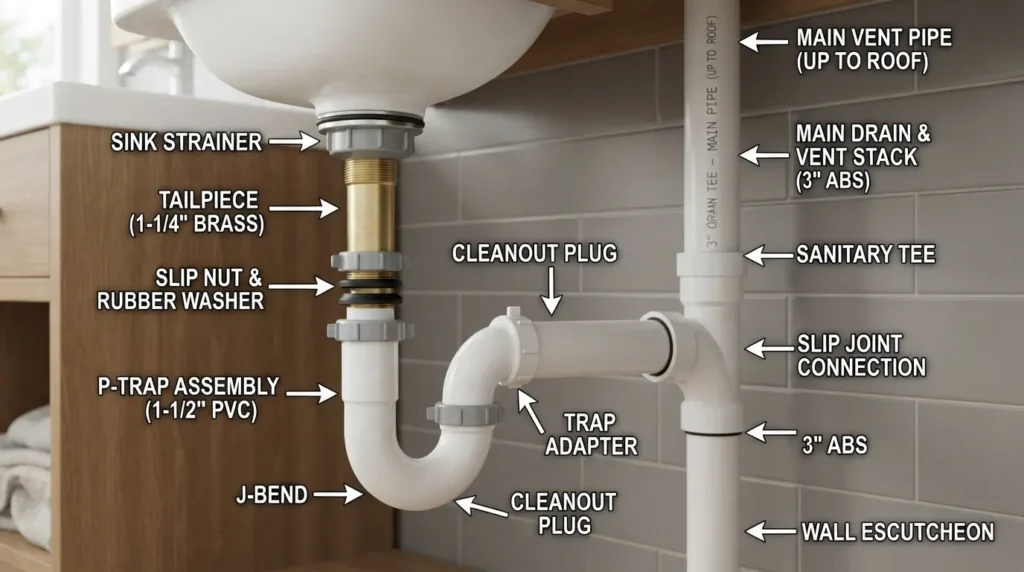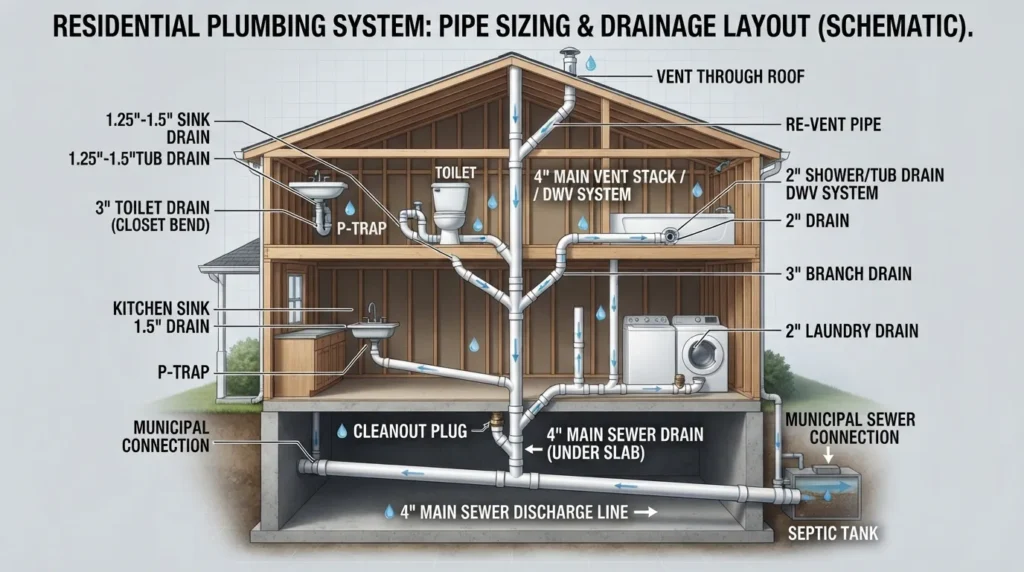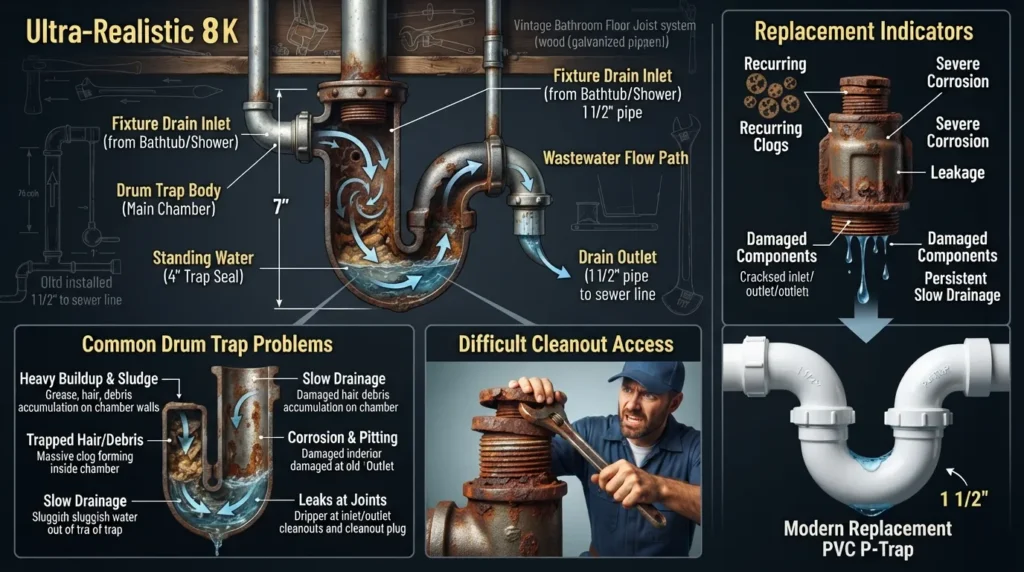
 If you have a clogged drain deep in the pipe, first determine whether the problem affects only one fixture or several. A single slow sink, tub, or shower usually points toward a local or branch-line blockage, while several slow drains, gurgling fixtures, or water backing up into another fixture can point toward a larger shared drain or sewer-line problem.
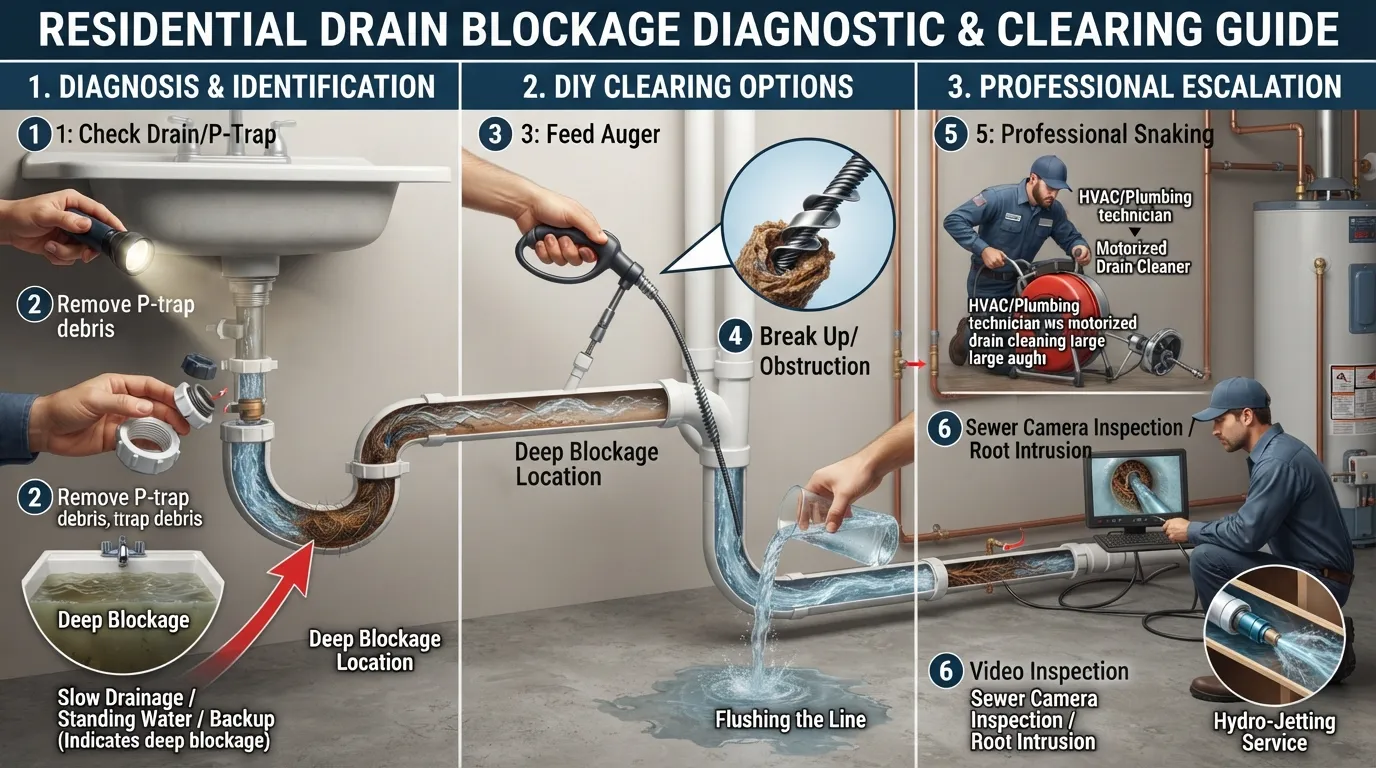
If the stopper and P-trap are already clear, a properly selected drain auger may reach a deeper obstruction. But if snaking does not restore normal flow, the clog keeps returning, several fixtures are affected, or you suspect roots or damaged piping, stop repeating the same DIY fix and move to proper diagnosis.
A deep drain clog is different from the hair or debris you can pull from the opening of a sink or shower. By the time you search for a clogged drain deep in a pipe, there is a good chance you have already tried one or more basic fixes and the water still will not drain normally.
That is where I would change the approach. Instead of asking, “What is the strongest thing I can pour down this drain?” start with three questions:
- Where is the blockage likely located?
- What is probably blocking the line?
- Which clearing method actually matches that problem?
That diagnosis matters because hair near a shower drain, grease deep in a kitchen branch line, tree roots in a sewer lateral, and a damaged pipe are four very different problems.
If you want to understand how traps, branch lines, stacks, cleanouts, and larger drains connect before troubleshooting, see our guide to how a home drainage system works.
How Do I Know If the Clog Is Deep in the Pipe?
A slow drain does not automatically mean the obstruction is deep. Start by separating a near-fixture clog from a deeper branch-line or main-line problem.
More likely: a surface or near-drain clog.
More likely: a blockage farther down that fixture’s branch drain.
More likely: a blockage in a larger shared branch, building drain, or sewer line.
More likely: a downstream obstruction shared by those fixtures.
Possible issue: only part of the obstruction was removed, or an underlying buildup, root, or pipe problem remains.
The first distinction I would make is simple: is this one clogged drain or a drainage-system problem affecting multiple fixtures?
One Clogged Drain vs. Multiple Clogged Drains
If Only One Drain Is Clogged
The problem is more likely near that fixture or inside its branch drain. A kitchen sink may have grease and food buildup farther down the line, while a bathroom sink or shower may have hair and soap residue beyond the immediately visible portion of the drain.
If Several Drains Are Slow or Backing Up
Do not keep treating each fixture as a separate clog. Multiple slow drains, gurgling, or wastewater appearing in another fixture can indicate a blockage farther downstream in plumbing shared by those fixtures.
That distinction can save you from spending time pouring products into a sink when the actual obstruction is much farther down the drainage system.
What Causes a Clog Deep in a Drain Pipe?
Deep blockages can form for different reasons, and those causes do not all respond to the same clearing method.
- Hair: Hair can bind with soap residue and other debris in bathroom drains.
- Soap and organic buildup: Residue can gradually narrow the usable opening inside a branch line.
- Fats, oils, and grease: Grease can coat the inside of kitchen drainage piping and trap food particles and other debris.
- Food debris: Material entering a kitchen drain can contribute to a deeper restriction, especially when it combines with grease.
- Foreign objects: A solid item may lodge at a fitting, bend, or restriction.
- Mineral or scale buildup: Deposits may gradually reduce the interior diameter of a pipe.
- Tree roots: Roots can enter compromised underground drain or sewer piping.
- Damaged or misaligned piping: A sag, offset, deterioration, or collapsed section can create recurring drainage problems that ordinary unclogging does not correct.
Miami-Dade Note: Keep Fats, Oils, and Grease Out of Drains
Miami-Dade County specifically advises residents not to pour fats, oils, and grease into sinks or garbage disposals because they can contribute to blockages and sewage backups. If a kitchen sink repeatedly clogs deep in the line, grease buildup deserves serious consideration instead of treating every backup as an isolated incident.
How to Clear a Clogged Drain Deep in the Pipe
If the problem appears limited to one fixture and there are no warning signs of a larger sewer-line blockage, work through the problem in a logical order instead of jumping between random remedies.
1. Stop Adding Water to a Fully Blocked Fixture
If water is already standing in the sink, tub, or shower, stop running more water. Remove enough standing water to safely reach the drain opening.
You can use a small container, sponge, or an appropriate wet-water removal method depending on the fixture and what has already been added to the drain.
Important Safety Warning
If you already poured a chemical drain cleaner into the fixture, do not blindly add another chemical, create pressure in the drain, or begin splashing and disassembling plumbing without considering what chemical may still be present. Drain-cleaning chemicals can be corrosive, and mixing products or causing contaminated water to splash can create a serious exposure hazard. Follow the product label and use professional help if safe access is uncertain.
2. Check the Stopper, Strainer, and Other Accessible Areas
Before deciding that the clog is several feet into the pipe, clear the areas you can actually inspect.
- Remove visible hair and debris from the drain opening.
- Clean the stopper or strainer.
- If you are comfortable working on an accessible sink trap, inspect it and reinstall it correctly afterward.
If the accessible portion is clean but the fixture still barely drains, the obstruction is more likely farther downstream.
3. Try a Plunger When the Situation Is Appropriate
A plunger can sometimes move a blockage that is still close enough to the fixture for pressure changes to affect it. It is generally more useful for a relatively local obstruction than for a blockage far down a long branch line.
If plunging makes no meaningful difference and you have already cleared the visible parts of the drain, move toward mechanical access rather than endlessly repeating the same step.
4. Use a Proper Drain Auger for a Deeper Branch-Line Clog
A drain snake or drum auger can reach farther into the drainage line and mechanically break through, retrieve, or disturb certain types of obstructions.
- Choose a tool that is appropriate for the fixture and pipe you are working on.
- Feed the cable slowly into the drain or suitable access point.
- When you feel resistance, remember that resistance may be a bend or fitting rather than the clog itself.
- Operate the auger according to the tool manufacturer’s instructions rather than forcing the cable.
- If the cable catches debris, withdraw it gradually.
- Clean the cable and repeat only as needed.
- Afterward, test the drain progressively rather than assuming one small trickle means the line is fully open.
Key point: The amount of cable you fed into the pipe does not prove that you reached the clog. Plumbing contains bends and branches, and a cable can travel a substantial distance without actually solving the obstruction you are trying to reach.
Why Is My Drain Still Clogged After Snaking 15, 25, or 50 Feet?
This is where many homeowners get stuck. The cable seems to travel deep into the pipe, but the sink or shower remains blocked.
If that happens, do not automatically assume you need an even longer snake. First consider why the first attempt failed.
The actual obstruction may be farther downstream than the tool reached.
Branches and fittings can send a cable somewhere other than the path you expected.
Water may temporarily pass through a narrow opening while a large amount of grease, scale, hair, or other material remains on the pipe wall.
Dense buildup, a solid object, roots, or heavy deposits may require different equipment.
A sagging, damaged, displaced, or collapsed section will not be permanently corrected simply by pushing a cable through it.
This is also why repeatedly snaking the same drain without learning anything new can become a cycle. If the same blockage comes back, the better question is no longer “How do I open it again?” but “Why does this line keep blocking?”
Which Unclogging Method Matches Which Problem?
There is no single “strongest” drain-opening method. The best option depends on the obstruction.
Hair or Soft Bathroom Debris
Useful direction: Physical removal or an appropriate mechanical drain tool. Hair is usually better removed than “dissolved” with repeated home remedies.
Grease and Kitchen Buildup
Useful direction: Mechanical clearing may restore flow. More extensive deposits can require more thorough professional drain cleaning instead of simply punching a temporary path through the buildup.
Solid Foreign Object
Useful direction: Retrieval or mechanical removal. A solid object cannot be expected to disappear because a liquid cleaner was poured into the drain.
Tree Roots or Main-Line Buildup
Useful direction: Main-line diagnosis and professional equipment. This is no longer the same job as pulling hair from a bathroom sink.
Damaged, Offset, or Sagging Pipe
Useful direction: Pipe-condition diagnosis and appropriate repair. Drain cleaning may temporarily improve flow without correcting the structural cause.
What If the Drain Is Clogged With Standing Water?
A clogged drain with standing water needs a slightly different approach because you first need safe access to the drain.
- Stop using the fixture. Do not add more water to an already full sink, tub, or shower.
- Remove enough standing water to work. Use an appropriate container or water-removal method.
- Determine whether any chemical product has already been added. This affects what is safe to do next.
- Clear visible debris. Remove hair, food, or other accessible material.
- Use mechanical clearing when appropriate. If the blockage is farther down a single fixture’s branch line, an appropriate auger may be the logical next tool.
- Watch the other fixtures. If several drains are backing up, shift from single-drain troubleshooting to shared-line diagnosis.
Do Boiling Water, Dawn, Vinegar, or Salt Work on a Deep Clog?
These questions appear frequently because homeowners understandably want a simple home remedy. The important question, however, is not whether a household product can affect some residue. It is whether it can remove the obstruction you actually have.
Does Pouring Boiling Water Down a Drain Help?
Hot water may help move light greasy or soapy residue in some situations, but boiling water should not be treated as a universal deep-clog solution. It will not retrieve a foreign object, remove roots, repair damaged piping, or reliably eliminate a dense obstruction farther down the line.
Does Dawn Dish Soap Unclog Drains?
Dish soap may help loosen light grease, especially when the problem is minor. It is not a substitute for mechanical clearing when the drain is blocked by a substantial accumulation of debris.
Can Vinegar Unclog a Deep Drain?
Vinegar may have a role in light cleaning, but a true blockage deep in a drain pipe usually needs the obstruction physically removed, broken up, or professionally cleaned.
Does Salt Unclog a Drain?
Salt is not a dependable solution for a seriously blocked drain line. If water cannot move because the pipe is physically obstructed, adding more household ingredients does not answer the central problem: what is blocking the line and how will it be removed?
What Is the Strongest Thing to Unclog a Drain?
The better question is what is the correct method for this particular clog?
A hair clog may respond to physical removal. A deeper branch clog may respond to an auger. Heavy buildup may need more thorough cleaning. Roots or structural problems need a completely different level of diagnosis.
“Stronger” is not automatically “better.” Correct diagnosis is.
Will a Blocked Drain Clear Itself?
I would not count on a deep blockage clearing itself. A small soft obstruction may occasionally move, but a true restriction can continue collecting debris and become more severe.
A partially clogged pipe can also be deceptive. Water may drain slowly today and then back up completely when the fixture receives a larger volume of water.
If the drain is becoming progressively slower, repeatedly clogging, or affecting additional fixtures, investigate the cause instead of waiting for it to disappear.
How Do You Know the Drain Is Actually Clear?
One of the most overlooked parts of unclogging a drain is verifying that you did more than create a small opening through the obstruction.
After Clearing the Drain, Test It in Stages
- Run a small amount of water first.
- Increase the flow and see whether the drain keeps up.
- Let the fixture hold some water, then release a larger volume.
- Listen for gurgling.
- Check nearby fixtures for unexpected movement or backup.
- Watch whether drainage slows again during normal use.
If a small trickle drains but a full sink backs up, there may still be a partial obstruction farther down the line.
When Should You Stop DIY Drain Cleaning?
DIY troubleshooting makes sense only while the problem remains reasonably identifiable and safe to access.
It Is Time to Escalate the Problem When:
- several drains are slow or backing up,
- a toilet flush causes a shower or tub to gurgle or fill,
- wastewater appears in a different fixture,
- the same drain repeatedly clogs after being snaked,
- your auger travels deep into the line but flow does not improve,
- you suspect roots, heavy buildup, or a damaged sewer line,
- a chemical cleaner is sitting in the line and mechanical access may create a splash hazard,
- you cannot safely identify or access the correct cleanout, or
- you are not comfortable operating the equipment needed for the job.
At that point, professional drain cleaning in Miami can help move the problem from trial-and-error toward proper diagnosis and clearing.
Drain Snake vs. Camera Inspection vs. Hydro Jetting
These are different tools for different jobs. Understanding that difference can prevent you from expecting one method to solve every type of clogged plumbing.
Drain Snake or Auger
A mechanical clearing tool that can break through, retrieve, or disturb many ordinary obstructions when the cable can reach the affected area.
Camera Inspection
Useful when the main question becomes why the line repeatedly blocks. Inspection can help identify conditions such as persistent buildup, root intrusion, obstructions, or visible pipe defects in accessible sections of the system.
Hydro Jetting
Hydro jetting uses high-pressure water to clean suitable drain and sewer piping. Unlike simply opening a narrow path through some types of buildup, it can be used to clean material from pipe walls when the pipe condition and blockage make jetting appropriate.
If a pipe is structurally damaged, however, cleaning alone does not repair it. That is why diagnosis should come before automatically choosing the most aggressive cleaning method.
How to Prevent Another Deep Drain Clog
Once the line is flowing normally, focus on what caused the blockage in the first place.
- Keep fats, oils, and grease out of kitchen drains.
- Use strainers where appropriate to catch hair and food debris.
- Do not send wipes, hygiene products, or other inappropriate materials through the drainage system.
- Do not ignore a drain that is gradually becoming slower.
- If the same line clogs repeatedly, investigate the cause instead of treating each backup as an unrelated event.
- Pay attention when multiple fixtures begin behaving differently at the same time.
If you are unsure whether a recurring problem is limited to one fixture or part of the larger drainage system, a local Miami plumbing team can help assess the problem in context.
See How a Drain Snake Is Used on a Blocked Line
If you have never seen a drain auger in use, this demonstration can help you visualize how the cable is fed into the pipe and worked through resistance.
A video can demonstrate technique, but it cannot tell you the condition of your specific plumbing. If the cable will not clear the blockage or several fixtures are involved, the next useful step may be diagnosis rather than another pass with the same tool.
Frequently Asked Questions
How do you unblock a clogged drain deep in a pipe at home?
Clear the accessible stopper or trap first. If only one fixture is affected and the obstruction appears to be farther down its branch drain, use an appropriate drain auger according to the tool instructions. If several fixtures are affected or repeated snaking fails, the blockage may require another access point or professional diagnosis.
How do you unclog a drain you cannot reach?
A drain auger can reach farther into a branch line than tools used only around the drain opening. If the obstruction is beyond the tool’s reach or cannot be approached safely from the fixture, another access point such as an appropriate cleanout or professional drain-cleaning equipment may be needed.
How do I know if the clog is deep in the pipe?
A deep clog becomes more likely when the visible drain, stopper, and accessible trap are clear but water still drains poorly. Multiple affected fixtures, gurgling, or water backing up elsewhere can indicate a blockage in a larger shared drainage line.
What unblocks a badly blocked drain fast?
The fastest effective method depends on the obstruction. A local soft clog may respond to plunging, while a deeper branch-line blockage may need an auger. Roots, extensive buildup, or main-line problems may require professional cleaning and diagnosis.
Will a blocked drain eventually clear itself?
Sometimes a small soft obstruction may shift, but a true deep blockage should not be expected to disappear on its own. Partial restrictions can continue collecting debris and may eventually cause a complete backup.
Why is my sink still clogged when the P-trap is clean?
If the P-trap is clear but the sink still will not drain normally, the obstruction may be farther down the trap arm or branch drain. At that point, a suitable auger or another access point may be needed.
Why does my drain keep clogging after I snake it?
You may have created only a narrow opening, failed to reach the full obstruction, or left heavy buildup behind. Recurring clogs can also point toward roots, a pipe defect, or another condition that requires diagnosis instead of repeated temporary clearing.
Can a deep clog cause water to back up into another drain?
Yes. When fixtures share drainage piping, a downstream obstruction can cause water or air movement to appear at another fixture. That is one reason multiple-drain symptoms deserve more attention than an isolated slow sink.
If you are dealing with a clogged drain deep in the pipe, do not treat every blockage as the same problem.
First determine whether one fixture or several fixtures are affected. Then confirm that the accessible drain components are clear. If the problem is isolated and appears to be farther down the branch line, a properly selected drain auger may be the logical next step.
But if the snake travels deep and the drain still will not clear, the clog repeatedly returns, several fixtures are affected, or you suspect roots or damaged piping, stop repeating the same fix. At that point, identifying the location and cause of the obstruction is more valuable than trying a stronger home remedy.
Still Dealing With a Deep or Recurring Drain Clog?
If the blockage is beyond what you can safely reach, several drains are involved, or the same clog keeps returning, a plumber can determine whether the line needs mechanical clearing, further inspection, more thorough cleaning, or repair.