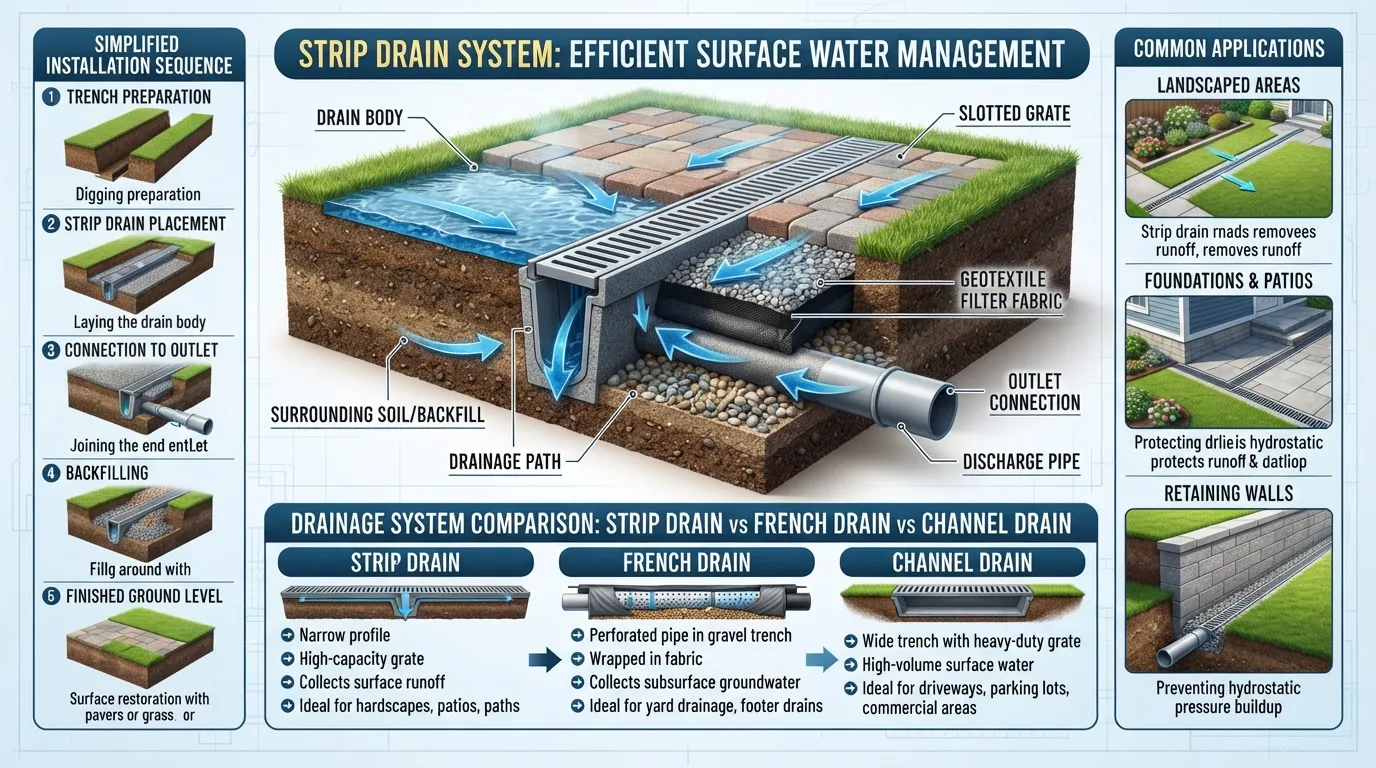
A strip drain is a narrow, prefabricated subsurface drainage system designed to collect water from surrounding soil and move it toward a designated drainage outlet. A typical geocomposite strip drain combines a perforated polymeric drainage core with geotextile filter fabric that lets water enter while helping keep soil and sand out of the flow channels. It can be used in saturated lawns, around foundations and retaining walls, and in other locations where subsurface water needs to be collected without building a traditional wide gravel-and-pipe drain.
If you are researching a strip drain because water keeps collecting around your property, the most important thing to understand is that choosing a drain starts with identifying what type of water you are trying to control. A strip drain may be a good solution for subsurface water, but it is not automatically the right answer for driveway runoff, a clogged household drain, or a sewer backup.
In this guide, I will show you how a strip drain system works, where it makes sense, where it does not, how it compares with French drains and channel drains, what installation involves, and what to check before you choose one.
Important terminology note: This guide uses strip drain to mean the geocomposite or prefabricated subsurface drainage product found in the dominant property-drainage search results. The term can also appear in other industries for narrow linear drains, including some tile and shower products. It is also unrelated to the medical practice of “stripping” a surgical drain.
What Is a Strip Drain?
A strip drain is a thin drainage product that creates a continuous pathway for subsurface water. Instead of relying on a large perforated round pipe surrounded by a wide bed of stone, a prefabricated strip drain uses an engineered core wrapped in filtration fabric.
American Wick Drain describes its strip-drain products as a perforated polymeric core fully wrapped with geotextile filter fabric. NDS uses a similar basic concept in its retail strip drain: a dimpled, perforated polymeric core surrounded by polypropylene geotextile fabric.
The basic components are:
- Drainage core: Creates open channels through which collected water can travel.
- Perforations or open collection area: Allow water to enter the drainage core.
- Geotextile filter fabric: Allows water through while helping prevent soil and sand from entering the flow channels.
- Outlet connection: Transfers collected water from the strip into an appropriate downstream drainage route.
The exact core material, dimensions, hydraulic capacity, fabric specification, fittings, and installation requirements vary between products, so a strip drain should be selected from actual project requirements rather than by appearance alone.
How Does a Strip Drain Work?
The easiest way to understand the system is to separate drainage into three jobs: collection, conveyance, and discharge.
Water in saturated soil reaches the geotextile-covered strip and passes through the filter fabric into the drainage core.
The core provides a low-resistance pathway that allows water to move along the length of the strip.
An outlet fitting or connected drainage system carries the water toward an approved or otherwise suitable discharge location.
Key idea: A strip drain can collect water efficiently, but collection alone does not solve a drainage problem. The water still needs somewhere appropriate to go.
That distinction matters. If the downstream outlet is blocked, undersized, poorly located, or nonexistent, installing more drainage material upstream may not solve the actual problem.
What Are Strip Drains Used For?
Strip drains are primarily associated with subsurface water management. Depending on the product and project design, applications can include:
- Saturated lawns and landscaped areas
- Foundation perimeter drainage
- Retaining-wall drainage
- Raised planter drainage
- Cut-off or interceptor drainage
- Roadway edge drainage
- Sports and turf drainage
- Structural and shoring-wall drainage
- Some underslab and civil drainage applications when specifically designed for that use
- Integration with sheet-drain systems
That does not mean the same strip-drain product is appropriate for every application on this list. Structural walls, underslab work, road drainage, shotcrete systems, and engineered sites may require project-specific design criteria and manufacturer details.
The Most Important Decision: What Type of Water Are You Draining?
Before comparing products, I would first classify the water problem. This simple step prevents many drainage mistakes.
This is why two properties that both appear to have a “drainage problem” may need completely different solutions.
Strip Drain vs. French Drain vs. Channel Drain
These systems overlap in the broad goal of moving unwanted water, but they collect water differently.
Strip Drain
Best matched to: Subsurface water.
Collection method: Water passes through geotextile into a narrow engineered core.
Typical advantage: Thin profile can reduce the amount of excavation and aggregate required compared with some conventional stone-and-pipe systems.
French Drain
Best matched to: Subsurface water and groundwater interception.
Collection method: Traditionally uses a perforated pipe with permeable aggregate and filtration components.
Typical advantage: Familiar, widely used configuration with many design variations.
Channel / Trench Drain
Best matched to: Surface runoff on hardscapes.
Collection method: Water enters through an exposed grate or channel opening.
Typical advantage: Intercepts water moving across driveways, patios, walkways and similar surfaces.
Is a Strip Drain Better Than a French Drain?
Not automatically. Geocomposite drainage products can provide installation advantages where a thinner drainage section, reduced excavation, lower aggregate use, or faster placement is important. Industry guidance also notes that a smaller trench and less handling of gravel and pipe can reduce installation effort in suitable designs.
But “easier to install” does not mean “better for every site.” The correct choice still depends on:
- The source and volume of water
- Soil and backfill conditions
- Available trench space
- Required hydraulic capacity
- Expected loads
- Foundation or retaining-wall conditions
- Outlet elevation and discharge route
- Manufacturer installation requirements
- Project specifications for structural or engineered work
I would choose the system by the water problem and site constraints, not simply by which product needs less digging.
Do Strip Drains Actually Work?
Yes, strip drains can work well when they are correctly matched to the drainage problem and installed as part of a complete system. Prefabricated products are specifically designed to collect and transport subsurface water, and manufacturers publish applications ranging from saturated lawns to foundation and retaining-wall drainage.
Performance, however, depends on more than the strip itself.
A Strip Drain May Underperform When:
- The real problem is surface runoff rather than subsurface water.
- The drain has no effective downstream outlet.
- The product is undersized for the application.
- The geotextile or drainage core is damaged during installation.
- Backfill does not match the manufacturer’s requirements.
- Connections or outlets restrict flow.
- The drain is installed in the wrong orientation for that product or application.
- Water is expected to move uphill or against the available hydraulic gradient without another means of conveyance.
- A heavily loaded location is used without confirming the product’s load suitability.
The most useful way to think about performance is this: the strip drain is one component in the water-management path, not the entire solution by itself.
How to Choose the Right Strip Drain System
If you are comparing products, don’t make the decision based only on strip width or roll length. Check the engineering and installation information that determines whether the product fits your application.
1. Confirm the Water Source
Determine whether the system needs to intercept groundwater, drain saturated soil, relieve water around a wall, or receive water from another drainage component. A product designed primarily for subsurface collection should not automatically replace a surface inlet.
2. Check Published Flow Capacity
Different strip drains have different core designs and hydraulic capacities. Use the manufacturer’s published flow data and design information instead of assuming every product with similar dimensions performs the same way.
3. Check the Filter Fabric
The geotextile is not decorative wrapping. It performs an important filtration function by allowing water into the system while helping keep surrounding soil out of the drainage channels.
4. Plan the Outlet Before Digging
Know how the strip will transition to its outlet, pipe, sump, approved stormwater route, or other designed discharge point. NDS, for example, sells an end outlet specifically to transition its strip-drain product into outlet piping.
5. Check Loads and Installation Location
A lawn installation, retaining-wall footing, road edge, underslab area, and vehicle-loaded location create very different demands. Do not assume a landscape product is traffic-rated or suitable for structural applications unless the manufacturer or project design confirms it.
How to Install a Strip Drain
The exact installation procedure depends on the brand, drain configuration, soil, outlet and application, so the manufacturer’s current instructions should control the installation. At a planning level, however, the process normally follows this sequence:
- Diagnose the drainage problem. Identify where the water enters the soil and where it needs to be intercepted.
- Choose a discharge point. Plan the entire drainage path before installing the collection strip.
- Lay out the drain route. Avoid unnecessary turns and conflicts with utilities or structures.
- Excavate the required trench or installation area. Follow the product’s specified depth and width rather than using a generic trench dimension.
- Place the strip in the specified orientation. Core and dimple orientation can matter depending on whether the strip is installed in a trench or against a wall.
- Connect sections and outlets correctly. Use the fittings or joining method approved for the system.
- Backfill with the required material. Some systems specify sand or aggregate around the drainage product.
- Compact or secure the installation as required. Protect the fabric and core from damage.
- Verify the discharge route. Make sure collected water can actually leave the system.
- Restore the finished surface. Regrade the surrounding area so surface conditions do not undermine the drainage plan.
Do not copy one product’s installation dimensions onto another. Core orientation, trench dimensions, backfill, connection details and structural requirements can differ. Use the installation instructions for the exact system being installed.
Does a Strip Drain Need Slope?
The drainage system needs a workable hydraulic path toward its discharge point, but the exact slope requirement should come from the system design and manufacturer’s instructions. Water entering a strip drain still has to move toward an outlet; simply placing a strip in wet soil without considering elevation and discharge can leave the underlying problem unresolved.
This is one of the practical questions worth resolving before excavation because outlet elevation may determine whether gravity drainage is practical or whether the drainage strategy needs to change.
Can You Bend a Strip Drain Around Corners?
Do not assume that a sharp 90-degree bend is acceptable simply because the product is flexible enough to move. Bending, folding or crushing an engineered drainage core can reduce its flow path.
If your route requires a corner, check whether the manufacturer specifies a fitting, approved connection detail, radius, cut-and-connect method, or another transition. Complex turns are a design issue—not something to improvise after the trench is open.
Should You Backfill a Strip Drain With Dirt, Sand or Gravel?
Use the backfill material specified for the exact product and application. For one NDS strip-drain product, the published trench installation guidance calls for sand or aggregate backfill and compaction. That does not establish a universal rule for every geocomposite drain.
The surrounding material affects how easily water reaches the drain and how well the drainage core and fabric are protected, so this is not a good place to substitute whatever soil happens to be available without checking the specification.
Strip Drain Failure Points to Avoid
A well-made product can still perform poorly when the system around it is wrong. These are the failure points I would check first:
- Wrong drain for the problem: Trying to fix heavy surface runoff with a subsurface-only collection strategy.
- No outlet: Collecting water without giving it a reliable place to discharge.
- Blocked downstream piping: The strip may work while the outlet system does not.
- Damaged geotextile: Tears or exposed core can compromise filtration.
- Crushed or folded core: Restricting the pathway that carries water.
- Poor connections: Allowing leakage, soil intrusion or hydraulic restrictions at transitions.
- Wrong capacity: Choosing a product without matching it to expected water conditions.
- Wrong installation orientation: Ignoring product-specific directions for trench or wall placement.
- Unverified loading: Installing beneath traffic or heavy loads without confirming suitability.
How Long Does a Strip Drain Last?
There is no single trustworthy lifespan number that applies to every strip drain system. Service life can vary with the polymeric core, geotextile, soil environment, installation quality, mechanical loading, outlet condition, exposure during construction and whether the system becomes damaged or obstructed.
For that reason, I would be cautious with any article that promises a universal number of years without tying it to a specific manufacturer, product specification and installation environment.
When comparing products, check:
- Core material
- Geotextile specification
- Published durability information
- Load limitations
- Manufacturer warranty
- Installation requirements
- Access to downstream outlets for inspection or maintenance
A product warranty and a product’s expected service life are also not necessarily the same thing.
Does a Strip Drain Need Maintenance?
The buried drainage core itself is not normally maintained in the same way as an exposed grate, but the complete system should not be treated as maintenance-free. Accessible outlets, connected piping, collection points and discharge areas should remain clear enough for water to leave the system.
If drainage performance changes over time, investigate the entire water path rather than assuming the buried strip has failed.
Strip Drain vs. Plumbing Drain: Don’t Confuse the Two
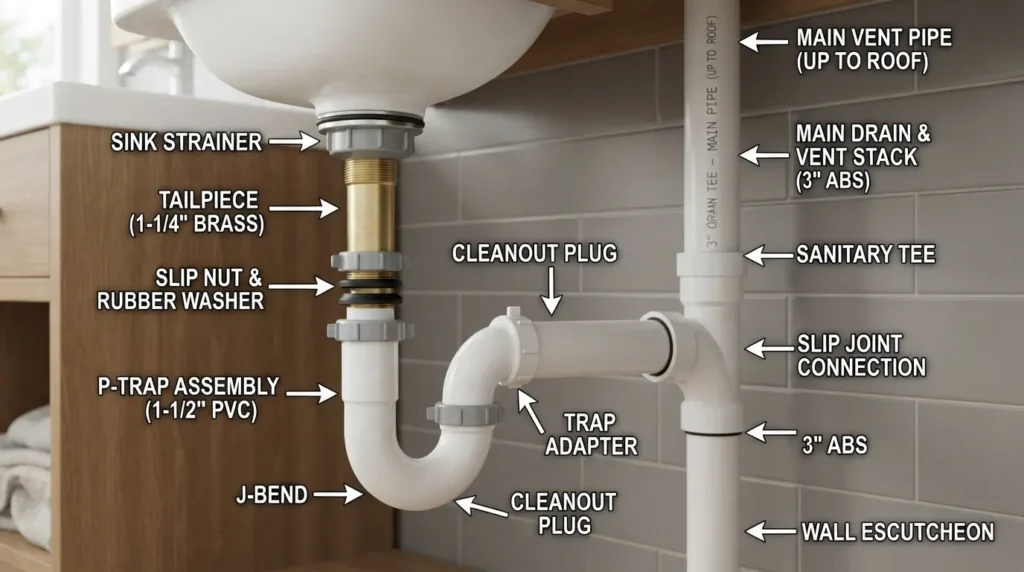
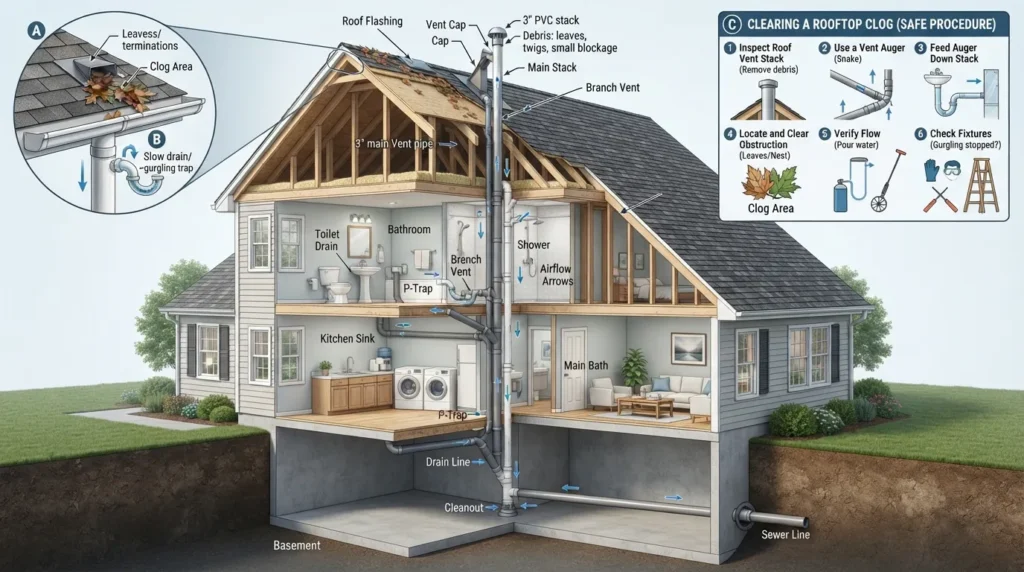
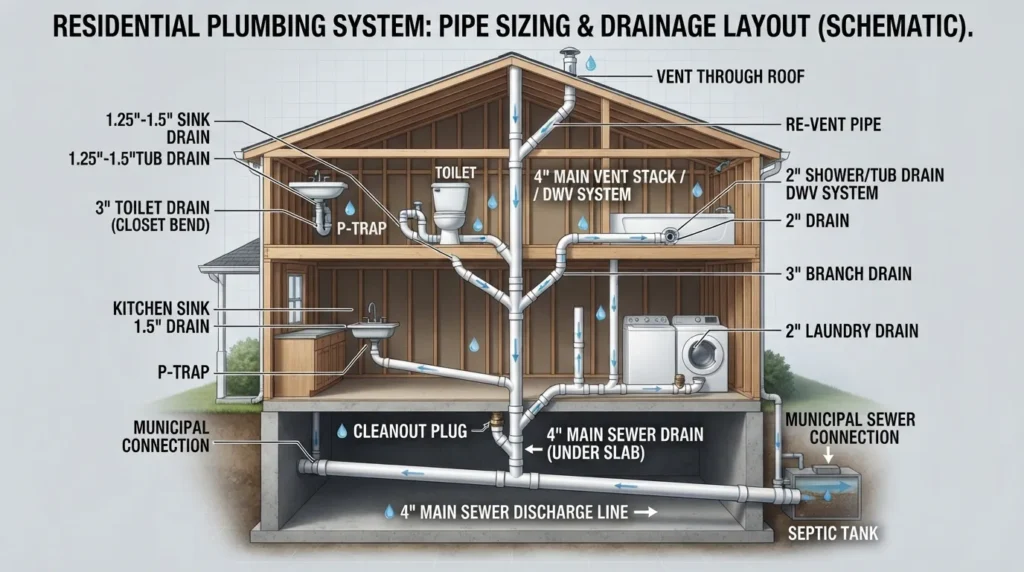
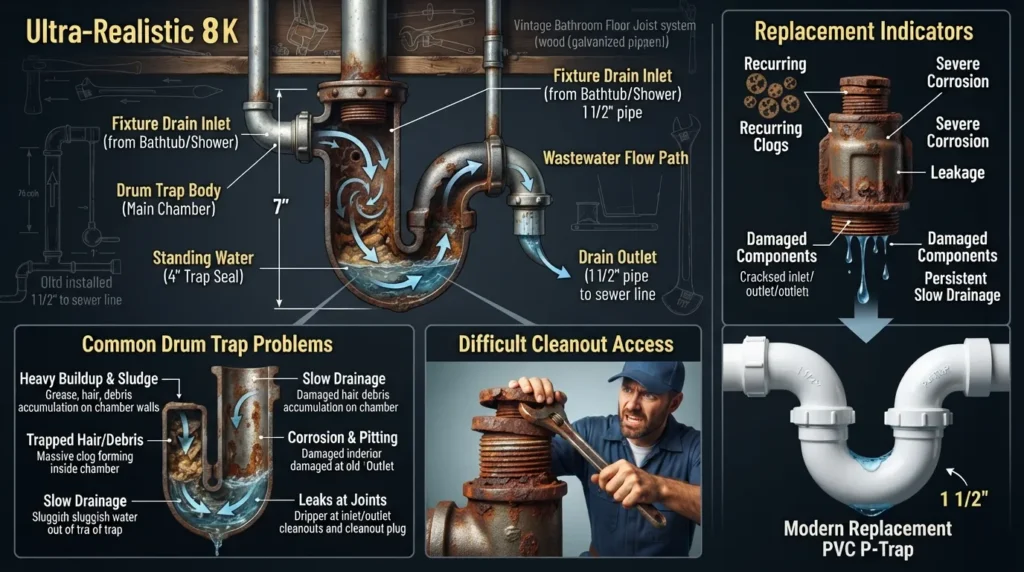
A geocomposite strip drain manages water in soil or around structures. Your home’s plumbing drain system carries wastewater from fixtures through traps, branch drains, stacks, the building drain and ultimately toward the sewer or other approved wastewater system.
If you are trying to understand the fittings and components inside that wastewater system, our complete guide to plumbing drain parts explains the difference between traps, branch piping, cleanouts, drain fittings and other common components.
If several indoor fixtures are backing up, water is returning through a drain, or a sink or shower stays clogged, installing an outdoor strip drain will not clear the restriction. In that situation, the correct next step is diagnosing the plumbing system and, when necessary, arranging professional drain cleaning in Miami.
Is a Strip Drain Right for a Miami Property?
The same decision framework applies in Miami: first determine whether the unwanted water is surface runoff, subsurface water, or wastewater from the plumbing system.
If water is moving through saturated soil around a landscape area or structure, a strip-drain system may be one option to evaluate. If water is racing across a paved surface, a channel-drain strategy may be more appropriate. If the water is coming from backed-up fixtures or a sewer line, the problem belongs to the plumbing drainage system instead.
If you are not sure which system is causing the problem, start with diagnosis rather than purchasing a drain based on its name. You can learn more about our Miami plumbing team and services, or speak with a local plumber when the issue may involve your home’s plumbing or sewer drainage.
Strip Drain Buying Checklist
Before buying a strip drain, make sure you can answer these questions:
- Am I collecting subsurface water or surface runoff?
- Where exactly will the collected water discharge?
- What flow capacity does the manufacturer publish?
- Is the product designed for my specific application?
- What trench or wall-installation detail is required?
- Which side or orientation should face the incoming water?
- What backfill is specified?
- How will corners and connections be handled?
- What outlet fitting is required?
- Will the location experience vehicle or structural loads?
- Do project specifications require an engineered drainage detail?
- Can the downstream discharge route remain accessible for inspection?
Frequently Asked Questions About Strip Drains
Do strip drains work?
Yes, when the product is correctly selected, installed and connected to a workable discharge route. They are designed specifically for collecting and conveying subsurface water, but they cannot compensate for a blocked or poorly planned downstream outlet.
What are strip drains used for?
Common uses include saturated lawns, foundation perimeter drainage, retaining walls and other subsurface water-management applications. Engineered systems are also used in civil, roadway, athletic-field and structural drainage projects.
Is a strip drain the same as a French drain?
No. Both can manage subsurface water, but a traditional French drain generally relies on a perforated pipe within permeable stone or aggregate, while a strip drain uses an engineered geocomposite drainage core wrapped in filter fabric.
Is a strip drain the same as a channel drain?
No. In the context covered here, a strip drain is buried and collects subsurface water through filter fabric. A channel or trench drain usually has an exposed opening or grate designed to capture water flowing across a surface such as a driveway, patio or walkway.
How do you install a strip drain?
Installation generally involves planning the outlet and route, excavating to the specified dimensions, positioning the strip in the correct orientation, connecting outlets or adjoining sections, using the required backfill and restoring the site. Always follow the instructions for the exact product because installation details vary.
Can a strip drain replace a French drain?
Sometimes it can serve as an alternative to a conventional perforated-pipe-and-stone system, but substitution should be based on hydraulic requirements, soil conditions, loading, outlet design and the intended application—not simply because the strip drain requires less space.
What is the lifespan of a strip drain?
There is no universal lifespan that applies to every strip drain. Longevity depends on the product materials, installation, soil environment, loads, drainage conditions and whether the system remains physically intact and able to discharge water. Use product-specific manufacturer data instead of relying on a generic number of years.
What does “stripping a drain” mean?
That phrase usually refers to a different medical topic involving surgical drains. It is not the same as the geocomposite strip-drain system used for property and subsurface water management, which is the subject of this guide.
Related Strip Drain Resources
If you are comparing products or planning an installation, these resources provide useful manufacturer, retailer and technical information. Product specifications can change, so confirm the current documentation for the exact system you plan to use.
American Wick Drain
Useful for understanding geocomposite strip-drain construction, applications, product families and manufacturer installation resources.
NDS Strip Drain at Lowe’s
Useful for reviewing an example residential strip-drain product, its specifications, installation notes, outlet requirements and customer questions.
Geosynthetics Magazine
Useful technical background when comparing strip or sheet drainage products with conventional French-drain construction.
Channel Drain Products
Useful when your problem is surface runoff rather than groundwater and you want to compare strip drainage with visible channel or trench drains.
A strip drain is most useful when your real problem is subsurface water and the system has a properly planned route for both collection and discharge. It can offer a compact alternative to some conventional perforated-pipe-and-stone drainage systems, but it is not automatically better than a French drain and it is not a substitute for a channel drain or household plumbing repair.
Choose the drain by the water problem: surface runoff, subsurface water and wastewater each require a different drainage strategy.