If you search for plastic drainage pipe, you will quickly find PVC, ABS, corrugated HDPE, perforatedpipe, solid pipe, sewer pipe, drain tile, culvert pipe, and several different sizes. They may all be made from plastic, but they are not interchangeable.
The short answer
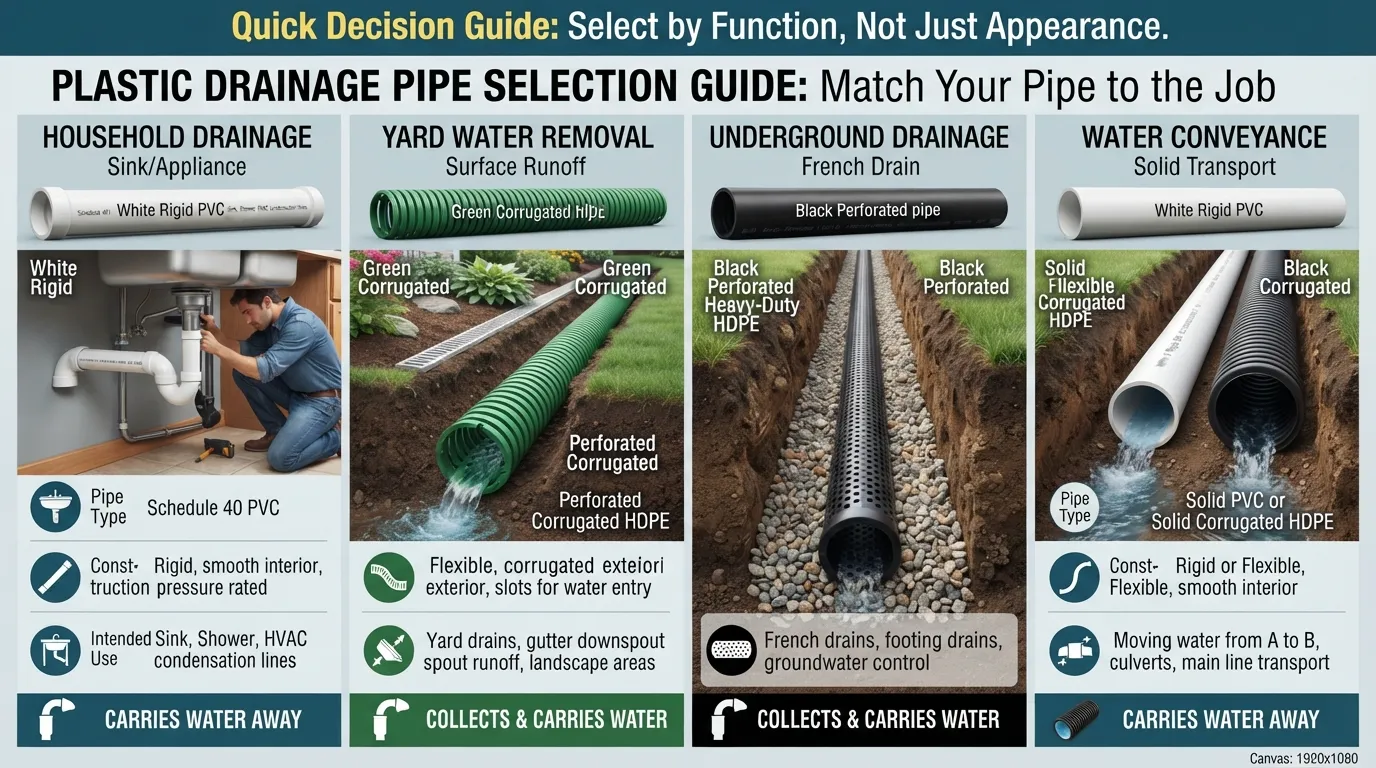
The right plastic drainage pipe depends first on what you need to drain and where the pipe will be installed. Rigid PVC or ABS is commonly associated with building drain, waste, and vent systems, while corrugated plastic pipe is widely used for exterior drainage applications. Yard drainage may require solid or perforated pipe depending on whether you need to collect water or simply carry water to another location.
If you are trying to choose a pipe for your home, I would not start with price, color, or even diameter. I would start with one question: What job does the pipe need to do?
This guide will help you make that decision without treating every plastic pipe as the same product. If you need a broader explanation of the components that connect to residential drain systems, see our guide to plumbing drain parts.
Start With the Job, Not the Pipe
The easiest way to narrow your choices is to identify the water source, where that water needs to go, and whether water must enter through the pipe wall or only travel through the pipe.
Indoor wastewater
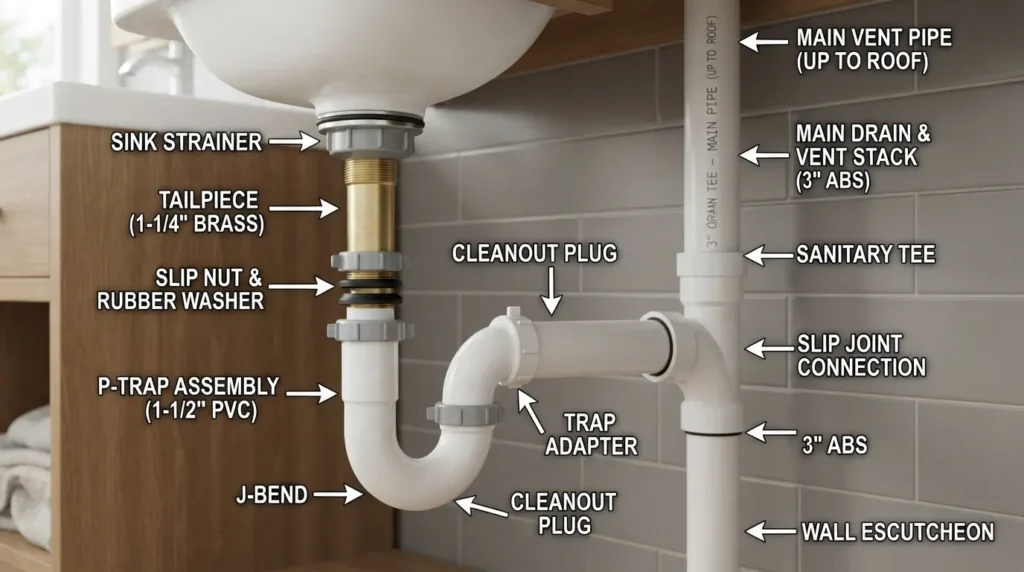
Think sinks, showers, tubs, toilets, and other fixtures connected to a building drain system. These applications typically involve a rigid DWV piping system and compatible fittings.
Yard runoff
If water is collecting on a lawn, near landscaping, or around a drainage inlet, the choice may involve exterior drainage pipe rather than household DWV pipe.
Groundwater collection
French drains and similar systems usually need water to enter along the length of the pipe, making perforation, surrounding aggregate, and filtration important parts of the system.
Conveying captured water
A downspout or catch basin already collects the water. In that situation, you generally want to move water through the pipe rather than let surrounding soil water enter it.
Sewer or building drainage
These systems require pipe and fittings intended for that specific application, installed according to applicable code and manufacturer requirements.
Driveway or culvert drainage
A culvert has structural and loading requirements in addition to flow requirements. Pipe profile, bedding, cover, diameter, and installation conditions matter.
What Is Plastic Drainage Pipe Actually Called?
There is no single name for every plastic drain pipe. The name usually changes with the material and application.
- PVC DWV pipe refers to polyvinyl chloride pipe designed for drain, waste, and vent applications.
- ABS DWV pipe refers to acrylonitrile butadiene styrene pipe used in compatible drainage systems where permitted.
- Corrugated HDPE drainage pipe is a flexible or profiled polyethylene pipe commonly associated with exterior water management.
- Perforated drain pipe contains openings that allow surrounding water to enter the drainage system.
- Solid drain pipe is intended to carry collected water without intentionally taking in groundwater through the wall.
- Drain tile is a term often used for subsurface drainage systems even when the modern pipe is plastic rather than clay tile.
- Sewer pipe refers to pipe designed for sewer or building-sewer applications.
- Culvert pipe refers to pipe used to carry water beneath roads, driveways, or similar crossings.
Do not buy by appearance alone
Two plastic pipes can look similar and even be described using the same nominal diameter, yet belong to different systems with different wall profiles, fitting dimensions, joining methods, performance requirements, and approved applications.
The Main Types of Plastic Drainage Pipe
Rigid PVC Drain Pipe
PVC is one of the most recognizable plastic piping materials. In drainage work, rigid PVC may be used in approved drain, waste, vent, sewer, or exterior drainage systems depending on the specific product.
A smooth interior can make rigid pipe attractive where maintaining a defined flow path and providing access for cleaning are important. However, you still need to confirm that the exact PVC pipe, fittings, joining method, and dimensions are suitable for the job.
ABS Drain Pipe
ABS is another rigid plastic material associated with DWV systems. It should not be treated as a generic substitute for PVC. Different materials use different joining systems and may be subject to different local requirements.
If you are modifying an existing drain, identify what is already installed before buying fittings or pipe.
Corrugated HDPE Drainage Pipe
Corrugated polyethylene pipe is common in exterior drainage because its profile and material make it suitable for many buried water-management applications when correctly selected and installed.
You may find:
- solid corrugated pipe,
- perforated corrugated pipe,
- pipe supplied with a filter sock,
- single-wall products,
- dual-wall or other structured-wall products, and
- larger drainage and culvert systems.
The important point is that “corrugated” describes a pipe form, not one universal specification.
Polypropylene and Other Plastic Drainage Systems
Plastic drainage is broader than PVC and HDPE. Manufacturers also produce polypropylene and other engineered thermoplastic systems for drainage, stormwater, sewer, and related applications.
For homeowners, the practical rule is simple: select the system by application and product specification, not merely by the word “plastic.”
Solid vs. Perforated Plastic Drain Pipe
This is one of the most important decisions in exterior drainage.
Choose solid pipe when…
You already have water collected at a point and want to carry it toward an approved discharge location.
- Downspout drainage
- Catch-basin outlet lines
- Some yard-drain conveyance runs
- Other applications where surrounding groundwater should not intentionally enter the pipe
Choose perforated pipe when…
The purpose of the system is to collect water from the surrounding soil along the trench or drainage area.
- French drains
- Subsurface groundwater collection
- Some foundation or landscape drainage systems
- Other engineered drainage installations requiring water entry through the pipe wall
A common mistake is using perforated pipe simply because it is labeled “drainage pipe.” If your goal is to move captured water from Point A to Point B, intentional holes in the pipe may work against that goal depending on the installation.
The opposite mistake is using solid pipe where the entire purpose of the trench is to collect subsurface water.
PVC vs. Corrugated Drain Pipe: Which Is Better?
Neither is automatically better. The useful question is: which construction is better suited to your specific application?
Rigid PVC
- Smooth rigid construction
- Uses system-specific fittings and joining methods
- Common in many DWV and defined drainage applications
- Maintains a fixed pipe shape
- Selection depends on the exact PVC product and application
“`
Corrugated plastic
- Common in exterior drainage systems
- Available in solid and perforated configurations
- Can accommodate certain site layouts more easily depending on product design
- Available in multiple wall constructions and sizes
- Installation quality, bedding, backfill, and product specification remain important
“`
For example, a flexible corrugated product intended for landscape drainage should not automatically replace rigid building drain pipe simply because both are plastic.
Watch: PVC vs. Corrugated Drainage Pipe
If you learn better by seeing how different drainage materials behave in a practical setup, this video can add useful context to the comparison above.
What About 4-Inch Plastic Drainage Pipe?
4-inch plastic drainage pipe is a common search because that diameter appears in many residential drainage products. But “4-inch” by itself does not tell you whether a pipe belongs in a French drain, a yard-drain system, a sewer application, or a building DWV system.
Before buying any 4-inch pipe, verify:
- the intended application,
- the pipe material,
- whether it is solid or perforated,
- the wall or pipe construction,
- the dimensional standard of the system,
- which fittings are compatible,
- the joining method,
- burial and loading requirements, and
- applicable local code or manufacturer instructions.
In other words, do not assume two products labeled “4 inch” will connect correctly or perform the same job.
Which Plastic Drainage Pipe Fits Your Situation?
For Yard Drainage
First decide whether your system needs to collect water across an area or move water that has already been collected.
If a surface inlet or catch basin is collecting runoff, the downstream pipe is primarily carrying water. If the system is intended to pick up water from saturated soil along a trench, a perforated drainage configuration may be more appropriate.
You also need a usable outlet. A drainage pipe that moves water from one low spot to another low spot does not solve the underlying drainage problem.
For a French Drain
A French drain is not simply a perforated pipe buried in dirt. It is a drainage system in which the pipe, aggregate, trench configuration, filtration strategy, slope, and outlet all work together.
The pipe needs to collect subsurface water and move it away. If soil fines and debris are allowed to migrate into the drainage structure, performance can decline over time.
For Downspout Drainage
A downspout has already collected roof runoff. In many systems, the buried line’s job is therefore to convey that water to an appropriate outlet rather than collect more water through perforations.
The entire route matters: inlet connection, pipe capacity, slope, access for maintenance, and discharge location.
For Household Sinks, Tubs, Showers, and Toilets
This is building plumbing, not landscape drainage. You need pipe and fittings approved for the specific drain, waste, and vent application.
Do not use exterior corrugated yard-drain products as substitutes for interior building drainage simply because they are plastic and appear to be a similar size.
For a Sewer or Building Drain Line
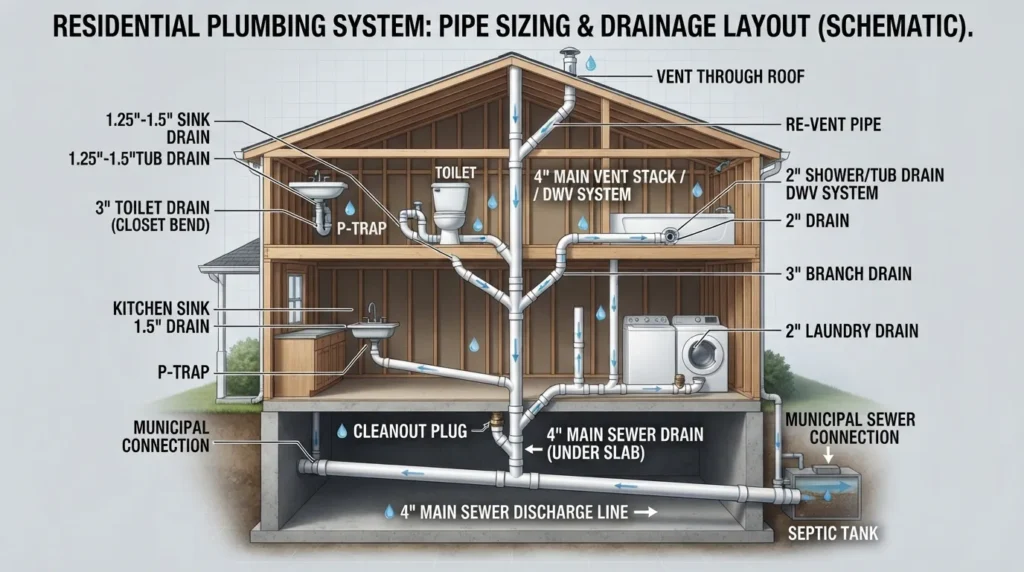
A sewer connection has different requirements from a French drain or downspout extension. Pipe material, diameter, fittings, grade, cleanout access, joining method, burial conditions, and local requirements all need to match the system.
If an existing sewer or building drain is backing up, do not assume the pipe needs replacement until the cause has been diagnosed.
For a Driveway Culvert
A culvert must carry water while also functioning within a buried structural installation. Product selection can depend on diameter, pipe profile, stiffness or load requirements, cover depth, bedding, backfill, traffic conditions, and site design.
This is one situation where buying the cheapest large plastic pipe that physically fits the ditch can be an expensive mistake.
A Simple Plastic Drain Pipe Decision Process
How to Choose Drainage Pipe Size
There is no single “best” drainage pipe size for every property.
Pipe sizing can depend on:
- the plumbing fixture or drainage system being served,
- expected water volume,
- pipe slope and route,
- whether multiple lines combine,
- the type of drainage system,
- the size of connected inlets and fittings,
- manufacturer requirements, and
- applicable plumbing or building requirements.
Bigger is not automatically better. An oversized pipe installed poorly can still hold debris, settle, separate, or fail to drain correctly.
Common Problems With Plastic Drainage Pipe
Plastic pipe has many useful applications, but problems can occur when the wrong product is selected or the system is installed poorly.
1. Using the Wrong Pipe for the Application
A yard-drain pipe, DWV pipe, sewer pipe, and culvert product solve different problems. Similar appearance does not make them interchangeable.
2. Poor Grade or Low Spots
Gravity drainage depends on a continuous workable path. Settlement or poor installation can create sections where water and debris remain instead of moving toward the outlet.
3. Incompatible Fittings
A fitting that can be forced over a pipe is not necessarily a correct fitting. Pipe dimensions, connection design, material, and system type need to match.
4. Crushed, Deformed, or Poorly Supported Pipe
Buried pipe depends on correct installation conditions. Bedding, backfill, cover, soil conditions, and loads can affect long-term performance.
5. Debris and Sediment
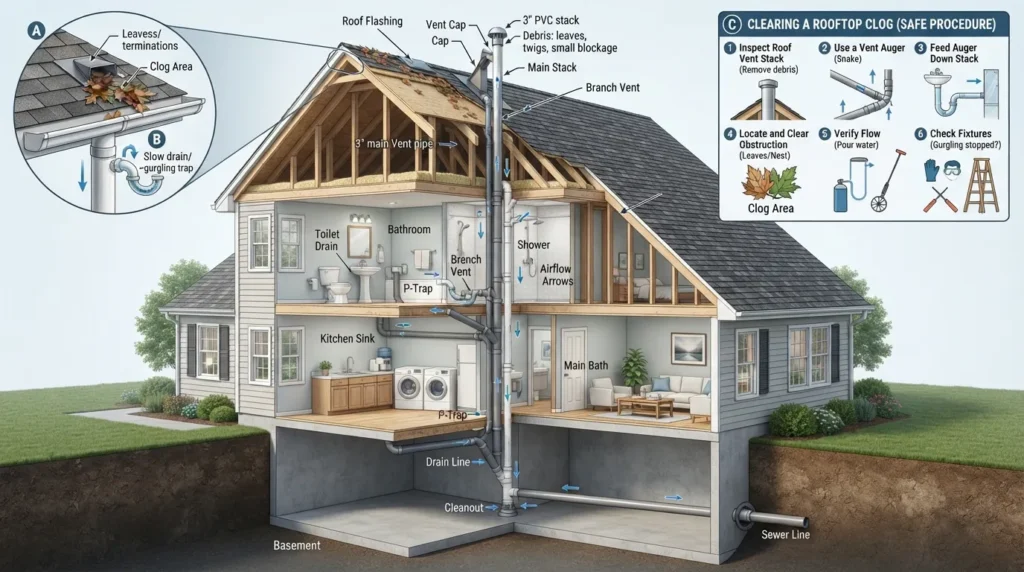
Leaves, dirt, roof debris, soap residue, grease, hair, scale, and other material can reduce flow depending on the drainage system.
6. Root Intrusion or Joint Problems
Roots do not need to “eat through” sound plastic pipe to cause trouble. Defective joints, cracks, displaced sections, or openings can provide a path into some buried drainage systems.
7. No Practical Cleaning Access
A drainage line is easier to maintain when the system has appropriate access points. Long buried runs with unnecessary sharp transitions can become difficult to inspect or service.
Does a Clogged Plastic Drain Pipe Need Replacement?
Not necessarily.
A slow or backed-up drain may be caused by an obstruction rather than a failed pipe. Depending on the system, diagnosis may involve checking the blockage location, pipe condition, flow path, cleanout access, and whether there is evidence of damage or repeated failure.
Cleaning may solve the problem when…
- the pipe is intact,
- the issue is an accessible obstruction,
- flow can be restored safely, and
- there is no evidence that pipe failure caused the blockage.
Repair or replacement may need investigation when…
- the line is damaged or displaced,
- sections have collapsed or deformed,
- joints repeatedly fail,
- the wrong pipe was used, or
- the same section keeps causing problems.
If the issue is a clogged or slow residential drain in Miami, our professional drain cleaning service can help determine whether the immediate problem is a blockage or whether the piping itself needs further evaluation.
What to Check Before Installing Plastic Drainage Pipe
You do not need to memorize every pipe specification before starting a project, but you should avoid treating drainage as “dig a trench and bury a tube.”
Before installation, confirm:
- The source of the water. Know whether you are draining fixtures, surface runoff, groundwater, a downspout, or another source.
- The destination. Know where the water will legally and practically discharge or connect.
- The pipe application. Confirm that the specific pipe is designed for the intended use.
- Solid vs. perforated construction. Decide whether water should enter through the pipe wall.
- The correct diameter. Size the system for the application rather than choosing by convenience.
- Compatible fittings. Stay within a compatible piping system.
- Slope and routing. Avoid layouts that create unnecessary low spots or difficult maintenance points.
- Bedding and backfill. Buried pipe needs proper support and installation.
- Access for maintenance. Consider how the system will be cleaned or inspected later.
- Local requirements. Plumbing, sewer, stormwater, and site-drainage work can have different rules. Follow applicable requirements and manufacturer instructions.
Important
Do not connect a new drainage pipe to a sewer, storm system, neighboring property, street, canal, or other discharge point until you know the connection and discharge method are permitted and appropriate for the property.
Plastic Drainage Pipe for Sale: What Should You Compare?
Because this search has a strong buying intent, it is useful to know what matters before you compare products at a plumbing supplier or home-improvement store.
Do not compare pipe on price alone. Compare:
- Application: DWV, sewer, yard drainage, French drain, stormwater, or culvert
- Material: PVC, ABS, HDPE, polypropylene, or another specified plastic
- Construction: rigid, corrugated, single-wall, dual-wall, or other profile
- Configuration: solid or perforated
- Diameter: according to the actual system requirement
- Length: including joints, transitions, and routing
- Connections: compatible fittings and joining method
- Installation conditions: burial depth, soil, load, bedding, and backfill requirements
- Availability: especially if you will need matching fittings later
- Manufacturer specifications: confirm the pipe is actually intended for your use
A low-cost pipe becomes expensive if it cannot connect to the rest of your system or has to be removed because it was intended for a different application.
Frequently Asked Questions About Plastic Drainage Pipe
What is a plastic drain pipe called?
It depends on the material and job. Common names include PVC DWV pipe, ABS drain pipe, corrugated HDPE drainage pipe, perforated drain pipe, drain tile, sewer pipe, and plastic culvert pipe. The correct name becomes clearer once you know the application.
Are plastic culverts as strong as metal culverts?
It is not useful to compare them using material alone. Structural performance depends on the specific pipe design, diameter, wall profile or stiffness, bedding, backfill, cover, installation quality, and loads above the culvert. A properly specified plastic culvert can be suitable for many applications, but you should select it according to the actual site requirements rather than treating plastic and metal as interchangeable products.
How much does a 20-foot plastic culvert cost?
There is no reliable single price because cost changes with diameter, pipe construction, structural specification, manufacturer, supplier, location, fittings, and delivery. For a buying decision, compare current quotes for the exact culvert specification your site requires rather than shopping by length alone.
What are common problems with plastic plumbing pipes?
Problems can include incorrect material selection, incompatible fittings, poor slope, bad joints, inadequate support, deformation in unsuitable buried conditions, clogs, sediment, damage, or using a pipe outside its intended application. Many of these are system-selection or installation problems rather than a problem with the word “plastic” itself.
How long do plastic drain pipes last?
There is no single lifespan that applies to every plastic drain pipe. Service life depends on the material, product specification, application, installation quality, soil and loading conditions, exposure, chemicals, joints, maintenance, and whether the pipe was appropriate for the job in the first place.
Do plumbers use plastic pipe instead of copper?
Yes, plastic piping is widely used in drainage systems. Copper and plastic should not be compared as though every plumbing application is the same, however. Drainage, venting, and pressurized water supply are different systems with different material requirements.
What is the best pipe for a residential water line?
That is a water-supply question rather than a drainage-pipe question. Residential water-line material should be selected according to applicable code, pressure and temperature conditions, water quality, routing, installation conditions, and material compatibility. Do not choose a water-supply pipe based on advice intended for gravity drainage.
Is PEX a plastic drainage pipe?
No. PEX is primarily associated with water-supply applications, not conventional gravity drainage. Questions about PEX lifespan should therefore not be used to decide which plastic drain pipe you need.
Is corrugated pipe good for a French drain?
Corrugated perforated drainage pipe is commonly sold for French-drain and subsurface-drainage applications, but pipe alone does not make a successful French drain. Trench design, aggregate, filtration, grade, outlet, soil conditions, and installation quality all affect performance.
Should I use perforated pipe for a downspout?
If the goal is simply to carry water already collected by the downspout to an appropriate outlet, a solid conveyance line is generally the more logical configuration to investigate. Perforated pipe is intended for situations where water needs to enter through the pipe wall as part of the drainage design.
The Most Important Rule: Do Not Choose by Diameter Alone
If you remember only one thing from this guide, make it this:
A plastic drain pipe is part of a system.
Choose it by application, material, construction, size, compatible fittings, installation conditions, and where the water needs to go. A pipe that looks right on the store shelf can still be wrong for your project.
That decision-first approach is especially important if you are comparing a 4-inch PVC pipe with a 4-inch corrugated drainage pipe, deciding between solid and perforated pipe, or trying to determine whether an existing drain should be cleaned or replaced.
Need Help With an Existing Drain Line?
If you are dealing with a slow drain, recurring backup, or a plastic drainage line you cannot confidently identify, diagnosis should come before buying replacement pipe.
Get help from a Miami plumber
If you need help evaluating a residential drainage problem, you can learn more about Miami Florida Plumbing or call our Miami plumbing team.
Plastic Drainage Pipe Product & Manufacturer Resources
If you are ready to compare products, the resources below can help you review available materials, diameters, fittings, corrugated systems, PVC options, and larger drainage products. Inventory, specifications, and prices can change, so confirm the current product details before purchasing.
- Ferguson — Plastic Drainage Pipe
- Lowe’s — Corrugated Drainage Pipe
- The Home Depot — PVC Drainage Products
- Advanced Drainage Systems — Pipe Systems
- American Copper & Brass — Plastic Sewer Pipe
Final takeaway: do not ask, “Which plastic drainage pipe is best?” until you can answer, “What exactly do I need this pipe to do?” Once the application is clear, material, construction, size, fittings, installation method, and buying decision become much easier to narrow down.