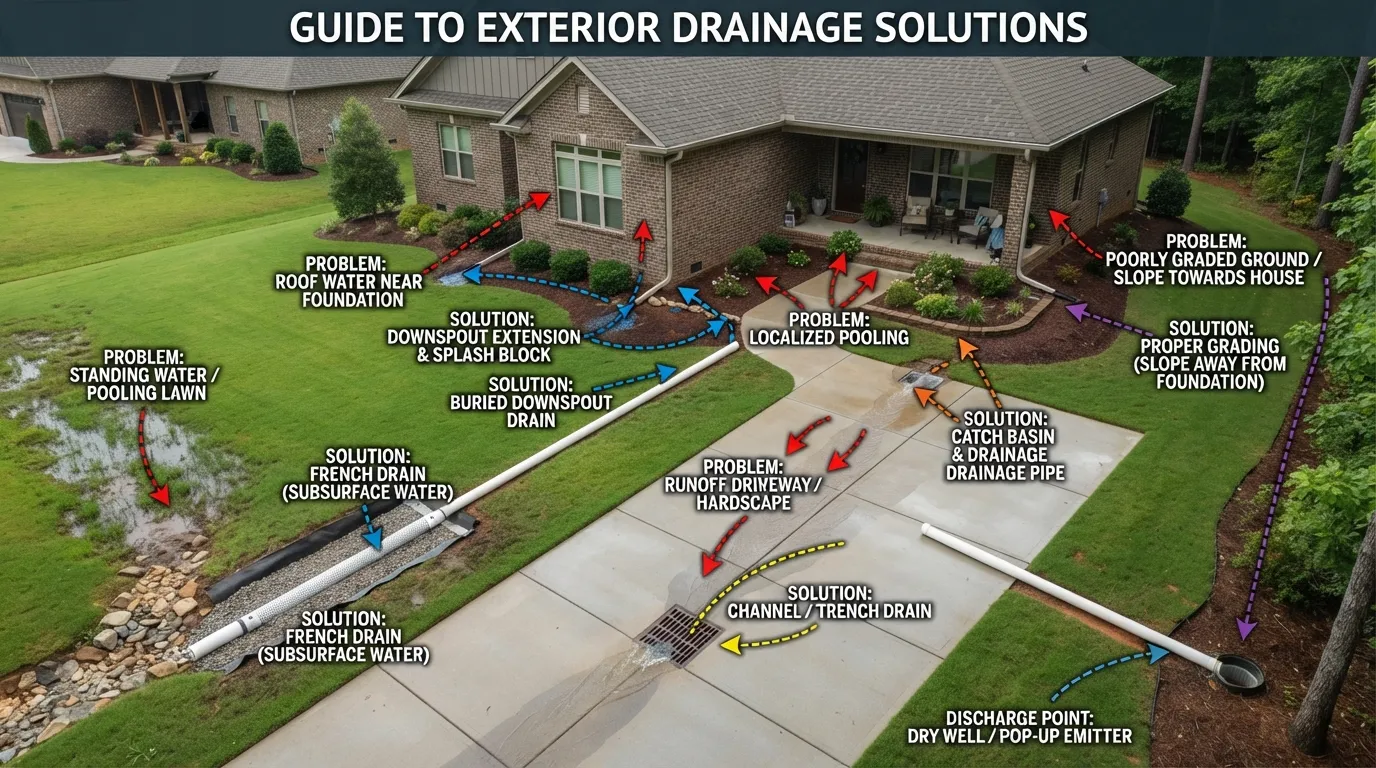
If water keeps pooling in your yard, running toward your foundation, collecting across a driveway, or leaving the soil wet long after the rain stops, you may need an exterior drainage system. But choosing the right system is not simply a matter of installing a French drain and hoping for the best.
The right solution depends on where the water comes from, whether it is moving above or below the soil, where it collects, and where it can safely discharge. I’ll walk you through those decisions so you can understand which exterior drainage solutions make sense for your property.
In a home-improvement context, an exterior drainage system is a combination of drains, pipes, grading, channels, basins, or other components that collect unwanted rainwater, surface runoff, or groundwater and move it away from areas where it can cause pooling, erosion, or moisture problems. The best system depends on the type of water problem you actually have.
What Is an Exterior Drainage System?
An exterior drainage system manages water outside your home. You may also hear it described as an outdoor drainage system, yard drainage system, exterior water drainage system, rainwater drainage system, or external drainage system.
Those terms can describe several different systems. A small water drain in a patio is not the same as a French drain buried in a soggy yard, and a pipe connected to a downspout serves a different purpose from a foundation drain.
The easiest way to understand exterior home drainage is to think of it as three jobs:
1. Collect
Capture water where it pools, flows, or enters saturated soil.
2. Convey
Move the water through a pipe, channel, swale, or other drainage path.
3. Discharge
Release it at an appropriate location where it will not simply create a new drainage problem.
That last step is easy to overlook. Installing a pipe is not enough if the water has nowhere appropriate to go.
If you want to understand how exterior drainage fits into the rest of the property, see our guide to how a complete home drainage system works.
Start With the Water Problem, Not the Drain
One of the biggest mistakes homeowners can make is choosing a drainage product before identifying the source of the water. A better approach is to diagnose the problem first.
Exterior Drainage System Selector
Water pools in one low area of the lawn
Evaluate a catch basin, improved grading, or another surface-water solution.
The lawn stays soggy below the surface
A French drain or another subsurface drainage method may be appropriate.
Water crosses a driveway or patio
A channel or trench drain can capture water across a hard surface.
A downspout dumps water beside the house
A properly routed downspout drainage line can carry roof runoff farther away.
The yard slopes toward the house
Grading, swales, drains, or a combination may be needed to redirect runoff.
Water collects near the foundation
The cause should be evaluated before choosing between grading, surface drainage, French drainage, or foundation drainage.
Surface Water vs. Subsurface Water
This distinction can quickly narrow down your options.
Surface Water
Surface water is water you can usually see flowing or pooling above the ground. Common examples include rainwater crossing a driveway, a puddle forming in a low section of lawn, or roof runoff flowing toward the house.
Possible solutions include:
- Catch basins
- Channel or trench drains
- Grading
- Swales
- Downspout drainage
- Surface inlets connected to underground pipe
Subsurface Water
Subsurface water moves through or remains within the soil. You may notice consistently soggy ground, water seeping through a slope, or moisture problems even when there is no obvious stream of water on the surface.
Depending on the cause, solutions may include:
- French drains
- Foundation or footing drains
- Subsurface collector systems
- Drainage combined with grading or other site improvements
Important:
Do not assume that every wet yard needs a French drain. A French drain is designed primarily to collect water moving through saturated soil. Fast-moving surface runoff may be better handled by a catch basin, channel drain, grading correction, or a combination system.
Common Types of Exterior Drainage Systems
1. French Drain
A French drain is a subsurface drainage system that typically uses a trench filled with drainage stone and a perforated pipe. Water enters through the surrounding gravel and openings in the pipe, then travels toward an outlet.
A French drain can make sense when the problem involves:
- Saturated soil
- Persistent soggy areas
- Water moving through a slope
- Subsurface moisture that needs an easier path away
Typical components may include drainage rock, filter fabric, perforated pipe, fittings, and a suitable discharge point.
2. Catch Basin or Yard Drain
A catch basin collects surface water at a specific low point. It normally has a grate at ground level and connects to an underground drainage pipe.
This can be useful when rainwater repeatedly collects in one part of a yard or landscaped area. Instead of expecting water to soak into already wet soil, the basin gives that surface water a defined place to enter the drainage system.
3. Channel or Trench Drain
A channel drain is a long, narrow drain with a grated top. It is commonly used where water moves across a paved surface.
Common locations include:
- Driveways
- Patios
- Pool decks
- Walkways
- Garage approaches
If your problem is water flowing across concrete rather than soaking through soil, a channel drain may make more sense than a French drain.
4. Downspout Drainage System
Gutters collect roof runoff, but that water still needs somewhere to go. A downspout that releases rainwater directly beside the house can create pooling and erosion.
An exterior rainwater drainage pipe can connect the downspout to solid underground pipe and carry the runoff to an appropriate discharge point. Solid pipe is generally used when the goal is to transport collected water rather than collect groundwater along the pipe’s entire length.
5. Grading and Swales
Not every exterior drainage problem requires buried pipe.
Grading shapes the ground so water naturally moves in a preferred direction. A swale is a shallow landscaped channel that guides surface runoff through the yard.
These methods can work alone or alongside catch basins, underground pipes, and other exterior drainage solutions.
6. Dry Well
A dry well receives collected water and allows it to disperse into surrounding soil. It can be one possible discharge strategy where soil conditions, groundwater conditions, available space, and local requirements make infiltration appropriate.
A dry well should not automatically be treated as the answer whenever there is no obvious outlet. If the surrounding ground cannot accept the water effectively, the system may not perform as intended.
7. Foundation or Footing Drain
A footing drain is installed around or near a building foundation to help manage water in the soil surrounding the structure. It is different from a simple surface yard drain and may involve deeper excavation and more complex access.
If your main symptom is water or persistent moisture around the foundation, it is worth diagnosing the cause before choosing a drainage method.
8. Combination Drainage Systems
Many properties are better served by several components working together rather than one standalone drain.
For example:
- A catch basin can collect lawn runoff and connect to solid pipe.
- A channel drain can intercept driveway water and route it underground.
- A French drain can collect subsurface water before sending it toward an outlet.
- Downspout lines can be combined with a broader rainwater management plan.
- Grading can direct runoff toward drains instead of allowing random pooling.
This is why it is more useful to think in terms of an exterior drainage system rather than simply buying an individual drain.
What Is the Best Drainage System for a Backyard?
The best backyard drainage system is the one matched to the source and movement of the water. A catch basin can be effective for surface pooling, a French drain may help with saturated soil, grading can redirect runoff, and a channel drain can manage water crossing a hard surface. Some yards need a combination of these methods.
Before choosing, look at the yard during or immediately after heavy rain and ask:
- Where does the water first appear?
- Is it flowing across the surface or rising through wet soil?
- Where is the lowest point?
- Does the ground slope toward or away from the house?
- Are gutters or downspouts contributing to the problem?
- Where could collected water safely go?
Those observations are more useful than choosing a system based only on its popularity.
Where Does Exterior Drainage Water Go?
Every drainage design needs an answer to this question.
Depending on the property and local requirements, collected water may be routed toward an approved stormwater connection, a suitable outlet, an appropriately designed infiltration area, a dry well, or another lawful discharge point.
The exact option depends on the site. Water should not simply be moved from one trouble spot to another or redirected in a way that creates problems for an adjacent property.
Think of the full drainage path:
Water source → collection point → pipe/channel → outlet
If any one of those pieces is missing, the system may not solve the original problem.
What Kind of Pipe Is Used for Outdoor Drainage?
The pipe depends on what you need it to do.
Perforated Drainage Pipe
Perforated pipe has openings that allow water from surrounding soil to enter. It is commonly associated with French drains and other subsurface drainage applications.
Solid Drainage Pipe
Solid pipe is used when water has already been collected and needs to be transported without picking up additional groundwater along the route. Downspout lines and catch-basin outlets are common examples.
Outdoor drainage piping may be manufactured from materials such as PVC, corrugated plastic, or HDPE depending on the application and system design.
Other important components can include:
- Drain grates
- Catch basins
- Channel sections
- Elbows and fittings
- Adapters
- Cleanouts
- Pop-up emitters
- Filter fabric
- Drainage gravel
When a French Drain Is Not the Best Answer
French drains are popular, but they are not a universal fix.
Driveway runoff
A channel drain may capture fast surface water more directly.
One isolated puddle
A catch basin or grading correction may be more targeted.
Roof runoff
Start by correcting gutter and downspout drainage.
Poor yard slope
The grade itself may need attention.
No suitable outlet
Adding pipe without a workable discharge plan does not complete the system.
How Exterior Drainage System Installation Works
Installation varies by system, but a well-planned project usually follows the same basic decision process.
- Identify the water source. Determine whether the problem comes from rainfall, roof runoff, surface flow, groundwater, poor grading, or a combination.
- Locate the collection area. Identify where water consistently pools or crosses the property.
- Choose the correct drain type. Match the solution to surface or subsurface water.
- Plan the route. Determine where the drainage pipe or channel will travel.
- Confirm a suitable discharge point. Do this before excavation begins.
- Check underground conditions. Utilities, existing pipes, roots, hardscape, irrigation, soil, and access can affect the route.
- Set the correct slope and elevations. Gravity systems must be able to move water in the intended direction.
- Install the appropriate pipe and drainage components.
- Restore the surrounding surface. Lawn, landscaping, pavers, or concrete may need repair after installation.
- Test the system. Confirm that water enters, moves, and exits as intended.
Before Digging
Have underground utilities identified before excavation, and verify any local permit, stormwater, drainage, or discharge requirements that apply to your property.
Can You Install a Yard Drain Yourself?
Some small drainage projects may be realistic DIY work. Others involve enough excavation, slope planning, utility conflicts, or foundation risk that professional evaluation can be worthwhile.
Projects That May Be Simpler
- Cleaning accessible outdoor drain grates
- Removing leaves and surface debris from catch basins
- Extending a simple downspout where appropriate
- Minor landscaping corrections that do not affect utilities or structures
Situations Where Professional Help Makes More Sense
- Water repeatedly reaches the house or foundation
- The system requires deep or extensive trenching
- You do not know where the water can legally discharge
- Multiple drains need to be connected
- An underground drain already exists but does not work
- You suspect a collapsed, blocked, or poorly sloped pipe
- The project crosses utilities, driveways, patios, or structural areas
- The yard continues flooding after previous drainage work
How Much Does a Backyard Drainage System Cost?
There is no single reliable flat price for an exterior drainage system because two yards with the same amount of pipe can require very different amounts of work.
The final cost is commonly influenced by:
French drain, catch basin, channel drain, grading, dry well, or combination system.
More excavation and material generally means more labor.
Tight spaces, fences, patios, or landscaping can change the work required.
Site conditions influence excavation and drainage design.
The outlet may require additional pipe, fittings, structures, or planning.
Sod, landscaping, pavers, concrete, or other finishes may need repair.
How Much Is a 30-Foot French Drain?
Length alone is not enough to price a 30-foot French drain accurately. Depth, pipe size, gravel quantity, filter fabric, excavation access, soil, disposal, outlet location, and restoration can all change the project.
If you are comparing estimates, ask for an itemized scope so you know whether the quote includes excavation, pipe, aggregate, fabric, fittings, discharge work, cleanup, and surface restoration.
How to Fix a Yard With Poor Drainage
Poor yard drainage is usually easier to solve when you identify why the water is staying there.
- Watch the yard during rain. Find the direction of runoff and the first locations that begin pooling.
- Check the grade. Look for low areas and sections that direct water toward the home.
- Inspect gutters and downspouts. Roof runoff may be adding a large amount of water to one area.
- Determine whether the problem is surface or subsurface.
- Check existing drains. A drainage system may already be present but clogged or damaged.
- Choose a collection method. This could be grading, a catch basin, channel drain, French drain, or another solution.
- Plan where the water will go.
It is common for the best answer to involve more than one step. For example, correcting a low spot may help surface runoff, while a separate underground line carries roof water away from the same area.
Exterior Drainage Maintenance and Troubleshooting
Even a well-designed system can lose performance when debris, sediment, roots, damaged pipe, or a blocked outlet restricts the flow.
Check exterior drainage periodically for:
- Leaves covering drain grates
- Mud or sediment inside catch basins
- Standing water over a drain that used to clear quickly
- Slow or backed-up drainage lines
- Damaged channel-drain grates
- Visible pipe separation
- Blocked discharge points
- New erosion around an outlet
- Recurring wet areas after previous drainage work
If an existing underground line is no longer carrying water properly, the problem may be a clog rather than the overall drainage design. In that situation, professional drain cleaning may help determine whether the line can be restored before you consider replacing parts of the system.
Exterior Drainage Considerations for Miami Homes
Drainage decisions in Miami and South Florida deserve a site-specific approach. Intense rain, relatively flat properties, groundwater conditions, paved surfaces, roof runoff, and local stormwater requirements can all affect how quickly water leaves a property and which drainage method is practical.
That means a solution that works well on a steep inland lot may not automatically be the best choice for a low, flat property in South Florida.
Before Choosing a System, Consider:
- Where water comes from during heavy rain
- Whether nearby ground is already saturated
- How much natural slope the property has
- Whether a gravity outlet is available
- How roof water is currently discharged
- Whether driveways or patios redirect runoff
- Local rules affecting stormwater discharge or drainage alterations
For broader plumbing and drainage help in the area, you can learn more about Miami Florida Plumbing.
Exterior Drainage System vs. Interior Drainage
Exterior and interior drainage solve different parts of a water problem.
Exterior Drainage
Attempts to manage water outside the building by collecting or redirecting runoff and groundwater before it becomes a larger property problem.
Interior Drainage
Manages water that reaches or enters the structure. The design depends on the building and the source of the moisture.
If water is starting outside, it usually makes sense to understand the exterior source before assuming the solution belongs inside the building.
Key Takeaways
- Choose a drainage system based on the water problem, not the popularity of the product.
- Use surface drains for surface runoff and subsurface systems where water is moving through saturated soil.
- Plan the entire path: collection, conveyance, and discharge.
- A French drain is useful in the right situation, but it is not the answer to every wet yard.
- Grading, catch basins, channel drains, downspout lines, and French drains can work together.
- Existing drainage may need cleaning or repair rather than complete replacement.
- For Miami properties, site slope, rainfall, groundwater conditions, and local drainage requirements should be considered before installation.
Frequently Asked Questions
What is an outside drainage system called?
It may be called an exterior drainage system, yard drainage system, outdoor drainage system, stormwater drainage system, or rainwater drainage system. The specific name depends on the type of drain being used, such as a French drain, catch basin, channel drain, or footing drain.
What is the best drainage system for a backyard?
There is no single best system for every backyard. A catch basin works well for localized surface pooling, a French drain can manage some subsurface water problems, grading can redirect runoff, and channel drains work well across paved areas. The right choice depends on how water enters and moves through your yard.
What can I use outside my house to create a drain for water?
For surface water, you may need a catch basin, channel drain, grading correction, or downspout drainage line. For water moving through saturated soil, a French drain may be more appropriate. First identify the source of the water and where it can safely discharge.
How much does a backyard drainage system cost?
The cost varies according to the drainage method, excavation depth, system length, access, materials, soil conditions, discharge design, and surface restoration. A site-specific estimate is more useful than a single generic price.
Can I install a yard drain myself?
Some simple drainage improvements can be DIY-friendly, but buried systems require correct slope, a suitable outlet, safe excavation, and awareness of underground utilities. Foundation drainage, deep trenches, complex layouts, or unresolved flooding usually justify professional evaluation.
How do you fix a yard with poor drainage?
Start by identifying where the water comes from and whether it is surface runoff or subsurface moisture. Then evaluate grading, gutters, downspouts, low spots, existing drains, and possible discharge points. The solution may involve grading, catch basins, French drains, channel drains, underground pipe, or a combination.
Can I install my own drainage system?
You can handle some simple projects if you understand the slope, outlet, pipe type, excavation requirements, and local rules. If the problem affects the foundation, requires extensive trenching, or has no obvious discharge point, professional planning is the safer approach.
How much is a 30-foot French drain?
A 30-foot length by itself does not provide enough information for an accurate price. Depth, excavation access, pipe, drainage rock, filter fabric, disposal, outlet work, and restoration all affect the total. Compare itemized local estimates rather than judging the project only by linear footage.
Related Exterior Drainage Resources
If you are researching outdoor drainage supplies, comparing components, or learning how different systems are assembled, these resources can help you explore the options further:
- Home Depot drainage products — useful for browsing common drainage components and supplies.
- Lowe’s outdoor drainage products — another resource for comparing yard drainage components.
- NDS drainage systems and components — useful for understanding how catch basins, channel drains, fittings, grates, dry wells, and related parts fit into a larger drainage system.
- Exterior French drain planning guidance — a helpful reference if you are specifically researching subsurface French drainage.
Not Sure Which Exterior Drainage Solution Fits Your Property?
If water keeps pooling, an existing outdoor drain is backing up, or you are unsure whether the problem is surface runoff, groundwater, or a clogged line, start with the cause before choosing a system.