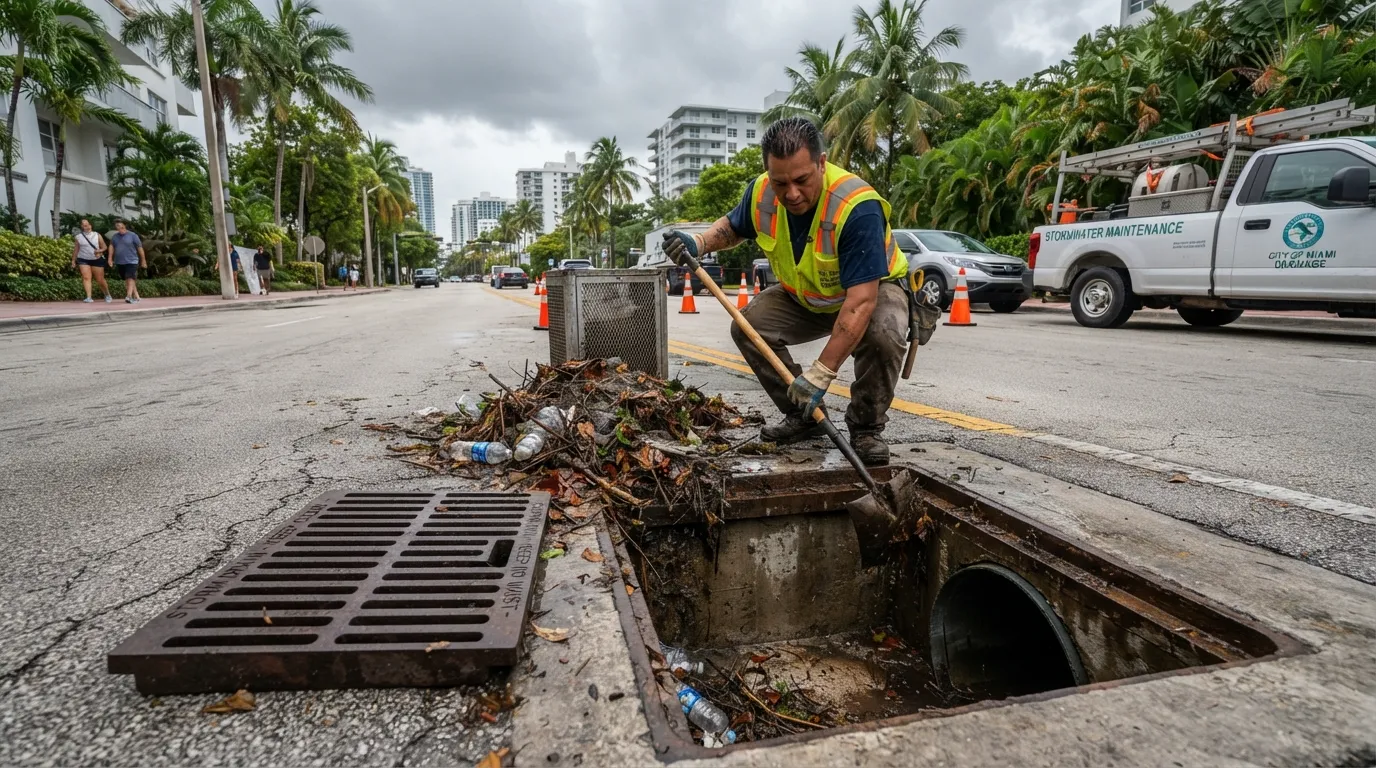
If water is pooling around a driveway, parking lot, catch basin, or outdoor drain every time it rains, the problem may be more than a few leaves sitting on top of the grate. Sediment, sand, trash, organic debris, grease, or another obstruction can build up inside a stormwater drainage system and reduce how quickly runoff can move away from your property.
Professional storm drain cleaning services are designed to find that restriction, remove accumulated debris, restore flow where possible, and identify problems that may need further inspection or repair. In Miami, where periods of heavy rain can quickly expose drainage weaknesses, waiting until water is already threatening a building is rarely the best maintenance strategy.
When Should You Consider Storm Drain Cleaning?
If an outdoor drain clears slowly, repeatedly holds standing water, has visible sediment or debris, floods during normal rainfall, or has not been inspected after major debris buildup or construction activity, it is worth having the system evaluated. The right service may involve catch basin cleaning, debris removal, flushing or jetting, vacuum extraction, and, when needed, camera inspection to find a deeper obstruction or damaged section.
What Is Storm Drain Cleaning?
A storm drain is part of a system built to collect and move rainwater away from paved and developed areas. Depending on the property, that system may include surface grates, inlets, catch basins, underground drainage pipes, culverts, retention areas, and downstream outlets.
When rain enters an inlet, heavier material can settle inside a catch basin while water continues toward an outlet pipe. Over time, however, sediment and debris can accumulate faster than the system can handle them. A blocked grate is easy to see, but buildup inside the basin or pipe may remain hidden until drainage slows or water begins backing up.
1. Surface Inlet
The grate or opening where rainwater first enters the drainage system.
2. Catch Basin
A chamber that can collect sediment and heavier debris before water reaches the outlet pipe.
3. Drainage Pipe
The underground line that carries runoff toward another part of the stormwater system.
4. Downstream Outlet
Where water continues toward another drainage structure, retention area, canal, or other approved stormwater destination.
Signs Your Storm Drain May Need Professional Cleaning
You do not have to wait for complete flooding before investigating a drainage problem. Small changes in drainage performance can be early signs that capacity is being lost.
- Standing water after rainfall: Water remains around the inlet, driveway, parking area, or low point longer than expected.
- Slow drainage: Water enters the drain but moves away noticeably more slowly than it used to.
- Visible sediment: Sand, silt, mud, leaves, or trash are building up inside or around the inlet.
- Recurring backups: The same area floods repeatedly even after surface debris has been removed.
- Overflow from a catch basin: Water rises instead of flowing freely into the downstream pipe.
- Multiple affected drains: More than one inlet on the property begins draining poorly, which can point to a shared downstream restriction.
- Drainage problems after construction: Soil, concrete residue, landscaping material, or construction debris can enter outdoor drainage systems.
- Problems during increasingly modest rainfall: A system that handled similar rain before but now struggles may have lost usable capacity.
Do Storm Drains Get Full?
Yes. A catch basin can gradually fill with sediment, sand, leaves, litter, and other debris. The pipe itself can also become restricted. Once enough usable space or flow capacity is lost, water may drain slowly, pool at the surface, or back up during heavier rainfall.
Storm Drain or Sewer Problem? Know the Difference Before You Call
One of the most common sources of confusion is the difference between a stormwater drainage problem and a sanitary drain or sewer problem. They serve different purposes, and the symptoms are not always the same.
Likely Stormwater Drainage Problem
- Pooling around an outdoor grate or catch basin
- Parking lot or driveway flooding during rain
- Visible leaves, silt, sand, or trash
- Outdoor drainage slows mainly during rainfall
- Water backs up around exterior inlets
Likely Sanitary Drain or Sewer Problem
- Toilets, sinks, showers, or tubs backing up
- Wastewater-related odors or backups
- Multiple indoor plumbing fixtures draining slowly
- A building drain or sewer line is affected regardless of rainfall
If you want a broader explanation of how these systems fit together around a property, our guide to how home drainage systems work explains the difference between sanitary drainage and stormwater drainage in more detail.
Who Is Responsible for the Drain: You or the City?
Before hiring anyone, determine whether the affected drain is part of a private property system or a public stormwater system. Responsibility can vary by location and ownership, so the physical location of the inlet matters.
Private driveway or yard drain
The property owner will generally need to investigate maintenance or service responsibility.
Parking lot or commercial catch basin
The property owner, manager, association, or responsible contractor will typically coordinate service.
HOA or private community system
Check with the association or property manager to confirm who maintains the drainage infrastructure.
Drain in a public street or right-of-way
The appropriate municipality or public works authority may be responsible. Report the issue rather than assuming it is a private drain.
This distinction can save time and prevent you from paying to investigate infrastructure that is not part of your property.
What Causes Storm Drains to Clog?
Storm drains collect runoff from outdoor surfaces, which means almost anything carried by moving rainwater can become part of the blockage.
- Leaves and landscaping debris
- Sand and soil
- Silt and fine sediment
- Trash and litter
- Grass clippings and organic material
- Grease or oily residue in some commercial environments
- Construction debris
- Roots entering damaged or vulnerable drainage lines
- Collapsed, shifted, or damaged pipe sections
That last point matters because not every drainage problem can be solved by cleaning. If the line remains restricted after debris is removed, a structural problem may need to be identified before a lasting solution is possible.
How Professional Storm Drain Cleaning Works
The exact process depends on the type of system, access, amount of debris, and where the restriction is located. A sensible service process begins with diagnosis instead of immediately assuming every problem requires the same equipment.
- Inspect the affected area. The technician determines where water is pooling and which inlet, basin, or line appears to be affected.
- Check accessible components. Surface debris, basin condition, sediment depth, and available access points are evaluated.
- Remove accumulated material. Debris inside a catch basin or accessible drainage structure can be extracted using appropriate professional equipment.
- Clear the downstream line when necessary. Depending on the blockage, high-pressure water jetting or another suitable drain-cleaning method may be used to break up and move stubborn material.
- Extract displaced debris where appropriate. Vacuum equipment may be used on systems that require sediment and waste removal rather than simply pushing material farther downstream.
- Inspect deeper problems when needed. A drain camera can help locate persistent obstructions, root intrusion, or suspected pipe damage when conditions allow.
- Verify drainage. Restored flow should be evaluated before the job is considered complete.
- Identify next steps. If cleaning exposes a damaged or failing section, repair may be a separate requirement.
Cleaning vs. Repair
Cleaning restores lost flow caused by removable buildup. It does not repair a crushed pipe, separated joint, severe root intrusion, or another structural defect. If a drain repeatedly clogs soon after being cleaned, diagnosing the underlying system becomes more important than repeating the same treatment.
Catch Basin Cleaning, Hydro Jetting, Vacuuming, and Camera Inspection: What Does Each One Do?
Catch Basin Cleaning
Removes sediment, leaves, trash, and other material that has settled inside the basin below the inlet.
High-Pressure Jetting
Uses pressurized water to break through and flush stubborn buildup inside suitable drainage lines.
Vacuum Extraction
Physically removes sediment, sludge, and displaced debris so it is not simply moved to another part of the system.
Camera Inspection
Helps investigate deeper restrictions or suspected pipe problems when the line and access conditions are suitable for inspection.
How Urgent Is Your Storm Drain Problem?
Not every slow drain is an emergency, but the amount of water involved and what is at risk should guide how quickly you respond.
Routine Maintenance
- Visible sediment buildup
- Leaves or debris collecting regularly
- Drainage is slower than normal
- No active flooding
Prompt Attention
- Recurring standing water
- Multiple drains are slowing
- Water repeatedly reaches parking or pedestrian areas
- Past cleaning did not solve the problem
Urgent Situation
- Water is actively approaching a building
- A parking area or access route is rapidly flooding
- Drainage has effectively stopped during heavy rain
- Conditions create an immediate property or safety concern
Why Storm Drain Maintenance Matters in Miami
Storm drainage matters everywhere, but Miami properties can face intense rainfall that puts a drainage system under pressure in a short period. A drain that seems acceptable during a light shower may behave very differently during a stronger storm.
Preventive maintenance is especially useful for properties with large paved surfaces because parking lots, driveways, roofs, walkways, and other hard surfaces generate runoff that must be moved somewhere. If an inlet or catch basin is already partially filled with sediment, the system has less usable capacity when rainfall increases.
There is also an environmental reason to keep stormwater systems functioning properly. Runoff can pick up litter, sediment, oil residue, landscaping material, and other pollutants as it crosses developed surfaces. Keeping debris out of drains and maintaining stormwater infrastructure helps reduce unnecessary material entering downstream waterways.
Before Miami’s Next Period of Heavy Rain, Check These Five Things
- Is the surface grate visibly covered with leaves, trash, or landscaping debris?
- Does water already pool around the drain during ordinary rainfall?
- Can you see significant sediment inside an accessible catch basin?
- Has the same location flooded before?
- Do you know whether the drain is private infrastructure or part of a public street system?
These observations will not diagnose every underground problem, but they can help you decide whether preventive service is sensible before the next storm exposes a larger restriction.
How Often Should Storm Drains Be Cleaned?
There is no responsible one-size-fits-all cleaning interval for every storm drain. A lightly used residential drain surrounded by little vegetation can have very different maintenance needs from a commercial parking lot that collects sediment, trash, vehicle residue, and landscaping debris.
Instead of relying only on a calendar, base maintenance on inspection and site conditions.
- How quickly does sediment accumulate?
- Are there trees or landscaping near the inlet?
- Has the property experienced recurring standing water?
- Is there active construction nearby?
- Does the site contain a large parking or paved area?
- Has a major storm recently moved unusual amounts of debris?
- Did previous inspections reveal recurring blockages?
Properties with heavier debris loads or a history of drainage problems may justify more frequent inspection than systems that remain consistently clear.
A Better Maintenance Rule
Do not wait for a storm drain to become completely blocked before giving it attention. Inspect high-risk drainage points before periods of heavy storm exposure and clean them when debris or sediment is beginning to reduce usable capacity.
How Much Does Storm Drain Cleaning Cost?
The cost of cleaning an outside storm drain cannot be estimated responsibly from the keyword alone. Two properties can have very different systems and require completely different levels of work.
Factors that can affect the scope and price include:
- Number of catch basins or drains
- Depth and size of the drainage structures
- Accessibility for cleaning equipment
- Amount and type of sediment or debris
- Length and diameter of affected piping
- Severity and location of the blockage
- Whether jetting is required
- Whether vacuum extraction is required
- Whether a camera inspection is needed
- Whether the problem is routine or urgent
- Whether damaged piping is discovered
- Waste handling or disposal requirements associated with the removed material
A useful estimate should therefore be based on the actual drainage system and problem, not a generic online number that may not apply to your property.
Residential vs. Commercial Storm Drain Cleaning
The underlying goal is the same—restore reliable stormwater flow—but the scale and consequences can be different.
Residential Properties
Common concerns may include:
- Driveway drains
- Yard drainage inlets
- Patio or exterior drains
- Localized pooling near the home
- Debris from trees and landscaping
Commercial & Multi-Property Sites
Common concerns may include:
- Parking-lot catch basins
- Retail and office properties
- HOA and condominium drainage systems
- Larger paved runoff areas
- Multiple connected inlets
- Maintenance coordination across a property
Commercial systems may also require a broader maintenance plan because a single downstream blockage can affect several drainage points across the same site.
Can You Clean a Storm Drain Yourself?
Simple surface maintenance is different from professional storm drain cleaning. If loose leaves or litter are covering a grate and can be removed safely without opening equipment, entering a structure, working in traffic, or contacting contaminated water, keeping the surface clear can help.
But you should not enter a catch basin, confined drainage structure, manhole, or underground pipe. Deep blockages, heavy sediment, unknown contamination, and underground drainage problems require equipment and safety procedures that go beyond basic property maintenance.
Also avoid assuming that forcing material farther into the pipe has solved the problem. Moving a blockage downstream can simply relocate the restriction.
What Happens to Water After It Enters a Storm Drain?
The exact destination depends on the local stormwater system. In general, runoff enters an inlet, moves through catch basins and underground drainage infrastructure, and continues toward an approved downstream drainage feature such as another stormwater structure, retention area, canal, or outfall.
A storm drain should not automatically be treated as the same thing as a sanitary sewer. Stormwater systems are designed around rainfall and runoff, while sanitary drainage carries wastewater from plumbing fixtures toward the appropriate wastewater system.
That distinction is also why dumping chemicals, oil, paint, trash, or other waste into an outdoor storm drain is a serious mistake: material entering stormwater infrastructure can ultimately affect downstream waterways.
Do Storm Drains Require Cleanouts?
Not every stormwater system is built with a residential-style cleanout fitting like you may see on a sanitary drain line. Access can instead come through grates, catch basins, manholes, inspection structures, or purpose-built access points.
The correct access method depends on how the system was designed. That is another reason a professional should identify the type of drainage system before recommending a cleaning method.
Choosing a Storm Drain Cleaning Company
When comparing storm drain cleaning contractors, look beyond a page that simply says the company can “unclog drains.” You want a provider that is willing to identify the actual drainage problem and explain what service is appropriate.
Useful questions to ask include:
- Will you inspect the drainage problem before recommending cleaning?
- Can you service the type of outdoor drain or catch basin on my property?
- How will accumulated sediment or debris be removed?
- When would jetting be appropriate?
- When would a camera inspection be useful?
- How do you determine whether the problem is a blockage or damaged pipe?
- Can you explain what should be done if the drain is actually public infrastructure?
- What maintenance would you recommend based on the conditions found?
If the problem extends beyond the stormwater system into other clogged drains on the property, our professional drain cleaning in Miami page explains related options for clearing difficult drainage blockages.
A Practical Storm Drain Decision Guide
Water only pools during rain
Start by evaluating the stormwater drainage system and affected exterior inlet.
Indoor fixtures are backing up
Investigate the sanitary drain or sewer system instead of assuming it is a storm drain issue.
Only the street drain is affected
Confirm whether the inlet is public infrastructure before arranging private service.
Cleaning helped only temporarily
A deeper obstruction or structural issue may need diagnosis rather than repeated surface cleaning.
Heavy rain is approaching and flow is poor
Treat the issue promptly, especially if water could reach a building or block safe access.
You are unsure what system you have
Start with diagnosis. Correctly identifying the drainage system prevents unnecessary or ineffective work.
Frequently Asked Questions About Storm Drain Cleaning
How often should storm drains be cleaned?
There is no single interval that fits every property. Cleaning frequency depends on sediment buildup, landscaping, property use, past flooding, construction activity, and inspection findings. Higher-risk drains should be checked more often than systems that consistently remain clear.
How much does it cost to have an outside drain cleaned?
The cost depends on the type of drain, access, amount of debris, number of drainage structures, severity of the blockage, equipment required, and whether inspection or repair is needed. A site-specific estimate is more reliable than a generic fixed price.
How do professionals clean storm drains?
The process can include inspection, catch basin cleaning, sediment extraction, high-pressure jetting, vacuum removal, and camera inspection. The appropriate combination depends on where the blockage is and what material is causing it.
What is the difference between a sewer cleanout and a storm drain?
A sewer cleanout is an access point associated with a sanitary drain or sewer line carrying wastewater. A storm drain collects rainwater and surface runoff. Although both involve drainage, they serve different systems and should not be treated as interchangeable.
What does a storm drain look like inside?
Many systems include an inlet or grate above a chamber or catch basin. Sediment can settle below the outlet, while water exits through a connected pipe. Designs vary, so not every storm drain looks exactly the same.
Do storm drains get clogged?
Yes. Leaves, sediment, trash, sand, soil, construction debris, grease, roots, and damaged piping can all reduce or stop stormwater flow.
What is a major problem with stormwater runoff?
Two major concerns are flooding when drainage capacity is inadequate and pollution when runoff carries sediment, litter, oil residue, chemicals, or other contaminants toward downstream waterways.
Where does water go after entering a storm drain?
It moves through the local stormwater network toward another drainage structure, retention area, canal, or other approved outlet depending on the system. Stormwater should not automatically be assumed to receive the same treatment as sanitary wastewater.
Get the Drainage Problem Identified Before It Becomes a Flooding Problem
A clogged storm drain is easier to manage when the problem is addressed while it is still a maintenance issue. Once a basin is heavily filled, a pipe is restricted, or water is already approaching a structure, your options become more urgent.
The best first step is not to guess which cleaning method you need. Identify whether the problem is a private storm drain, public drainage inlet, sanitary drain, catch basin, or deeper underground line. From there, the appropriate cleaning or inspection method becomes much clearer.
Need Help With a Drainage Problem in Miami?
If an exterior drain is backing up, water is repeatedly pooling around your property, or you are not sure whether you are dealing with a stormwater or plumbing drainage problem, you can start by having the situation properly assessed.
For more information about the company and the plumbing services available in the area, visit our local Miami plumbing team.
Related Miami Stormwater Resources
If the affected drain appears to be part of a public street or municipal stormwater system rather than your private property, these local government resources can help you determine the appropriate next step: