A commercial drain does much more than move water away. In a restaurant, warehouse, office building, parking area, commercial kitchen, or industrial space, the drainage system has to handle the type and volume of wastewater or surface water produced in that location while remaining accessible for cleaning and maintenance.
A commercial drain is a drainage component or system designed for business and high-use environments. Depending on the application, it may include a floor drain, floor sink, trench or channel drain, roof or storm drain, drain strainer, trap, cleanout, grease interceptor connection, branch piping, and larger building drainage lines. The right setup depends on where the drain is installed, what enters it, expected water volume, solids or grease exposure, traffic loads, maintenance access, and local plumbing requirements.
If you are trying to choose a commercial drain, understand an existing system, prevent recurring clogs, or determine when professional cleaning is needed, I will walk you through those decisions rather than simply giving you a list of drain products.
What Is a Commercial Drain?
A commercial drain is a drain or drainage system serving a non-residential property or business operation. You may find commercial drainage in restaurants, hotels, offices, schools, retail spaces, warehouses, manufacturing facilities, garages, parking areas, locker rooms, commercial kitchens, mechanical rooms, and other high-use environments.
The basic job is simple: collect unwanted water or wastewater and move it safely into the appropriate drainage system. The design can become much more demanding than that definition suggests because different commercial spaces create very different drainage conditions.
A restaurant may need to manage water mixed with food solids and fats, oils, and grease. A warehouse may need a floor or trench drainage system that can serve a large surface area. A parking or loading area may require a drain and grate selected for surface runoff and expected traffic loads. A restroom floor drain has an entirely different operating environment.
Commercial drain manufacturers therefore offer different drain bodies, grates, strainers, outlets, cleanouts, floor sinks, trench systems, and related components for different applications. For example, commercial floor sinks intended for kitchens or mechanical areas should not automatically be treated as suitable for areas exposed to heavy vehicle loads. :contentReference[oaicite:0]{index=0}
Commercial Drain vs. Residential Drain vs. Industrial Drain
Residential Drainage
Primarily serves homes and residential fixtures such as sinks, toilets, tubs, showers, and household appliances.
Commercial Drainage
Serves businesses and shared facilities where drainage may face higher use, larger floor areas, food waste, grease, frequent cleaning, public traffic, or operational downtime concerns.
Industrial Drainage
Often involves manufacturing, processing, workshops, or specialized facilities where drainage requirements may be influenced by unusual flows, solids, chemicals, temperatures, equipment, or heavy loads.
The labels can overlap. A warehouse, for example, may be considered a commercial facility while using drainage components designed for demanding or industrial-style conditions. What matters most is the actual application, not simply whether a product is marketed as “commercial” or “industrial.”
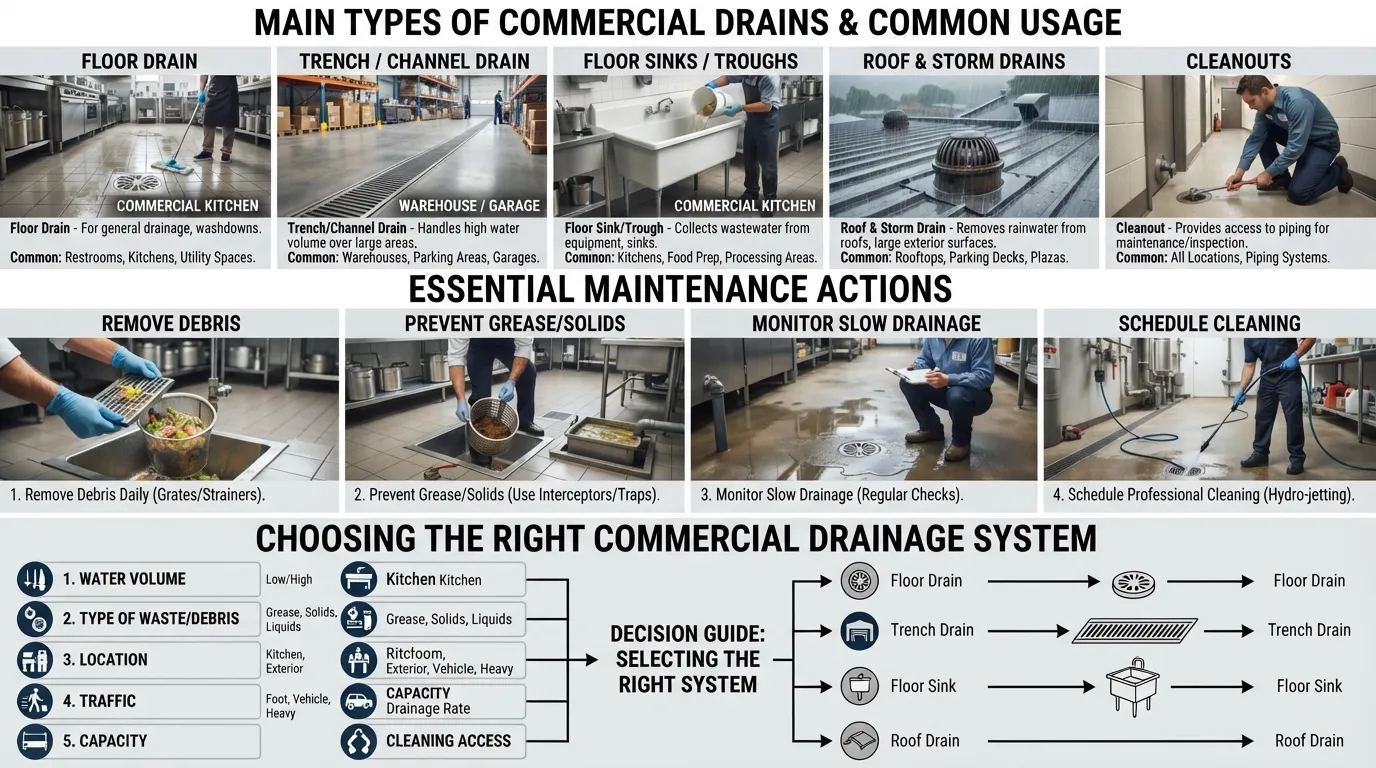
The Main Types of Commercial Drains
There is no single commercial drain that fits every business. These are some of the most important types you are likely to encounter.
1. Commercial Floor Drains
Floor drains collect water directly from the surrounding floor surface. They are common in commercial kitchens, restrooms, locker rooms, utility areas, mechanical spaces, washdown areas, and other locations where water may reach the floor.
A typical assembly may include a grate or strainer, drain body, outlet connection, and a trapped connection to the sanitary drainage system when required by the application and code. The grate helps keep larger debris out while allowing water to enter.
Commercial floor drains deserve special attention because their job depends heavily on the room. A drain in a restroom does not face the same grease, food debris, cleaning activity, or traffic conditions as one in a restaurant kitchen.
2. Trench or Channel Drains
A trench drain is a long, linear drainage channel covered by a grate. Instead of collecting water at one small point, it intercepts water across a wider line.
That makes trench and channel drains useful in areas such as:
- Parking areas and garages
- Loading zones
- Warehouses
- Commercial entrances
- Washdown areas
- Workshops and shop floors
- Large paved or hard-surface areas
When choosing a commercial trench drain, look beyond channel width. Expected water flow, outlet configuration, grate material, pedestrian or vehicle traffic, debris load, installation conditions, and maintenance access all matter.
3. Floor Sinks and Floor Troughs
Floor sinks and floor troughs are frequently used where equipment or fixtures discharge indirectly into a drainage receptor, particularly in food-service and mechanical applications.
They can provide a larger receiving area than a basic round floor drain, but the drain or floor sink still has to match the actual environment. A light-duty floor sink should not be substituted for a drainage system designed to carry heavy rolling or vehicle loads. :contentReference[oaicite:1]{index=1}
4. Roof and Stormwater Drains
Not every commercial drain carries sanitary wastewater. Roof drains, exterior channel drains, catch basins, and other stormwater components manage rainwater and surface runoff.
This distinction is important because a sanitary drain and storm drainage system have different purposes and should not be treated as interchangeable.
5. Cleanouts and Drain Access Points
A cleanout does not collect floor water, but it is an important part of a maintainable commercial drainage system. It creates an access point through which piping can be inspected or mechanically serviced without unnecessarily dismantling fixtures or opening finished building surfaces.
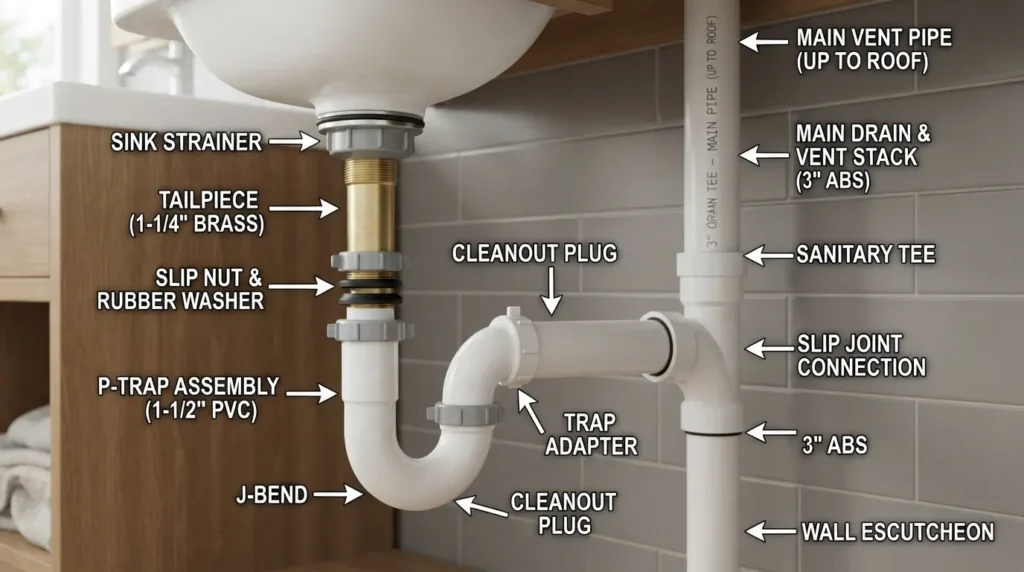
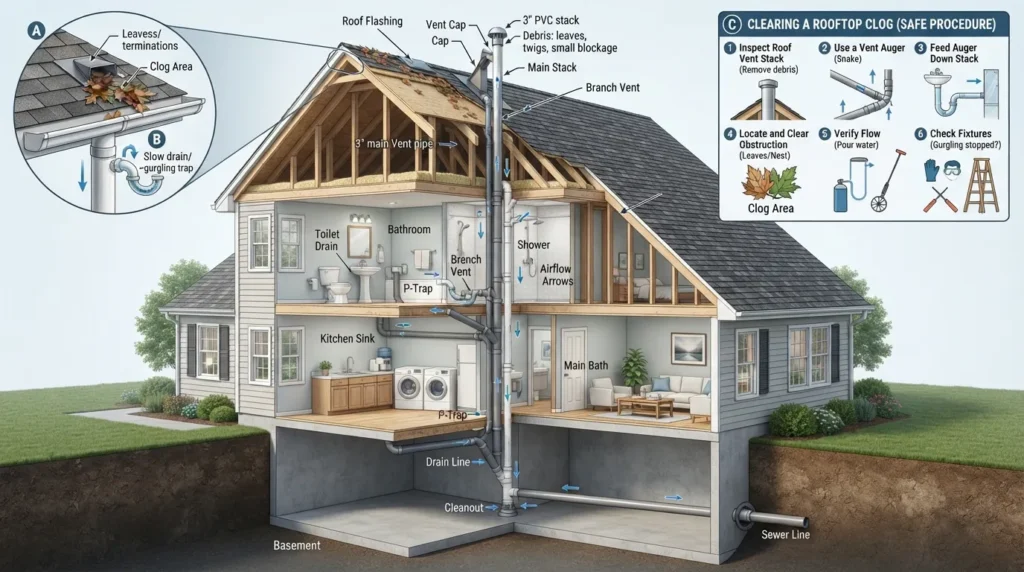
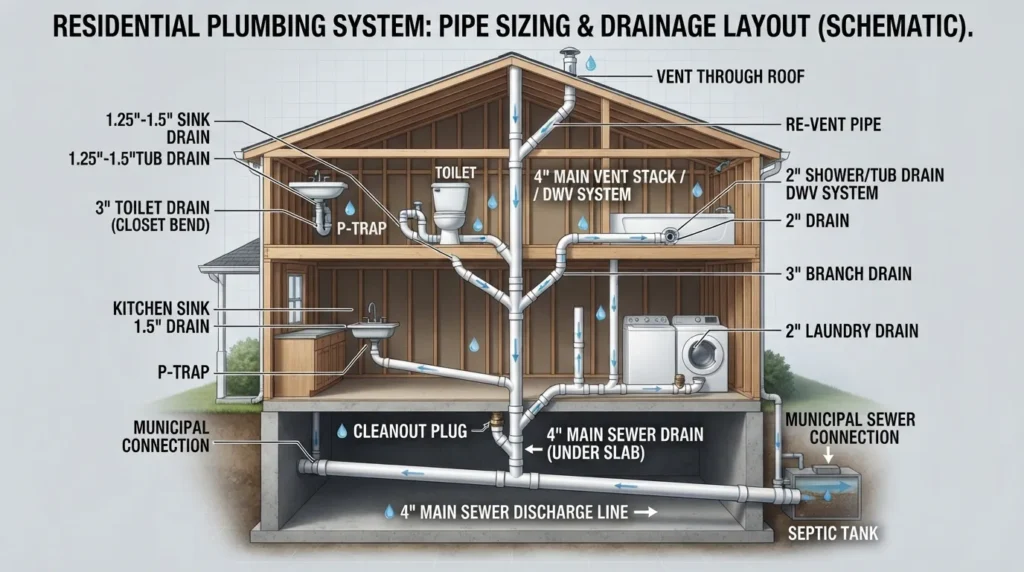
If you want to understand how traps, branches, vents, cleanouts, building drains, and larger drainage piping connect together, our guide to how a building drainage system works explains the drainage path in more detail.
How a Commercial Drainage System Works
A drain opening is only the visible beginning of the system. For a sanitary commercial floor drain, a simplified drainage path may look like this:
The exact arrangement depends on the drain, building, connected fixtures, drainage type, code requirements, and whether interceptors or other equipment are part of the system.
Which Commercial Drain Is Right for Your Facility?
This is where product lists often stop being useful. Instead of choosing a drain because it looks “heavy duty,” start with what the drain actually needs to handle.
Commercial Drain Decision Matrix
Restaurant / Commercial KitchenCommon concerns: water, food solids, grease, frequent washdown, equipment discharge.
Consider: floor drains, floor sinks or troughs, strainers, accessible cleaning, and applicable grease-control requirements.
WarehouseCommon concerns: larger floor areas, runoff, wash water, debris, carts or equipment.
Consider: floor or trench drainage, expected flow, grate strength, outlet capacity, and service access.
Garage / Parking AreaCommon concerns: surface water, dirt, sediment, tires, and vehicle loading.
Consider: trench or surface drainage designed for the expected traffic and debris conditions.
Restroom / Locker RoomCommon concerns: routine floor water, cleaning, hair or debris, and odors from low-use drains.
Consider: floor drains, trap-seal protection, accessible grates, and routine cleaning.
Mechanical / Utility AreaCommon concerns: equipment discharge, condensate, leaks, maintenance water.
Consider: an approved receptor and drainage arrangement appropriate for the equipment and discharge.
Industrial / Process AreaCommon concerns: unusual solids, temperature, chemicals, process liquids, equipment, or heavy traffic.
Consider: drainage materials and system design specifically compatible with what will enter the drain.
7 Factors to Check Before Choosing a Commercial Drain
- What enters the drain? Clean water, food solids, grease, sediment, wash water, and process discharge can require very different solutions.
- How much water must it handle? A small utility-room drain and a long trench drain across a loading area should not be selected using the same assumptions.
- Will people, carts, or vehicles cross it? Grates and drain bodies must suit the expected traffic and load conditions.
- How will debris be controlled? Strainers, baskets, grates, or interceptors can reduce what reaches downstream piping.
- Can the system be cleaned easily? Removable components and accessible cleanouts can make future maintenance less disruptive.
- Where does the outlet connect? Outlet location, pipe size, slope, branch drainage, and the final system all need to work together.
- What do the applicable plans and codes require? Drain selection should be coordinated with the actual project rather than based on a product description alone.
Important:
Do not choose a commercial floor drain solely by diameter, grate appearance, or the phrase “heavy duty.” Flow, outlet sizing, load conditions, waterproofing details, drainage connection, maintenance access, and code requirements should all be considered together.
Commercial Kitchen Drains: Grease and Food Solids Change the Equation
Commercial kitchens deserve their own drainage strategy because what enters the drainage system can be very different from what enters a typical restroom or office drain.
Food scraps and other solids can accumulate near strainers, traps, branches, and downstream piping. Fats, oils, and grease can also cool and accumulate inside drainage systems instead of simply disappearing when they are washed down a sink.
This is why prevention starts before material enters the pipe. Appropriate strainers, baskets, grease-control practices, regular cleaning, and required interceptors can all play a role.
Miami-Dade Food-Service Note
Miami-Dade currently identifies non-residential facilities that handle, prepare, or process food and discharge or have the potential to discharge fats, oils, and grease as FOG generators. Applicable facilities are subject to county FOG-control requirements, including an approved operational FOG control device and operating-permit requirements. Property-specific requirements should always be confirmed before installation or alteration work. :contentReference[oaicite:2]{index=2}
Commercial Drain Strainers: A Simple Part With a Big Job
A drain strainer or debris basket helps stop larger materials before they travel farther into the drainage piping. In a restaurant that might mean food particles. In another commercial facility it could mean paper, packaging debris, sediment, hair, or other solids.
A strainer does not eliminate the need for drain cleaning, and it cannot prevent every blockage. It simply reduces one common pathway by which solids enter the system.
The practical rule is simple: if a removable strainer catches debris, it also needs a routine for emptying and cleaning. A blocked strainer can restrict drainage even when the pipe below it is clear.
Common Commercial Drain Problems and What They May Mean
A symptom can point you in the right direction, but it is not a diagnosis by itself. The same slow drain can have different causes depending on the facility and piping.
Slow Drainage
Possible causes include localized debris, grease, sludge, scale, a partially blocked branch, or another restriction.
Recurring Clogs
Repeated clearing without lasting improvement can justify investigating the underlying line condition or blockage location.
Several Drains Back Up Together
When multiple fixtures are affected, the restriction may be farther downstream in shared drainage piping rather than at one individual drain.
Standing Water Around a Floor Drain
Check for blocked grates or strainers first. If those are clear, the drain line, drainage capacity, floor conditions, or another system issue may need evaluation.
Drain Odor
Possible causes include organic buildup, an unclean drain, or loss of the water seal in a trapped drain that is rarely used.
Grease or Sludge Buildup
A cable may open a pathway through some blockages, while heavier buildup along the pipe wall may require a different cleaning method after pipe condition is considered.
Drain Snaking vs. Hydro Jetting vs. Camera Inspection
There is no single “best” commercial drain-cleaning tool. The useful question is: which method matches the problem?
Drain Snaking or Mechanical Clearing
A professional drain cable or auger can be useful for a localized obstruction that can be broken through, cut, or retrieved mechanically.
Hydro Jetting
Hydro jetting uses high-pressure water and may be appropriate for heavier grease, sludge, or buildup along the inside of suitable piping. Pipe condition and the nature of the blockage should be evaluated before jetting is selected. :contentReference[oaicite:3]{index=3}
Sewer Camera Inspection
A camera is diagnostic rather than simply a cleaning method. It can be valuable when backups keep returning or when the location or cause of a problem is unclear. Camera inspection can reveal conditions such as roots, offsets, cracks, bellies, or stubborn obstructions. :contentReference[oaicite:4]{index=4}
If your business already has a slow, blocked, or repeatedly backing-up drain, our commercial drain cleaning service explains how we match snaking, hydro jetting, camera inspection, and other methods to the actual condition of the line.
How Often Should Commercial Drains Be Cleaned?
There is no responsible single cleaning interval for every commercial drain.
A lightly used floor drain in one property may need very different attention from a restaurant drain exposed to grease, food debris, and frequent cleaning water every day.
A better maintenance schedule is based on:
- Type of business
- How frequently the drain is used
- Whether grease or food solids enter the area
- Amount of sediment or debris
- History of previous clogs
- Age and condition of connected piping
- How quickly drainage performance changes
- Manufacturer or facility maintenance requirements
A better maintenance rule:
Do not wait for a full backup to be the first sign that a high-use commercial drain needs attention. Track how quickly strainers collect debris, whether flow is slowing, whether odors are developing, and whether previous blockages are starting to repeat.
A Practical Commercial Drain Maintenance Checklist
- Keep the grate and surrounding floor clear. Prevent obvious debris from entering the drain.
- Empty baskets and strainers before they become packed.
- Watch drainage speed. A gradual slowdown can be easier to address before a complete blockage develops.
- Do not treat grease disposal as a drain-cleaning problem. Keep fats, oils, grease, and food solids out of the drainage system wherever required and practical.
- Check low-use drains for odor or trap-seal problems.
- Document recurring backups. Note which drains are affected and whether multiple fixtures react at the same time.
- Use professional diagnosis when the same clog keeps returning. Repeatedly opening the line without understanding the cause can leave the underlying problem unresolved.
- Keep required grease-control devices and other drainage equipment maintained according to applicable requirements.
Do Commercial Floor Drains Have P-Traps?
Commercial sanitary floor drains commonly use a trapped connection or other code-compliant arrangement that maintains a water seal between the occupied space and the sanitary drainage system.
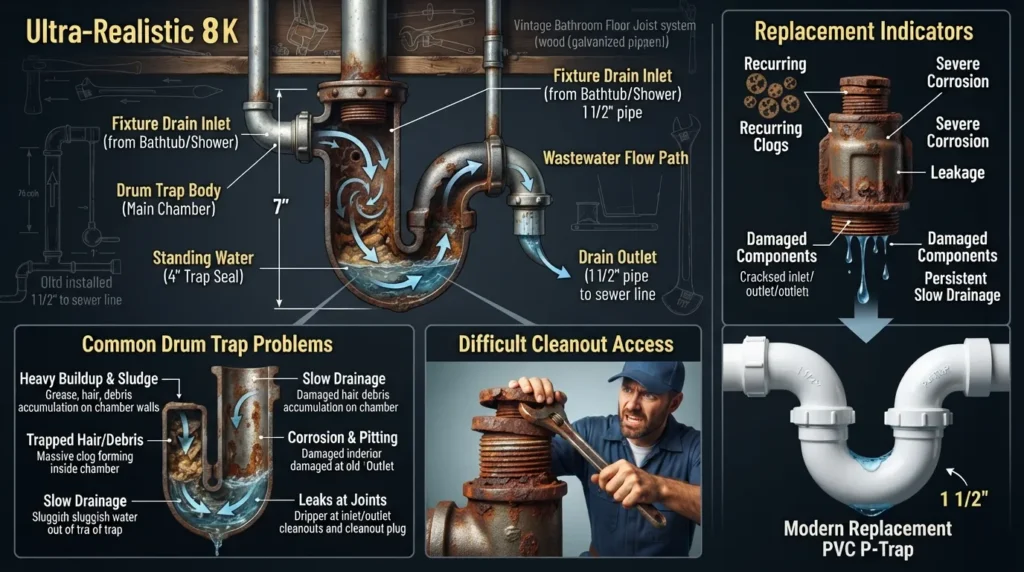
The familiar P-trap is one type of plumbing trap, but you should not assume every commercial floor drain has the same visible configuration as the trap under a sink. The exact arrangement depends on the drain, installation, drainage system, and applicable code.
This also explains why an infrequently used floor drain can sometimes develop an odor: if the trap seal is lost or another drainage problem exists, the protection that normally separates the room from the sanitary system may no longer be functioning as intended.
What Is the Standard Size of a Commercial Sink Drain?
There is no single universal commercial sink-drain size that should be applied to every sink or business.
The correct drain connection depends on factors such as:
- The sink or fixture being installed
- Manufacturer requirements
- Number of compartments or connected fixtures
- Direct versus indirect waste arrangement
- Expected discharge
- Trap and branch-drain sizing
- Local plumbing-code requirements
If you are replacing a commercial sink, floor sink, or drain assembly, the safest approach is to identify the exact fixture and existing drainage connection rather than ordering a drain solely from a generic “standard size” search result.
What Are the Three Types of Drainage?
You may see different answers because “types of drainage” can refer to plumbing, civil engineering, landscaping, or building systems. There is no universal three-item classification that fits every context.
For a commercial-property owner, a useful broad distinction is:
- Sanitary drainage: carries wastewater from plumbing fixtures toward the sanitary sewer or another approved wastewater system.
- Storm or surface drainage: manages rainwater from roofs, parking areas, paved surfaces, entrances, and other exterior areas.
- Specialty or process drainage: serves equipment, manufacturing, food service, or other applications where the discharge may require special materials, receptors, interception, treatment, or system design.
The most important point is not the label. It is knowing what type of water or waste the drain is intended to receive and where that material is allowed to go.
Commercial Drain Installation: What Needs to Be Planned?
Installing a floor drain or trench drain is not simply a matter of cutting a hole and connecting a pipe. The drain has to become part of the building’s larger plumbing or stormwater system.
Depending on the project, planning may involve:
- Drain location and floor elevations
- Drainage slope
- Outlet and downstream pipe sizing
- Trap and vent requirements
- Waterproofing details
- Cleanout access
- Grease interception
- Backflow or backwater protection where applicable
- Grate and load requirements
- Permitting and inspection
Miami-Dade states that regulated plumbing-system installation, alteration, replacement, and repair work may require a permit before the work begins, depending on the project. :contentReference[oaicite:5]{index=5}
Before modifying an existing commercial drain:
Confirm whether the problem is really the drain fixture itself. A recurring backup may instead be caused by downstream grease, roots, damaged piping, an improperly performing branch line, or another condition that replacement of the visible drain will not solve.
Commercial Drain Considerations for Miami Properties
Miami commercial drainage deserves a local perspective because exterior drainage, sanitary drainage, grease-control requirements, existing sewer conditions, and heavy-rain events can all affect how a property performs.
For businesses in Miami-Dade, I would pay particular attention to these areas:
- Food-service grease: restaurants and other FOG-generating facilities may have specific county requirements for grease-control devices and maintenance. :contentReference[oaicite:6]{index=6}
- Heavy rainfall: surface and storm drainage should be kept distinct from sanitary drainage and maintained so blocked grates or channels do not become an avoidable bottleneck.
- Recurring underground-line problems: several drains backing up together can justify checking shared or main drainage piping instead of repeatedly treating individual fixtures.
- Permits and plans: commercial plumbing alterations should be checked against the project’s current Miami-Dade or applicable municipal requirements before work begins. :contentReference[oaicite:7]{index=7}
For broader plumbing support across Miami-Dade, you can also learn more about our Miami plumbing team and the residential and commercial services we provide. The company website currently lists residential and commercial plumbing service, Florida plumbing contractor license CFC1432859, and more than a decade serving the Miami area. :contentReference[oaicite:8]{index=8}
Watch: Commercial Drain Care Questions
If you prefer a visual explanation, this commercial drain-care overview covers common maintenance questions and can help you understand the issues facility teams often need to think about. :contentReference[oaicite:9]{index=9}
When Should You Call a Commercial Plumber?
Routine debris removal around a grate is one thing. A drainage problem that affects the piping or business operation is different.
Professional diagnosis becomes more important when:
- A drain repeatedly clogs after being cleared
- Several drains or fixtures slow down at the same time
- Wastewater or sewage is backing up
- A restaurant line has substantial grease buildup
- You suspect roots or damaged underground piping
- A camera inspection may be needed to locate the problem
- A floor or trench drain needs to be installed or replaced
- The project involves grease interceptors, commercial plumbing alterations, permits, or code-sensitive work
Our published drain-cleaning process uses symptom evaluation first and then matches mechanical clearing, hydro jetting, or camera inspection to the line and blockage instead of treating every clog the same way. :contentReference[oaicite:10]{index=10}
Commercial Drain Backing Up in Miami?
Tell us what you are seeing—one slow floor drain, recurring grease buildup, several fixtures backing up, an overflowing line, or a drain that needs professional evaluation. We can help determine the next practical step before you spend money on the wrong solution.
Commercial Drain FAQs
Key Takeaways
- A commercial drain should be selected according to the facility and actual drainage load—not simply the word “commercial” on a product page.
- Floor drains, trench drains, floor sinks, storm drains, strainers, traps, cleanouts, and interceptors solve different parts of the drainage problem.
- Restaurants need special attention to food solids, fats, oils, grease, strainers, and applicable grease-control requirements.
- Recurring clogs are a reason to diagnose the system rather than repeatedly treating the same symptom.
- Snaking, hydro jetting, and camera inspection serve different purposes.
- Commercial drain-cleaning frequency should be based on usage and buildup rather than a universal calendar interval.
- Installation decisions should account for flow, outlet connections, traffic loads, service access, and applicable permits and plumbing requirements.
Related Commercial Drain Resources
If you are comparing commercial drainage systems or researching an upcoming project, these manufacturer and government resources can help you review product categories and local requirements. Always verify that a specific product is suitable for your project before purchasing it.
- Oatey Commercial Drains — floor drains, roof drains, floor sinks, cleanouts, and related commercial drainage products.
- Zurn Commercial Floor Drains — commercial floor-drain product and specification reference.
- Commercial Trench Drain Systems — examples of channel widths, grate options, and trench-drain configurations.
- Commercial Drain Strainers — examples of strainers designed to keep larger solids out of commercial drains.
- Miami-Dade Fats, Oils & Grease Requirements — official information for applicable non-residential FOG generators.
- Miami-Dade Building Permit Information — official permitting guidance for regulated construction and plumbing work.
Product links above are provided as research references. Product suitability, drainage design, code compliance, and installation requirements depend on the specific commercial property and project.