 For most outdoor drain cleaning jobs, start by removing leaves, mud, grass, and other debris from the grate or catch basin instead of immediately pushing the blockage farther into the pipe. Then identify what type of drain and pipe you have, find where the line discharges if possible, and choose the clearing method based on the actual obstruction. A garden hose may handle loose debris, a manual auger can help with a reachable solid clog, and suitable underground lines may require jetting. Recurring dirt, roots, or a drain that still will not flow can point to a deeper or damaged-pipe problem.
If your outside drain is overflowing, full of mud, or holding water after a storm, I would not start by asking, “What is the strongest drain cleaner?” I would start with a better question: what kind of drain is this, and what is actually blocking it?
That distinction matters because a backyard catch basin filled with leaves needs a different approach from a buried downspout pipe packed with silt. A corrugated landscape pipe with roots is different again. And an outdoor stormwater drain should not automatically be treated like an indoor kitchen or bathroom drain.
This guide will help you diagnose the problem first, choose the safest practical outdoor drain cleaning method, know which DIY fixes are worth trying, and recognize when repeated unclogging is unlikely to solve the real issue.
First, Identify What Kind of Outdoor Drain You Have
Before using a plunger, drain snake, bladder, pressure washer, or chemical product, look at the drainage system itself. A residential property can have several systems that move different kinds of water.
A sanitary drain carries wastewater from fixtures such as sinks, showers, toilets, and laundry equipment. Outdoor drainage generally handles rainwater and surface runoff from roofs, patios, driveways, landscaped areas, catch basins, and similar locations. If you want to understand how these systems relate to the rest of your plumbing, see our guide to how a home drainage system works.
Common outdoor drains you may be dealing with
- Yard or landscape drain: A surface inlet that collects rainwater from grass or landscaped areas.
- Catch basin: A box-like collection point that can trap leaves, soil, and sediment before water enters underground piping.
- Patio or driveway drain: A surface drain or channel that removes runoff from hard surfaces.
- Buried downspout drain: Underground piping that carries roof runoff away from the building.
- Pop-up emitter system: A buried drainage line that releases water through an outlet farther from the house.
- Subsurface drainage: Systems such as perforated landscape or foundation drainage that may behave differently from a simple solid underground pipe.
Important distinction
If several indoor fixtures are backing up, sewage is rising, or flushing one fixture affects another, you may have a sanitary drain or sewer problem rather than a simple blocked outside drain. Do not assume every water problem around the property is the same kind of clog.
Diagnose the Blockage Before You Try to Unclog It
The most useful information is often sitting right in front of you. Look at what the drain is doing, what material is visible, and when the problem appears.
Leaves, grass, mulch or litter
Usually start with manual removal, a wet/dry vacuum where appropriate, and a controlled water test. Do not wash a pile of surface debris deeper into the line.
Mud, dirt or silt
Remove as much sediment as possible from the basin first. Packed soil usually needs physical removal and flushing rather than a household liquid drain remedy.
A solid object near the opening
Retrieve it if you can do so safely. A manual auger may help break or pull a reachable obstruction rather than forcing the object farther underground.
Roots
Roots are a different problem from ordinary debris. Clearing them may restore flow temporarily, but root entry can also indicate a joint, crack, or damaged section that needs investigation.
Dirt keeps coming back
Repeated soil inside a buried line—especially when it is not entering through the surface opening—can be a clue that the pipe is cracked, separated, collapsed, or otherwise compromised.
Drain is clear but the yard still floods
The problem may involve grading, insufficient drainage capacity, an obstructed outlet, or another site-drainage condition instead of a simple clog.
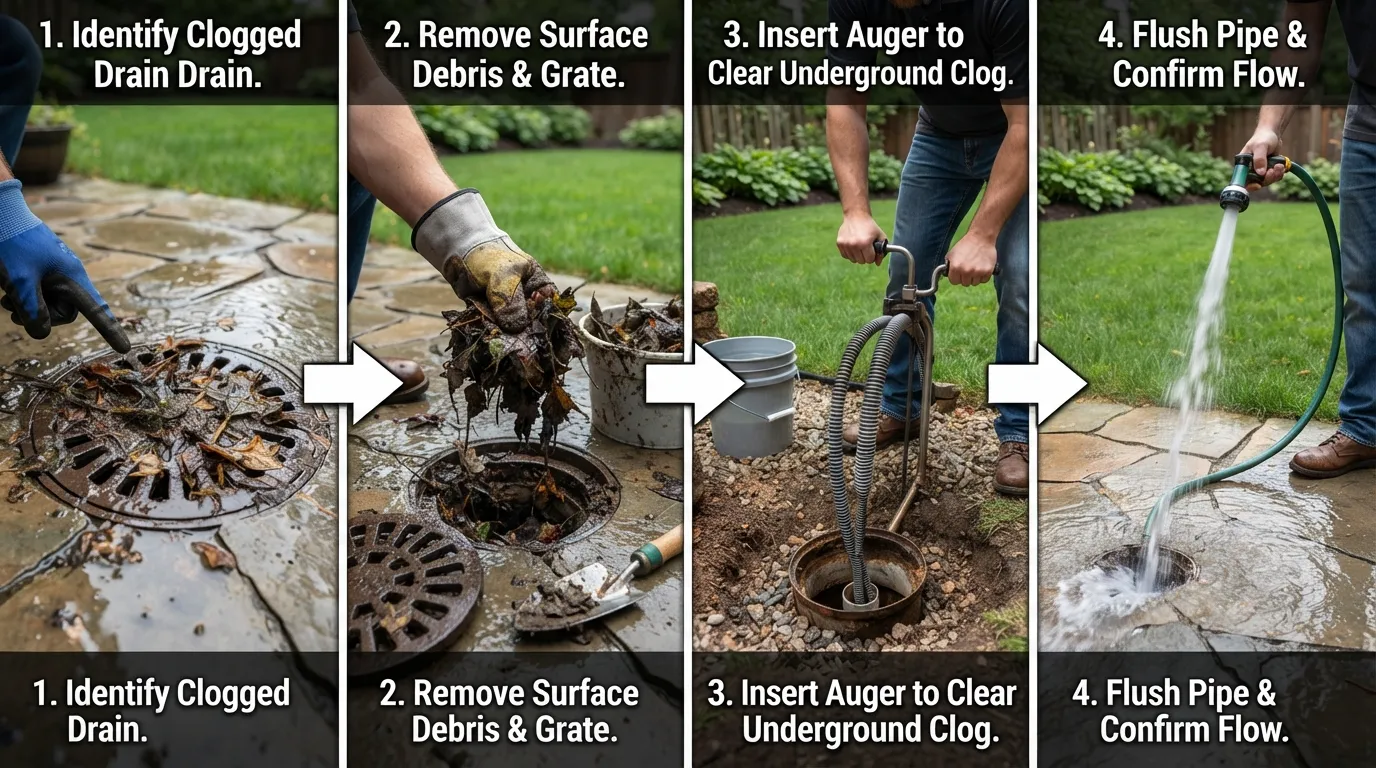
How to Clean an Outdoor Drain Step by Step
For a typical blocked outside drain, work from the least aggressive method to the more specialized one. You want to restore flow without turning a small blockage into a deeper problem.
- Put on gloves and inspect the area. If you will use pressurized equipment, appropriate eye protection is also important.
- Remove the grate or accessible cover. Keep screws or fasteners somewhere safe.
- Clear surface debris first. Pull out leaves, grass, twigs, trash, mulch, and other material by hand or with an appropriate tool.
- Remove sediment from the catch basin. Scoop out mud and dirt or use a wet/dry vacuum rated for wet pickup where practical.
- Look into the pipe opening. A visible object near the entrance may be removable without sending equipment deep into the line.
- Use a controlled garden-hose test. If water drains normally, the blockage may have been limited to the inlet or catch basin. If the basin immediately fills again, the restriction is probably farther down the line.
- Try an appropriate manual clearing tool. A hand-operated auger can help with some reachable solid obstructions.
- Consider flushing or jetting only after you understand the pipe. Deeper loose sediment and organic debris may require more thorough flushing, but pipe material, condition, access, and outlet location matter.
- Confirm that water reaches the discharge point. Do not stop just because water disappears from the inlet.
- Clean the grate and surrounding area. Removing nearby debris reduces the amount that immediately washes back into the drain.
Which Outdoor Drain Cleaning Method Should You Use?
There is no single “best outdoor drain cleaner.” The best method depends on the blockage, pipe, and access point.
Garden hose
A garden hose is a reasonable first flushing tool after you have manually removed loose material. It works best when the remaining debris is light enough to move and the drainage route is open. If water immediately backs up, continuously adding more water will not solve a packed or structural obstruction.
Wet/dry vacuum
A wet/dry vacuum can be especially useful when a catch basin is holding mud, leaves, and dirty water. Removing debris from the basin first gives you a cleaner starting point and prevents you from intentionally flushing that material deeper into an underground pipe.
Outdoor drain plunger
A plunger may help when you can create a useful seal over a relatively small drain opening and the blockage is localized. It is generally less useful on a large open catch basin or a long underground landscape line where there is no good seal.
Manual drain auger or snake
A manual auger can help break up or retrieve a solid obstruction near an accessible opening. Pipe material matters, however. Powered metal drain equipment can damage some corrugated landscape piping, so do not treat every buried drain like a standard rigid sewer line.
Drain bladder or blow bag
A drain bladder expands inside a suitable pipe and uses water pressure to work against a blockage. It may push through some obstructions, but it does not necessarily remove all debris or scrub the pipe clean. Make sure the device is appropriate for the pipe and that you understand where the water and loosened material can go.
Pressure washer sewer jetter
Jetting can be useful for loose silt, sediment, leaves, and similar material farther inside a suitable underground line. It is not the right answer for every pipe or every blockage. Older, damaged, brittle, unknown, or problematic piping deserves more caution, and jetting by itself is not a structural repair.
When the system has a known downstream outlet, cleaning from an appropriate downstream access point can help flushed material move out instead of driving it deeper into the drainage route.
Choose by problem, not by tool power
A stronger machine is not automatically a better solution. If a pipe is cracked, separated, root-damaged, collapsed, or poorly routed, aggressive cleaning can miss the underlying cause. When the clog keeps returning, diagnosis becomes more valuable than simply repeating the same clearing method.
How to Unblock an Outside Drain Full of Mud or Dirt
If your outside drain is clogged with mud, I would focus on removing sediment rather than trying to dissolve it.
- Remove the grate.
- Scoop or vacuum loose mud from the basin.
- Find the pipe opening and clear packed material immediately around it.
- Add a small amount of water and watch whether it moves through the pipe.
- If the line remains blocked, use a suitable mechanical or flushing method based on the pipe material and obstruction depth.
- Check the outlet and confirm that sediment actually leaves the system.
If soil repeatedly appears inside a buried drain even though it is not washing in through the grate, stop assuming you simply have another dirty drain. Soil can enter through a damaged or separated section of buried pipe, and that changes the solution completely.
How Do You Unclog an Outdoor Underground Drain Pipe?
An underground drain is harder because you cannot see the route or blockage. The first goal is to understand the system.
1. Find the inlet and outlet
Look for where water enters and where it should discharge. Depending on the property, the outlet may be a pop-up emitter, open pipe, basin, or another approved drainage point.
2. Clear both accessible ends
Sometimes the problem is not deep underground at all. Leaves, soil, landscaping, or debris can obstruct the inlet or discharge point.
3. Test flow
Run water carefully from the upstream side and watch for discharge. If water backs up quickly without appearing at the outlet, you likely have an underground restriction.
4. Match the method to the obstruction
A reachable solid object may respond to a manual auger. Loose sediment farther into a suitable pipe may be flushable or jettable. Roots, recurring blockage, or suspected pipe damage call for a different level of diagnosis.
5. Do not blindly push equipment toward a buried dead end
If you do not know where a drainage line terminates, first determine its route as far as reasonably possible. A buried or blocked outlet can turn what looks like a normal cleaning job into a stuck-tool or flooding problem.
What to Do When an Outside Drain Is Overflowing
An overflowing outdoor drain tells you water is reaching the inlet faster than it can leave. The cause may be a blocked grate, a full catch basin, an underground clog, an obstructed outlet, or a broader drainage-capacity problem.
Start by clearing the visible inlet and surrounding surface. If the basin is full of sediment, remove it. Then test the underground line. If the line flows normally in a controlled test but flooding returns only during intense rainfall, look beyond the word “clog.” The site may have a grading, capacity, outlet, or broader stormwater-management issue.
Clog or drainage-design problem?
If the drain will not pass water on a normal hose test: suspect an obstruction or damaged line. If the drain passes a normal test but the property still floods during heavy rain: capacity, grading, discharge conditions, or the larger site drainage system may need attention.
Can You Use Boiling Water, Dawn, Baking Soda or Other Home Remedies?
This is where I would be careful with generic drain-cleaning advice.
Boiling water is not a practical answer for packed mud, roots, sticks, gravel, or a deep underground blockage. Those problems generally need physical removal, mechanical clearing, flushing, or diagnosis.
Dawn or another detergent is also not an outdoor-drain cure. It will not remove roots or a structural obstruction, and if the drain is part of a stormwater system, you should think about where anything you pour into it will discharge.
Miami-Dade explains that stormwater can travel through drainage pipes to waterways without being filtered or treated first, and it specifically identifies detergents among potential stormwater pollutants. That is one reason I recommend identifying the drain and its discharge route before pouring household cleaners into an exterior drainage system.
If you want a more “natural” approach to outdoor drain cleaning, the most useful starting point is often simpler: physically remove leaves and mud, clean the catch basin, clear the outlet, and use plain water appropriately once the solid material is out.
What Should Be in an Outdoor Drain Cleaning Kit?
You do not need every drain-cleaning product on the shelf. A practical basic kit can include:
- Water-resistant work gloves
- Eye protection
- Bucket or debris container
- Screwdriver or appropriate grate-removal tool
- Small scoop or hand trowel
- Wet/dry vacuum rated for wet pickup
- Garden hose
- Manual drain auger for suitable pipes and obstructions
- A flashlight
More aggressive equipment—such as powered drain machines, pressure-washer sewer jetters, or specialized inspection tools—should be chosen only after the pipe, access point, and blockage justify them.
Outdoor Drain Cleaning in Miami: Why Heavy Rain Changes the Diagnosis
Outdoor drainage becomes especially noticeable when rainfall increases. In Miami-Dade, keeping runoff paths clear is part of preparing for heavy rain. County guidance recommends removing debris from gutters, downspouts, and storm drains so water has a clearer path away from the property.
That makes preventive backyard drain cleaning worthwhile before a major rain event—not after standing water has already revealed the problem.
For a Miami property, pay attention to:
- Leaves, palm debris, and litter covering surface inlets
- Sediment collecting in catch basins
- Buried downspout lines that do not discharge properly
- Tree-root intrusion around underground piping
- Recurring clogs that may indicate pipe defects
- Water that pools even after the drain itself has been cleared
Heavy rainfall can expose a weak drainage system, but it does not automatically prove the pipe is clogged. The pattern of the flooding still matters.
How Much Does It Cost to Have Outside Drains Cleaned?
There is no responsible one-price answer for every outside or yard drain because the work can range from clearing a dirty catch basin to locating a deep underground obstruction.
The price can change based on:
- Where the blockage is located
- How deep it is in the line
- Whether both ends of the drainage pipe are accessible
- The pipe material and condition
- Whether the blockage is leaves, mud, roots, or another obstruction
- Whether snaking, jetting, or camera inspection is needed
- Whether the pipe needs repair after the clog is located
Because of those variables, it is better to price the actual diagnosis and required method than to assume every yard drain unclogging job should cost the same.
When Should You Stop DIY Outdoor Drain Cleaning?
DIY cleaning makes sense when you are dealing with accessible leaves, surface debris, shallow mud, or another clearly localized obstruction. I would consider professional diagnosis when:
- The underground line will not pass water after accessible debris is removed.
- The blockage keeps returning.
- You find roots.
- Dirt appears to be entering through the buried pipe itself.
- You suspect a cracked, separated, offset, or collapsed pipe.
- You do not know where the underground line terminates.
- The pipe material or condition makes aggressive equipment risky.
- You need camera inspection, professional snaking, or hydro jetting.
- Several indoor plumbing fixtures are also backing up, suggesting a different drainage problem.
A professional drain-cleaning process should diagnose the restriction first and then match the equipment to the line and blockage. Camera inspection can also help identify roots, cracks, offsets, or other conditions when the cause is not obvious.
Need Help With a Stubborn Outdoor Drain in Miami?
If the blockage is deeper than a simple grate or catch-basin cleaning, our professional drain cleaning service in Miami can help diagnose the restriction and determine whether snaking, jetting, inspection, or another solution makes sense.
You can also learn more about the Miami plumbing team at EZ Plumbing or call our plumbing team for help.
How to Keep an Outdoor Drain From Clogging Again
Once the drain is flowing, prevention is usually easier than another emergency cleanup.
- Remove leaves, grass clippings, mulch, and litter from drain grates regularly.
- Clean sediment from catch basins before it reaches the underground pipe.
- Keep downspouts and their underground connections clear.
- Know where buried drainage lines discharge and keep those outlets accessible.
- Do not landscape over an outlet or drainage access point.
- Check outdoor drains before periods of heavy rain.
- If roots or soil repeatedly enter a line, investigate the pipe instead of repeatedly treating the symptom.
- Watch how quickly water drains after cleaning; slow flow can be an early sign that debris remains farther downstream.
See an Underground Drain-Cleaning Method in Action
If you want to visualize how a sewer-jetter approach can be used on an underground drainage pipe, the video below provides a useful demonstration. Treat it as a visual reference rather than a universal instruction: your pipe material, condition, access, and blockage still determine whether jetting is appropriate.
Outdoor Drain Cleaning FAQs
Helpful Outdoor Drain Cleaning Resources
If you want to compare methods or research a particular tool before using it, these resources provide additional technical or local information:
- Miami-Dade County Stormwater Management — useful for understanding stormwater drainage and why materials entering exterior drains matter.
- Miami-Dade Heavy Rain Guidance — local preparation guidance for gutters, downspouts, storm drains, and flooding.
- ClogHog Landscape Drain Cleaning Guide — technical information on augers, sediment, pipe materials, and sewer-jetter cleaning.
- Roto-Rooter Outdoor Drain FAQ — a concise comparison of snaking, jetting, and blow-bag methods.
Good outdoor drain cleaning is less about finding the strongest product and more about making the right diagnosis. Identify the drain, remove accessible debris, understand what is blocking the pipe, choose a method that fits the pipe material and condition, and confirm that water reaches the outlet. If the same blockage keeps returning, treat that recurrence as information—it may be telling you the drainage system needs more than another quick unclogging.