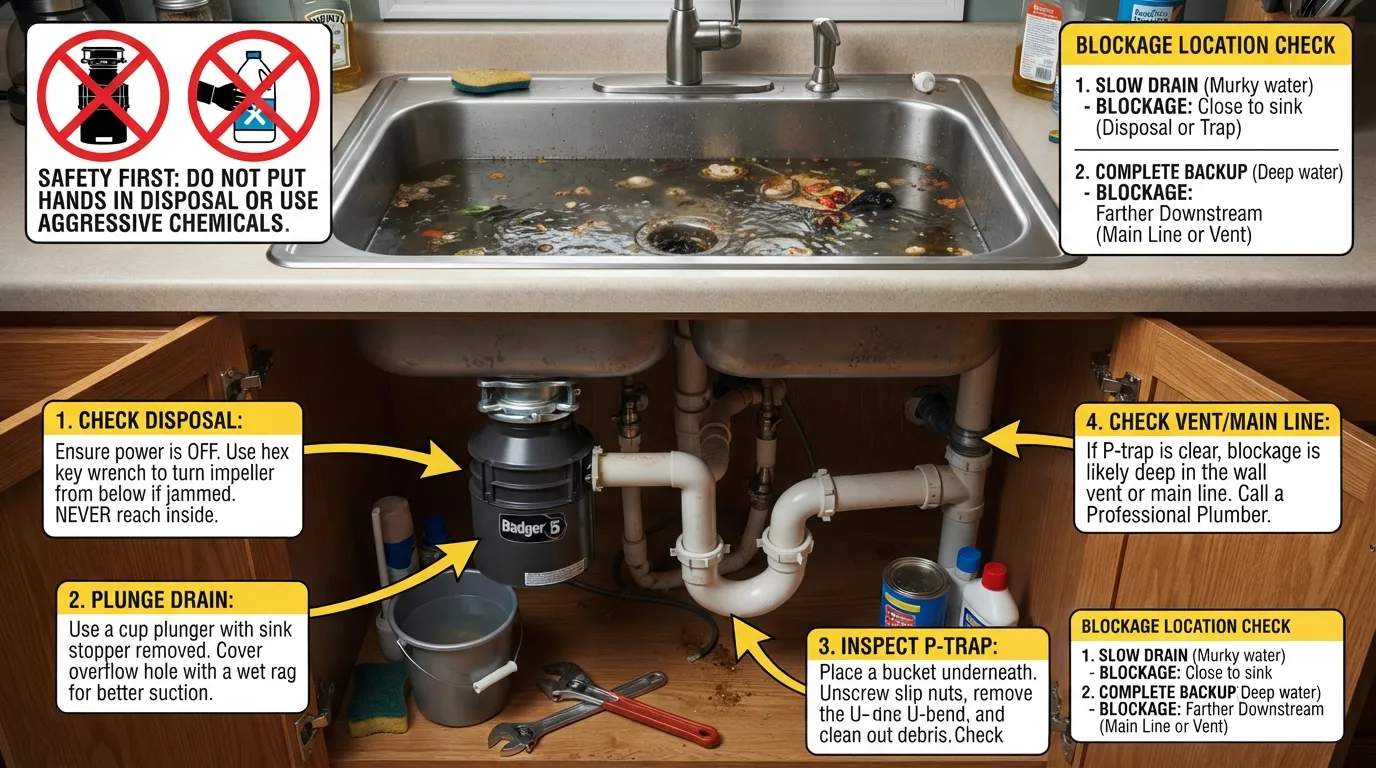
If your kitchen sink is backing up, water is usually being slowed or blocked somewhere downstream of the basin. Common causes include grease and food buildup, a garbage disposal problem, a clogged P-trap or trap arm, a deeper kitchen branch drain restriction, and—especially when other fixtures are affected—a larger shared drain problem.
Before reaching for a drain cleaner, look at when and where the water comes back up. A double sink backing up on both sides tells you something different from a sink that backs up only when the dishwasher runs. That pattern can help you decide what to check first and when it is time to stop DIY troubleshooting.
A backed-up kitchen sink is frustrating because the obvious answer—“there must be a clog”—does not tell you where the restriction is.
You may have already plunged the sink, cleaned the P-trap, run the garbage disposal, or even used a small drain snake and still have water coming back. In that situation, I would stop thinking of the sink as one isolated opening and start thinking about the drainage path behind it.
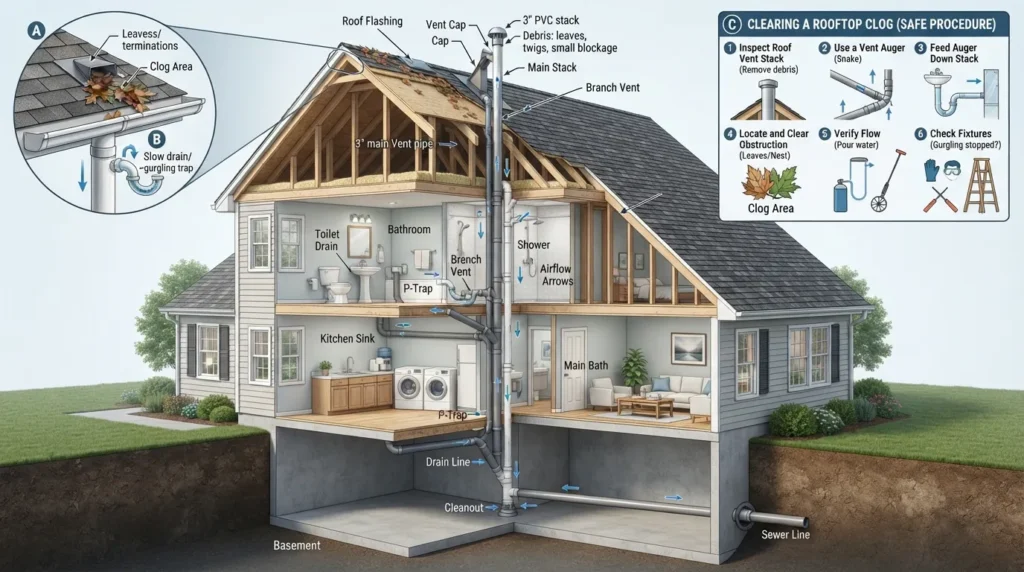
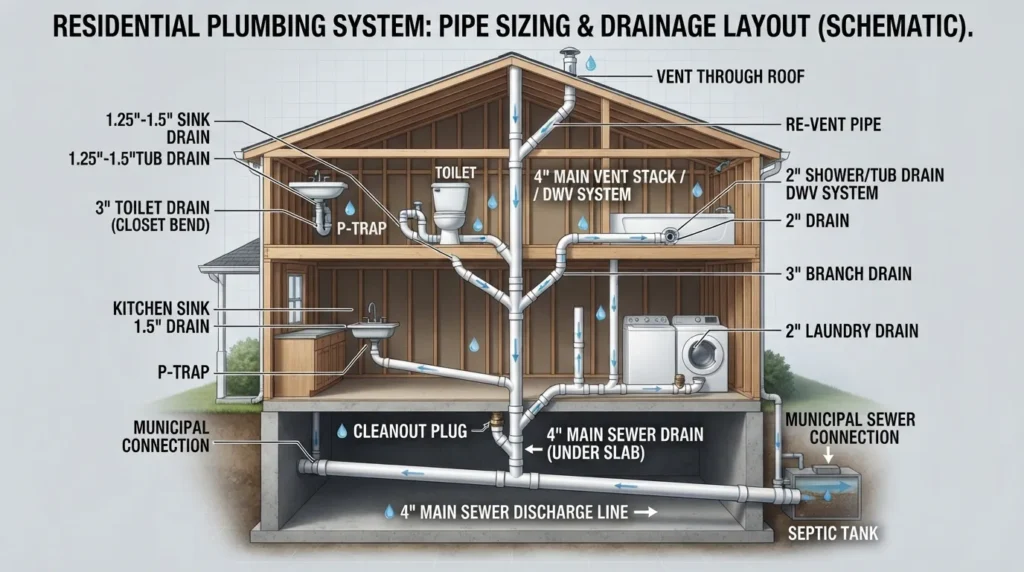
Water may need to pass through the disposal or tailpiece, P-trap, trap arm, kitchen branch line, and eventually a larger shared drain. Understanding how those parts connect makes troubleshooting much easier. If you want the bigger picture, this guide to your home drainage system and how its parts work together explains that path in more detail.
First, Use the Backup Pattern to Narrow Down the Problem
The fastest way to make sense of a kitchen sink backup is to notice the pattern before taking anything apart.
Both Sides of a Double Sink Back Up
A restriction in the shared drain path downstream of where the two bowls connect becomes more likely.
The Sink Handles Low Flow but Backs Up at Full Flow
That behavior can point toward a partial restriction: some water gets through, but not quickly enough when flow increases.
The P-Trap Is Clean but Water Still Backs Up
The restriction may be farther into the trap arm or kitchen branch instead of directly beneath the sink.
The Garbage Disposal Runs, but Water Returns
If the disposal temporarily moves the water and it rises again when the unit stops, a downstream restriction deserves attention.
The Dishwasher Triggers the Backup
The dishwasher’s discharge may be exposing a restriction in the sink, disposal, or shared kitchen drain path.
The Washing Machine Triggers It
If the plumbing layout shares a downstream drain, a larger discharge can expose a restriction farther along the system.
Several Fixtures Are Backing Up
A shared branch, building drain, or main drainage problem becomes more important to rule out.
Water Appears Even When You Are Not Using the Sink
In an apartment or condo, this can be a reason to consider shared building drainage and contact management rather than assuming the problem is limited to your sink.
These patterns are diagnostic clues, not guarantees. Plumbing layouts vary, so the goal is to narrow the likely area before deciding what to do next.
What Causes a Kitchen Sink to Back Up?
1. Grease, Fat, Oil, and Food Buildup
Kitchen drains have to carry more than water. Small amounts of fat, oil, grease, food residue, soap, and other debris can enter the drain over time.
Grease is especially troublesome because what goes down as a liquid does not necessarily stay that way. It can cool, cling to the inside of piping, and catch additional debris, gradually reducing the opening available for water.
This is particularly relevant locally. Miami-Dade County warns residents that fats, oils, and grease can damage kitchen sewage pipes and contribute to plumbing and sewage backups. Its guidance recommends keeping FOG out of sinks and garbage disposals and disposing of it with solid waste after it cools.
You can review Miami-Dade County’s fats, oils, and grease guidance for local disposal recommendations.
2. A Clogged P-Trap
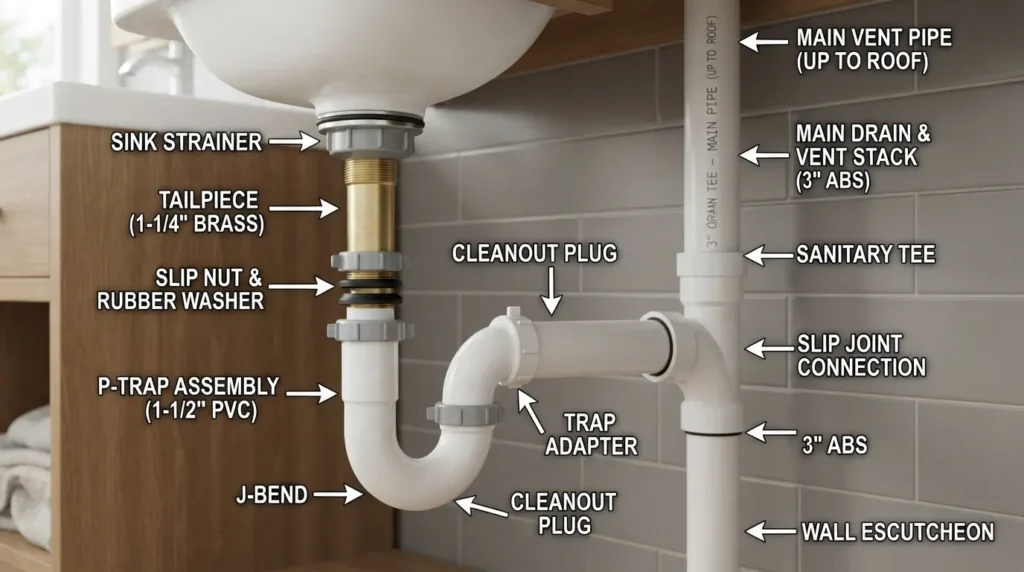
The curved pipe under the sink is the P-trap. Its normal job is to hold a water seal that helps keep sewer gases from entering your home, but its shape can also collect debris.
If the blockage is inside the trap, removing and cleaning it may solve the problem. If the trap is completely clear and the sink still backs up, however, that is useful information: the restriction may be farther downstream.
3. A Restriction in the Trap Arm or Kitchen Branch Drain
The horizontal piping that leaves the P-trap and enters the wall is only the beginning of the downstream path. A kitchen branch can develop buildup farther away from the sink, which explains why a short DIY snake may not always solve a recurring problem.
A partial restriction can also produce a confusing symptom: the sink drains normally when the faucet is running gently but starts filling when you turn the water up. The pipe is accepting some flow, just not as much as you are sending into it.
4. A Garbage Disposal Problem
A garbage disposal can contribute to a backup in more than one way. Food may jam the unit, debris may collect around its discharge path, or the disposal may run normally while a restriction exists farther down the drain.
That distinction matters because a disposal that will not run is a different problem from a disposal that runs while the sink still backs up.
5. A Venting or Drainage-System Problem
Drain vents help plumbing systems move wastewater while balancing air pressure. Vent-related problems can contribute to slow or unusual drainage symptoms, although you should not assume every gurgle or backup is automatically a blocked vent.
The pattern across fixtures is more useful. If the kitchen is the only affected fixture, start by investigating the kitchen drainage path. If multiple fixtures are slow, gurgling, or backing up, the scope may be broader.
6. A Larger Shared Drain or Main-Line Restriction
If wastewater is coming up in multiple fixtures, or one appliance repeatedly causes water to appear in another fixture, a shared downstream section may need professional investigation.
A kitchen-only backup does not automatically mean there is a main sewer problem. The fact that other fixtures continue to work normally can be an important clue that the restriction is still somewhere along the kitchen’s own branch.
How to Unclog a Backed-Up Kitchen Sink: Start With the Least Invasive Fix
If the backup appears limited to the kitchen and there are no signs of a larger sewage problem, I would work from the easiest and safest checks toward the deeper ones.
Step 1: Stop Adding Water and Remove Standing Water
If the sink is already full, do not keep running the faucet to see whether it will eventually clear. Scoop or bail enough standing water into a bucket so you can work without overflowing the basin.
If dirty water is actively rising on its own, or other fixtures are also backing up, skip repeated DIY testing and move to the professional-help section below.
Step 2: Check the Garbage Disposal, If You Have One
If the disposal does not operate, turn off power to the unit before inspecting it. Never place your hand inside a garbage disposal.
Depending on the model, you may be able to check its reset button or use the manufacturer’s recommended tool to free a jam from outside the grinding chamber.
If the disposal runs normally but water still cannot drain, the disposal motor itself may not be the real problem.
Step 3: Plunge the Sink Correctly
A sink plunger can be useful for a localized obstruction. Add enough water to cover the plunger cup, make a tight seal over the drain, and use controlled up-and-down strokes.
For a double kitchen sink: seal the second drain opening with a stopper or wet cloth while plunging the other side. Otherwise, pressure can simply escape through the opposite basin instead of working against the restriction.
Step 4: Clean the P-Trap
If plunging does not work and you are comfortable working under the sink, place a bucket beneath the trap before loosening it. Water and debris may be sitting inside.
Remove visible buildup, rinse the trap, inspect the nearby fittings, and reinstall everything carefully before testing for leaks.
Safety Warning
If you recently poured a chemical drain opener into the sink, do not casually disconnect the trap or plunge aggressively. Caustic liquid may still be sitting in the plumbing and can splash onto skin or eyes. Follow the product’s safety instructions and tell a plumber what was used before they begin work.
Step 5: Check Beyond the P-Trap
If the P-trap is clean, the next likely area is the pipe leading into the wall and the kitchen branch beyond it.
A suitable drain auger can sometimes reach a deeper localized obstruction. Feed it carefully rather than forcing it. If the cable repeatedly stops, becomes stuck, goes an unexpected direction, or the backup quickly returns, continuing with more force can create a bigger problem.
That is the point where diagnosis matters more than simply using a longer tool.
Kitchen Sink Clogged on Both Sides: What Does That Usually Mean?
When both bowls of a double kitchen sink are clogged or backing up, the first question is whether those bowls share a common downstream drain—which most double-sink arrangements do.
If the restriction is located after the two sides join, water entering one bowl may have nowhere to go and can rise in the other bowl instead.
This is why you may see symptoms such as:
- Water draining from one basin and appearing in the other.
- Both sides filling even though you are using only one faucet.
- The garbage disposal pushing water toward the opposite bowl.
- Plunging one drain simply moving water into the second sink.
When plunging a double sink, sealing the second opening helps direct pressure toward the drainage path instead of across the sink.
If both bowls remain backed up after the P-trap and accessible connecting pipes are confirmed clear, the obstruction is more likely to be farther downstream.
Kitchen Sink Backing Up With a Garbage Disposal
A garbage disposal can make a backup look stranger than it really is. Use the behavior of the unit to separate three different situations.
The Disposal Does Not Run
You may be dealing with a jam, overload, power problem, or disposal failure. Turn off power before performing any manufacturer-approved checks, and never put your hand into the unit.
The Disposal Runs, but the Sink Still Backs Up
If the motor sounds normal yet water has nowhere to go, look beyond the simple question of whether the disposal works. The discharge piping or downstream drain may be restricted.
The Disposal Drains the Sink, Then Water Comes Back When You Turn It Off
This is an especially useful diagnostic clue.
A running disposal can move water under more force than gravity alone. If it temporarily pushes water away but the water returns once the unit stops, that can indicate that the downstream path is still restricted and the water has not actually escaped the drainage system normally.
In other words, a sink that appears to “drain” only while the disposal is operating may still have a deeper drainage problem.
Useful Diagnostic Rule
Do not confuse “the disposal can move the water” with “the drain is clear.” If the water repeatedly returns, identify where normal gravity drainage is being restricted.
Kitchen Sink Backing Up but No Clog Is Visible
This search is common because homeowners often inspect the obvious areas and conclude, “There is no clog.”
What that usually proves is something narrower: there is no visible clog in the part you checked.
If you have already cleaned the strainer, disposal area, and P-trap, possible areas still remain downstream:
- The trap arm entering the wall.
- A farther section of the kitchen branch drain.
- A section where grease and debris have reduced the pipe’s usable opening.
- A shared drain farther downstream.
- Less commonly, another drainage or venting condition that requires proper diagnosis.
This is also why a short snake can come back clean while the sink continues to back up. The cable may not have reached the actual restriction, or it may have passed through a limited opening without fully resolving the underlying buildup.
Why Does My Kitchen Sink Back Up Only at Full Flow?
This is one of the most useful symptoms to pay attention to.
If the sink can accept a small stream indefinitely but fills after 10, 20, or 30 seconds at higher flow, a partial restriction becomes a reasonable possibility.
Think of it as a capacity problem: water is leaving the sink, but the restricted pipe cannot carry it away as quickly as the faucet is supplying it. Once incoming flow exceeds outgoing flow, the basin starts filling.
That does not identify the exact location by itself, but it does give you a better clue than simply saying “the sink is clogged.”
Why Does the Kitchen Sink Back Up When the Dishwasher Runs?
A dishwasher pumps out a relatively concentrated discharge of wastewater. In many kitchens, that discharge connects into the sink’s drainage arrangement, often through the garbage disposal or another fitting beneath the sink.
If the dishwasher runs and water starts rising in the sink, do not focus only on the dishwasher. A restriction in the shared kitchen drainage path may become noticeable when the dishwasher sends water into a line that is already draining poorly.
Check whether:
- The sink is already draining slowly before the dishwasher starts.
- Water appears specifically during the dishwasher’s drain cycle.
- A garbage disposal is part of the same setup.
- Both bowls of a double sink are affected.
- The problem disappears temporarily after plunging but returns later.
If the backup repeatedly returns whenever the dishwasher drains, treating it as a recurring kitchen-drain problem is usually more useful than repeatedly bailing water out of the basin.
Why Does the Kitchen Sink Back Up When the Washing Machine Drains?
This symptom points you farther away from the sink itself.
A washing machine can discharge a substantial volume of water quickly. If its drainage path eventually joins piping shared with the kitchen and a restriction exists downstream, that higher flow may reveal the problem by sending water toward another available fixture.
Because plumbing layouts differ from home to home, you cannot diagnose the exact blockage location from this symptom alone. But if the kitchen sink repeatedly reacts to a washing machine elsewhere in the home, I would be more cautious about assuming you have a simple P-trap clog.
Professional drain diagnosis becomes more appropriate when multiple fixtures or appliances interact this way.
Why Is My Kitchen Sink Backing Up Again After I Cleaned It?
A temporary improvement does not always mean the underlying restriction was fully removed.
A backup may return because:
- You cleared the P-trap but the real blockage is farther downstream.
- Plunging opened a small passage without removing the rest of the buildup.
- A snake restored some flow but did not fully address material along the pipe.
- The garbage disposal or discharge piping was not the actual source.
- Grease and debris continue accumulating in the same drain section.
- The original problem involves a larger shared drainage issue.
If a sink repeatedly clogs after several attempts to clear it, the next useful step is usually to determine why the problem keeps returning instead of repeating the same treatment.
Kitchen Sink Backing Up in an Apartment or Condo
If you live in a multifamily building, there is another possibility to consider: some drainage piping may be shared between units.
Pay particular attention if:
- Water appears in your sink when you are not using it.
- The backup seems connected to water use elsewhere in the building.
- Dirty or foul-smelling water rises unexpectedly.
- The problem affects more than one fixture.
- Neighbors report drainage problems at the same time.
In those situations, contact the landlord, property manager, or building maintenance team promptly. Taking apart piping inside one unit may not solve a restriction located in shared building drainage.
When a Kitchen Sink Backup Is More Than a Simple Clog
Stop DIY Troubleshooting and Get Help If:
- Several drains or fixtures are backing up at the same time.
- Dirty wastewater rises into the sink unexpectedly.
- The sink keeps backing up after the P-trap has been cleaned.
- A drain snake does not restore normal flow or the problem quickly returns.
- The dishwasher or washing machine repeatedly causes the sink to overflow.
- The disposal runs but water consistently returns afterward.
- You suspect the obstruction is inside a wall or deeper branch line.
- You have already used chemical drain cleaner and are concerned about safely opening the piping.
- You are dealing with shared plumbing in an apartment or condo.
Professional drain cleaning and blockage diagnosis can address problems that are deeper than the parts directly beneath the sink. Depending on the situation, a plumber may use mechanical drain-cleaning equipment, inspection methods, or another approach appropriate for the pipe and obstruction.
What Not to Do When Your Kitchen Sink Is Backed Up
Do Not Keep Filling the Sink to “Test” It
If you already know the sink cannot keep up with full flow, repeatedly filling it adds overflow risk without telling you much more.
Do Not Put Your Hand Inside a Garbage Disposal
Disconnect power before working around a disposal and use only manufacturer-approved methods for dealing with a jam.
Do Not Mix Drain Chemicals
Never combine different drain cleaners or mix drain-opening chemicals with bleach, vinegar, or other household cleaners. Chemical reactions and splashing can create serious hazards.
Do Not Assume a Clear P-Trap Means the Whole Drain Is Clear
The P-trap is only one short section of a much longer drainage path. A clean trap is evidence that you should investigate farther downstream—not proof that no restriction exists.
Do Not Force a Drain Snake That Will Not Advance
If an auger repeatedly stops or becomes difficult to retrieve, forcing it is not a substitute for knowing what is happening inside the pipe.
Do Not Pour Grease Down the Drain
Do not rely on hot water or a garbage disposal to make cooking grease safe for your plumbing. Keep fats, oils, and grease out of the drain in the first place.
Do Baking Soda and Vinegar Actually Unclog Kitchen Drains?
Baking soda and vinegar create a visible fizz, which makes the combination feel powerful, but it should not be confused with mechanically removing an established blockage.
For light residue or odor, household cleaning methods may have limited usefulness. But if you have standing water, both sides of a double sink are backing up, or the problem keeps returning, you need to address the restriction itself.
A plunger, cleaning an accessible trap, or an appropriate auger gives you a way to physically move or remove an obstruction instead of relying on a reaction inside the pipe.
Does Dawn Dish Soap Really Unclog a Drain?
Dish soap may help loosen some greasy residue under the right conditions, but it is not a dependable solution for an established kitchen drain obstruction.
If the sink is already holding standing water or backing up from another appliance, adding more liquid does not tell you where the restriction is or remove solid debris farther down the line.
Use the symptoms to diagnose the drain rather than treating dish soap as a substitute for clearing a clog.
Why Shouldn’t You Automatically Pour Boiling Water Down the Drain?
Advice about boiling water often ignores one important fact: not every drainage system uses the same pipe material or installation.
Very hot water can interact differently with plastic and metal piping, joints, seals, and existing standing chemicals. Because you may not know exactly what is beneath the sink or inside the wall, I would not make repeated kettles of boiling water the default solution to a serious backup.
More importantly, boiling water does not remove many of the problems discussed in this guide, such as a solid obstruction, a jammed disposal, or a restriction deep in a branch line.
What Is the Strongest Thing to Unclog a Kitchen Drain?
“Strongest” is usually the wrong question.
The better question is: what method matches the obstruction and its location?
A localized soft blockage may respond to plunging. A clogged trap may need to be physically cleaned. A deeper obstruction may need an auger. A recurring or difficult problem may justify professional equipment and inspection.
The more accurately you identify the problem, the less you need to rely on increasingly aggressive chemicals.
Why Do Some People Pour Salt Down the Drain Every Night?
You do not need a nightly salt routine to keep a normal kitchen drain working.
Prevention is much more straightforward: keep grease and food solids out of the plumbing, use the disposal appropriately if you have one, and respond to slow drainage before it becomes a full backup.
If a drain needs a nightly treatment to keep flowing, that is a reason to look for an underlying drainage problem rather than creating another maintenance ritual.
What Do Plumbers Use Instead of Drano?
Professional drain work is not based on finding a stronger bottle of chemical cleaner.
Depending on what is happening, a plumber may use:
- A mechanical drain snake or auger.
- Different cable heads or equipment suited to the type of blockage.
- Drain inspection methods when the obstruction or pipe condition is unclear.
- Professional cleaning methods appropriate for heavy buildup and the condition of the drainage piping.
The important difference is diagnosis. A plumber can choose a method based on where the restriction appears to be instead of treating every backup as the same clog.
How to Prevent Your Kitchen Sink From Backing Up Again
- Keep fats, oils, and grease out of the sink. Let cooking grease cool and dispose of it appropriately instead of washing it down the drain.
- Scrape food from plates before washing them. A garbage disposal does not turn your drain into a trash can.
- Use the garbage disposal according to its manufacturer’s instructions. Do not force large amounts of food waste into it.
- Pay attention to slow drainage. A sink that drains at half flow but not at full flow may be giving you an early warning.
- Watch for recurring patterns. If backups repeatedly happen when the dishwasher or another appliance drains, investigate the shared drainage path.
- Address recurring clogs instead of repeatedly treating the symptom. A problem that continually returns may need deeper diagnosis.
A Simple Decision Guide: What Should You Do Next?
Only the kitchen sink is affected and the clog seems local?
Start with the disposal, proper plunging, and the P-trap.
P-trap is clear but the sink still backs up?
Shift your attention to the trap arm and kitchen branch farther downstream.
Both sides back up or the disposal pushes water into the other bowl?
A shared downstream restriction becomes more likely.
Dishwasher or washing machine triggers the backup?
Think beyond the sink opening and consider the shared downstream path.
Several fixtures are affected or wastewater is coming back unexpectedly?
Stop treating it as an isolated sink clog and arrange professional diagnosis.
Frequently Asked Questions About a Kitchen Sink Backing Up
How do I fix a kitchen sink that is backing up?
First stop adding water, check the garbage disposal if present, plunge the sink correctly, and inspect the P-trap. If those areas are clear but the sink still backs up, the restriction may be farther into the kitchen branch and may require an auger or professional drain service.
What would cause my kitchen sink to back up?
Common possibilities include grease and food buildup, a clogged P-trap, a garbage disposal or discharge problem, a deeper branch-drain restriction, and a larger shared drain problem when multiple fixtures are involved.
Why is my kitchen sink clogged on both sides?
If both bowls share a common drain, a restriction downstream of their connection can cause water from one side to rise in the other. Seal the second drain when plunging so pressure is directed toward the blockage.
Why is my sink backing up even though the P-trap is clear?
A clean P-trap rules out only that section. The obstruction may still be in the trap arm, inside the wall, farther down the kitchen branch, or in another shared section of drainage piping.
Why does the sink back up when I run the garbage disposal?
If water moves into the opposite bowl or returns after you switch the disposal off, a restriction downstream of the disposal may be preventing normal gravity drainage.
Why does my kitchen sink back up when the dishwasher runs?
Because the dishwasher usually discharges into the kitchen drainage arrangement, its pumped flow can expose an existing restriction in the disposal, sink drain, or shared downstream line.
Can a main drain clog affect only the kitchen sink?
Plumbing configurations vary, so symptoms alone cannot prove the location. However, if every other fixture drains normally and only the kitchen backs up, investigating the kitchen branch before assuming a whole-house main-line problem is reasonable.
Should I use chemical drain cleaner?
For a serious or recurring backup, mechanical removal and proper diagnosis are generally more useful than repeatedly adding chemicals. Never mix drain-opening products, and tell a plumber if chemicals have already been placed in the drain.
If your kitchen sink is backing up, do not stop at “it must be clogged.” The way the water behaves can help you work out where to look next.
A backup limited to one sink may be close to the fixture. Both sides of a double sink filling together can point toward their shared downstream path. A clean P-trap shifts attention farther into the branch. A dishwasher, washing machine, or multiple fixtures triggering the problem can suggest a broader shared-drain issue.
Start with safe, accessible checks. Stop when the problem becomes deeper, recurring, shared between fixtures, or difficult to diagnose without proper equipment.
Still Dealing With a Kitchen Sink Backup in Miami?
If the sink keeps backing up after basic troubleshooting, the next step is to identify where the drainage path is restricted rather than repeatedly treating the basin. You can learn more about local plumbing help in Miami or speak directly with someone about the problem.