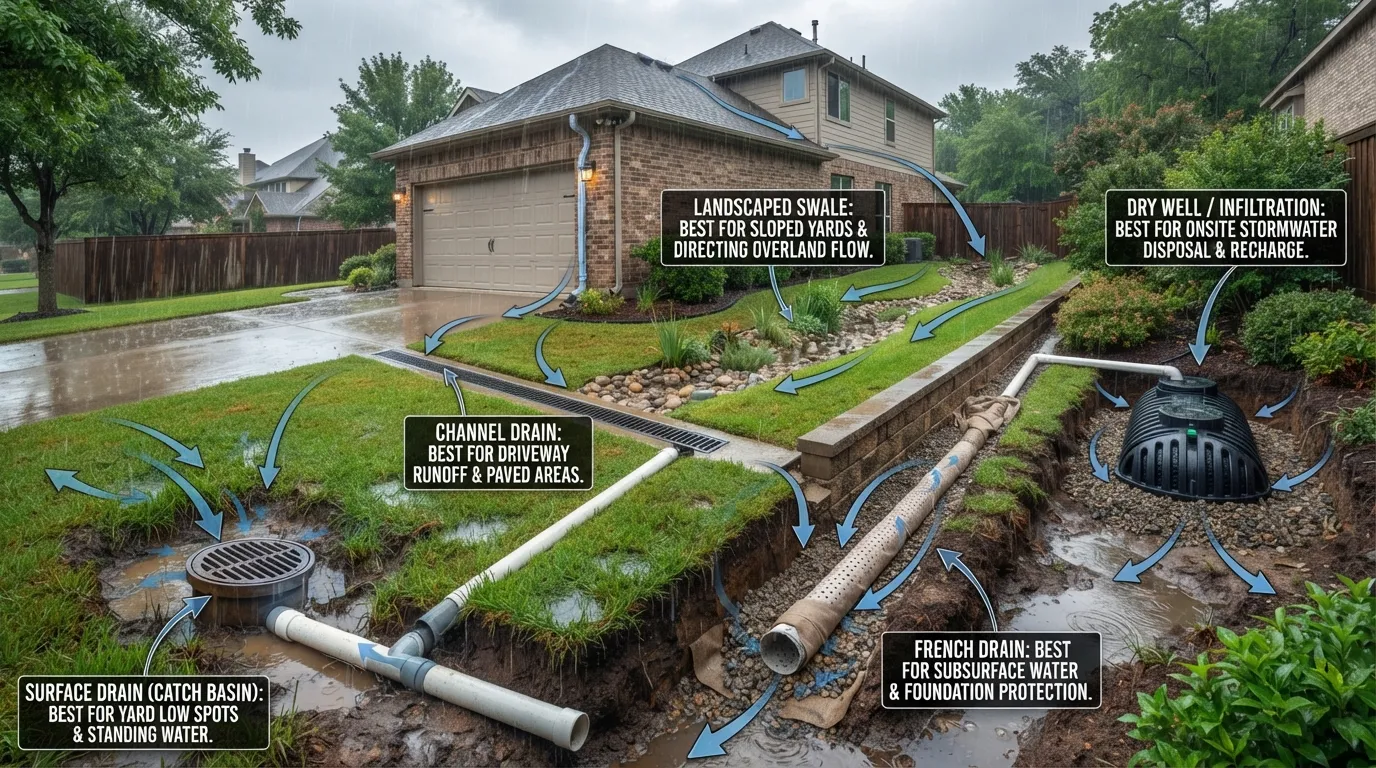
When rain falls faster than the ground can absorb it, that water has to go somewhere. A well-planned stormwater drainage system collects, redirects, stores, or absorbs runoff before it can pool around your yard, driveway, foundation, or other low areas.
There is no single universal list of stormwater drainage system types. Different sources may classify broad drainage methods, individual drainage components, or complete stormwater management systems. For a residential property, the most useful systems to understand include catch basins and area drains, channel drains, French drains, swales, dry wells and infiltration systems, rain gardens, permeable surfaces, storm sewers, culverts, and detention or retention systems. The right option depends on where the water comes from, whether it is surface water or groundwater, your property’s slope, soil and groundwater conditions, and where the collected water can legally and safely go.
This distinction matters because a catch basin, French drain, swale, storm sewer, and detention pond do not perform exactly the same job. Some collect water, some convey it, some encourage it to infiltrate into the ground, and others temporarily store or control runoff.
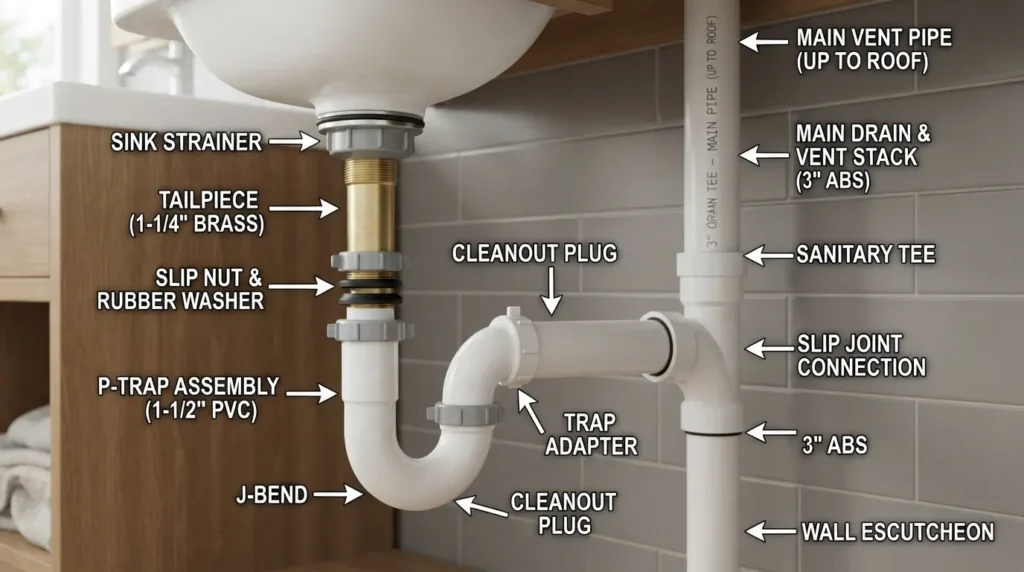
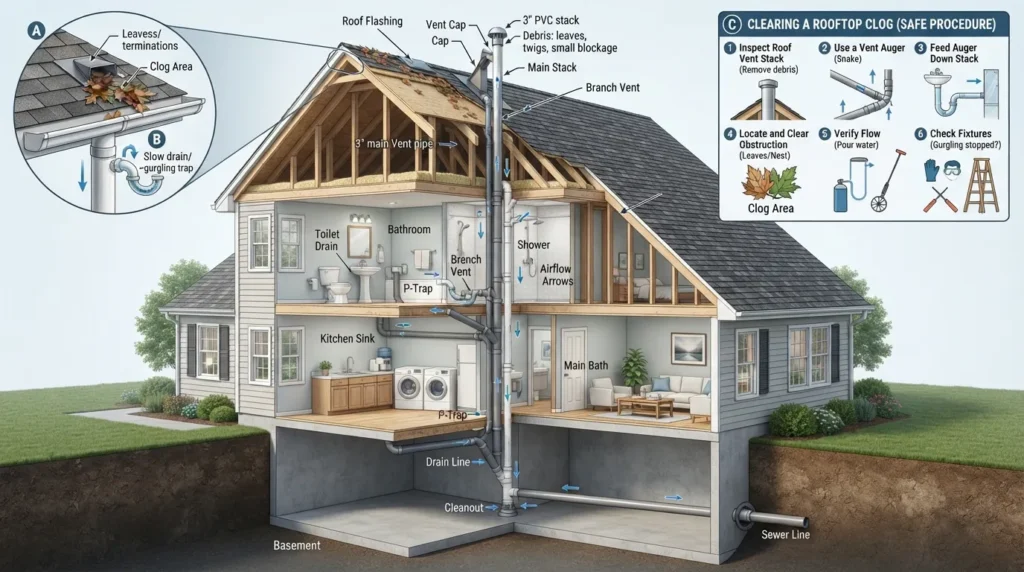
If you are trying to understand drainage beyond stormwater alone, our complete guide to home drainage systems explains how stormwater drainage differs from sanitary and other household drainage systems.
How Does a Stormwater Drainage System Work?
Stormwater is rainwater that falls on a property. Water landing on grass or other porous ground may soak into the soil, while runoff from roofs, driveways, streets, patios, parking areas, and other impervious surfaces is more likely to travel across the surface. EPA guidance notes that runoff from impervious areas can also pick up sediment, trash, chemicals, and other pollutants as it moves. :contentReference[oaicite:0]{index=0}
A residential stormwater drainage system usually performs one or more of four functions:
- Collect the runoff at a low point or where it crosses a paved surface.
- Convey the water through a pipe, channel, swale, or similar route.
- Infiltrate or absorb water where site conditions safely allow it.
- Store or slow runoff so it does not overwhelm the downstream drainage system.
Many effective systems combine several of these functions. For example, a catch basin may collect runoff, an underground pipe may convey it, and a permitted discharge or infiltration feature may manage the water at the other end.
Important: A drainage component should not be chosen simply because water is visible. The source of the water, elevations, slope, available outlet, soil conditions, groundwater level, drainage rules, and the amount of runoff all affect which solution is appropriate.
The Main Types of Storm Water Drainage Systems
Instead of treating every drainage feature as though it belongs to the same category, it is more useful to look at what each system actually does and the problem it is designed to address.
1. Catch Basins and Area Drains
A catch basin or area drain collects surface water through a grated opening. It is commonly positioned at a low point where runoff naturally gathers.
Water enters through the grate and is then routed through an underground drainage pipe toward an appropriate outlet or another part of the stormwater system. Some catch basins also provide space below the outlet where sediment and debris can settle before entering the pipe.
- Best suited for: low spots, patios, paved areas, yards, and areas where surface water concentrates.
- Main strength: directly captures concentrated surface runoff.
- Main limitation: grates, basin sumps, and connected pipes can become restricted by leaves, sediment, trash, or other debris.
2. Channel Drains and Trench Drains
A channel drain, sometimes called a trench drain, is a long narrow drain with a grate across the top. Instead of collecting water from one small low point, it intercepts runoff across a line.
That makes channel drains especially useful where water crosses a driveway, garage entrance, patio, pool deck, walkway, or other hard surface.
- Best suited for: sheet flow moving across paved surfaces.
- Main strength: catches water across a wider path than a single area drain.
- Main limitation: performance depends on proper elevation, slope, outlet design, and routine grate/channel cleaning.
3. French Drains
A French drain is a subsurface drainage system typically built with a trench, drainage aggregate, and perforated pipe. Instead of relying mainly on an exposed surface grate, it intercepts water moving through saturated soil and redirects it toward a suitable discharge point.
This makes French drains useful when the problem is persistent wet soil or subsurface water rather than only a concentrated stream of water running across pavement.
- Best suited for: chronically wet areas, saturated soil, and some foundation-side or landscape drainage problems.
- Main strength: collects water below the surface along a drainage path.
- Main limitation: it requires appropriate slope, filtration, pipe placement, and somewhere for the collected water to go.
French Drain
Usually targets: water moving through saturated soil.
Collection method: gravel-filled trench and perforated pipe.
Common role: subsurface drainage.
Storm Drain / Catch Basin
Usually targets: visible surface runoff.
Collection method: grate or inlet at the surface.
Common role: collection and conveyance.
That is the main difference between a French drain and a storm drain: a French drain generally intercepts subsurface water, while a storm drain inlet is designed to collect surface runoff.
4. Swales and Open Drainage Channels
A swale is a shallow graded depression or channel that uses the shape and slope of the land to move, slow, or sometimes infiltrate stormwater. Swales may be covered with grass or other vegetation rather than concrete.
Unlike an underground pipe, a swale keeps the drainage path visible and can spread water movement over a wider area.
- Best suited for: yards and landscapes with enough space and suitable grading.
- Main strength: can convey runoff while slowing water and supporting infiltration.
- Main limitation: needs sufficient space, proper slope, and a destination for larger flows.
5. Dry Wells and Other Infiltration Systems
A dry well receives stormwater and holds it underground while water gradually infiltrates into the surrounding soil. Other infiltration systems use trenches, chambers, or aggregate-filled areas to accomplish a similar goal.
These systems are different from simple conveyance pipes because the goal is not necessarily to carry all water far away. Instead, they manage some runoff on the site by allowing it to enter the ground.
- Best suited for: sites where soil and groundwater conditions allow adequate infiltration.
- Main strength: reduces the amount of runoff that must immediately leave the property.
- Main limitation: infiltration may perform poorly or be inappropriate where soils drain slowly, groundwater is too high, or local requirements restrict the design.
This last limitation is particularly important in South Florida. Miami-Dade is low-lying and its underground water supply can be relatively close to the surface, which means heavy rain may sometimes have limited space to drain into the ground. :contentReference[oaicite:1]{index=1}
6. Rain Gardens and Bioretention Areas
A rain garden is a shallow landscaped depression designed to receive runoff from nearby roofs, lawns, driveways, or other surfaces. Soil, vegetation, and natural processes help slow and manage the incoming water.
The EPA includes rain gardens among green infrastructure practices that use soil, plants, infiltration, evaporation, and related natural processes to manage rainwater. :contentReference[oaicite:2]{index=2}
- Best suited for: landscape areas where runoff can be safely directed into a planted feature.
- Main strength: combines stormwater management with landscape use and can help filter runoff.
- Main limitation: placement and design have to match soil, overflow, groundwater, and site conditions.
7. Permeable Pavement
Permeable pavement reduces runoff by allowing water to pass through or between the paved surface into an underlying drainage or storage layer rather than immediately flowing across conventional impervious pavement.
Common approaches can include pervious concrete, porous asphalt, and permeable interlocking pavers. EPA research and guidance recognize permeable pavement as a stormwater management practice. :contentReference[oaicite:3]{index=3}
- Best suited for: certain driveways, parking areas, walkways, and hardscape projects.
- Main strength: manages runoff close to where rain lands.
- Main limitation: the entire system below the surface must be designed for site conditions; a permeable surface alone does not guarantee adequate drainage.
8. Storm Sewer Systems
A storm sewer is an underground pipe network that receives stormwater through surface inlets and conveys the collected runoff toward an appropriate outlet or larger stormwater facility. These networks may serve individual developments or much larger municipal areas. :contentReference[oaicite:4]{index=4}
For a homeowner, the important distinction is that the grated inlet you see at the street is only one component. The storm sewer includes the underground conveyance network beyond that inlet.
- Best suited for: concentrated runoff from developed areas.
- Main strength: moves significant runoff through a defined network.
- Main limitation: debris, sediment, downstream restrictions, or rainfall that exceeds available capacity can contribute to temporary ponding or flooding.
9. Culverts
A culvert carries water beneath a road, driveway, path, or similar obstruction. Culverts may use round pipes, box structures, or other configurations depending on the application.
They are usually more relevant to roadside, municipal, rural, or larger-property drainage than to a typical small residential yard, but they are an important part of the broader stormwater conveyance system.
10. Detention and Retention Systems
Detention and retention systems manage larger volumes of runoff by storing water rather than sending the full storm flow downstream immediately.
Detention generally emphasizes temporary storage and controlled release, while retention systems may maintain a permanent pool or use other methods to retain water. Underground pipe or chamber systems can also provide stormwater storage on developed sites. :contentReference[oaicite:5]{index=5}
These systems are commonly associated with subdivisions, commercial developments, municipal projects, and larger sites rather than a small homeowner drainage repair.
So, What Are the “Four Types of Drainage”?
This question causes confusion because there is no single four-part classification used in every residential, landscape, plumbing, and civil-engineering context.
For practical property drainage, you can think in terms of four functions rather than forcing every component into one rigid list:
Catch basins, area drains, roof drainage inlets.
Pipes, channels, swales, culverts, storm sewers.
Dry wells, infiltration trenches, rain gardens, permeable surfaces.
Detention, retention, underground storage, controlled release.
A complete stormwater system may use two, three, or all four functions together. That is why one article may list four drainage “types” while another lists six, nine, or more individual systems.
Which Stormwater Drainage System Solves Which Problem?
The best system is determined by the water problem, not by which drainage product is most familiar.
These are starting points rather than one-size-fits-all prescriptions. Two properties with the same visible puddle may need different solutions if one has a grading problem while the other has poor infiltration, an obstructed outlet, high groundwater, or runoff arriving from another part of the property.
How to Choose a Residential Storm Water Drainage System
Before planning a stormwater system installation, work through these questions in order.
1. Is the Water on the Surface or in the Soil?
If water visibly flows across a driveway and gathers at a low spot, a surface collection system may make sense. If the soil remains saturated even when obvious surface runoff has stopped, subsurface drainage may need to be evaluated.
2. Where Is the Water Coming From?
Look beyond the puddle itself. Runoff may be arriving from:
- roof downspouts,
- an uphill portion of the yard,
- a driveway or patio,
- neighboring grades,
- street runoff,
- or saturated ground.
Correcting the source is often more effective than simply installing another drain at the lowest point.
3. Where Will the Water Go?
Every collection system needs an end strategy. Water may be conveyed to an approved drainage connection, safely dispersed over an appropriate area, managed by an infiltration feature, or temporarily stored. The exact option depends on site design and local requirements.
A drain that collects water efficiently but has nowhere suitable to discharge it is not a complete drainage solution.
4. Does the Site Have Enough Fall?
Most passive drainage systems depend heavily on gravity. Pipe elevations, channel slope, yard grading, and outlet height can determine whether water moves as intended or sits inside the system.
5. Can the Soil Actually Absorb More Water?
Do not assume that a dry well, rain garden, or other infiltration feature will work everywhere. Soil permeability and groundwater conditions affect how quickly stored stormwater can enter the ground.
6. What Happens During a Bigger Storm?
A good design considers an overflow path. Even an infiltration system or drain that works during routine rain may receive more water during a major downpour. Water needs a route that does not simply redirect flooding toward the building or another vulnerable area.
Why Stormwater Drainage Is Different in Miami
Miami and the wider Miami-Dade area add an important local consideration to residential stormwater drainage: the ground does not always have unlimited capacity to absorb more water.
Miami-Dade County explains that the area is close to sea level and the underground water supply lies relatively near the ground surface. During major rain events, this can leave rainwater with limited space to drain, contributing to flooding in some locations. :contentReference[oaicite:6]{index=6}
That means a Miami property owner should be cautious about assuming that simply sending runoff into an underground infiltration feature will solve every drainage problem.
For a Miami Property, Evaluate These Together
- Where water originates
- Existing lot grading and low points
- Amount of roof and paved surface runoff
- Soil infiltration conditions
- Groundwater conditions
- Existing drainage pipes and inlets
- Safe and permitted discharge locations
- Overflow behavior during heavy rainfall
Miami-Dade also maintains stormwater and flood-protection requirements, and construction work can require appropriate permits depending on the project. :contentReference[oaicite:7]{index=7}
In other words, the best residential stormwater drainage system in Miami is not simply the system with the highest capacity. It is the one that matches the property’s actual water source, elevations, outlet, and local conditions.
Storm Drains and Sanitary Drains Are Not the Same System
This distinction is important for both drainage performance and water quality.
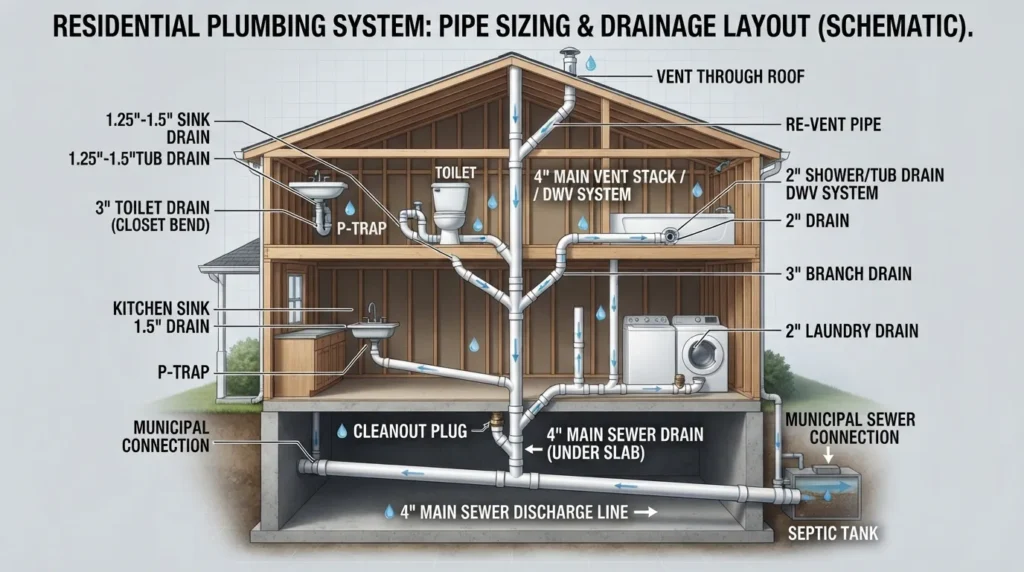
Storm drainage is intended to handle rainwater and runoff. Sanitary drainage carries wastewater from fixtures such as toilets, sinks, and showers toward the sanitary sewer or an approved onsite wastewater system.
You should not assume that a storm drain sends water to the same place as a household sewer pipe. Municipal stormwater systems commonly move runoff through separate drainage infrastructure.
Miami-Dade specifically states that nothing but rainwater is allowed to drain into storm drains located in streets, curbs, and rights-of-way. :contentReference[oaicite:8]{index=8}
What Should Never Go Into a Storm Drain?
A storm drain should never be treated like a garbage disposal or sanitary sewer.
Keep substances such as these out of storm drains:
- motor oil and automotive fluids,
- paint and solvents,
- cleaning chemicals,
- trash and plastics,
- soil and construction sediment,
- yard waste and excessive organic debris,
- pet waste,
- and other pollutants.
Runoff can carry pollutants from developed surfaces into local waterways and groundwater. :contentReference[oaicite:9]{index=9}
For Miami-Dade street storm drains: the simple rule is rainwater only. :contentReference[oaicite:10]{index=10}
Can Storm Drains Get Full?
Yes. Seeing water temporarily cover a drain does not automatically mean the drain is defective, but stormwater systems can become overwhelmed or restricted.
Common reasons include:
- leaves, litter, sediment, or debris blocking the inlet,
- debris or sediment inside connected pipes,
- rain falling faster than the system can carry it away,
- an inadequate or damaged drainage route,
- a downstream system that is already full,
- and local groundwater or flood conditions limiting drainage performance.
In Miami-Dade, low elevation and relatively shallow groundwater are additional factors that can complicate drainage during significant rainfall. :contentReference[oaicite:11]{index=11}
Stormwater Drainage Maintenance Matters
Even a properly selected drainage system can lose performance when its collection points and flow paths are neglected.
Depending on the system, routine maintenance may include:
- removing leaves and debris from grates,
- cleaning sediment from catch basins,
- keeping swales clear and properly graded,
- checking outlets for blockage or erosion,
- maintaining vegetation in rain gardens or bioswales,
- preventing soil and mulch from covering drainage openings,
- and investigating underground drainage lines when water stops flowing as expected.
If the problem involves a clogged drainage line or another plumbing-side blockage, professional drain cleaning service in Miami can help determine whether an obstruction is preventing proper flow. Site-grading, civil stormwater, or landscape drainage problems may require a different type of drainage professional depending on the scope.
Watch: How to Choose a Landscape Drainage System
If you learn better visually, this overview shows several landscape drainage approaches and how different systems address stormwater runoff. :contentReference[oaicite:12]{index=12}
Frequently Asked Questions
What are the four types of drainage?
There is no universal four-type classification for every drainage field. For property stormwater, a practical way to group drainage is by four functions: collection, conveyance, infiltration, and storage or flow control. Individual systems such as catch basins, French drains, swales, dry wells, and detention systems may perform one or more of these functions.
What is the main difference between a French drain and a storm drain?
A French drain generally intercepts water moving through saturated soil using a gravel-filled trench and perforated pipe. A storm drain or catch-basin inlet collects surface runoff through a grate and sends it into a drainage pipe or stormwater network.
What are the different types of rain drain systems?
Rainwater can be handled by roof gutters and downspouts, catch basins, area drains, channel drains, swales, French drains, dry wells, rain gardens, permeable surfaces, underground storm pipes, and storage systems. The best combination depends on where the rain lands and where runoff can safely go.
What are the different types of storm drains?
At property level, common stormwater collection inlets include grated area drains, catch basins, and linear channel or trench drains. Municipal systems may also use curb inlets and other engineered structures connected to underground storm sewers.
What should you not put in a storm drain?
Do not put oil, chemicals, paint, trash, sediment, yard waste, sewage, or other pollutants into a storm drain. In Miami-Dade street storm drains, the County’s guidance is particularly simple: only rainwater should enter. :contentReference[oaicite:13]{index=13}
What is one of the biggest problems with stormwater runoff?
Stormwater can create both a water-volume problem and a water-quality problem. Excess runoff can contribute to flooding and erosion, while water moving over streets, roofs, lawns, and other developed areas can carry pollutants into waterways and groundwater. :contentReference[oaicite:14]{index=14}
Do storm drains ever get full?
Yes. A storm drain can temporarily back up when rainfall exceeds available drainage capacity, when an inlet or pipe is blocked, when the downstream system is restricted, or when local flooding and groundwater conditions limit how quickly water can leave the area.
What is the only liquid that should enter the stormwater system?
For Miami-Dade storm drains in streets, curbs, and rights-of-way, the County states that only rainwater should drain into the stormwater system. :contentReference[oaicite:15]{index=15}
Can one house use more than one stormwater drainage system?
Yes. In fact, combining components is often necessary. A property might use a channel drain at a driveway, catch basins in low areas, underground conveyance pipes, and a separate approved discharge or storage feature. Each component solves a different part of the drainage problem.
The most useful way to understand the types of storm water drainage systems is not to memorize one arbitrary list. Start by identifying what the system needs to accomplish: collect runoff, move it, absorb it, store it, or combine several of those functions.
For residential properties, catch basins, channel drains, French drains, swales, dry wells, rain gardens, and permeable surfaces are among the systems you are most likely to evaluate. Larger storm sewers, culverts, detention facilities, and retention systems play a bigger role in developments and municipal drainage networks.
The final choice should always follow the water: identify where it comes from, how it moves across or through your property, and where it can safely go. In Miami, groundwater, heavy rainfall, grading, existing infrastructure, and local drainage requirements deserve particular attention before deciding on a stormwater system installation.
Having Trouble With Drainage in Miami?
If water is not draining properly, the first step is figuring out whether you are dealing with a clogged drain or pipe, a surface-water problem, a grading issue, or a larger stormwater design concern.
You can learn more about our Miami plumbing services, or speak with our plumbing team about the drainage problem you are seeing.
Helpful Stormwater Resources
- Miami-Dade County Stormwater Management — local stormwater and flood-management information. :contentReference[oaicite:16]{index=16}
- Miami-Dade Flood Prevention Guidance — local drainage, flooding, permits, and storm-drain pollution guidance. :contentReference[oaicite:17]{index=17}
- EPA: Urbanization and Stormwater Runoff — overview of runoff, impervious surfaces, and stormwater pollutants. :contentReference[oaicite:18]{index=18}
- EPA: Types of Green Infrastructure — rain gardens, permeable pavement, and other runoff-management approaches. :contentReference[oaicite:19]{index=19}