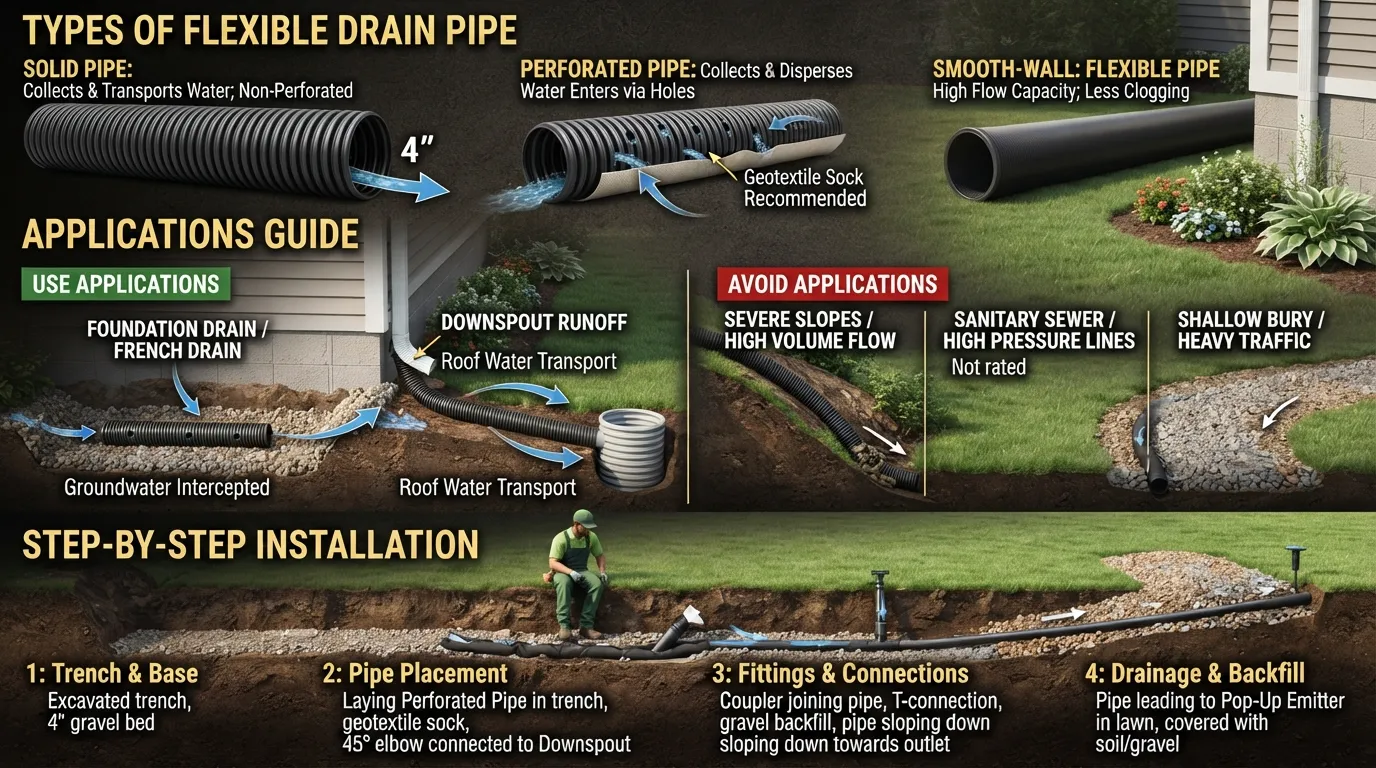
If you are searching for a flex pipe drain, the first thing I want you to know is that this term can describe two very different products. One is flexible corrugated drainage pipe used outdoors to move rainwater, groundwater, and downspout runoff. The other is flexible or accordion-style tubing sometimes found beneath sinks and other indoor fixtures.
Those products should not automatically be treated as interchangeable. Outdoor flexible drain pipe can be useful for yard and landscape drainage, while an indoor sanitary drainage system has different requirements for pipe, traps, fittings, flow, service access, and code compliance.
A flexible drain pipe can be a good choice when its design matches the job. Solid corrugated pipe is commonly used to carry exterior water from one point to another, while perforated pipe is designed to collect or disperse water through openings along the pipe. For an indoor sink or sanitary drain, do not assume accordion-style flexible tubing is an acceptable substitute for a properly designed trap and DWV connection simply because it fits.
In this guide, I’ll help you identify which kind of flexible drain you actually need, compare solid, perforated, and socked pipe, explain where 3-inch and 4-inch products fit, show how FLEX-Drain can connect with PVC, and point out situations where rigid pipe or professional drainage work may be the better solution.
What Is a Flex Pipe Drain?
A flex pipe drain is a drainage pipe designed with enough flexibility to bend around obstacles or follow a route that would otherwise require several rigid fittings. Many outdoor versions are made with a corrugated or ribbed wall and are sold in expandable lengths or coils.
A common example in the current market is 4-inch FLEX-Drain by Amerimax. The manufacturer’s retail documentation describes solid versions for channeling water from one point to another and notes compatibility with many traditional 3-inch and 4-inch corrugated drainage products and 4-inch PVC through appropriate connectors or fittings.
The broader term can also be used for other flexible drainage products, including black corrugated HDPE pipe and smaller tubing. That is why you should choose a pipe by application, material, diameter, wall design, connection method, and product approval rather than by the word “flex” alone.
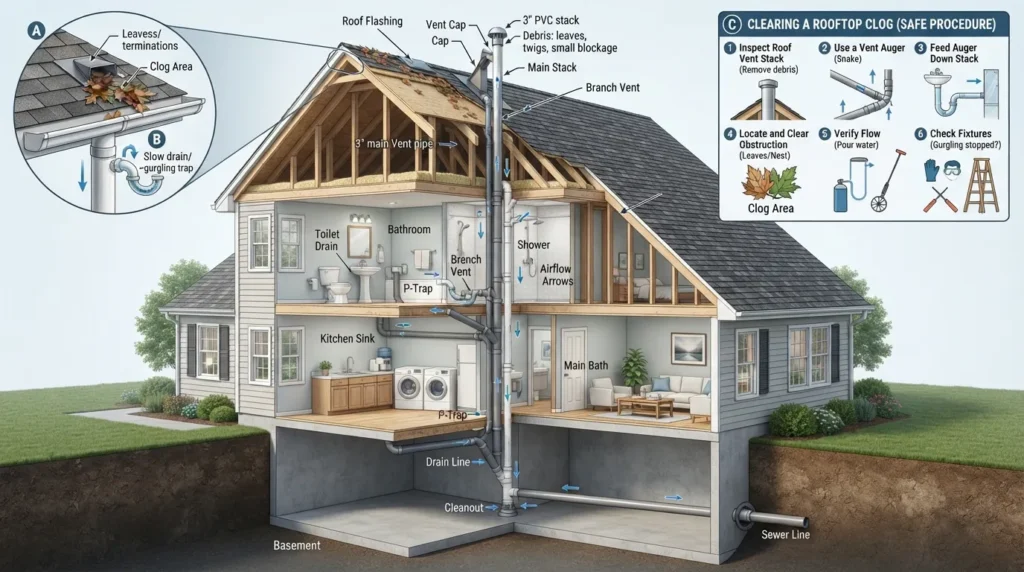
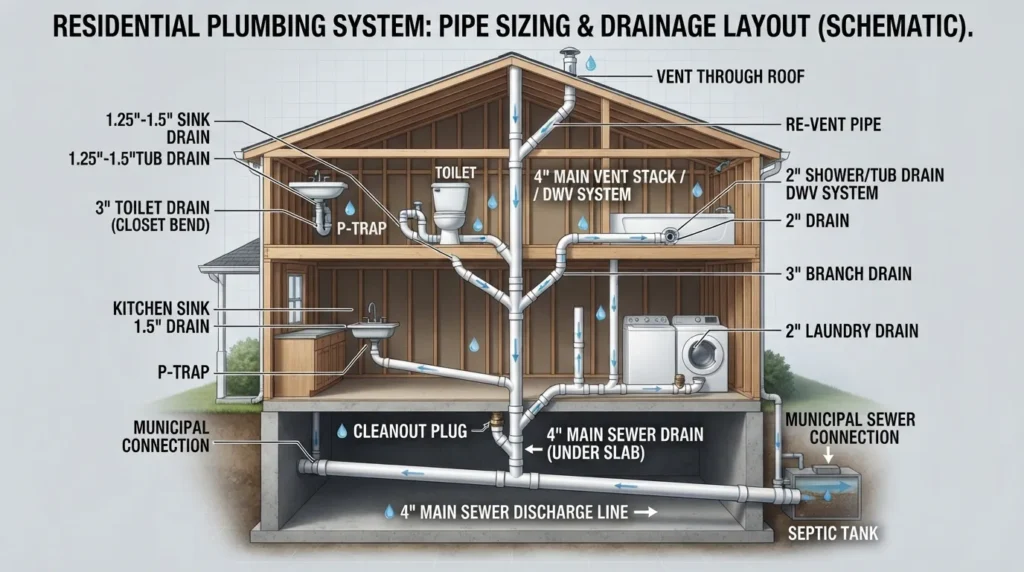
If you want to understand where flexible pipe fits within the rest of a drainage system, our guide to plumbing drain parts explains traps, rigid drain pipe, fittings, cleanouts, vents, and other related components.
Outdoor Flex Drain vs. Indoor Accordion Drain: Know the Difference First
- Yard and landscape drainage
- Downspout runoff
- Groundwater collection
- French-drain applications
- Routing around landscape obstacles
- Solid, perforated, or filtered designs
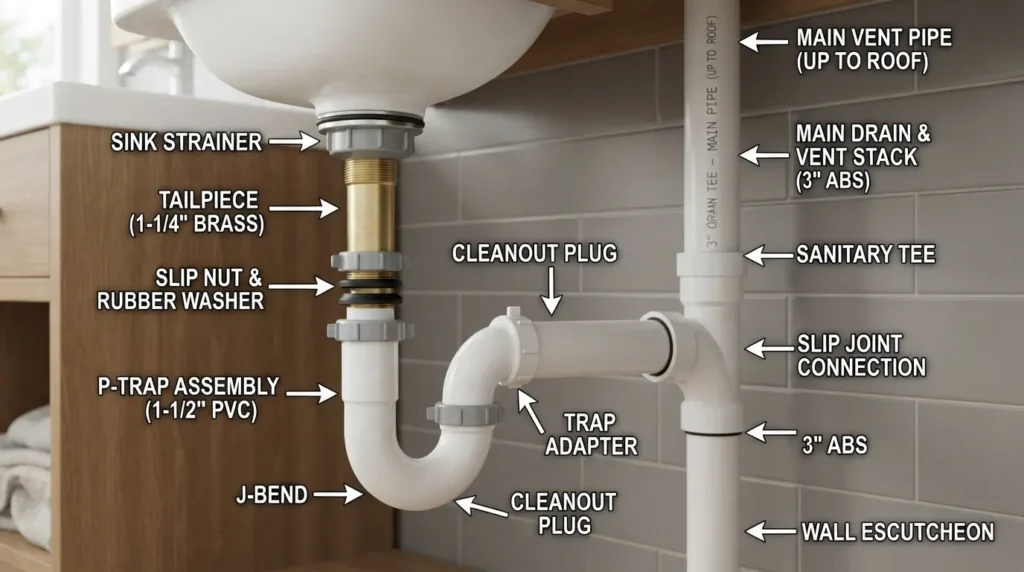
- Sometimes found beneath sinks
- Deals with household wastewater rather than yard runoff
- Must not be confused with outdoor corrugated drainage pipe
- Requires attention to trap configuration and approved materials
- Ribbed interiors can create debris-catching surfaces
- Should not be chosen simply because it bends into place
This distinction matters because a pipe that works well for redirecting a gutter downspout does not automatically belong beneath a bathroom or kitchen sink. Indoor drainage carries wastewater through a sanitary DWV system, while exterior corrugated drainage usually manages rainwater or groundwater.
Florida’s plumbing code identifies approved materials for sanitary drainage systems and also limits where slip-joint connections are used in fixture drainage. So if you are repairing an indoor drain in Miami, verify the exact product and configuration instead of assuming any flexible tube is code-compliant.
Do not make a plumbing-material decision based on appearance alone. “Flexible,” “black,” “4 inch,” or “fits the opening” does not tell you whether a pipe is suitable for sanitary wastewater, storm drainage, yard drainage, or another application.
Are Flexible Drain Pipes Any Good?
Yes, flexible drain pipes can be very useful for the right exterior drainage project. Their main advantage is installation flexibility. A corrugated pipe can often follow curves, work around landscaping, and reduce the number of rigid elbows needed on an irregular route.
For example, Amerimax markets its solid FLEX-Drain for diverting water and its perforated versions for wet-area and landscape drainage. Lowe’s currently lists FLEX-Drain products in several 4-inch configurations, including solid, perforated, and socked versions.
Advantages of Flexible Outdoor Drain Pipe
- Can bend around landscaping and obstacles.
- Can reduce the number of separate directional fittings on some drainage runs.
- Lightweight products may be easier to transport and position than rigid pipe.
- Solid and perforated versions allow you to match the pipe to different water-management goals.
- Common fittings can connect downspouts, pipe sections, corrugated systems, and certain PVC configurations.
Potential Limitations
- Corrugated interiors are not as smooth as rigid smooth-wall pipe.
- Poor routing can create low areas where water and debris remain.
- A flexible pipe can still perform poorly if the outlet, slope, bedding, or backfill is wrong.
- Not every flexible product is designed for vehicle loads, deep burial, sanitary wastewater, or every underground condition.
- More flexibility can tempt DIY installers to create unnecessary bends rather than designing a clean drainage path.
The practical question is therefore not simply, “Is flex pipe good?” It is, “Is this particular flex pipe appropriate for this particular drainage problem?”
Solid vs. Perforated vs. Sock: Which Flex Drain Do You Need?
Best question: Do I need to carry water from one location to another?
A solid flex drain keeps water inside the run until it reaches the outlet, making it useful for applications such as moving downspout discharge away from a structure.
Best question: Do I need water to enter through the sides of the pipe?
Perforations allow surrounding water to enter the drainage system. That makes this design relevant to wet areas and French-drain-style groundwater collection.
Best question: Does the surrounding soil contain fine material that may enter the perforations?
A filtered sock adds a barrier around the perforated pipe. Manufacturer guidance for FLEX-Drain specifically positions its socked version for finer soil or sand where additional filtration is useful.
Moving collected water away? Start by evaluating solid pipe.
Collecting water from saturated ground? Evaluate perforated pipe.
Fine surrounding soil or filtration concern? Evaluate a manufacturer-approved filtered or socked system.
Where Is Flexible Drain Pipe Commonly Used Outdoors?
1. Downspout Drainage
A solid flexible pipe can connect to a suitable downspout adapter and route roof runoff toward an appropriate discharge area. Flexibility can be especially helpful when the route must work around landscaping, walkways, roots, or other obstacles.
2. Yard Drainage
If a low part of the yard remains wet after rain, the drainage design may involve a catch basin, perforated drainage system, solid outlet pipe, grading improvements, or a combination of components. Flex pipe may be one part of that solution, but the pipe alone cannot correct a poor discharge point or a route that does not drain by gravity.
3. French Drains
Perforated corrugated pipe is commonly associated with French-drain systems because groundwater needs a way to enter the pipe. The complete installation may also involve drainage aggregate and filtration materials depending on the product and site conditions.
4. Foundation Runoff Management
Solid pipe is frequently used to carry gutter or surface water away from a foundation. The important idea is controlled conveyance: water should be directed to a suitable discharge point rather than simply moved to another problematic spot beside the house.
What Size Flex Pipe Drain Should You Use?
Searchers commonly encounter 3-inch and 4-inch flexible drainage pipe, but size should be based on the drainage system rather than the keyword you found online.
Four-inch pipe is especially prominent in retail outdoor-drainage results. Lowe’s currently lists multiple FLEX-Drain by Amerimax products as 4-inch solid, perforated, and socked drainage pipe, while other manufacturers sell 3-inch corrugated drainage products as well.
Before buying, check:
- The size of the existing pipe or downspout connection.
- The manufacturer’s fitting compatibility.
- Whether the pipe is solid or perforated.
- The amount and source of water being managed.
- The length of the drainage run.
- The discharge location.
- Whether the product is approved for the planned installation environment.
Do not confuse a 4-inch outdoor corrugated drainage pipe with a 4-inch sanitary drain or sewer component. Matching nominal numbers do not make two different piping systems interchangeable.
Flexible Drain Pipe vs. Rigid PVC
- Easier to curve around many obstacles
- Often lightweight and easy to reposition
- Available in solid and perforated designs
- Can simplify irregular outdoor routes
- Ribbed interior creates a different flow surface than smooth-wall pipe
- Careful bedding, slope, and backfill still matter
- Maintains a predictable straight alignment
- Smooth interior surface
- Uses dedicated fittings for changes in direction
- Can be easier to maintain consistent grade on a planned route
- Requires more fittings where obstacles force direction changes
- Exact PVC type and standard must still match the application
Neither material wins every project. Flex pipe can make an irregular exterior route easier, while rigid smooth-wall pipe offers a controlled shape and smoother internal pathway. The better choice depends on the water being carried, route, maintenance needs, installation conditions, and applicable requirements.
Can You Connect FLEX-Drain to PVC?
Yes, certain FLEX-Drain products and fittings are designed to connect with 4-inch PVC. Amerimax documentation describes connectors and flexible fittings that work with common 3-inch and 4-inch corrugated drainage pipe and 4-inch PVC.
That does not mean every generic flexible pipe can be pushed onto every PVC pipe. Before connecting two systems:
- Identify the exact flex-drain product.
- Confirm the nominal diameter of both pipes.
- Use a connector or adapter approved by the product manufacturer.
- Make sure the joint is suitable for the installation location.
- Support and backfill the connection according to the relevant instructions.
A physical fit is not the same as a correct connection. Use the fitting designed for the specific pipe system instead of improvising with tape, sealant, or a loose friction fit.
How to Install a FLEX-Drain Pipe
The exact installation depends on whether you are installing solid pipe, perforated pipe, a French drain, a downspout extension, or another drainage system. Always follow the instructions for the exact product you purchased.
At a planning level, a typical outdoor drainage project follows this sequence:
- Identify the water source. Determine whether you are carrying downspout runoff, collecting groundwater, or solving another drainage problem.
- Choose the correct pipe type. Use solid, perforated, or filtered pipe according to the job.
- Choose a valid discharge point. Know where the collected water will go before digging.
- Plan the route. Avoid unnecessary bends, abrupt dips, and areas where the pipe could hold standing water.
- Locate utilities before excavation. Do not dig blindly around buried services.
- Prepare the trench and base. Follow product instructions for width, depth, bedding, gravel, and filtration materials.
- Maintain the intended drainage path. Gravity drainage needs a route that actually allows water to move toward the outlet.
- Connect fittings securely. Use compatible couplers, downspout adapters, wyes, tees, or PVC transition pieces where required.
- Check the system before backfilling. Confirm alignment and connections while they are still accessible.
- Backfill according to the manufacturer’s instructions. Installation requirements can vary by pipe design and anticipated loads.
Watch: FLEX-Drain Installation Example
This installation video demonstrates a FLEX-Drain drainage-pipe system and provides useful visual context for how the components are routed and connected. Treat it as product-specific guidance rather than a substitute for the instructions supplied with your exact pipe.
Can You Bury a FLEX-Drain Pipe?
Many flexible corrugated drainage products are designed for underground use, but burial requirements are product- and site-specific. Amerimax markets FLEX-Drain products for above- and below-ground drainage applications, and its product documentation includes underground installation guidance.
Before burying any flex pipe, verify:
- Whether the exact product is rated for burial.
- Recommended trench and bedding requirements.
- Maximum or minimum cover where specified.
- Whether vehicles or other heavy loads will cross the installation.
- Required backfill and compaction.
- Local building, plumbing, drainage, or right-of-way requirements.
How Deep Does a Flex Drain Need to Be Buried?
There is no single burial depth that applies to every flexible drainage product and every property. Depth can change with the manufacturer, drainage design, soil, surface loads, outlet elevation, and local requirements. Use the installation instructions for the exact product rather than copying a depth from a different pipe or French-drain system.
What About EZ-Drain Burial Depth?
EZ-Drain is a specific manufactured French-drain system, not a generic name for every flex pipe. If you are installing an NDS EZ-Drain product, use NDS installation specifications for that exact system instead of applying FLEX-Drain or conventional gravel-and-pipe instructions to it.
Are Flexible Drain Pipes Legal?
There is no useful universal yes-or-no answer. Whether a flexible drain product is acceptable depends on which product it is, what it carries, where it is installed, its listing or applicable standard, and the code governing that installation.
For example, an exterior pipe carrying roof runoff is a different application from an indoor pipe carrying sanitary wastewater from a sink. Florida’s plumbing code provides specific material requirements for sanitary drainage systems, so you should not generalize from an outdoor FLEX-Drain product to an indoor DWV installation.
“Flexible pipe is illegal” is too broad, but “any flexible pipe is fine” is equally unsafe. Identify the exact drainage application first, then verify the product and local requirements.
Can You Use Flexible Pipe for a Sink Drain?
If by “flexible pipe” you mean an accordion-style tube used to make an awkward under-sink connection, I would not treat it as equivalent to a properly configured sink drain simply because it makes alignment easier.
A sink drainage assembly normally needs a correctly configured trap, trap arm, approved connections, and an unobstructed route into the sanitary drainage system. Ribbed tubing also creates more internal texture than smooth tubular or rigid drainage components, which can make debris retention a practical concern.
If your reason for using flex tubing is that the sink outlet and wall connection do not line up, that alignment problem should be solved with the correct drainage components rather than automatically bridging the gap with whatever flexible tube fits.
What Is the 135 Rule in Plumbing?
You may see the “135-degree rule” while researching drains, but it should not be confused with a FLEX-Drain installation rule. The phrase commonly refers to a Uniform Plumbing Code cleanout provision in which additional cleanout access is required when the aggregate horizontal change in direction exceeds 135 degrees.
The important qualifier is that plumbing codes differ by jurisdiction. Florida uses the Florida Building Code, Plumbing, so you should not take a rule quoted from a different code and automatically apply it to a Miami installation. For any permitted sanitary-drain work, follow the code adopted for the property.
Common Flex Pipe Drain Installation Mistakes
- Using perforated pipe when you only want to transport water. Water can interact with the surrounding soil through the perforations rather than remaining contained to the outlet.
- Using solid pipe when the goal is groundwater collection. A solid wall does not provide the same entry points as a perforated drainage pipe.
- Creating dips or bellies. Flexibility is useful, but the pipe should not wander vertically and create unintended low points.
- Adding too many bends. Just because a pipe bends does not mean every obstacle should be followed with a tight or unnecessary curve.
- Ignoring the discharge point. Moving water ten feet does not solve a drainage problem if the outlet simply creates another wet area.
- Using the wrong adapter. Pipe diameter alone does not guarantee connector compatibility.
- Backfilling before testing the layout. Check alignment and connections while the system is accessible.
- Assuming all black corrugated pipe is the same. Materials, wall designs, fittings, perforations, ratings, and intended uses vary.
- Using an exterior drainage product as a shortcut for indoor plumbing. Stormwater and sanitary drainage are different systems.
- Trying to fix a clog by replacing a short section with flex pipe. A recurring blockage may be caused by buildup, roots, a damaged line, a belly, or another problem that needs diagnosis.
How to Decide Which Drain Pipe You Actually Need
Are you moving downspout water away?
Start by evaluating a solid outdoor drainage pipe and a compatible downspout adapter.
Are you collecting water from wet soil?
Evaluate a perforated drainage system designed for groundwater entry.
Is fine soil or sand likely to enter the drainage system?
Evaluate the filtration method specified for the system, which may include a socked pipe or other filter material.
Do you have landscaping obstacles or an irregular route?
A flexible corrugated pipe may make routing easier, provided you can still maintain a functional drainage path.
Are you repairing a sink or indoor wastewater drain?
Stop treating exterior corrugated drainage pipe as the comparison. Identify the required fixture, trap, tubular, or DWV components.
Is an existing drain repeatedly slow or clogged?
Diagnose the cause before changing pipe. A blockage, poor alignment, root intrusion, damaged pipe, or another defect may need to be corrected first.
Flex Drain Considerations for Miami Properties
Outdoor drainage deserves extra attention in South Florida because heavy rainfall and a high water table can expose weak points in drainage systems. A flex pipe may be useful in the right layout, but successful water management still depends on where the water comes from, where the pipe takes it, site elevations, soil conditions, and the capacity of the complete drainage path.
If you are unsure whether the problem is an exterior runoff issue, a clogged drain, or a damaged underground line, the Miami plumbing team at EZ Plumbing Repair Services can help you identify the right type of drainage problem before unnecessary parts are replaced.
For drains that are already backing up, draining slowly, or repeatedly clogging, see our professional drain cleaning service in Miami. Diagnosing the underlying restriction is often more useful than installing a different piece of pipe without knowing why the existing system is failing.
Frequently Asked Questions About Flex Pipe Drains
Are flexible drain pipes any good?
Yes, when the pipe is designed for the application. Flexible corrugated pipe can be convenient for exterior water-management routes, especially where obstacles make a perfectly straight run difficult. It still needs correct selection, drainage direction, connections, bedding, and backfill.
Are flexible drain pipes legal?
Some flexible drainage products are appropriate for specific applications, but there is no universal rule covering every product. Acceptance depends on the pipe, use, listing or standard, location, and applicable code. An outdoor stormwater pipe should not automatically be treated as an indoor sanitary drain product.
Can I use flexible pipe for a drain pipe?
Yes, if the flexible product is designed and approved for the type of drainage you are building. For outdoor rainwater drainage, corrugated flex pipe is common. For indoor sanitary drainage, verify the approved material and fixture/DWV configuration rather than using a generic accordion tube as a shortcut.
Can you bury a FLEX-Drain pipe?
Many FLEX-Drain products are intended for above- or below-ground drainage applications. Follow the installation requirements for the exact model, particularly for trench preparation, backfill, burial depth, and areas exposed to loads.
How deep should flexible drain pipe be buried?
There is no safe universal depth for all flexible drainage pipes. Follow the exact manufacturer’s instructions and account for drainage grade, soil, surface loading, outlet elevation, and local requirements.
How do you connect FLEX-Drain to PVC?
Use a manufacturer-compatible adapter or connector. Certain Amerimax FLEX-Drain fittings are designed to transition between FLEX-Drain, common corrugated drainage pipe, and 4-inch PVC. Verify the exact product dimensions before buying the fitting.
What is the difference between solid and perforated flex drain?
Solid pipe is primarily used to carry water through the pipe to an outlet. Perforated pipe allows water to enter or interact with the pipe through openings along its wall, making it useful in groundwater and French-drain applications.
Is 4-inch flexible drain pipe common?
Yes. Four-inch corrugated drainage pipe is widely represented in outdoor drainage products, including solid, perforated, and socked FLEX-Drain configurations. Three-inch corrugated drainage products are also available, so always match the size to the system.
Can flexible pipe replace rigid PVC?
Not automatically. Flexible corrugated pipe and rigid PVC have different physical characteristics and may serve different drainage applications. Choose based on the complete system rather than assuming one is a drop-in replacement for the other.
A flex pipe drain can be an effective drainage component, especially for outdoor rainwater, downspout, landscape, and groundwater-management projects where flexibility makes routing easier. But “flex drain” is a broad term, and choosing the wrong type can create more problems than it solves.
Before you buy or install one, answer five questions:
- Am I dealing with exterior water or indoor sanitary wastewater?
- Do I need to carry water or collect water?
- Should the pipe be solid, perforated, or filtered?
- What pipe size and fittings actually match the system?
- Can the planned route, outlet, burial method, and materials meet the product and local requirements?
Once those answers are clear, choosing between flexible corrugated pipe, rigid PVC, and another drainage solution becomes much easier.
If you are in Miami-Dade and the drain is slow, backing up, repeatedly clogging, or you are unsure whether the problem is inside the pipe or in the drainage layout, get the system diagnosed before replacing parts unnecessarily.
Related Product & Installation Resources
If you are comparing products before buying, use these resources to check the exact diameter, length, solid or perforated construction, fitting compatibility, manufacturer instructions, and current availability. Product selections and specifications can change, so verify the model you plan to install.