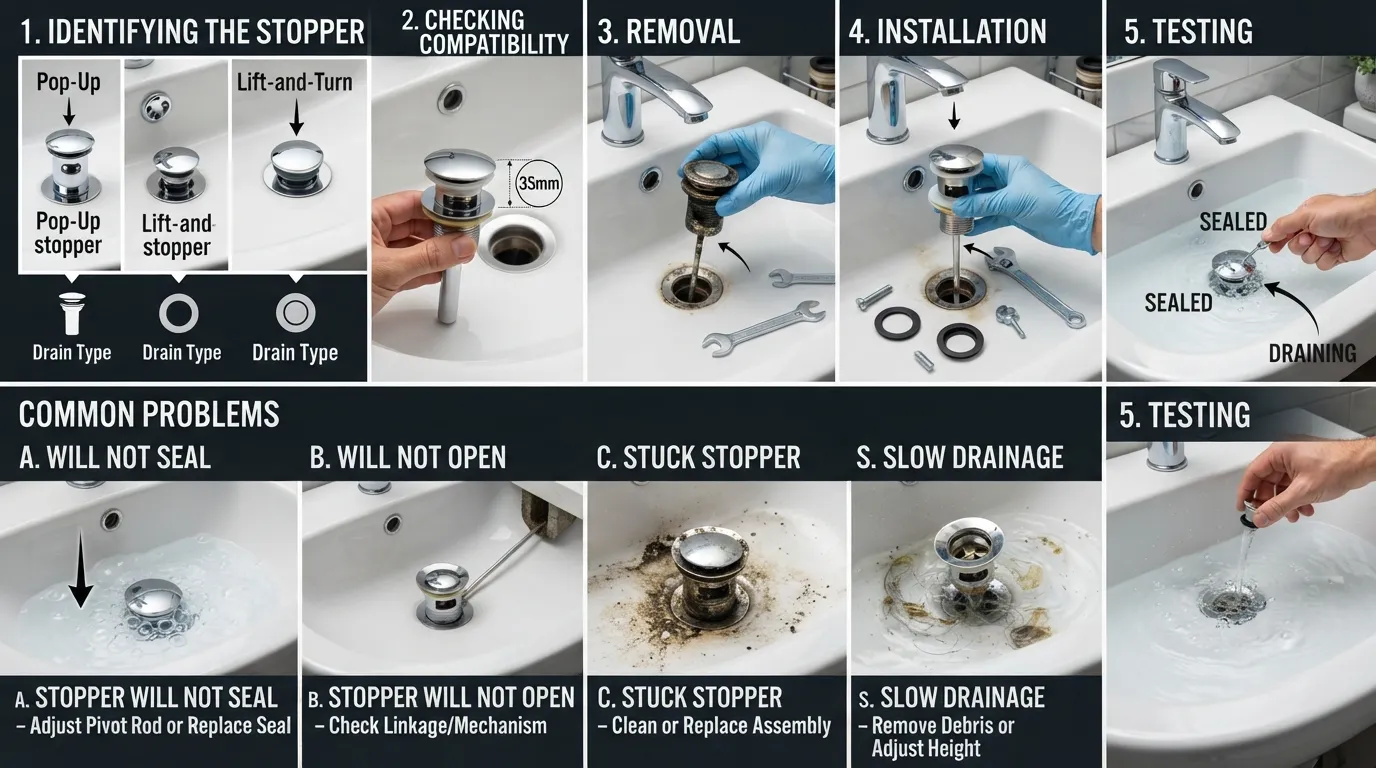
If you searched for a bathroom plug, you are probably looking for the part that closes a bathroom sink or bathtub drain so it can hold water. In U.S. plumbing, that part is usually called a drain plug, drain stopper, sink stopper, or tub stopper.
Do not buy a bathroom plug based on appearance alone. First identify whether it is for a sink or bathtub, determine how the existing stopper operates, measure the drain opening, and check whether you need only a removable stopper or an entire drain assembly. Sink and tub stoppers can use different sizes and mechanisms.
There is one source of confusion worth clearing up immediately: some people use “bathroom plug” to mean an electrical outlet. This guide is primarily about plumbing drain plugs and stoppers. I cover the electrical meaning briefly near the end so you can quickly get to the right information.
What Is a Bathroom Plug Actually Called?
For a sink or bathtub, the most useful general term is drain stopper. You may also see products labeled sink stopper, bath plug, basin plug, tub stopper, pop-up stopper, drain plug, or drain closure.
The names overlap, but the products are not always interchangeable. Retailers separate bathroom sink plugs and stoppers by application, while plumbing manufacturers offer different operating mechanisms for sinks and tubs.
Bathroom sink
Look for terms such as sink stopper, pop-up stopper, push-button drain, or bathroom sink drain assembly.
Bathtub
Look for tub stopper, bath plug, toe-touch, lift-and-turn, or trip-lever drain parts.
Bathroom basin
“Basin plug” is another way of describing a stopper used to hold water in a wash basin or sink.
Which Bathroom Plug Do You Need?
This is the question I would answer before shopping. A stopper that looks close enough in a product photo can still be wrong for your fixture.
1. Start With the Fixture: Sink or Bathtub?
Do not assume one “universal bathroom plug” will work everywhere. Bathroom sink and bathtub stoppers can have different dimensions, drain assemblies, attachment methods, and operating mechanisms. Ace Hardware specifically advises identifying the sink-or-tub application and measuring the drain before choosing a stopper.
2. Identify How Your Current Stopper Opens and Closes
Operate the existing stopper a few times and watch what happens. That often tells you more than its finish or shape.
- Lift rod behind the faucet: commonly operates a traditional sink pop-up stopper through linkage beneath the sink.
- Push the stopper itself: may indicate a push-button or press-to-seal design.
- Lift and twist: commonly indicates a lift-and-turn tub stopper.
- Press with your toe: commonly indicates a toe-touch bathtub stopper.
- Lever on the overflow plate: points toward a trip-lever-style bathtub drain mechanism.
- Loose rubber or silicone piece: may simply seal over or inside the drain without being mechanically connected.
Manufacturers offer multiple tub mechanisms, including toe-touch and lift-and-turn designs, while traditional sink pop-ups can use rods and linkage beneath the basin.
3. Measure Before You Buy
Measure the relevant drain opening and compare it with the replacement manufacturer’s specifications. Do not rely only on words such as “universal.” Retail listings contain stoppers intended for different drain dimensions, and even products described as universal have stated compatibility ranges.
Before ordering a replacement
- Confirm whether the fixture is a sink or bathtub.
- Measure the drain opening rather than guessing.
- Photograph the existing stopper before removing it.
- Check whether it twists, pushes, lifts, or uses a separate lever.
- Look underneath a sink for rods or linkage connected to the drain.
- Check the manufacturer or model when the stopper is part of a proprietary drain assembly.
Common Types of Bathroom Drain Plugs and Stoppers
Pop-Up Sink Stopper
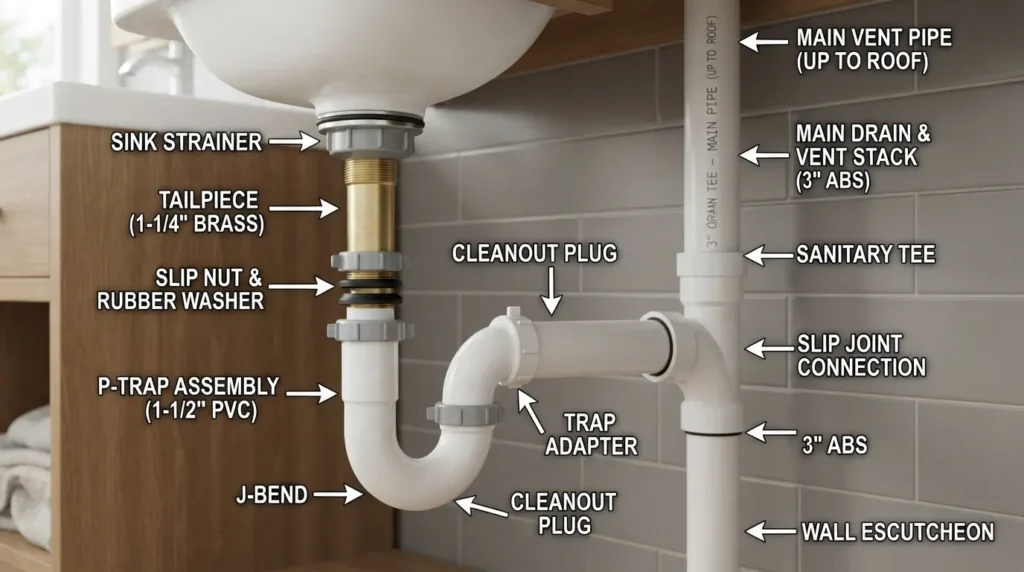
A traditional bathroom sink pop-up usually moves when you operate a lift rod near the faucet. Beneath the sink, components such as the clevis and ball rod transfer that movement to the stopper.
If this type does not close completely or does not open high enough, the problem may sometimes be adjustment of the linkage rather than the stopper itself. Pfister’s troubleshooting guidance, for example, describes adjusting the pop-up linkage when a stopper does not seat or drain properly.
Push or Click-Style Sink Stopper
Push-style drain stoppers operate from the stopper itself rather than a lift rod. Some designs seal when pressed and open when pressed again.
These can make access straightforward on certain models because the top stopper may unscrew for cleaning or service, but the exact removal method depends on the product.
Rubber or Silicone Drain Plug
A basic rubber or silicone plug can be the simplest option when you only need to cover or seal a compatible drain opening and do not need an integrated mechanism.
The important word is compatible. Different sizes are sold, so measure first instead of assuming every flat or rubber stopper will seal every bathroom drain.
Lift-and-Turn Tub Stopper
A lift-and-turn stopper is operated by lifting and twisting the top. Danco describes this style as opening through a lift and partial turn, with the reverse action closing the drain for filling the tub.
Toe-Touch Tub Stopper
A toe-touch stopper is pressed to close and pressed again to open. It is common on bathtub drain assemblies where the user wants to operate the drain without bending down and turning a knob.
Trip-Lever Bathtub Drain
If your bathtub has a lever on the overflow plate, the visible drain opening may be only one part of a larger mechanism. In that case, replacing a loose rubber plug may not address the actual problem.
Bathroom Sink Plug vs. Bathtub Plug: Do Not Choose by Looks Alone
Bathroom Sink
- May connect to faucet-operated linkage
- May use a push-style stopper
- Can collect hair, soap residue, and debris around the stopper
- Replacement may involve the stopper alone or more of the drain assembly
Bathtub
- May use toe-touch or lift-and-turn operation
- May connect to a trip-lever mechanism
- May require compatibility with the existing drain body or adapter
- Overflow hardware can be part of the overall bath waste assembly
Do You Actually Need a New Plug—or Is the Drain Clogged?
This is the distinction many shopping pages cannot make for you.
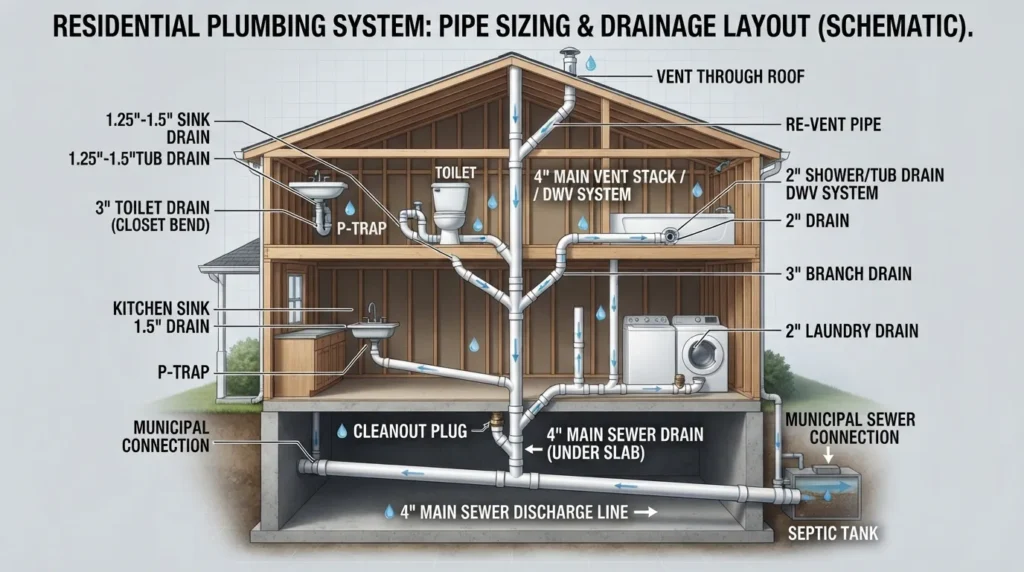
A stopper and a drain do different jobs. The stopper controls whether water is intentionally held or released at the fixture opening. Once released, wastewater still has to move through the fixture drain, trap, branch piping, and the rest of the home’s drainage system. You can see that full path in our guide to how your home drainage system works.
Quick Diagnosis: Stopper Problem or Drain Problem?
Likely stopper/mechanism issue
- Water will not stay in the sink or tub
- Stopper will not close fully
- Stopper will not open properly
- Lift rod or lever moves but stopper does not respond correctly
- Stopper is visibly damaged or worn
Likely drain-flow issue
- Water remains slow after the stopper is fully open or removed
- Hair or buildup repeatedly gathers in the drain
- Bad odors return after cleaning the visible stopper
- The same slow drain keeps coming back
- Several fixtures are draining poorly or backing up together
A slow sink can be caused by a localized obstruction near the fixture, while several fixtures having problems at once can point farther downstream in shared drainage piping. EZ Plumbing’s drain-cleaning guidance also lists recurring clogs, gurgling, odors, pooling water, and multiple fixture backups among signs that the problem may extend beyond the visible drain opening.
How to Replace a Bathroom Sink Plug or Stopper
The exact procedure depends on the design, so treat the steps below as an identification and replacement framework rather than universal instructions for every drain assembly.
- Identify the stopper type. Determine whether it pulls out, unscrews, pushes, or connects to linkage underneath the sink.
- Inspect before forcing anything. If the stopper does not release with gentle movement, determine how it is retained before applying more force.
- Remove accessible hair and buildup. Debris around a stopper can restrict movement and water flow.
- Compare the old part with the replacement. Check dimensions, mechanism, thread or connection style, and manufacturer compatibility.
- Install according to the replacement manufacturer’s instructions. Drain assemblies differ, so the instructions supplied with the actual product should control.
- Test both functions. Close the stopper and confirm the basin holds water. Then open it and confirm water drains freely.
- Inspect below the sink. If you disturbed the drain assembly, check carefully for leaks while water is draining.
Do not force a stuck stopper.
Some pop-up stoppers are connected to hardware beneath the sink. Lowe’s removal guidance also recommends avoiding excessive pressure when a stopper does not lift easily because the assembly can be damaged.
Installing a Bathroom Sink Pop-Up Drain Stopper
If you are trying to understand how the stopper relates to the rest of a sink drain assembly, this installation video can help you visualize the components before you begin.
How to Fix Common Bathroom Plug Problems
The Stopper Will Not Hold Water
First make sure the stopper is actually reaching the fully closed position. On a linkage-operated pop-up, an adjustment beneath the sink may affect how tightly it seats. If the stopper closes correctly but still will not seal, inspect the stopper and sealing surfaces for damage or buildup.
The Sink Drains Too Slowly
Remove accessible debris around the stopper and test again. If a pop-up stopper does not rise high enough, its position can restrict flow. If drainage remains slow with the stopper fully open or removed, start thinking beyond the plug itself.
The Stopper Is Stuck
Do not immediately pry against the sink or tub surface. Determine whether the stopper unscrews, connects to a retaining rod, or uses another mechanism. A stuck mechanical stopper can become a damaged drain assembly if you treat every design like a loose rubber plug.
Water Leaks Under the Sink
A leak below the basin is a different problem from a stopper simply failing to hold water. Inspect the drain assembly and connections rather than assuming replacing the visible top stopper will solve the leak.
Hair Keeps Collecting Around the Stopper
Hair and bathroom residue can accumulate around sink, tub, and shower drains. Some replacement products combine stopper and hair-catching functions, but recurring slow drainage may still need cleaning beyond the visible opening.
When a New Bathroom Plug Is Not Enough
If the stopper itself works but the fixture still drains slowly, keeps clogging, smells bad, or backs up, buying another plug may only distract from the real problem.
Pay particular attention when:
- water drains slowly even with the stopper completely open;
- the problem returns soon after visible hair is removed;
- you hear gurgling from another fixture;
- more than one drain is slow at the same time;
- wastewater rises into a tub, shower, toilet, or floor drain;
- the drain repeatedly needs plunging or clearing.
For Miami-area homes, our professional drain cleaning service handles sink, tub, shower, and deeper drainage restrictions when the issue extends beyond the stopper.
Not Sure Whether It Is the Stopper or the Drain?
If you are in Miami and the bathroom drain is still slow, stuck, leaking, or backing up after you check the stopper, you do not have to guess which part to replace. Our local Miami plumbing team can help identify whether the problem is at the fixture or farther into the drainage system.
What If You Meant an Electrical Plug in the Bathroom?
If by “bathroom plug” you mean electricity rather than the drain, the U.S. terms are generally electrical outlet or receptacle. Bathroom receptacles are a separate electrical-safety topic, not a type of plumbing plug.
GFCI protection is required for bathroom receptacles under the National Electrical Code, and the purpose of a ground-fault circuit interrupter is to reduce electric-shock risk when a ground fault occurs. Local requirements can depend on the electrical code adopted in your jurisdiction, so adding or relocating a bathroom outlet should be handled according to applicable code rather than copied from a generic DIY article.
Important distinction
Drain plug or stopper: controls water at the sink or tub drain.
Electrical plug: the plug attached to an appliance cord.
Electrical outlet/receptacle: the wall device into which an electrical plug is inserted.
Bathroom Plug FAQs
What kind of plug goes in a bathroom?
For a bathroom sink or tub, use a drain stopper designed for that specific fixture, opening size, and drain mechanism. Do not assume every rubber, pop-up, or tub stopper is universally interchangeable.
What do you call a bathroom plug?
The plumbing part is most commonly called a drain stopper, drain plug, sink stopper, or tub stopper. “Basin plug” is another common term for a wash-basin stopper.
Can you put a plug in a bathroom sink?
Yes. A compatible stopper can be used to hold water in a sink. The important part is matching the stopper to the drain opening and, where applicable, the existing drain mechanism.
Are bathroom sink plugs a standard size?
You should not treat them as one universal size. Manufacturers and retailers sell different drain and stopper dimensions, so measure your opening and check the product specifications before buying.
Can I replace only the stopper instead of the whole drain?
Sometimes. A loose rubber stopper or compatible replacement pop-up may only require the stopper itself. If the linkage, drain body, threads, seal, or tub mechanism is damaged, more of the assembly may need attention.
Why does my bathroom sink drain slowly after I replace the plug?
Make sure the stopper opens far enough and that hair or debris is not restricting the opening. If the sink remains slow with the stopper removed, the restriction is probably not being caused by the stopper alone.
What is a bathroom plug socket called?
If you mean electricity, the U.S. term is usually a bathroom outlet or receptacle. That is separate from the plumbing drain plug covered in this guide.
Do bathroom electrical outlets need GFCI protection?
In U.S. residential bathrooms, bathroom receptacles are covered by NEC GFCI requirements. Because electrical-code adoption can vary locally, use the rules applicable to your jurisdiction when installing or modifying an outlet.
How do I add an electrical plug outlet in a bathroom?
That is electrical work rather than a drain-stopper project. Bathroom receptacle installation involves electrical protection, circuit, placement, and local-code requirements, so use a qualified electrical professional rather than treating it like a plumbing plug replacement.
The Simplest Way to Choose the Right Bathroom Plug
- Identify the fixture: bathroom sink or bathtub.
- Identify the mechanism: pop-up, push, lift-and-turn, toe-touch, trip lever, or loose plug.
- Measure the drain: never rely on appearance alone.
- Check compatibility: especially when threads, linkage, overflow hardware, or a complete drain assembly are involved.
- Diagnose the symptom: decide whether the stopper has failed or the drain itself is slow or clogged.
- Test after replacement: make sure the fixture both holds water and drains freely without leaking.
The key is to avoid solving the wrong problem. If water will not stay in the fixture, focus on the stopper and its mechanism. If water will not leave the fixture even when the stopper is fully open, start investigating the drain.
Related Bathroom Plug and Drain Stopper Resources
If you have identified your stopper type and are ready to compare replacement products, these retailer categories can help you see the available designs, materials, sizes, and mechanisms. Product availability and specifications can change, so verify compatibility with your own fixture before ordering.
- Home Depot — Bathroom Sink Plugs & Stoppers
- Lowe’s — Sink Drains & Stoppers
- Ace Hardware — Plumbing Stoppers
- Walmart — Bath and Tub Plugs
- Target — Bath Plug Products
- Amazon — Bath Plug Search
Final takeaway: the best bathroom plug is not simply the one with the right color or the word “universal” on the listing. Match the stopper to the fixture, mechanism, and drain dimensions first. And if the water is still moving slowly once the stopper is fully open, stop shopping for plugs and start looking at the drainage problem instead.